




The Meghalaya Board Class 10 Syllabus for 2026 includes five core subjects that consist of six written papers, each worth 80 marks for theory and 20 marks for internal assessment. Each of the science subjects has three units, while Math includes fourteen chapters. In social science, there are 22 total chapters. English consists of two books and a grammar section. For the MIL subjects, there is one textbook related to each subject.
- Total number of chapters across core subjects: 39, including Maths + Science + Social Science.
- Language subjects are conceptually similar. English has two books, plus the grammar section, while MIL has one full textbook.
- There will be some slight adjustments made in 2026 to the English and social science chapters to align with the current curriculum.
Quick Links: MBOSE Class 10 Exam Pattern

Key Summary
- The Meghalaya Board Class 10 Syllabus 2026 includes five core subjects with six written papers, each carrying 80 marks theory + 20 marks internal assessment.
- Science is divided into 3 units, Mathematics has 14 chapters, and Social Science includes 4 sections with 22 chapters.
- English follows a two-book format with a grammar section, while MIL subjects are based on one prescribed textbook.
- The syllabus provides unit-wise and subject-wise blueprint, helping students focus on high-weightage chapters for better scoring.
- Minor updates in 2026 include rationalised English and Social Science chapters, aligning the syllabus with current academic requirements.
- What is Meghalaya Board Class 10 Syllabus 2026?
- Meghalaya Class 10 Board Syllabus Overview
- Meghalaya Class 10 Subject-Wise Blueprint 2026
- Meghalaya Class 10 Question Paper Pattern
- Meghalaya Class 10 Syllabus High-Weightage Chapters 2026
- Internal Assessment Structure 2026
- Deleted Syllabus for Meghalaya Class 10 (2026)
- Meghalaya Class 10 Syllabus Mark Distribution
- Meghalaya Class 10 Syllabus Prescribed Textbooks 2026
- FAQs
What is Meghalaya Board Class 10 Syllabus 2026?
The Meghalaya Board Class 10 Syllabus 2026 is the official chapter-wise curriculum prescribed by MBOSE for all SSLC subjects for the 2025–26 academic year. The syllabus covers five core subjects and includes a total of 40+ examinable chapters across Mathematics, Science and Social Science. It also prescribes two English books, a grammar section, and a single MIL textbook for the year.
| Component | Details |
|---|---|
| Board | Meghalaya Board of School Education (MBOSE) |
| Class | SSLC / Class 10 |
| Academic Session | 2025–26 |
| Total Core Subjects | 5 |
| Total Written Papers | 6 |
| Total Content Load | 40+ chapters (Maths + Science + Social Science) |
| English Structure | Two books + grammar |
| MIL Structure | One prescribed textbook |
| Basis of Question Paper | Only the officially prescribed 2026 syllabus |
Also check: MBOSE SSLC Overview
Ques. Is the MBOSE Class 10 syllabus for 2026 completely new or similar to previous years?
Ans. The 2026 syllabus is largely similar to previous years, maintaining continuity in chapter structure and subject distribution. Core subjects follow the same unit-wise and chapter-wise framework as in 2025. Only minor updates or small subtopics have been revised in certain chapters, and no full chapters have been removed.
Ques. Where can students access the official MBOSE Class 10 syllabus for 2026?
Ans. Students can access the complete syllabus on the official MBOSE website. The syllabus is available in PDF format for each subject, covering both theory and internal assessment components.
Ques. Does the syllabus cover both theory and internal assessment portions?
Ans. Yes, the MBOSE Class 10 syllabus clearly outlines both the 80-mark theory papers and the 20-mark internal assessment for each subject. The internal assessment includes class tests, project work, assignments, and practicals where applicable.
Meghalaya Class 10 Board Syllabus Overview
The Meghalaya Board Class 10 Syllabus 2026 contains 15 chapters in Mathematics, 5 structured units in Science, and 23 chapters in Social Science. English follows a two-book format, while MIL subjects rely on one prescribed textbook.
| Subject | Structure (2026) | Content Load |
|---|---|---|
| Mathematics | Single textbook | 15 chapters |
| Science | 5 units (Physics, Chemistry, Biology) | 5 units / multi-chapter |
| Social Science | 4 sections (History, Geography, Civics, Economics) | 23 chapters |
| English | 2 literature books + grammar | Book I + Book II + grammar |
| MIL | 1 prescribed textbook | Full book |

Meghalaya Class 10 Mathematics Syllabus 2026
The Mathematics syllabus for 2026 is organised into 15 chapters covering algebra, geometry, trigonometry and statistics, following the standard progression used by MBOSE. The textbook contains 15 examinable chapters arranged in a linear sequence for the 2025–26 session. The chapters cover number systems, algebraic equations, geometric constructions, mensuration and basic statistics.
| Unit / Area | Chapters Included | Total Chapters |
|---|---|---|
| Number Systems & Algebra | Real Numbers, Polynomials, Linear Equations in Two Variables | 3 |
| Coordinate Geometry | Coordinate Geometry | 1 |
| Geometry | Triangles, Circles, Constructions | 3 |
| Mensuration | Areas Related to Circles, Surface Areas and Volumes | 2 |
| Trigonometry | Introduction to Trigonometry, Applications of Trigonometry | 2 |
| Statistics & Probability | Statistics, Probability | 2 |
| Advanced Algebra & Functions | Quadratic Equations, Arithmetic Progressions | 2 |
Meghalaya Class 10 Science Syllabus 2026
The Science syllabus for 2026 is divided into five main units covering Physics, Chemistry and Biology. The units include topics from basic Physics, core Chemistry chapters and the full Biology section.
| Unit | Chapters Included | Notes |
|---|---|---|
| Physics – I | Light: Reflection and Refraction | Basic numerical and diagram-based questions |
| Physics – II | Human Eye and Colourful World, Electricity | Two chapters from the Physics section |
| Chemistry – I | Chemical Reactions and Equations, Acids-Bases-Salts | Foundation-level Chemistry topics |
| Chemistry – II | Metals and Non-metals, Carbon Compounds | Applied Chemistry chapters |
| Biology | Life Processes, Control & Coordination, Reproduction, Heredity & Evolution, Environment | Full Biology unit with multiple chapters |
Meghalaya Class 10 Social Science Syllabus 2026
The Social Science syllabus for 2026 includes 23 chapters divided across History, Geography, Civics and Economics.
| Section | Chapters Included | Total Chapters |
|---|---|---|
| History |
| 5 |
| Geography |
| 7 |
| Civics (Political Science) |
| 6 |
| Economics |
| 5 |
Meghalaya Class 10 English Syllabus 2026
The English syllabus for 2026 follows a two-book literature structure along with a separate grammar and writing section, all prescribed by MBOSE for the 2025–26 academic year.
| Component | Chapters / Sections Included | Notes |
|---|---|---|
| Book I (Prose + Poems) | Full set of prose chapters and poems prescribed by MBOSE | Standard literature text |
| Book II (Supplementary Reader) | All the short stories in the book | Used for short and long answers |
| Grammar | Tenses, Editing, Omission, Sentence Transformation, Prepositions, Modals | Fixed grammar list |
| Writing | Letter Writing, Notice, Article, Story Writing | Follows MBOSE formats |
Meghalaya Class 10 MIL Syllabus 2026
The MIL syllabus for 2026 is based on one prescribed textbook issued by MBOSE for the 2025–26 academic session. The syllabus applies to Khasi, Garo, Assamese, Bengali, Hindi and other approved MIL languages.
| MIL Language | Syllabus Structure | Notes |
|---|---|---|
| Khasi | One prescribed textbook (full book) | All prose + poetry included |
| Garo | One prescribed textbook (full book) | Standard chapter list |
| Assamese | One prescribed textbook (full book) | Full text for the exam |
| Bengali | One prescribed textbook (full book) | Prose + poetry |
| Hindi (Course A/B as applicable) | One prescribed textbook (full book) | All chapters included |
| Other approved MILs | As per MBOSE’s single prescribed text | Language-specific list |
Ques. Will MBOSE change the Class 10 syllabus content or delete chapters for 2026?
Ans. No major chapters are being removed for 2026; only a few subtopics may have been reduced in certain subjects. The core structure for Mathematics, Science, Social Science, English, and MIL remains intact, so students should prepare the full syllabus without skipping large units.
Ques. How do I know which chapters from the syllabus are most important for scoring well in exams?
Ans. You can identify high-priority chapters by looking at how MBOSE distributes marks in their blueprint (unit-wise or section-wise). Focus especially on high‑weightage topics in Maths (like Algebra & Geometry), Science (especially Biology & Electricity), and Social Science (History + Geography). Practising these high-weightage chapters first can improve your board exam score.
Ques. Is the internal assessment (IA) in the MBOSE Class 10 syllabus tough to score?
Ans. Internal Assessment is manageable if you consistently complete your class assignments, projects, and class tests. Since IA contributes 20 marks, regular study and active participation in school activities can help you secure most of these marks without last-minute stress.
Meghalaya Class 10 Subject-Wise Blueprint 2026
The Meghalaya Board follows a fixed chapter-wise and unit-wise marks distribution for Class 10 exams. blueprint divides marks across units in Mathematics and Science, and across sections in Social Science. English follows a literature + grammar + writing split, while MIL papers follow a literature-heavy distribution.
Meghalaya Class 10 Mathematics Blueprint 2026
The Mathematics paper follows a balanced marks split across seven key areas, with algebra, geometry and data handling forming the major scoring portions.
| Unit / Area | Approx. Weightage |
|---|---|
| Number Systems & Algebra | 20% |
| Geometry | 20% |
| Mensuration | 15% |
| Trigonometry | 15% |
| Coordinate Geometry | 10% |
| Statistics & Probability | 20% |

Meghalaya Class 10 Science Blueprint 2026
Science weightage is divided among Physics, Chemistry and Biology, with Biology carrying the largest share due to its longer unit structure.
| Unit | Approx. Weightage |
|---|---|
| Physics | 30% |
| Chemistry | 30% |
| Biology | 40% |
Meghalaya Class 10 Social Science Blueprint 2026
Social Science uses a section-wise distribution where all four areas: History, Geography, Civics and Economics carry similar mark weightage with slight variation.
| Section | Approx. Weightage |
|---|---|
| History | 25% |
| Geography | 25% |
| Civics | 20% |
| Economics | 20% |

Meghalaya Class 10 English Blueprint 2026
The English paper gives equal importance to literature, grammar and writing tasks, making it important for students to prepare all three components.
| Component | Approx. Weightage |
|---|---|
| Literature (Book I + II) | 40% |
| Grammar | 30% |
| Writing | 30% |
Meghalaya Class 10 MIL Blueprint 2026
MIL subjects are mostly literature-based, and the marks are spread across prose, poetry and short-answer language exercises from the prescribed textbook.
| Component | Approx. Weightage |
|---|---|
| Prose | 40% |
| Poetry | 30% |
| Language Application / Short Answers | 30% |
Ques. How accurate is the MBOSE Class 10 blueprint for unit-wise weightage?
Ans. The MBOSE blueprint gives a good estimate of mark distribution among units, but students say it's not always 100% fixed. Some topic-wise variation can happen in the actual question paper, so while the blueprint is a strong guide, it shouldn't be the only basis for skipping any chapter.
Ques. Can I ignore low‑weightage chapters according to the blueprint and still score well?
Ans. Several students argue that relying solely on high-weightage units can backfire. Although some units carry more marks, questions from lower-weightage chapters still appear, and they can score. It’s safer to cover all chapters, but you can prioritise heavier ones during final revision.
Ques. Does the blueprint change every year or remain mostly the same?
Ans. Many students ask this, and from past MBOSE blueprints, it appears the overall structure is quite stable. The board tends to maintain the same unit‑wise division across years. That said, exact mark splits or question‑type patterns may shift slightly, so checking the latest official blueprint is always recommended.
Meghalaya Class 10 Question Paper Pattern
The Meghalaya Board follows a fixed structure for all Class 10 question papers, and each subject uses a predictable mix of short, medium and long questions. The paper pattern is based entirely on the officially prescribed 2026 syllabus.
| Subject | Question Types Used |
|---|---|
| Mathematics | Very Short Answers, Short Answers, Long Answers |
| Science | Objective, Short Answers, Long Answers |
| Social Science | Short Answers, Long Answers, Map Questions |
| English | Reading, Writing, Grammar, Literature Questions |
| MIL | Prose, Poetry, Short Answers, Long Answers |
Also check: MBOSE Class 10 Board Practice Papers
Meghalaya Class 10 Syllabus High-Weightage Chapters 2026
Some chapters across subjects carry more marks in the Meghalaya Class 10 Board exams, and knowing them helps students prioritize preparation. The following list is based on MBOSE patterns and past year trends.
| Subject | Chapters / Units | Approx. Weightage Notes |
|---|---|---|
| Mathematics |
| 50–55% of paper |
| Science |
| 60% of theory marks |
| Social Science |
|
|
| English |
| 60% of marks |
| MIL | Core chapters from the prescribed textbook | 70–75% of marks focus on the main prose and poetry |
Internal Assessment Structure 2026
The Meghalaya Board uses a fixed internal assessment system for Class 10, based on periodic tests, project work and practical components. Internal assessment carries 20 marks per subject and follows a standard pattern across all schools.
| Component | Marks | Details |
|---|---|---|
| Periodic Test | 10 | One or two short written tests are conducted during the year |
| Assignment / Project Work | 5 | Subject-specific projects or written assignments |
| Class Attendance & Participation | 5 | Attendance record and classroom activity score |
Ques. Can schools really give full 20/20 internal assessment marks?
Ans. Yes. Many students report that some schools do award the full 20 internal marks. While this depends heavily on the school’s internal marking policy, good performance in tests, projects and participation can make it possible.
Ques. What activities count toward the 20 internal marks?
Ans. Internal assessment typically includes a variety of tasks: written tests, project work/assignments, group or individual activities, quizzes, and class participation. MBOSE’s own guidelines list these as suggested components.
Ques. What if I get very low internal assessment marks? How can I pass?
Deleted Syllabus for Meghalaya Class 10 (2026)
The Meghalaya Class 10 syllabus 2026 session continues with limited deletions across major subjects. Only minor subtopics have been removed for the 2025–26 cycle. No full chapters have been deleted from Mathematics, Science or Social Science.
| Subject | Deleted / Reduced Portion (2026) | Notes |
|---|---|---|
| Mathematics | No full chapter removed; minor optional exercises excluded | Applies to selected exercises only |
| Science | Small portions from Heredity & Evolution and Carbon Compounds | Limited to subtopics, not full chapters |
| Social Science | A few case studies from Geography and Civics | Does not affect core theory |
| English | No deletions in Book I or Book II | Full books to be studied |
| MIL | No reduction announced | Entire textbook included |
Meghalaya Class 10 Syllabus Mark Distribution
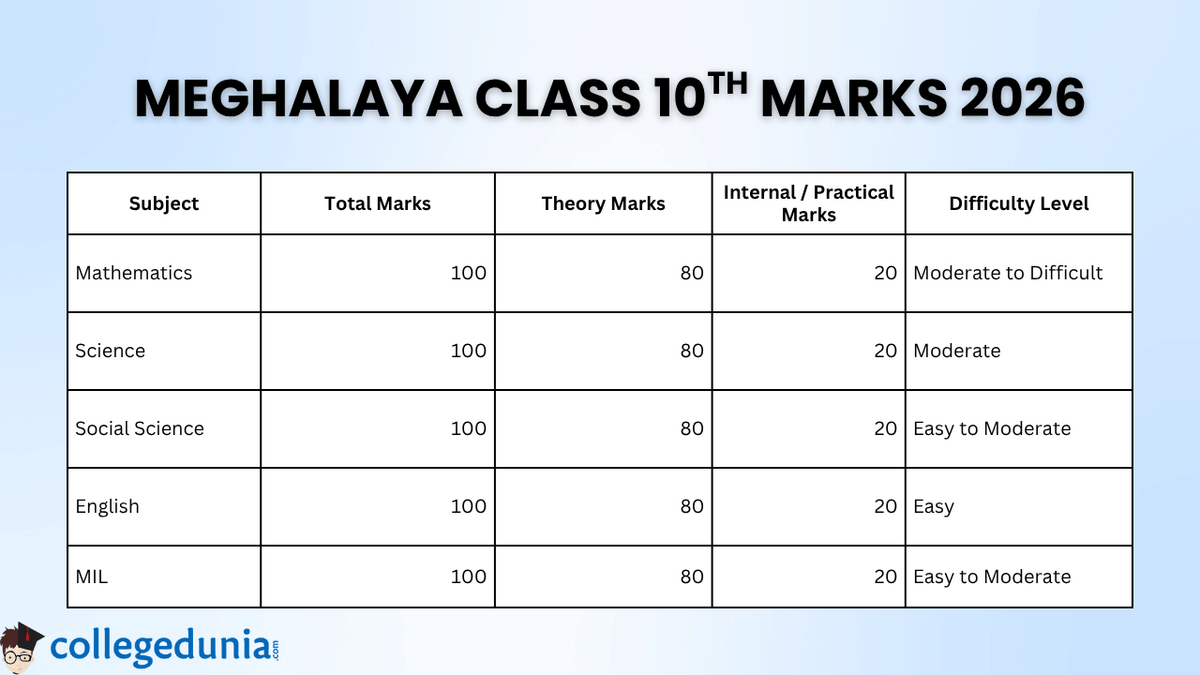
Marks are divided across theory and practical components depending on the subject. Science includes practical evaluations, while Mathematics and Social Science are fully theoretical.
| Subject | Total Marks | Theory | Internal/Practical | Difficulty Level |
|---|---|---|---|---|
| Mathematics | 100 | 80 | 20 | Moderate to Difficult |
| Science | 100 | 80 | 20 | Moderate |
| Social Science | 100 | 80 | 20 | Easy to Moderate |
| English | 100 | 80 | 20 | Easy |
| Hindi/Alt. English | 100 | 80 | 20 | Easy to Moderate |
Ques. How are marks divided between theory and internal assessment for each subject?
Ans. For most Class 10 subjects under MBOSE, the total marks are 100, split as 80 marks for theory and 20 marks for internal assessment. Science includes practicals within the internal component, while Mathematics, Social Science, and languages are mostly theory-focused. This uniform distribution helps students plan their preparation effectively.
Ques. Do all subjects have the same internal assessment marks?
Ans. Yes. Each major subject has 20 marks for internal assessment, but the evaluation method may vary. For Science, these 20 marks include practicals, projects, and experiments, while for languages and Social Science, they come from assignments, class tests, and participation.
Ques. Which subjects are considered more scoring based on mark distribution?
Ans. Students often find English and MIL subjects easier to score because internal assessments are straightforward and the theory portion is predictable. Mathematics and Science require consistent practice due to problem-solving and practical evaluations, while Social Science is easier if students revise all chapters thoroughly.
Meghalaya Class 10 Syllabus Prescribed Textbooks 2026
The Meghalaya Board uses officially approved textbooks for all Class 10 subjects, and these books form the only basis for the 2026 exam. Every subject follows a fixed textbook list released by MBOSE for the 2025–26 academic session.
| Subject | Textbook Name / Source |
|---|---|
| Mathematics | MBOSE Class X Mathematics Textbook (Latest Edition) |
| Science | MBOSE Science Textbook for Class X |
| Social Science | Contemporary India, India & the Contemporary World – Part II, Democratic Politics, Understanding Economic Development |
| English Book I | First Flight (Prose + Poems) |
| English Book II | Footprints Without Feet |
| Grammar & Writing | MBOSE Grammar + Writing Modules |
| MIL (Khasi / Garo / Assamese / Bengali / Hindi) | One prescribed textbook per language |
Ques. Have the Class 10 textbooks changed for the 2025‑26 session under MBOSE?
Ans. Yes. MBOSE has rationalised the English and Social Science textbooks for Classes 9 and 10 starting from the 2025 academic session. This means schools must use the revised set of books as per the board’s updated syllabus.
Ques. Where can I find the official list of textbooks prescribed by MBOSE for Class 10 in 2026?
Ans. The most reliable place to check is the MBOSE website, where syllabus and textbook notifications are published. The board’s “Courses of Studies / Syllabus” section shows the approved Class 10 textbooks for all subjects.
Ques. Are NCERT books now being used for Class 10 in Meghalaya Board?
FAQs
Ques. What is the pass mark for the Meghalaya Class 10 board exam?
Ans. To clear the Class 10 board exam under MBOSE, students need to secure a minimum of 30% in each subject, including both theory (80 marks) and internal assessment (20 marks).
Ques.. How is the internal assessment (IA) evaluated in MBOSE Class 10?
Ans. The 20 marks for internal assessment come from written tests, project work, or class assignments. Teachers may also give weightage to class discussions, charts, and class activities.
Ques. Do I need to study all chapters, or can I focus only on high-weightage ones?
Ans. While some chapters carry more marks, skipping other chapters is risky. The official content‑weightage is only indicative and can vary slightly in exam papers. For full coverage and to avoid surprises, it’s better to study the entire syllabus thoroughly.
Ques. How are the 80 marks in theory exams distributed by question type?
Ans. The theory exam of each subject is structured into four sections:
- 30 MCQs (1 mark each)
- Very short answer questions (2 marks each)
- Short answer questions (3 marks each)
- Long answer questions (4 marks each)
Ques. Has MBOSE removed or reduced any chapters for the 2026 syllabus?



Comments