


NCERT Solutions for Class 10 Maths Chapter 2 Polynomials Exercise 2.3

Jasmine Grover logo

Jasmine Grover

Education Journalist | Study Abroad Strategy Lead

NCERT Solutions for Class 10 Maths Chapter 2 Polynomials Exercise 2.3 is provided in this article with step by step explanation. Class 10 Maths Chapter 2 Exercise 2.3 has 5 exercises that covers division algorithm for polynomials.

Download PDF: NCERT Solutions for Class 10 Maths Chapter 2 Exercise 2.3

Check out the solutions of Class 10 Maths NCERT solutions chapter 2 Polynomics Exercise 2.3
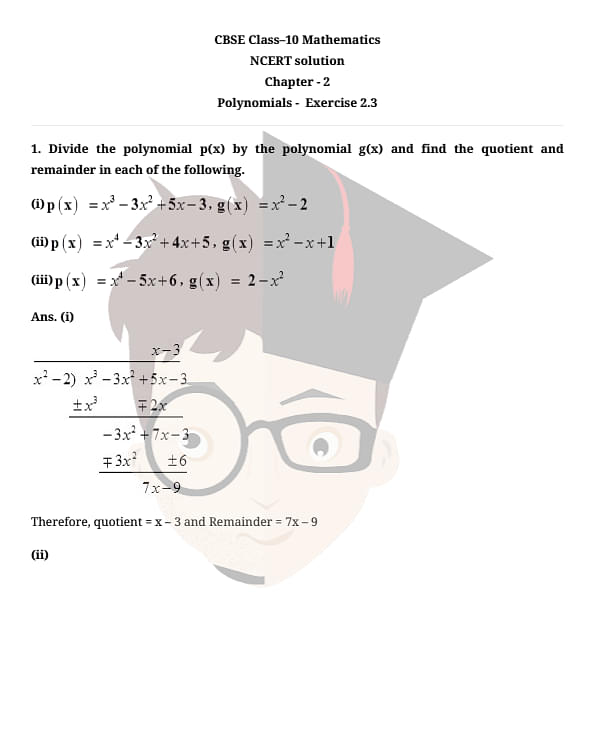
Read More: NCERT Solutions For Class 10 Maths Polynomials

Check out other exercise solutions of Class 10 Maths Chapter 2 Polynomials


Class 10 Chapter 2 Polynomials Topics:

CBSE Class 10 Maths Study Guides:

CBSE X Related Questions

  • 1.
    PQ is tangent to a circle with centre O. If \(OQ = a\), \(OP = a + 2\) and \(PQ = 2b\), then relation between \(a\) and \(b\) is

      • \(a^2 + (a + 2)^2 = (2b)^2\)
      • \(b^2 = a + 4\)
      • \(2a^2 + 1 = b^2\)
      • \(b^2 = a + 1\)

    • 2.
      An ice-cream cone of radius \(r\) and height \(h\) is completely filled by two spherical scoops of ice-cream. If radius of each spherical scoop is \(\frac{r}{2}\), then \(h : 2r\) equals

        • \(1 : 8\)
        • \(1 : 2\)
        • \(1 : 1\)
        • \(2 : 1\)

      • 3.
        The dimensions of a window are 156 cm \(\times\) 216 cm. Arjun wants to put grill on the window creating complete squares of maximum size. Determine the side length of the square and hence find the number of squares formed.


          • 4.
            If \(PQ\) and \(PR\) are tangents to the circle with centre \(O\) and radius \(4 \text{ cm}\) such that \(\angle QPR = 90^{\circ}\), then the length \(OP\) is

              • \(4 \text{ cm}\)
              • \(4\sqrt{2} \text{ cm}\)
              • \(8 \text{ cm}\)
              • \(2\sqrt{2} \text{ cm}\)

            • 5.
              A conical cavity of maximum volume is carved out from a wooden solid hemisphere of radius 10 cm. Curved surface area of the cavity carved out is (use \(\pi = 3.14\))

                • \(314 \sqrt{2}\) \(\text{cm}^{2}\)
                • \(314\) \(\text{cm}^{2}\)
                • \(\frac{3140}{3}\) \(\text{cm}^{2}\)
                • \(3140 \sqrt{2}\) \(\text{cm}^{2}\)

              • 6.
                Three tennis balls are just packed in a cylindrical jar. If radius of each ball is \(r\), volume of air inside the jar is

                  • \(2\pi r^3\)
                  • \(3\pi r^3\)
                  • \(5\pi r^3\)
                  • \(4\pi r^3\)

                Comments


                No Comments To Show

