


NCERT Solutions for Class 10 Maths Chapter 8 Introduction to Trigonometry Exercise 8.1

Jasmine Grover logo

Jasmine Grover

Education Journalist | Study Abroad Strategy Lead

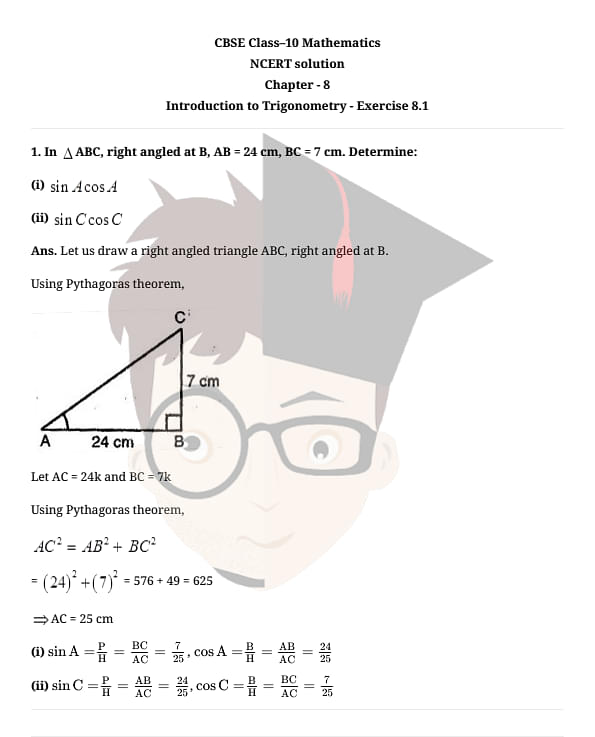
NCERT Solutions for Class 10 Maths Chapter 8 Introduction to Trigonometry Exercise 8.1 is provided in this article. Class 10 Maths Chapter 8 Introduction to Trigonometry covers important concepts like trigonometric ratios, trigonometry table, trigonometric identities and formulas. Chapter 8 exercise 8.1 includes questions based on trigonometric ratios.

Download PDF: NCERT Solutions for Class 10 Maths Chapter 8 Introduction to Trigonometry Exercise 8.1


Check below the pdf of NCERT Solutions for Class 10 Maths Chapter 8 Exercise 8.1
Read Also: NCERT Solutions for Class 10 Maths Chapter 8 Introduction to Trigonometry

Check out NCERT solutions of other exercises of class 10 maths chapter 8 Introduction to Trigonometry:


Class 10 Chapter 8 Introduction to Trigonometry Related Links:

CBSE Class 10 Maths Study Guides:

CBSE X Related Questions

  • 1.
    Assertion (A) : \((\sqrt{3} + \sqrt{5})\) is an irrational number.
    Reason (R) : Sum of the any two irrational numbers is always irrational.

      • Both Assertion (A) and Reason (R) are true and Reason (R) is the correct explanation of the Assertion (A).
      • Both Assertion (A) and Reason (R) are true, but Reason (R) is not the correct explanation of Assertion (A).
      • Assertion (A) is true, but Reason (R) is false.
      • Assertion (A) is false, but Reason (R) is true.

    • 2.
      An ice-cream cone of radius \(r\) and height \(h\) is completely filled by two spherical scoops of ice-cream. If radius of each spherical scoop is \(\frac{r}{2}\), then \(h : 2r\) equals

        • \(1 : 8\)
        • \(1 : 2\)
        • \(1 : 1\)
        • \(2 : 1\)

      • 3.
        Assertion (A) : If probability of happening of an event is \(0.2p\), \(p>0\), then \(p\) can't be more than 5.
        Reason (R) : \(P(\bar{E}) = 1 - P(E)\) for an event \(E\).

          • Both Assertion (A) and Reason (R) are true and Reason (R) is the correct explanation of the Assertion (A).
          • Both Assertion (A) and Reason (R) are true, but Reason (R) is not the correct explanation of Assertion (A).
          • Assertion (A) is true, but Reason (R) is false.
          • Assertion (A) is false, but Reason (R) is true.

        • 4.
          If \(PQ\) and \(PR\) are tangents to the circle with centre \(O\) and radius \(4 \text{ cm}\) such that \(\angle QPR = 90^{\circ}\), then the length \(OP\) is

            • \(4 \text{ cm}\)
            • \(4\sqrt{2} \text{ cm}\)
            • \(8 \text{ cm}\)
            • \(2\sqrt{2} \text{ cm}\)

          • 5.
            Arc \(PQ\) subtends an angle \(\theta\) at the centre of the circle with radius \(6.3 \text{ cm}\). If \(\text{Arc } PQ = 11 \text{ cm}\), then the value of \(\theta\) is

              • \(10^{\circ}\)
              • \(60^{\circ}\)
              • \(45^{\circ}\)
              • \(100^{\circ}\)

            • 6.
              For any natural number n, \( 5^n \) ends with the digit :

                • 0
                • 5
                • 3
                • 2

              Comments


              No Comments To Show


