


NCERT Solutions for class 11 Biology Chapter 2 : Biological Classification

NCERT Solutions for Class 11 Biology Chapter 2 Biological Classification are provided in the article below. It includes all the important definitions, concepts, and methodologies that will be really beneficial for the students appearing for CBSE Class 11 Exam 2022-23. The important topics that are included in this chapter are:

Expected no. of Questions: 1-2 questions of around 3-4 marks.

Download PDF: NCERT Solutions for Class 11 Biology Chapter 2 Biological Classification


NCERT Solutions for Class 11 Biology Chapter 2
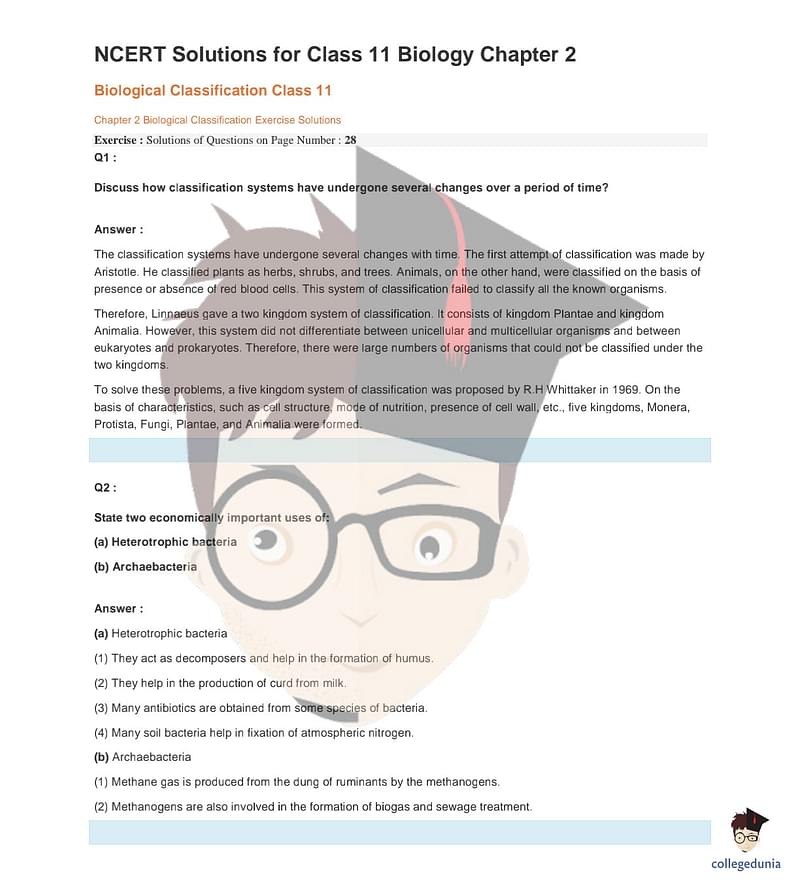
NCERT SolutionsNCERT SolutionsNCERT SolutionsNCERT SolutionsNCERT SolutionsNCERT Solutions

Class 11 Biology Chapter 2 Biological Classification: Important Topics

Biological classification is the process of identifying traits in living organisms and arranging them according to their characteristics. The study of living organism classification helps to study the common features of the group, only one or two species from each categorized category should be studied. It helps in the identification of new organisms.

  • Five Kingdom Classification

The five-kingdom classification was not the initial result of the classification of living organisms. Carolus Linnaeus was the first person to come up with a two-kingdom classification, which included only the kingdom Plantae and kingdom Animalia. Living things are divided into five kingdoms: animal, plant, fungi, protist and monera

Chapter Related Links:

Kingdom Monera Kingdom Protista Kingdom Fungi
Kingdom Plantae Kingdom Animalia Ascomycetes
Deuteromycetes Mumps Bacteriophage

CBSE Class 11 Biology Study Guides:

CBSE CLASS XII Related Questions

  • 1.
    Which of the following sacred groves is found in Meghalaya?

      • Jaintia hills
      • Bastar
      • Chanda
      • Sarguja

    • 2.
      Assertion (A) : The milk produced by transgenic cow 'Rosie' was nutritionally more balanced product for human babies than natural cow milk.
      Reason (R) : It was human protein enriched milk containing human alpha lactalbumin.

        • Both Assertion (A) and Reason (R) are true and Reason (R) is the correct explanation of the Assertion (A).
        • Both Assertion (A) and Reason (R) are true, but Reason (R) is not the correct explanation of the Assertion (A).
        • Assertion (A) is true, but Reason (R) is false.
        • Assertion (A) is false, but Reason (R) is true.

      • 3.
        A DNA molecule is 160 base pairs long. It has 30% Guanine. How many Adenine bases are present in this DNA molecule?

          • 48
          • 64
          • 96
          • 192

        • 4.
          Which of the following statements about plasmids is incorrect?

            • Plasmids have the ability to replicate within the bacterial cell.
            • Their replication is controlled by chromosomal DNA.
            • They are autonomously replicating circular extra-chromosomal DNA.
            • They often carry antibiotic resistant genes.

          • 5.
            Assertion (A): Repetitive sequences make up a very large portion of human genome.
            Reason (R): Repetitive sequences do not have direct coding functions in the genome.

              • Both Assertion (A) and Reason (R) are true and Reason (R) is the correct explanation of the Assertion (A).
              • Both Assertion (A) and Reason (R) are true, but Reason (R) is not the correct explanation of the Assertion (A).
              • Assertion (A) is true, but Reason (R) is false.
              • Assertion (A) is false, but Reason (R) is true.

            • 6.
              Monascus purpureus is a yeast used commercially in the production of which one of the following?

                • Ethanol
                • Streptokinase
                • Citric acid
                • Statins
              CBSE CLASS XII Previous Year Papers

              Comments


              No Comments To Show


