



Education Journalist | Study Abroad Strategy Lead
Relation between power and resistance is represented by series and parallel conditions. Power is the rate of doing work and resistance is a particle that helps us to measure opposition to current flow in an electrical circuit. In one of them, power is directly proportional to resistance and in second, power is inversely proportional to resistance. Power and resistance have a proportional relationship.
Also Read: Current Electricity
| Table of Content |
Key Terms: Power, Resistance, Ohm's Law, Watts, Joules, Conductors, Electricity, Electrical circuit, Current flow, Energy, Wattage
What is Power?
[Click Here for Sample Questions]
The rate of doing work is the definition of power. In other words, it is the energy amount or no. of energy that is consumed per unit of time and the unit of power is J/s ( joule per second ) where j represents joule and s represents second.
Joule per second is equivalent to a watt. The rate at which a lightbulb converts electrical energy into heat energy and the light is measured in watts (W) - the higher the wattage, the more power, or in other words, the more electrical energy utilized per unit of time. Watt is the power of a system that transfers one joule of energy every second.
What is Resistance?
[Click Here for Previous Year Questions]
In an electrical circuit, resistance measures current flow. It is measured in ohms which is symbolized by Omega (Ω). German physicist Georg Simon Ohm introduced ohms unit as well as ohm’s law. Resistance measurements are commonly used to determine the state of a component or circuit. Many components have a set resistance value, such as heating elements and resistors.

Resistance Diagram
Discover about the Chapter video:
Current Electricity Detailed Video Explanation:
Also Read:
Relation Between Power and Resistance
[Click Here for Sample Questions]
There are two different types of relation between Power and Resistance which are discussed below
1st Relation
Power is defined as the ratio of the square of Voltage and Resistance.
P = V2/R
Here, P is the Power that can be measured in Watt.
V is the Electric Potential which can be measured in Volts.
R is the Resistance which can be measured in ohm.
This equation can be derived by the following methods.
We know that,
P = VQ/T ----------- (1)
We have also read that,
I = Q/T
On Putting this value in equation 1, we will get
P = IV ----------------- (2)
According to ohm’s law,
V = IR
I = V/R
On putting this value of I in equation 2, we will get
P = V * V/ R
P = V2/R
This Relation tells us that Power is inversely proportional to Resistance. It means that When we increase the resistance then the power will decrease or vice versa.
2nd Relation
Power is the multiplied product of square of Current and Resistance.
P = I2*R
Here, P is the Power which can be measured in Watt.
I is the Electric Current which can be measured in Ampere.
R is the Resistance which can be measured in ohm.
This equation can be derived by following methods.
We Know that,
P = VQ/T ----------- (1)
We have also read that,
I = Q/T
On Putting this value in equation 1, we will get
P = IV ----------------- (2)
According to ohm’s law,
V = IR
On putting this value of V in equation 2, we will get
P = I*IR
P = I2R
This Relation tells us that Power is directly proportional to Resistance. It means that When we will increase the value of resistance then the power will also increase or vice versa.
Things to Remember
- Energy transmission can be utilised to perform work, so power is also a measure of how quickly this work is completed.
- In P = I2 R, Power is directly proportional to Resistance ( Current Constant throughout the circuit ).
- In P = V2 / R, Power is inversely proportional to Resistance ( Potential difference constant throughout the circuit ).
- There will undoubtedly be resistance wherever power exists.
- "Resistance" may sound negative, however, it can be advantageous in the field of electrical.
- Resistance is an amount of resistance experienced when current flows through a conductor.
Also Read:
Sample Questions
Ques. How does the resistance affect the voltage? (2 Marks)
Ans. The resistance is inversely proportional to the current, which is directly proportional to the voltage. This indicates that when the voltage is increased, the current increases, whereas as the resistance is increased, the current decreases.
Ques. What happens to the power if the resistance connected to a battery is cut in half? (2 Marks)
Ans. Because the circuit's resistance has doubled, the current has been cut in half. This signifies that the battery's power output is half of what it was previously. However, the power is now split between two lights.
Ques. Explain the resistance with a real-life example? (2 Marks)
Ans. We must slow down our car some distance before the speed breakers if we are travelling at high speeds; else, our vehicle will jump with a lot of jerk. So, the maximum current flowing through the circuit (road) is represented by our high-speed vehicle, and the speed breaker represents the resistance that prevents accidents or short circuits in our homes.
Ques. Give 6 Examples Of Ohm's Law In Everyday Life? (2 Marks)
Ans. We discovered six applications of Ohm's law in our daily lives.
- Electric Heaters
- Electric Kettles and Irons
- Design of Electric Devices
- Fuse Design
- Mobile or Laptop Charger
- Domestic Fans
Ques. Find the power dissipated by the car headlight through which 2.50 A flows when 12.0 V is applied to it, both when it is hot and when it is cold? (3 Marks)
Ans. We know the voltage and current for the hot headlamp, so we can use P = IV to calculate the power. We know the voltage and resistance for the cold headlight, thus we can calculate the power using P = V 2/R.
We get the current and voltage numbers for the hot headlamp by plugging in the known values.
P = IV = (2.50 A)(12.0 V) = 30.0 W.
Because the cold resistance was 0.350 Ω , the power it uses when it initially turns on is
P = V2 / R = (12.0 V)2 / 0.350 Ω = 411 W
Heated headlight dissipates 30 W, which is average. When it's cold, though, the 411 W is noticeably higher. As the bulb's temperature rises and its resistance rises, the initial power quickly drops.
Ques. find the power dissipated by the bike headlight through which 5.0 A flows when 24.0 V is applied to it, both when it is hot and when it is cold? (3 Marks)
Ans. We know the voltage and current for the hot bike headlight, so we can use P = IV to calculate the power. We know the voltage and resistance for the cold bike headlight, thus we can calculate the power using P = V2/R.
We get the current and voltage numbers for the hot bike headlight by plugging in the known values.
P = IV = (5.0 A)(24.0 V) = 120.0 W.
Because the cold resistance was 0.350 Ω , the power it uses when it initially turns on is
P = V2 / R = (24.0 V) 2 / 0.350 Ω = 1645 W
The heated headlight dissipates 120 W, which is average. When it's cold, though, the 1645 W is noticeably higher. As the bulb's temperature rises and its resistance rises, the initial power quickly drops.
Ques. Calculate power if person A does 30 J of work in 2 hrs and another person B does the same amount of work in 3 hrs? (3 Marks)
Ans. So, here we have given formula
Power = Work / time
In Case 1:
Work in form of energy is 30 J and Time is 2 hrs then
P = W/T = 30/2 = 15 W
In Case 2:
Work in form of energy is also 30 J but time is 3 hrs then
P = W/T = 30/2 = 10 W
We can see that individual A has more capability than person B. As a result, power A is bigger than power B.
Ques. A kitchen in North America has three appliances connected to a 120 V circuit with a 15 A circuit breaker: an 850 W coffee maker, a 1200 W microwave oven, and a 900 W toaster.
1. Draw a schematic diagram of this circuit.
2. Which of these appliances can be operated simultaneously without tripping the circuit breaker? (5 Marks)
Ans. a. Outlets are wired in parallel so that the appliances on a circuit are independent of one another. Turning the coffee maker off will not result in the toaster turning off (assuming both were on at the same time). Each appliance will also get the same regulated voltage, which simplifies the design of electrical devices. The downside to this scheme is that the parallel currents can add up to dangerously high levels. A circuit breaker in series before the parallel branches can prevent overload by automatically opening the circuit.
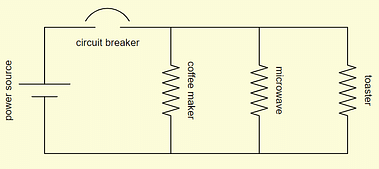
b. A 15 A circuit operating at 120 V consumes 1,800 W of total power.
P = VI = (120 V), (15 A) = 1,800 W
Total power in a parallel circuit is the sum of the power consumed on the individual branches.
coffee maker + microwave oven = 850 W + 1200 W = 2050 W
microwave oven + toaster = 1200 W + 900 W = 2100 W
toaster + coffee maker = 900 W + 850 W = 1750 W
On this circuit, only the coffee maker and toaster can be operated simultaneously. All other combinations will trigger the circuit breaker to open.
Ques. A 220 V, 100 W bulb is connected to a 110 V source. Calculate the power consumed by the bulb. (5 Marks)
Ans. To find the power of the bulb:
- Electric Power: The rate at which electrical energy is dissipated into other forms of energy is called electrical power i.e.,
\(P = \frac{W}{t} = VI = {I^2}R = \frac{{{V^2}}}{R}\)
Where V = Potential difference, R = Resistance and I = current.
Given: Potential difference (V) = 220 V, power of the bulb (P) = 100 W and actual voltage (V') = 110 V
- The resistance of the bulb can be calculated as,
\(\Rightarrow R=\frac{V^2}{P}=\frac{(220)^2}{100}=484 \,\Omega\)
- The power consumed by the bulb.
\(\Rightarrow P=\frac{V^2}{R}=\frac{(110)^2}{484}=25 \,W\)
Ques. An electric heater does 200 J of work in 2 seconds. Find the resistance of the electric heater if the current in the circuit is 2 A. (3 Marks)
Ans. Resistance of electric heater can be calculated as follows:
- Heating effect of electric current: When a current is flowing in a circuit having resistance there is a heat dissipation due to the resistance. This is called the heating effect of electric current.
- The heat dissipated is given by:
Heat (H) = I2 R t
Where I = the current flowing in the circuit, R = the resistance of the circuit, and t = the time taken
Given that: current (I) = 2 A
Resistance = R
Heat dissipated = work done by the heater (H) = 200 J
Time (t) = 2 sec
Heat (H) = I2 R t = 22 × R × 2 = 200 J
8 R = 200
Resistance of the heater (R) = 200/8 = 25 Ω
Ques. A current of 5 A is drawn by a filament of an electric bulb for 2 minutes. Find the amount of electric charge that flows through the circuit. (4 Marks)
Ans. The electric charge can be calculated in the following way:
- Electric charge: It is an intrinsic property of the elementary particles of matter which gives rise to electric force between various objects.
It is a scalar quantity.
- SI unit of electric charge is coulomb (C).
- The total charge on the conductor is given by q = It, when current flows through the conductor for some time.
Where I = current and t = time
CALCULATION:
Given - I = 5 A and t = 2 min = 120 s
- The total charge on the conductor is given by q = It
⇒ Q = It
⇒ Q = 5 × 120 = 600 C
Ques. What does resistivity of a material depend on? (4 Marks)
Ans. Resistivity of material depends on:
- The unit for resistivity is the ohm-meter (Ω-m).
- The resistivity of a material depends on its nature and the temperature of the conductor.
- The resistivity of a material doesn't depend on its shape and size (length and area).
- Materials that conduct electrical current easily are called conductors and have a low resistivity.
- Materials that do not conduct electricity easily are called insulators and these materials have a high resistivity.
- Resistivity is inversely proportional to the number of free electrons per unit volume of the conductor and to the average relaxation time of the free electrons in the conductor.
- Resistance: The property of any conductor that opposes the flow of electric current through it and depends on the shape and size of the materials, temperature, and nature of the materials is called resistance.
- It is denoted by R and the SI unit is the ohm (Ω).
The resistance is given by:
R = ρL/A
where ρ is resistivity, L is the length and A is the area of the cross-section.
EXPLANATION:
From the above discussion, we can say that
- The resistivity doesn't depend on the dimensions (length, diameter, and area) of the conductor.
- The resistivity depends on the material of the conductor. So option 4 is correct.
- The resistivity depends on the temperature of the conductor. But the effect of temperature is negligible.
- The resistivity does not depend on the density of the conductor.
Previous Year Questions
- In the circuit shown, a four-wire potentiometer is made of a…...[JEE Main 2019]
- The efficiency of the transmission line is approximately….[JEE Main 2020]
- the maximum Joule heating in RR will take place for….[JEE Main 2020]
- The minimum fuse capacity (rated value) of the building will be...[JEE Main 2020]
- the expected reading of the voltmeter will be….[JEE Main 2019]
- Which of the following must be known in order to determine… [BITSAT 2012]
- A motor of power P0 is used to deliver water at a certain rate through… [VITEEE 2009]
- A coil of inductive reactance 31Ω has a resistance of 8 Ω… [NEET 2006]
- A 30V−90W lamp is operated on a 120v DC line… [VITEEE 2015]
- An aluminium rod and a copper rod are taken such that… [DUET 2007]
- In the adjacent shown circuit, a voltmeter of internal resistance… [BITSAT 2009]
- A wire of resistance 12 ohm is in the form of a circle… [JIPMER 1999]
- A cell of constant emf first connected to a resistance… [BITSAT 2006]
- In an a.c. circuit the e.m.f. (∈) and the current (i) at… [NEET 2008]
- A circuit contain two resistors R1 and R2 in series. Find the ratio of… [JIPMER 2019]
- The masses of three copper wires are in the ratio… [VITEEE 2015]
- A letter 'A' is constructed of a uniform wire with resistance… [BITSAT 2012]
- In a region of magnetic induction B =102 tesla, a circular coil of radius… [NEET 1988]
- A 10V battery with internal resistance… [JKCET 2018]
- Resistances 1 Ω,2 Ω and 3 Ω are connected to form a triangle… [VITEEE 2017]
For Latest Updates on Upcoming Board Exams, Click Here: https://t.me/class_10_12_board_updates
Check-Out:



Comments