



Education Journalist | Study Abroad Strategy Lead | Updated On - Apr 7, 2026
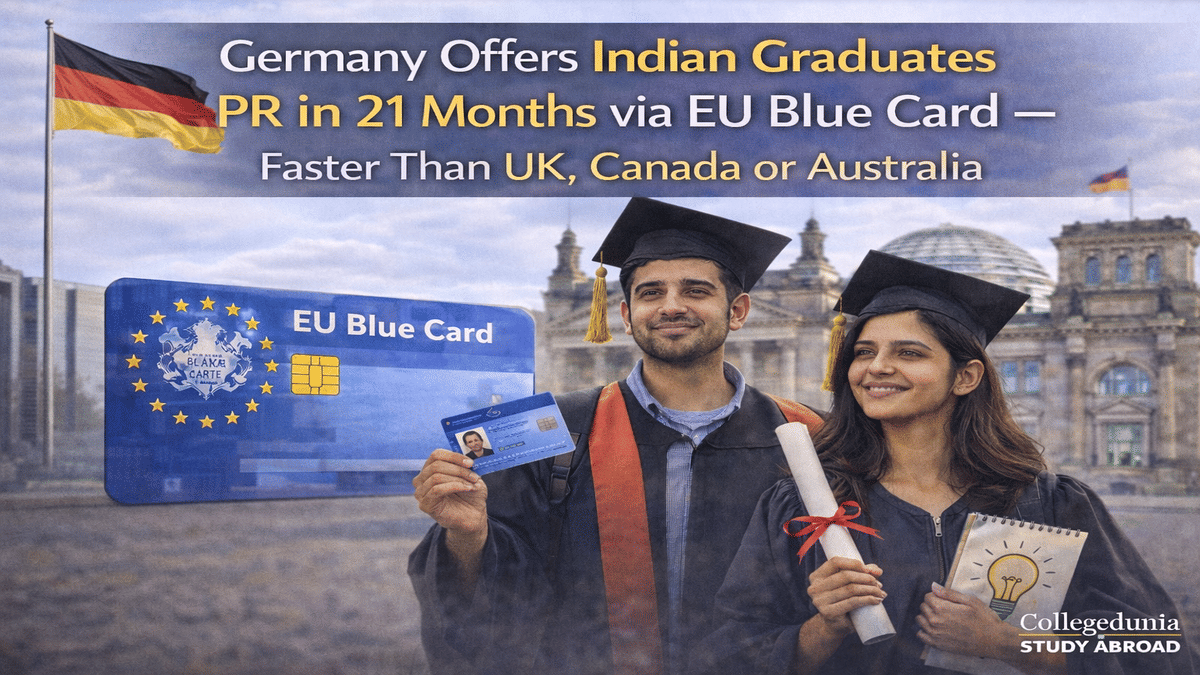
Indian STEM graduates working in Germany can now qualify for permanent residency in as little as 21 months through the EU Blue Card. It is the fastest confirmed PR pathway available to Indian nationals among all major study destinations. With Germany's 2026 salary thresholds now in effect and Indian student enrolment having doubled to nearly 60,000 since 2020, the route is more relevant, and more achievable, than at any point before.
What the EU Blue Card Actually Offers in 2026?
The EU Blue Card is Germany's premium work residence permit for degree-holders in qualified employment. It requires no lottery, no points draw, and no employer sponsorship beyond a standard job contract. Once issued, it gives holders the right to live and work in Germany, bring family members, and critically apply for a permanent settlement permit on a timeline that no comparable destination matches.
The settlement permit (Niederlassungserlaubnis) — Germany's equivalent of permanent residency — is available to EU Blue Card holders after:
- 21 months, if the holder demonstrates B1-level German (CEFR)
- 27 months, if the holder demonstrates A1-level German
This is confirmed under Section 18g of the German Residence Act (AufenthG), as published on the official Make it in Germany portal (Federal Government of Germany).
Previously, before the 2023 Skilled Immigration Act reforms, the standard PR timeline for Blue Card holders was 33 months — meaning the 21-month route represents a 12-month acceleration for those who invest in German language skills.
Check details on how to get Germany work visa?
The 2026 Salary Thresholds — and What They Mean in INR
Effective 1 January 2026, Germany's EU Blue Card salary thresholds have been updated in line with the pension insurance contribution ceiling:
| Category | Annual Salary (EUR) | Monthly (EUR) | In INR (approx.) |
|---|---|---|---|
| Standard occupations | €50,700 | €4,225 | ₹54.5 lakh/year |
| Shortage occupations (STEM, IT, healthcare, architecture, teaching) | €45,934 | €3,828 | ₹49.3 lakh/year |
| New entrants (degree within last 3 years — all professions) | €45,934 | €3,828 | ₹49.3 lakh/year |
Exchange rate: 1 EUR = ₹107.40 as of 7 April 2026 (Source: BookMyForex)
The new entrant threshold is the most significant provision for Indian students. Any graduate who completed their degree within the last three years — regardless of field — qualifies for the lower €45,934 threshold. This means an Indian student graduating from a German university in 2025 or 2026 needs a starting salary of approximately ₹49.3 lakh/year to qualify for the Blue Card, not the higher ₹54.5 lakh standard bar.
For Indian graduates in IT, engineering, and healthcare — Germany's three highest-demand sectors — the shortage occupation threshold applies automatically, making the Blue Card accessible at entry-level salaries in those fields.
How Germany Compares: PR Timelines Across Major Destinations
For Indian students weighing where to study and build a long-term career, the PR timeline is one of the most consequential factors. Here is how Germany's EU Blue Card route compares against the other major destinations:
| Destination | PR / Settlement Route | Minimum Timeline | Notes for Indian Nationals |
|---|---|---|---|
| Germany (EU Blue Card + B1 German) | Settlement Permit | 21 months | Confirmed; no lottery or draw |
| Canada (Express Entry) | Permanent Residency | ~2–3 years | CRS score competition; no guaranteed timeline |
| UK (Skilled Worker → ILR) | Indefinite Leave to Remain | 5 years | Dropping to 10 years under proposed Earned Settlement model |
| Australia (Skilled Migration) | Permanent Residency | 2–4 years | State nomination required for most streams |
| USA (Green Card) | Permanent Residency | 10–20+ years | Per-country backlog; Indian nationals face longest wait |
Germany's 21-month timeline is not a best-case scenario — it is the standard confirmed route for Blue Card holders who meet the B1 German requirement. No other major destination offers a comparable, guaranteed PR pathway in under two years for Indian graduates.
Who Qualifies: The Indian Student Pathway
For Indian students currently studying in Germany — or planning to — the Blue Card pathway works in a clear sequence:
Step 1 — Complete a qualifying degree in Germany (or India) A German university degree automatically qualifies. An Indian degree qualifies if it is recognised as equivalent to a German academic qualification (check via anabin.kmk.org). Most IIT, NIT, and top Indian university degrees in engineering, IT, and sciences are recognised.
Step 2 — Secure a qualifying job offer The job must be in a qualified role matching your degree. Salary must meet the 2026 threshold: €45,934 for new entrants and shortage occupations (₹49.3 lakh), or €50,700 for standard roles (₹54.5 lakh).
Step 3 — Apply for the EU Blue Card Apply online via Germany's Consular Services Portal. Under the "Focus on India" fast-track, processing time for Indian applicants has been cut to approximately 2 weeks.
Step 4 — Begin German language learning immediately B1 German is the difference between PR in 21 months and PR in 27 months. Free and subsidised German courses are available through the Goethe-Institut and, under the "Focus on India" plan, through German-supported programmes in India before departure.
Step 5 — Apply for the Settlement Permit at 21 months Once 21 months of qualified Blue Card employment are complete and B1 German is demonstrated, apply at the local Foreigners Authority (Ausländerbehörde). The settlement permit has permanent validity.
What Changes for September 2026 Applicants
Indian students applying for German university programmes for Winter Semester 2026/27 (application deadlines typically January–July 2026) should factor the following into their planning:
- Target shortage occupation fields — IT, engineering, STEM, healthcare, architecture, and teaching all qualify for the lower €45,934 Blue Card threshold
- Start German at A2 or above before arrival — B1 is achievable within 18–24 months of consistent study; starting early compresses the timeline
- Choose programmes at universities with strong industry placement — TU Munich, RWTH Aachen, KIT, TU Berlin, and Heidelberg have the strongest employer pipelines in shortage sectors
- Factor in near-zero tuition — most German public universities charge only a semester fee of €150–€350, meaning Indian graduates enter the workforce with significantly lower debt than UK or US counterparts
The Bigger Picture
Germany's EU Blue Card PR pathway did not change overnight. The 21-month route was introduced as part of the 2023 Skilled Immigration Act reforms, and the 2026 salary threshold update — a ~5% increase from 2025 levels — keeps the bar broadly stable in real terms. What has changed is the context around it.
With the UK's Graduate Route shortening to 18 months from January 2027, Canada's Express Entry becoming increasingly competitive for Indian applicants, and US Green Card backlogs stretching beyond a decade, Germany's combination of near-zero tuition, a structured Blue Card pathway, and a confirmed 21-month PR route makes it the most comprehensively attractive long-term destination for Indian STEM graduates in 2026.
For Indian students who invest in German language skills — the single biggest lever in the entire pathway — the timeline from first day of study to permanent residency can be as short as three to four years total.












1691403626.png?tr=w-305,h-145,c-force?h=175&w=350&mode=stretch)



Comments