



Education Journalist | Study Abroad Strategy Lead | Updated On - Mar 23, 2026
Germany needs approximately 300,000 skilled foreign workers every year just to maintain current staffing levels — and it has made India its primary recruitment target. The German government has launched a sweeping "Focus on India" initiative: 30 new measures designed to make it faster, cheaper, and simpler for Indian professionals to live and work in Germany. For Indian students already studying in Germany, and for those planning to go, this is the most consequential shift in the bilateral employment relationship in a generation.
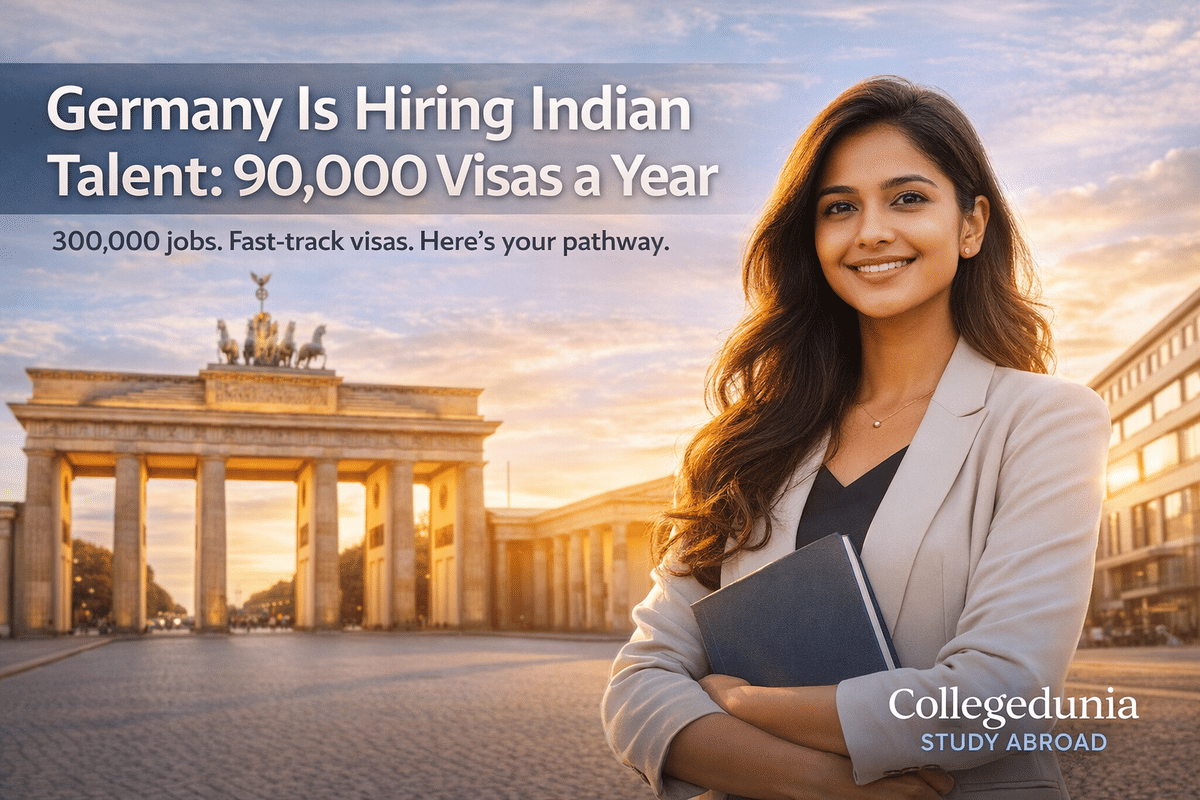
The numbers tell the story. The annual skilled work visa quota for Indian professionals has been tripled — from 20,000 to 90,000 per year. Visa processing times for eligible Indian applicants have been cut from up to nine months to as little as two weeks. And Germany's 163-occupation shortage list now covers roles from software engineers and nurses to electricians and logistics specialists — all of which Indian graduates are well-positioned to fill.
Check Post Study Work Visa in Germany
Why Germany Is Turning to India Now?
Germany's labour crisis is structural, not cyclical. The Institute for Employment Research (IAB) and the German Economic Institute (IW) estimate that over 260,000 positions remain unfilled in the top shortage sectors alone. Healthcare leads with roughly 46,000 vacancies, followed by IT, engineering, construction, education, and logistics. By 2035, Germany is projected to face a shortage of 7 million skilled professionals if current trends continue.
India is the logical partner.
- Over 1 million Indians enter the labour market every month, producing a large, young, English-proficient workforce in exactly the sectors Germany needs most.
- The number of Indian professionals working in Germany has already grown sharply — from 23,000 in 2015 to 137,000 by early 2024.
- The "Focus on India" plan, launched by the German Foreign Office in October 2024 and now in full implementation, is designed to accelerate that trajectory significantly.
For Indian students already enrolled in German universities — approximately 60,000 as of 2023/24, according to DAAD — this creates a direct post-graduation employment pipeline that did not exist at this scale even two years ago.
What the "Focus on India" Plan Actually Changes?
The 30-measure plan introduces concrete improvements across three areas:
Visa processing:
- Processing time for skilled Indian workers reduced from up to 9 months to 2 weeks for eligible applicants
- Fully digital application — no consulate visit required
- Applications processed through Germany's online consular portal
Qualification recognition:
- Faster recognition of Indian degrees and vocational qualifications: now 3–4 months once documents are submitted
- Partial recognition available: if a qualification doesn't fully match German standards, applicants can complete bridging training
- Degrees already in Germany's recognised database skip the recognition process entirely
Integration support:
- Free or subsidised German language courses available in India before departure
- Cultural orientation and housing assistance programmes for new arrivals
The plan also introduced a new "Work and Stay Agency" (WSA), currently being rolled out, to cut bureaucratic red tape for visa and permit processing at the local level.
Which Sectors Are Hiring — and What Indian Graduates Can Earn
Germany's shortage occupation list covers 163 roles. The highest-demand sectors for Indian professionals are:
| Sector | Key Roles | Typical Annual Salary | In INR (approx.) |
|---|---|---|---|
| IT & Tech | Software developer, data scientist, AI engineer, cybersecurity | €55,000–€80,000 | ₹59.5–86.6 lakh |
| Engineering | Mechanical, electrical, civil, renewable energy | €50,000–€70,000 | ₹54.1–75.8 lakh |
| Healthcare | Nurses, elder care specialists, doctors | €35,000–€65,000 | ₹37.9–70.4 lakh |
| Construction & Trades | Electricians, plumbers, welders | €35,000–€50,000 | ₹37.9–54.1 lakh |
| Education | Teachers, early childhood educators | €38,000–€55,000 | ₹41.1–59.5 lakh |
Exchange rate: 1 EUR = ₹108.24 as of March 23, 2026 (Source: BookMyForex)
For Indian students completing Master's degrees in STEM or healthcare in Germany, these salary ranges represent a direct post-graduation target — particularly given that Germany's public universities charge little to no tuition, meaning graduates enter the workforce with significantly lower debt than their UK or US counterparts.
The Three Visa Routes Indian Graduates Should Know
1. EU Blue Card
The primary route for degree-holders with a job offer. Minimum salary threshold: €48,300/year (€43,759.80 for bottleneck professions). Processing time: 2 weeks under the "Focus on India" fast-track. Leads to permanent residency in 21–33 months with German language skills.
2. Chancenkarte (Opportunity Card)
Germany's job-seeker visa — no job offer required. Allows Indian professionals with a recognised degree or vocational qualification to enter Germany for up to one year to search for work. Particularly useful for Indian graduates who want to explore the market before committing to a role.
3. Standard Skilled Worker Visa
For roles not covered by Blue Card thresholds. Requires a job offer and recognised qualification. Processing: 2 weeks under the fast-track for Indian applicants.
All three routes are now processed digitally, with no in-person consulate visit required for eligible Indian applicants.
Who Is Affected?
- Indian students currently enrolled in German universities — the post-graduation employment pathway is now faster and more structured than at any point in recent history
- Indian STEM and engineering graduates — highest demand, highest salaries, fastest Blue Card eligibility
- Indian nursing and healthcare graduates — Germany needs 40,000–46,000 nurses; Indian healthcare professionals with recognised qualifications are in active demand
- Indian IT professionals — Berlin and Munich are particularly active hiring markets; English widely used in tech roles
- Indian graduates considering post-study work in the UK or Canada — Germany now offers a comparable or superior pathway, with lower tuition debt and a structured PR route
What Students and Graduates Should Do Now?
If you are currently studying in Germany:
- Begin qualification recognition early. If your Indian degree needs recognition for your target role, start the process at anabin.kmk.org or anerkennung-in-deutschland.de. The process takes 3–4 months — start before you graduate.
- Check the shortage occupation list. Visit make-it-in-germany.com to confirm whether your target role is on the Mangelberuf (bottleneck profession) list. Shortage roles qualify for lower Blue Card salary thresholds and faster processing.
- Explore the Chancenkarte if you don't yet have a job offer. The Opportunity Card lets you stay in Germany for up to a year to search. You do not need a job offer to apply — only a recognised degree or vocational qualification.
- Target the Blue Card salary threshold. For most roles, the minimum is €48,300/year (₹52.3 lakh). For shortage professions, it drops to €43,759.80 (₹47.4 lakh). Negotiate your first offer with these thresholds in mind.
If you are planning to study in Germany:
- Choose your programme with the shortage list in mind. Engineering, IT, healthcare, and green economy programmes align directly with Germany's highest-demand roles. Graduates in these fields have the clearest path to Blue Card eligibility.
- Start German language learning now. German B1 or higher significantly accelerates the PR timeline (from 33 months to 21 months on the Blue Card). Free courses are available through the Goethe-Institut and, under the "Focus on India" plan, through German-supported programmes in India.
- Factor in the post-study work advantage. Germany's 18-month post-study job-search permit, combined with the Chancenkarte and Blue Card route, gives Indian graduates more flexibility than most competing destinations.
The "Focus on India" plan signals a fundamental shift in how Germany views Indian talent — not as a temporary student cohort, but as a long-term workforce pipeline. The tripling of the visa quota, the digital fast-track, and the integration support infrastructure are not incremental tweaks. They represent a deliberate policy choice to make India Germany's primary skilled labour source country.
For Indian students weighing their options in 2026 — with US F-1 visa issuances down 69% in summer 2025, UK tuition costs rising, and Canada tightening its study permit caps — Germany's combination of near-zero tuition, a structured work pathway, and now an actively welcoming labour market makes it the most comprehensively attractive destination for Indian students in years.
The caveat: German language skills remain a meaningful differentiator. While English is sufficient for many tech and multinational roles, B1-level German opens faster PR timelines and a wider range of employers. Students who invest in language learning before or during their studies will have a measurable advantage.













1691403626.png?tr=w-305,h-145,c-force?h=175&w=350&mode=stretch)



Comments