



Germany has become a popular destination for Indian students in the last few years. The country attracts lakhs of international students every year. Some of the reasons for becoming a top study abroad destination are: high-quality education, modern campuses, low or zero tuition fees, strong international connections, and vibrant culture.
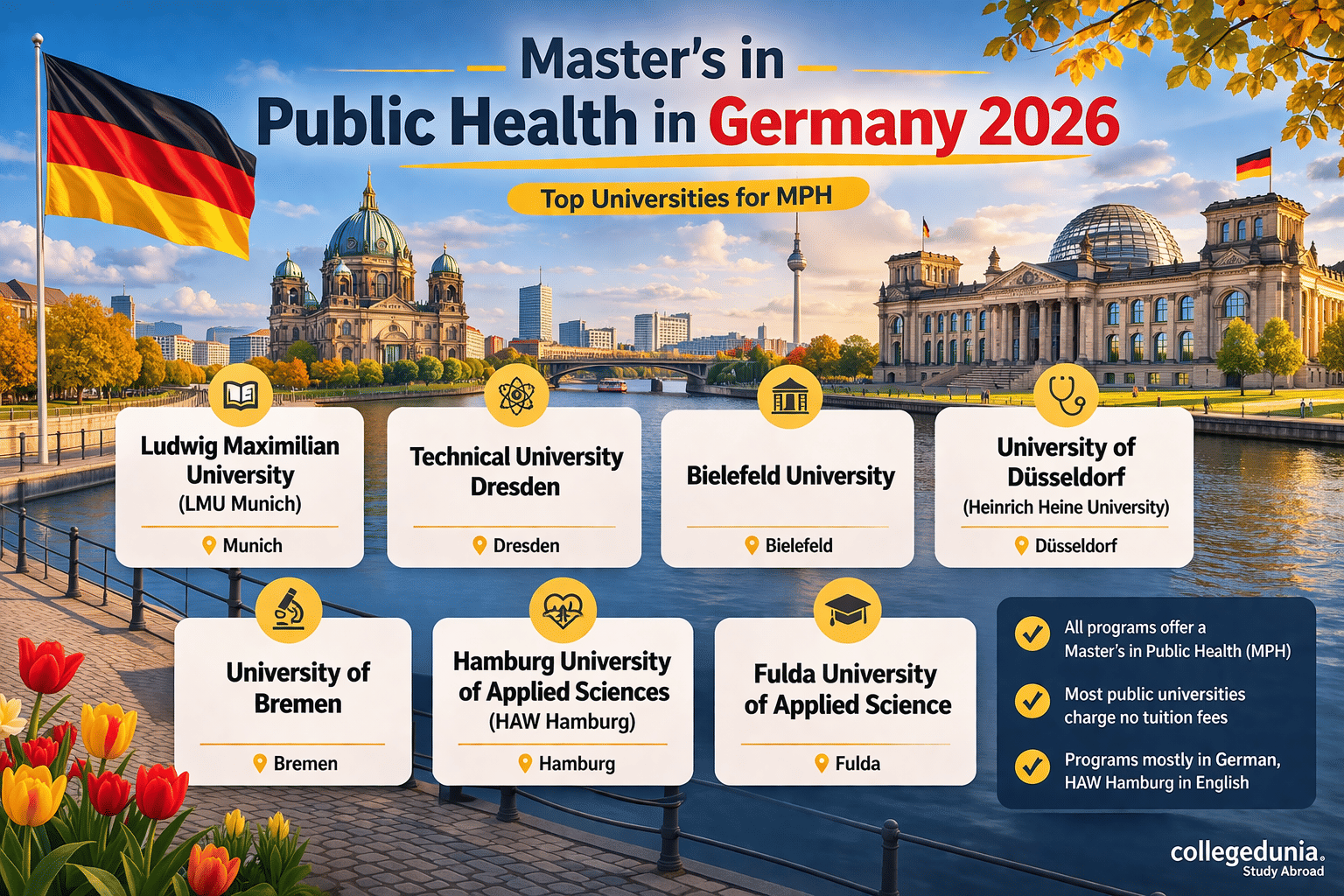
Some popular universities featured by QS are: Ludwig Maximilian University (#58), Technical University of Dresden (#218), and the University of Hamburg (#193). Most of the public universities are government-funded and have no (or very low) tuition fees. Students have to make a semester contribution, which usually lies between EUR 150- 400 (INR 16,244-43,319). The average monthly cost of living in Germany is EUR 1,305-2,515 (INR 1.4-2.7 lakh). There are plenty of scholarships for international students up to EUR 992 (INR 1.07 lakh) to pursue a Master's in Public Health (MPH).
Explore more: Study in Germany 2026
- Why Study in Germany?
- Master’s in Public Health Germany University Rankings 2026
- Master’s in Public Health Universities and Fees 2026
- Admission Requirements Master’s in Public Health in Germany
- Documents Required for a Master’s in Public Health in Germany
- Cost of Living in Germany
- Scholarships for Master's in Public Health in Germany
- What is the DAAD Scholarship?
- How to Apply for a German Student Visa?
- Post-Study Work Options
- FAQs
Why Study in Germany?
Some of the reasons to choose Germany as your next study destination are as follows:
- Global Exposure: Indian students can experience new food, lifestyles, and European culture.
- Low or No Tuition Fees: Most public universities do not charge tuition fees to students. Students just need to pay a semester contribution of some amount (EUR 150-400/INR 16,244-43,319).
- Scholarship availability: Germany provides several popular scholarships, like the DAAD Scholarship, for various master’s programs.
- Post-study work opportunity: After completing studies, students can apply for a post-study work visa. The visa allows students to work up to 18 months after graduation.
Check out: Free Universities in Germany 2026
Master’s in Public Health Germany University Rankings 2026
The table below lists the universities that offer a master's in public health and their rankings.
| University Name | Location | QS World University Rankings 2026 | Collegedunia Study Abroad Overall Rankings 2026 |
|---|---|---|---|
| Ludwig Maximilian University (LMU Munich) | Munich | #58 | #34 |
| Technical University Dresden | Dresden | #218 | #136 |
| Bielefeld University | Bielefeld | #1001-1200 | #243 |
| University of Düsseldorf | Düsseldorf | - | #274 |
| University of Bremen | Breman | - | #372 |
| Hamburg University of Applied Sciences | Hamburg | #193 | #780 |
| Fulda University of Applied Science | Fulda | - | - |
Check out: Collegedunia Study Abroad Rankings 2026
Master’s in Public Health Universities and Fees 2026
A master's in public health is a two-year master’s degree program that focuses on public health studies. The admissions are usually based on the student's grades and experience. The tuition fees for the universities mentioned below are zero, except for HAW Hamburg (which is EUR 2400/INR 2.5 lakh).
| University Name | Program offered | Language of Instruction | Semester contribution |
|---|---|---|---|
| Ludwig Maximilian University | MPH | German | EUR 150 (INR 16,245) |
| Technical University Dresden | Master of Public Health | German | EUR 338 (INR 36,605) |
| Bielefeld University | Master of Public Health | German (partially: English) | EUR 300 (INR 32,489) |
| University of Düsseldorf (Heinrich Heine University Düsseldorf) | MPH | German (partially: English) | EUR 350 (INR 37,904) |
| University of Bremen | MA Public Health | German | EUR 350 (INR 37,904) |
| Hamburg University of Applied Sciences (HAW Hamburg) | Master of Public Health | Fully English | EUR 379 (INR 41,045) |
| Fulda University of Applied Science | MSc Public Health | German | EUR 360 (INR 38,987) |
Important note: Students may be required to complete a preparatory course (pre-master program). It is only required if your bachelor’s degree is not closely related and missing key subjects. It covers the basic medical subjects and language training (English and German).
Tip for Indian students: If you want to pursue MPH in the English language, HAW Hamburg is considered a strong option.
Check out: Exams to study in Germany for International students
Admission Requirements Master’s in Public Health in Germany
The admission requirements to enrol in a master's in public health in Germany are listed below in the table.
| Parameters | Eligibility criteria |
|---|---|
| Academic Qualifications |
A bachelor’s degree in a relevant field (public health, nursing, health science or equivalent) |
| English Proficiency | B2 level (IELTS: 6.5-7 | TOEFL: 90) |
| Work Experience | Proof of a minimum of 1 year of work experience in the public health sector |
Note: Some universities in Germany, like HAW Hamburg and Technical University Dresden, also require a C1 level (advanced level) of German language proficiency.
Documents Required for a Master’s in Public Health in Germany
The essential documents required for your admission to universities in Germany are the following:
- Academic Transcripts: Official academic records and degree certificates
- APS Certificate: It is a mandatory document for Indian students planning to study in Germany. This certificate ensures the authenticity of academic records and helps with the visa application.
- CV/Resume: An updated CV that reflects your skills, educational background and experience (if any).
- LoR (Letter of Recommendation): Two letters of recommendation that explain your skills and capabilities for the course. This might be recommended by a professor or employees.
- Letter of Motivation: It's a document where a student explains why they are applying for a particular course and university.
- VPD (Preliminary review documentation): It's an important document issued by *Uni-Assist. It helps in verifying the qualifications, evaluating them and converting them into the German grading system.
*Uni-Assist is an online platform that processes the application for international students. It checks the qualifications and documents, then sends your applications to the German universities.
Cost of Living in Germany
The average monthly cost of living in Germany is EUR 1,305-2,515 (INR 1.4-2.7 lakh). These data are being sourced from Numbeo for major cities like Munich, Hamburg, and Dresden.
| Expense | Cost per Month (EUR) | Cost per Month (INR) |
|---|---|---|
| Accommodation | EUR 800-1,500 | INR 86,639 - 1.6 lakh |
| Food | EUR 300-500 | INR 32,489 - 54,149 |
| Transportation | EUR 55-65 | INR 5,956 - 7,039 |
| Miscellaneous Expense | EUR 150-450 | INR 16,244 - 48,734 |
Note: Currency conversion rate used: EUR 1 = INR 108.3 as of 10 April 2026.
Check out: Cost of Living in Germany
Scholarships for Master's in Public Health in Germany
Most of the public universities are government-funded and charge no tuition fees to students. However, expenses remain high for living and semester contributions. Universities offer some scholarships to help students in this case. Some of the popular scholarships in Germany are:
| University Name | Scholarship type | Eligibility | Coverage |
|---|---|---|---|
| Ludwig Maximilian University | SIST LMU Study Scholarship | International students with strong academic records, knowledge of the field of study and financial needs. | EUR 650 (INR 70,394) per month for up to ten months |
| Technical University Dresden | DAAD-STIBET Scholarship | International students who have secured a 2.5 GPA out of 4 (65-70%) so far and are near completion of their degree. | Scholarship worth EUR 300 (INR 32,489) per month for up to 3 months |
| University of Düsseldorf | STIBET Completion of Studies Grant | International students must have a UG degree and a minimum GPA of 2.5 out of 4 (65-70%). | Scholarship worth EUR 992 (INR 1.07 lakh) per month. |
| Hamburg University of Applied Sciences | HAW Academic Excellence Scholarship(merit-based) | International students with strong grades and no other funding or scholarships | Scholarship worth EUR 1,800 (INR 1.9 lakh) for one semester |
Note: Apart from these scholarships, there are also external scholarships available in Germany. One of the most popular external scholarships is the DAAD Scholarship.
What is DAAD Scholarship?
The DAAD Scholarship (Deutscher Akademischer Austauschdienst) is a government-funded scholarship for international students. It is considered one of the most prestigious scholarships for Indian students who have completed their UG degree. This scholarship funds either your full master's degree or one year of study in Germany. The duration of funding is typically 10-24 months, and it covers:
- Monthly stipend of EUR 992 (INR 1.07 lakh) to cover living expenses.
- Medical/health insurance for the entire program duration.
- Travel allowance to cover international travel expenses.
- Study allowances are provided for study materials and other academic needs.
Additional benefits include accommodation costs, allowances for family members and a free language course to help settle down in Germany.
To know more, check out: DAAD Scholarship Guide for Indian Students
How to Apply for a German Student Visa?
To study in Germany, students are required to apply for a German student visa (also known as a national visa or D-visa). Students are required to apply online for a visa and book an appointment with the embassy or consulate (VFS Global for Indian students). VFS Global helps with the visa applications. Students are required to book an appointment, submit documents, and attend the interview, which takes about 10 minutes. After the interview, you need to provide biometrics, pay the visa fee, and wait for the results.
Documents Checklist for a German Visa:
- Acceptance letter from the University
- Valid Passport
- Academic transcripts
- APS Certificate
- Language proficiency proof (English and German)
- Letter of motivation
- Passport-sized Photographs
- Proof of funds (a *German blocked account showing minimum funds of EUR 11,904/INR 12.8 lakh)
Note: A blocked account is a type of bank account where your money is deposited and can be withdrawn (EUR 992/1.07 lakh) monthly. It is a mandatory requirement to ensure you have sufficient funds to cover the living expenses. This step needs to be made before going to Germany.
Check out: German Study Visa Processing Time
Post-Study Work Options
After completing their studies, students can apply for a post-study work permit. This allows students to stay and work in Germany for 18 months, but this is a temporary resident permit. If you have found a suitable job, you can apply for an *EU Blue Card.
Students can find jobs in the health sector. Some of the popular career options are:
- Public health officer
- Epidemiologist
- Data analyst
- Healthcare specialist/Consultant
*The EU blue card is a residence permit for working professionals. This allows you to stay and work in Germany for a long time.
Check out the latest news: Indian Graduates getting PR via EU Blue card
In conclusion, Germany combines affordability, quality education and strong career prospects. The country has become a popular choice for aspiring study abroad students.
FAQs
Ques. Can I work while holding a visa?
Ans. Yes, students can work part-time for 140 full days or 20 hours per week during the semester. The minimum wage is around EUR 13.80 (INR 1,494) per hour.
Ques. What is the validity of a German student visa?
Ans. The validity of a German student visa is 2 years, with the option to extend it for 1–2 years.
Ques. Is Studienkolleg necessary for international students?
Ans. It depends on the student's qualifications. It is only required if your academic qualifications do not meet the entry requirements. In this case, students must complete Studienkolleg and pass the final exam, Feststellungsprüfung (FSP).
Ques. Is Studeinkolleg required for Master’s in Germany?
Ans. No, Studeinkolleg is not required for Master’s program in Germany. It is required for bachelor’s program, if the student’s previous qualification does not meet the admission requirements.



Found 7 universities
| Ranking | College Info | Top Courses | Fees & Cost of Living | ||||||||||||||||||||||||||||||||||||||||||||||||||||||||||||||||||||||||||||||||||||||||||||||||
|---|---|---|---|---|---|---|---|---|---|---|---|---|---|---|---|---|---|---|---|---|---|---|---|---|---|---|---|---|---|---|---|---|---|---|---|---|---|---|---|---|---|---|---|---|---|---|---|---|---|---|---|---|---|---|---|---|---|---|---|---|---|---|---|---|---|---|---|---|---|---|---|---|---|---|---|---|---|---|---|---|---|---|---|---|---|---|---|---|---|---|---|---|---|---|---|---|---|---|---|
| -- |  Ludwig Maximilian University of Munich, MunichBavaria, Germany10%Acceptance Rate | M.Sc Public Health Course duration: 2 years Exams Accepted: Duolingo105IELTS6.5 | Tuition: (€600/Yr)₹65.6K/Yr Living: (€1,100/Yr)₹1.2L/Yr | ||||||||||||||||||||||||||||||||||||||||||||||||||||||||||||||||||||||||||||||||||||||||||||||||
| -- |  Technical University Dresden, DresdenSaxony, Germany22%Acceptance Rate | M.P.H Course duration: 2 years Exams Accepted: IELTS6.5 | Tuition: (€700/Yr)₹76.5K/Yr Living: (€5,997/Yr)₹6.55L/Yr | ||||||||||||||||||||||||||||||||||||||||||||||||||||||||||||||||||||||||||||||||||||||||||||||||
| -- |  Bielefeld University, BielefeldNorth Rhine-Westphalia, Germany50%Acceptance Rate | M.Sc Public Health Course duration: 2 years Exams Accepted: IELTS7 | Tuition: (€600/Yr)₹65.6K/Yr | ||||||||||||||||||||||||||||||||||||||||||||||||||||||||||||||||||||||||||||||||||||||||||||||||
| -- |  University of Duesseldorf, DusseldorfNorth Rhine-Westphalia, Germany58%Acceptance Rate | M.S Public Health Course duration: 2 years | Tuition: (€600/Yr)₹65.6K/Yr | ||||||||||||||||||||||||||||||||||||||||||||||||||||||||||||||||||||||||||||||||||||||||||||||||
| -- |  University of Bremen, BremenBremen, Germany16%Acceptance Rate | M.A Public Health Course duration: 2 years Exams Accepted: TOEFL95 | -- | ||||||||||||||||||||||||||||||||||||||||||||||||||||||||||||||||||||||||||||||||||||||||||||||||
| -- |  Hamburg University of Applied Sciences, HamburgHamburg, Germany24%Acceptance Rate | M.P.H Course duration: 2 years Exams Accepted: TOEFL90 | Tuition: (€785/Yr)₹85.8K/Yr | ||||||||||||||||||||||||||||||||||||||||||||||||||||||||||||||||||||||||||||||||||||||||||||||||
| -- |  Fulda University of Applied Sciences, FuldaHesse, Germany68%Acceptance Rate | M.S Public Health Nutrition Course duration: 2 years Exams Accepted: TOEFL85 | Tuition: (€600/Yr)₹65.6K/Yr Living: (€183/Yr)₹20K/Yr | ||||||||||||||||||||||||||||||||||||||||||||||||||||||||||||||||||||||||||||||||||||||||||||||||
SUBSCRIBE TO OUR NEWS LETTER


