



Education Journalist | Study Abroad Strategy Lead | Updated On - Apr 1, 2026
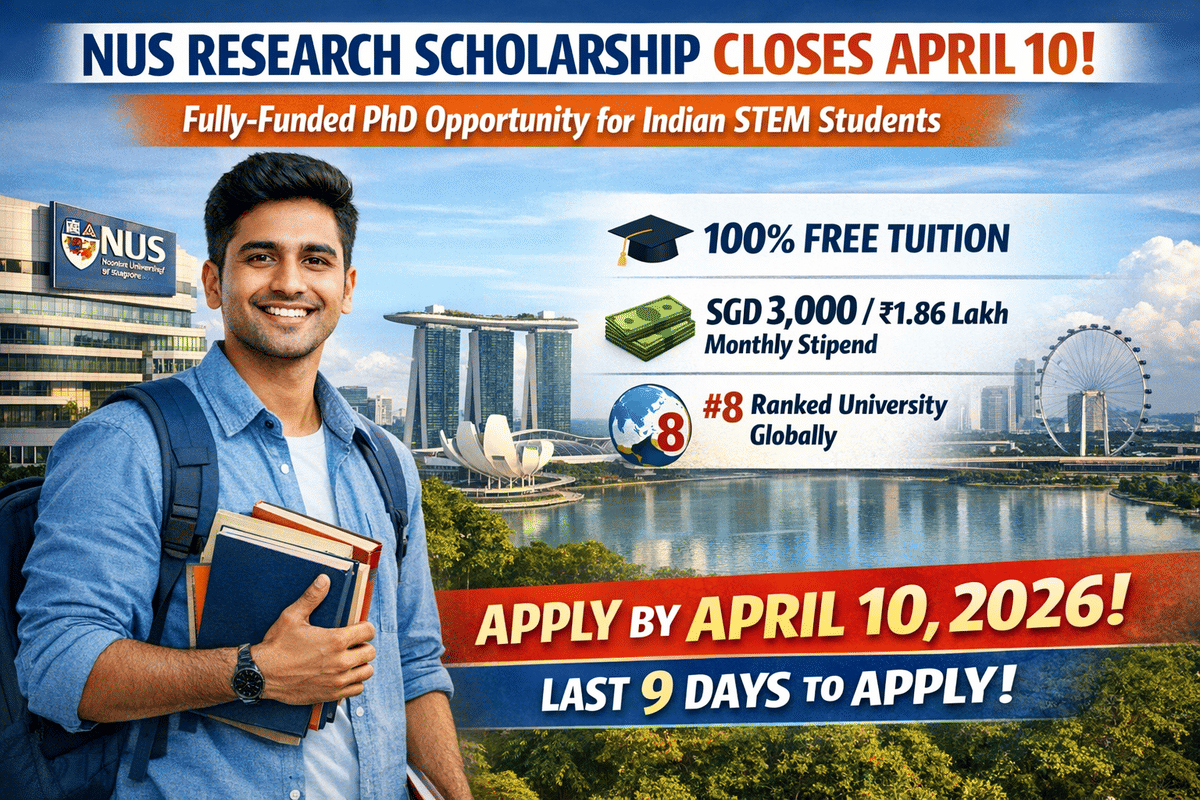
Indian students in STEM fields have 9 days to apply for one of the most valuable fully-funded research scholarships available globally. The NUS Research Scholarship closes on April 10, 2026 for the August 2026 intake at the National University of Singapore — the world's #8 ranked university (QS World University Rankings 2026, published June 2025).
The scholarship covers 100% of tuition fees and pays a monthly stipend of SGD 3,000 (~₹1.86 lakh/month) for international PhD students. With US PhD funding shrinking by 15–20% due to federal research cuts and UK PhD costs rising, Singapore's fully-funded research pathway is drawing serious attention from Indian STEM graduates for the first time — and the April 10 window is the last entry point for a 2026 start.
Check courses and admission scenario at National University of Singapore
What the NUS Research Scholarship Covers
The NUS Research Scholarship is awarded by the NUS Graduate School and individual faculties to outstanding candidates pursuing full-time graduate research degrees — both PhD and Master's (Research). It is not a partial award. Every component of the cost of study is covered.
Full benefits for international students (2026):
| Benefit | PhD (International) | Master's Research (International) |
|---|---|---|
| Monthly stipend | SGD 3,000 (~₹1.86 lakh) | SGD 2,900 (~₹1.80 lakh) |
| Tuition fee subsidy | 100% — full waiver | 100% — full waiver |
| Post-PhD Qualifying Exam top-up | +SGD 500/month | N/A |
| Duration | Up to 4 years | Up to 2 years |
| Renewal basis | Semester-by-semester, performance-based | Semester-by-semester |
Note: SGD/INR: 1 SGD = ₹62 (April 1, 2026)
What this means in INR terms: An Indian PhD student on the NUS Research Scholarship receives approximately ₹1.86 lakh/month — or ₹22.3 lakh/year — in living stipend, with zero tuition cost. Singapore's average PhD student living cost is SGD 1,200–1,800/month (₹74,400–₹1.12 lakh). The stipend comfortably covers living expenses, leaving a monthly surplus of SGD 1,200–1,800 (~₹74,400–₹1.12 lakh).
The before/after: Before 2023, NUS PhD stipends for international students were SGD 2,000–2,200/month. The current SGD 3,000 rate represents a 36% increase — a deliberate move by NUS to compete with US and European PhD funding packages as those markets become more uncertain.
Check PhD Programs Abroad for Indian Students
Who Can Apply — Eligibility for Indian Students
Academic requirement: A bachelor's degree with at least Second Class Honours (Upper Division) or equivalent. For Indian universities, this typically means a CGPA of 7.5/10 or above (or 75%+ aggregate in a 4-year engineering/science degree). First-class or distinction graduates are strongly preferred.
Fields with April 10 deadline: The April 10 deadline specifically applies to Computing, Engineering, and Science — the three faculties with the highest Indian student representation and the strongest research output in AI, data science, semiconductor engineering, and biomedical sciences.
MOE subsidy eligibility: Applicants must be eligible for the Singapore Ministry of Education (MOE) tuition fee subsidy. For international students, this requires signing a 3-year service obligation to work in Singapore after graduation — meaning scholarship recipients must remain in Singapore for 3 years post-PhD, working for a Singapore-registered employer.
What is NOT required: No IELTS or TOEFL score is required if your undergraduate degree was taught in English — which applies to all IIT, NIT, BITS Pilani, and most other Indian university graduates.
No GRE required. NUS does not require GRE scores for PhD admissions.
Why Singapore — and Why Now for Indian STEM Students?
The NUS Research Scholarship has existed for decades, but 2026 is the year it is genuinely competing with US PhD programmes for Indian STEM talent — for three specific reasons:
1. US PhD funding is shrinking.
Trump's federal research cuts have caused a 15–20% decline in funded PhD and RA positions at US universities in 2025–26. MIT, Stanford, Johns Hopkins, and Duke have all paused or reduced PhD admissions in specific departments. NUS has not cut a single funded position.
2. Singapore's AI and semiconductor ecosystem is expanding.
The Singapore government committed SGD 1 billion to AI research infrastructure in 2024. A*STAR (Agency for Science, Technology and Research) — NUS's primary research partner — is actively hiring PhD graduates into permanent research roles. The 3-year service obligation is not a burden; it is a guaranteed employment pathway into one of Asia's fastest-growing tech ecosystems.
3. The visa is straightforward.
Singapore's Student Pass processes in approximately 4 weeks with a near-100% approval rate for NUS-admitted students. There is no lottery, no administrative processing hold, no social media vetting. Indian students who have spent months navigating US F-1 visa uncertainty find Singapore's process refreshingly predictable.
The 3-Year Service Obligation: What Indian Students Must Understand
The MOE subsidy — which enables the full tuition waiver — comes with a condition: recipients must work in Singapore for 3 years after completing their degree, for a Singapore-registered employer.
What this means practically:
- You cannot return to India immediately after your PhD and work for an Indian company
- You must secure employment with a Singapore-registered employer — which includes Singapore offices of Indian companies like Infosys, TCS, Wipro, and HCL, all of which have Singapore operations
- If you leave Singapore before completing the 3-year obligation, you must repay a portion of the tuition subsidy
For most Indian STEM PhD graduates, this is not a barrier. Singapore's tech and research job market for PhD graduates is strong — median starting salaries for PhD-level AI/ML researchers at Singapore companies and research institutes are SGD 6,000–9,000/month (₹3.72–5.58 lakh/month). The 3-year obligation is effectively a guaranteed employment contract in one of Asia's highest-paying tech markets.
How to Apply Before April 10
Step 1: Apply for admission first. The NUS Research Scholarship is awarded alongside admission — you apply for both simultaneously through the NUS Graduate Admissions portal. Go to: nusgs.nus.edu.sg → Graduate Admissions → Research Programmes.
Step 2: Identify a supervisor. NUS PhD admissions are supervisor-led. Before applying, identify 2–3 faculty members whose research aligns with your interests and email them directly. A positive response from a potential supervisor significantly strengthens your application.
Step 3: Prepare your documents. Required: official transcripts, 3 letters of recommendation, research statement (500–1,000 words), CV, and proof of English proficiency if applicable. No GRE required.
Step 4: Submit by April 10, 2026. The portal closes at midnight Singapore time (SGT) on April 10. That is 9 days from today. Do not wait — the system can be slow during peak submission periods.
Step 5: If you miss April 10. The next NUS Research Scholarship deadline is October 1, 2026 for the January 2027 intake. Missing April 10 does not close the door permanently — but it delays your start by 5 months.
The Bigger Picture: Singapore as a PhD Destination for Indian Students
NUS is ranked #8 globally in QS 2026 — ahead of UCL (#9), Caltech (#10), University of Hong Kong (#11), and NTU (#12). For Indian students, this means an NUS PhD carries the same global academic weight as a degree from the world's top 10 universities — at zero tuition cost and with a living stipend that covers expenses.
The comparison with US PhD programmes is stark. A funded PhD at a top-20 US university typically pays 25,000–35,000/year in stipend (₹20.9–29.2 lakh) — comparable to NUS's SGD 36,000/year (₹22.3 lakh). But the US PhD now comes with F-1 visa uncertainty, administrative processing holds of 4–6 months for STEM applicants, and a proposed Duration of Status rule that would add new bureaucratic complexity mid-degree. Singapore offers equivalent academic prestige, equivalent funding, and a fraction of the visa friction.
For Indian STEM students who have been conditioned to think of the US as the only viable PhD destination, the NUS Research Scholarship closing on April 10 is worth a serious second look — and there are 9 days left to take it.








Comments