





Brown University’s acceptance rate stands at 5.65% for the class of 2029 (students entering in Fall 2025). As per the official statistics published by Brown University, a total of 42,765 students applied for admission in Fall 2025. Of which, 2,418 applicants were accepted. Key statistics include:
- Applications (Class of 2029): 42,765
- Students admitted: 2,418
- Overall acceptance rate: 5.65%
- Early Decision admits: 907
- Total first-year intake: 1,768 students
Brown is among the most selective universities in the world. Some of its joint and professional programs are even more competitive:
- Brown-RISD Dual Degree:
- 748 applicants, 15 enrolled
- PLME (8-year medical program):
- 4,128 applicants, 53 enrolled
The academic profile of the admitted first-year students at Brown University is as follows:
| Category | Data / Range | What does it mean for Indian Students? |
|---|---|---|
| Class Rank | 95% in the top 10% of the graduating class | Strong board results (CBSE/ISC/State Boards) are critical |
| SAT (Middle 50%) | 1480–1560 | Competitive SAT scores significantly strengthen the application |
| SAT- EB Reading & Writing | 63% scored 750–800 | High verbal proficiency is expected |
| SAT- Math | 71.67% scored 750–800 | Strong quantitative skills are essential, especially for STEM |
| ACT (Middle 50%) | 34–35 | Equivalent to top SAT performance |
| ACT High Scores | 58% scored 35–36 | The majority of admits are top scorers |
Brown-RISD Dual Degree: The Brown-RISD (Rhode Island School of Design) Dual Degree Program (BRDD) is a highly selective 5-year undergraduate program where students earn a Bachelor of Fine Arts (BFA) from RISD and a Bachelor of Arts (AB) or Science (ScB) from Brown University.
Brown University PLME Program: The Brown University Program in Liberal Medical Education (PLME) is a highly selective eight-year, combined baccalaureate-MD program: the only Ivy League program of its kind. It allows students to pursue a broad undergraduate liberal arts education while securing guaranteed admission to The Warren Alpert Medical School of Brown University
- Brown University Early Decision Acceptance Rate for Class of 2030
- Brown University Acceptance Rate Trends
2.1 Brown University Overall Acceptance Rate Trend
2.2 Brown University Early Decision Acceptance Rate Trend
2.3 Brown University Regular Decision Acceptance Rate Trend
2.4 Brown University International Acceptance Rate Trend
Brown University Early Decision Acceptance Rate for Class of 2030
Brown University offers 2 application cycles for undergraduate admissions.
- Early decision (November 1, each year): For students who seek admission offers by December for the following fall intake.
- Regular decision (January 5, each year): For students who can wait till early April for admission decisions for the same year’s fall intake.
As per the reports published by The Brown Daily Herald (student-run newspaper of the university), Brown’s early decision acceptance stands at 16.5% for the class of 2030 (students entering in fall 2026). Brown’s Class of 2030 is slightly more selective than last year’s Class of 2029, which had a 17.9% ED acceptance rate. However, it remains less selective than the Class of 2027, which recorded Brown’s lowest ED acceptance rate at 13%.
| Metric | Data |
|---|---|
| Total ED Applicants (Class of 2030) | 5,406 |
| ED Admits (Class of 2030) | 890 |
| ED Acceptance Rate (Class of 2030) | 16.5% |
| ED Admits (Class of 2029) | 906 |
| ED Acceptance Rate (Class of 2029) | 17.9% |
| Lowest ED Acceptance Rate (Recent) | 13% (Class of 2027) |
Note: Regular decision (RD) application statistics for Fall 2026 will be published later in March-April 2026.
Read the differences between Early decision, Regular decision, and Early action application rounds in USA.
Brown University Acceptance Rate Trends
Based on the application types, here are the trends of Brown University’s acceptance rate over the last 3 years.
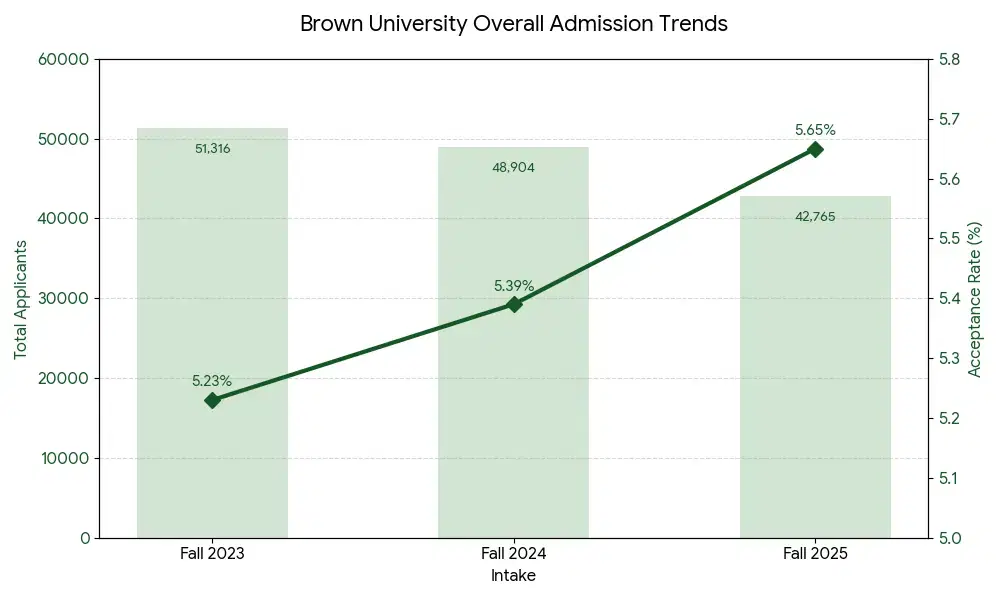
Brown University Overall Acceptance Rate Trend
As per the details published by Brown University, a 3-year overall acceptance rate trend is as follows.
| Intake | Total Applicants | Accepted Applicants | Acceptance Rate |
|---|---|---|---|
| Fall 2025 | 42,765 | 2,418 | 5.65% |
| Fall 2024 | 48,904 | 2,638 | 5.39% |
| Fall 2023 | 51,316 | 2,686 | 5.23% |
Trend:
- Applications peaked in Fall 2023 and declined steadily through Fall 2025, signaling post-pandemic normalization.
- The number of admitted students has fallen each year, keeping class sizes tightly controlled.
- Acceptance rates remain below 6% across all cycles, confirming extreme selectivity.
- The slight rise to 5.65% in Fall 2025 reflects fewer applicants, not easier admissions.
- Overall, competition remains Ivy League-level intense despite lower application volumes.
Brown University Early Decision Acceptance Rate Trend
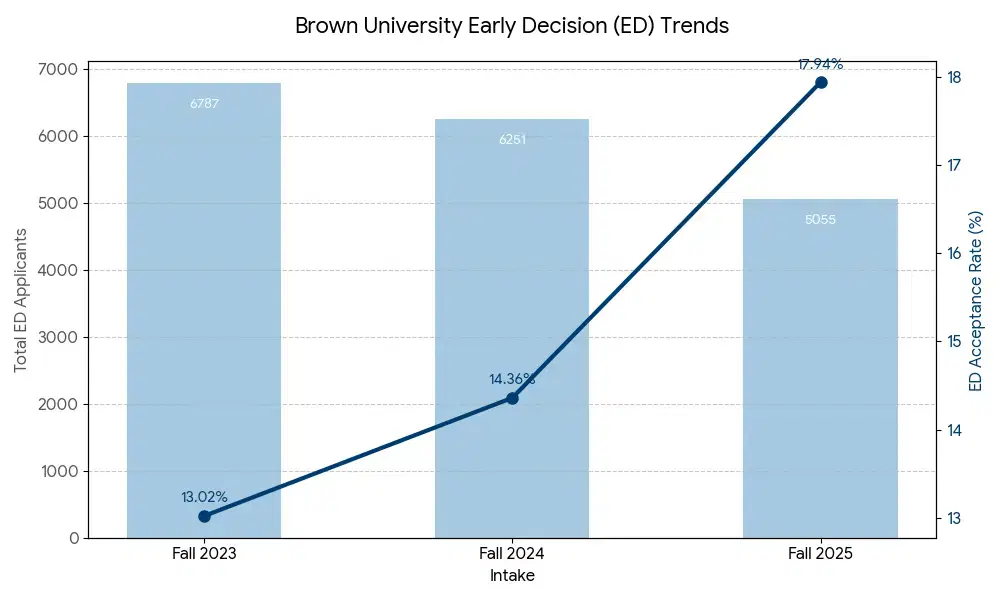
- Early Decision (ED) applications declined steadily from Fall 2023 to Fall 2025.
- The number of ED admits remained relatively stable each year, showing controlled intake.
- ED acceptance rates rose sharply to 17.94% in Fall 2025 from 13.02% in Fall 2023.
- The higher ED admit rate reflects lower applicant volume, not reduced selectivity.
| Intake | Total ED Applicants | Accepted ED Applicants | ED Acceptance Rate |
|---|---|---|---|
| Fall 2025 | 5,055 | 907 | 17.94% |
| Fall 2024 | 6,251 | 898 | 14.36% |
| Fall 2023 | 6,787 | 884 | 13.02% |
Brown University Regular Decision Acceptance Rate Trend
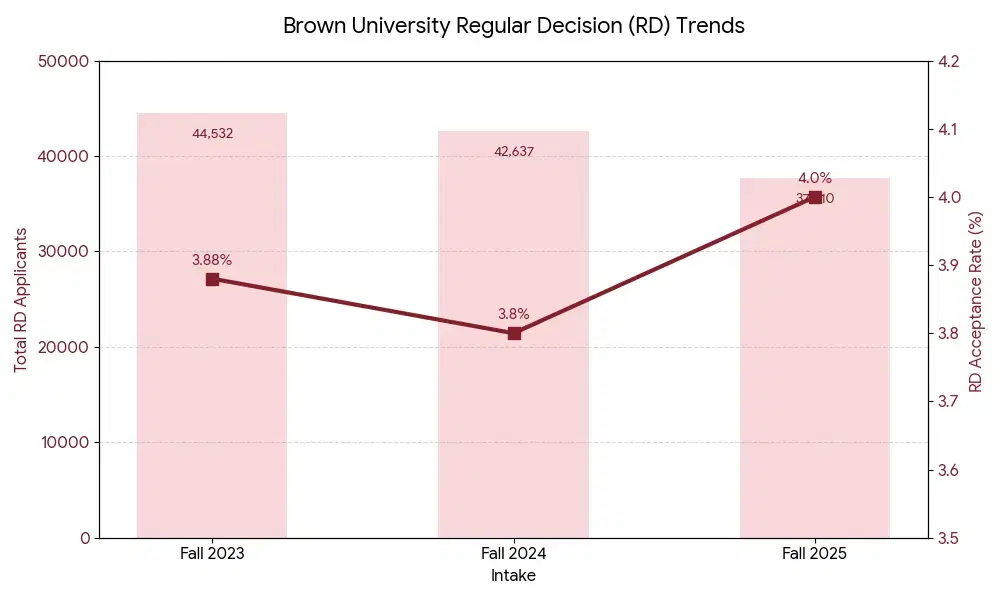
Brown University’s regular decision (RD) acceptance rate also shows a similar trend to early decision (ED) rates.
- Declining application and admitted students numbers.
- Stable admits to maintain small classes.
| Intake | Total RD Applicants | Accepted RD Applicants | RD Acceptance Rate |
|---|---|---|---|
| Fall 2025 | 37,710 | 1,508 | 4% |
| Fall 2024 | 42,637 | 1,623 | 3.8% |
| Fall 2023 | 44,532 | 1,727 | 3.88% |
Brown University International Acceptance Rate Trend
Brown University publishes separate statistics on international application trends. Based on the official publications, Brown’s international acceptance rate trend is tabulated below.
| Intake | International Applicants | Accepted International Applicants | International Acceptance Rate |
|---|---|---|---|
| Fall 2024 | 10,919 | 475 | 4.3% |
| Fall 2023 | 10,646 | 401 | 3.76% |
Trend:
- International applications rose slightly from Fall 2023 to Fall 2024, indicating sustained global interest in Brown.
- The number of international admits increased year-on-year, despite intense competition.
- International acceptance rate improved to 4.3% in Fall 2024 from 3.76% in Fall 2023.
- Even with the uptick, international admissions remain more selective than overall intake.
Brown University’s latest admissions data confirms a consistent pattern: selectivity at Brown is deliberate and structurally maintained, not driven by short-term fluctuations in applicant numbers.
- Academic excellence is non-negotiable: With 95% of admitted students in the top 10% of their class and SAT mid-50% ranges between 1480-1560, strong board results, and high standardized test scores are baseline expectations.
- Ultra-selective programs amplify competition: The Brown-RISD Dual Degree and PLME program demonstrate single-digit effective enrollment rates, underscoring how niche, interdisciplinary, or accelerated pathways operate at an even higher level of selectivity.
International acceptance rates, while slightly improving, remain more competitive than the overall rate. It signals that global demand for Brown continues to rise despite limited seats.
FAQs
Ques: What GPA do you need to get into Brown University?
Ans: There is no official minimum GPA at Brown University. However, most admitted students have around a 3.9+ unweighted GPA and rank in the top 10% of their class. Strong academic performance in a rigorous curriculum is essential.
Ques: What is the easiest Ivy League school to get into?
Ans: All Ivy League universities are highly competitive. In recent years, universities like Cornell University have had slightly higher acceptance rates compared to others. However, no Ivy League school is truly “easy” to get into.
Ques: Is it harder to get into Brown or Harvard?
Ans: Both Brown University and Harvard University are extremely selective. Harvard typically has a slightly lower acceptance rate, making it marginally more competitive overall. However, admission difficulty depends on the applicant’s profile and fit
Ques: Is Brown University an Ivy League?
Ans: Yes. Brown University is one of the eight Ivy League institutions in the United States, known for its strong academics and unique Open Curriculum.








interested in this College ?
Follow & Share this college to get information about admission.



Comments