




WBBSE Madhyamik 2026 Question Papers is available for download here. The West Bengal Board of Secondary Education (WBBSE) is conducting the Madhyamik exams from 2 Feb,2026 – 12 Feb,2026. Students can check subject-wise paper analysis along with question papers here. Download the WBBSE Class 10 Question Paper with Solution PDF from the links provided below.
WBBSE Madhyamik 2026 Geography Question Paper with Solutions (7 Feb,2026)
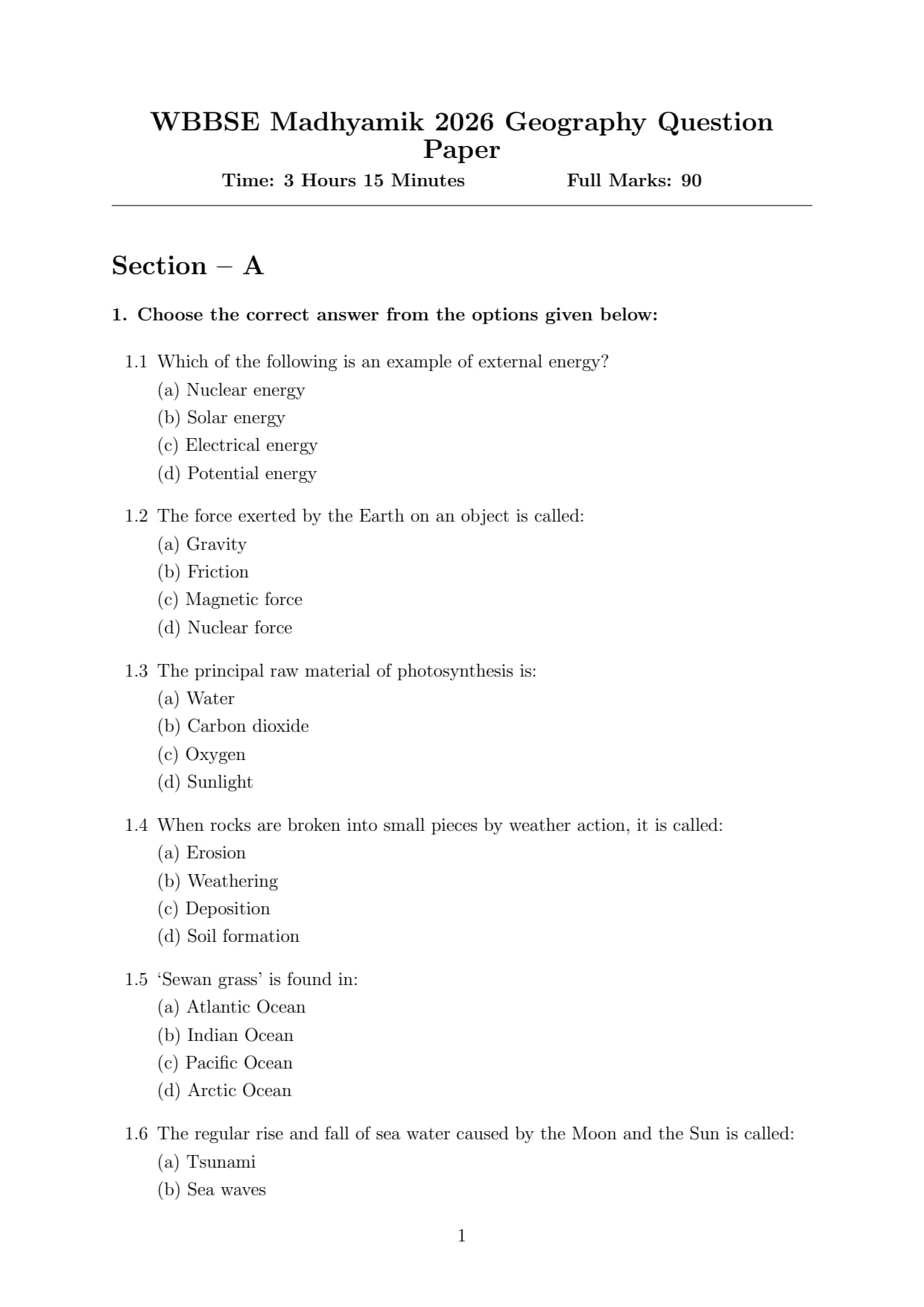
Which of the following is an example of external energy?
View Solution
Step 1: Understanding the Concept:
Energy sources are classified as internal or external based on their origin. Internal energy is inherent to the matter of the Earth (like heat from the core or atomic bonds), while external energy comes from sources outside the Earth's atmosphere.
Step 2: Detailed Explanation:
Nuclear, electrical, and potential energies are all forms of energy stored or generated within terrestrial systems or the structure of matter on Earth. Solar energy, however, consists of radiation produced by the Sun. Since the Sun is an extraterrestrial body, the energy it provides to Earth is the primary example of external energy.
Step 3: Final Answer:
The correct answer is (b) Solar energy. Quick Tip: Solar energy is the ultimate external power source that drives the Earth's weather patterns, ocean currents, and the water cycle.
The force exerted by the Earth on an object is called:
View Solution
Step 1: Understanding the Concept:
Gravity is a fundamental attractive force that exists between any two masses. The magnitude of this force depends on the mass of the objects and the distance between them.
Step 2: Detailed Explanation:
The Earth has a massive amount of matter, which creates a strong gravitational field. This field exerts a downward pull on all objects near its surface, directed toward the planet's center. Friction is a contact force between surfaces, and magnetic or nuclear forces involve specific particle interactions, whereas gravity acts on everything with mass.
Step 3: Final Answer:
The correct answer is (a) Gravity. Quick Tip: Gravity is what gives objects weight. On Earth, the acceleration due to this force is approximately \(9.8 \ m/s^2\).
The principal raw material of photosynthesis is:
View Solution
Step 1: Understanding the Concept:
Photosynthesis is a biochemical process where green plants synthesize food. "Raw materials" refers to the inorganic reactant molecules that are chemically transformed during the process.
Step 2: Detailed Explanation:
The chemical reaction for photosynthesis is: \[ 6CO_2 + 6H_2O + Light Energy \rightarrow C_6H_{12}O_6 + 6O_2 \]
In this equation, Carbon dioxide (\(CO_2\)) and Water are the reactants. While sunlight provides the necessary energy, Carbon dioxide is the principal raw material absorbed from the atmosphere to build the carbon framework of glucose molecules.
Step 3: Final Answer:
The correct answer is (b) Carbon dioxide. Quick Tip: Plants are often called "carbon sinks" because they remove the raw material \(CO_2\) from the air to perform photosynthesis.
When rocks are broken into small pieces by weather action, it is called:
View Solution
Step 1: Understanding the Concept:
The Earth's surface is constantly being reshaped by geological processes. The mechanical or chemical breakdown of solid rock at its original location is a specific stage of the rock cycle.
Step 2: Detailed Explanation:
Weathering is the process where rocks are worn away or broken into smaller fragments by natural elements such as rain, extreme temperature changes, and biological activity. Unlike erosion, which involves the \textit{movement of these pieces, weathering refers specifically to the breakdown that occurs \textit{in situ (without displacement).
Step 3: Final Answer:
The correct answer is (b) Weathering. Quick Tip: Think of the sequence: Weathering (breaks the rock), Erosion (transports the pieces), and Deposition (drops the pieces in a new location).
‘Sewan grass’ is found in:
View Solution
Step 1: Understanding the Concept:
Sewan grass (\textit{Lasiurus scindicus) is a highly nutritious perennial grass. Geographical questions often link terrestrial flora to the major oceanic basins or regions they are closest to.
Step 2: Detailed Explanation:
Sewan grass is primarily found in the arid and semi-arid regions of the Thar Desert in Rajasthan, India. Since this geographical area is a central part of the Indian subcontinent, it is regionally associated with the Indian Ocean basin.
Step 3: Final Answer:
The correct answer is (b) Indian Ocean. Quick Tip: Sewan grass is known as the "King of the Desert" because it is a vital fodder crop that survives in extreme heat with very little water.
The regular rise and fall of sea water caused by the Moon and the Sun is called:
View Solution
Step 1: Understanding the Concept:
Tides are the periodic rise and fall of sea levels. This phenomenon is primarily driven by the gravitational forces exerted by the Moon and the Sun, combined with the rotation of the Earth.
[Image of gravitational pull of the moon and sun causing tides on earth]
Step 2: Detailed Explanation:
While the Sun is much larger, the Moon is much closer to Earth, making its gravitational pull the dominant force in creating tides. As the Earth rotates, different parts of the ocean are pulled toward the Moon, creating a "bulge" or high tide. Tsunamis are caused by underwater earthquakes, sea waves by wind, and ocean currents by temperature/salinity differences and wind.
Step 3: Final Answer:
The correct answer is (d) Tides. Quick Tip: Most coastal areas experience two high tides and two low tides every lunar day (approximately 24 hours and 50 minutes).
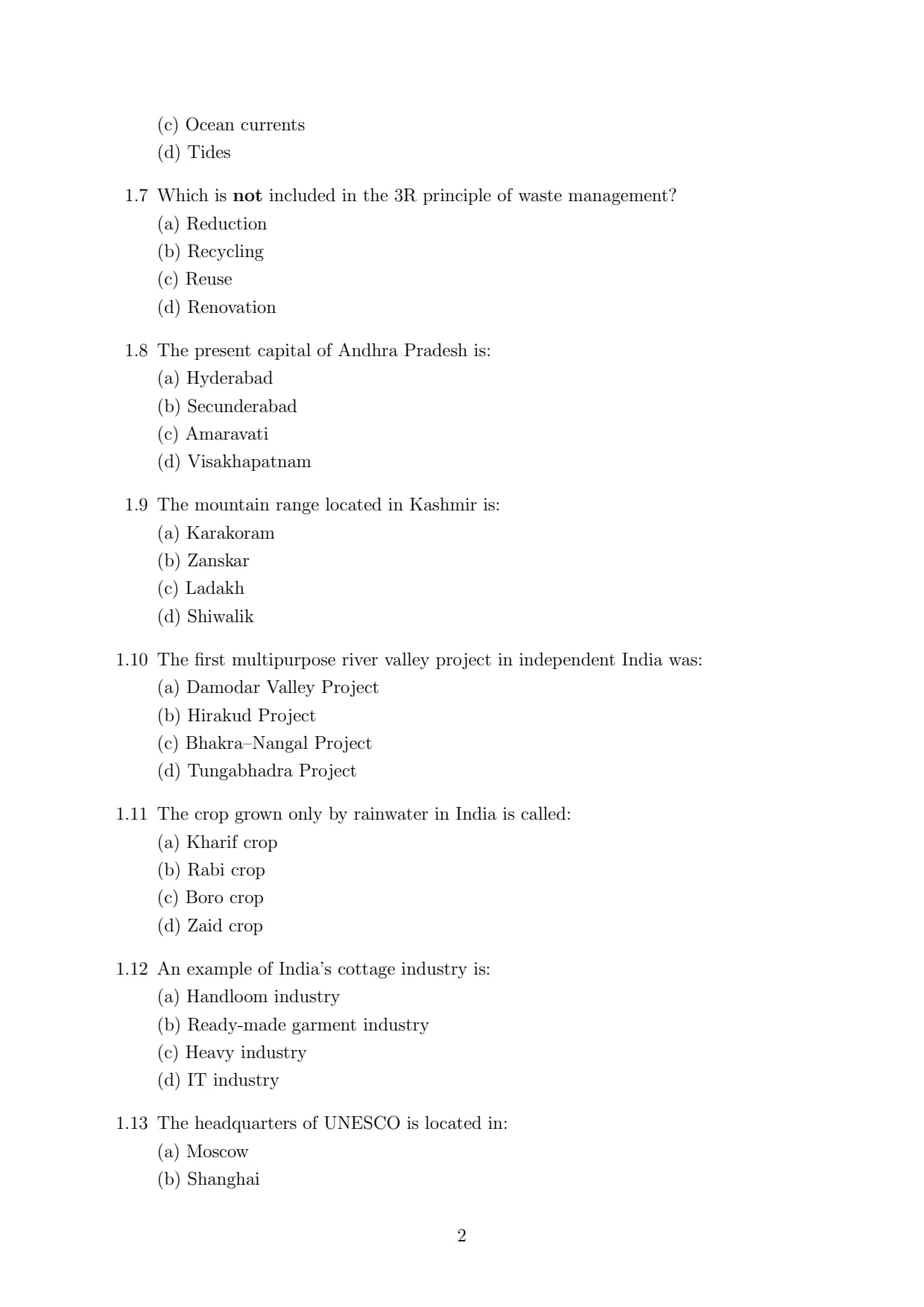
Which is not included in the 3R principle of waste management?
View Solution
Step 1: Understanding the Concept:
The 3R principle is a globally recognized hierarchy used to promote environmental sustainability by minimizing waste production and maximizing resource efficiency.
Step 2: Detailed Explanation:
The three components are:
Reduce: Cutting back on the amount of waste produced.
Reuse: Using items again instead of throwing them away.
Recycle: Processing used materials into new products.
"Renovation" refers to repairing or improving a building or structure and is not part of the standard waste management 3R framework.
Step 3: Final Answer:
The correct answer is (d) Renovation. Quick Tip: In recent years, the 3Rs have been expanded by some to include others like "Refuse" and "Rot" (composting), but the core remains Reduce, Reuse, and Recycle.
The present capital of Andhra Pradesh is:
View Solution
Step 1: Understanding the Concept:
Following the bifurcation of Andhra Pradesh in 2014, a new capital city was required as the previous capital, Hyderabad, became the capital of the newly formed state of Telangana.
Step 2: Detailed Explanation:
Amaravati was designated as the greenfield capital city of Andhra Pradesh. Although there have been legislative discussions and proposals regarding a "three-capital" model (including Visakhapatnam and Kurnool), as of current administrative standing and judicial rulings, Amaravati remains the official capital.
Step 3: Final Answer:
The correct answer is (c) Amaravati. Quick Tip: Amaravati is located on the southern bank of the Krishna River in the Guntur district.
The mountain range located in Kashmir is:
View Solution
Step 1: Understanding the Concept:
The northern part of India features several parallel mountain ranges that form part of the Trans-Himalayas and the Greater Himalayas.
Step 2: Detailed Explanation:
While all these ranges are in the broader northern region:
Karakoram and Ladakh ranges are primarily located in the Union Territory of Ladakh.
Shiwalik is the outermost range of the Himalayas stretching across northern India.
The Zanskar range lies specifically within the geographical and administrative boundaries associated with the Kashmir region (Trans-Himalayan part).
Step 3: Final Answer:
The correct answer is (b) Zanskar. Quick Tip: The Zanskar Range separates the Zanskar Valley from the Indus Valley and contains peaks over 6,000 meters.
The first multipurpose river valley project in independent India was:
View Solution
Step 1: Understanding the Concept:
Multipurpose river valley projects are designed for several objectives simultaneously, such as irrigation, flood control, and hydroelectric power generation.
Step 2: Detailed Explanation:
The Damodar Valley Corporation (DVC) was established on July 7, 1948, making the Damodar Valley Project the first of its kind in independent India. It was modeled after the Tennessee Valley Authority (TVA) of the USA to tame the Damodar River, once known as the "Sorrow of Bengal."
Step 3: Final Answer:
The correct answer is (a) Damodar Valley Project. Quick Tip: Jawaharlal Nehru referred to these multipurpose projects as the "Temples of Modern India."
The crop grown only by rainwater in India is called:
View Solution
Step 1: Understanding the Concept:
Indian agriculture is deeply influenced by the seasonal cycle of the monsoon. Crops are classified into different categories based on the season in which they are sown and harvested.
Step 2: Detailed Explanation:
The Kharif crops are known as monsoon crops because they are sown at the beginning of the first rains in June–July and harvested in September–October. These crops, such as rice, maize, and cotton, rely heavily on the southwest monsoon rains for growth. In contrast, Rabi crops (like wheat) are grown in winter, and Zaid crops are grown in the short summer season between the two.
Step 3: Final Answer:
The correct answer is (a) Kharif crop. Quick Tip: To remember: \textbf{K}harif starts with the \textbf{K}oming of the monsoon.
An example of India’s cottage industry is:
View Solution
Step 1: Understanding the Concept:
A cottage industry is a small-scale, decentralized manufacturing business that is often operated out of a home rather than a purpose-built factory. These industries typically rely on manual labor and traditional tools.
Step 2: Detailed Explanation:
The handloom industry is a classic example of a cottage industry in India. It involves weaving cloth by hand using traditional looms, often involving the work of an entire family within their own residence. The ready-made garment industry is usually organized in small to medium factories, while heavy industry and IT are large-scale, modern sectors.
Step 3: Final Answer:
The correct answer is (a) Handloom industry. Quick Tip: Cottage industries are vital to the rural economy in India, providing employment and preserving traditional craftsmanship.
The headquarters of UNESCO is located in:
View Solution
Step 1: Understanding the Concept:
UNESCO (United Nations Educational, Scientific and Cultural Organization) is a specialized agency of the United Nations aimed at promoting world peace and security through international cooperation in education, the sciences, and culture.
Step 2: Detailed Explanation:
Since its establishment in 1945, the headquarters of UNESCO has been located in Paris, France. The main building, known as the "three-pointed star," was inaugurated in 1958 at Place de Fontenoy.
Step 3: Final Answer:
The correct answer is (d) Paris. Quick Tip: While UNESCO is in Paris, remember that the main UN headquarters is in New York and the World Health Organization (WHO) is in Geneva.
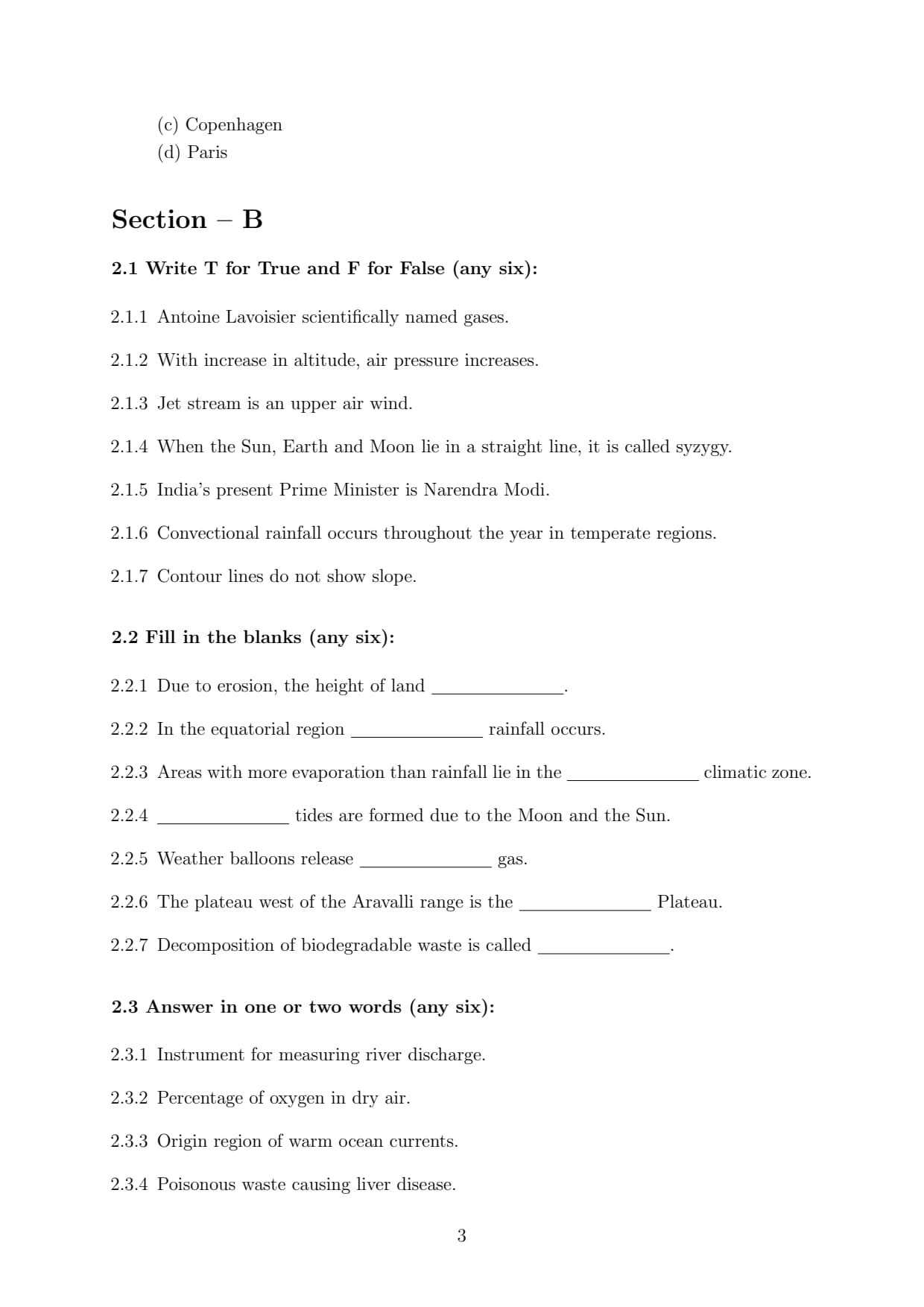
Antoine Lavoisier scientifically named gases.
View Solution
Step 1: Understanding the Concept:
Antoine Lavoisier was a fundamental figure in the 18th-century chemical revolution, known for moving chemistry from a qualitative to a quantitative science.
Step 2: Detailed Explanation:
Lavoisier is famous for providing scientific names to various substances. He named Oxygen in 1777 and Hydrogen in 1783. He was instrumental in establishing the modern system of chemical nomenclature, ensuring that names reflected the chemical structure or properties of the substance.
Step 3: Final Answer:
The statement is True. Quick Tip: Lavoisier is often called the "Father of Modern Chemistry." If you see a question about the naming of Oxygen or Hydrogen, he is usually the person responsible!
With increase in altitude, air pressure increases.
View Solution
Step 1: Understanding the Concept:
Air pressure is determined by the weight of the air molecules above a specific point. The Earth's atmosphere is densest at the surface due to gravity.
[Image of atmospheric pressure decreasing with increasing altitude]
Step 2: Detailed Explanation:
As altitude increases, the number of air molecules above you decreases, and the air becomes less dense. Because there is less "weight" of air pressing down from above, the air pressure decreases as you go higher. This is why airplanes must be pressurized.
Step 3: Final Answer:
The statement is False. Quick Tip: Remember: High altitude = Thin air = Low pressure. This is also why water boils at a lower temperature in the mountains!
Jet stream is an upper air wind.
View Solution
Step 1: Understanding the Concept:
Winds are categorized by their location in the atmosphere. Surface winds occur near the ground, while upper-air winds circulate high above the Earth.
Step 2: Detailed Explanation:
Jet streams are fast-flowing, narrow, meandering air currents located in the upper atmosphere, specifically near the tropopause. They are caused by the rotation of the Earth and atmospheric heating. These "rivers of air" are vital for weather forecasting and aviation.
Step 3: Final Answer:
The statement is True. Quick Tip: Pilots often use jet streams to save fuel and time when flying from West to East!
When the Sun, Earth and Moon lie in a straight line, it is called syzygy.
View Solution
Step 1: Understanding the Concept:
Orbital mechanics often lead to the alignment of three or more celestial bodies. This alignment is responsible for events like eclipses.
Step 2: Detailed Explanation:
The term syzygy comes from the Greek word for "yoked together." It refers specifically to the straight-line configuration of the Sun, Earth, and Moon (or other planets). This occurs during every New Moon and Full Moon, leading to higher "spring tides."
Step 3: Final Answer:
The statement is True. Quick Tip: Think of "Syzygy" as the "straight-line" word. It’s also a great high-scoring word in Scrabble!
India’s present Prime Minister is Narendra Modi.
View Solution
Step 1: Understanding the Concept:
This is a factual question regarding the current political leadership of the Republic of India.
Step 2: Detailed Explanation:
Narendra Modi assumed office as the Prime Minister of India on May 26, 2014. As of early 2026, he remains the head of government following the 2024 general elections.
Step 3: Final Answer:
The statement is True. Quick Tip: The Prime Minister is the head of the Union Council of Ministers, appointed by the President of India.
Convectional rainfall occurs throughout the year in temperate regions.
View Solution
Step 1: Understanding the Concept:
Convectional rainfall is caused by the intense heating of the surface, which causes moist air to rise, cool, and condense.
Step 2: Detailed Explanation:
Convectional rainfall is most common in Equatorial regions, where it occurs daily due to high heat. In temperate regions, it primarily happens during the summer months when the ground is warm enough. It is not a year-round characteristic of temperate climates, which rely more on cyclonic/frontal rainfall.
Step 3: Final Answer:
The statement is False. Quick Tip: Equatorial regions are famous for "4 o'clock rain," which is the classic example of daily convectional rainfall.
Contour lines do not show slope.
View Solution
Step 1: Understanding the Concept:
Contour lines are used on topographic maps to connect points of equal elevation. They are the primary way to visualize a 3D landscape on a 2D map.
Step 2: Detailed Explanation:
Contour lines are specifically used to determine the steepness of a slope. When the lines are close together, the slope is steep. When the lines are far apart, the slope is gentle. Therefore, they are essential for showing slope.
Step 3: Final Answer:
The statement is False. Quick Tip: If contour lines form a circle with increasing values inside, you’re looking at a hill. If they are very tight, it’s a cliff!
Due to erosion, the height of land ______.
View Solution
Step 1: Understanding the Concept:
Erosion is an exogenic (external) process that involves the wearing away and removal of rock and soil from the Earth's surface by agents like water, wind, and ice.
Step 2: Detailed Explanation:
When agents of erosion transport material away from a specific area, the surface level of that land is lowered. This process, known as degradation, leads to a reduction in the overall elevation or height of the landform over time.
Step 3: Final Answer:
The height of land decreases. Quick Tip: While erosion (degradation) decreases the height of land, deposition (aggradation) increases it by adding layers of sediment.
In the equatorial region ______ rainfall occurs.
View Solution
Step 1: Understanding the Concept:
In equatorial regions, high temperatures throughout the year lead to intense heating of the Earth's surface and the air above it.
Step 2: Detailed Explanation:
The heated air becomes light, rises, cools at higher altitudes, and condenses to form cumulonimbus clouds. This leads to heavy showers, usually in the afternoon. Because this is driven by the rising of warm air currents, it is classified as convectional rainfall.
Step 3: Final Answer:
Convectional rainfall occurs. Quick Tip: Equatorial rainfall is often called "4 o'clock rain" because the convection cycle usually peaks in the late afternoon.
Areas with more evaporation than rainfall lie in the ______ climatic zone.
View Solution
Step 1: Understanding the Concept:
Climatic zones are defined by the moisture balance between precipitation (rainfall) and evapotranspiration.
Step 2: Detailed Explanation:
In arid or desert zones, the high temperatures and dry air cause water to evaporate very quickly. Since these areas receive very little rainfall, the rate of evaporation far exceeds the total precipitation, leading to a permanent water deficit and dry soil conditions.
Step 3: Final Answer:
Arid (or desert) climatic zone. Quick Tip: Arid regions typically receive less than 250mm of rain per year, making evaporation the dominant part of the water cycle there.
______ tides are formed due to the Moon and the Sun.
View Solution
Step 1: Understanding the Concept:
Tides are created by the gravitational pull of the Moon and the Sun on the Earth's oceans. The relative positions of these bodies determine the strength of the tide.
Step 2: Detailed Explanation:
When the Sun, Moon, and Earth are aligned in a straight line (Syzygy), their gravitational forces combine to create the highest high tides and lowest low tides. These are specifically called Spring Tides. If the question refers to the general phenomenon, "Ocean" tides is also a valid descriptive term.
Step 3: Final Answer:
Spring tides are formed. Quick Tip: Spring tides happen twice a month—during the Full Moon and the New Moon—when the celestial bodies line up.
Weather balloons release ______ gas.
View Solution
Step 1: Understanding the Concept:
Weather balloons must rise high into the atmosphere, so they must be filled with a gas that is significantly lighter than the surrounding air (a lifting gas).
Step 2: Detailed Explanation:
Helium is the most common gas used because it is non-flammable and safe, though Hydrogen is also used in some regions because it is cheaper and provides even more lift, despite being highly combustible.
Step 3: Final Answer:
Helium (or Hydrogen) gas. Quick Tip: Helium is preferred for safety because, unlike Hydrogen, it doesn't explode if there's a spark!
The plateau west of the Aravalli range is the ______ Plateau.
View Solution
Step 1: Understanding the Concept:
The Aravalli Range is a major mountain system in northwestern India. It acts as a geographical barrier between different physiographic divisions.
Step 2: Detailed Explanation:
The region to the west of the Aravalli range in Rajasthan consists of the Thar Desert and the Marwar upland/plateau. It is characterized by sandy plains and scattered rocky outcrops.
Step 3: Final Answer:
Marwar Plateau. Quick Tip: The Aravallis are one of the oldest fold mountain systems in the world, running from Gujarat to Delhi.
Decomposition of biodegradable waste is called ______.
View Solution
Step 1: Understanding the Concept:
Biodegradable waste consists of organic matter (like food scraps and leaves) that can be broken down by microorganisms such as bacteria and fungi.
Step 2: Detailed Explanation:
The natural process of recycling organic material into a rich soil amendment is known as Composting. This decomposition happens through the aerobic or anaerobic action of microbes, resulting in "humus" or compost.
Step 3: Final Answer:
Composting. Quick Tip: Composting is a key part of the "Recycle" step in waste management, turning trash into "black gold" for gardens!
Instrument for measuring river discharge.
View Solution
Step 1: Understanding the Concept:
River discharge is the volume of water flowing through a river channel per unit of time. To calculate this, hydrologists must measure the velocity of the water and the cross-sectional area of the river.
Step 2: Detailed Explanation:
A current meter is the primary instrument used to measure the velocity of the water flow. By taking multiple velocity readings across a river's width and depth and multiplying them by the area, the total discharge (often measured in cumecs or cusecs) is determined.
Step 3: Final Answer:
The instrument is a Current meter. Quick Tip: Discharge is typically calculated using the formula \(Q = A \times v\), where \(A\) is the area and \(v\) is the velocity measured by the meter.
Percentage of oxygen in dry air.
View Solution
Step 1: Understanding the Concept:
The Earth's atmosphere is a mixture of various gases. The composition of "dry air" excludes water vapor, which can vary significantly depending on location and weather.
Step 2: Detailed Explanation:
Dry air is primarily composed of Nitrogen (about 78.08%) and Oxygen (about 20.95%). Other gases like Argon and Carbon dioxide make up the remaining small percentage. For general scientific purposes, the oxygen level is rounded to 21%.
Step 3: Final Answer:
The percentage is 20.95% (or 21%). Quick Tip: Oxygen is the second most abundant gas in our atmosphere. Without it, aerobic respiration and combustion would be impossible!
Origin region of warm ocean currents.
View Solution
Step 1: Understanding the Concept:
Ocean currents are large-scale movements of water. Their temperature depends on where they originate. Water near the equator absorbs more solar energy than water at the poles.
Step 2: Detailed Explanation:
Warm ocean currents originate in the low latitudes (Equatorial or Tropical regions). Because the Sun's rays are most direct here, the surface water heats up and then flows toward the higher, cooler latitudes (the poles) to redistribute heat.
Step 3: Final Answer:
The origin region is the Equatorial/Tropical region. Quick Tip: Warm currents always flow from the Equator toward the Poles, while cold currents flow from the Poles toward the Equator.
Poisonous waste causing liver disease.
View Solution
Step 1: Understanding the Concept:
Certain chemical wastes are "hepatotoxic," meaning they specifically target and damage the liver when ingested or absorbed through contaminated water and food.
Step 2: Detailed Explanation:
Arsenic is a major poisonous waste often found in contaminated groundwater. Long-term exposure leads to arsenicosis, which significantly damages the liver. Other industrial wastes like PCBs or certain heavy metals (like Lead) are also notorious for causing chronic liver diseases and failure.
Step 3: Final Answer:
The waste is Arsenic. Quick Tip: Bioaccumulation is the process where these poisons build up in the body over time, making even small doses dangerous in the long run.
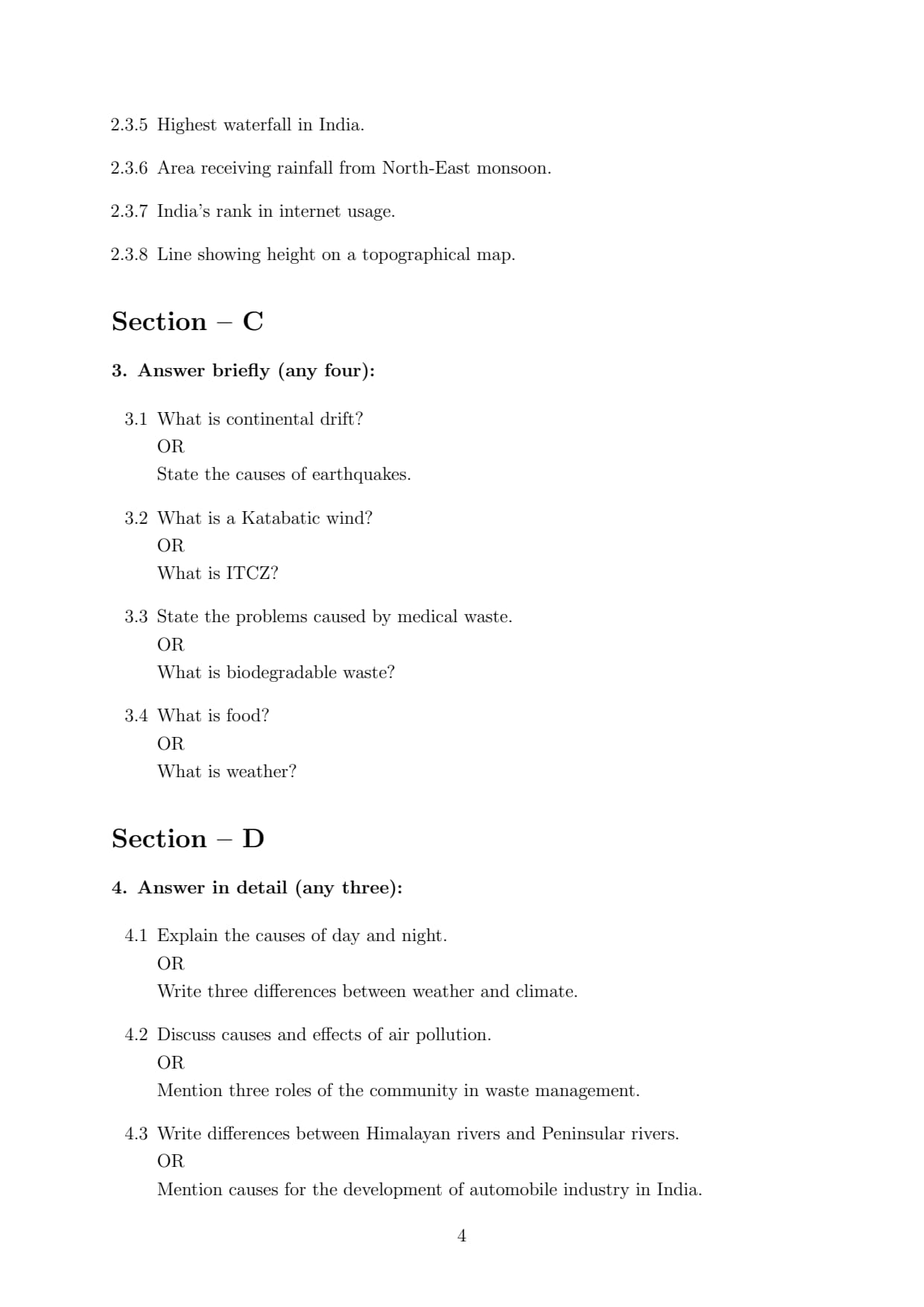
Highest waterfall in India.
View Solution
Step 1: Understanding the Concept:
The "highest" waterfall is measured by the total vertical drop from the top to the base. India has many seasonal and perennial waterfalls located mainly in the Western Ghats.
Step 2: Detailed Explanation:
Kunchikal Falls, located in the Shimoga district of Karnataka, is the highest waterfall in India with a height of approximately 455 meters (1,493 ft). It is formed by the Varahi River. Note: Jog Falls is often mistakenly cited, but it is actually the highest "un-tiered" waterfall.
Step 3: Final Answer:
The highest waterfall is Kunchikal Falls. Quick Tip: Most of India's major waterfalls are found in Karnataka and Meghalaya due to the hilly terrain and heavy rainfall.
Area receiving rainfall from North-East monsoon.
View Solution
Step 1: Understanding the Concept:
The North-East monsoon, also known as the "Retreating Monsoon," occurs during October and November. As it blows over the Bay of Bengal, it picks up moisture.
Step 2: Detailed Explanation:
While most of India is dry during this time, the Coromandel Coast of Tamil Nadu and parts of Andhra Pradesh receive significant rainfall. This is because the winds travel over the sea, get saturated, and hit the coast of South-East India.
Step 3: Final Answer:
The Coromandel Coast (Tamil Nadu). Quick Tip: Tamil Nadu gets the majority of its annual rainfall from the North-East monsoon, rather than the South-West monsoon that feeds the rest of India.
India’s rank in internet usage.
View Solution
Step 1: Understanding the Concept:
This rank refers to the total number of active internet users within a country.
Step 2: Detailed Explanation:
As of 2026, India ranks 2nd globally in the number of internet users, trailing only China. This is due to the rapid expansion of mobile data and affordable smartphones across both urban and rural India.
Step 3: Final Answer:
India ranks 2nd. Quick Tip: India has one of the cheapest mobile data rates in the world, which has been the main driver for its high rank in internet usage.
Line showing height on a topographical map.
View Solution
Step 1: Understanding the Concept:
Topographical maps represent the three-dimensional terrain of the Earth's surface on a two-dimensional paper. To show vertical height, specific lines are used to connect points of equal elevation.
Step 2: Detailed Explanation:
Contour lines are imaginary lines that join all places having the same height above mean sea level. The vertical distance between two successive contour lines is known as the "contour interval."
Step 3: Final Answer:
The line is a Contour line. Quick Tip: Close contour lines = Steep slope. Far apart contour lines = Gentle slope. If they cross (rare), it indicates an overhanging cliff!
What is continental drift?
(OR)
State the causes of earthquakes.
View Solution
Step 1: Understanding the Concept:
Continental drift is a geological theory that explains how continents shift positions on Earth's surface. Alternatively, earthquakes are sudden vibrations of the Earth's crust caused by the release of energy in the lithosphere.
Step 2: Detailed Explanation:
Continental Drift: Proposed by Alfred Wegener in 1912, this theory suggests that all continents were once joined in a single supercontinent called Pangea. Over millions of years, they drifted apart to their current positions.
Causes of Earthquakes:
1. Tectonic Movements: The primary cause is the movement of lithospheric plates (sliding, colliding, or pulling apart).
2. Volcanic Eruptions: Violent eruptions can cause local tremors.
3. Anthropogenic Causes: Activities like mining, dam construction (reservoir-induced seismicity), or nuclear explosions.
Step 3: Final Answer:
Continental drift is the large-scale movement of continents over geological time. Earthquakes are primarily caused by plate tectonics and volcanic activity. Quick Tip: The "matching coastlines" of South America and Africa were one of the first pieces of evidence Wegener used to prove Continental Drift!
What is a Katabatic wind?
(OR)
What is ITCZ?
View Solution
Step 1: Understanding the Concept:
Katabatic winds are local drainage winds caused by gravity. The ITCZ (Intertropical Convergence Zone) is a global belt of low pressure where trade winds meet.
Step 2: Detailed Explanation:
Katabatic Wind: At night, air at higher elevations (mountains) cools quickly and becomes dense. Gravity pulls this cold, heavy air down the slopes into the valleys. These are also called "mountain breezes."
ITCZ: The Intertropical Convergence Zone is a region near the equator where the Northern and Southern Hemisphere trade winds converge. It is characterized by high humidity, frequent afternoon thunderstorms, and low pressure.
Step 3: Final Answer:
Katabatic winds are gravity-driven cold winds flowing downslope. The ITCZ is a low-pressure belt near the equator where trade winds meet. Quick Tip: Think of Katabatic winds as "K" for "Kold" (cold) air falling down, while Anabatic winds are warm air rising up.
State the problems caused by medical waste.
(OR)
What is biodegradable waste?
View Solution
Step 1: Understanding the Concept:
Medical waste includes hazardous materials from hospitals, while biodegradable waste refers to organic matter that decomposes naturally.
Step 2: Detailed Explanation:
Medical Waste Problems:
1. Infection: Can spread diseases like HIV or Hepatitis if needles/syringes are reused or handled poorly.
2. Toxic Pollution: Burning medical plastics can release dioxins into the air.
3. Water Contamination: Chemicals and drugs can leach into groundwater.
Biodegradable Waste: This is waste that can be broken down into simpler substances (carbon dioxide, water, methane) by microorganisms like bacteria and fungi. Examples include food scraps, paper, and wood.
Step 3: Final Answer:
Medical waste poses risks of infection and chemical pollution. Biodegradable waste is organic matter that can be naturally decomposed. Quick Tip: Medical waste is usually color-coded in bins (Yellow, Red, Blue) to ensure hazardous items are treated differently from regular trash.
What is food?
(OR)
What is weather?
View Solution
Step 1: Understanding the Concept:
Food is the source of energy for living organisms. Weather describes the short-term atmospheric conditions of a specific place.
Step 2: Detailed Explanation:
Food: Any substance consumed to provide nutritional support for an organism. It contains essential nutrients like carbohydrates, fats, proteins, vitamins, or minerals which produce energy and stimulate growth.
Weather: The state of the atmosphere at a particular place and time. It includes elements such as temperature, humidity, precipitation, brightness, visibility, and wind. Weather is temporary and can change within minutes or hours.
Step 3: Final Answer:
Food provides energy and nutrients for life. Weather is the day-to-day condition of the atmosphere in a specific area. Quick Tip: Don't confuse Weather with Climate! Weather is what happens "today," while Climate is the average weather over "30 years."
Explain the causes of day and night.
(OR)
Write three differences between weather and climate.
View Solution
Step 1: Understanding the Concept:
Day and night are caused by the Earth's rotation on its axis. Weather and climate represent the atmospheric conditions over different time scales.
[Image of Earth's rotation causing day and night]
Step 2: Detailed Explanation:
Causes of Day and Night:
1. Rotation: The Earth rotates on its axis from West to East once every 24 hours.
2. Spherical Shape: Because the Earth is nearly a sphere, only one half faces the Sun at any given time.
3. Illumination: The half facing the Sun experiences "Day," while the half in the shadow experiences "Night."
Differences between Weather and Climate:
\begin{tabular{|l|l|l|
\hline
Feature & Weather & Climate
\hline
Duration & Short-term (day-to-day) & Long-term (30-35 years)
\hline
Area & Covers a small area & Covers a large region
\hline
Change & Changes very frequently & Remains stable for a long time
\hline
\end{tabular
Step 3: Final Answer:
Day and night result from Earth's rotation. Weather is a temporary state, whereas climate is the long-term average of weather patterns. Quick Tip: Remember: Weather tells you what clothes to wear today; Climate tells you what clothes to have in your closet!
Discuss causes and effects of air pollution.
(OR)
Mention three roles of the community in waste management.
View Solution
Step 1: Understanding the Concept:
Air pollution involves the introduction of harmful substances into the atmosphere. Waste management involves collective actions by society to handle refuse responsibly.
Step 2: Detailed Explanation:
Air Pollution:
- Causes: Industrial emissions (smoke, \(SO_2\)), vehicular exhaust (\(CO\), \(NO_x\)), burning of fossil fuels, and agricultural activities (pesticides, stubble burning).
- Effects: Respiratory diseases (asthma, bronchitis), Acid rain, Global warming (Greenhouse effect), and damage to the Ozone layer.
Community Roles in Waste Management:
1. Source Segregation: Separating wet (organic) waste from dry (recyclable) waste at home.
2. Awareness: Educating neighbors about the harmful effects of littering and open burning.
3. Composting: Creating community pits to convert kitchen waste into manure.
Step 3: Final Answer:
Air pollution is caused by human industrial activity and results in health and environmental crises. Community involvement focuses on the "3Rs" and segregation at the source. Quick Tip: Indoor air pollution can be just as dangerous as outdoor pollution—ensure good ventilation in kitchens and avoid burning incense or candles in closed spaces.
Write differences between Himalayan rivers and Peninsular rivers.
(OR)
Mention causes for the development of automobile industry in India.
View Solution
Step 1: Understanding the Concept:
Indian rivers are divided into two main groups based on their origin. The automobile industry is a key manufacturing sector driven by economic factors.
Step 2: Detailed Explanation:
Himalayan vs. Peninsular Rivers:
\begin{tabular{|l|l|l|
\hline
Feature & Himalayan Rivers & Peninsular Rivers
\hline
Nature & Perennial (flow all year) & Seasonal (depend on rain)
\hline
Source & Glaciers and Rain & Rainfall only
\hline
Course & Long course, perform erosion & Short course, reach maturity
\hline
\end{tabular
Causes for Automobile Industry Development:
1. High Demand: A large population and rising middle-class income.
2. Infrastructure: Improvement in national highways and road connectivity.
3. Government Policy: "Make in India" initiatives and FDI (Foreign Direct Investment) support.
Step 3: Final Answer:
Himalayan rivers are glacier-fed and perennial, while Peninsular rivers are rain-fed. The auto industry thrives due to domestic demand and supportive policies. Quick Tip: Himalayan rivers are "youthful" and form deep V-shaped valleys, whereas Peninsular rivers are "old" and flow through broad, shallow valleys.
Write three differences between a topographical map and a sketch.
(OR)
Mention advantages of rainwater harvesting.
View Solution
Step 1: Understanding the Concept:
Maps and sketches are visual representations of the Earth, but they differ in accuracy and scale. Rainwater harvesting is a sustainability practice.
Step 2: Detailed Explanation:
Topographical Map vs. Sketch:
1. Scale: A map is drawn to a specific scale; a sketch is a rough drawing without a scale.
2. Accuracy: Maps are highly accurate and based on surveys; sketches are based on memory or observation.
3. Details: Maps use conventional signs and contour lines; sketches show only prominent landmarks.
Advantages of Rainwater Harvesting:
1. Water Conservation: Reduces dependency on groundwater and municipal supply.
2. Flood Prevention: Reduces soil erosion and surface runoff during heavy rains.
3. Cost-Effective: Simple to set up and reduces water bills.
Step 3: Final Answer:
Topographical maps are precise scientific tools, while sketches are informal drawings. Rainwater harvesting provides a sustainable solution to water scarcity. Quick Tip: To turn a sketch into a map, you must add three things: a Scale, a North arrow, and a Legend (Key).
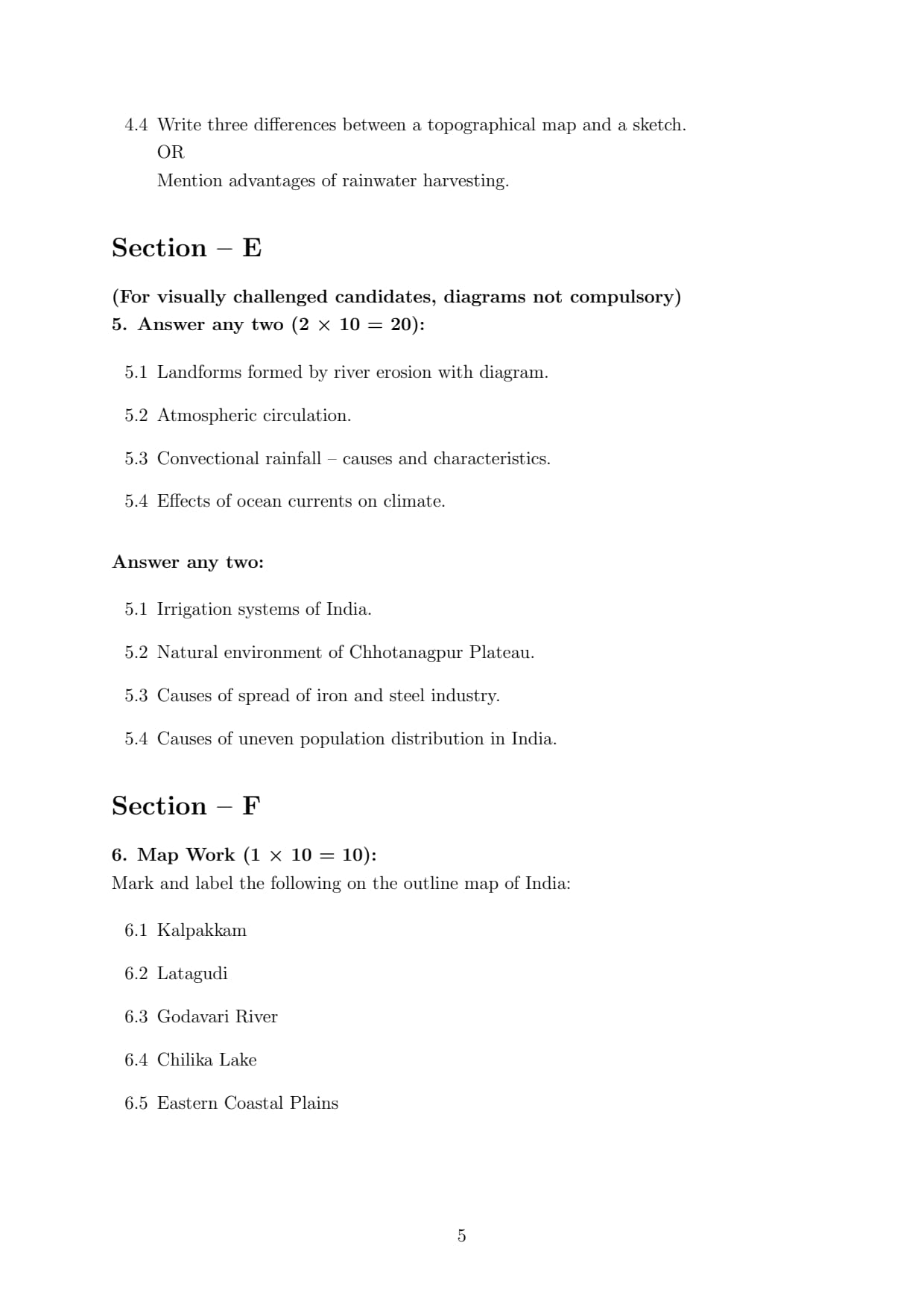
Landforms formed by river erosion with diagram.
View Solution

Step 1: Understanding the Concept:
River erosion occurs primarily in the upper course where the gradient is steep and the water has high kinetic energy. The river carves through the landscape through processes like hydraulic action, abrasion, and solution.
Step 2: Detailed Explanation:
Several distinct landforms are created by this process:
1. V-Shaped Valley: The river cuts vertically into the valley floor. Weathering of the valley sides leads to a "V" shape.
2. Gorge and Canyon: In hard rock or arid regions, vertical erosion is much faster than lateral erosion, resulting in very narrow, steep-sided valleys.
3. Waterfalls: Formed when a river flows over a layer of hard rock followed by soft rock; the soft rock erodes faster, creating a sudden drop.
4. Potholes: Circular depressions in the rocky bed of a river formed by the swirling action of pebbles (corrasion).
Step 3: Final Answer:
River erosion primarily shapes the upper course of a river, creating deep, vertical features like V-shaped valleys, gorges, and waterfalls through the mechanical wearing down of the riverbed. Quick Tip: Remember the "Grand Canyon" in the USA as the world's most famous example of a canyon formed by river erosion (the Colorado River).
Atmospheric circulation.
View Solution

Step 1: Understanding the Concept:
Atmospheric circulation is the large-scale movement of air by which heat is distributed on the surface of the Earth. It is driven by the unequal heating of the Earth's surface by the Sun.
Step 2: Detailed Explanation:
The circulation is divided into three main cells in each hemisphere:
1. Hadley Cell: Warm air rises at the equator (low pressure) and sinks at \(30^\circ\) N/S (high pressure), creating the Trade Winds.
2. Ferrel Cell: Air flows poleward and eastward near the surface and equatorward and westward at higher altitudes. This creates the Westerlies.
3. Polar Cell: Cold air sinks at the poles and flows toward lower latitudes, meeting the Ferrel cell at the Polar Front.
These cells are influenced by the Coriolis Effect, which deflects winds to the right in the Northern Hemisphere and to the left in the Southern Hemisphere.
Step 3: Final Answer:
Atmospheric circulation consists of the Hadley, Ferrel, and Polar cells, which redistribute heat from the equator to the poles through a system of planetary winds. Quick Tip: The "Doldrums" is the area at the equator where air rises vertically, leading to very calm surface winds—a nightmare for ancient sailors!
Convectional rainfall – causes and characteristics.
View Solution
Step 1: Understanding the Concept:
Convectional rainfall occurs when the energy of the sun heats the earth's surface and causes water to evaporate to form water vapor.
Step 2: Detailed Explanation:
Causes:
1. Intense heating of the ground during the day.
2. Warm air becomes light and rises in convection currents.
3. As the air rises, it expands and cools (adiabatic cooling).
4. Water vapor condenses to form large Cumulonimbus clouds.
Characteristics:
1. It is often accompanied by thunder and lightning.
2. It usually occurs in the late afternoon.
3. It is common in Equatorial regions throughout the year and in temperate regions during summer.
4. It results in heavy but short-duration showers.
Step 3: Final Answer:
Convectional rainfall is caused by surface heating and vertical air movement, characterized by sudden, heavy afternoon thunderstorms common in the tropics. Quick Tip: This type of rain is often called "4 o'clock rain" because the heating cycle typically reaches its peak and causes a downpour by late afternoon.
Effects of ocean currents on climate.
View Solution
Step 1: Understanding the Concept:
Ocean currents act like conveyor belts, transporting warm water and precipitation from the equator toward the poles and cold water from the poles back to the tropics.
Step 2: Detailed Explanation:
1. Temperature Regulation: Warm currents (like the Gulf Stream) raise the temperature of coastal areas in high latitudes, keeping ports ice-free. Cold currents (like the Labrador Current) lower the temperature of tropical coasts.
2. Rainfall: Winds blowing over warm currents pick up moisture and bring heavy rainfall to coastal areas. Winds over cold currents are dry, often leading to the formation of coastal deserts (e.g., the Atacama Desert near the cold Peru Current).
3. Fog Formation: Where warm and cold currents meet (e.g., near Newfoundland), thick fog is common, which can be a hazard for navigation but creates rich fishing grounds.
4. Moderating Effect: They reduce the extreme temperature differences between day and night in maritime regions.
Step 3: Final Answer:
Ocean currents significantly influence regional climates by regulating temperature, determining rainfall patterns, and contributing to the formation of deserts or rich fishing zones. Quick Tip: The "North Atlantic Drift" is the reason the UK and Western Europe have much milder winters than parts of Canada at the same latitude!
Irrigation systems of India.
View Solution
Step 1: Understanding the Concept:
Irrigation is the artificial application of water to crops to fulfill their water requirements, especially in regions with seasonal or uncertain rainfall. In India, the irrigation system is diverse due to varied topography and climate.
Step 2: Detailed Explanation:
The primary systems used in India include:
1. Canal Irrigation: Common in the Northern Plains (Punjab, Haryana, UP). Canals are either perennial (from rivers) or inundation (overflow during floods).
2. Well and Tube-well Irrigation: This is the most popular form in India. It involves tapping groundwater. Tube-wells are predominant in the Indo-Gangetic plains.
3. Tank Irrigation: Mostly used in the Peninsular Plateau (South India) where the rocky terrain makes it difficult to dig wells or canals. Natural depressions are used to store rainwater.
4. Modern Methods: Drip and Sprinkler irrigation are being promoted to conserve water and increase efficiency in arid regions.
Step 3: Final Answer:
India relies on a combination of canals, wells, and tanks for irrigation, with groundwater (wells) being the largest contributor to the country's agricultural water supply. Quick Tip: Over 60% of India's irrigation is currently supplied by groundwater (wells and tube-wells), which has led to concerns about falling water tables in many states.
Natural environment of Chhotanagpur Plateau.
View Solution
Step 1: Understanding the Concept:
The Chhotanagpur Plateau, covering parts of Jharkhand, Odisha, and West Bengal, is a distinct physiographic unit in India known for its rugged terrain and rich natural resources.
Step 2: Detailed Explanation:
1. Topography: It is a "peneplain" characterized by flat-topped hills (locally called 'Pats') and steep escarpments. It is drained by rivers like the Damodar, Subarnarekha, and Koel.
2. Vegetation: The region is covered with Tropical Moist and Dry Deciduous forests. Sal is the most dominant tree species found here.
3. Mineral Wealth: It is often called the "Ruhr of India" because it contains the country's largest deposits of coal, iron ore, mica, and bauxite.
4. Climate: The region experiences a tropical monsoon climate with distinct hot summers and cold winters.
Step 3: Final Answer:
The Chhotanagpur Plateau is characterized by its "Pat" land topography, deciduous forests, and immense mineral wealth, which drives the industrial economy of the region. Quick Tip: The Damodar River valley in this plateau is the most important coal-producing region in India, housing the famous Jharia and Raniganj coalfields.
Causes of spread of iron and steel industry.
View Solution
Step 1: Understanding the Concept:
The iron and steel industry is a "weight-losing" industry, meaning the raw materials are much heavier than the finished product. Therefore, its location and spread are heavily influenced by the availability of resources.
Step 2: Detailed Explanation:
The spread of this industry is caused by:
1. Proximity to Raw Materials: Availability of iron ore, coking coal, and limestone in close proximity (like the Chhotanagpur region).
2. Transport Facilities: Development of railways and proximity to ports for importing high-grade coking coal and exporting finished steel.
3. Water Supply: Huge quantities of water are required for cooling; hence, plants are located near rivers (e.g., TISCO near Subarnarekha).
4. Market Demand: Growth of the automobile, construction, and railway sectors increases the demand for steel across different regions.
5. Government Policy: Public sector investments (Bhilai, Rourkela, Durgapur) were strategically spread to promote regional development.
Step 3: Final Answer:
The iron and steel industry spreads based on the availability of bulky raw materials, efficient transport networks, and strategic government planning for industrial growth. Quick Tip: Iron and steel is known as a "Basic Industry" because its products are used as raw materials for almost every other manufacturing industry!
Causes of uneven population distribution in India.
View Solution
Step 1: Understanding the Concept:
Population distribution refers to the way people are spread across a territory. In India, this is highly uneven, with some areas being extremely crowded while others are nearly empty.
Step 2: Detailed Explanation:
1. Physical Factors: Level plains with fertile soil (Northern Plains) support high populations, while rugged mountains (Himalayas) or deserts (Thar) have low density.
2. Climate: Regions with moderate temperatures and adequate rainfall (Coastal Plains) attract more people than regions with extreme climates.
3. Availability of Water: Historically, civilizations and cities have grown near perennial rivers.
4. Economic Factors: Urbanization and industrialization (Delhi, Mumbai, Bangalore) attract migrants for employment and better living standards.
5. Historical Factors: Ancient settled areas like the Ganges valley have always maintained high population densities due to a long history of agriculture.
Step 3: Final Answer:
The uneven distribution of population in India is a result of a combination of favorable physical terrain, climatic stability, and economic opportunities in industrial hubs. Quick Tip: The Indo-Gangetic Plain is one of the most densely populated regions in the world, while Arunachal Pradesh has the lowest population density in India.
Mark and label the following on the outline map of India:
6.1 Kalpakkam
6.2 Latagudi
6.3 Godavari River
6.4 Chilika Lake
6.5 Eastern Coastal Plains
View Solution

Step 1: Understanding the Concept:
Map pointing requires identifying the precise geographical coordinates or locations of specific landmarks, rivers, and regions on a physical outline map of India. This involves understanding the political boundaries and physical features of different states.
Step 2: Key Formula or Approach:
To accurately mark these locations:
1. Identify the State.
2. Locate the specific point relative to the coastline or major rivers.
3. Use standard cartographic symbols (dots for cities, lines for rivers, and shading for regions).
Step 3: Detailed Explanation:
6.1 Kalpakkam: Located on the Coromandel Coast in the state of Tamil Nadu, south of Chennai. It is famous for the Madras Atomic Power Station.
6.2 Latagudi: A small tourist locality and gateway to the Gorumara National Park, located in the Jalpaiguri district of West Bengal (North Bengal).
6.3 Godavari River: The longest river of Peninsular India. It originates at Trimbakeshwar in Maharashtra and flows eastward through Telangana and Andhra Pradesh before entering the Bay of Bengal.
6.4 Chilika Lake: Asia's largest brackish water lagoon, located in Odisha on the east coast. It is marked as a distinct indentation on the coastline between the Mahanadi and Godavari deltas.
6.5 Eastern Coastal Plains: A wide stretch of land between the Eastern Ghats and the Bay of Bengal, extending from West Bengal in the north to Tamil Nadu in the south.
Step 4: Final Answer:
The locations are marked on the map of India: Kalpakkam (Tamil Nadu), Latagudi (West Bengal), Godavari River (Peninsular India), Chilika Lake (Odisha), and Eastern Coastal Plains (East Coast). Quick Tip: When marking the Godavari river, ensure the line starts in the Western Ghats and flows toward the East. For Chilika Lake, look for the small "hook" shape on the Odisha coastline!
WBBSE Class 10 Geography Preparation



Comments