




WBBSE Madhyamik 2026 question papers are available for download here. The West Bengal Board of Secondary Education (WBBSE) is conducting the Madhyamik exams from February 2 to February 12, 2026. Students check subject-wise paper analysis along with memory-based question papers here. They download the WBBSE Class 10 Question Paper with Solution PDF from the links provided below.
WBBSE Madhyamik 2026 Physical Science Question Paper with Solutions(10 Feb,2026) Memory Based

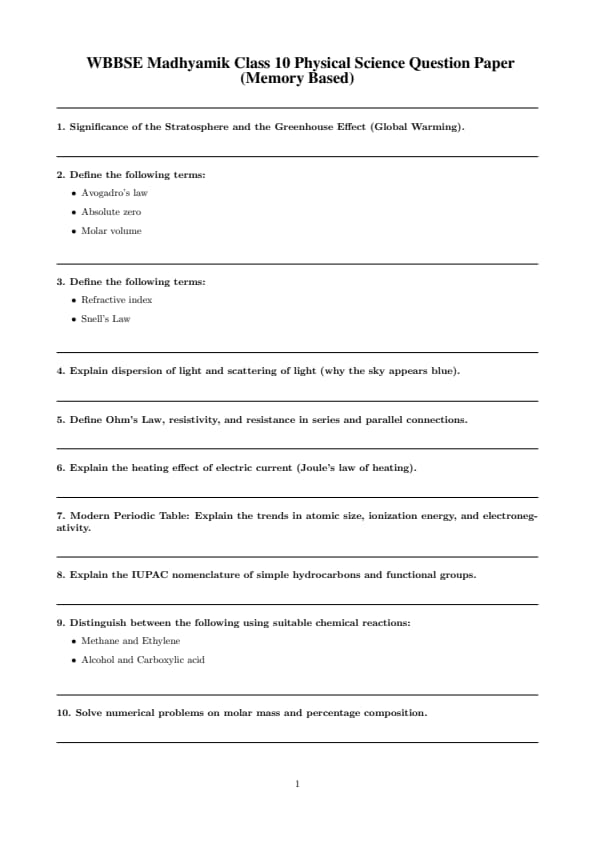
Significance of the Stratosphere and the Greenhouse Effect (Global Warming).
View Solution
(A) Significance of the Stratosphere:
The stratosphere is the layer of the atmosphere extending approximately from 10 km to 50 km above the Earth's surface. It plays a crucial role in maintaining life on Earth due to the following reasons:
Ozone Layer Protection:
The stratosphere contains the ozone layer, which absorbs harmful ultraviolet (UV) radiation from the Sun, thereby protecting living organisms from skin cancer, genetic damage, and eye disorders.
Temperature Regulation:
Due to absorption of UV radiation by ozone, temperature increases with altitude in the stratosphere, creating a stable atmospheric layer that prevents excessive vertical mixing.
Climatic Stability:
The stability of the stratosphere helps maintain steady weather patterns in the troposphere below, ensuring a balanced climate system.
Safe Air Travel:
Commercial jet aircraft often fly in the lower stratosphere to avoid turbulence and adverse weather conditions present in the troposphere.
(B) Significance of the Greenhouse Effect (Global Warming):
The greenhouse effect is a natural process by which certain gases in the Earth's atmosphere trap heat, keeping the planet warm enough to sustain life.
Maintenance of Earth’s Temperature:
Greenhouse gases such as carbon dioxide, methane, and water vapour trap outgoing infrared radiation, preventing excessive heat loss and maintaining an average global temperature suitable for life.
Support of Life Processes:
Without the natural greenhouse effect, Earth's average temperature would be too low to support ecosystems, agriculture, and biodiversity.
Impact of Enhanced Greenhouse Effect:
Human activities such as burning fossil fuels and deforestation have increased greenhouse gas concentrations, leading to global warming.
Consequences of Global Warming:
Enhanced greenhouse effect causes rising global temperatures, melting of glaciers, sea-level rise, extreme weather events, and ecological imbalance.
Conclusion:
The stratosphere protects life by filtering harmful solar radiation, while the greenhouse effect regulates Earth's temperature. However, excessive enhancement of the greenhouse effect due to human activities leads to global warming, posing serious environmental challenges. Quick Tip: \textbf{Stratosphere} = Protection from UV radiation (ozone layer). \textbf{Greenhouse Effect} = Temperature regulation; excess leads to global warming.
Define the following terms:
Avogadro's law
Absolute zero
Molar volume
View Solution
(i) Avogadro's Law:
Avogadro's law states that equal volumes of all gases, at the same temperature and pressure, contain equal numbers of molecules.
Mathematically, \[ V \propto n \quad (at constant T and P) \]
(ii) Absolute Zero:
Absolute zero is defined as the lowest possible temperature at which the thermal motion of particles is minimum.
Its value is: \[ 0\,K \;=\; -273.15^\circC \]
(iii) Molar Volume:
Molar volume is defined as the volume occupied by one mole of a substance.
For an ideal gas at standard temperature and pressure (STP), the molar volume is: \[ 22.4\ L mol^{-1} \] Quick Tip: Avogadro’s law connects \textbf{volume and number of moles}. Absolute zero is the reference point for the Kelvin scale. Molar volume of a gas at STP is \textbf{22.4 L}.
Define the following terms:
Refractive index
Snell's Law
View Solution
(i) Refractive Index:
The refractive index of a medium is defined as the ratio of the speed of light in vacuum to the speed of light in that medium.
It is denoted by \( n \) and given by: \[ n = \frac{c}{v} \]
where \( c \) is the speed of light in vacuum and \( v \) is the speed of light in the medium.
(ii) Snell's Law:
Snell's law states that for a given pair of media, the ratio of the sine of the angle of incidence to the sine of the angle of refraction is constant.
Mathematically, \[ \frac{\sin i}{\sin r} = constant = \frac{n_2}{n_1} \]
where \( n_1 \) and \( n_2 \) are the refractive indices of the first and second media respectively. Quick Tip: Higher refractive index \( \Rightarrow \) light travels slower. Snell’s law explains bending of light at the boundary of two media.
Explain dispersion of light and scattering of light (why the sky appears blue).
View Solution
(A) Dispersion of Light:
Dispersion of light is the phenomenon in which white light splits into its constituent colours when it passes through a transparent medium such as a prism.
This occurs because different colours of light have different wavelengths and hence travel with different speeds in a medium.
The sequence of colours obtained is: \[ Violet, Indigo, Blue, Green, Yellow, Orange, Red (VIBGYOR) \]
Violet light deviates the most while red light deviates the least due to their difference in wavelengths.
(B) Scattering of Light (Why the Sky is Blue):
Scattering of light is the phenomenon in which light is deviated from its straight path when it strikes tiny particles present in a medium such as air molecules.
The sky appears blue due to Rayleigh scattering, which states that the amount of scattering of light is inversely proportional to the fourth power of its wavelength: \[ Scattering \propto \frac{1}{\lambda^4} \]
Since blue light has a shorter wavelength than red light, it is scattered much more by air molecules.
As a result, when sunlight passes through the atmosphere, blue light is scattered in all directions and reaches our eyes, making the sky appear blue.
Conclusion:
Dispersion explains the splitting of white light into colours, while scattering explains the preferential spreading of shorter wavelengths, which is why the sky appears blue during the day. Quick Tip: Dispersion depends on \textbf{wavelength and refractive index}. Blue colour of the sky is due to \textbf{maximum scattering of shorter wavelengths}.
Define Ohm's Law, resistivity, and resistance in series and parallel connections.
View Solution
(i) Ohm's Law:
Ohm's law states that the current flowing through a conductor is directly proportional to the potential difference across its ends, provided the physical conditions such as temperature remain constant.
Mathematically, \[ V \propto I \quad \Rightarrow \quad V = IR \]
where \( V \) is the potential difference, \( I \) is the current, and \( R \) is the resistance of the conductor.
(ii) Resistivity:
Resistivity is a material property that measures how strongly a substance opposes the flow of electric current.
It is denoted by \( \rho \) and is given by: \[ \rho = \frac{RA}{L} \]
where \( R \) is resistance, \( A \) is the cross-sectional area, and \( L \) is the length of the conductor.
The SI unit of resistivity is \(\Omega\,m\).
(iii) Resistance in Series Connection:
When resistors are connected in series, the same current flows through each resistor.
The equivalent resistance \( R_s \) is given by: \[ R_s = R_1 + R_2 + R_3 + \cdots \]
(iv) Resistance in Parallel Connection:
When resistors are connected in parallel, the potential difference across each resistor is the same.
The equivalent resistance \( R_p \) is given by: \[ \frac{1}{R_p} = \frac{1}{R_1} + \frac{1}{R_2} + \frac{1}{R_3} + \cdots \]
Conclusion:
Ohm's law explains the relationship between voltage, current, and resistance, while resistivity characterizes materials. Series and parallel combinations help control current and voltage in electrical circuits. Quick Tip: Series: total resistance \textbf{increases}. Parallel: total resistance \textbf{decreases}. Resistivity depends only on the \textbf{material}, not on shape or size.
Explain the heating effect of electric current (Joule’s law of heating).
View Solution
Heating Effect of Electric Current:
When an electric current flows through a conductor, electrical energy is converted into heat energy due to the resistance offered by the conductor.
This phenomenon is known as the heating effect of electric current.
Joule’s Law of Heating:
According to Joule’s law, the heat produced in a conductor is:
Directly proportional to the square of the current flowing through it,
Directly proportional to the resistance of the conductor,
Directly proportional to the time for which the current flows.
Mathematically, \[ H = I^2 R t \]
where \( H \) = heat produced, \( I \) = current, \( R \) = resistance, \( t \) = time.
Applications of Heating Effect:
Electric heaters, irons, and toasters.
Electric bulbs, where the filament becomes white hot.
Electric fuses, which protect circuits by melting when excessive current flows.
Conclusion:
The heating effect of electric current is a useful phenomenon that converts electrical energy into heat energy and is widely used in household and industrial appliances. Quick Tip: Heat produced increases rapidly with increase in current. Fuse wire has high resistance and low melting point.
Modern Periodic Table: Explain the trends in atomic size, ionization energy, and electronegativity.
View Solution
The Modern Periodic Table arranges elements in increasing order of their atomic numbers. Several physical and chemical properties of elements show periodic trends due to changes in atomic structure.
(A) Trend in Atomic Size:
Atomic size refers to the distance from the centre of the nucleus to the outermost electron shell.
Across a Period (Left to Right):
Atomic size decreases because the nuclear charge increases while the number of shells remains the same, pulling electrons closer to the nucleus.
Down a Group (Top to Bottom):
Atomic size increases due to the addition of new electron shells, which increases the distance of the outermost electrons from the nucleus.
(B) Trend in Ionization Energy:
Ionization energy is the minimum energy required to remove the most loosely bound electron from an isolated gaseous atom.
Across a Period:
Ionization energy generally increases due to increasing nuclear charge and decreasing atomic size.
Down a Group:
Ionization energy decreases because the outermost electron is farther from the nucleus and is less strongly attracted.
(C) Trend in Electronegativity:
Electronegativity is the tendency of an atom to attract shared electrons towards itself in a chemical bond.
Across a Period:
Electronegativity increases as atomic size decreases and nuclear attraction increases.
Down a Group:
Electronegativity decreases due to increasing atomic size and shielding effect.
Conclusion:
These periodic trends arise due to systematic changes in atomic structure and help in predicting the chemical behaviour of elements. Quick Tip: Smaller atom \(\Rightarrow\) higher ionization energy and electronegativity. Atomic size shows an opposite trend to ionization energy across a period.
Explain the IUPAC nomenclature of simple hydrocarbons and functional groups.
View Solution
IUPAC Nomenclature:
IUPAC (International Union of Pure and Applied Chemistry) nomenclature is a systematic method of naming organic compounds so that each compound has a unique and universally accepted name.
(A) IUPAC Nomenclature of Simple Hydrocarbons:
Simple hydrocarbons contain only carbon and hydrogen atoms and are classified as alkanes, alkenes, and alkynes.
Step 1: Selection of Parent Chain
Choose the longest continuous carbon chain as the parent hydrocarbon.
Step 2: Naming the Parent Chain
The name depends on the number of carbon atoms:
\[ Meth (1), Eth (2), Prop (3), But (4), Pent (5), Hex (6) \]
Step 3: Suffix Based on Type of Bond
Alkanes (single bond): -ane
Alkenes (double bond): -ene
Alkynes (triple bond): -yne
Step 4: Numbering the Chain
Number the carbon atoms so that the multiple bond gets the lowest possible number.
Example: \[ CH_3–CH=CH–CH_3 \Rightarrow But-2-ene \]
(B) IUPAC Nomenclature of Functional Groups:
Functional groups are specific atoms or groups of atoms that determine the chemical properties of organic compounds.
\begin{tabular{|c|c|c|
\hline
Functional Group & Formula & Suffix / Prefix
\hline
Alcohol & –OH & -ol
Carboxylic acid & –COOH & -oic acid
Aldehyde & –CHO & -al
Ketone & –CO– & -one
Halo group & –Cl, –Br & chloro-, bromo-
\hline
\end{tabular
Rules for Naming Compounds with Functional Groups:
The functional group gets priority in numbering.
The carbon containing the functional group is given the lowest possible number.
The suffix of the functional group replaces the hydrocarbon suffix.
Example: \[ CH_3–CH_2–OH \Rightarrow Ethanol \]
Conclusion:
IUPAC nomenclature provides a logical and uniform system for naming hydrocarbons and organic compounds containing functional groups, ensuring clarity and consistency in chemistry. Quick Tip: Longest chain decides the \textbf{parent name}. Functional group always gets \textbf{priority in numbering}. Remember common suffixes: \textbf{-ane, -ene, -yne, -ol, -oic acid}.
Distinguish between the following using suitable chemical reactions:
Methane and Ethylene
Alcohol and Carboxylic acid
View Solution
(A) Distinguishing Methane and Ethylene:
Methane is a saturated hydrocarbon (alkane), whereas ethylene is an unsaturated hydrocarbon (alkene).
They can be distinguished using the following tests:
Test 1: Bromine Water Test
Methane:
Does not decolourise bromine water in the absence of sunlight.
Ethylene:
Decolourises bromine water due to addition reaction.
Reaction: \[ CH_2=CH_2 + Br_2 \rightarrow CH_2Br–CH_2Br \]
(B) Distinguishing Alcohol and Carboxylic Acid:
Alcohols and carboxylic acids differ in acidity and chemical behaviour. They can be distinguished as follows:
Test 1: Sodium Bicarbonate Test
Alcohol:
Does not react with sodium bicarbonate.
Carboxylic Acid:
Reacts with sodium bicarbonate producing brisk effervescence of carbon dioxide.
Reaction: \[ R–COOH + NaHCO_3 \rightarrow R–COONa + H_2O + CO_2 \uparrow \]
Conclusion:
Unsaturated hydrocarbons like ethylene undergo addition reactions, while saturated hydrocarbons like methane do not.
Carboxylic acids show acidic behaviour by releasing carbon dioxide with sodium bicarbonate, unlike alcohols. Quick Tip: Bromine water test is used to identify \textbf{unsaturation}. Effervescence with NaHCO\(_3\) confirms a \textbf{carboxylic acid}.
Solve numerical problems on molar mass and percentage composition.
View Solution
(A) Numerical on Molar Mass:
Problem:
Calculate the molar mass of calcium carbonate, \( CaCO_3 \).
Solution:
Atomic masses: \[ Ca = 40,\quad C = 12,\quad O = 16 \]
Molar mass of \( CaCO_3 \): \[ = 40 + 12 + (3 \times 16) \] \[ = 40 + 12 + 48 \] \[ = 100\ g mol^{-1} \]
Answer:
Molar mass of calcium carbonate is \( \boxed{100\ g mol^{-1}} \).
(B) Numerical on Percentage Composition:
Problem:
Calculate the percentage composition of carbon, hydrogen, and oxygen in ethanol, \( C_2H_5OH \).
Solution:
Molecular formula of ethanol: \[ C_2H_6O \]
Atomic masses: \[ C = 12,\quad H = 1,\quad O = 16 \]
Molar mass of ethanol: \[ (2 \times 12) + (6 \times 1) + 16 = 24 + 6 + 16 = 46\ g mol^{-1} \]
Percentage of Carbon: \[ \frac{24}{46} \times 100 = 52.17% \]
Percentage of Hydrogen: \[ \frac{6}{46} \times 100 = 13.04% \]
Percentage of Oxygen: \[ \frac{16}{46} \times 100 = 34.79% \]
Answer:
Carbon = \( 52.17% \)
Hydrogen = \( 13.04% \)
Oxygen = \( 34.79% \)
Conclusion:
Molar mass is calculated by summing atomic masses, while percentage composition is determined by comparing the mass of each element to the total molar mass of the compound. Quick Tip: Always use correct atomic masses before calculation. Sum of percentage composition should be approximately \textbf{100%}.



Comments