




WBBSE Madhyamik 2026 question papers are available for download here. The West Bengal Board of Secondary Education (WBBSE) is conducting the Madhyamik exams from 2 Feb 2026 – 12 Feb 2026. Students can check subject-wise paper analysis along with memory-based question papers here. The WBBSE Class 10 Question Paper with Solution PDF is downloadable from the links provided below.
WBBSE Madhyamik 2026 History Question Paper with Solutions (6 Feb,2026)
Related Links
- WBBSE Madhyamik 2026 Geography Question Paper
- WBBSE Madhyamik 2026 Mathematics Question Paper
- WBBSE Madhyamik 2026 Physical Science Question Paper
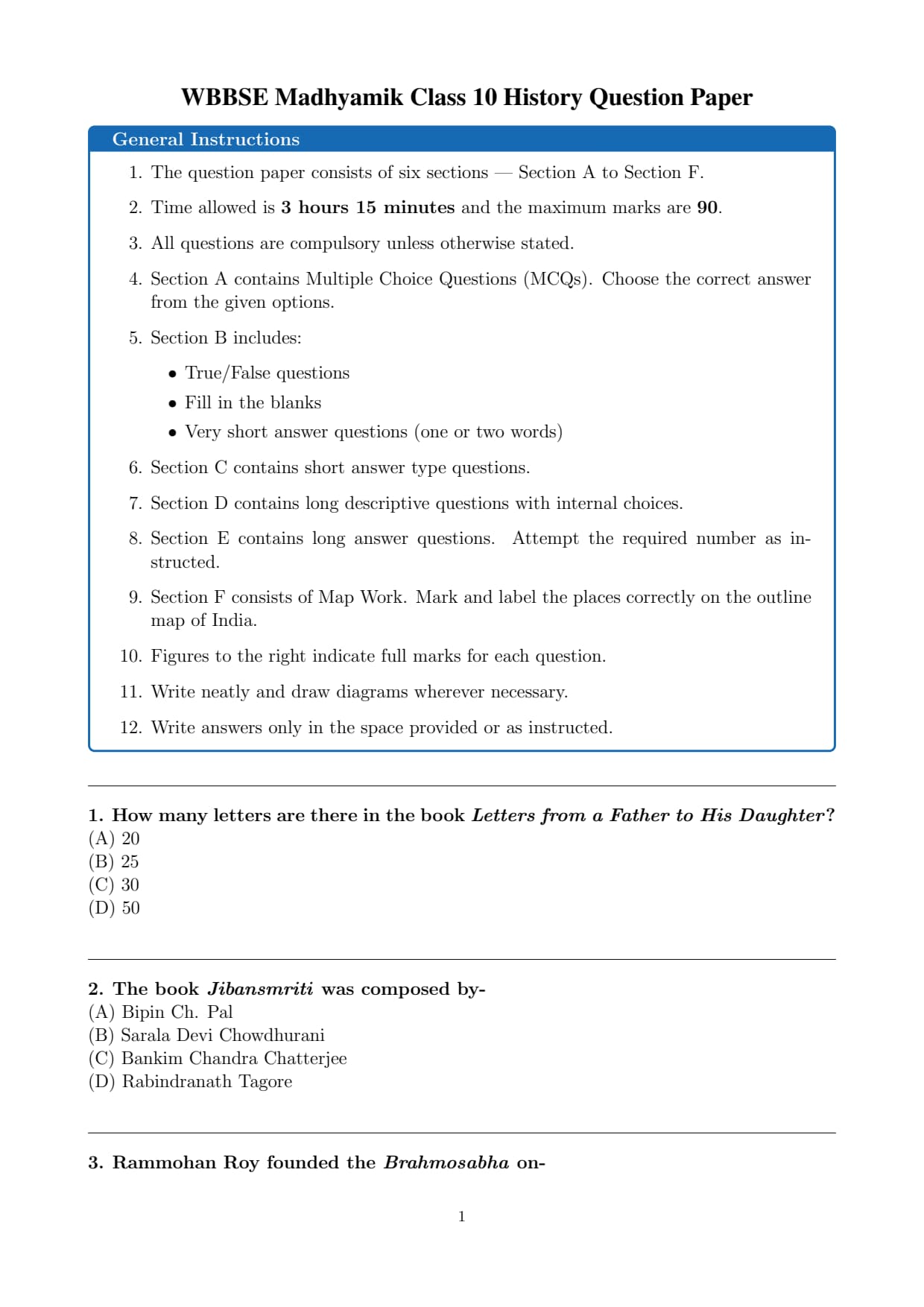
How many letters are there in the book Letters from a Father to His Daughter?
View Solution
Concept:
Letters from a Father to His Daughter is a collection of personal letters written by Jawaharlal Nehru to his daughter Indira Gandhi in 1928. These letters were meant to introduce her to natural history and civilization in a simple and engaging manner. The number of letters in the collection is a well-known factual detail from Indian history and literature.
Step 1: Identify the author and context.
The book was written by Jawaharlal Nehru while he was away from his daughter. He wrote a series of educational letters to explain the world in a simple narrative style.
Step 2: Recall the total number of letters.
The collection contains exactly 30 letters compiled into the book.
Step 3: Match with the given options.
Option (C) corresponds to 30. Quick Tip: Important factual recall: \textit{Letters from a Father to His Daughter by Jawaharlal Nehru contains 30 letters and is often asked in GK and exam-based literature questions.
The book Jibansmriti was composed by-
View Solution
Concept:
Jibansmriti is an autobiographical work written in Bengali. The title means “My Reminiscences,” and it reflects the author's early life, childhood memories, family background, and intellectual development.
Step 1: Identify the nature of the book.
\textit{Jibansmriti is not a novel or essay collection but an autobiography.
Step 2: Recall the author.
The autobiography \textit{Jibansmriti was written by Rabindranath Tagore, the Nobel Prize-winning poet, writer, and philosopher of India.
Step 3: Match with the options.
Among the given options, Rabindranath Tagore corresponds to option (D). Quick Tip: \textit{Jibansmriti (My Reminiscences) is the autobiography of Rabindranath Tagore and is frequently asked in literature and GK exams.
Rammohan Roy founded the Brahmosabha on-
View Solution
Concept:
The Brahmosabha was a reformist religious movement founded to promote monotheism and oppose social evils such as idol worship, caste discrimination, and sati. It later evolved into the Brahmo Samaj, which played a key role in the Bengal Renaissance.
Step 1: Identify the founder.
Raja Rammohan Roy was a major social and religious reformer in 19th-century India and is often called the “Father of the Indian Renaissance.”
Step 2: Recall the year of establishment.
He founded the Brahmosabha in 1828 in Calcutta to promote rational religious thought and social reform.
Step 3: Match with the options.
Option (D) corresponds to 1828 A.D. Quick Tip: The Brahmosabha founded by Raja Rammohan Roy in 1828 later developed into the Brahmo Samaj, a key movement in the Bengal Renaissance.
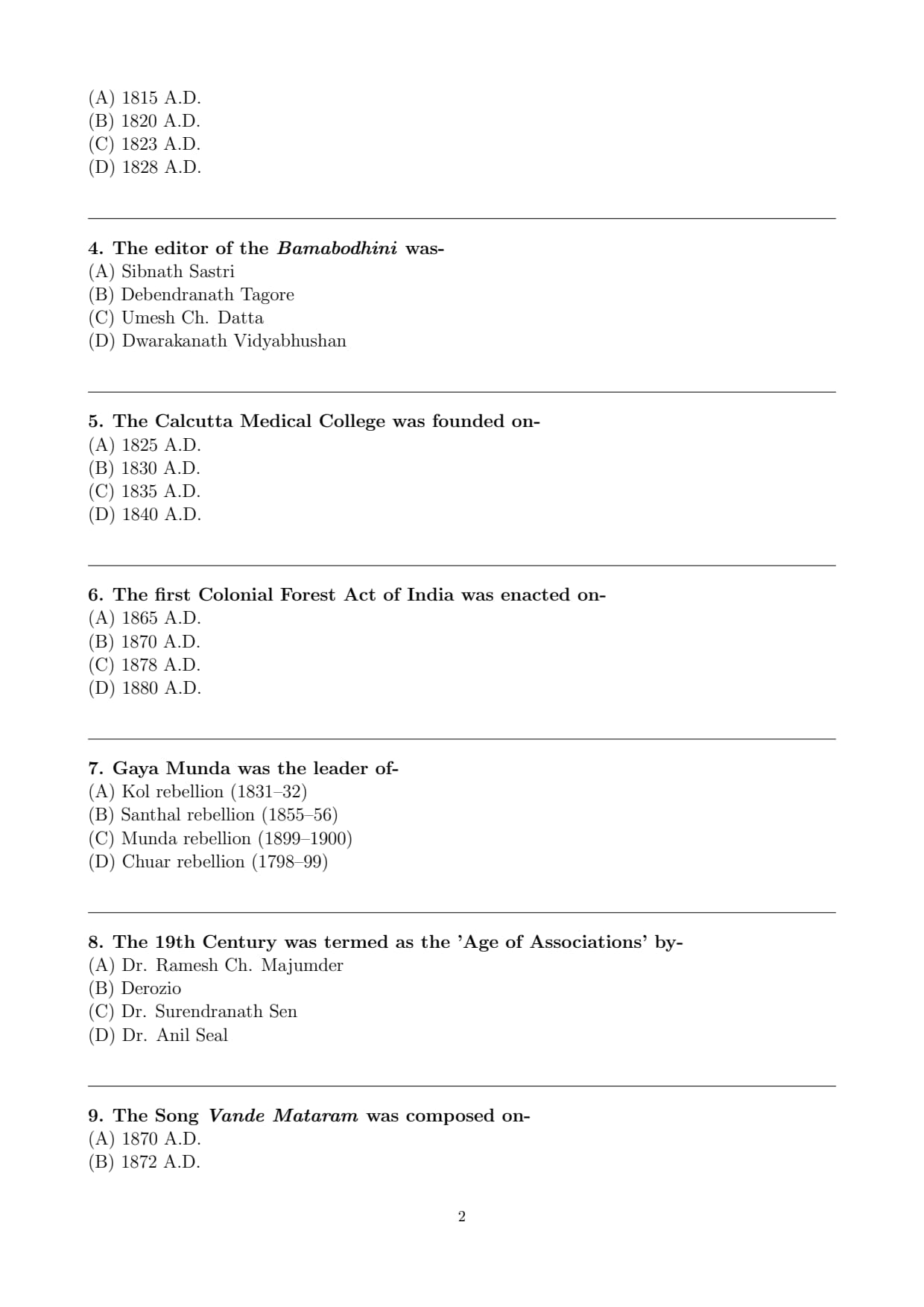
The editor of the Bamabodhini was-
View Solution
Concept:
Bamabodhini Patrika was a Bengali magazine started in the 19th century to promote women’s education and social awareness during the Bengal Renaissance.
Step 1: Understand the publication.
The magazine focused on improving women’s literacy and social reform, making it an important periodical in reformist history.
Step 2: Identify the editor.
Umesh Chandra Datta was the editor of the \textit{Bamabodhini Patrika and played a significant role in spreading progressive ideas.
Step 3: Match with the options.
Option (C) corresponds to Umesh Ch. Datta. Quick Tip: \textit{Bamabodhini Patrika was edited by Umesh Chandra Datta and was important for promoting women’s education during the Bengal Renaissance.
The Calcutta Medical College was founded on-
View Solution
Concept:
Calcutta Medical College was one of the earliest institutions in Asia to teach Western medicine. It marked a major shift in medical education in India during British rule.
Step 1: Identify the significance.
The institution was established to introduce modern scientific medical education in India.
Step 2: Recall the founding year.
Calcutta Medical College was founded in 1835 in Calcutta (now Kolkata).
Step 3: Match with the options.
Option (C) corresponds to 1835 A.D. Quick Tip: Calcutta Medical College (est. 1835) was the first institution in India to teach Western medicine systematically.
The first Colonial Forest Act of India was enacted on-
View Solution
Concept:
The Indian Forest Acts were introduced by the British government to regulate forest resources and assert state control over forests, mainly for commercial and strategic purposes.
Step 1: Identify the first act.
The earliest forest legislation during British rule aimed at establishing state monopoly over forest resources.
Step 2: Recall the year.
The first Indian Forest Act was passed in 1865, marking the beginning of colonial forest administration.
Step 3: Match with the options.
Option (A) corresponds to 1865 A.D. Quick Tip: The first Indian Forest Act was passed in 1865, followed by more comprehensive acts in 1878 and 1927.
Gaya Munda was the leader of-
View Solution
Concept:
The Munda Rebellion was a tribal uprising led by the Munda community against British rule and exploitative landlords. It was part of a larger movement of tribal resistance in colonial India.
Step 1: Identify the leader.
Gaya Munda was a prominent associate and leader within the Munda uprising movement.
Step 2: Identify the rebellion.
The Munda Rebellion (1899--1900), also associated with Birsa Munda, was a major tribal revolt in the Chotanagpur region.
Step 3: Match with the options.
Option (C) corresponds to the Munda rebellion (1899--1900). Quick Tip: The Munda Rebellion (1899--1900) was led by Birsa Munda, and Gaya Munda was one of the key leaders associated with this tribal uprising.
The 19th Century was termed as the 'Age of Associations' by-
View Solution
Concept:
The term "Age of Associations" refers to the rise of political and social organizations in 19th-century India, which laid the foundation for modern nationalism.
Step 1: Understand the phrase.
The 19th century saw the formation of numerous political bodies, literary societies, and reform organizations that contributed to national awakening.
Step 2: Identify the historian.
Historian Dr. Anil Seal used the term "Age of Associations" to describe this phase of Indian history.
Step 3: Match with the options.
Option (D) corresponds to Dr. Anil Seal. Quick Tip: Historian Anil Seal described the 19th century in India as the "Age of Associations" due to the rise of socio-political organizations.
The Song Vande Mataram was composed on-
View Solution
Concept:
Vande Mataram is one of the most iconic patriotic songs of India. It was written by Bankim Chandra Chattopadhyay and later included in his novel \textit{Anandamath.
Step 1: Identify the author.
Bankim Chandra Chattopadhyay composed the song as a patriotic hymn to the motherland.
Step 2: Recall the year of composition.
The song was composed in 1876 and later published in the novel \textit{Anandamath (1882).
Step 3: Match with the options.
Option (D) corresponds to 1876 A.D. Quick Tip: \textit{Vande Mataram was composed by Bankim Chandra Chattopadhyay in 1876 and later included in Anandamath.
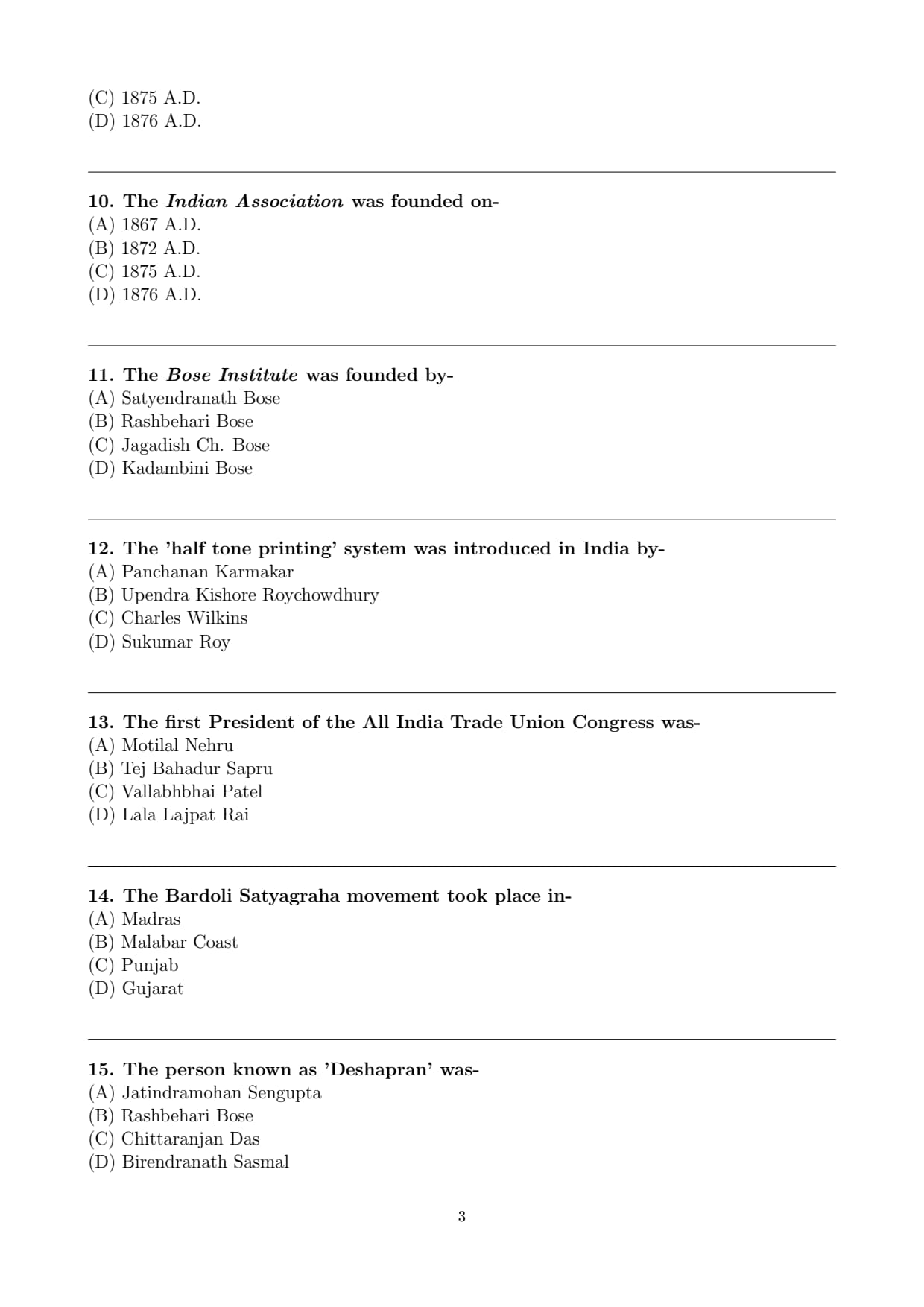
The Indian Association was founded on-
View Solution
Concept:
The Indian Association was one of the earliest political organizations in India that aimed to unify Indians and promote political awareness before the formation of the Indian National Congress.
Step 1: Identify the founders.
The association was founded by Surendranath Banerjee and Ananda Mohan Bose.
Step 2: Recall the founding year.
The Indian Association was established in 1876 in Calcutta.
Step 3: Match with the options.
Option (D) corresponds to 1876 A.D. Quick Tip: The Indian Association (1876), founded by Surendranath Banerjee, was a precursor to the Indian National Congress.
The Bose Institute was founded by-
View Solution
Concept:
The Bose Institute is one of India's oldest interdisciplinary research institutes. It was established to promote scientific research in both physical and biological sciences.
Step 1: Identify the institution.
The Bose Institute (Basu Bigyan Mandir) is a premier research center located in Kolkata.
Step 2: Recall the founder.
It was founded by Sir Jagadish Chandra Bose, a pioneering Indian scientist known for his contributions to plant physiology, biophysics, and wireless communication.
Step 3: Match with the options.
Option (C) corresponds to Jagadish Ch. Bose. Quick Tip: The Bose Institute was founded in 1917 by Sir Jagadish Chandra Bose and is one of India’s earliest modern research institutes.
The 'half tone printing' system was introduced in India by-
View Solution
Concept:
Half-tone printing is a technique that reproduces photographs and shaded illustrations using dots of varying sizes. It revolutionized printing by enabling high-quality image reproduction in books and magazines.
Step 1: Understand the innovation.
Half-tone printing allowed realistic photographic reproduction in printed media.
Step 2: Identify the pioneer in India.
Upendra Kishore Roychowdhury, a writer, illustrator, and technologist, introduced and developed advanced printing techniques including half-tone blocks in India.
Step 3: Match with the options.
Option (B) corresponds to Upendra Kishore Roychowdhury. Quick Tip: Upendra Kishore Roychowdhury was a pioneer of modern printing in India and introduced half-tone block making.
The first President of the All India Trade Union Congress was-
View Solution
Concept:
The All India Trade Union Congress (AITUC) was the first national-level trade union organization in India, formed to represent workers' rights during the freedom struggle.
Step 1: Identify the organization.
AITUC was founded in 1920 to unite various labor movements in India.
Step 2: Recall the first president.
Lala Lajpat Rai, a prominent nationalist leader and freedom fighter, became its first president.
Step 3: Match with the options.
Option (D) corresponds to Lala Lajpat Rai. Quick Tip: The All India Trade Union Congress (1920) had Lala Lajpat Rai as its first president, linking labor movements with the freedom struggle.
The Bardoli Satyagraha movement took place in-
View Solution
Concept:
The Bardoli Satyagraha was a major peasant movement during the Indian freedom struggle. It was a non-violent protest against unjust land revenue hikes imposed by the British government.
Step 1: Identify the movement.
The Bardoli Satyagraha took place in 1928 and was led by Sardar Vallabhbhai Patel.
Step 2: Locate Bardoli.
Bardoli is a town in the present-day state of Gujarat.
Step 3: Match with the options.
Option (D) corresponds to Gujarat. Quick Tip: Bardoli Satyagraha (1928) took place in Gujarat and earned Vallabhbhai Patel the title “Sardar.”
The person known as 'Deshapran' was-
View Solution
Concept:
Many leaders of the Indian freedom movement were known by honorific titles reflecting their contributions. These titles are often important in history-based examinations.
Step 1: Identify the title.
The title "Deshapran" (meaning “Life of the Nation”) was given as a mark of respect for patriotic dedication.
Step 2: Identify the person.
Jatindramohan Sengupta, a nationalist leader from Bengal, was popularly known as "Deshapran."
Step 3: Match with the options.
Option (A) corresponds to Jatindramohan Sengupta. Quick Tip: Jatindramohan Sengupta was popularly known as “Deshapran,” a title honoring his nationalist contributions.
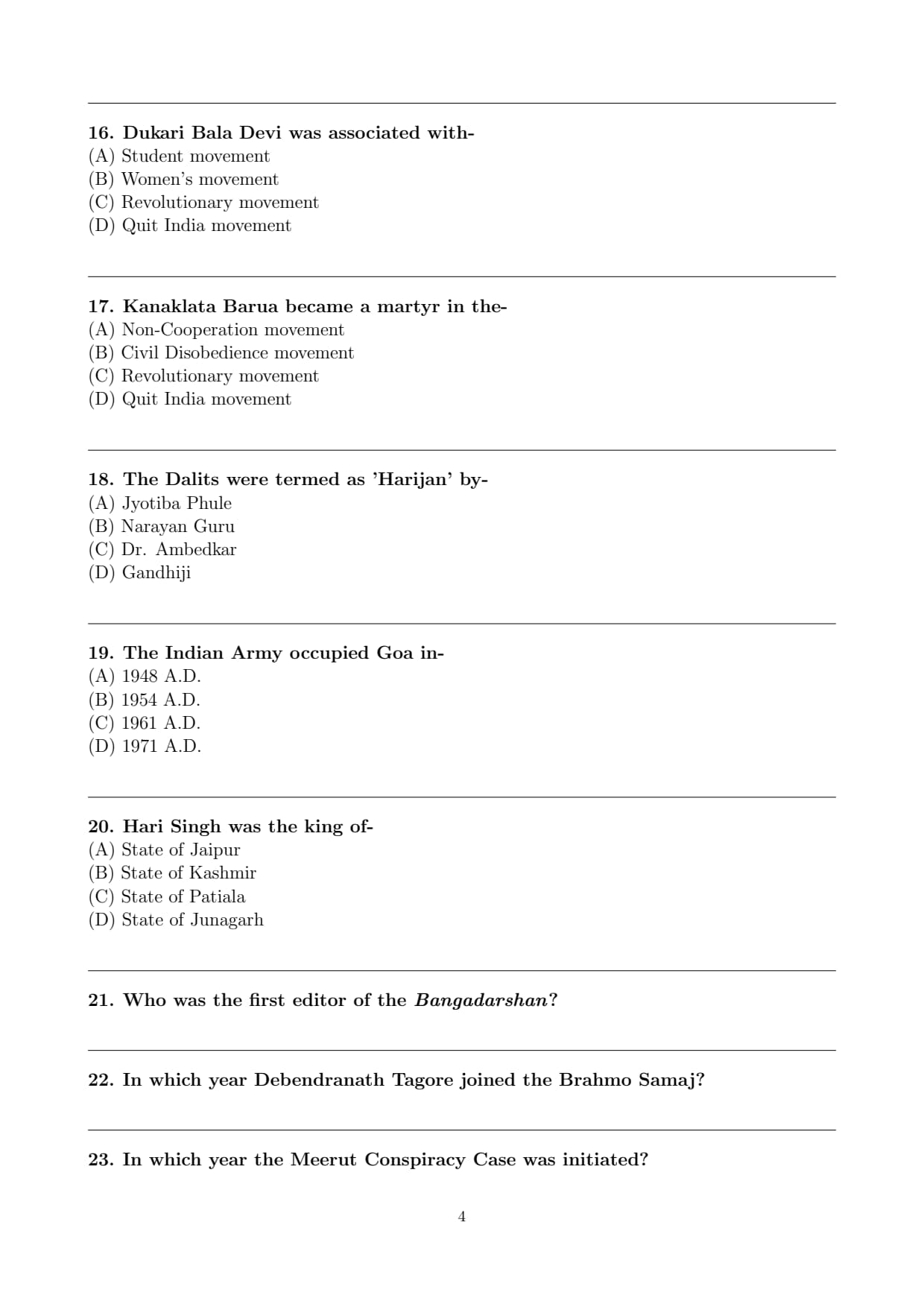
Dukari Bala Devi was associated with-
View Solution
Concept:
Many women actively participated in revolutionary activities during the Indian freedom struggle, often working behind the scenes in secret networks.
Step 1: Identify the personality.
Dukari Bala Devi is remembered for her role in assisting revolutionary activities in Bengal.
Step 2: Identify the movement.
She was associated with revolutionary groups that worked against British rule.
Step 3: Match with the options.
Option (C) corresponds to the Revolutionary movement. Quick Tip: Several lesser-known women like Dukari Bala Devi contributed significantly to the revolutionary movement in Bengal.
Kanaklata Barua became a martyr in the-
View Solution
Concept:
The Quit India Movement (1942) witnessed widespread participation from youth and women across India, many of whom sacrificed their lives.
Step 1: Identify the individual.
Kanaklata Barua was a young freedom fighter from Assam.
Step 2: Recall the historical event.
She was shot dead while leading a procession carrying the national flag during the Quit India Movement in 1942.
Step 3: Match with the options.
Option (D) corresponds to the Quit India movement. Quick Tip: Kanaklata Barua of Assam became a martyr during the Quit India Movement while hoisting the national flag.
The Dalits were termed as 'Harijan' by-
View Solution
Concept:
The term "Harijan" meaning “Children of God” was used during the freedom movement to refer to Dalits in a more respectful way, though it later became controversial.
Step 1: Identify the origin of the term.
The term was popularized during social reform efforts to remove untouchability.
Step 2: Identify the leader.
Mahatma Gandhi used the term "Harijan" while advocating for the upliftment of Dalits.
Step 3: Match with the options.
Option (D) corresponds to Gandhiji. Quick Tip: Mahatma Gandhi coined the term "Harijan" for Dalits during his campaign against untouchability.
The Indian Army occupied Goa in-
View Solution
Concept:
Goa remained a Portuguese colony even after India gained independence in 1947. The Indian government later took military action to liberate Goa from Portuguese rule.
Step 1: Identify the event.
The annexation of Goa was carried out through a military operation known as Operation Vijay.
Step 2: Recall the year.
The Indian Army liberated and occupied Goa in December 1961, integrating it into the Indian Union.
Step 3: Match with the options.
Option (C) corresponds to 1961 A.D. Quick Tip: Goa was liberated from Portuguese rule in 1961 through Operation Vijay and later became a state in 1987.
Hari Singh was the king of-
View Solution
Concept:
At the time of India's independence in 1947, princely states were ruled by hereditary monarchs who had to choose whether to join India or Pakistan.
Step 1: Identify the ruler.
Maharaja Hari Singh was the last ruling monarch of the princely state of Jammu and Kashmir.
Step 2: Historical significance.
He signed the Instrument of Accession in 1947, leading to Jammu and Kashmir joining India.
Step 3: Match with the options.
Option (B) corresponds to the State of Kashmir. Quick Tip: Maharaja Hari Singh was the last ruler of Jammu and Kashmir and signed the Instrument of Accession in 1947.
Who was the first editor of the Bangadarshan?
View Solution
Concept:
Bangadarshan was a prominent Bengali literary magazine of the 19th century that played a key role in shaping modern Bengali literature and intellectual thought.
Step 1: Identify the magazine.
\textit{Bangadarshan was first published in 1872 and became an influential platform for literary and cultural discourse during the Bengal Renaissance.
Step 2: Identify the editor.
The magazine was founded and first edited by Bankim Chandra Chattopadhyay, one of the pioneers of modern Bengali literature.
Step 3: Historical significance.
Under his editorship, the magazine published many important literary works and essays that shaped nationalist and literary consciousness. Quick Tip: \textit{Bangadarshan (1872) was founded and first edited by Bankim Chandra Chattopadhyay, a key figure of the Bengal Renaissance.
In which year Debendranath Tagore joined the Brahmo Samaj?
View Solution
Concept:
The Brahmo Samaj was a socio-religious reform movement founded by Raja Rammohan Roy. It aimed at promoting monotheism, social reform, and rational religious thought during the Bengal Renaissance.
Step 1: Identify the personality.
Debendranath Tagore, father of Rabindranath Tagore, was an important leader of the Brahmo Samaj after the death of Raja Rammohan Roy.
Step 2: Historical development.
Although the Brahmo Samaj was founded earlier, Debendranath Tagore formally joined the movement in 1843 and later revitalized it through the Tattwabodhini Sabha.
Step 3: Significance.
His leadership gave the Brahmo Samaj a philosophical foundation and helped expand its influence in Bengal. Quick Tip: Debendranath Tagore joined the Brahmo Samaj in 1843 and played a major role in its revival and expansion.
In which year the Meerut Conspiracy Case was initiated?
View Solution
Concept:
The Meerut Conspiracy Case was a landmark political trial during British rule that targeted trade unionists and communist leaders in India.
Step 1: Identify the event.
The British government arrested several labor leaders and charged them with conspiring to overthrow colonial rule.
Step 2: Recall the year.
The arrests and the initiation of the Meerut Conspiracy Case took place in 1929.
Step 3: Historical importance.
The trial drew international attention and exposed colonial repression of workers’ movements. Quick Tip: The Meerut Conspiracy Case began in 1929 and involved several trade union and communist leaders.
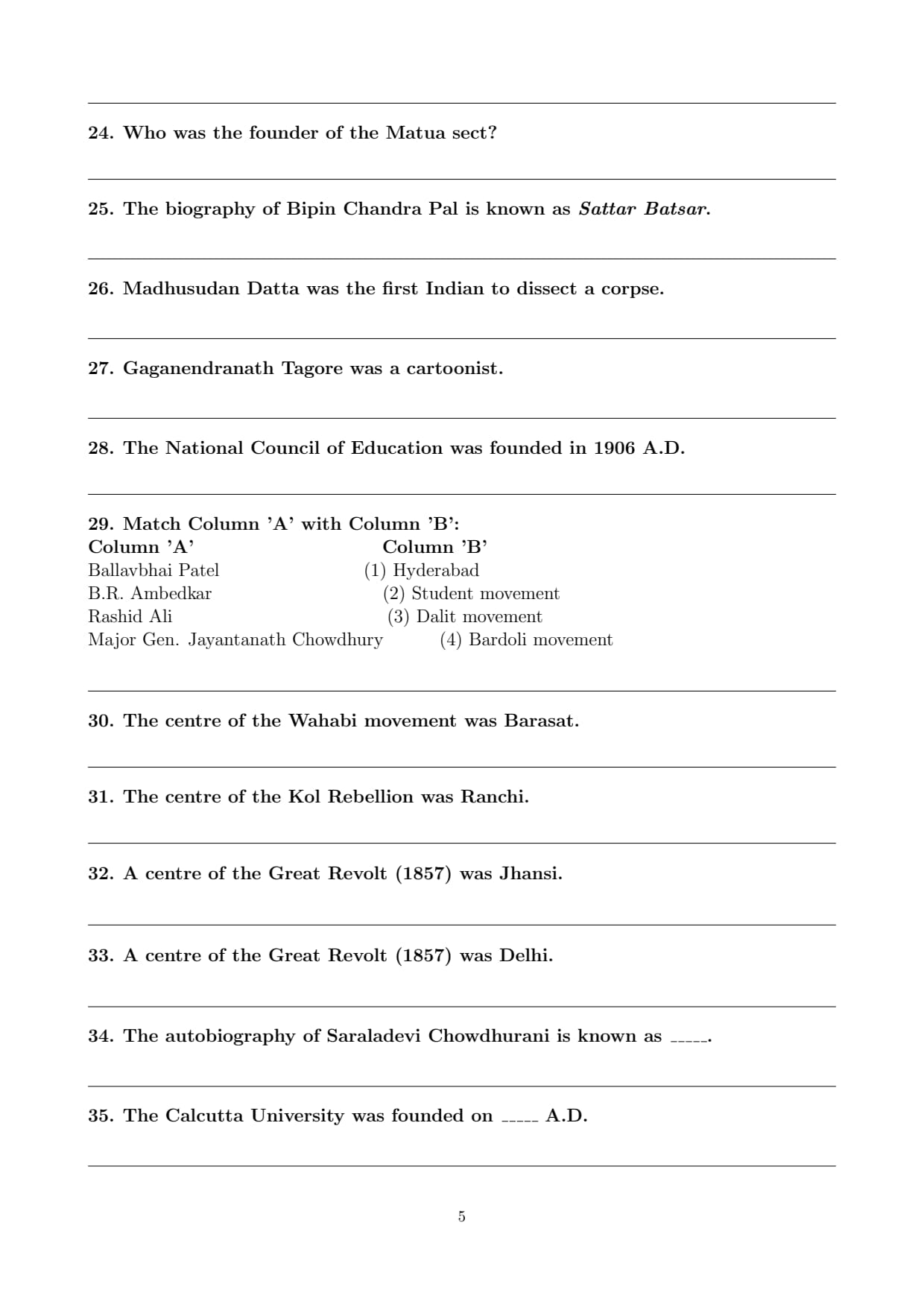
Who was the founder of the Matua sect?
View Solution
Concept:
The Matua sect is a religious and social reform movement that emerged in Bengal among the marginalized Namashudra community.
Step 1: Identify the movement.
The Matua movement emphasized equality, social justice, and spiritual upliftment of oppressed communities.
Step 2: Identify the founder.
Harichand Thakur founded the Matua sect in the 19th century in Bengal.
Step 3: Significance.
The movement later expanded under the leadership of his son, Guruchand Thakur. Quick Tip: Harichand Thakur founded the Matua sect, a major socio-religious movement among the Namashudra community in Bengal.
The biography of Bipin Chandra Pal is known as Sattar Batsar.
View Solution
Concept:
Bipin Chandra Pal, one of the Lal-Bal-Pal trio of Indian nationalism, was an influential freedom fighter, writer, and orator.
Step 1: Identify the work.
Sattar Batsar (meaning “Seventy Years”) is an autobiographical work associated with Bipin Chandra Pal.
Step 2: Nature of the text.
The book reflects his life experiences, political journey, and role in the nationalist movement.
Step 3: Conclusion.
Hence, the statement is correct. Quick Tip: \textit{Sattar Batsar is the autobiographical work of nationalist leader Bipin Chandra Pal.
Madhusudan Datta was the first Indian to dissect a corpse.
View Solution
Concept:
The first Indian to dissect a human corpse in modern medical education was Madhusudan Gupta, not Madhusudan Datta.
Step 1: Identify the confusion.
Michael Madhusudan Datta was a famous Bengali poet and literary figure, not associated with medical science.
Step 2: Historical fact.
Madhusudan Gupta performed the first human dissection by an Indian in 1836 at Calcutta Medical College.
Step 3: Conclusion.
The statement is incorrect because it confuses Madhusudan Datta with Madhusudan Gupta. Quick Tip: Madhusudan Gupta (not Michael Madhusudan Datta) performed the first human dissection by an Indian in 1836.
Gaganendranath Tagore was a cartoonist.
View Solution
Concept:
Gaganendranath Tagore was a prominent artist of the Bengal Renaissance known for his modernist and satirical artistic style.
Step 1: Identify the personality.
He belonged to the Tagore family and was the elder brother of Abanindranath Tagore.
Step 2: Artistic contribution.
Gaganendranath Tagore was famous for his caricatures and cartoons that satirized colonial society and the Bengali elite.
Step 3: Conclusion.
Thus, the statement that he was a cartoonist is correct. Quick Tip: Gaganendranath Tagore was a pioneer of modern Indian art and is well known for his satirical cartoons and caricatures.
The National Council of Education was founded in 1906 A.D.
View Solution
Concept:
The National Council of Education (NCE) was established as part of the Swadeshi Movement to promote national education free from colonial control.
Step 1: Historical background.
The Swadeshi Movement (1905) inspired efforts to create indigenous educational institutions.
Step 2: Founding year.
The National Council of Education was founded in 1906 in Bengal.
Step 3: Significance.
It later led to the establishment of institutions like Jadavpur University. Quick Tip: The National Council of Education was founded in 1906 during the Swadeshi Movement to promote national education in India.
Match Column 'A' with Column 'B':
Column 'A' \hspace{4cm Column 'B'
Ballavbhai Patel \hspace{3cm (1) Hyderabad
B.R. Ambedkar \hspace{3.6cm (2) Student movement
Rashid Ali \hspace{4.6cm (3) Dalit movement
Major Gen. Jayantanath Chowdhury \hspace{1cm (4) Bardoli movement
View Solution
Concept:
This question connects key historical personalities with movements or events associated with them. Matching relies on understanding their major contributions.
Step 1: Ballavbhai Patel
Sardar Vallabhbhai Patel led the Bardoli Satyagraha (1928), a major peasant movement. \[ Ballavbhai Patel \rightarrow Bardoli movement (4) \]
Step 2: B.R. Ambedkar
Dr. B.R. Ambedkar was the foremost leader of the Dalit movement and worked for social justice and equality. \[ B.R. Ambedkar \rightarrow Dalit movement (3) \]
Step 3: Rashid Ali
Rashid Ali is associated with student activism and movements during the freedom struggle. \[ Rashid Ali \rightarrow Student movement (2) \]
Step 4: Major Gen. Jayantanath Chowdhury
He played an important role in the Hyderabad operation during the integration of princely states. \[ Major Gen. Jayantanath Chowdhury \rightarrow Hyderabad (1) \]
Final Matching: \[ A-4, B-3, C-2, D-1 \] Quick Tip: Remember key associations: Patel \(\rightarrow\) Bardoli, Ambedkar \(\rightarrow\) Dalit movement, Hyderabad integration \(\rightarrow\) Major Gen. J.N. Chowdhury.
The centre of the Wahabi movement was Barasat.
View Solution
Concept:
The Wahabi movement in India was an Islamic revivalist movement aimed at purifying religious practices and opposing British rule.
Step 1: Identify the actual centre.
The Wahabi movement in India was mainly centred in Patna and parts of North India.
Step 2: Identify Barasat.
Barasat is associated with the Titumir-led peasant uprising in Bengal, not the Wahabi movement.
Step 3: Conclusion.
Thus, the statement is incorrect. Quick Tip: Wahabi movement centre \(\rightarrow\) Patna; Barasat is linked with Titumir’s rebellion.
The centre of the Kol Rebellion was Ranchi.
View Solution
Concept:
The Kol Rebellion (1831--32) was a major tribal uprising against British rule and exploitative landlords in the Chotanagpur region.
Step 1: Identify the region.
The rebellion mainly took place in the Chotanagpur plateau.
Step 2: Identify the centre.
Ranchi, located in the Chotanagpur region (present-day Jharkhand), was the core area of the Kol uprising.
Step 3: Conclusion.
Hence, the statement is correct. Quick Tip: Kol Rebellion (1831--32) was centred in the Chotanagpur region, especially Ranchi.
A centre of the Great Revolt (1857) was Jhansi.
View Solution
Concept:
The Revolt of 1857 was a widespread uprising against British rule that spread across North and Central India, with several key centres of resistance.
Step 1: Identify major centres.
Important centres included Delhi, Kanpur, Lucknow, Jhansi, and Gwalior.
Step 2: Role of Jhansi.
Jhansi became a major centre under the leadership of Rani Lakshmibai, who played a heroic role in the revolt.
Step 3: Conclusion.
Thus, the statement is correct. Quick Tip: Jhansi was a major centre of the Revolt of 1857 under Rani Lakshmibai.
A centre of the Great Revolt (1857) was Delhi.
View Solution
Concept:
Delhi was the symbolic and political centre of the Revolt of 1857.
Step 1: Importance of Delhi.
The rebels declared Bahadur Shah II as the Emperor of India in Delhi, making it the main centre of rebellion.
Step 2: Strategic role.
Delhi became the focal point of resistance and a rallying symbol for rebels across North India.
Step 3: Conclusion.
Hence, the statement is correct. Quick Tip: Delhi was the main symbolic centre of the Revolt of 1857, where Bahadur Shah II was proclaimed emperor.
The autobiography of Saraladevi Chowdhurani is known as _____.
View Solution
Concept:
Saraladevi Chowdhurani was a nationalist leader, writer, and social reformer associated with the Bengal Renaissance and early nationalist movements.
Step 1: Identify the work.
Her autobiography reflects her personal experiences in social reform and nationalist politics.
Step 2: Recall the title.
Her autobiography is titled Jibaner Jharapata (meaning “Fallen Leaves of Life”).
Step 3: Conclusion.
Thus, the correct answer is \textit{Jibaner Jharapata. Quick Tip: Saraladevi Chowdhurani’s autobiography is \textit{Jibaner Jharapata.
The Calcutta University was founded on _____ A.D.
View Solution
Concept:
The University of Calcutta is one of the oldest modern universities in India and was established during British rule.
Step 1: Historical background.
In 1857, three presidency universities were founded in India — Calcutta, Bombay, and Madras.
Step 2: Founding year.
The University of Calcutta was officially established in 1857.
Step 3: Conclusion.
Hence, the correct answer is 1857 A.D. Quick Tip: The three presidency universities — Calcutta, Bombay, and Madras — were all established in 1857.
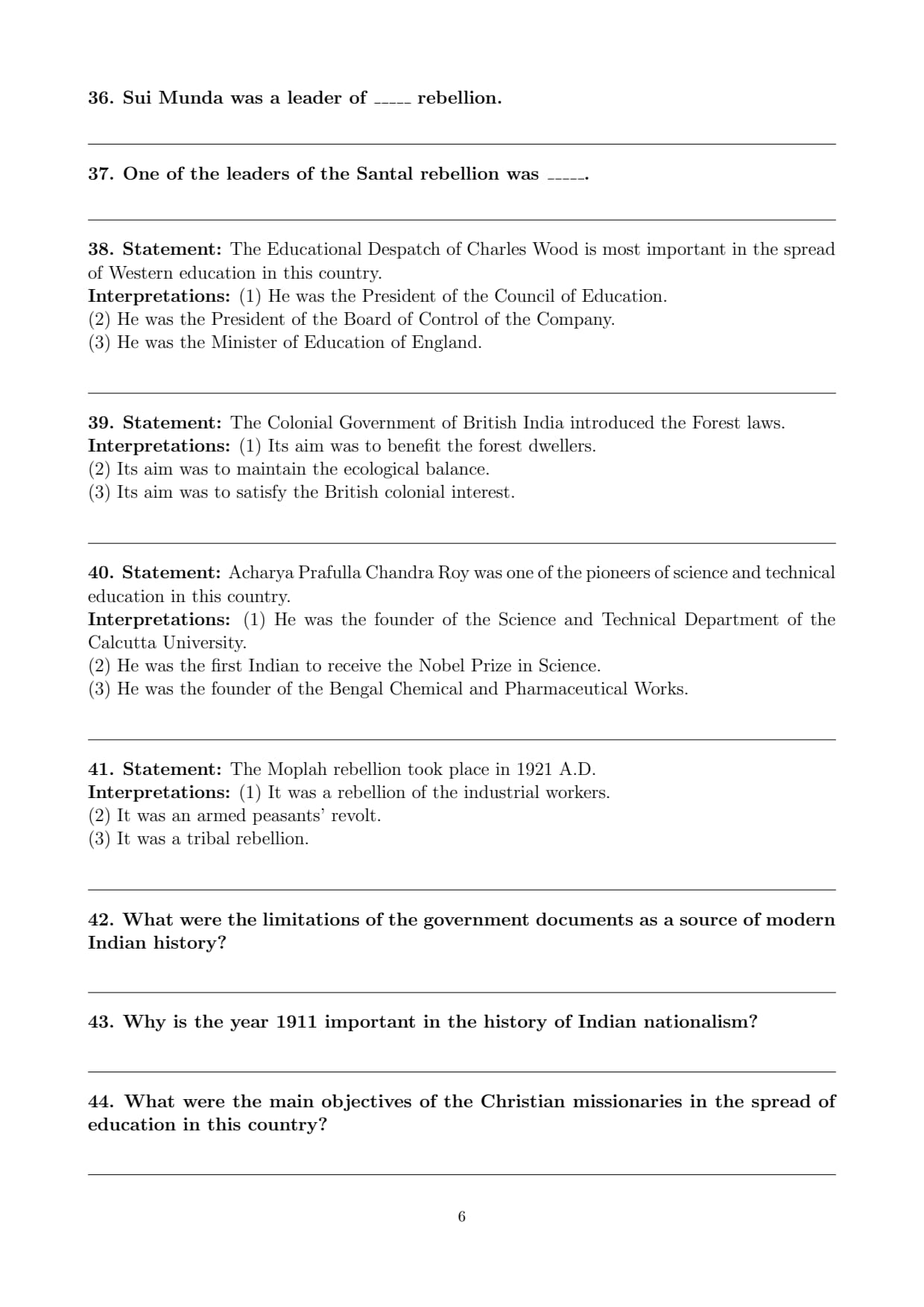
Sui Munda was a leader of _____ rebellion.
View Solution
Concept:
The Kol Rebellion (1831--32) was an important tribal uprising against British rule and oppressive landlords in the Chotanagpur region.
Step 1: Identify the personality.
Sui Munda was one of the prominent tribal leaders associated with the Kol uprising.
Step 2: Identify the rebellion.
He played a role in mobilizing tribal resistance during the Kol Rebellion.
Step 3: Conclusion.
Hence, the blank should be filled with \textit{Kol rebellion. Quick Tip: Sui Munda is associated with the Kol Rebellion (1831--32) of the Chotanagpur region.
One of the leaders of the Santal rebellion was _____.
View Solution
Concept:
The Santal Rebellion (1855--56) was a major tribal uprising against British rule and exploitative zamindars in present-day Jharkhand and Bengal.
Step 1: Identify the leaders.
The rebellion was led by the Murmu brothers — Sidhu Murmu and Kanhu Murmu.
Step 2: Fill the blank.
Since the question asks for one leader, either Sidhu or Kanhu is correct.
Step 3: Conclusion.
A correct answer is \textit{Sidhu Murmu (or Kanhu Murmu). Quick Tip: The Santal Rebellion (1855--56) was led by Sidhu and Kanhu Murmu.
Statement: The Educational Despatch of Charles Wood is most important in the spread of Western education in this country.
Interpretations:
(1) He was the President of the Council of Education.
(2) He was the President of the Board of Control of the Company.
(3) He was the Minister of Education of England.
View Solution
Concept:
The Wood’s Despatch of 1854 is considered the Magna Carta of English education in India. It laid the foundation of modern Western education under British rule.
Step 1: Understand the statement.
The statement is correct because the Educational Despatch of 1854 played a crucial role in spreading Western education in India.
Step 2: Examine Interpretation (1).
Charles Wood was not the President of the Council of Education in India. \[ Interpretation (1) is incorrect. \]
Step 3: Examine Interpretation (2).
Charles Wood was the President of the Board of Control, which supervised the East India Company’s administration. \[ Interpretation (2) is correct. \]
Step 4: Examine Interpretation (3).
He was not the Minister of Education of England. \[ Interpretation (3) is incorrect. \]
Conclusion:
Only Interpretation (2) correctly explains the statement. Quick Tip: Wood’s Despatch (1854) is called the Magna Carta of English education in India. Charles Wood was the President of the Board of Control.
Statement: The Colonial Government of British India introduced the Forest laws.
Interpretations:
(1) Its aim was to benefit the forest dwellers.
(2) Its aim was to maintain the ecological balance.
(3) Its aim was to satisfy the British colonial interest.
View Solution
Concept:
The British introduced forest laws in India mainly to control forest resources for economic and strategic purposes rather than for environmental or local welfare.
Step 1: Understand the statement.
The statement is correct because the British colonial government enacted several Forest Acts (1865, 1878, 1927).
Step 2: Examine Interpretation (1).
Forest laws restricted the traditional rights of forest dwellers and tribal communities. \[ Interpretation (1) is incorrect. \]
Step 3: Examine Interpretation (2).
Ecological conservation was not the primary objective of colonial forest policy. \[ Interpretation (2) is incorrect. \]
Step 4: Examine Interpretation (3).
The main objective was to secure timber and forest resources for railways, shipbuilding, and revenue. \[ Interpretation (3) is correct. \]
Conclusion:
Only Interpretation (3) correctly explains the statement. Quick Tip: British forest laws were mainly introduced to serve colonial economic interests, especially timber extraction.
Statement: Acharya Prafulla Chandra Roy was one of the pioneers of science and technical education in this country.
Interpretations:
(1) He was the founder of the Science and Technical Department of the Calcutta University.
(2) He was the first Indian to receive the Nobel Prize in Science.
(3) He was the founder of the Bengal Chemical and Pharmaceutical Works.
View Solution
Concept:
Acharya Prafulla Chandra Ray was a pioneering Indian chemist, educator, and industrialist who contributed immensely to scientific education and indigenous industry in India.
Step 1: Understand the statement.
The statement is correct because P.C. Ray played a major role in developing modern science education and research in India.
Step 2: Examine Interpretation (1).
He was associated with the development of science education at Calcutta University and helped build its scientific departments. \[ Interpretation (1) is correct. \]
Step 3: Examine Interpretation (2).
The first Indian Nobel laureate in science was C.V. Raman (Physics, 1930), not P.C. Ray. \[ Interpretation (2) is incorrect. \]
Step 4: Examine Interpretation (3).
He founded the Bengal Chemical and Pharmaceutical Works, India’s first indigenous chemical industry. \[ Interpretation (3) is correct. \]
Conclusion:
Interpretations (1) and (3) correctly explain the statement. Quick Tip: Prafulla Chandra Ray founded Bengal Chemicals and was a pioneer of modern science education in India.
Statement: The Moplah rebellion took place in 1921 A.D.
Interpretations:
(1) It was a rebellion of the industrial workers.
(2) It was an armed peasants' revolt.
(3) It was a tribal rebellion.
View Solution
Concept:
The Moplah (Mapilla) Rebellion of 1921 occurred in the Malabar region of Kerala and was a significant agrarian uprising during the British period.
Step 1: Understand the statement.
The statement is correct because the Moplah rebellion took place in 1921 during the Khilafat and Non-Cooperation movements.
Step 2: Examine Interpretation (1).
The rebellion was not led by industrial workers but mainly by peasants. \[ Interpretation (1) is incorrect. \]
Step 3: Examine Interpretation (2).
It was essentially an armed peasant uprising against oppressive landlords and colonial authority. \[ Interpretation (2) is correct. \]
Step 4: Examine Interpretation (3).
It was not primarily a tribal revolt; it was an agrarian movement. \[ Interpretation (3) is incorrect. \]
Conclusion:
Only Interpretation (2) correctly explains the statement. Quick Tip: The Moplah Rebellion (1921) was an armed peasant uprising in the Malabar region of Kerala.
What were the limitations of the government documents as a source of modern Indian history?
View Solution
Concept:
Government documents are important primary sources for modern Indian history, especially for understanding colonial administration, policies, and official perspectives. However, they have several limitations that historians must critically evaluate.
Limitations:
1. Official Bias:
Government records were created by colonial authorities and often reflected the interests and viewpoints of the rulers rather than the ruled.
2. Lack of People's Perspective:
These documents rarely represent the voices of common people such as peasants, workers, women, and tribal communities.
3. Selective Recording:
Only events considered important by the administration were documented. Many local movements and everyday experiences were ignored.
4. Justification of Policies:
Colonial documents often attempted to justify British policies and portray them as beneficial, even when they were exploitative.
5. Incomplete Information:
Some records were lost, censored, or never documented, leading to gaps in historical reconstruction.
6. Language and Accessibility Issues:
Many documents were written in official language (English or Persian earlier), making them less accessible to the broader population and sometimes limiting interpretation.
Conclusion:
While government documents are valuable historical sources, historians must use them cautiously and supplement them with other sources such as personal accounts, newspapers, folk traditions, and oral histories. Quick Tip: Government documents are useful but biased sources — always compare them with non-official sources for balanced historical analysis.
Why is the year 1911 important in the history of Indian nationalism?
View Solution
Concept:
The year 1911 is significant in Indian nationalist history because of several political developments that influenced the course of the freedom movement.
Key Reasons:
1. Annulment of the Partition of Bengal:
The British government revoked the 1905 Partition of Bengal in 1911 due to strong nationalist opposition and the Swadeshi Movement.
2. Transfer of Capital:
The capital of British India was shifted from Calcutta to Delhi, reducing Bengal’s political importance and aiming to weaken nationalist influence.
3. Royal Proclamation:
King George V announced these changes during the Delhi Durbar of 1911, marking a major administrative shift.
4. Impact on Nationalism:
The annulment was seen as a victory for Indian nationalism, proving that mass movements could compel the British to reverse policies.
Conclusion:
Thus, 1911 marked both a symbolic success for Indian nationalism and a strategic shift in British colonial policy. Quick Tip: 1911: Annulment of Bengal Partition and transfer of capital from Calcutta to Delhi.
What were the main objectives of the Christian missionaries in the spread of education in this country?
View Solution
Concept:
Christian missionaries played a significant role in the spread of modern education in India, especially during the 19th century. Their educational activities were driven by both religious and social motives.
Main Objectives:
1. Spread of Christianity:
A primary aim was to promote Christian teachings and facilitate conversion through education.
2. Moral and Religious Reform:
Missionaries sought to reform what they viewed as social evils by spreading Western moral values.
3. Promotion of Western Education:
They introduced modern subjects such as science, mathematics, and English literature.
4. Upliftment of Marginalized Groups:
Missionary schools often targeted lower castes, tribal communities, and women who had limited access to traditional education.
5. Cultural Influence:
They aimed to create a class of Indians familiar with Western culture and thought.
Conclusion:
While missionary education contributed significantly to modern learning, it was closely linked with religious and cultural objectives. Quick Tip: Missionary education combined Western learning with the aim of spreading Christianity and social reform.
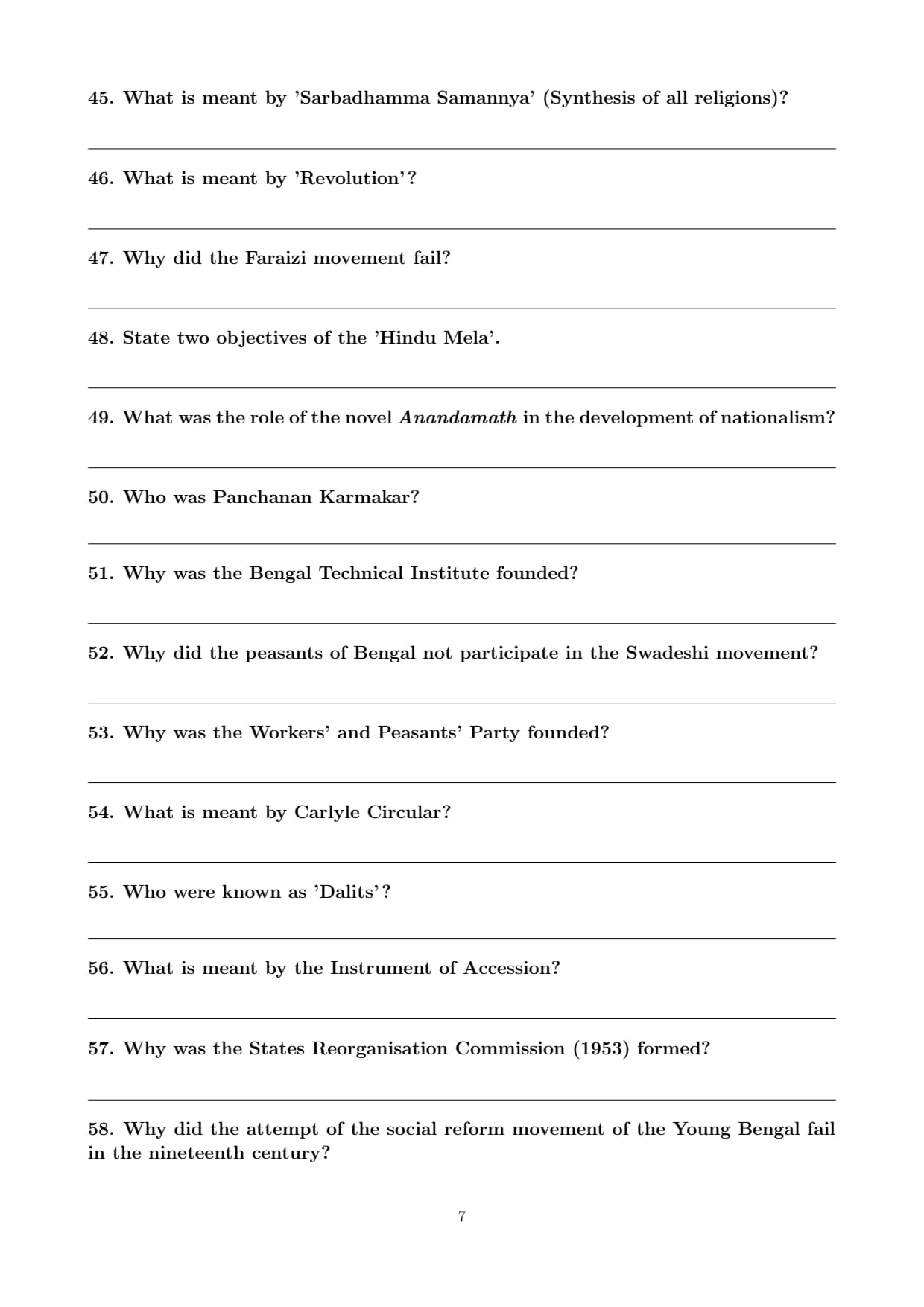
What is meant by 'Sarbadhamma Samannya' (Synthesis of all religions)?
View Solution
Concept:
'Sarbadhamma Samannya' refers to the idea of harmony and unity among all religions, emphasizing that all faiths ultimately lead to the same truth.
Explanation:
The concept promotes religious tolerance and mutual respect among followers of different faiths.
It became prominent during the Bengal Renaissance and Indian reform movements.
Thinkers like Ramakrishna Paramahamsa and Swami Vivekananda advocated this idea.
It aimed to counter religious divisions and promote national unity.
Conclusion:
'Sarbadhamma Samannya' means the synthesis or harmony of all religions, highlighting unity in diversity. Quick Tip: Sarbadhamma Samannya = harmony of all religions; strongly associated with Ramakrishna and Vivekananda.
What is meant by 'Revolution'?
View Solution
Concept:
A revolution refers to a sudden and fundamental change in political, social, or economic structures, often brought about by mass movements or uprisings.
Explanation:
It involves the overthrow or transformation of an existing system of authority.
Revolutions can be violent (e.g., armed uprisings) or non-violent (mass movements).
In the Indian context, it may refer to revolutionary activities against British colonial rule.
Conclusion:
A revolution is a rapid and profound transformation of an established system, usually driven by popular movements. Quick Tip: Revolution = rapid and fundamental change in political or social order.
Why did the Faraizi movement fail?
View Solution
Concept:
The Faraizi Movement was a 19th-century Islamic reform movement led by Haji Shariatullah and later by Dudu Miyan in Bengal. It aimed at religious purification and social reform among Muslim peasants.
Reasons for Failure:
1. Strong British Opposition:
The colonial government suppressed the movement due to its mobilization of peasants.
2. Zamindari Resistance:
Local landlords opposed the movement as it challenged exploitative agrarian practices.
3. Limited Organizational Structure:
The movement lacked a strong centralized political structure to sustain long-term resistance.
4. Leadership Crisis:
After the death of key leaders like Dudu Miyan, the movement lost momentum.
5. Regional Limitation:
It remained confined mainly to Bengal and did not expand into a wider national movement.
Conclusion:
Due to repression, leadership loss, and limited reach, the Faraizi Movement gradually declined. Quick Tip: Faraizi Movement declined due to British repression, zamindari opposition, and loss of leadership.
State two objectives of the 'Hindu Mela'.
View Solution
Concept:
The Hindu Mela, started in 1867 in Bengal, was an early nationalist initiative aimed at fostering patriotism and cultural pride.
Objectives:
1. Promotion of Nationalism:
To instill a sense of national identity and pride among Indians through cultural activities.
2. Revival of Indigenous Culture:
To encourage Indian traditions, literature, and arts as a counter to Western cultural dominance.
3. Swadeshi Spirit (additional point):
To promote indigenous goods and discourage dependence on foreign products.
Conclusion:
The Hindu Mela aimed to promote nationalism and revive indigenous culture among Indians. Quick Tip: Hindu Mela (1867) aimed to promote nationalism and revive Indian culture and traditions.
What was the role of the novel Anandamath in the development of nationalism?
View Solution
Concept:
Anandamath, written by Bankim Chandra Chattopadhyay and published in 1882, played a significant role in shaping early Indian nationalism through literature.
Role in Nationalism:
1. Inspiration for Patriotism:
The novel depicted the struggle against oppression and inspired a sense of national pride.
2. Introduction of 'Vande Mataram':
It included the patriotic song \textit{Vande Mataram, which later became a national slogan of the freedom movement.
3. Spiritual Nationalism:
It blended religious imagery with nationalism, presenting the motherland as a divine entity.
4. Influence on Freedom Fighters:
The novel inspired revolutionaries and nationalist leaders in the late 19th and early 20th centuries.
Conclusion:
\textit{Anandamath played a vital role in awakening nationalist consciousness and providing cultural inspiration for the freedom movement. Quick Tip: \textit{Anandamath (1882) popularized Vande Mataram and inspired early Indian nationalism.
Who was Panchanan Karmakar?
View Solution
Concept:
Panchanan Karmakar was an important figure in the early history of printing in Bengal.
Explanation:
He was one of the earliest Bengali type-founders and craftsmen.
He worked with Charles Wilkins in developing Bengali printing types.
His work contributed significantly to the growth of Bengali printing and publishing.
Conclusion:
Panchanan Karmakar was a pioneer of Bengali typography and printing. Quick Tip: Panchanan Karmakar was an early Bengali type-founder associated with the development of Bengali printing.
Why was the Bengal Technical Institute founded?
View Solution
Concept:
The Bengal Technical Institute (founded in 1906) was established during the Swadeshi Movement as part of efforts to promote national education and self-reliance.
Reasons for Foundation:
1. Promotion of National Education:
It aimed to provide technical education free from British control.
2. Swadeshi Ideals:
The institute was inspired by the Swadeshi Movement’s goal of economic self-reliance.
3. Development of Indigenous Industry:
It sought to train Indians in engineering and technical skills to reduce dependence on foreign expertise.
4. Alternative to Colonial Institutions:
It provided an indigenous alternative to government-run technical institutions.
Conclusion:
The Bengal Technical Institute was founded to promote technical education based on nationalist and Swadeshi ideals. Quick Tip: Bengal Technical Institute (1906) was founded during the Swadeshi Movement to promote national technical education.
Why did the peasants of Bengal not participate in the Swadeshi movement?
View Solution
Concept:
Although the Swadeshi Movement (1905) had strong urban support, peasant participation in Bengal remained limited due to several socio-economic reasons.
Reasons:
1. Urban-Centric Leadership:
The movement was mainly led by urban middle-class leaders and did not fully address rural concerns.
2. Economic Constraints:
Swadeshi goods were often more expensive, making it difficult for poor peasants to boycott cheaper foreign products.
3. Lack of Awareness:
Limited communication and literacy restricted the spread of nationalist ideas in rural areas.
4. Zamindari Pressure:
Many peasants were dependent on landlords who did not support the movement.
5. Focus on Political Rather than Agrarian Issues:
The movement did not directly address peasants’ immediate problems such as rent and land rights.
Conclusion:
Due to economic hardship, lack of awareness, and limited rural focus, peasants in Bengal largely stayed away from the Swadeshi Movement. Quick Tip: Swadeshi Movement had limited peasant participation due to urban leadership and lack of agrarian focus.
Why was the Workers' and Peasants' Party founded?
View Solution
Concept:
The Workers' and Peasants' Party (WPP) emerged in the 1920s as a left-wing political formation in India, influenced by socialist and communist ideas.
Reasons for Foundation:
1. Representation of Labour and Peasants:
It aimed to organize workers and peasants and represent their economic and political interests.
2. Spread of Socialist Ideas:
The party sought to popularize socialist ideology in the Indian freedom struggle.
3. Opposition to Colonial Exploitation:
It protested against British economic policies that exploited labour and agrarian classes.
4. Strengthening Mass Politics:
The party tried to link the national movement with mass struggles of workers and peasants.
Conclusion:
The Workers' and Peasants' Party was founded to mobilize labour and peasants and introduce socialist perspectives into Indian politics. Quick Tip: Workers' and Peasants' Party (1920s) aimed to organize labour and peasants and spread socialist ideas in India.
What is meant by Carlyle Circular?
View Solution
Concept:
The Carlyle Circular was an official directive issued during the Swadeshi Movement to curb student participation in nationalist activities.
Explanation:
Issued in 1905 by R.W. Carlyle, the Chief Secretary of Bengal.
It prohibited students from taking part in political meetings, protests, and nationalist movements.
Institutions were warned that students involved in politics could face expulsion or disciplinary action.
The circular led to widespread protests and encouraged the growth of national education institutions.
Conclusion:
The Carlyle Circular was a colonial measure aimed at suppressing student involvement in the Swadeshi Movement. Quick Tip: Carlyle Circular (1905) banned students from participating in nationalist politics during the Swadeshi Movement.
Who were known as 'Dalits'?
View Solution
Concept:
The term "Dalit" refers to communities that were historically placed at the lowest level of the traditional caste hierarchy in India and subjected to social discrimination.
Explanation:
The word "Dalit" means "oppressed" or "broken" in Sanskrit.
It was used for communities earlier referred to as "Untouchables."
Dalits faced social exclusion, economic exploitation, and denial of basic rights.
Leaders like Dr. B.R. Ambedkar worked for their upliftment and social equality.
Conclusion:
Dalits were socially marginalized communities subjected to caste-based discrimination in traditional Indian society. Quick Tip: Dalits = historically oppressed communities formerly called "Untouchables."
What is meant by the Instrument of Accession?
View Solution
Concept:
The Instrument of Accession was a legal document used during the transfer of power in 1947 to integrate princely states into India or Pakistan.
Explanation:
It was signed by rulers of princely states.
By signing it, a ruler agreed to accede to either India or Pakistan.
The accession usually covered defence, foreign affairs, and communications.
It played a crucial role in the political integration of India.
Conclusion:
The Instrument of Accession was the legal means through which princely states joined the Indian Union. Quick Tip: Instrument of Accession (1947) enabled princely states to join India or Pakistan.
Why was the States Reorganisation Commission (1953) formed?
View Solution
Concept:
After independence, there was strong demand for reorganizing Indian states on linguistic and administrative lines.
Reasons for Formation:
1. Linguistic Demands:
People demanded states based on linguistic identity for administrative convenience and cultural unity.
2. Regional Movements:
Movements like the Andhra agitation intensified the need for reorganization.
3. Administrative Efficiency:
Reorganisation was necessary to improve governance and reduce regional disparities.
4. National Integration:
It aimed to balance regional aspirations with national unity.
Conclusion:
The States Reorganisation Commission (1953) was formed to examine and recommend the reorganisation of Indian states, mainly on linguistic lines. Quick Tip: States Reorganisation Commission (1953) led to linguistic reorganisation of states in 1956.
Why did the attempt of the social reform movement of the Young Bengal fail in the nineteenth century?
View Solution
Concept:
The Young Bengal Movement, led by Henry Louis Vivian Derozio and his followers (Derozians), aimed at social and intellectual reform in early 19th-century Bengal. Despite its progressive ideas, the movement failed to achieve lasting social impact.
Reasons for Failure:
1. Limited Social Base:
The movement was confined mainly to a small group of educated urban youth and did not reach the broader population.
2. Lack of Mass Support:
Its radical ideas failed to gain acceptance among conservative Indian society.
3. Western-Oriented Outlook:
The excessive emphasis on Western rationalism alienated traditional sections of society.
4. Absence of Organised Structure:
The movement lacked strong organization and leadership continuity after Derozio’s early death.
5. Cultural Disconnect:
It did not effectively connect reform ideas with indigenous traditions, making reforms appear foreign.
6. No Concrete Reform Programme:
The movement focused more on intellectual debate than practical social reform measures.
Conclusion:
Due to its limited reach, lack of organization, and disconnect from Indian social realities, the Young Bengal Movement failed to bring about significant social reform. Quick Tip: Young Bengal Movement failed due to limited mass support, excessive Western orientation, and lack of organization.
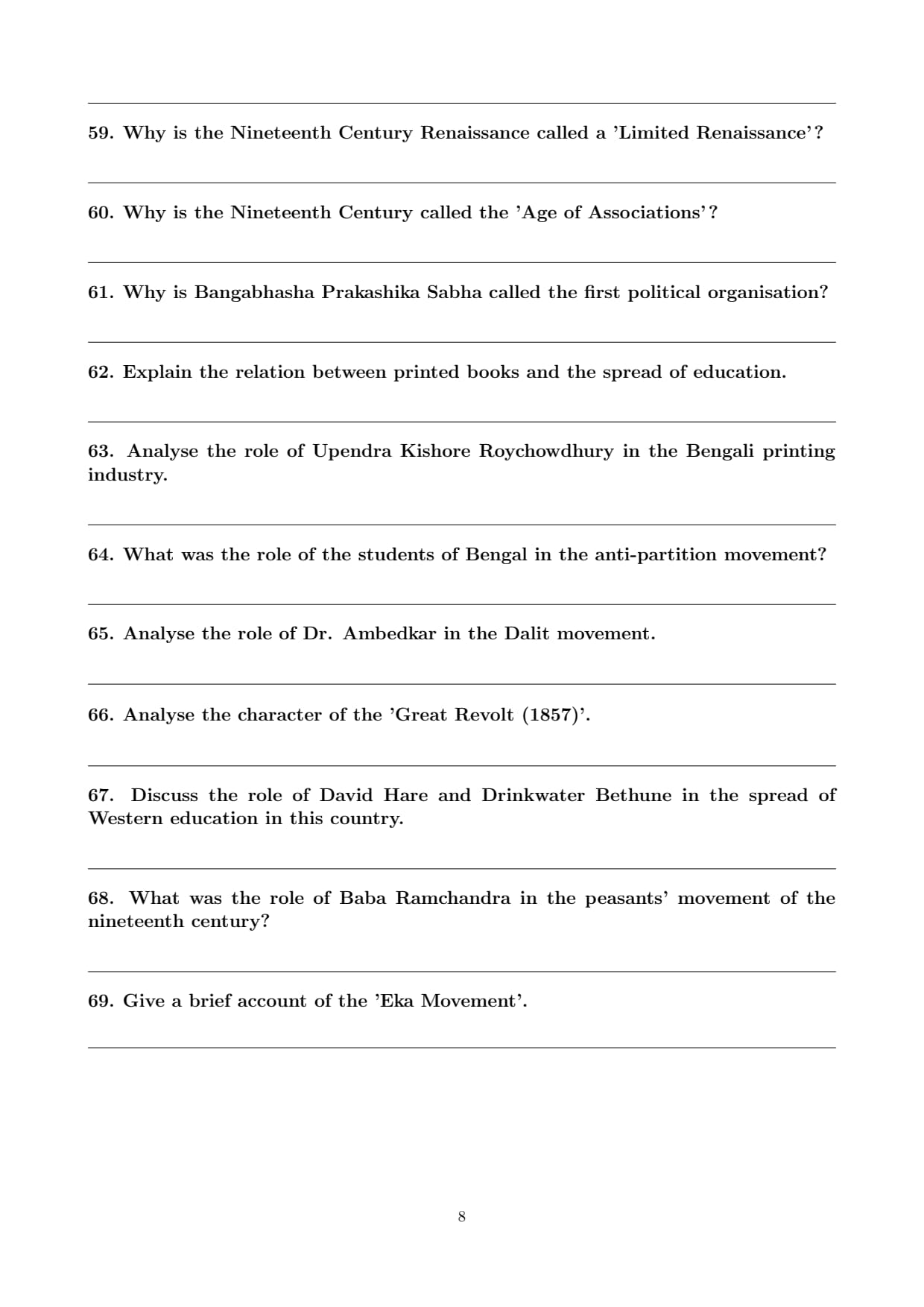
Why is the Nineteenth Century Renaissance called a 'Limited Renaissance'?
View Solution
Concept:
The Nineteenth Century Renaissance in India, particularly in Bengal, brought significant intellectual, social, and cultural awakening. However, historians often describe it as a "Limited Renaissance" because its impact was restricted in several ways.
Reasons:
1. Urban and Elite-Centric:
The Renaissance mainly influenced educated urban elites and did not significantly affect rural masses.
2. Limited Social Reach:
Large sections of society, including peasants, workers, and tribal communities, remained outside its influence.
3. Regional Restriction:
Its strongest impact was confined largely to Bengal and a few urban centers.
4. Gender Limitations:
Although it addressed women’s issues, real social transformation for women remained limited.
5. Dependence on Western Ideas:
Much of the Renaissance was inspired by Western education and thought, which limited its indigenous roots.
6. Lack of Mass Political Mobilization:
Unlike later nationalist movements, it did not mobilize people on a large political scale.
Conclusion:
The Nineteenth Century Renaissance is called a "Limited Renaissance" because its benefits were confined mainly to urban, educated elites and did not transform the broader Indian society. Quick Tip: 19th-century Renaissance = intellectually significant but socially limited in reach.
Why is the Nineteenth Century called the 'Age of Associations'?
View Solution
Concept:
The nineteenth century in India witnessed the emergence of numerous political, social, and cultural organizations that contributed to the growth of modern public life and nationalism.
Reasons:
1. Rise of Public Organisations:
Many associations were formed for social reform, education, and political awareness.
2. Spread of Political Consciousness:
These organizations promoted political discussion and civic participation among educated Indians.
3. Social Reform Movements:
Associations like the Brahmo Samaj and other reformist bodies worked against social evils.
4. Foundation of Nationalism:
Early political associations laid the groundwork for later national movements and organizations like the Indian National Congress.
5. Intellectual Awakening:
They fostered debate, journalism, and modern public opinion.
Conclusion:
Because of the rapid growth of numerous social and political organizations, historians describe the nineteenth century as the "Age of Associations." Quick Tip: 19th century = Age of Associations due to the rise of reformist and political organisations.
Why is Bangabhasha Prakashika Sabha called the first political organisation?
View Solution
Concept:
The Bangabhasha Prakashika Sabha, founded in 1836 in Calcutta, is considered one of the earliest political associations in India.
Reasons:
1. Early Political Discussion:
It was among the first organizations where Indians discussed political issues and administrative policies.
2. Public Opinion Formation:
The Sabha aimed to create awareness about governance and promote political consciousness.
3. Indigenous Initiative:
It was formed by Indians, marking an early step toward organized political activity.
4. Precursor to Later Bodies:
It laid the foundation for later political associations and nationalist organizations.
Conclusion:
Bangabhasha Prakashika Sabha is called the first political organization because it initiated organized political discussion and awareness among Indians. Quick Tip: Bangabhasha Prakashika Sabha (1836) is regarded as the earliest political association in India.
Explain the relation between printed books and the spread of education.
View Solution
Concept:
The advent of printed books played a crucial role in the spread of education in modern India by making knowledge more accessible and affordable.
Relation between Printing and Education:
1. Mass Production of Books:
Printing technology enabled large-scale production of books, making them widely available.
2. Affordable Learning Materials:
Printed books were cheaper than handwritten manuscripts, allowing more people to access education.
3. Spread of Literacy:
The availability of textbooks and primers helped promote literacy among common people.
4. Standardization of Knowledge:
Printed materials ensured uniformity in curriculum and dissemination of ideas.
5. Growth of Vernacular Education:
Books printed in regional languages made education accessible beyond English-speaking elites.
6. Role in Social Reform and Nationalism:
Printed books spread reformist and nationalist ideas, contributing to intellectual awakening.
Conclusion:
Thus, printed books were instrumental in expanding education by democratizing knowledge and promoting literacy and awareness. Quick Tip: Printing revolution = mass education, literacy growth, and spread of reformist ideas.
Analyse the role of Upendra Kishore Roychowdhury in the Bengali printing industry.
View Solution
Concept:
Upendra Kishore Roychowdhury was a pioneer of modern printing technology in Bengal and played a transformative role in the development of the Bengali printing industry.
Role in Printing Industry:
1. Technological Innovation:
He introduced advanced printing techniques, including half-tone block making, in India.
2. Modernization of Printing:
He improved printing quality through scientific methods and experimentation.
3. Establishment of U. Ray \& Sons:
He founded a modern printing press that became a landmark in Bengali publishing.
4. Contribution to Children's Literature:
He published high-quality illustrated books and magazines like \textit{Sandesh.
5. Integration of Art and Technology:
He combined artistic skill with technical expertise, raising the standard of book illustration.
6. Influence on Future Generations:
His work inspired later developments in printing and publishing in Bengal.
Conclusion:
Upendra Kishore Roychowdhury modernized the Bengali printing industry through innovation, quality printing, and artistic excellence. Quick Tip: Upendra Kishore Roychowdhury pioneered half-tone printing and modernized Bengali publishing.
What was the role of the students of Bengal in the anti-partition movement?
View Solution
Concept:
Students played a dynamic and influential role in the Anti-Partition Movement (1905) against the partition of Bengal, making it a mass-based nationalist struggle.
Role of Students:
1. Leadership in Protests:
Students actively organized rallies, processions, and public demonstrations against the partition.
2. Boycott Movement:
They promoted the boycott of British goods and encouraged the use of Swadeshi products.
3. Spread of Nationalist Ideas:
Students distributed pamphlets, sang patriotic songs, and spread awareness among the masses.
4. Participation in Swadeshi Education:
Many students left government institutions and joined national schools and colleges.
5. Revolutionary Activities:
Some students later became involved in revolutionary nationalist organizations.
6. Facing Repression:
Despite British measures like the Carlyle Circular, students continued their nationalist activities.
Conclusion:
The participation of students transformed the Anti-Partition Movement into a vibrant mass movement and strengthened the foundation of Indian nationalism. Quick Tip: Students were the backbone of the Anti-Partition Movement through protests, Swadeshi, and nationalist education.
Analyse the role of Dr. Ambedkar in the Dalit movement.
View Solution
Concept:
Dr. B.R. Ambedkar was the foremost leader of the Dalit movement and played a pivotal role in the struggle for social justice and equality in modern India.
Role in the Dalit Movement:
1. Fight Against Untouchability:
Ambedkar led movements against caste discrimination and social exclusion.
2. Social and Political Mobilization:
He organized Dalits through associations like the Depressed Classes Federation.
3. Temple Entry and Civil Rights Movements:
He led agitations such as the Mahad Satyagraha for access to public water and temple entry movements.
4. Demand for Political Representation:
He advocated separate electorates and political safeguards for Dalits.
5. Role in Constitution Making:
As the Chairman of the Drafting Committee, he ensured constitutional guarantees of equality and fundamental rights.
6. Promotion of Education and Self-Respect:
He emphasized education and self-empowerment as tools for liberation.
Conclusion:
Dr. Ambedkar transformed the Dalit movement into a powerful struggle for equality, dignity, and constitutional rights. Quick Tip: Dr. Ambedkar = key architect of Dalit rights, social justice, and constitutional equality in India.
Analyse the character of the 'Great Revolt (1857)'.
View Solution
Concept:
The Revolt of 1857, also known as the First War of Independence, was a major uprising against British rule. Historians have debated its character, describing it as a complex and multi-dimensional movement.
Character of the Revolt:
1. Sepoy Mutiny:
Initially, it began as a revolt of Indian soldiers (sepoys) in the British army due to grievances like greased cartridges and discrimination.
2. Feudal Reaction:
Dispossessed rulers, zamindars, and princes joined the revolt to regain lost power and privileges.
3. Peasant Uprising:
In many regions, peasants participated due to agrarian distress and oppressive revenue policies.
4. Popular Revolt:
In areas like Awadh, the revolt took the form of a broad-based popular uprising involving multiple social groups.
5. Religious Dimension:
There was a perception that British policies threatened traditional religions, which contributed to unity among Hindus and Muslims.
6. Limited National Character:
Although it showed elements of unity, it lacked all-India coordination and a clear national ideology.
7. Regional Variation:
The intensity and nature of the revolt varied across regions, being strong in North and Central India but weak elsewhere.
Historiographical Views:
British historians called it a "Sepoy Mutiny."
Nationalist historians described it as the "First War of Independence."
Modern historians view it as a combination of military, feudal, and popular uprisings.
Conclusion:
The Great Revolt of 1857 was a multi-faceted movement with military, feudal, and popular elements. Though not a fully developed national movement, it marked the beginning of organized resistance against British rule. Quick Tip: 1857 Revolt = multi-dimensional: sepoy mutiny + feudal reaction + popular uprising.
Discuss the role of David Hare and Drinkwater Bethune in the spread of Western education in this country.
View Solution
Concept:
David Hare and John Elliot Drinkwater Bethune were two important figures who significantly contributed to the spread of Western education in 19th-century India, particularly in Bengal.
Role of David Hare:
1. Promotion of Modern Education:
David Hare was a Scottish watchmaker turned educationist who dedicated his life to promoting Western education in Bengal.
2. Founding of Institutions:
He played a key role in establishing institutions such as the Hindu College (1817) and the School Book Society.
3. Support for Secular Education:
He promoted scientific and rational education rather than religious instruction.
4. Spread of English Education:
Hare strongly supported English as a medium for modern knowledge and intellectual development.
Role of Drinkwater Bethune:
1. Pioneer of Women's Education:
Bethune was a strong advocate of female education in India.
2. Establishment of Bethune School:
In 1849, he founded the Bethune School in Calcutta, the first government-supported school for girls in India.
3. Institutional Support:
As a law member of the Governor-General’s Council, he worked to promote educational reforms.
4. Encouragement of Social Reform:
His initiatives inspired Indian reformers to support women’s education.
Conclusion:
David Hare contributed significantly to the spread of Western education among boys and the urban middle class, while Drinkwater Bethune pioneered modern female education. Together, they played a crucial role in the development of modern education in India. Quick Tip: David Hare → Hindu College, modern education; Bethune → pioneer of women's education, Bethune School (1849).
What was the role of Baba Ramchandra in the peasants' movement of the nineteenth century?
View Solution
Concept:
Baba Ramchandra was an important leader of peasant movements in North India, especially in Awadh (Oudh), and played a significant role in mobilizing peasants against oppressive agrarian systems.
Role in the Peasants' Movement:
1. Leader of Awadh Peasant Movement:
He emerged as a prominent leader of the peasant struggle in Awadh during the early 20th century (often discussed with late colonial agrarian movements).
2. Mobilization of Peasants:
Baba Ramchandra organized peasants against high rents, illegal cesses, and exploitation by landlords.
3. Formation of Kisan Sabhas:
He helped establish peasant organizations and mobilized rural masses under the banner of Kisan Sabhas.
4. Use of Religious Idiom:
He used religious symbols and recitations from the Ramayana to connect with peasants and spread awareness.
5. Link with National Movement:
He connected peasant struggles with the broader nationalist movement and worked with Congress leaders at times.
6. Demand for Agrarian Reforms:
He raised demands for reduction of rent, abolition of forced labour (begar), and protection of tenants’ rights.
Conclusion:
Baba Ramchandra played a crucial role in awakening political consciousness among peasants and organizing agrarian resistance, making him a key figure in early peasant movements in India. Quick Tip: Baba Ramchandra = leader of Awadh peasant movement; organized Kisan Sabhas and mobilized peasants against zamindars.
Give a brief account of the 'Eka Movement'.
View Solution
Concept:
The Eka Movement was a peasant uprising that took place in the early 1920s in the districts of Hardoi, Bahraich, and Sitapur in Uttar Pradesh. It emerged as part of the broader wave of agrarian unrest during the Non-Cooperation period.
Key Features:
1. Background:
Peasants were suffering due to high rents, illegal cesses, and exploitation by landlords and revenue officials.
2. Meaning of 'Eka':
The term "Eka" means unity, symbolizing collective peasant resistance.
3. Leadership:
Local leaders and village headmen played a significant role, though it was less centrally organized than other movements.
4. Nature of Protest:
Peasants took pledges of unity, refused to pay excessive rents, and sometimes resisted landlords violently.
5. Relation with National Movement:
Initially influenced by the Non-Cooperation Movement, it later became more militant and less controlled by national leaders.
6. Suppression:
The British government suppressed the movement through repression and arrests.
Conclusion:
The Eka Movement was an important peasant protest reflecting agrarian distress and the growing politicization of rural India during the early 20th century. Quick Tip: Eka Movement (1921–22) = peasant unity movement in U.P. against high rents and landlord exploitation.



Comments