




Chapters such as Calculus (including limits, derivatives, and integrals), Coordinate Geometry (including straight lines, circles, and 3D geometry), Algebra (complex numbers, quadratic equations, sequences and series, matrices, and binomial theorem), and Vectors and 3D Geometry are the high weightage chapters for JEE Mains 2026 Maths.
- Class 11 JEE important topics are complex numbers, sequences and series, conic sections and trigonometry.
- The important topics for Class 12 JEE include differential calculus, integral calculus, 3D geometry, matrices and probability
| Section | Important Chapters |
|---|---|
| Calculus | Limits, Continuity & Differentiability; Applications of Derivatives; Indefinite & Definite Integrals; Applications of Integrals; Differential Equations |
| Coordinate Geometry | Straight Lines; Circles; Parabola, Ellipse & Hyperbola |
| Algebra | Complex Numbers & Quadratic Equations; Sequences & Series; Binomial Theorem; Matrices & Determinants |
| Vectors & 3D Geometry | Vector Algebra; 3D Geometry (Equations of Lines & Planes) |
Related Links:
Key Summary
- Topics such as calculus hold around 30% weightage. This makes it the most important section of the JEE Main exam. Topics such as Coordinate geometry and algebra cover around 40%. The remaining topics, such as probability, trigonometry and statistics, contribute to the rest of the percentage.
- The Maths syllabus of Class 11 JEE contains complex numbers, conic sections, trigonometry and sequences and series. The candidates should focus on these topics, as they will help them build a strong base for Class 12 chapters like differential and integral calculus.
- Chapters like sets and functions, and mathematical reasoning are smaller but easy-scoring if you revise them well.
- From the Class 12 syllabus, different units and topics like differential calculus, integral calculus, 3D geometry, matrices and probability are important. These chapters are frequently asked in the exam. The candidates are required to focus on these subjects if they want to score in the 90+ percentile range.
- To gain depth in the basic concepts and problems, the candidates can start with the NCERT Maths for classes 11 and 12. Next, they can start their practice with RD Sharma, advanced problem-solving with Cengage and topic preparation in high-weightage subjects such as calculus, algebra, and coordinate geometry with Arihant Skills in Mathematics series.
- High Weightage Chapters for JEE Mains 2026 Maths from Class 11 Syllabus
- High Weightage Chapters for JEE Mains 2026 Maths from Class 12 Syllabus
- Detailed JEE Mains Maths Syllabus 2026
- Best Books to Prepare for High Weightage Chapters for JEE Mains 2026 Maths
- JEE Main 2025 Last 7 Days Preparation Tips to Boost Your Score
- High Weightage Chapters for JEE Mains 2026 Maths FAQs
- Related News
High Weightage Chapters for JEE Mains 2026 Maths from Class 11 Syllabus
As per the experts, you need to give importance to chapters such as Complex Numbers, Sequences and Series, and Conic Sections. These subjects are mainly weighted and are directly related to Class 12 subjects. You will be able to score well in the JEE Main exam upon practising enough problems from the standard JEE Mains books, such as NCERT and Arihant.
| Chapter | Weightage | Why This Chapter is Important |
|---|---|---|
| Sets, Relations and Functions | 6-7% | Basic for many advanced topics in Class 12 and helps in solving multiple-choice questions quickly. |
| Complex Numbers and Quadratic Equations | 7-8% | High scoring and frequently asked; it strengthens your basics for advanced algebra questions. |
| Permutations and Combinations | 4-5% | Important for counting-based problems and helps in probability questions. |
| Binomial Theorem and Its Applications | 4-5% | Direct questions are often asked; less time-consuming and easy to score. |
| Sequences and Series | 6-7% | Arithmetic and geometric series are repeatedly tested with straightforward questions. |
| Straight Lines and Conic Sections | 7-8% | Fundamental for coordinate geometry and frequently appears in JEE Mains every year. |
| Trigonometric Ratios and Identities | 6-7% | Strong basics in trigonometry help you solve advanced problems quickly. |
| Mathematical Reasoning | 3-4% | Small topic, but gives you guaranteed marks with basic practice. |
| Statistics and Probability (Class 11 Basics) | 3-4% | Easy to score if you practice standard questions regularly. |
High Weightage Chapters for JEE Mains 2026 Maths from Class 12 Syllabus
You are required to first concentrate on subjects such as Differential Calculus, Integral Calculus and 3D Geometry, which have the highest weightage. These topics are present in nearly every session of the JEE Mains exam. These chapters can be the candidate's strongest scoring points. Regular practice using some NCERT examples and the standard books of JEE Mains, such as Cengage or Arihant, can help to score better.
| Chapter | Weightage | Why This Chapter is Important |
|---|---|---|
| Differential Calculus (Limits, Continuity and Differentiability) | 9-10% | Core topic for both Mains and Advanced; questions are a mix of conceptual and application-based problems. |
| Integral Calculus (Integration and Its Applications) | 9-10% | High-scoring with direct formula-based questions; also essential for Area and Differential Equations. |
| Vectors and 3D Geometry | 8-9% | One of the most consistent high-scoring areas requires strong practice for visual understanding. |
| Probability | 6-7% | Often appears with direct, straightforward questions; accuracy can help you score easily. |
| Matrices and Determinants | 7-8% | Quick and formula-driven; regularly features in both JEE Mains and mock tests. |
| Application of Derivatives | 6-7% | Important for curve analysis and optimisation problems; very scoring with regular practice. |
| Relations and Functions (Class 12 Level) | 5-6% | Builds on Class 11 concepts and links to advanced algebra. |
| Differential Equations | 4-5% | Direct formula-based questions require consistent practice for accuracy. |
| Linear Programming | 3-4% | Small topic, but ensures easy marks if practised from NCERT and other JEE Mains books. |
Also Read
JEE Main Reduced Syllabus 2026Detailed JEE Mains Maths Syllabus 2026
The JEE Mains 2026 Maths syllabus is based on topics from both Class 11 and Class 12 NCERT curriculum.
Class 11 Maths Syllabus for JEE Mains 2026
| Unit | Important Topics |
|---|---|
| Sets, Relations and Functions | Sets and their representation, types of relations, functions and domain-range concepts. |
| Complex Numbers and Quadratic Equations | Basics of complex numbers, polar representation, quadratic equations and nature of roots. |
| Permutations and Combinations | Counting principles, factorials and arrangement-combination problems. |
| Binomial Theorem and Its Applications | General and middle terms, expansion applications. |
| Sequences and Series | Arithmetic and geometric progressions, sum of series, special sequences. |
| Straight Lines and Conic Sections | Slope, distance, equation of line, circle, parabola, ellipse and hyperbola basics. |
| Trigonometry | Trigonometric functions, identities, equations, inverse trigonometric functions. |
| Mathematical Reasoning | Statements, logical reasoning and basic truth tables. |
| Statistics and Probability | Mean, median, mode, standard deviation and probability basics. |
Class 12 Maths Syllabus for JEE Mains 2026
| Unit | Important Topics |
|---|---|
| Differential Calculus | Limits, continuity, differentiability, derivatives and higher order derivatives. |
| Integral Calculus | Indefinite and definite integrals, applications of integrals like area under curves. |
| Vectors and 3D Geometry | Vector operations, dot and cross product, equation of line and plane, shortest distance problems. |
| Probability and Statistics | Conditional probability, Bayes' theorem, mean and variance, probability distribution. |
| Matrices and Determinants | Matrix operations, inverse of matrices, properties of determinants,and solving systems of equations. |
| Application of Derivatives | Tangents, normals, maxima-minima, increasing-decreasing functions. |
| Relations and Functions | Advanced relations and functions concepts based on Class 11 fundamentals. |
| Differential Equations | Formation and solutions of differential equations, order and degree. |
| Linear Programming | Linear inequalities, graphical method of solutions and optimization problems. |
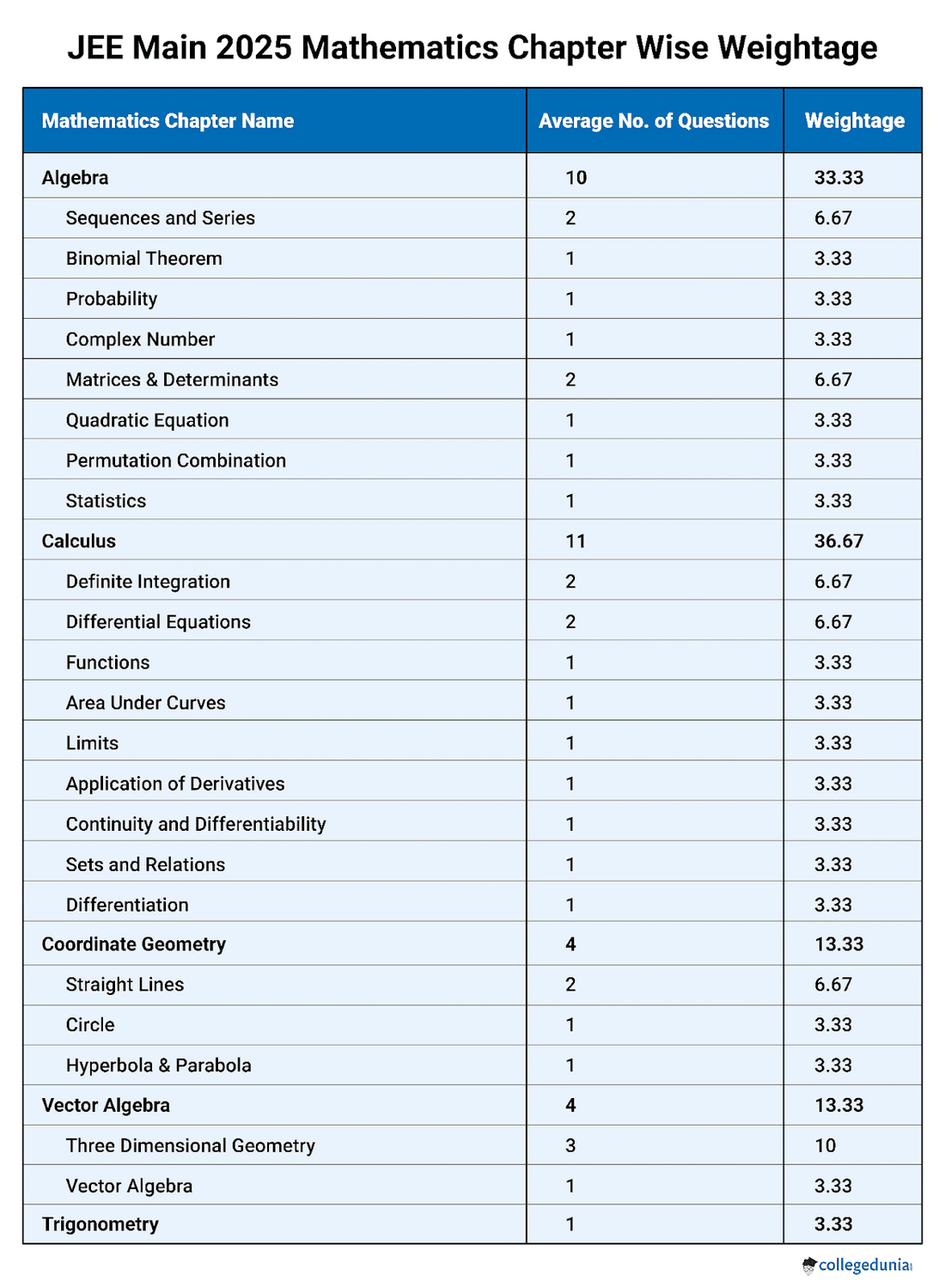
Overall High Weightage Chapters for JEE Mains 2026 Maths
| Chapter | Weightage (Approx.) |
|---|---|
| Coordinate Geometry (Straight Lines, Conics, 3D Geometry) | 20% |
| Calculus (Limits, Differentiation, Integration, Applications) | 30% |
| Probability, Permutations and Combinations | 10% |
| Algebra (Complex Numbers, Sequences, Series, Matrices) | 20% |
| Trigonometry | 7% |
| Mathematical Reasoning and Statistics | 5-6% |
Also Read
Detailed JEE Mains SyllabusBest Books to Prepare for High Weightage Chapters for JEE Mains 2026 Maths
You can start by clearing your basics with NCERT, and then proceed to Cengage or Arihant to practice as many problems as possible. Read these along with frequent mock exams to ensure that you have mastered the high weightage chapters for JEE Mains 2026 Maths.
Here is a detailed list of the best books for different parts of the JEE Maths syllabus, with their purpose clearly explained.
| Book Name | Best For | Why This Book is Recommended |
|---|---|---|
| NCERT Mathematics (Class 11 and 12) | Basics and concept clarity | Essential for understanding core concepts; builds a strong foundation for every topic. |
| RD Sharma (Objective Mathematics) | Concept building and practice | Covers all topics with solved examples and a wide range of practice problems. |
| Cengage Mathematics Series | Advanced problem-solving | Detailed coverage for every chapter; best for building depth and accuracy in problem-solving. |
| Arihant Series - Skills in Mathematics (by Dr. SK Goyal) | Topic-wise practice | Ideal for practicing specific high-weightage chapters like Calculus, Algebra and Coordinate Geometry. |
| Trigonometry by SL Loney | Trigonometry mastery | Excellent for strengthening basics and solving tricky problems efficiently. |
| Problems in Calculus of One Variable by I.A. Maron | Calculus practice | Useful for advanced calculus problems and building strong problem-solving speed. |
| Play with Graphs by Amit M Agarwal (Arihant) | Graph-based problem-solving | Very useful for visual understanding and handling graph-based questions in the JEE Mains exam. |
| Previous Years’ JEE Mains and Advanced Papers | Exam pattern and speed | Helps in understanding question trends and improving accuracy through real exam-level problems. |
Also Read
JEE Main 2025 Last 7 Days Preparation Tips to Boost Your Score
Your preparation strategy should be focused on accuracy, time management and revising the high-weightage chapters for JEE Mains 2026 Maths and other sections. Here is a detailed plan you can use to make the most of the last week.
1. Revise High Weightage Chapters First
Revise the high weightage chapters to be included in JEE Mains 2026 such as Maths, Physics and Chemistry, within the first two days. In Maths, it is important to focus on Calculus, Coordinate Geometry, Algebra and Probability.
| Subject | High Weightage Topics to Revise |
|---|---|
| Mathematics | Differential Calculus, Integral Calculus, 3D Geometry, Probability, Sequences & Series, Matrices and Determinants |
| Physics | Mechanics, Current Electricity, Electrostatics, Modern Physics and Optics |
| Chemistry | Organic Chemistry (named reactions), Chemical Bonding, Coordination Compounds and Thermodynamics |
2. Attempt Mock Tests in Exam Conditions
Attempt one full-length mock test per day at the same time as your real exam. This can help enhance your strength, time-saving abilities, and adapt to exam pressure. At the end of every mock, take at least two hours to analyse your mistakes and rewrite weak points
3. Focus on Accuracy Over Attempts
In the last week, avoid chasing high attempt numbers. Instead, work on improving accuracy. In Maths, for example, focus on solving problems correctly from high-weightage chapters for JEE Mains 2026 Maths like Calculus and Coordinate Geometry, instead of attempting all questions.
4. Quick Formula and Concept Revision
Prepare a formula sheet for each subject. Go through these daily, especially formulas for integration, differentiation, trigonometry, and coordinate geometry in Maths. Quick revisions help retain concepts during the exam.
5. Avoid New Topics
The last seven days are not for starting new topics. Stick to the chapters you have already studied and strengthen them with short practice sessions. New topics may create confusion and lower confidence.
6. Solve Previous Year Questions
Practice at least 2-3 years of previous JEE Mains papers. Practising the paper will give the candidates a better understanding of the type of questions asked and the weightage of different topics. The candidates are required to pay attention to repeated questions from high-weightage chapters as they are likely to be repeated.
Read more:
How to Prepare for JEE Main Maths? IIT JEE Study Plan, Time Table, Best Books, Mock Tests, PYQsHigh Weightage Chapters for JEE Mains 2026 Maths FAQs
Ques. Is JEE Mains 2026 going to be tough?
Ans. The JEE Mains exam is all about the preparation of a candidate. When they are studying the concepts and rehearsing a sufficient number of questions, the exam will become less intimidating.
- Maths is one of the most difficult subjects, so it is advisable to spend some extra time on the high weightage chapters for JEE Mains 2026 Maths. The syllabus includes Algebra, Coordinate Geometry and Calculus.
Ques. Is the JEE syllabus reduced for 2026?
Ans. The JEE syllabus includes Maths, Physics and Chemistry, which is expected to remain the same in 2025.
- The candidates are advised to check the official NTA notification in case of any minor updates.
Ques. Which chapter in maths has the highest weightage in JEE Mains?
Ans. Calculus has the highest weightage in the JEE Mains 2026 Maths section. It nearly contributes 30% of the total questions.
- After Calculus, focus on Coordinate Geometry, Algebra and Probability, as these chapters are repeated in almost every session.
Ques. Which IIT is making the 2026 paper?
Ans. The organising IIT for JEE 2026 has not been officially announced yet.
- Usually, one IIT rotates as the conducting institute every year, but for the JEE Mains exam, both paper is created and managed by NTA.
- The candidates should keep checking the NTA website for official announcements to stay updated.
Ques. Which year was JEE Maths toughest?
Ans. There are many candidates for whom the Maths section is the toughest in JEE Mains 2021 and 2019. It was mainly due to the lengthy calculations and tricky questions.
- However, difficulty changes every year, so focus on building strong basics in your JEE Maths syllabus to handle any paper confidently.



Comments