




JEE Main 2026 April 2 Shift 1 mathematics question paper is available here with answer key and solutions. NTA is conducted the first shift of the day on April 2, 2026, from 9:00 AM to 12:00 PM.
- The JEE Main Mathematics Question Paper contains a total of 25 questions.
- Each correct answer gets you 4 marks while incorrect answers gets you a negative mark of 1.
Candidates can download the JEE Main 2026 April 2 Shift 1 mathematics question paper along with detailed solutions to analyze their performance and understand the exam pattern better.
JEE Main 2026 April 2 Shift 1 Mathematics Question Paper with Solution PDF
Also Check:
- JEE Main 2026 April 4 Shift 1 Question Paper with Solutions
- Download JEE Main 2026 Session 2 Question Paper for all Shifts
Question 1:
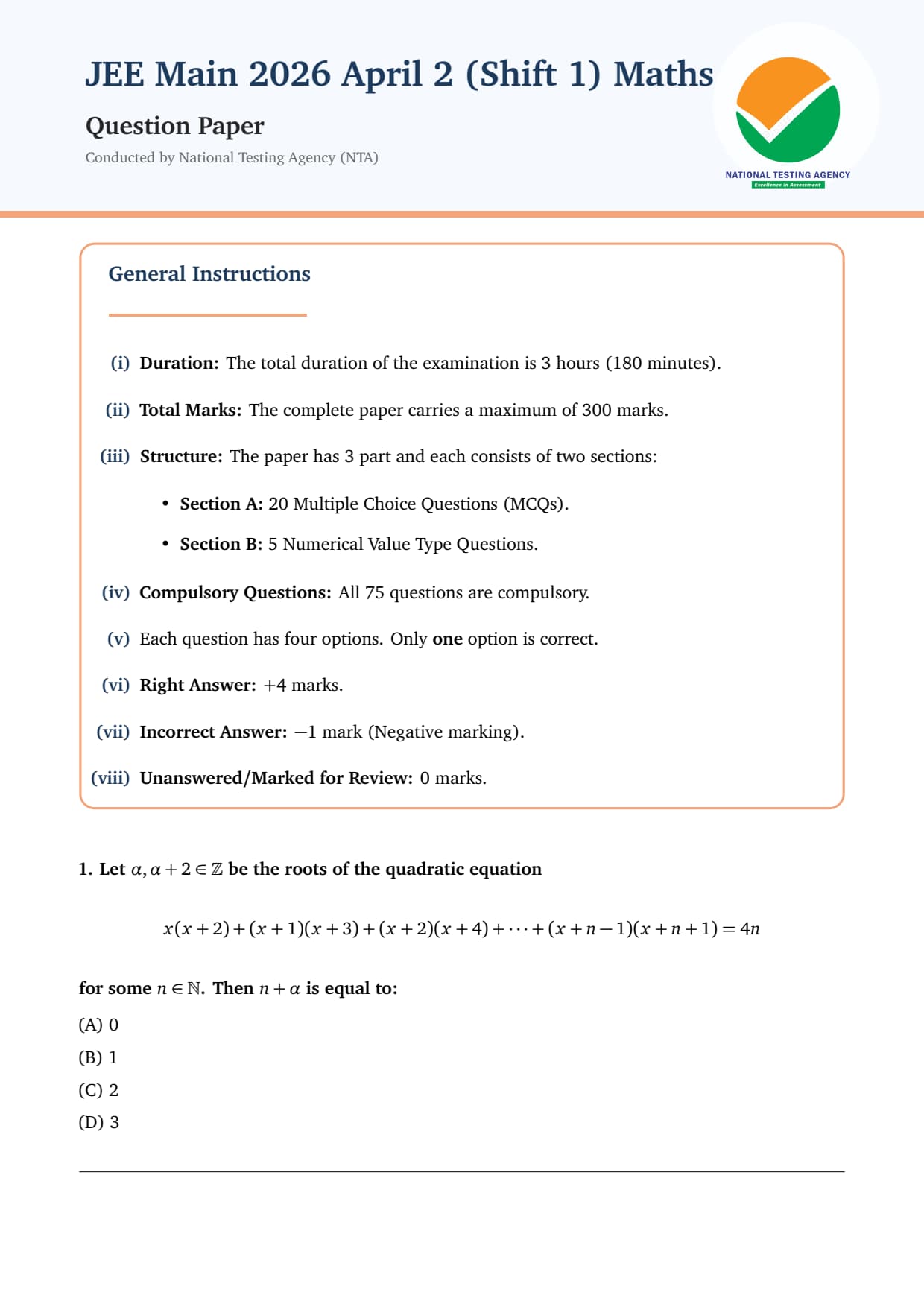
Let \( \alpha, \alpha + 2 \in \mathbb{Z} \) be the roots of the quadratic equation \[ x(x+2) + (x+1)(x+3) + (x+2)(x+4) + \cdots + (x+n-1)(x+n+1) = 4n \]
for some \( n \in \mathbb{N} \). Then \( n + \alpha \) is equal to:
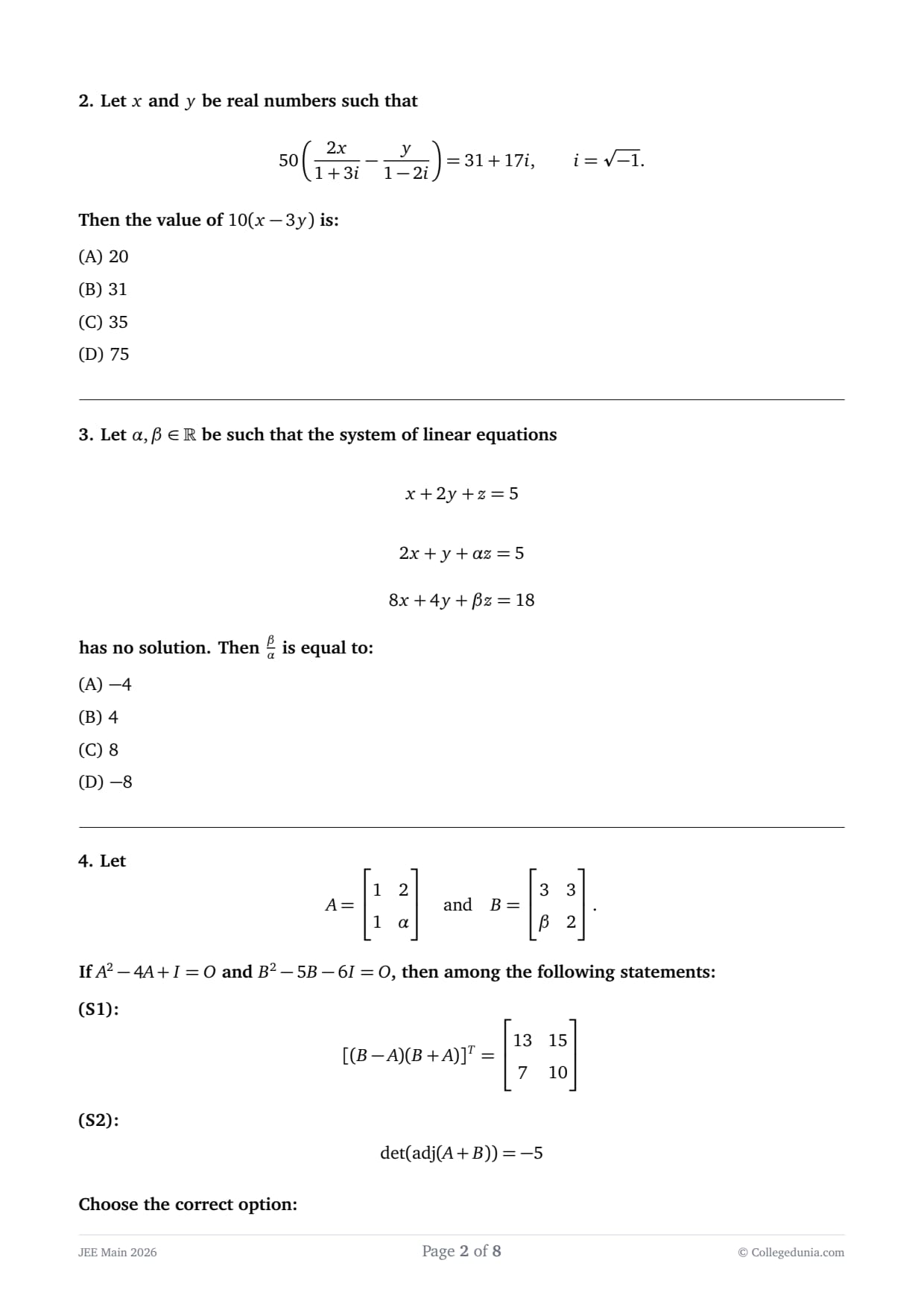
Let \(x\) and \(y\) be real numbers such that \[ 50\left(\frac{2x}{1+3i} - \frac{y}{1-2i}\right) = 31 + 17i, \qquad i = \sqrt{-1}. \]
Then the value of \(10(x-3y)\) is:
Let \( \alpha, \beta \in \mathbb{R} \) be such that the system of linear equations \[ x + 2y + z = 5 \] \[ 2x + y + \alpha z = 5 \] \[ 8x + 4y + \beta z = 18 \]
has no solution. Then \( \frac{\beta}{\alpha} \) is equal to:
Let \[ A= \begin{bmatrix} 1 & 2
1 & \alpha \end{bmatrix} \quad and \quad B= \begin{bmatrix} 3 & 3
\beta & 2 \end{bmatrix}. \]
If \(A^2-4A+I=O\) and \(B^2-5B-6I=O\), then among the following statements:
(S1): \[ [(B-A)(B+A)]^T= \begin{bmatrix} 13 & 15
7 & 10 \end{bmatrix} \]
(S2): \[ \det(\operatorname{adj}(A+B))=-5 \]
Choose the correct option:
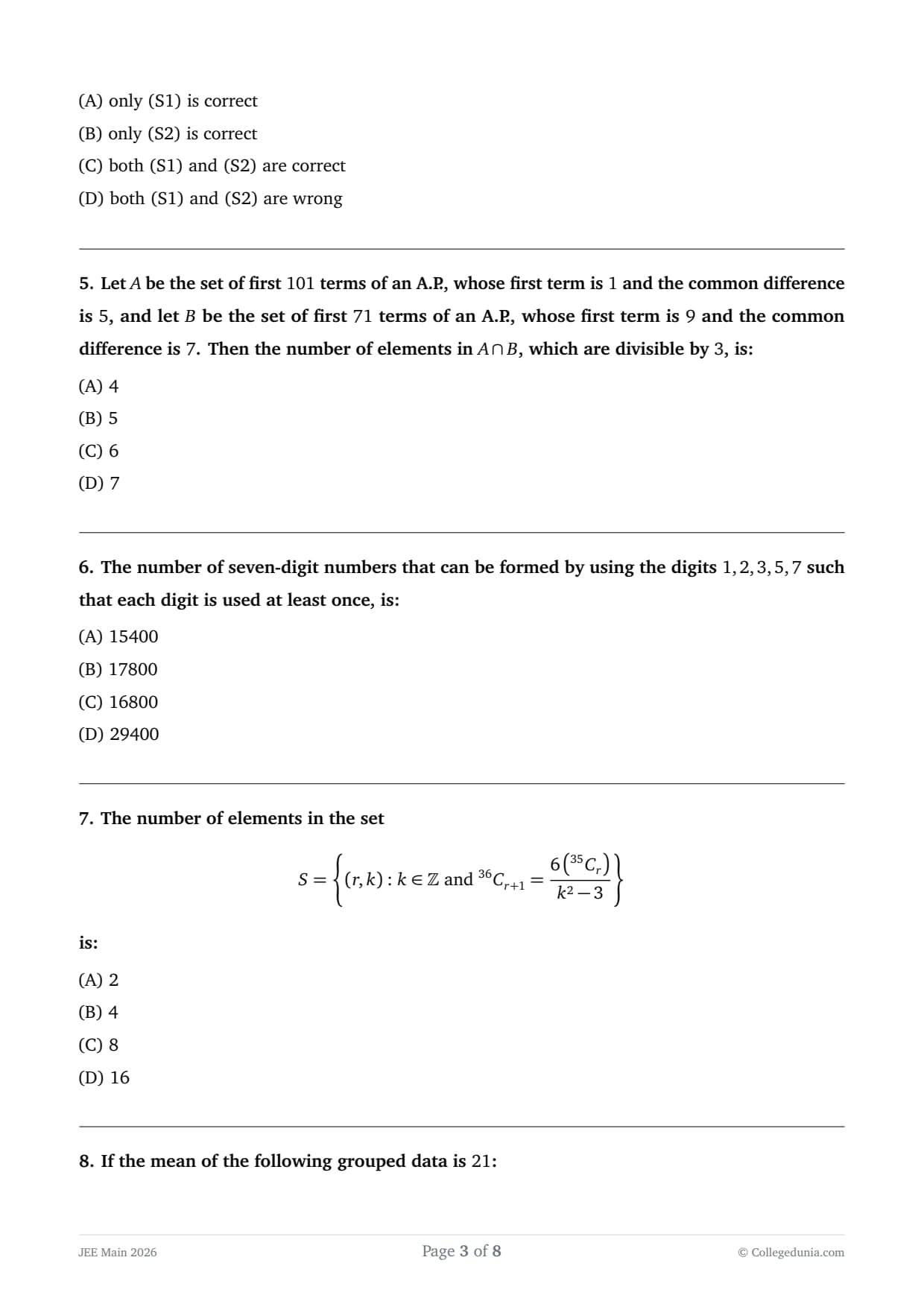
Let \(A\) be the set of first \(101\) terms of an A.P., whose first term is \(1\) and the common difference is \(5\), and let \(B\) be the set of first \(71\) terms of an A.P., whose first term is \(9\) and the common difference is \(7\). Then the number of elements in \(A \cap B\), which are divisible by \(3\), is:
The number of seven-digit numbers that can be formed by using the digits \(1,2,3,5,7\) such that each digit is used at least once, is:
The number of elements in the set \[ S=\left\{(r,k): k\in \mathbb{Z} and {^{36}C_{r+1}}=\frac{6\left({^{35}C_r}\right)}{k^2-3}\right\} \]
is:
If the mean of the following grouped data is \(21\):

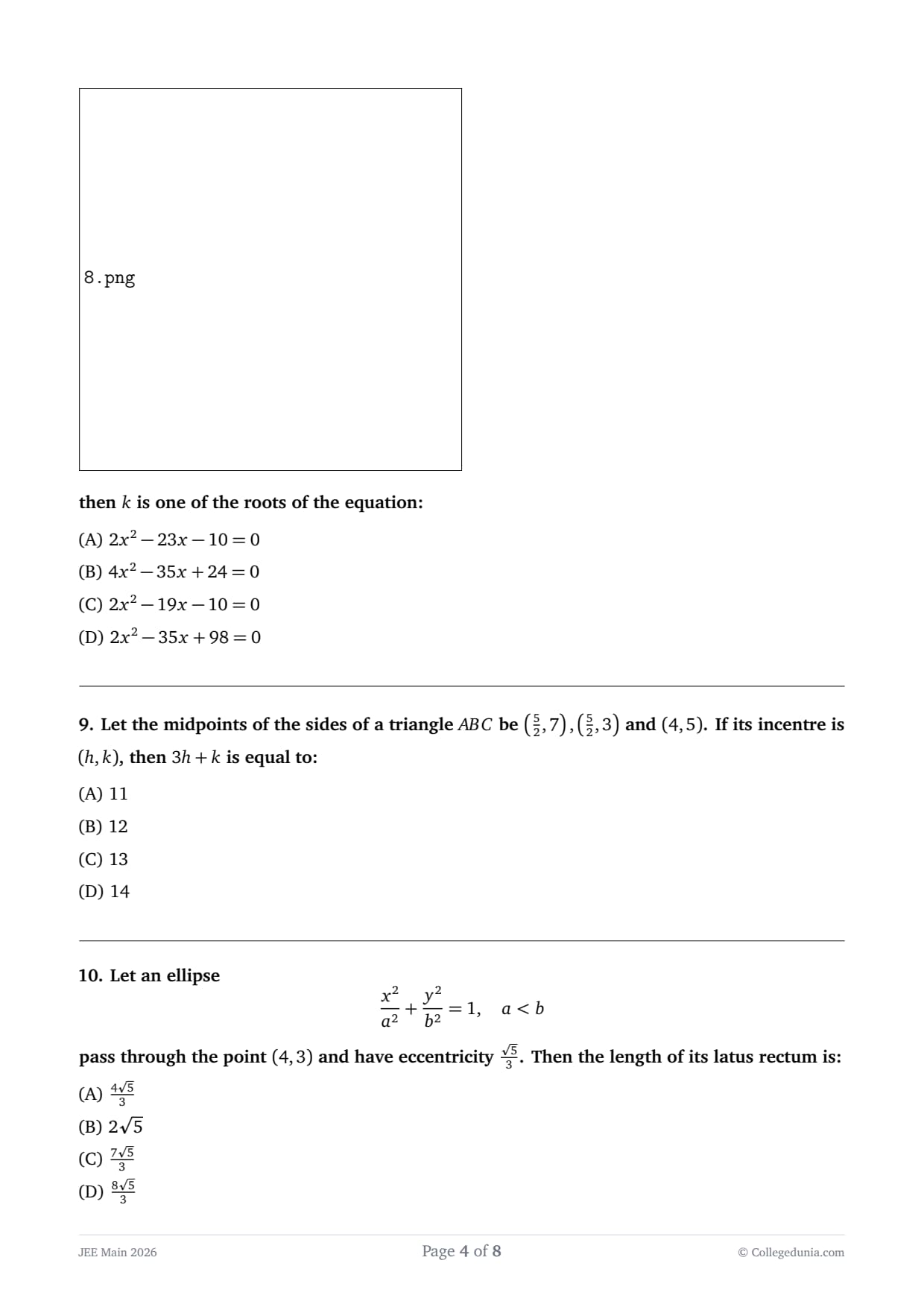
then \(k\) is one of the roots of the equation:
Let the midpoints of the sides of a triangle \(ABC\) be \( \left(\frac{5}{2},7\right), \left(\frac{5}{2},3\right)\) and \( (4,5) \). If its incentre is \((h,k)\), then \(3h+k\) is equal to:
Let an ellipse \[ \frac{x^2}{a^2}+\frac{y^2}{b^2}=1,\quad apass through the point \((4,3)\) and have eccentricity \( \frac{\sqrt5}{3} \). Then the length of its latus rectum is:
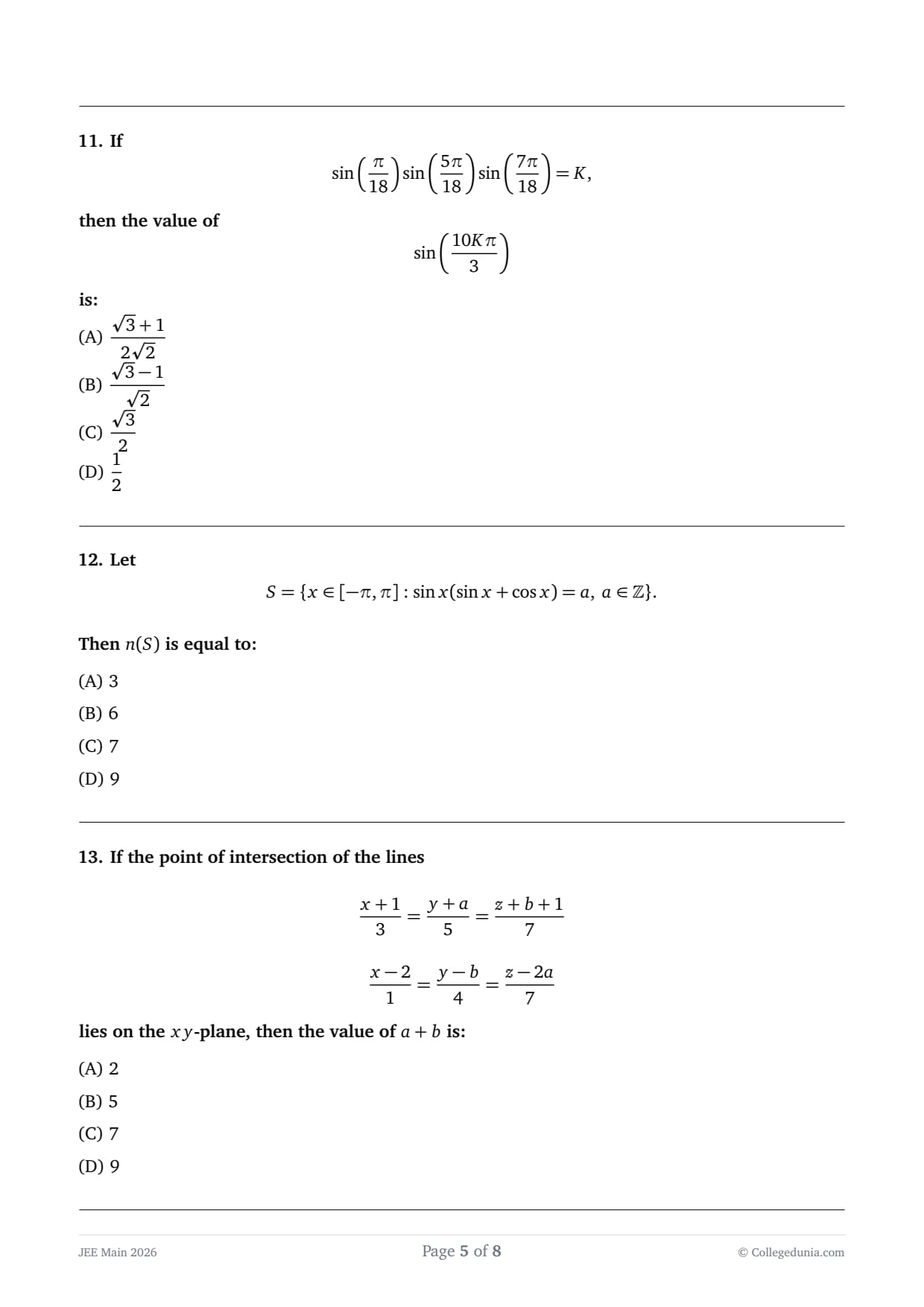
If \[ \sin\left(\frac{\pi}{18}\right)\sin\left(\frac{5\pi}{18}\right)\sin\left(\frac{7\pi}{18}\right)=K, \]
then the value of \[ \sin\left(\frac{10K\pi}{3}\right) \]
is:
Let \[ S=\{x\in[-\pi,\pi]:\sin x(\sin x+\cos x)=a,\; a\in\mathbb{Z}\}. \]
Then \(n(S)\) is equal to:
If the point of intersection of the lines \[ \frac{x+1}{3}=\frac{y+a}{5}=\frac{z+b+1}{7} \] \[ \frac{x-2}{1}=\frac{y-b}{4}=\frac{z-2a}{7} \]
lies on the \(xy\)-plane, then the value of \(a+b\) is:
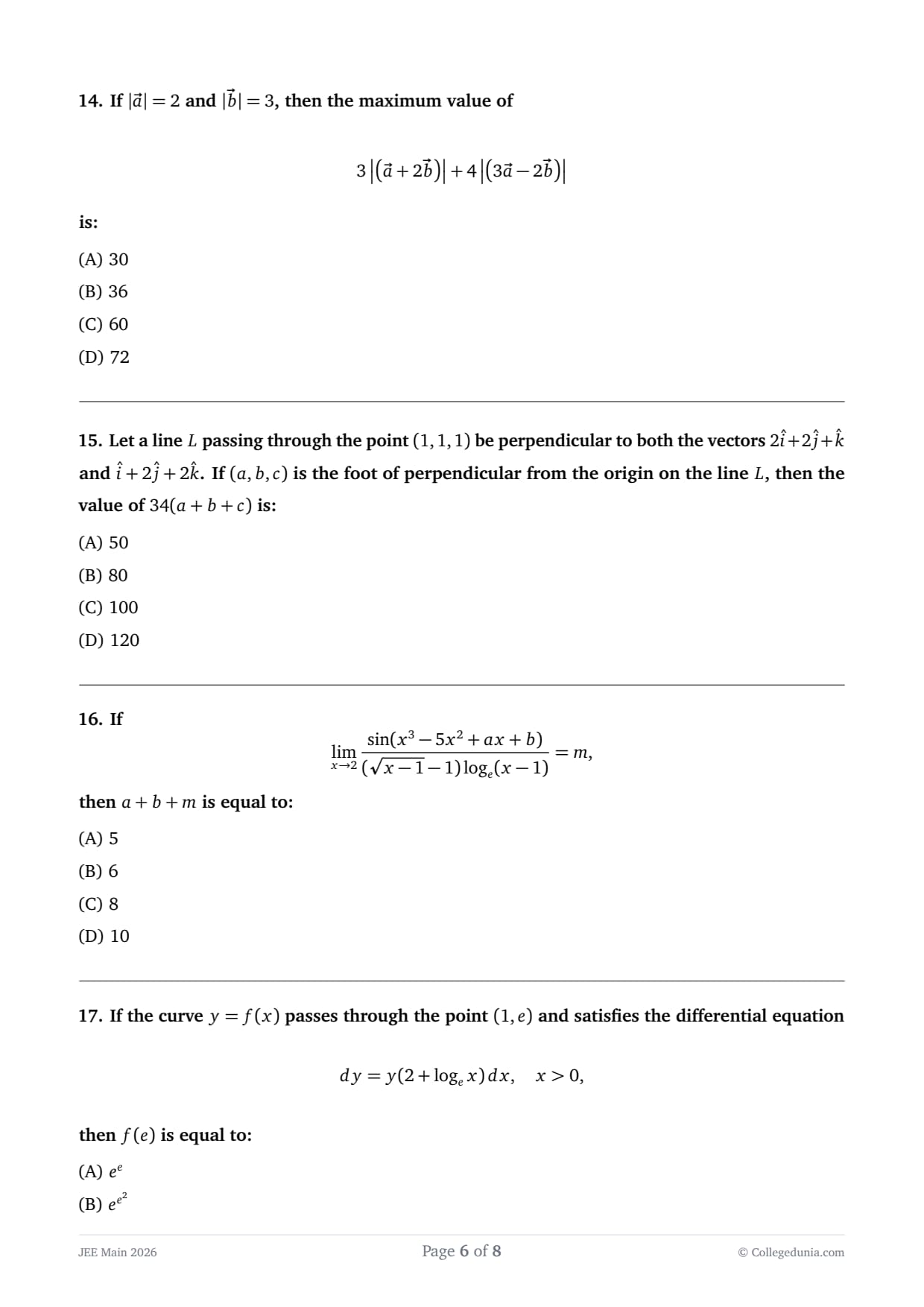
If \(|\vec a|=2\) and \(|\vec b|=3\), then the maximum value of
\[ 3\left|\left(\vec a+2\vec b\right)\right| + 4\left|\left(3\vec a-2\vec b\right)\right| \]
is:
Let a line \(L\) passing through the point \((1,1,1)\) be perpendicular to both the vectors \(2\hat{i}+2\hat{j}+\hat{k}\) and \(\hat{i}+2\hat{j}+2\hat{k}\). If \((a,b,c)\) is the foot of perpendicular from the origin on the line \(L\), then the value of \(34(a+b+c)\) is:
If \[ \lim_{x\to 2}\frac{\sin(x^3-5x^2+ax+b)}{(\sqrt{x-1}-1)\log_e(x-1)}=m, \]
then \(a+b+m\) is equal to:
If the curve \(y=f(x)\) passes through the point \((1,e)\) and satisfies the differential equation \[ dy=y(2+\log_e x)\,dx,\quad x>0, \]
then \(f(e)\) is equal to:
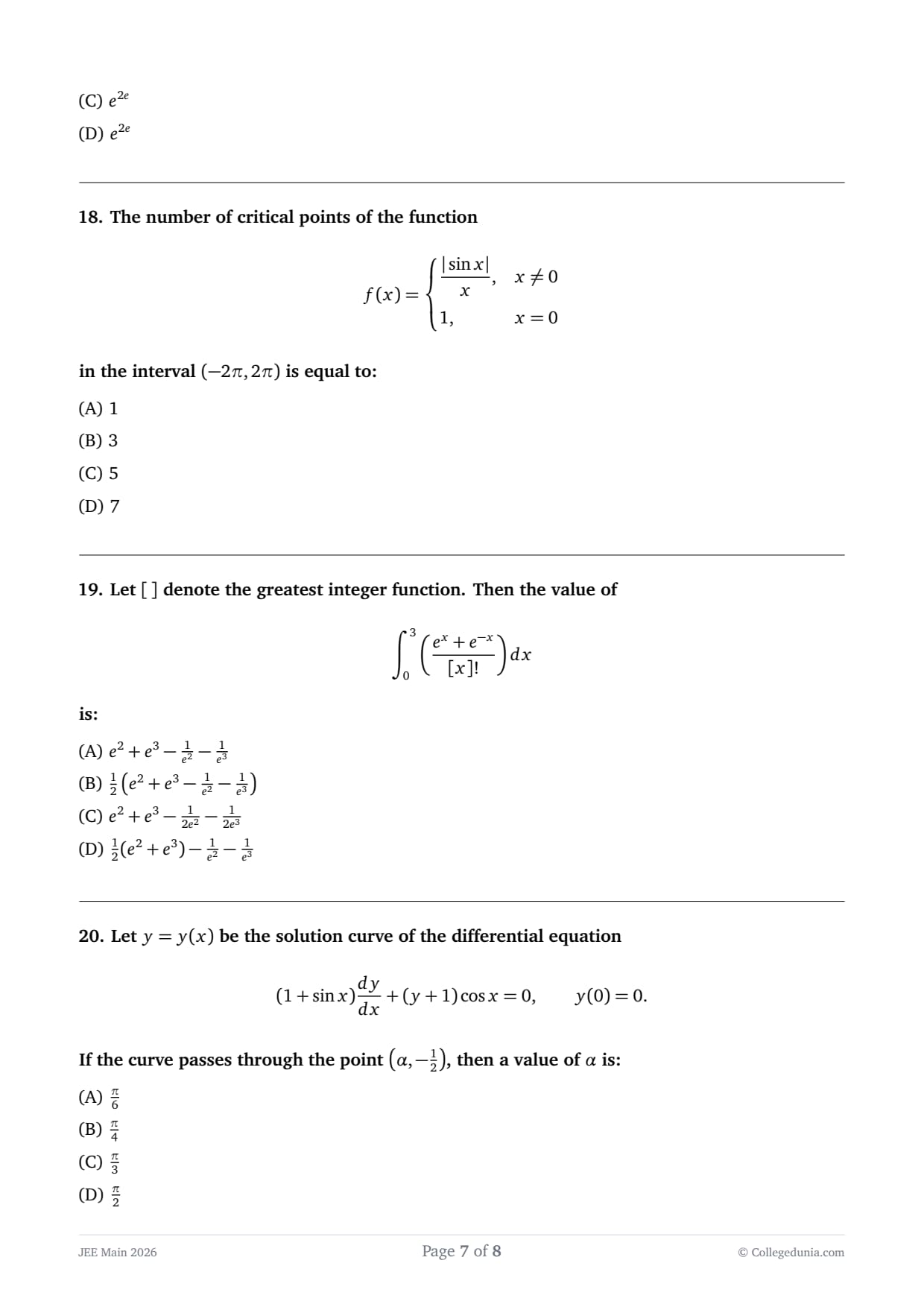
The number of critical points of the function \[ f(x)= \begin{cases} \dfrac{|\sin x|}{x}, & x\neq0
1, & x=0 \end{cases} \]
in the interval \((-2\pi,2\pi)\) is equal to:
Let \([\,]\) denote the greatest integer function. Then the value of \[ \int_{0}^{3}\left(\frac{e^x+e^{-x}}{[x]!}\right)dx \]
is:
Let \(y=y(x)\) be the solution curve of the differential equation \[ (1+\sin x)\frac{dy}{dx}+(y+1)\cos x=0,\qquad y(0)=0. \]
If the curve passes through the point \( \left(\alpha,-\frac12\right) \), then a value of \( \alpha \) is:
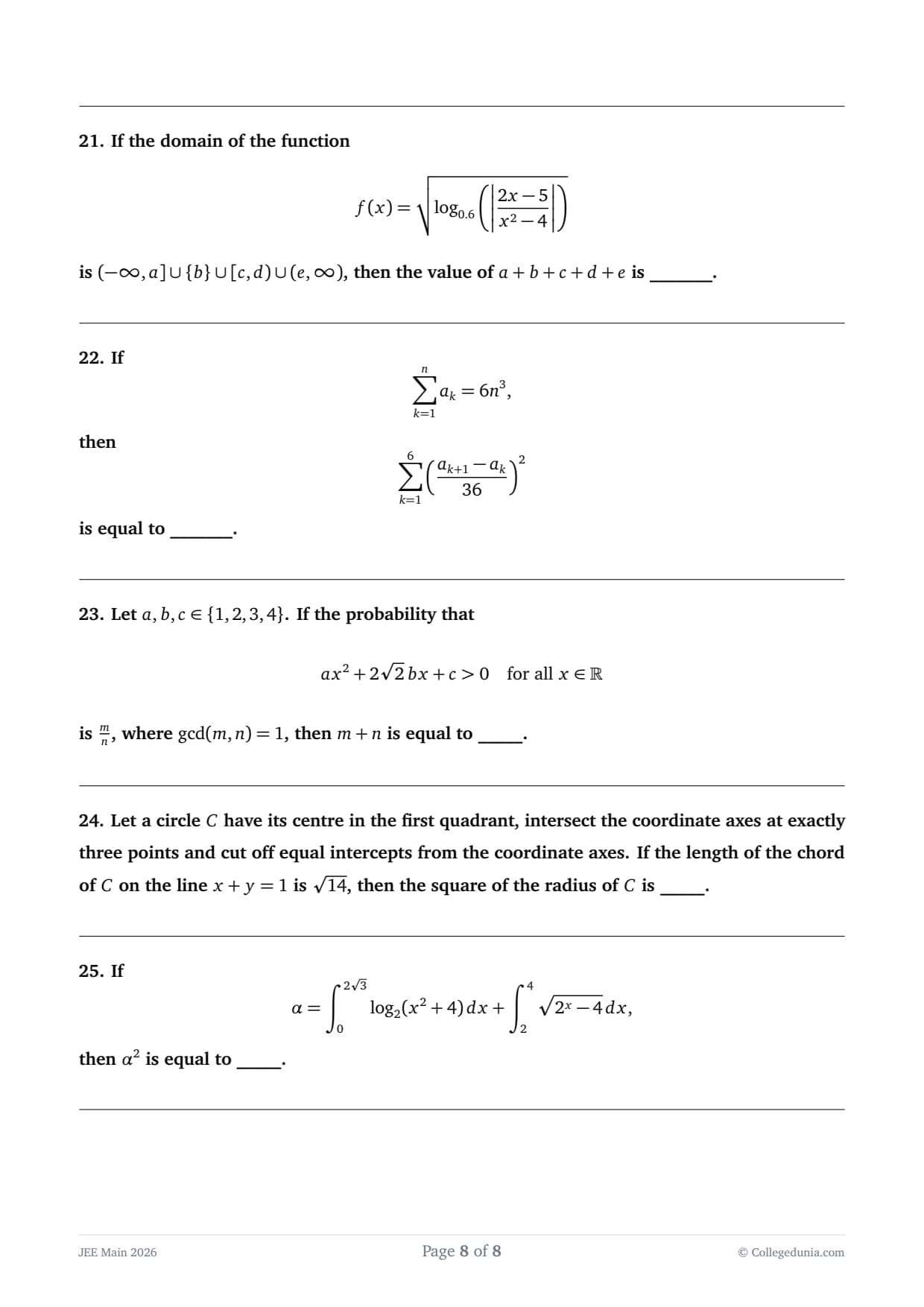
If the domain of the function \[ f(x)=\sqrt{\log_{0.6}\left(\left|\frac{2x-5}{x^2-4}\right|\right)} \]
is \((-\infty,a] \cup \{b\} \cup [c,d) \cup (e,\infty)\), then the value of \(a+b+c+d+e\) is _______.
If \[ \sum_{k=1}^{n} a_k = 6n^3, \]
then \[ \sum_{k=1}^{6}\left(\frac{a_{k+1}-a_k}{36}\right)^2 \]
is equal to _______.
Let \(a,b,c \in \{1,2,3,4\}\). If the probability that \[ ax^2 + 2\sqrt{2}\,bx + c > 0 \quad for all x \in \mathbb{R} \]
is \( \frac{m}{n} \), where \(\gcd(m,n)=1\), then \(m+n\) is equal to _____.
Let a circle \(C\) have its centre in the first quadrant, intersect the coordinate axes at exactly three points and cut off equal intercepts from the coordinate axes. If the length of the chord of \(C\) on the line \(x+y=1\) is \(\sqrt{14}\), then the square of the radius of \(C\) is _____.
If \[ \alpha=\int_{0}^{2\sqrt{3}} \log_2(x^2+4)\,dx + \int_{2}^{4} \sqrt{2^x-4}\,dx, \]
then \(\alpha^2\) is equal to _____.
JEE Main 2026 Mathematics Exam Pattern
| Particulars | Details |
|---|---|
| Exam Mode | Online (Computer-Based Test) |
| Paper | B.E./B.Tech |
| Medium of Exam | 13 languages: English, Hindi, Gujarati, Bengali, Tamil, Telugu, Kannada, Marathi, Malayalam, Odia, Punjabi, Assamese, Urdu |
| Type of Questions | Multiple Choice Questions (MCQs) + Numerical Value Questions |
| Total Marks | 100 marks |
| Marking Scheme | +4 for correct answer & -1 for incorrect MCQ and Numerical Value-based Questions |
| Total Questions | 25 Questions |



Comments