




The JEE Main session 2, April 8 B.E./B. Tech paper scheduled for the 2nd shift from 3:00 PM to 6:00 PM has been concluded. Based on the students' reactions, the paper was moderate in difficulty. The detailed paper analysis and the question paper are given below.
- JEE Main session 2 April 8 B.E./B.Tech Paper Analysis Live Updates
- JEE Main session 2 April 8 Question Paper PDF (Available)
So far, the JEE Main session 2 exams have been easy to moderate in difficulty, with Maths being a little lengthy and tough, Chemistry being NCERT-based and on the easier side, and Physics being highly calculative and formula-based. You can check the shift-wise detailed paper analysis below.
The JEE Main 2026 Session 2 exam is scheduled from April 2 to April 8, 2026, for students appearing in the B.Tech, B.Arch and B.Planning.
Session 2 is important for students who want to improve their percentile to secure top ranks or qualify for JEE Advanced.
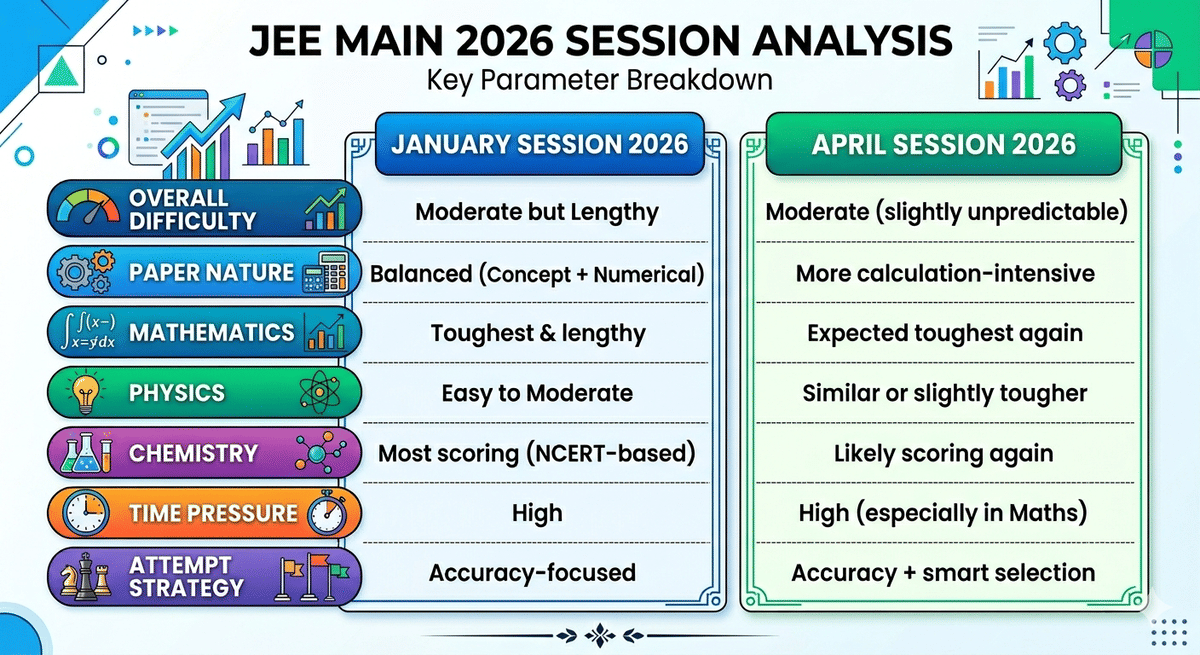
- Based on JEE Main 2026 January session 1 Paper analysis, it is expected that JEE Main 2026 session 2 paper is going to be moderate to tough in difficulty level.
- JEE Main 2026 April session might follow a similar pattern of numerical, conceptual and application-based questions as compared to the January session.
- As per experts and previous year analysis, the JEE Main April session is usually more calculation-intensive, specifically in Mathematics.
In this article, we will provide live shift-wise paper analysis, difficulty level, subject-wise review, good attempts, and student reactions for each day of the exam from April 2 to April 8.
Related Links:
- Check JEE Main 2026 Session 2 Papers Analysis Live Updates- Check Expected Difficulty Level
- Check JEE Main 2026 vs 2025 Cutoff Comparison to understand expected percentile trends and admission chances.
JEE Mains April 2 to April 8 Shift-Wise Paper Analysis (To Be Updated Live)
Check the shift-wise JEE Main 2026 Session 2 (April 2-8) paper analysis below, with updates for each exam after every shift.
| Date and Shift | Paper Analysis | Difficulty Level |
|---|---|---|
| April 8 | The overall difficulty of the paper was Moderate, similar to the analysis of the previous shifts. Physics was largely formula-based, with questions asked from topics such as Ray optics, Current Electricity and Modern Physics. Chemistry was the easiest, and mostly NCERT-based, with more weightage from the Organic and Inorganic chemistry. Numerical questions were asked from Physical Chemistry. Mathematics was lengthy and slightly on the tough side, with questions asked on topics such as Calculus, Coordinate Geometry, and Algebra. | Moderate |
| April 7 Shift 2 | B Arch: Overall, the paper was moderate in difficulty. The Mathematics section was slightly lengthy, but Aptitude was on the easier side. Drawing was based on 3D shapes, perspective view, and scene sketching. | Moderate |
| April 7 Shift 2 | B.Planning: The paper was easy to moderate, especially in the Planning & Aptitude sections. Questions were focused on data interpretation, maps, graphs, and basic planning concepts. | Easy to Moderate |
| April 6 Shift 2 | The overall level of the paper was easy to moderate, and the shift was easier compared to the January session. The average attempts of the candidates with decent preparation were around 55. Physics was easy and formula-based, with questions asked on topics such as Ray optics, Binding Energy, Current Electricity, Capacitor, Magnetic effect of current, Isothermal Process, and Spring. Around 45-50 minutes were taken by students to attempt the Physics section. The average attempt in this section was around 20. The chemistry section was moderate, with questions requiring more knowledge than the NCERT. Statement-based questions were present. Chemistry was also calculative, with most of the numericals from Physical Chemistry. Questions from organic chemistry were more in numbers and Inorganic question were fewer in number. The questions were more theory-based due to statement-based questions. Questions were asked on topics such as Titration, Mole concept, Electrochemistry, Thermal chemistry, Coordination, Chemical bonding, and salt analysis. Maths was on the easier side, but the calculations were lengthy. Around 15 questions were doable. However, around 5 minutes were required to solve 1 maths question. The questions were asked on topics such as Vector 3D (shortest distance, Parallelogram, etc.), Matrices and Determinants, etc. Conic sections dominated the maths section with more than 5 questions. Average attempts were around 12-14. The Marks vs Percentile analysis for this shift is, around 190 marks required to secure the 99th Percentile. | Easy to Moderate |
| April 6 Shift 1 | The overall difficulty level of the paper was moderate, and the entire paper was calculation-based. However, the paper was easier than the January session. No questions were out of the syllabus. And the expected Marks vs Percentile for this shift will be around 170 marks, as per students' feedback. The physics section was moderate with calculation and formula-based questions. The question asked on topics such as Current Electricity, Modern Physics, Electrostatics, Nuclear Physics, NLM, Rotation, Ray Optics (Magnification), Error, and Thermodynamics. The paper was filled with formula-based numericals. The average time taken to solve the physics section was around 1 hour or more. The average attempts were around 20-22. Chemistry was the easiest, dominated by NCERT-based Organic & Inorganic questions. Around 7 questions were asked from Physical Chemistry. There were statement-based questions in Inorganic chemistry. Questions were asked on topics such as Biomolecule (Deficiency disease), Boiling Point and Chemical Kinetics. The average time taken by students to attempt the physics section was around 55 minutes. Average attempts were around 20. Maths was lengthy & moderate, with an average number of attempts of students in this section being 8-10 questions. Questions were asked on topics such as Conic section (4-5 questions), Geometry, Calculus, ITF, Limit and Functions. The Physics and Chemistry had taken so much time that students could not attempt the maths section to the full potential. | Moderate |
| April 5 Shift 2 | The paper was slightly tougher than Shift 1 with moderate overall difficulty. The 99th percentile is expected with around 175-180 marks. Physics sections were easy to moderate in difficulty. Some questions were lengthy and time-consuming. Questions were asked on Unit dimensions, Kinetics, Rotation, Moment of Inertia, Energy, Modern Physics, wavelength, Electrostatics, Current Electricity, Ray optics, Thermodynamics, and EM waves. No question was asked on Fluids and Optical instruments. Average attempts were around 20, with a time taken of around 50 minutes. Chemistry was easy, but it had many statement-based questions. It was much easier compared to the January session, according to the students. Inorganic questions can be done using NCERTs, but Organic and Physical will require additional resources. Questions asked on topics such as Biomolecule, Chemical Kinetics, GOC (Stability), Ionic equilibrium, Mole concept, Coordination Chemistry, Dichromate Ion & Salt Analysis. Average attempts were higher, around 20-22, with time taken around 55 minutes due to lengthy statements. Maths was lengthy and moderate in difficulty, and increased the time pressure on students. Average attempts were around 10-12. Questions were asked on topics such as Coordinate geometry, Vector 3D, Calculus (Integrating Factor), Statistics, P&C, Sequence and Series, Probability, and Area under the curve. | Moderate |
| April 5 Shift 1 | The overall difficulty of the paper was easy to moderate. The paper was comparatively easier than the January session. The Physics section was moderate and lengthy. The questions were formula-based and more calculative. Questions were asked on topics such as Microscope, Semiconductor, Newton's Laws of Motion, Electromagnetic Induction, Electrostatics, Elasticity, Magnetism, Unit dimension, and Capacitor. In Modern Physics, the question was asked on the photoelectric effect, and in current electricity, the question was aksed on circuit analysis. Around 20 was the average attempt in Physics, with the time taking around 50 minutes. Chemistry was NCERT-driven and straightforward, not required to use of a pen for most of the questions. The weightage of questions from Physical chemistry was low compared to Inorganic and Organic chemistry. The maximum weightage was from the organic chemistry. In Physical chemistry, lengthy calculations were not there as seen in the previous shift of the April session. Around 7-8 questions were statement-based, with around 2-3 question havinf 4 statements. Questions were asked on topics such as Electronegativity, Biomolecules, GOC, P block reactions, etc. The average attempt was around 20, with a time taken of around 40 minutes. Maths was lengthy and time-consuming, but easier and doable. Around 4-5 questions were easy. The maths section was easier than the January session. Average attempts were around 12-14. Questions were asked on topics such as Vector 3D (2 ques), Function (2 ques), Limit, Applications of Derivatives, Sequence and series, Definite Integration, Area, Quadratic equations combined with Trigo, Probability, Submission, Binomial, Metrics, and Statistics ( mean deviation). As per the students' feedback and experts' analysis, around 190 – 200 marks will be required for the 99th percentile in this shift. Students from the January session attempted around 10 more questions in this shift. The average attempts in this shuft was around 55-60. | Easy to Moderate |
| April 4 Shift 2 | The overall level of the paper was of easy to moderate difficulty. Based on students' feedback, this shift was the easiest among all till now. The physics section was easy to moderate, with questions asked from Kinematics, Current Electricity, Capacitors, Optics, and Electromagnetism. Rthe question were direct and formula-based. The question was asked on lens and it required calculating the ratio of radius and focus. The physics section was more tilted towards calculations. Questions from the 11th class syllabus were more. If we rate the January session physics 10/10, the Physics section of this shift was 6 or 7 /10. The average attempt was around 20. The Chemistry questions were NCERT-based, and it was also easy to moderate with a 6 or 7/10 rating in difficulty as compared to the January session. Questions were asked from all three sections, i.e., Physical, Organic, and Inorganic. Around 3-4 questions were asked about organic chemistry. Chemistry numericals were tough and mostly from Physical Chemistry. Assertion & Reason questions and statement-based questions have made the chemistry lengthy. Questions were asked on topics such as the D-block, Practical organic chemistry, Aldehyde, Carbon relation, chemical bonding, salt analysis, and General organic chemistry. Questions from the Inorganic Chemistry were line-to-line directly from the NCERT. Average attempts were around 18-20. Questions in chemistry were also asked on topics such as COC, biomolecules, semiconductors, and Osmotic Pressure in Liquids. Maths was a little lengthy with moderate to tough difficulty. Questions were from Vector 3D, Conic section, Matrices and Determinants, Calculus, P&C, Probability, Binomial, Log, and Sequences. Around 3-4 questions were very easy. Average attempts were around 10. In the difficulty level Maths section was 10/10. However, the paper was balanced, with a slight tilt towards calculation-heavy Chemistry and formula-based Physics. Based on experts' analysis, the 99th percentile will be around 190+, and the 94th percentile will be more than 100. | Easy to Moderate |
| April 4 Shift 1 | Based on the early students’ reactions, the paper was tougher than the April 2 shift 2 but was easier than the January session. Mathematics was the toughest and most time-consuming section with lengthy calculations. Questions were from vector 3D, Metrics, Mean and Median, Function, Inverse Trigonometric Functions, Conic section and sequence. The average attempt was around 8-10 in Mathematics. Around 2 questions were also from coordinate geometry. The Chemistry section was easy with questions from all the parts, such as physical chemistry, organic chemistry, and inorganic chemistry. No salt questions were there, which were around 2-3 in the April 2 shifts. There were comparatively fewer questions from organic chemistry. Questions were asked on Biomolecules, Thermodynamics, Name reactions, Liquid solutions, Kinetics, Redox (carrier method), Equilibrium, and Empirical formula. Good attempts were around 20-22. There were a lot of assertion-reason type and statement-based questions, including some match the following questions in chemistry. The average time taken for the chemistry section was around 50 minutes. The Physics section was moderate. Around 2-3 questions were asked from Modern Physics. Questions were asked on topics such as Rotation, SHM, Young’s Modulus, Projectile motion, Work, Momentum, Current electricity, fluids, and surface tension. The average time taken in the physics section was around 50-55 minutes. Based on students' point of view and expert analysis, the cutoff is expected to be around 180 -190 for the 99th percentile. | Easy to Moderate |
| April 2 Shift 2 | Based on the early students' reactions, the paper was easy to moderate. The Mathematics section was doable with around 10-12 easy questions. Questions were asked on the system of linear equations, conic sections, parabola equations, circle, calculus, integration, continuity, and vectors. The Chemistry section was the trickiest and the toughest due to more calculation-based questions. Inorganic questions were based on the NECRT. However, some questions were outside the NECRT also. More questions were from Physical Chemistry as compared to the morning shift. Physical chemistry was also slightly tougher. The magnetic moment question was also there, which was lengthy and calculative. In Physics, there were questions from Optics and Modern Physics, such as Binding energy. Overall, the physics section was moderate. Students with decent preparation have attempted around 55-60 questions. As the Maths section was comparatively easy, it is likely to influence the Marks vs percentile trend. | Easy to Moderate |
| April 2 Shift 1 | Based on the early students' reactions, the paper was easier than the January session. In Chemistry, the questions were NCERT-based and asked on topics such as salt analysis, bond length, and coordination compounds. There were statement-based and assertion-reasoning questions from organic chemistry. The weightage of organic chemistry was higher. Questions in Mathematics were lengthier and tested calculation speed. Around 12-13 questions were doable in Mathematics, and other questions were slightly on the tough side. The physics section was moderate, and the questions were more formula-based and easier than in the previous session. Most of the candidates with a good level of preparation attempted around 60 questions. The question pattern was the same as the previous session, and some of the questions were repeated from the PYQs. | Moderate |
JEE Main 2026 April Session 2 Expected Difficulty Level
- The JEE Main April Session 2 paper is expected to be moderate to tough, but as per the JEE Main Session 1 paper analysis, it might be lengthy as well.
- As per experts, JEE Main April Session 2 paper analysis, Maths will be the most time-consuming section, Chemistry will be the most scoring section, and Physics will be concept-driven with moderate difficulty.
- A balanced mix of NCERT Class 11 and 12 topics with numerical and conceptual questions is expected across all April Shifts.
| Subject | Expected Difficulty Level | Nature of Questions | Time Consumption | Scoring Potential |
|---|---|---|---|---|
| Mathematics | Moderate to Tough | Lengthy, calculation-heavy, multi-step problems | Very High | Moderate |
| Physics | Easy to Moderate | Formula-based + conceptual | Moderate | High |
| Chemistry | Easy to Moderate | NCERT-based, direct & statement-based | Low to Moderate | Very High |
| Overall Paper | Moderate (Lengthy) | Balanced mix of concepts + numericals | High | Moderate to High |
Check: Expected JEE Main 2026 Cutoff Percentile for General Category to Qualify for NITs
JEE Main 2026 January Session 1 vs JEE Main 2026 April Session 2
Also Check:
Check:
JEE Main Jan 29th B.Arch & B.Planning Analysis
The JEE Main 29th Jan Exam for B.Arch/B. Planning was conducted today in a single shift. As per the candidate’s feedback, the difficulty level was moderate, with mathematics being the most time-consuming section.
| Paper | Section | Difficulty Level | Nature of Questions | Key Candidate Feedback |
|---|---|---|---|---|
| B.Arch (2A) | Mathematics | Moderate to Difficult | Numerical-based, lengthy | Time-consuming; accuracy crucial |
| Aptitude Test | Easy to Moderate | Conceptual & visual | Scoring: predictable patterns | |
| Drawing Test | Moderate | Perspective & creativity-based | Lengthy but standard topics | |
| B.Planning (2B) | Mathematics | Moderate | Numerical-based | Manageable with practice |
| Planning Section | Easy to Moderate | Knowledge & awareness-based | Questions from urban planning & sustainability | |
| Aptitude Test | Easy to Moderate | Logical & visual | High attempt potential |
JEE Main Jan 28 Shift 2 Paper Analysis
With the conduct of JEE Main Jan 28 Shift 2, the session 1 exam for B.E./B. Tech has been concluded. As per the initial feedback from candidates, the difficulty level was moderate but lengthy and time-consuming.
| Subject | Difficulty Level | Question Nature | Key Topics Asked | Overall Trend |
|---|---|---|---|---|
| Physics | Easy | Direct & formula-based |
| Most scoring; higher attempts |
| Chemistry | Difficult & Lengthy | Case-study + numerical-based |
| Toughest & most time-consuming |
| Mathematics | Moderate | Numerical & calculation-heavy |
| Required careful time allocation |
| Overall Paper | Moderate (Lengthy) | Balanced syllabus coverage | Class 11 & 12 topics mixed | Time management was important |
JEE Main Jan 28 Shift 1 Paper Analysis
The JEE Main Jan 28 Shift 1 is of a moderate to tough level. In which physics is comparatively easier, whereas mathematics and chemistry are lengthy and more time-consuming.
JEE Main 2026 Jan 28 Shift 1: Subject-Wise Analysis
| Subject | Difficulty Level | Question Nature | Key Topics Asked | Overall Trend |
|---|---|---|---|---|
| Physics | Easy to Moderate | Calculative, formula-based | Ray Optics, Modern Physics, Electrostatics | Easier than other sections but time-consuming |
| Chemistry | Moderate & Lengthy | Statement-based + conceptual |
| Lengthy but manageable |
| Mathematics | Difficult & Lengthy | Indirect, numerical-heavy | Vectors & 3D, Relations & Sets, multi-step problems | Toughest section |
| Overall Paper | Moderate to Tough | Balanced syllabus coverage | Class 11 & 12 topics mixed | Time management was decisive |
JEE Main Jan 24 Shift 2 Paper Analysis
The Shift 2 of Jan 24 has been concluded. As per the initial feedback, it was moderate but lengthy and time-consuming. The level of questions were difficult than NCERT, and more numerical-based questions were asked.
JEE Main 2026 Jan 24 Shift 2: Subject-Wise Analysis
| Subject | Difficulty Level | Question Nature | Key Topics Asked | Overall Trend |
|---|---|---|---|---|
| Physics | Moderate | Direct, formula-based | Ray Optics, Cylinder, standard numericals | Doable and less time-consuming |
| Chemistry | Moderate to Difficult | Numerical + assertion/statement-based | Physical Chemistry (~50%), mixed concepts | Tricky and lengthy |
| Mathematics | Difficult & Lengthy | Highly numerical, calculation-heavy | Vectors & 3D, Circle/Ellipse, Relations & Sets | Toughest and most time-consuming |
| Overall Paper | Moderate (Lengthy) | Balanced syllabus coverage | Class 11 & 12 topics mixed | Time management was decisive |
JEE Main Jan 24 Shift 1 Paper Analysis
As Shift 1 of JEE Main Jan 24 Shift 1 Paper Analysis has been concluded, and according to the initial feedback, the exam was moderate but lengthy and time-consuming. Overall, the shift continued the trend of balanced yet time-intensive examinations seen across Session 1.
JEE Main 2026 Jan 24 Shift 1 Subject-Wise Analysis
| Subject | Difficulty Level | Question Nature | Key Topics Asked | Overall Trend |
|---|---|---|---|---|
| Mathematics | Moderate to Difficult | Calculative & lengthy | Coordinate Geometry, Vectors/3D, multi-step numeric problems | Most time-consuming section; required strong calculation speed |
| Physics | Moderate & Lengthy | Statement + calculation-based | Ray Optics, Microscopes, core concept numericals | Moderate overall; some lengthy problems affecting pacing |
| Chemistry | Easy to Moderate | Mixed & statement-based | Coordination Compounds, Physical Chemistry Fundamentals | Scoring is relatively simpler compared to other sections |
| Overall Paper | Moderate (lengthy) | Balanced from the syllabus | Covered all major topics with a mix of conceptual + numeric | Time management is decisive for good attempts |
JEE Main Jan 23 Shift 2 Paper Analysis
The JEE Main 2026 Jan 23rd Shift 2 Analysis has been updated on certain educational institutes like Motiononline, esaraljee & Allen. As per the analysis, the difficulty level was moderate but time-consuming & lengthy.
JEE Main 23rd Jan Shift 2 Paper Analysis Current Analysis:
| Subject | Difficulty Level | Question Nature | Topics with Weightage | Overall Trend |
|---|---|---|---|---|
| Physics | Tough | Conceptual and lengthy calculations | Ray Optics, Current Electricity, conceptual, and numeric problems | Most time-consuming & toughest section |
| Mathematics | Moderate | Calculation-intensive, pattern similar to PYQs | Coordinate Geometry, Vectors & 3D, standard calculation sets | Balanced but time-heavy |
| Chemistry | Moderate | Statement-based + NCERT-aligned questions | Organic ~50%, Physical & Inorganic fundamentals | Moderate and scoring |
| Overall | Moderate (lengthy, balanced) | Balanced across the syllabus with a calculation focus | Mixed topics from Class 11 & 12 | Moderate but time-consuming |
JEE Main Jan 23 Shift 1 Paper Analysis
The JEE Main 2026 Jan 23 Shift 1 is over, and as per the current responses, it was of a moderate level, with the paper being more lengthy as compared to other shifts.
Time Management was important to attempt the questions.
Overall, this shift is considered on the tougher side than other shifts.
| Subject | Difficulty Level | Question Nature | Major Topics Covered | Overall Trend |
|---|---|---|---|---|
| Physics | Easy to Moderate | Direct, NCERT-based | Ray Optics, Modern Physics, Electrostatics, | Easy scoring and conceptual |
| Chemistry | Moderate to Difficult | Twisted/mixed concepts, numerical heavy | Physical (Kinetics, Thermodynamics), Organic & Inorganic mix | Time-consuming; mixed topic questions are typical of an advanced pattern |
| Mathematics | Moderate to Difficult | Lengthy calculations; multi-step | Vectors & 3D, Matrices, Conic Sections, Sequence & Series | Most time-consuming and multi-step problems |
| Overall Paper | Moderate to Difficult | Time-pressure + varied concepts | Balanced across syllabus with multi-concept entries | Tougher than some earlier shifts; time management is crucial |
JEE Main 2026 Jan 22 Shift 2 Paper Analysis
The Jan 22nd Shift 2 from 3:00 P.M. to 6:00 P.M. was comparatively more difficult than other shifts. The questions were NCERT-based, mainly from Class 12th, but were slightly twisted.
As per the initial feedback from the expert and educational institutes like Motion Online & Sri Chaitanya Educational Institute, the Jan 22 Shift 2 paper analysis is as follows:
| Parameter | Physics | Chemistry | Mathematics | Overall |
|---|---|---|---|---|
| Difficulty Level | Slightly Difficult | Moderate | Moderate to Difficult | Moderate to Difficult |
| Question Nature | Conceptual + Analytical | NCERT-based & Scoring | Lengthy & Calculation-Intensive | Balanced but Time-Pressured |
| High-Weight Topics | Mechanics, Electrostatics, Magnetism, Modern Physics | Physical (Equilibrium, Thermodynamics), Inorganic, Organic basics | Calculus, Algebra, Coordinate Geometry, Vectors/3D | Mixed Class 11 & 12 |
| Time Consumption | Moderate | Low to Moderate | High | Moderate to High |
| Scoring Potential | Moderate | High | Moderate | Moderate |
| Key Challenge | Application-oriented problems | Slight numeric focus | Multi-step calculations | Time management |
JEE Main 2026 Jan 22 Shift 1 Paper Analysis
The JEE Main 2026 Jan 22 Shift 1 has been concluded, and its analysis has been updated by different coaching institutes and experts.
According to the video by @SriChaitanyaAcademyJEE, the candidate-wise responses after the exam are:
| Candidate | Overall Difficulty | ToughestSubject | Scoring Subject | Key Observation |
|---|---|---|---|---|
| Candidate 1 | Moderate | Physics | Chemistry | Physics was comparatively difficult, with easier questions from maths & chemistry. |
| Candidate 2 | Moderate | Physics | Chemistry/Mathematics | Questions were more calculation-based, and chemistry was balanced. |
| Candidate 3 | Lenghty | Maths | Chemistry | Chemistry was easy to solve and score. Mathematics was more numerically-based. |
| Candidate 4 | Moderate | Maths | Chemistry | More application-based questions in Maths and Chemistry included direct questions. |
As per most of the candidates, physics and mathematics were comparatively tougher, whereas chemistry was easier.
JEE Main 2026 January 21 Shift 2 Paper Analysis
The JEE Main 2026 Session 1, January 21 Shift 2, is also over, and as per the current feedback from the candidates, the exam was of a moderate difficulty level. As per the analysis and expert reviews, in shift 2, mathematics and physics were more challenging than in shift 1.
| Parameter | Physics | Chemistry | Mathematics | Overall |
|---|---|---|---|---|
| Difficulty Level | Moderate to Difficult | Easy to Moderate | Moderate to Difficult | Moderate |
| Question Nature | Numerical & application-based | NCERT-based, mix of theory & numericals | Lengthy, calculation-based | Balanced but time-pressured |
| Dominant Focus | Concept application, numericals | Direct questions from NCERT | Multi-step problems | Accuracy + time management |
| Time Consumption | High | Low to Moderate | High | Moderate to High |
| Scoring Potential | Moderate | High | Low to Moderate | Moderate |
| Key Challenge | Lengthy numericals | Careful reading of options | Speed and calculation accuracy | Section prioritisation |
JEE Main 2026 21st January Shift 1 Paper Analysis
The JEE Main 2026 January Session 1, Shift 1 from 9:00 A.M. to 12:00 P.M. is over. As per the expert updates and the students' feedback, the exam was of moderate difficulty, with chemistry being the highest-scoring section, mathematics being the most time-consuming section, and physics being easy to moderate.
JEE Main 2026 Jan 21 Shift 1: Candidate-Wise Responses
As per the video taken by the collegedunia team from the live exam centre, the candidate-wise responses are as follows:
| Candidate | Overall Difficulty | Toughest | Key Paper Observation | Expected Marks / Cutoff |
|---|---|---|---|---|
| Candidate 1 | Moderate to Tough | Physics is the toughest | Lengthy numericals; paper tougher than expected for the first shift |
|
| Candidate 2 | Tough | Mathematics | More theory in Chemistry; high weightage of Coordinate Geometry | Marks: 100–102 |
| Candidate 3 | Easy to Moderate | Chemistry is the toughest | Paper manageable; no major time issues; more unique questions |
|
| Candidate 4 | Tough | Mathematics (Numericals) | Direct concepts are asked in different formats | Marks: Around 100 |
| Candidate 5 | Moderate to Difficult | Chemistry was unexpected | Numerical-based paper; 70–80% Physics from Class 11 | Cutoff expected slightly lower |
| Candidate 6 | Moderate to Difficult | Chemistry is the toughest | Pattern similar to previous years, Difficulty aligned with PYQs | Marks: 152 |
JEE Main 2026 Expected Exam Analysis
Anup Sir from Mathongo suggests that the JEE Main 2026 follows a stable 300-mark pattern with easy to moderate difficulty. He noted that Maths is becoming more predictable, Physics more conceptual, and Chemistry mostly NCERT-based but time-consuming.
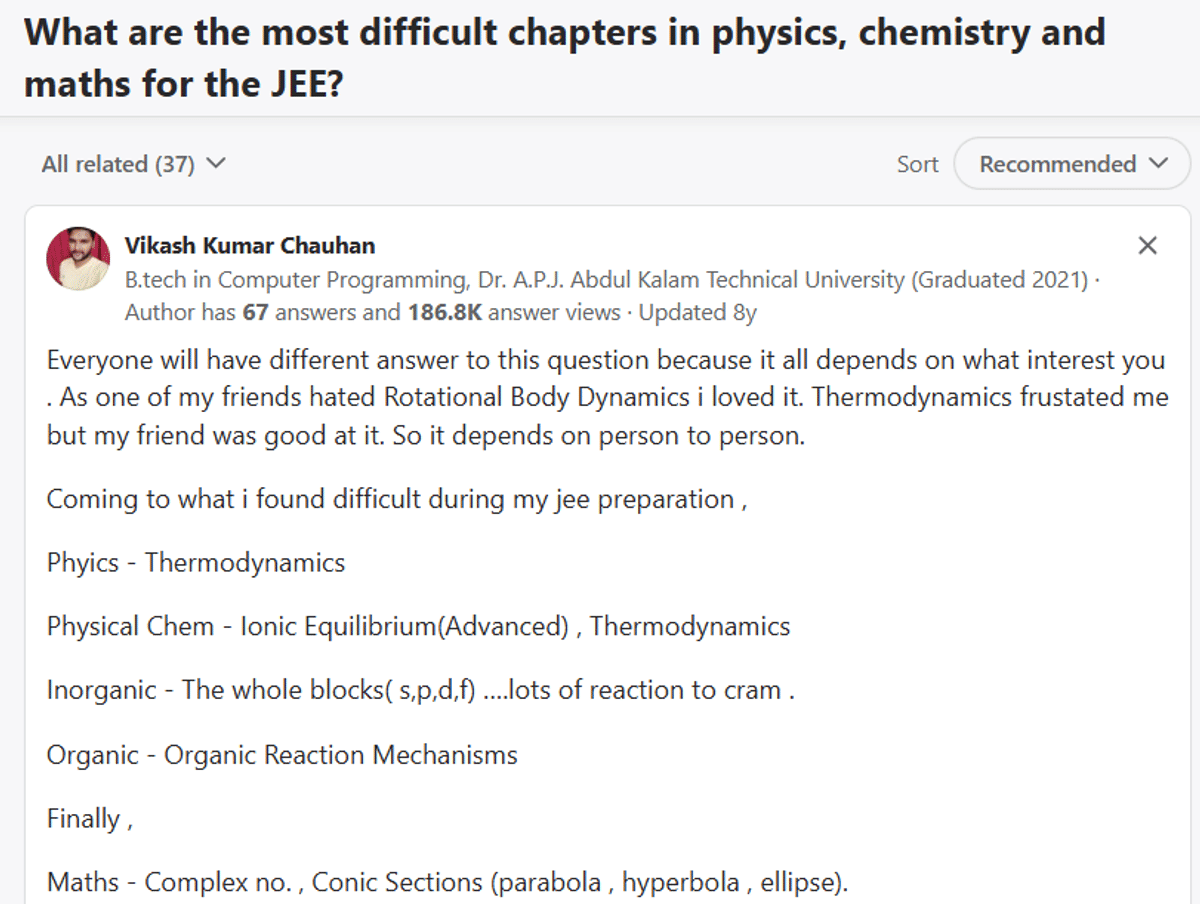
Source - Quora
JEE Main 2026 Subject-wise Difficulty Level
The difficulty level of the JEE Main exam in 2026 is estimated to be moderate with some easy questions, moderate questions, and difficult questions.
- Mathematics: The most difficult part, with the good attempts around 19-22 out of 25, it reflects that it’s better to get the answers correct rather than attempt all questions.
- Physics: Relatively challenging and balanced; attempts between 20 and 22 are possible with strong conceptual understanding and practice with numericals.
- Chemistry: Most scoring subject; maximum good attempts (22-24/25) because of direct and NCERT-based questions, mostly from Organic and Inorganic Chemistry.
| Subject | Expected Difficulty Level | Key Characteristics | Total Questions | Expected Good Attempts |
|---|---|---|---|---|
| Mathematics | Moderate to Tough | Lengthy, time-consuming, multi-concept problems with tricky calculations; accuracy is crucial | 25 | 19 – 22 |
| Physics | Moderate | Balanced mix of conceptual questions and numerical problem-solving | 25 | 20 – 22 |
| Chemistry | Easy to Moderate | Mostly NCERT-based and direct questions, especially from Organic & Inorganic Chemistry | 25 | 22 – 24 |
| Overall Paper | Moderate | Balanced paper with a mix of easy, moderate, and a few challenging questions | 75 | 61 – 68+ |
JEE Main Marks vs Percentile 2026 (Good Attempts)
The Newton School of JEE Main score vs percentile 2026 shows that even with a small change in the marks can have a huge impact on the percentile, especially at the higher scores.
- Scoring 240 – 250 marks with around 72-75 correct answers is expected to place you in the 99+ percentile.
- While 220-230 marks will place the candidate in the 99.7-99.8 percentile range, where the competition is the highest.
- A score of 200-210 marks will still provide you 99.3-99.5 percentile, which is suitable for top NITs and IIITs.
| Marks (out of 300) | Expected Percentile | Approx. AIR Rank | Good Attempts (out of 75) | Admission / Outcome |
|---|---|---|---|---|
| 240 – 250 | 99.9+ | ~1,600 | 72 – 75 | Top 0.1%, Elite rank |
| 220 – 230 | 99.7 – 99.8 | ~3,000 – 4,800 | 68 – 72 | IIT-level performance |
| 200 – 210 | 99.3 – 99.5 | ~8,000 – 11,000 | 65 – 68 | NIT CS (Top NITs) |
| 180 – 190 | ~99.0 | ~16,000 | 62 – 65 | Strong NIT Core / CS |
| 165 – 175 | 98.5 – 98.8 | ~20,000 – 25,000 | 60 – 62 | NIT CS / ECE |
| 150 – 160 | 98.0 – 98.3 | ~30,000 – 32,000 | 58 – 60 | Good NIT branches |
| 140 – 145 | 96.0 – 96.5 | ~58,000 – 64,000 | 55 – 58 | Safe NIT admission |
| 130 – 135 | 94.5 – 95.0 | ~80,000 – 88,000 | 52 – 55 | Borderline NIT |
| 115 – 120 | 93.5 – 94.0 | ~1,40,000 | 48 – 50 | JEE Advanced cutoff (Gen) |
| 100 – 105 | 90 – 91 | ~1,70,000 | 42 – 45 | Below Adv cutoff |
| < 90 | < 88 | >2,00,000 | < 40 | Limited options |
Ques. Is 70 a bad score in JEE Mains?
Ans. A score of 70 in JEE Main is considered below average, which is not good for the top NITs or IIITs, for the candidates in the General category, as it requires much higher cutoff of 90+ percentile. In contrast, candidates from OBC, EWS, SC, or ST categories may still qualify for some state or private engineering colleges.
Ques. Who got 99.97 percentile in JEE Mains?
Ans. Many Students achieved a 99.97th percentile in the JEE Main across different sessions and years.
- JEE Main 2025: Paras Gore (JEE Main 2025), Vansh Goel (Amritsar topper).
- JEE Main 2024: Tanush Bansal (Ludhiana topper).
- JEE Main 2022: Nevish Ashok Pathe, Tanishka Kabra.
- JEE Main 2021: Shreyansh Jain, Tambat (February session).
- JEE Main 2019: Gurbaaz Singh Nandra
JEE Mains Paper Analysis of Last 10 Years
In the last 10 years, JEE Main paper analysis shows that the overall difficulty of the exam has remained moderate to high.
- Maths has consistently been the toughest and most time-consuming subject, along with lengthy and multi-concept questions.
- Physics has become more conceptual and application-based over the years.
- Chemistry has remained the most scoring subject because of its strong NCERT-based questions.
| Year | Overall Difficulty | Physics | Chemistry | Mathematics | Key Trend / Notes |
|---|---|---|---|---|---|
| 2025 | Moderate–High | Moderate | Mostly NCERT & scored | Maths lengthy & tough | Multi‑concept maths & physics numericals |
| 2024 | Moderate–Difficult | Conceptual Physics | Easier but conceptual Chem | Maths complex | Maths and conceptual reasoning rose |
| 2023 | Moderate | Moderate Physics | Chemistry easy, NCERT | Maths lengthy/tricky | Strong NCERT trend in chemistry |
| 2022 | Moderate–Difficult | Tricky Physics | Easy, NCERT | High maths load | Maths and time management biggest challenge |
| 2021 | Moderate | Easier Physics | Scoring Chemistry | Maths toughest | Physics easier, maths remains time‑consuming |
| 2020 | Moderate–High | Concept heavy, tricky | Easy–Moderate | Hard questions | Transition year; Physics toughest among sections |
| 2019 | Moderate–High | Conceptual twist | Mixed difficulty | Moderate | Balanced difficulty with some tough shifts |
| 2018 | Moderate | More application | Organic focus | Geometry heavy | Balanced with more application‑based physics |
| 2017 | Moderate | Balanced syllabus | Mostly NCERT | Mixed Algebra & Calculus | Stable pattern, formula and application mix |
| 2016 | Moderate–High | Conceptual, tricky | NCERT + numerical | Lengthy Calculations | Early NTA transition; longer maths emphasis |
Top 5 Toughest JEE Mains Papers
The data of the 5 toughest JEE Main papers shows that 2025 and 2020 were the toughest years in JEE Main history.
- The 28 January 2025 shift 1 JEE Main paper was one of the most difficult ever, with very low attempt rates and difficulty comparable to JEE Advanced.
- Similarly, 2020 was also the toughest year across all shifts due to the NTA transition, which introduced a new paper pattern with an increased difficulty level.
| Rank | Year / Shift | Subjects Most Difficult | Difficulty Level | Reason for Toughness | Student Feedback / Insights |
| 1 | 2025 Jan 28 Shift‑1 | Maths & Physics | Very High | Lengthy Maths problems, multi‑concept Physics questions, and higher-than-Advanced conceptual level | Students called it one of the toughest mains ever; low attempt rates were observed. |
| 2 | 2020 (All Shifts) | Physics | Very High | Concept-heavy Physics, NTA transition, unfamiliar question types | Widely considered extremely tough due to a sudden shift in exam pattern. |
| 3 | 2019 Specific Shifts (Apr 10 S2, Jan 9 S1, Apr 12 S1) | Physics & Maths | High | Multi-concept Physics, tricky Maths questions not seen before | Shift-wise tough; required deeper understanding beyond memorization. |
| 4 | 2022 Specific Shifts (Jun 27 S2, Jun 28 S1, Jun 29 S2) | Maths | High | Lengthy and calculation-heavy Maths questions | Considered tricky due to multi-step calculations; Physics moderately tough. |
| 5 | 2025 Apr Shifts (Apr 3 S2, Apr 4 S2) | Maths & Physics | High–Very High | Complex Maths logic, application-based Physics | Many students rated these shifts as challenging; above-average difficulty trends observed. |
Ques. What is the 80/20 rule in JEE Mains?
Ans. The 80/20 rule in JEE Main is an efficient preparation strategy; it suggests that 80% of your scores come from only 20% of the syllabus, which means the students should only focus on high-weightage topics.
- Mathematics: Calculus, Coordinate Geometry.
- Physics: Mechanics, Electrostatics, Modern Physics.
- Chemistry: Organic reactions, Physical Chemistry formulas.
Ques. Is 200 out of 300 in JEE Mains good?
Ans. Scoring 200 out of 300 in JEE Main is considered a very good performance, which will place you in the 99-99.7 percentile, providing you with the opportunity to take admission to top NITs and IIITs, especially in CSE and EE branches.
Easiest vs Toughest Shifts Analysis in JEE Main 2025
In JEE Main 2025, there were drastic changes in every shift. In mathematics, there were major changes. As per the students' reaction and expert analysis, some shifts were considered as the most scoring, whereas some were rank droppers for candidates.
Check below, the difficulty level comparison of JEE Main 2025 as per the candidates' opinion for Session 1 and Session 2:
JEE Main 2025: Session 1 Difficulty Level (January 2025)
The Shift 1 of 25th January was considered the easiest shift, whereas Shift 2 of January 2027 was considered the toughest shift.
| Date & Shift | Physics Difficulty | Chemistry Difficulty | Maths Difficulty | Overall | Toppers Insights |
|---|---|---|---|---|---|
| Jan 24 (Shift 1) | Easy–Moderate | Easy | Moderate | Scoring | “NCERT-Based Chemistry + formula-based Physics made it smooth.” |
| Jan 24 (Shift 2) | Moderate | Moderate | Moderate–Tough | Balanced | “Maths length reduced attempts slightly.” |
| Jan 25 (Shift 1) | Easy | Easy | Moderate | Easiest of Session 1 | “Highest accuracy shift; straightforward questions.” |
| Jan 25 (Shift 2) | Moderate–Tough | Moderate | Tough | Rank-Dropping | “Maths lengthy; Physics tricky numerical values.” |
| Jan 27 (Shift 1) | Easy–Moderate | Easy | Moderate | Scoring | “Organic + Physical Chem dominated; time-saving shift.” |
| Jan 27 (Shift 2) | Moderate | Moderate | Tough | Toughest of Session 1 | “3D Geometry + Calculus made Math extremely time-consuming.” |
JEE Main 2025: Session 2 Difficulty Level ( April 2025)
- The April 9th Shift 1 was considered the easiest shift, and the shift 2 of April 6th was considered the toughest shift.
- Session 2 is considered more time-consuming than session 1 because of calculation-based mathematics questions.
| Date & Shift | Physics Difficulty | Chemistry Difficulty | Maths Difficulty | Overall Tag | Topper Insights |
|---|---|---|---|---|---|
| Apr 6 (Shift 1) | Moderate | Easy | Moderate | Balanced–Easy | “NCERT-based Chemistry, better attempts” |
| Apr 6 (Shift 2) | Tough | Moderate | Tough | Toughest of Session 2 | “Time-consuming Maths + tricky Physics.” |
| Apr 8 (Shift 2) | Easy–Moderate | Easy | Moderate | Scoring | “Smooth paper across subjects.” |
| Apr 8 (Shift 2) | Moderate | Moderate | Moderate | Balanced | “No surprises, but Maths was slow.” |
| Apr 9 (Shift 1) | Easy | Easy–Moderate | Moderate | Easiest of Session 2 | “Chem + Physics both direct; high attempt rate.” |
| Apr 9 (Shift 2) | Moderate–Tough | Moderate | Tough | High Difficulty | “Maths again toughest; lengthy PYQ-modified problems.” |
Also Read: JEE Main Syllabus: Easy Chapters
Ques. How does NTA normalisation adjust scores for difficult shifts?
Ans. In JEE Main, NTA uses a statistical method to compare scores in both, which ensures that tougher shift candidates don’t have any disadvantage.
- The Raw marks will be converted into normalised percentile, with a scale of 0-100.
- It ensures that a student scoring 70 marks in a hard shift may get a higher percentile than someone scoring 80 in an easy shift.
| Difficulty of Shift | Avg Raw Score | Expected 95 Percentile |
|---|---|---|
| Easy | 140–150 | 165–175 |
| Moderate | 110–120 | 145–155 |
| Tough | 85–95 | 130–140 |
Ques. Are morning shifts generally tougher, or is it just a myth?
Ans. Generally, according to candidates, the morning shifts are tougher, but as per 2025, the shift-wise difficulty level can vary according to different factors.
JEE Mains Morning vs Afternoon Shift Difficulty
| Shift Type | Student Perception | Reality from Paper Trends |
|---|---|---|
| Morning (9 AM) | “More tricky, concept-heavy” | 50% tough, 50% moderate → no fixed pattern |
| Afternoon (3 PM) | “More calculation-based” | 45% tough, 55% moderate → balanced |



Comments