




High weightage JEE Physics chapters include: Mechanics, Modern Physics, Current Electricity & Magnetism, Electrostatics, Optics, Thermodynamics, and Heat. Physics in JEE Mains carries 25 questions. About 70% of the weightage comes from Class 12 topics.
NCERT is a first and foremost reference; H.C. Verma and D C Pandey are also good books to prepare for JEE Physics Mains. JEE Mains Physics 80-20 rule. 80% questions come from 20% of the syllabus.
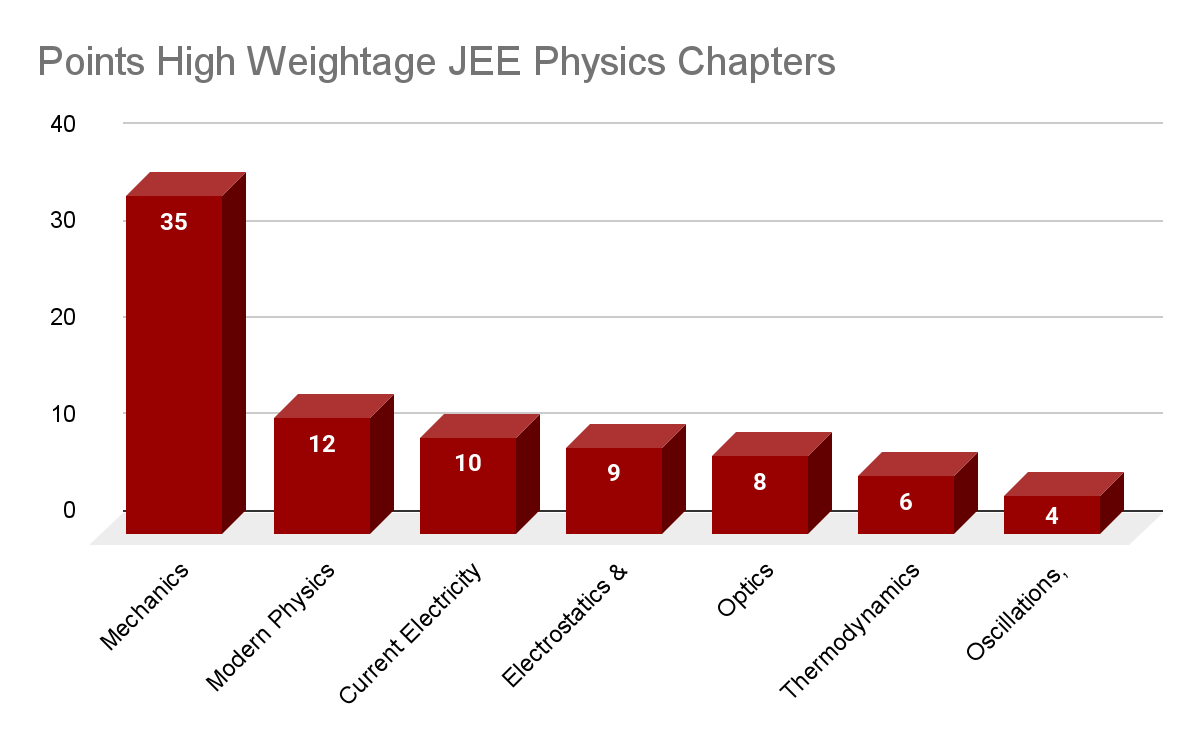
- Mechanics: 30-35%
- Modern Physics:10-12%
- Current electricity & Magnetism:8-10%
- Electrostatics:7-9%
- Optics:6-8%
- Thermodynamics and Heat:5-6%
Also Read
Key Summary
- Class 12 Physics contributes nearly 70% of the JEE Mains Physics paper.
- Mechanics dominates with 7-8 questions, and is one of the High weightage JEE Physics chapters.
- Modern Physics topics, such as semiconductors, Atoms, and the photoelectric effect, are repeated every year.
- Electrostatics and current electricity are combined for 4-5 questions annually.
- Optics (Ray and Wave) gives about 2 questions (6-8% weightage) consistently.
- Thermodynamics and Heat Transfer overlap with Chemistry, offering a dual prep advantage.
- Magnetism and Electromagnetic Induction produce 2-3 questions in each exam.
- Oscillations and Waves appear with moderate frequency, around 1-2 questions.
- Studying NCERT first, followed by HC Verma and DC Pandey, ensures coverage of both basics and advanced applications.
High Weightage JEE Physics Chapters
- Modern Physics (Photoelectric Effect, Semiconductors, Nuclear Physics) consistently contributes 10-12% of questions.
- Mechanics overall has the largest share (30-35%), though spread across many subtopics.
- Current Electricity & Magnetism together account for 8-10% weightage.
- Electrostatics and Capacitors carry about 7-9%.
- Optics (Ray + Wave) covers 6-8% and is highly scoring.
- Thermodynamics and Heat Transfer provide 5-6% weightage.
- Topics like Oscillations, Waves, and Communication Systems appear regularly but in a lower proportion (2-4%).
| Chapters with more weightage | Approx. Weightage | Approx.Questions |
|---|---|---|
| Mechanics | 30-35% | 7-8 |
| Modern Physics | 10-12% | 3-4 |
| Current Electricity & Magnetism | 8-10% | 2-3 |
| Electrostatics & Capacitors | 7-9% | 2 |
| Optics | 6-8% | 2 |
| Thermodynamics & Heat | 5-6% | 1-2 |
| Oscillations, Waves & Communications | 2-4% | 1 |
Also Read
Easy Chapters in Physics for JEE Main 2025High Weightage JEE Physics Chapters-Class 11 Physics
- Laws of Motion, Work, Power & Energy collectively give 7–8% of the paper.
- Rotational Motion alone contributes 6–7% with at least 2–3 questions almost every year.
- Thermodynamics and Heat account for 6–7% weightage.
- Gravitation appears with 2–3% coverage but often has tricky conceptual questions.
- Oscillations and Waves contribute 3–4% weightage.
- Units & Dimensions and Error Analysis are small, but scoring with 1–2 questions almost every year.
- Kinematics and Motion in a Straight Line, though basic, form the foundation for multiple mechanics-based questions.
| Sections | Approx. Weightage | Approx.Questions |
|---|---|---|
| Laws of MotionWork, Power & Energy | 7-8% | 2 |
| Rotational Motion | 6-7% | 2 |
| Thermodynamics & Heat | 6-7% | 2 |
| Gravitation | 2-3% | 1 |
| Oscillations & Waves | 3-4% | 1 |
| Units & Dimensions, Error Analysis | 2% | 1 |
| Kinematics & Straight Line Motion | 3-4% | 1 |

Also Read
JEE Main Syllabus 2026High weightage JEE Physics chapters-Class 12 Physics
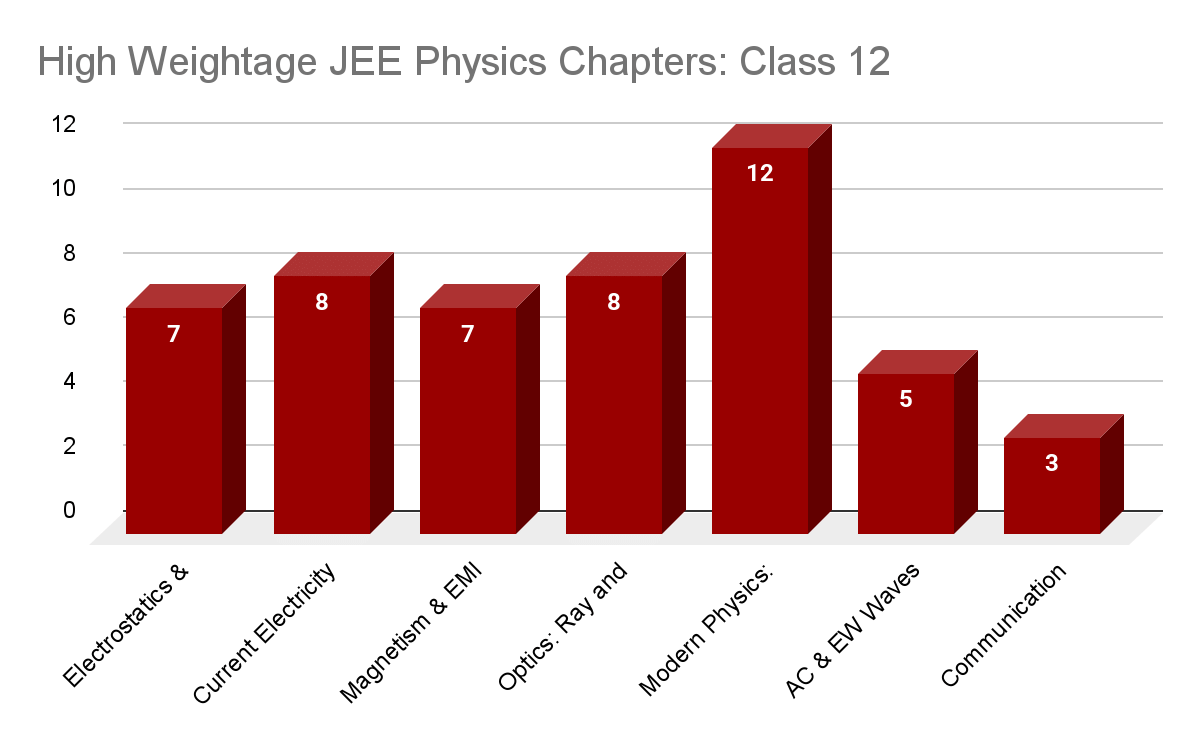
- Electrostatics and Capacitance together give 6–7% of marks.
- Current Electricity contributes 3-4 questions (~8%).
- Magnetism & Electromagnetic Induction account for 6-7%.
- Optics (Ray + Wave) holds 6-8%, mostly scoring questions.
- Modern Physics (Atoms, Nuclei, Semiconductors) carries 10-12%, making it a top priority.
- Alternating Current and Electromagnetic Waves combine for 4-5% weightage.
- Communication Systems sometimes give 1–2 direct questions.
| Sections | Approx. Weightage | Approx.Questions |
|---|---|---|
| Electrostatics & Capacitance | 6-7% | 2 |
| Current Electricity | 7-8% | 2-3 |
| Magnetism & EMI | 6-7% | 2 |
| Optics: Ray and Wave | 6-8% | 2 |
| Modern Physics: Atoms, Nuclei, Semiconductors | 10-12% | 3-4 |
| AC & EW Waves | 4-5% | 1 |
| Communication systems | 2-3% | 1 |
High Weightage JEE Physics Chapters: Most Important Chapters for JEE Mains
- Mechanics (especially Rotation, Laws of Motion, Work-Energy, Gravitation).
- Electrostatics & Current Electricity – highly repetitive and conceptual.
- Optics (especially Lenses and Interference/Young’s Double Slit Experiment).
- Modern Physics – easiest scoring section with high weightage.
- Thermodynamics & Heat Transfer – overlaps with Chemistry, giving a double advantage.
- Magnetism & Electromagnetic Induction – 2–3 questions almost every year.
- Oscillations and Waves – though fewer, often carry moderate difficulty questions.
| Chapters | Why Important | Repeated Topics | How often do they repeat |
|---|---|---|---|
| Mechanics | Has largest share ~30% |
|
Every year, 7-8 questions |
| Electrostatics & Current Electricity | High-accuracy scoring |
|
Every year, 4-5 questions |
| OPtics | Direct, Formula-based scoring |
|
Every year, 2 questions |
| Modern Physics | Easy, Formula-based, High-return section |
|
Every year, 3-4 questions |
| Thermodynamics & Hot Transfer | Repeats in Chemistry and Conceptual |
|
Every alternate year, 2-3 questions |
| Magnetism & EMI | Strong concepts and recurring |
|
Every year, 2-3questions |
| Oscillations & Waves | Moderate difficulty |
|
Almost every year, 1-2 questions |
Also Read
JEE Main Physics Question PapersHigh Weightage Chapters for JEE Mains
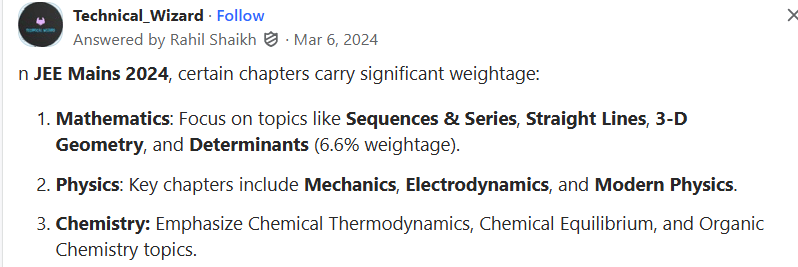
- Physics: Modern Physics, Current Electricity, Optics, Thermodynamics, Mechanics.
- Chemistry: Coordination Compounds, Thermodynamics, p-Block, Chemical Bonding, Organic Compounds (Amines, Aldehydes, Ketones).
- Mathematics: Calculus, Probability, Vectors & 3D, Coordinate Geometry, Algebra (Quadratic, Complex Numbers).
- Together, these select chapters cover 50–60% of the JEE Main paper.
| Subjects | Chapters |
| Physics |
|
| Chemistry |
|
| Mathematics |
|
Also Read
JEE Main Physics Syllabus- Download PDF, Class 11 and 12 Topics-Wise WeightageHigh Weightage JEE Physics Chapters: Quora & Reddit Discussion
- Quora and Reddit users have shared important topics in JEE Mains Physics.
- The users have shared repeated chapters and useful tips for preparation.



High weightage JEE Physics chapters FAQs
Ques. Which Chapter in Physics has the highest weightage in JEE?
Ans.Electrostatistics, Modern Physics, and Optics are considered high-weightage areas.
- Electrostatics, Current Electricity, and Magnetism often carry 15-20 marks.
- Optics contributes to 8-10 questions.
- 3-4 questions come from Modern Physics and Semiconductor devices.
- Mechanics has the largest share of ~30-35%. Topics such as Laws of Motion, Work-Energy, and Rotation contribute to this share.
Ques. What is the 80-20 rule for JEE Mains?
Ans.80-20 rule in JEE mains means, 80% of questions come from 20% of the chapters.
- The high-weightage chapters include: Electrostatics, Current Electricity, Optics, Thermodynamics, Modern Physics, and Mechanics.
- These chapters provide 40-45% of the total questions.
Ques. Is 75% removed from JEE?
Ans.75% is not removed from JEE.
- It was temporarily relaxed from 2020-2022 due to COVID.
- 75% score in Class 12 for Gen/EWS/OBC and 65% for SC/ST candidates is required for admissions into IIT and NIT.
Ques. Is 70% good in JEE?
Ans.70% is low in JEE Main.
- With 70 percentile chance for NIT/IIT is too low.
- 70 marks in JEE translates to a 60-65 percentile.
- With 70 marks, admission is possible via JoSAA
Ques. Is top 20 percentile required for IIT?
Ans.Yes, the top 20 percentile is an alternative to the 75% board rule.
- If you get top 20th percentile, you can still be eligible if you score <75% in boards.





Comments