




The All India Rank (AIR) in JEE Main 2026 is calculated by first normalising all the scores across the sessions, followed by choosing and compiling the highest normalised percentiles in descending order.
- Raw marks are not taken into consideration for AIR.
- Since the exam is conducted in multiple sessions, each sessions’ marks are normalised to ensure fairness, and then the AIR is calculated.
- To break the ties in ranking, subject scores are considered, with Maths having the top priority, followed by Physics and Chemistry.
- Age is also taken into account by NTA while allotting AIR.
Related Links:
- JEE Main 2026 Score Calculator (Session 2)
- Jee-Main Rank Predictor 2026: Marks vs Percentile …
- JEE Main Marks vs Percentile 2026: Check Shift-Wise …

Key Summary
- The All India Rank (AIR) for JEE Mains 2026 is based on the normalised percentile score.
- Raw marks are not taken into account to calculate the AIR in JEE Mains 2026.
- Normalisation is done to ensure fairness in evaluation as the exam is conducted in multiple sessions.
- To break the ties, the normalised percentile score is taken up to 7 decimal places.
- Even if there exists a situation of tie, the normalised percentile score of Mathematics is given higher preference than Physics, followed by Physics and then by Chemistry.
- If there is still a tie between the candidates, the age is considered and the higher rank is given to those of older age.
Step-by-Step Procedure to Calculate AIR for JEE Mains 2026
Calculating the AIR for JEE Mains 2026 includes step-by-step procedures.
- A student should first calculate his/ her raw mark (if the marks are released, this step can be skipped).
- Then the percentile should be estimated.
- Finally, if you appeared for multiple sessions, consider your highest percentile for calculating the All India Rank (AIR).
Determining the Raw Score
First calculate your raw score based on the correct and incorrect responses. For each correct response 3 marks should be added and for an incorrect response 1 mark should be subtracted.
Estimating Percentile
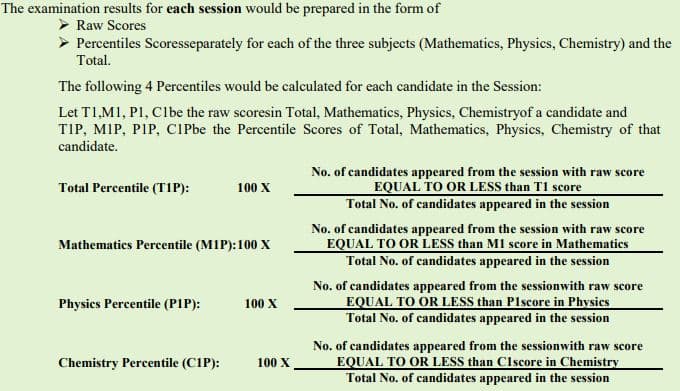
The estimation of the percentile is dependent on the total number of candidates, and the number of candidates who scored equal to less than your score.
To calculate the percentile, the number of candidates who scored raw marks less than or equal to your score are divided by the total number of candidates, and then the obtained value is multiplied by 100.
| Percentile = (Number of candidates with raw marks equal to or less than your mark / Total Number of Candidates ) * 100 |
Calculating AIR for JEE Mains 2026
The AIR calculation for JEE Mains 2026 relies on the percentile value and the total number of candidates.
The percentile estimated or given by the NTA is subtracted from 100 and then divided by 100. The final value is then multiplied by the number of candidates.
| AIR = ((100 - Percentile Estimated/ given by NTA) / 100) * Number of Candidates |
Source: jeemain.nta.nic.in
Ques. How to check JEE Main 2026 rank?
Ans. In order to check your JEE Main 2026 rank, go to the official website of NTA (jeemain.nta.nic.in) or ntaresults.nic.in. After getting redirected to the page, click on the “JEE Main 2026 Session 1/ 2 Result” link, then give in your “Application Number” and “Date of Birth.” Type the captcha and submit to view/ download your score card and rank.
Ques. Which was the toughest shift in JEE 2026?
Ans. The shift 1 exam for Session 2 (April) JEE Main 2026 conducted on April 6, 2026 is considered to be the toughest shift. Experts’ analyses and students’ responses to the shift 1 exam highlighting the Maths paper being “brutal” and “lengthy”, and the extremely calculation-oriented questions in Physics validate the reasoning for the exam to be the toughest so far for the academic year 2026. Similarly the shift 1 exam for the January Session (Session 1) is also considered to be tough due its time-consuming and tricky questions.
What is JEE Main Normalisation?
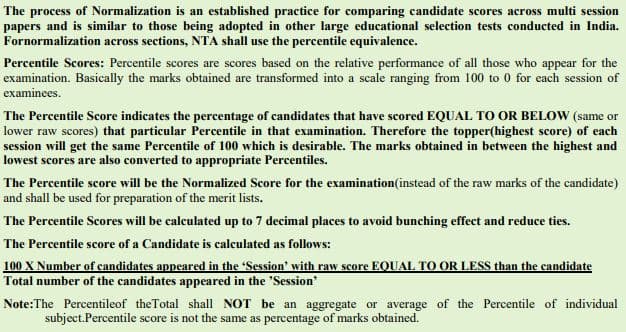
Normalisation is the process of comparing the candidates’ scores in the multiple sessions of the exam conducted.
- Normalisation is not dependent on the raw marks.
- The percentile is only considered for normalisation.
- The percentile score will be the normalised score, and this score will be used to calculate the AIR to prepare the merit list.
- The score will be calculated up to 7 decimal places to avoid multiple students receiving the same marks and thereby reducing ties.
Source: jeemain.nta.nic.in
JEE Main Tie-Breaking Policy
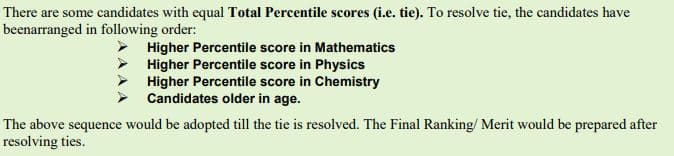
The NTA attempts mainly to avoid ties and crowding of students over the same mark. That is the key reason why 7 decimal places are taken for the normalised percentile score.
- However, even if there is a tie, the student who has a higher normalised percentile for Mathematics is given higher rank in comparison to Physics and Chemistry.
- The next higher rank is given to the ones with higher normalised percentile in Physics, and then Chemistry at last.
- Even if two or more students still result in a tie, their age is considered.
- The student who is older is given the higher rank.
Source: jeemain.nta.nic.in
Key Factors for Calculating AIR in JEE Mains 2026
There are four main factors that are considered when calculating the All India Rank (AIR) in JEE Mains 2026.
- Total Candidates: The total number of candidates who appear for the exam affect the calculation of AIR.
For example, if 12 lakh students participated in the exam and a student scored 250 marks out of 300, the AIR can be 240. But for the same mark, the AIR can be 640, if the number of students is 13 lakh.
- Percentile vs Marks: High marks in a tough shift result in better ranks, which are comparatively lower than for the same marks in easy shifts.
- Category: The category of each student also impacts the AIR as students from OBC-NCL and SC/ ST/ EWS have higher chances of getting a relatively lower rank even if they score a less normalised percentile than the General category.
- High Rank: As the AIR is completely based on normalisation, the high rank plays a key role in affecting the AIR. The high rank determines whether a paper was easy or tough, and hence, impacting the AIR.



Comments