




JEE Main 2026 percentile calculation after normalisation is based on the NTA score, which is being calculated using the formula:

This formula compares candidates' performance only against other candidates in their specific shift to ensure fairness across different difficulty levels.
- A candidate scoring 250 marks out of 300 in a tough shift may get a higher percentile than other candidates who score 260 in an easier shift
- In JEE Main 2026, both sessions produce separate percentile scores from which NTA takes the best of the two for the final merit list.
- Even a 10-mark difference can lead to significant percentile changes in competitive ranges.

Key Summary
- In JEE Main 2026, shift difficulty plays a major role with cases where a candidate with lower score in a tough shift results in higher percentile than the higher score in easier shift.
- The calculation depends on three key inputs: total candidates in the session, number of candidates scoring equal or below, and applying the official formula up to 7 decimal precision.
- For tie breaking scenarios, NTA is issuing separate subject wise percentiles for Physics, Chemistry and Mathematics.
- For final merit, NTA considers the best percentile out of both sessions, which will determine CRL and JoSAA counselling eligibility.
Also Read:
- JEE Main Marks vs Percentile 2026: Check Shift-Wise Marks and Rank Prediction
- JEE Main 2026 Marks vs Percentile vs Rank Predictor for Session 2 April Exam
- How Many Candidates applied for the JEE Mains 2026 Session 2 Exam?
What is Normalization in JEE Main 2026?
- Normalization is a statistical method used by National Testing Agency (NTA) to ensure fairness across multiple exam sessions in JEE Main 2026.
- The JEE Main exam is conducted over several days and shifts and the difficulty levels of the question papers can vary.
- The normalization process ensures that one candidate will not be disadvantaged if he/she receives a tough paper than the other candidate who receives an easier one.
- The percentile is calculated up to 7 decimal places to minimize the tie between candidates.
- In JEE Main 2026, if the percentile scores remain same between candidates then the tie breaking rules will be followed.
Also Read: How is All India Rank calculated in JEE Main 2026?
Ques. Does normalisation change candidates' actual marks in JEE Main 2026?
Ans. No, normalisation does not change candidates' marks in JEE Main 2026. Normalisation only converts marks into percentiles according to candidates shift’s performance.
Ques. Is normalization in JEE Main 2026 the same method used since 2019?
Ans. Yes, the normalization method used in JEE Main 2026 is the same since 2019.
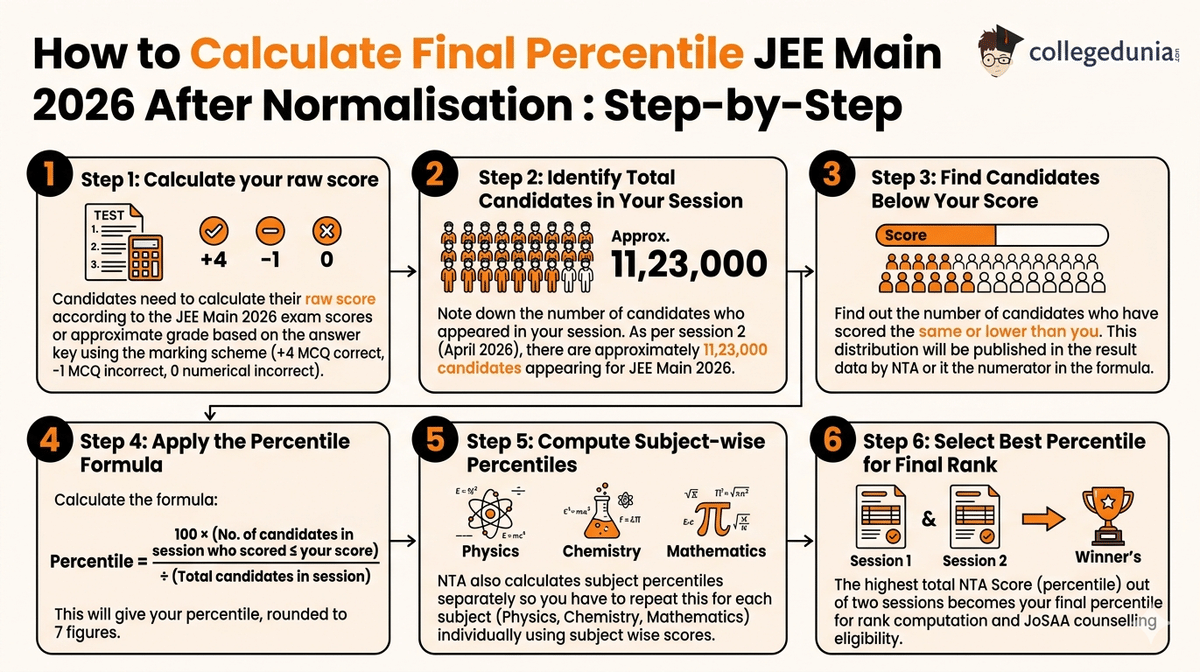
How to Calculate Final Percentile JEE Main 2026 After Normalisation: Step-by-Step
After NTA published the official result information, candidates can follow the steps given below to figure out how to calculate the JEE Mains percentile from marks using the official formula:
| Step 1 | Calculate you raw scoreCandidates need to calculate their raw score according to the JEE Main 2026 exam scores or approximate grade based on the answer key using the marking scheme (+4 MCQ correct, -1 MCQ incorrect, 0 numerical incorrect). |
| Step 2 | Identify Total Candidates in Your SessionNote down the number of candidates who appeared in your session. As per session 2 (April 2026), there are approximately 11,23,000 candidates appearing for JEE Main 2026. |
| Step 3 | Find Candidates Below Your ScoreFind out the number of candidates who have scored the same or lower than you. This distribution will be published in the result data by NTA or it is the numerator in the formula |
| Step 4 | Apply the Percentile FormulaCalculate the formula:Percentile = 100 × (No. of candidates in session who scored ≤ your score) ÷ (Total candidates in session)This will give your percentile, rounded to 7 figures. |
| Step 5 | Compute Subject-wise PercentilesNTA also calculates subject percentiles separately so you have to repeat this for each subject (Physics, Chemistry, Mathematics) individually using subject wise scores. |
| Step 6 | Select Best Percentile for Final RankThe highest total NTA Score (percentile) out of two sessions becomes your final percentile for rank computation and JoSAA counselling eligibility. |
Here is a example to show how to calculate JEE Main percentile from marks for a candidate who scored 250 out of 300 in Session 2:
| Parameter | Value | Formula Step | Result |
|---|---|---|---|
| Candidate Raw Score | 250 | Input | - |
| Candidates scoring ≤ 250 | 11,00,000 | Count from NTA data | - |
| Total candidates in session | 11,23,000 | NTA official figure | - |
| Percentile Calculation | (11,00,000 / 11,23,000) x 100 | Apply formula | 97.95% |
| Final Percentile Score | - | - | 97.9519145 |
Also Read: Lowest Percentile Required for NIT in JEE Main 2026
Ques. If my Session 2 percentile is lower, will NTA use Session 1 automatically?
Ans. Yes, NTA will use your session 1 percentile automatically if your session 2 percentile is lower than session 1 because NTA's policy is best of two so in your scorecard whichever session gives you the higher percentile is considered.
Ques. Can I use Session 1 percentile for JEE Main 2026 cut-off even if I appear in Session 2?
Ans. Yes, you can use session 1 percentile for JEE Main 2026 cutoff even if you appeared in session 2. Your best percentile across sessions is what counts toward the JEE Advanced 2026 eligibility cut-off.
JEE Main 2026 Expected Marks vs Percentile
- Candidates scoring 285-300 marks range are placing them in 99.99+ percentile, which get them admission in top IIT colleges.
- Candidates scoring between 200-249 are getting 98-99.5 percentile, which remains strong for getting admission in top branches at NITs and IIITs.
- Candidates scoring 150-179 marks can get expected percentile from 90-96, which is sufficient for mid tier NITs and GFTIs.
- In the 120-140 marks range, the percentile would be 80-90 in JEE Main 2026, where candidates can get admission in state level engineering colleges.
- Candidates scoring marks below 120 can get expected percentile below 80 in JEE Main 2026, which narrows the options to get admission in private and state colleges.
| Score Range (Out of 300) | Expected Percentile | Category |
|---|---|---|
| 285 - 300 | 99.99+ | IIT level topper |
| 250 - 284 | 99.5 - 99.99 | Top IIT aspirant |
| 200 - 249 | 98 - 99.5 | NIT/ IIIT Top branches |
| 180 - 199 | 96 - 98 | Good NIT/ IIIT |
| 150 - 179 | 90 - 96 | State NITs / GFTIs |
| 120 - 149 | 80 - 90 | State level colleges |
| Below 120 | Below 80 | Private/State colleges |
Also Read:
Collegedunia Percentile Predictor: Calculate Your JEE Main 2026 Expected Percentile
- In Collegedunia predictor, candidates can predict their expected marks, percentile and college in JEE Main 2026 exam.
- You must have calculated the JEE Main mark from the answer key, but if you are still wondering how to calculate the JEE Main mark, then do check How to calculate JEE Main Marks from the Answer key.
After that follow the following steps given below:
| Step 1 | Visit the Collegedunia Predictor Page:Go to the Collegedunia JEE Main 2026 Percentile Predictor Page . |
| Step 2 | Enter your expected marks:Input your estimated score out of 300 based on your exam attempt or answer key calculation. |
| Step 3 | Submit the Information:Click on the “Check Predict Rank” button |
| Step 4 | Get your predicted rank:The tool will display expected CRL and estimated percentile |
| Step 5 | Analyze your admission chances:Compare your predicted JEE Main percentile and rank with previous year NIT/IIIT cutoffs, branch wise closing ranks and JoSAA counselling trends. |

Check this:

Also Read:
Check out this video by Collegedunia for more information:
Ques: What details are required to use the Collegedunia percentile predictor?
Ans. Candidates need only their expected marks out of 300 marks to generate percentile and rank estimates.
Ques: How should candidates use the predicted percentile after getting it?
Ans. Candidates should compare it with previous year cutoffs and counselling trends to shortlist colleges.



Comments