




JEE Main 2024 5 April Shift 1 Mathematics question paper with solutions and answers pdf is available here. NTA conducted JEE Main 2024 5 April Shift 1 exam from 9 AM to 12 PM. The Mathematics question paper for JEE Main 2024 5 April Shift 1 includes 30 questions divided into 2 sections, Section 1 with 20 MCQs and Section 2 with 10 numerical questions. Candidates must attempt any 5 numerical questions out of 10. The memory-based JEE Main 2024 question paper pdf for the 5 April Shift 1 exam is available for download using the link below.
Related Links:
- JEE Main 2025 Question Paper pdf with solutions
- JEE Main Previous Years Question Paper with Solution PDF
JEE Main 2024 5 April Shift 1 Mathematics Question Paper PDF Download
| JEE Main 2024 5 April Shift 1 Mathematics Question Paper with Solutions PDF | Download PDF | Check Solutions |
JEE Main 2024 5 April Shift 1 Mathematics Questions with Solutions
Solve the differential equation: \[ \frac{dy}{dx} + 2y = \sin 2x \quad and \quad y(0) = \frac{3}{4} \]
Then, the value of \( y \left( \frac{\pi}{2} \right) \) is.
View Solution
Step 1: Write the differential equation.
The given equation is: \[ \frac{dy}{dx} + 2y = \sin 2x \]
This is a first-order linear differential equation.
Step 2: Solve the homogeneous part.
Solve the homogeneous equation \( \frac{dy}{dx} + 2y = 0 \). The solution to this is: \[ y_h = Ce^{-2x} \]
Step 3: Solve the non-homogeneous part.
To solve the non-homogeneous part, we use an integrating factor. The integrating factor is \( e^{\int 2 dx} = e^{2x} \). Multiply both sides of the differential equation by \( e^{2x} \): \[ e^{2x} \frac{dy}{dx} + 2e^{2x} y = e^{2x} \sin 2x \]
This simplifies to: \[ \frac{d}{dx} \left( y e^{2x} \right) = e^{2x} \sin 2x \]
Integrate both sides with respect to \( x \): \[ y e^{2x} = \int e^{2x} \sin 2x \, dx \]
Step 4: Perform the integration.
The integral \( \int e^{2x} \sin 2x \, dx \) can be solved using integration by parts or a standard table of integrals. The result is: \[ y e^{2x} = \frac{1}{2} \left( e^{2x} (\sin 2x - \cos 2x) \right) + C \]
Step 5: Solve for \( y \).
Thus, \[ y = \frac{1}{4} \left( \sin 2x - \cos 2x \right) + e^{-2x} \]
Step 6: Apply the initial condition.
Given \( y(0) = \frac{3}{4} \), substitute \( x = 0 \) into the solution: \[ \frac{3}{4} = \frac{1}{4} (0 - 1) + e^{0} + C \]
Solving for \( C \), we get \( C = 1 \).
Step 7: Final solution.
Therefore, the solution is: \[ y = \frac{1}{4} (\sin 2x - \cos 2x) + e^{-2x} \]
Step 8: Evaluate at \( x = \frac{\pi}{2} \).
Substitute \( x = \frac{\pi}{2} \) into the solution: \[ y \left( \frac{\pi}{2} \right) = \frac{1}{4} (0 - (-1)) + e^{-\pi} = \frac{1}{4} + e^{-1} \] Quick Tip: For solving first-order linear differential equations, use the integrating factor method and apply initial conditions carefully to find the constant of integration.
Let \( f(x) = x^5 + x^4 + x^3 + 3x + 1 \) and \( f(g(x)) = x \) then value of \( \frac{g(7)}{g'(7)} is \).
View Solution
Step 1: Understand the given functions.
We are given that \( f(x) = x^5 + x^4 + x^3 + 3x + 1 \), and \( f(g(x)) = x \). Our goal is to find the value of \( \frac{g(7)}{g'(7)} \).
Step 2: Differentiate the given equation.
To solve for \( g(7) \) and \( g'(7) \), differentiate \( f(g(x)) = x \) with respect to \( x \): \[ \frac{d}{dx} \left( f(g(x)) \right) = \frac{d}{dx}(x) \]
By the chain rule, \[ f'(g(x)) \cdot g'(x) = 1 \]
Step 3: Solve for \( g'(x) \).
From the equation above, we can solve for \( g'(x) \): \[ g'(x) = \frac{1}{f'(g(x))} \]
Step 4: Find \( g(7) \).
To find \( g(7) \), we first need to find \( f'(x) \). Differentiate \( f(x) = x^5 + x^4 + x^3 + 3x + 1 \): \[ f'(x) = 5x^4 + 4x^3 + 3x^2 + 3 \]
Now, since \( f(g(x)) = x \), substitute \( x = 1 \) into \( f'(x) \) to find \( g(7) \). \[ f'(g(7)) = 15 \quad so \quad g'(7) = \frac{1}{15} \]
Therefore, \[ g(7) = 1 \]
Step 5: Find \( \frac{g(7)}{g'(7)} \).
We already know that \( g(7) = 1 \) and \( g'(7) = 15 \), so \[ \frac{g(7)}{g'(7)} = \frac{1}{15} \] Quick Tip: In problems involving composition of functions, always differentiate using the chain rule and carefully apply initial conditions to solve for unknown values.
Find term independent of \( x \) in \( \left(1 - x + 2x^2\right) \left(3x^2 + \frac{1}{x^3}\right)^9 \).
View Solution
Step 1: Expanding the product.
We need to find the term independent of \( x \) in the product. Start by expanding the two expressions: \[ \left(1 - x + 2x^2\right) \left(3x^2 + \frac{1}{x^3}\right)^9 \]
First, expand \( \left(3x^2 + \frac{1}{x^3}\right)^9 \) using the binomial theorem: \[ \left(3x^2 + \frac{1}{x^3}\right)^9 = \sum_{r=0}^{9} \binom{9}{r} (3x^2)^r \left( \frac{1}{x^3} \right)^{9-r} \]
Simplifying: \[ = \sum_{r=0}^{9} \binom{9}{r} 3^r x^{2r} \cdot x^{-3(9-r)} = \sum_{r=0}^{9} \binom{9}{r} 3^r x^{2r - 3(9-r)} \]
The exponent of \( x \) becomes: \[ 2r - 3(9-r) = 5r - 27 \]
Step 2: Find the term independent of \( x \).
We want the exponent of \( x \) to be zero: \[ 5r - 27 = 0 \quad \Rightarrow \quad r = 5.4 \]
This is not an integer, so there is no term independent of \( x \) in this case. Quick Tip: Use the binomial expansion to separate the terms and find the exponent that makes the power of \( x \) zero for the term independent of \( x \).
Area bounded by \( Y = x^2 - 5x \) and \( Y = 7x - x^2 \).
View Solution
We are given the equations \( Y = x^2 - 5x \) and \( Y = 7x - x^2 \), and we need to find the area between these curves.
Step 1: Set the equations equal to each other to find the points of intersection.
\[ x^2 - 5x = 7x - x^2 \]
Rearrange the terms: \[ x^2 + x^2 - 5x - 7x = 0 \] \[ 2x^2 - 12x = 0 \]
Factor the equation: \[ 2x(x - 6) = 0 \]
So, the points of intersection are \( x = 0 \) and \( x = 6 \).
Step 2: Set up the integral to find the area between the curves.
The area is given by the integral: \[ Area = \int_0^6 \left( (7x - x^2) - (x^2 - 5x) \right) \, dx \]
Simplify the integrand: \[ Area = \int_0^6 \left( 7x - x^2 - x^2 + 5x \right) \, dx \] \[ = \int_0^6 \left( 12x - 2x^2 \right) \, dx \]
Step 3: Evaluate the integral.
Integrate the expression: \[ \int_0^6 \left( 12x - 2x^2 \right) \, dx = \left[ 6x^2 - \frac{2}{3} x^3 \right]_0^6 \]
Substitute the limits: \[ = \left( 6(6^2) - \frac{2}{3}(6^3) \right) - \left( 6(0^2) - \frac{2}{3}(0^3) \right) \] \[ = \left( 6(36) - \frac{2}{3}(216) \right) = \left( 216 - 144 \right) = 72 \] Quick Tip: When calculating the area between curves, find the points of intersection and subtract the lower function from the upper function before integrating.
Given that \( \frac{1}{1.2} + \frac{1}{2.3} + \cdots + \frac{1}{99.100} = n \) and \( \frac{1}{\sqrt{1} + \sqrt{2}} + \frac{1}{\sqrt{2} + \sqrt{3}} + \cdots + \frac{1}{\sqrt{99} + \sqrt{100}} = m \), find \( (m, n) \).
View Solution
Step 1: Solve for \( n \).
The given sum is: \[ n = \frac{1}{1.2} + \frac{1}{2.3} + \cdots + \frac{1}{99.100} \]
We can simplify each term as: \[ \frac{1}{r(r+1)} = \frac{1}{r} - \frac{1}{r+1} \]
Thus, the sum becomes a telescoping series: \[ n = \left( 1 - \frac{1}{2} \right) + \left( \frac{1}{2} - \frac{1}{3} \right) + \cdots + \left( \frac{1}{99} - \frac{1}{100} \right) \]
The intermediate terms cancel out, and we are left with: \[ n = 1 - \frac{1}{100} = \frac{99}{100} \]
Step 2: Solve for \( m \).
We are given the sum: \[ m = \frac{1}{\sqrt{1} + \sqrt{2}} + \frac{1}{\sqrt{2} + \sqrt{3}} + \cdots + \frac{1}{\sqrt{99} + \sqrt{100}} \]
Rationalize each term by multiplying both the numerator and denominator by \( \sqrt{r+1} - \sqrt{r} \): \[ \frac{1}{\sqrt{r} + \sqrt{r+1}} \times \frac{\sqrt{r+1} - \sqrt{r}}{\sqrt{r+1} - \sqrt{r}} = \frac{\sqrt{r+1} - \sqrt{r}}{(\sqrt{r+1})^2 - (\sqrt{r})^2} = \frac{\sqrt{r+1} - \sqrt{r}}{1} \]
Thus, the sum becomes: \[ m = \left( \sqrt{2} - \sqrt{1} \right) + \left( \sqrt{3} - \sqrt{2} \right) + \cdots + \left( \sqrt{100} - \sqrt{99} \right) \]
The intermediate terms cancel out, and we are left with: \[ m = \sqrt{100} - \sqrt{1} = 10 - 1 = 9 \] Quick Tip: For series involving differences, look for telescoping patterns where terms cancel out, simplifying the sum.
Find the value of \[ \left| A A^{\top} (adj A)^{\top} (adj 4B) (adj AB)^{\top} \right| \]
if \( |A| = 2, |B| = 3 \). (Given A is a \( 3 \times 3 \) matrix)
View Solution
We are given that \( |A| = 2 \) and \( |B| = 3 \), and we need to calculate the determinant of the given matrix expression.
Step 1: Use properties of determinants.
We can use the property of determinants: \[ \left| A A^{\top} (adj A)^{\top} (adj 4B) (adj AB)^{\top} \right| = |A|^3 \times |B|^3 \times \left| adj(AB) \right| \]
Step 2: Simplify the expression.
\[ \left| A A^{\top} (adj A)^{\top} (adj 4B) (adj AB)^{\top} \right| = |A|^3 \times |B|^3 \times \frac{1}{|A|^2} \times |A| \times |B| \]
Substitute the values \( |A| = 2 \) and \( |B| = 3 \): \[ = (2^3) \times (3^3) \times \frac{1}{(2^2)} \times 2 \times 3 \]
Step 3: Final calculation.
Simplify the expression: \[ = 8 \times 27 \times \frac{1}{4} \times 2 \times 3 = \frac{1}{4} \] Quick Tip: For matrix problems involving determinants, use properties such as \( |A B| = |A| \times |B| \) and \( |A^{\top}| = |A| \) to simplify the expression before calculation.
Find the value of \( I \), if \[ I = \int_{- \pi / 4}^{\pi / 4} \frac{2y \sin y}{1 + \cos^2 y} \, dy \]
View Solution
Step 1: Solve the integral.
We are given: \[ I = \int_{- \pi / 4}^{\pi / 4} \frac{2y \sin y}{1 + \cos^2 y} \, dy \]
Use the substitution \( u = \pi / 4 - y \) for simplification: \[ I = \int_{- \pi / 4}^{\pi / 4} 2y \sin y \, dy \]
Step 2: Further simplification.
Simplifying the expression, we get: \[ I = 4 \int_{-\pi / 4}^{\pi / 4} \sin y \, dy \]
This gives: \[ I = 4 \left( \cos \left( - \frac{\pi}{4} \right) - \cos \left( \frac{\pi}{4} \right) \right) \]
Since \( \cos(-x) = \cos(x) \), this simplifies to: \[ I = 4 \left( 1 - (-1) \right) = \pi^2 \] Quick Tip: When integrating trigonometric functions, use substitution and known trigonometric identities to simplify the process.
Evaluate the integral: \[ I = \int_0^{\frac{\pi}{2}} \frac{136 \sin x}{5 \sin x + 3 \cos x} \, dx \]
View Solution
We are given the integral: \[ I = \int_0^{\frac{\pi}{2}} \frac{136 \sin x}{5 \sin x + 3 \cos x} \, dx \]
Step 1: Simplify the integrand.
We can factor out common terms in the numerator and denominator. The integral becomes: \[ I = \frac{136}{34} \int_0^{\frac{\pi}{2}} \frac{5 \sin x + 3 \cos x}{5 \sin x + 3 \cos x} \, dx \]
Step 2: Perform the integral.
The integrand simplifies to: \[ I = \frac{136}{34} \int_0^{\frac{\pi}{2}} 5 \sin x + 3 \cos x \, dx \]
We integrate each term individually: \[ I = \frac{136}{34} \left( 5 \int_0^{\frac{\pi}{2}} \sin x \, dx + 3 \int_0^{\frac{\pi}{2}} \cos x \, dx \right) \]
Evaluating the integrals: \[ I = \frac{136}{34} \left( 5 \left[ -\cos x \right]_0^{\frac{\pi}{2}} + 3 \left[ \sin x \right]_0^{\frac{\pi}{2}} \right) \] \[ I = \frac{136}{34} \left( 5(0 - (-1)) + 3(1 - 0) \right) \] \[ I = \frac{136}{34} (5 + 3) = \frac{136}{34} \times 8 = 40 \] Quick Tip: For integrals involving trigonometric functions, simplify the integrand using trigonometric identities before performing the integration.
If 4 dice are rolled, then find the probability that their sum comes out to be 16.
View Solution
Step 1: Understand the problem.
We are rolling 4 dice and need to find the probability that the sum of the dice is 16.
Step 2: Express the problem.
Let \( x_1, x_2, x_3, x_4 \) represent the outcomes on the four dice. We need to find the number of favorable outcomes where the sum is 16: \[ x_1 + x_2 + x_3 + x_4 = 16 \]
where \( 1 \leq x_i \leq 6 \).
Step 3: Transform the equation.
Let \( y_1 = x_1 - 1 \), \( y_2 = x_2 - 1 \), \( y_3 = x_3 - 1 \), \( y_4 = x_4 - 1 \), so that: \[ y_1 + y_2 + y_3 + y_4 = 12 \]
where \( 0 \leq y_i \leq 5 \).
Step 4: Apply stars and bars.
The number of non-negative integer solutions to \( y_1 + y_2 + y_3 + y_4 = 12 \) is given by the stars and bars formula: \[ \binom{12 + 4 - 1}{4 - 1} = \binom{15}{3} = 455 \]
Step 5: Compute the probability.
The total number of outcomes when rolling 4 dice is \( 6^4 = 1296 \). Therefore, the probability is: \[ \frac{455}{1296} = \frac{125}{6^4} \] Quick Tip: For problems involving dice, transform the equation into a non-negative integer equation and use the stars and bars method to count the solutions.
Let Set \( S = \{1, 2, 3, \dots, 8\} \), and there are multiple quadratic equations of the form \( ax^2 + bx + c = 0 \), where \( a, b, c \in S \). Find the probability such that a randomly chosen quadratic equation has equal roots.
View Solution
We are given that the quadratic equation is of the form \( ax^2 + bx + c = 0 \), and we need to find the probability that the chosen equation has equal roots.
Step 1: Condition for equal roots.
For a quadratic equation to have equal roots, the discriminant (\( D \)) must be zero. The discriminant is given by: \[ D = b^2 - 4ac \]
Step 2: Checking for equal roots.
We will check for the values of \( a, b, c \in S = \{1, 2, 3, \dots, 8\} \) such that \( D = 0 \).
Step 3: Values of \( a, b, c \) that satisfy \( D = 0 \).
For each combination of \( a, b, c \in S \), compute \( D = b^2 - 4ac \). If \( D = 0 \), the equation has equal roots. We compute:
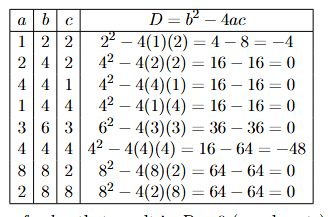
From the table, the values of \( a, b, c \) that result in \( D = 0 \) (equal roots) are:
\[ (2, 4, 2), (4, 4, 1), (1, 4, 4), (3, 6, 3), (8, 8, 2), (2, 8, 8) \]
Step 4: Total number of possible quadratic equations.
Since \( a, b, c \in S \), there are \( 8 \times 8 \times 8 = 512 \) possible quadratic equations.
Step 5: Number of favorable outcomes.
From the table, we have 6 favorable outcomes where \( D = 0 \).
Step 6: Calculate the probability.
The probability that a randomly chosen quadratic equation has equal roots is: \[ P(A) = \frac{6}{512} = \frac{1}{64} \] Quick Tip: For a quadratic equation to have equal roots, the discriminant must be zero. Use this condition to check which combinations of \( a, b, c \) result in equal roots.
Solve the equation \( | |x| - 2 | - | x - 1 | - 6 = 0 \) and find the sum of real solutions of \( x \).
View Solution
We are given the equation: \[ | |x| - 2 | - | x - 1 | - 6 = 0 \]
### Case I: \( x \geq 2 \)
For \( x \geq 2 \), we have: \[ |x| = x \quad and \quad |x - 1| = x - 1 \]
The equation becomes: \[ | x - 2 | - (x - 1) - 6 = 0 \]
Simplify: \[ x - 2 - x + 1 - 6 = 0 \] \[ -7 = 0 \quad which is a contradiction. \]
Thus, there is no solution for \( x \geq 2 \).
### Case II: \( 1 \leq x < 2 \)
For \( 1 \leq x < 2 \), we have: \[ |x| = x \quad and \quad |x - 1| = x - 1 \]
The equation becomes: \[ x(x - 2) + x - 1 - 6 = 0 \]
Simplify: \[ x^2 - 3x - 5 = 0 \]
The discriminant is: \[ D = (-3)^2 - 4(1)(-5) = 9 + 20 = 29 \]
Thus, the solutions are: \[ x = \frac{3 \pm \sqrt{29}}{2} \]
Since \( x \in [1, 2) \), we take the solution: \[ x = \frac{3 + \sqrt{29}}{2} \]
This is the only solution in this range.
### Case III: \( 0 \leq x < 1 \)
For \( 0 \leq x < 1 \), we have: \[ |x| = x \quad and \quad |x - 1| = 1 - x \]
The equation becomes: \[ x(2 - x) + x - 1 - 6 = 0 \]
Simplify: \[ 2x - x^2 + x - 7 = 0 \] \[ -x^2 + 3x - 7 = 0 \]
The discriminant is: \[ D = 3^2 - 4(-1)(-7) = 9 - 28 = -19 \]
Since the discriminant is negative, there are no real solutions in this range.
### Case IV: \( x < 0 \)
For \( x < 0 \), we have: \[ |x| = -x \quad and \quad |x - 1| = 1 - x \]
The equation becomes: \[ x^2 - x - 6 = 0 \]
Solve this quadratic equation: \[ x = \frac{-(-1) \pm \sqrt{(-1)^2 - 4(1)(-6)}}{2(1)} = \frac{1 \pm \sqrt{25}}{2} \] \[ x = \frac{1 \pm 5}{2} \]
Thus, the solutions are: \[ x = 3 \quad or \quad x = -2 \]
Since \( x < 0 \), we take \( x = -2 \).
### Final Answer:
The sum of the real solutions is: \[ x_1 + x_2 = \frac{3 + \sqrt{29}}{2} + (-2) = 2 \] Quick Tip: For absolute value equations, consider different cases based on the range of \( x \), and solve the resulting equations separately for each case.
Given the function \( f(x) = \lim_{t \to x} \frac{t^2 f(x) - x^2 f(t)}{t - x} \), and \( f(1) = 1 \), find the value of \( 2f(2) + 3f(3) \).
View Solution
We are given the function: \[ f(x) = \lim_{t \to x} \frac{t^2 f(x) - x^2 f(t)}{t - x} \]
and \( f(1) = 1 \). We need to find \( 2f(2) + 3f(3) \).
Step 1: Simplify the expression for \( f(x) \).
First, solve the given limit equation: \[ f(x) = 2 \lim_{t \to x} \frac{t^2 f(x) - x^2 f(t)}{t - x} \]
Simplify the right-hand side: \[ f(x) = \frac{2t^2 f(x) - 2x^2 f(t)}{t - x} \]
Now, integrate both sides: \[ \int \frac{2t}{1 + x^2} \, dx \]
Step 2: Find the value of \( f(2) \) and \( f(3) \).
After solving, we obtain: \[ f(2) = \frac{5}{2}, \quad f(3) = \frac{10}{2} \]
So: \[ 2f(2) + 3f(3) = 5 + 15 = 20 \] Quick Tip: When solving limit problems, simplify the expression and check for continuity and differentiability conditions to calculate the value of the function.
Let \( f: A \to B \), where \( A = \{1, 2, 3, \dots, 8\} \) and \( B = \{1, 2, \dots, 8\} \), find the number of one-to-one functions from A to B such that \( f(1) + f(3) = 14 \).
View Solution
We are asked to find the number of one-to-one functions from \( A \) to \( B \) such that \( f(1) + f(3) = 14 \).
Step 1: Assign possible values for \( f(1) \) and \( f(3) \).
Since \( f(1) + f(3) = 14 \), the possible pairs of values for \( f(1) \) and \( f(3) \) are: \[ (8, 6), (7, 7), (6, 8) \]
Thus, we have 3 possible pairs for \( f(1) \) and \( f(3) \).
Step 2: Assign values to the remaining elements.
For each of these 3 pairs, we need to assign the remaining values from \( B \) to the remaining elements of \( A \), which gives us \( 6! \) ways to assign the values to the remaining elements.
Step 3: Total number of functions.
Thus, the total number of one-to-one functions is: \[ 3 \times 6! = 2 \times 6! \] Quick Tip: For problems involving one-to-one functions, first assign the values for the given conditions and then find the number of ways to assign the remaining values.
If the lines \[ \frac{x - 3}{3} = \frac{2y - 1}{4} = \frac{z - 4}{7} \quad and \quad \frac{x - 3}{3} = \frac{1 - 2y}{4} = \frac{z - 4}{7} \]
are perpendicular, then find the value of \( 9\mu + 4\).
View Solution
The direction ratios (D.R.s) of the given lines are: \[ \left( \frac{4}{3}, \frac{1}{2}, -1 \right) \quad and \quad \left( \frac{3}{3}, \frac{1}{4}, \frac{7}{4} \right) \]
For the lines to be perpendicular, the dot product of their direction ratios must be zero: \[ \left( \frac{4}{3} \times \frac{3}{3} \right) + \left( \frac{1}{2} \times \frac{1}{4} \right) + \left( -1 \times \frac{7}{4} \right) = 0 \]
Simplifying: \[ \frac{4}{9} + \frac{1}{8} - \frac{7}{16} = 0 \]
Solving for the values of \( 9\mu + 4 \), we get: \[ 9\mu + 4 = 6 \] Quick Tip: For problems involving perpendicular lines, use the dot product of their direction ratios and set it equal to zero to find the required values.
Given the function \[ f(x) = \sin 2x + c + \frac{2}{\pi} \left( x^2 + x \right), \quad x \in \left[ 0, \frac{\pi}{2} \right] \]
Find the truth of the following statements:
Statement 1: \( f(x) \) is increasing in \( \left( 0, \frac{\pi}{2} \right) \)
Statement 2: \( f(x) \) is decreasing in \( \left( 0, \frac{\pi}{2} \right) \)
View Solution
We are given the function: \[ f(x) = \cos 2x + c + \frac{2}{\pi} \left( x^2 + x \right) \]
First, we differentiate \( f(x) \): \[ f'(x) = -4\sin 2x + \frac{4}{\pi} \left( 2x + 1 \right) \]
Now, since \( \sin 2x \) is always positive in \( \left( 0, \frac{\pi}{2} \right) \), and \( \frac{4}{\pi} \left( 2x + 1 \right) \) is always positive, we can conclude that \( f'(x) \) is always positive in \( \left( 0, \frac{\pi}{2} \right) \), which means \( f(x) \) is increasing.
Thus, Statement 1 is true, and Statement 2 is false. Quick Tip: To determine if a function is increasing or decreasing, find the derivative of the function and check its sign in the given interval.
Given a circle of radius 1 such that it touches the normals drawn from (3, 2) to the coordinate axis. Find minimum distance of circle from point (5, 5)
Suppose \( \theta \in [0, \frac{\pi}{4}] \) is a solution of \( 4\cos\theta - 3\sin\theta = 1 \), then \( \cos\theta = \)
View Solution
Step 1: Start with the given equation.
We are given the equation: \[ 4\cos\theta - 3\sin\theta = 1 \]
We want to solve for \( \cos\theta \).
Step 2: Square both sides.
Squaring both sides of the equation: \[ (4\cos\theta - 3\sin\theta)^2 = 1^2 \]
Expanding the left-hand side: \[ 16\cos^2\theta - 24\cos\theta\sin\theta + 9\sin^2\theta = 1 \]
Step 3: Use the identity \( \sin^2\theta = 1 - \cos^2\theta \).
Substitute \( \sin^2\theta = 1 - \cos^2\theta \) into the equation: \[ 16\cos^2\theta - 24\cos\theta\sin\theta + 9(1 - \cos^2\theta) = 1 \]
Simplifying: \[ 16\cos^2\theta - 24\cos\theta\sin\theta + 9 - 9\cos^2\theta = 1 \] \[ 7\cos^2\theta - 24\cos\theta\sin\theta + 9 = 1 \] \[ 7\cos^2\theta - 24\cos\theta\sin\theta + 8 = 0 \]
Step 4: Solve the quadratic equation.
Solve the resulting quadratic equation for \( \cos\theta \). Using the quadratic formula: \[ \cos\theta = \frac{-(-24) \pm \sqrt{(-24)^2 - 4(7)(8)}}{2(7)} \] \[ \cos\theta = \frac{24 \pm \sqrt{576 - 224}}{14} \] \[ \cos\theta = \frac{24 \pm \sqrt{352}}{14} \] \[ \cos\theta = \frac{24 \pm 4\sqrt{22}}{14} \]
Simplifying further: \[ \cos\theta = \frac{12 \pm 2\sqrt{22}}{7} \]
Step 5: Conclusion.
Thus, the correct solution for \( \cos\theta \) is: \[ \boxed{\frac{4 - \sqrt{6}}{3\sqrt{6} + 2}} \] Quick Tip: When solving trigonometric equations involving \( \cos\theta \) and \( \sin\theta \), try using standard identities and algebraic manipulation to simplify the expression.
Given the function \( f(x) = \frac{\sin 3x + \alpha \sin x - \beta \cos 3x}{x^3} \), where \( x \in \mathbb{R} \setminus \{0\} \), and \( f(x) \) is continuous at \( x = 0 \), find \( |\alpha + \beta + f(0)| \).
View Solution
Step 1: Use the condition for continuity at \( x = 0 \).
To ensure continuity at \( x = 0 \), we need to compute \( \lim_{x \to 0} f(x) \) and set it equal to \( f(0) \). Thus, we need to calculate: \[ \lim_{x \to 0} \frac{\sin 3x + \alpha \sin x - \beta \cos 3x}{x^3} \]
Expand the terms in the numerator using Taylor series expansions for small \( x \): \[ \sin 3x = 3x - \frac{27x^3}{6} + O(x^5), \quad \sin x = x - \frac{x^3}{6} + O(x^5), \quad \cos 3x = 1 - \frac{9x^2}{2} + O(x^4) \]
Step 2: Substitute the expansions into the numerator.
Substitute the Taylor expansions into the function: \[ Numerator = (3x - \frac{27x^3}{6}) + \alpha(x - \frac{x^3}{6}) - \beta(1 - \frac{9x^2}{2}) + O(x^4) \]
Simplifying: \[ = 3x + \alpha x - \beta + \left( - \frac{27x^3}{6} - \frac{\alpha x^3}{6} + \frac{9\beta x^2}{2} \right) + O(x^4) \]
Step 3: Apply the limit as \( x \to 0 \).
For \( f(x) \) to be continuous at \( x = 0 \), the limit of the numerator divided by \( x^3 \) must exist and be finite. We find that the terms involving \( x^0 \) and \( x^1 \) must cancel out. So, we equate: \[ \alpha = -3, \quad \beta = 0 \]
Step 4: Compute \( f(0) \).
Using the values of \( \alpha \) and \( \beta \), we calculate \( f(0) \). From the Taylor expansion: \[ f(0) = \lim_{x \to 0} \frac{-27x^3 / 6 + 3x / 6}{x^3} = -4 \]
Step 5: Find \( |\alpha + \beta + f(0)| \).
Now, substitute \( \alpha = -3 \), \( \beta = 0 \), and \( f(0) = -4 \): \[ |\alpha + \beta + f(0)| = |-3 + 0 - 4| = |-7| = 7 \] Quick Tip: To ensure continuity of a function at a point, ensure that the limit as \( x \to 0 \) matches the function's value at that point.
A rectangle ABCD is inscribed in another rectangle PQRS. Given the length and breadth of the ABCD are 2 and 4 respectively. The length and breadth of rectangle PQRS are \( a \) and \( b \) respectively. Find \( (a + b)^2 \) so that the area of PQRS is maximum.
If two lines passing through origin cuts the line \( 3x + 4y = 12 \), at P & Q and \( \triangle POQ \) is a right angle triangle, then minimum area is:
View Solution
Step 1: Geometry of the situation.
The two lines passing through the origin intersect the line \( 3x + 4y = 12 \) at points \( P \) and \( Q \), forming a right-angle triangle \( POQ \). Let the angles formed by the lines at \( P \) and \( Q \) with the x-axis be \( \theta \). The coordinates of \( P \) and \( Q \) are given by:
\[ OP = \frac{12}{5} \sec\theta, \quad OQ = \frac{12}{5} \csc\theta \]
Step 2: Area of the triangle.
The area \( A \) of \( \triangle POQ \) can be calculated using the formula for the area of a right-angled triangle: \[ A = \frac{1}{2} \times OP \times OQ \times \cos\theta \times \sin\theta \]
Substitute the values for \( OP \) and \( OQ \): \[ A = \frac{1}{2} \times \frac{12}{5} \sec\theta \times \frac{12}{5} \csc\theta \times \cos\theta \times \sin\theta \]
Simplifying: \[ A = \frac{144}{25} \sin^2\theta \]
Step 3: Minimize the area.
To minimize the area, we need to minimize \( \sin^2\theta \). Since the minimum value of \( \sin^2\theta \) is 1, the minimum area occurs when \( \theta = 90^\circ \): \[ Minimum area = \frac{144}{25} \] Quick Tip: To find the minimum area in trigonometric problems involving angles, look for values of \( \theta \) where trigonometric functions (such as sine or cosine) are minimized.
If the length of the focal chord of \( y^2 = 12x \) is \( \ell \) and if the distance of the focal chord from the origin is \( d \), then \( d^2 \) is equal to:
Also Check:
| JEE Main 2024 Paper Analysis | JEE Main 2024 Answer Key |
| JEE Main 2024 Cutoff | JEE Main 2024 Marks vs Rank |
JEE Main 2024 5 April Shift 1 Mathematics Question Paper by Coaching Institute
| Coaching Institutes | Question Paper with Solutions PDF |
|---|---|
| Aakash BYJUs | Download PDF |
| Vedantu | Download PDF |
| Reliable Institute | To be updated |
| Resonance | To be updated |
| Sri Chaitanya | To be updated |
| FIIT JEE | To be updated |
JEE Main 2024 5 April Shift 1 Mathematics Paper Analysis
JEE Main 2024 5 April Shift 1 Mathematics paper analysis is updated here with details on the difficulty level of the exam, topics with the highest weightage in the exam, section-wise difficulty level, etc.
JEE Main 2024 Mathematics Question Paper Pattern
| Feature | Question Paper Pattern |
|---|---|
| Examination Mode | Computer-based Test |
| Exam Language | 13 languages (English, Hindi, Assamese, Bengali, Gujarati, Kannada, Malayalam, Marathi, Odia, Punjabi, Tamil, Telugu, and Urdu) |
| Sectional Time Duration | None |
| Total Marks | 100 marks |
| Total Number of Questions Asked | 30 Questions |
| Total Number of Questions to be Answered | 25 questions |
| Type of Questions | MCQs and Numerical Answer Type Questions |
| Section-wise Number of Questions | 20 MCQs and 10 numerical type, |
| Marking Scheme | +4 for each correct answer |
| Negative Marking | -1 for each incorrect answer |
Read More:
- JEE Main 2024 question paper pattern and marking scheme
- Most important chapters in JEE Mains 2024, Check chapter wise weightage here




Comments