




JEE Main 2024 5 April Shift 1 question paper with solutions and answers pdf is available here. NTA conducted JEE Main 2024 5 April Shift 1 exam from 9 AM to 12 PM. The question paper for JEE Main 2024 5 April Shift 1 includes 90 questions equally divided into Physics, Chemistry and Maths. Candidates must attempt 75 questions in a 3-hour time duration. The memory-based JEE Main 2024 question paper pdf for the 5 April Shift 1 exam is available for download using the link below.
Related Links:
- Download JEE Main 2026 April 5 Shift 1 Question Paper
- Download JEE Main Previous Year Question Papers PDF with Solutions
- Download JEE Main 2025 Question Paper for all Shifts
JEE Main 2024 5 April Shift 1 Question Paper PDF Download
| JEE Main 2024 Question Paper with Answer Key 5 Apr Shift 1 |  Download Download |
Check Solutions |

JEE Main 2024 5 April Shift 1 Questions with Solutions
SECTION-A
PHYSICS
Question 1:
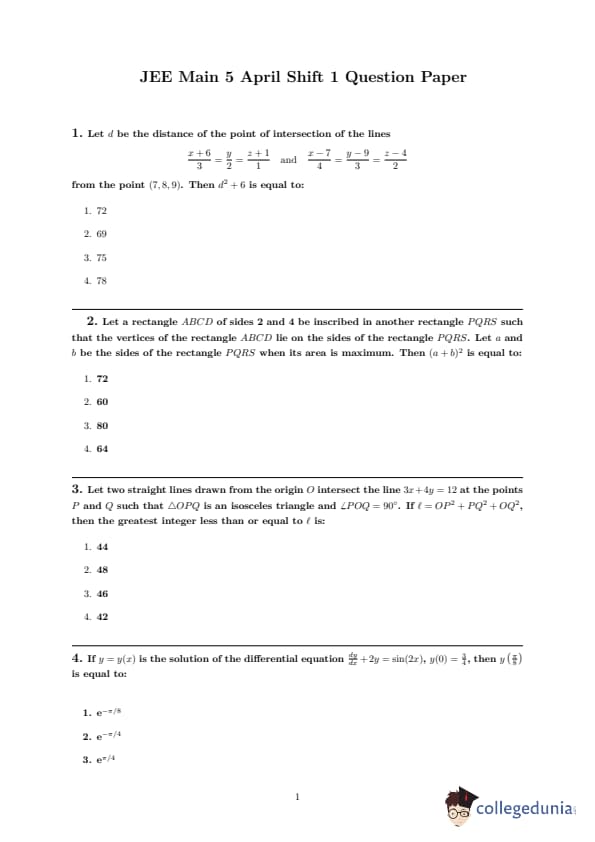
Let d be the distance of the point of intersection of the lines
(x + 6)/3 = (y)/2 = (z + 1)/1 and (x - 7)/4 = (y - 9)/3 = (z - 4)/2 from the point (7, 8, 9). Then d² + 6 is equal to:
View Solution
Let a rectangle ABCD of sides 2 and 4 be inscribed in another rectangle PQRS such that the vertices of the rectangle ABCD lie on the sides of the rectangle PQRS. Let a and b be the sides of the rectangle PQRS when its area is maximum. Then (a + b)² is equal to:
View Solution
Let two straight lines drawn from the origin O intersect the line 3x + 4y = 12 at the points P and Q such that ΔOPQ is an isosceles triangle and ∠POQ = 90°. If ℓ = OP² + PQ² + OQ², then the greatest integer less than or equal to ℓ is:
View Solution
If y = y(x) is the solution of the differential equation dy/dx + 2y = sin(2x), y(0) = 3/4, then y(π/8) is equal to:
View Solution
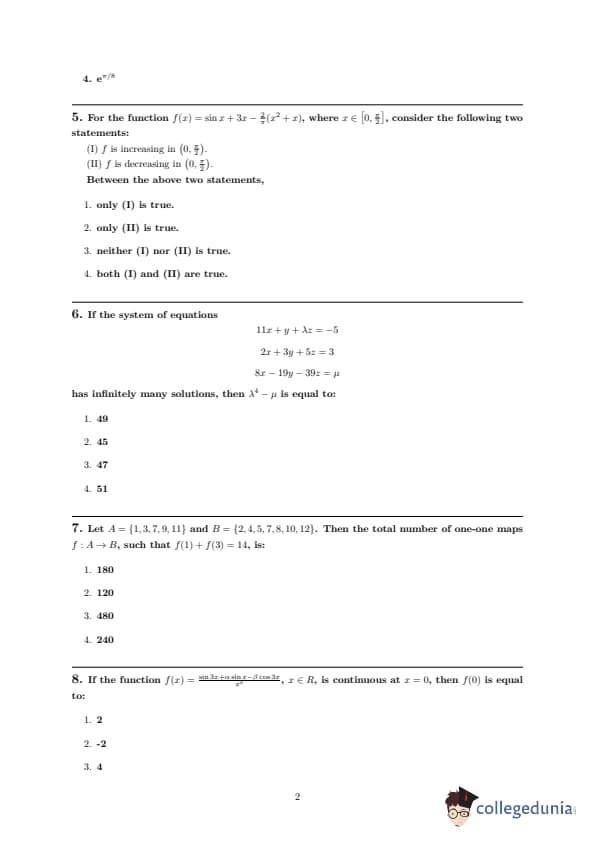
For the function f(x) = sin x + 3x - (2/π)(x² + x), where x ∈ [0, π/2], consider the following two statements:
(I) f is increasing in (0, π/2).
(II) f is decreasing in (0, π/2).
Between the above two statements:
View Solution
If the system of equations
11x + y + λz = -5
2x + 3y + 5z = 3
8x - 19y - 39z = µ
has infinitely many solutions, then λ⁴ - µ is equal to:
View Solution
Let A = {1, 3, 7, 9, 11} and B = {2, 4, 5, 7, 8, 10, 12}. Then the total number of one-one maps f : A → B, such that f(1) + f(3) = 14, is:
View Solution
If the function f(x) = (sin 3x + α sin x - β cos 3x) / x³, x ∈ ℝ, is continuous at x = 0, then f(0) is equal to:
View Solution
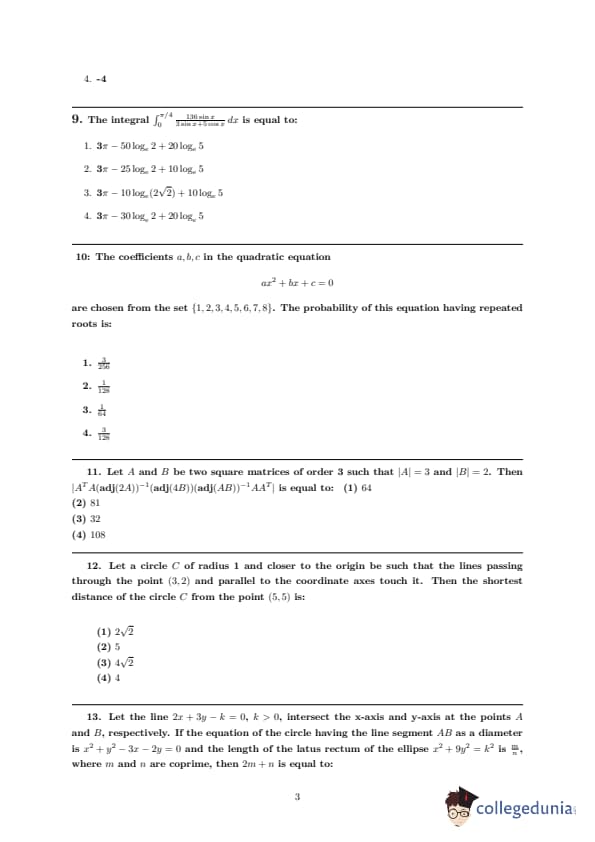
The integral ∫₀ to π/4 of (136 sin x / (3 sin x + 5 cos x)) dx is equal to:
View Solution
The coefficients a, b, and c in the quadratic equation ax² + bx + c = 0 are chosen from the set {1, 2, 3, 4, 5, 6, 7, 8}. The probability of this equation having repeated roots is:
View Solution
For repeated roots, the discriminant must be zero. The total number of combinations is 512, and the favorable cases are 8, leading to a probability of 1/64.
Two integers x and y are chosen with replacement from the set {0,1,2,...,10}. Then the probability that |x - y| > 5 is:
(1) 30/121
(2) 62/121
(3) 60/121
(4) 31/121
View Solution
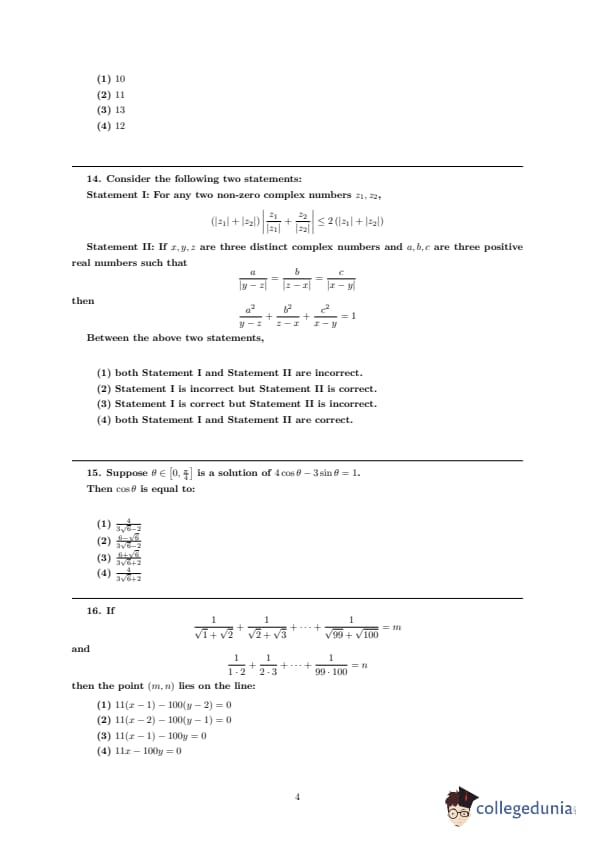
If the domain of the function f(x) = cos⁻¹(2 - |x|) / 4 is [−α, β) − {γ}, then α + β + γ is equal to:
(1) 12
(2) 9
(3) 11
(4) 8
View Solution
Consider the system of linear equations x + y + z = 4μ, x + 2y + 2z = 10μ, x + 3y + 4λz = μ² + 15. Which one of the following statements is NOT correct?
(1) The system has a unique solution if λ = 1/2 and μ = 1
(2) The system is inconsistent if λ = 1/2 and μ = 1
(3) The system has an infinite number of solutions if λ = 1/2 and μ = 15
(4) The system is consistent if λ = 1/2
View Solution
If the circles (x + 1)² + (y +2)² = r² and x² + y² - 4x - 4y + 4 = 0 intersect at exactly two distinct points, then:
(1) 5 < r < 9
(2) 0 < r < 7
(3) 3 < r < 7
(4) 1/2 < r < 7
View Solution
If the length of the minor axis of an ellipse is equal to half of the distance between the foci, then the eccentricity of the ellipse is:
(1) √5 / 3
(2) √3 / 2
(3) 1 / √3
(4) 2 / √5
View Solution
Let M denote the median of the following frequency distribution.
Class Frequency
0-4 3
4-8 9
8-12 10
12-16 8
16-20 6
Then 20M is equal to:
(1) 416
(2) 104
(3) 52
(4) 208
View Solution
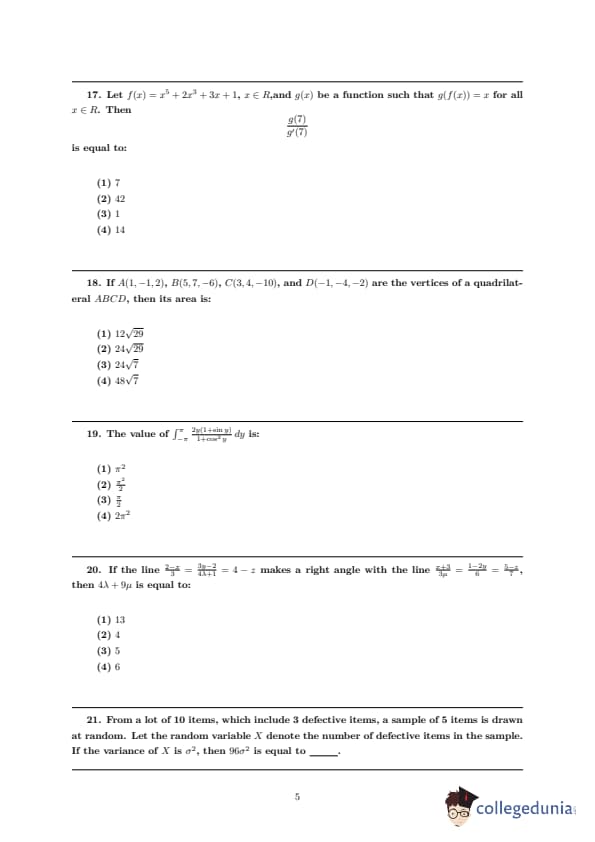
If f(x) = 2cos⁴x / (3 + 2cos⁴x) + 2sin⁴x / (3 + 2sin⁴x), then 1/5 f'(0) is equal to:
(1) 0
(2) 1
(3) 2
(4) 6
View Solution
Let A(2,3,5) and C(−3,4,−2) be opposite vertices of a parallelogram ABCD. If the diagonal BD = i + 2j + 3k, then the area of the parallelogram is equal to:
(1) 1/2 √410
(2) 1/2 √474
(3) 1/2 √586
(4) 1/2 √306
View Solution
If 2sin³x + sin²x cosx + 4sinⁿx − 4 = 0 has exactly 3 solutions in the interval (0, nπ/2), n ∈ N, then the roots of the equation x² + nx + (n−3) = 0 belong to:
(1) (0, ∞)
(2) (−∞, 0)
(3) −√17/2, √17/2
(4) Z
View Solution
Let f : −π/2, π/2 → R be a differentiable function such that f(0) = 1/2. If the limit lim(x→0) ∫(0 to x) f(t)dt / (e^(x²) - 1) = α, then 8α² is equal to:
(1) 16
(2) 2
(3) 1
(4) 4
View Solution
A group of 40 students appeared in an examination of 3 subjects - Mathematics, Physics, Chemistry. It was found that all students passed in at least one of the subjects, 20 students passed in Mathematics, 25 in Physics, and 16 in Chemistry. At most 11 students passed in both Mathematics and Physics, 15 in both Physics and Chemistry, and 10 in both Mathematics and Chemistry. The maximum number of students passed in all three subjects is:
View Solution
If d1 is the shortest distance between the lines x+1/2 = y-1/-12 = z/1 and x-1/-7 = y+8/2 = z-4/5, and d2 is the shortest distance between the lines x-1/2 = y-2/1 = z-6/-3 and x/1 = y+2/1 = z-1/6, then the value of 32√3d1/d2 is:
View Solution
Let the latus rectum of the hyperbola x²/9 - y²/b² = 1 subtend an angle of π/3 at the center of the hyperbola. If b² is equal to 1/m(1+√n), where l and m are co-prime numbers, then l²+m²+n² is equal to:
View Solution
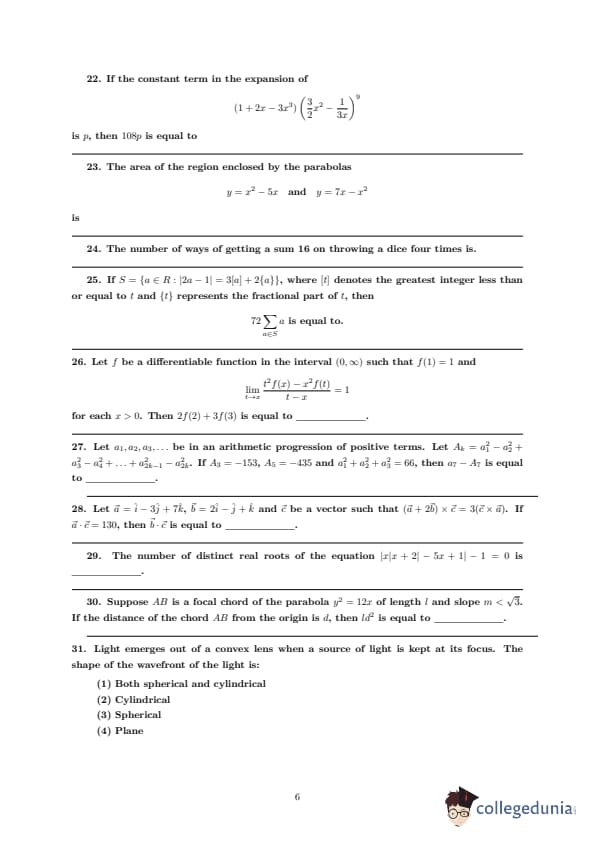
Let A = {1,2,3,...,7} and let P(1) denote the power set of A. If the number of functions f : A → P(A) such that a ∈ f(a), ∀a ∈ A is mn, and m and n are least, then m + n is equal to:
View Solution
The value of ∫(0 to 9) 10x / (x+1) dx is:
View Solution
Number of integral terms in the expansion of (√7z + 1/(6√z))^824 is equal to:
View Solution
Let y = y(x) be the solution of the differential equation (1 − x²)dy = xy + x³ + 2√1−x² dx, with y(0) = 0. If y(1/2) = m/n, where m and n are co-prime numbers, then m + n is equal to:
View Solution
Let α, β ∈ N be roots of the equation x² − 70x + λ = 0, where λ/2, λ/3 ∉ N. If λ assumes the minimum possible value, then √α−1+√β−1(λ+35)/|α−β| is equal to:
View Solution
If the function f(x) = { 1/|x| , |x| ≥ 2
ax² + 2b , |x| < 2 } is differentiable on R, then 48(a + b) is equal to:
View Solution
Let α = 1² + 4² + 8² + 13² + 19² + 26² + ... up to 10 terms and β = Σ₁₀n=1 n⁴. If 4α - β = 55k + 40, then k is equal to:
View Solution
Match List-I with List-II.
List-I | List-II
A. Coefficient of viscosity | I. [ML⁻¹T⁻¹]
B. Surface Tension | II. [ML⁰T⁻²]
C. Angular momentum | III. [ML²T⁻¹]
D. Rotational kinetic energy | IV. [ML²T⁻²]
(1) A-I, B-II, C-III, D-IV
(2) A-I, B-II, C-IV, D-III
(3) A-III, B-IV, C-II, D-I
(4) A-IV, B-III, C-II, D-I
View Solution
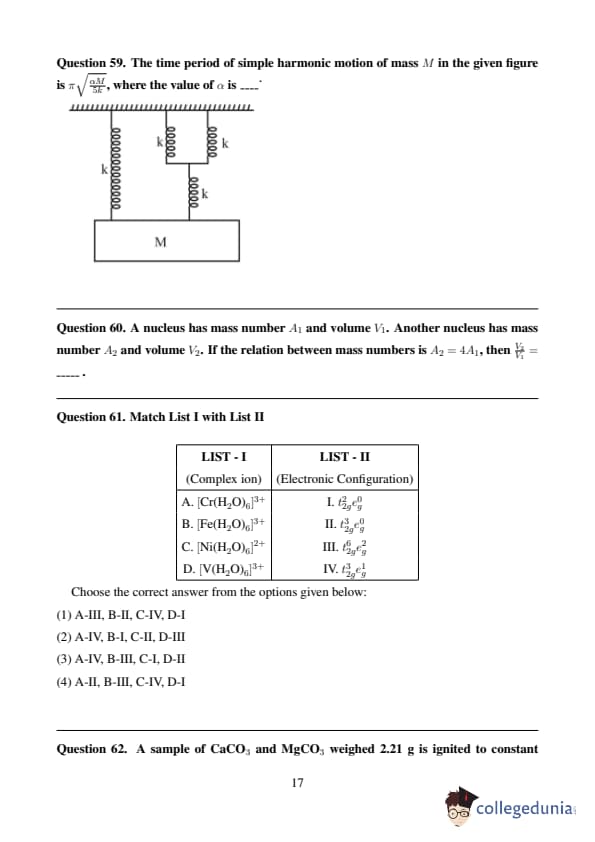
All surfaces shown in the figure are frictionless, and the pulleys and the string are light. The acceleration of the block of mass 2 kg is:
(1) g
(2) g/3
(3) 2g/3
(4) g/4
View Solution
A potential divider circuit is shown in the figure. The output voltage ( V₀ ) is:
(1) 4V
(2) 2 mV
(3) 0.5 V
(4) 12 mV
View Solution
Young’s modulus of a material of a wire of length ( L ) and cross-sectional area ( A ) is ( Y ). If the length of the wire is doubled and cross-sectional area is halved, then Young’s modulus will be:
(1) Y/4
(2) Y
(3) 4Y
(4) 2Y
View Solution
The work function of a substance is 3.0 eV. The longest wavelength of light that can cause the emission of photoelectrons from this substance is approximately:
(1) 215 nm
(2) 414 nm
(3) 400 nm
(4) 200 nm
View Solution
The ratio of the magnitude of the kinetic energy (KE) to the potential energy (PE) of an electron in the 5th excited state of a hydrogen atom is:
(1) 4(2) 1/4
(3) 1/2
(4) 1
View Solution
A particle is placed at point A on a frictionless track ABC as shown. It is gently pushed to the right. The speed of the particle when it reaches point B is:
(Take g = 10 m/s²)
(1) 20 m/s
(2) √10 m/s
(3) 2√10 m/s
(4) 10 m/s
View Solution
The electric field of an electromagnetic wave in free space is represented as E = E₀ cos(ωt - kx) ĩ. The corresponding magnetic induction vector will be:
(1) B = E₀ C cos(ωt − kx) ĵ
(2) B = (E₀/C) cos(ωt − kx) ĵ
(3) B = E₀ C cos(ωt + kx) ĵ
(4) B = (E₀/C) cos(ωt + kx) ĵ
View Solution
Two insulated circular loops A and B of radius a, carrying a current I in anticlockwise direction, are arranged perpendicular to each other. The magnitude of the magnetic induction at the center will be:
(1) √2 μ₀I/a
(2) μ₀I/(2a)
(3) μ₀I√2/a
(4) 2μ₀I/a
View Solution
The diffraction pattern of light of wavelength 400 nm diffracting from a slit of width 0.2 mm is focused on the focal plane of a convex lens of focal length 100 cm. The width of the 1st secondary maxima will be:
View Solution
Primary coil of a transformer is connected to 220 V ac. Primary and secondary turns of the transformer are 100 and 10 respectively. The secondary coil of the transformer is connected to two series resistances shown in the figure. The output voltage V0 is:
View Solution
The gravitational potential at a point above the surface of Earth is −5.12 × 10⁷ J/kg and the acceleration due to gravity at that point is 6.4m/s². Assume that the mean radius of Earth to be 6400 km. The height of this point above the Earth’s surface is:
View Solution
An electric toaster has resistance of 60 Ω at room temperature (27°C). The toaster is connected to a 220 V supply. If the current flowing through it reaches 2.75 A, the temperature attained by toaster is around: (if α = 2× 10⁻⁴ °C⁻¹)
View Solution
A Zener diode of breakdown voltage 10V is used as a voltage regulator as shown in the figure. The current through the Zener diode is:
View Solution
Two thermodynamical processes are shown in the figure. The molar heat capacity for process A and B are CA and CB. The molar heat capacity at constant pressure and constant volume are represented by CP and CV respectively. Choose the correct statement:
View Solution
The electrostatic potential due to an electric dipole at a distance r varies as:
View Solution
A spherical body of mass 100 g is dropped from a height of 10 m from the ground. After hitting the ground, the body rebounds to a height of 5 m. The impulse of force imparted by the ground to the body is given by: (given g = 9.8m/s²)
View Solution
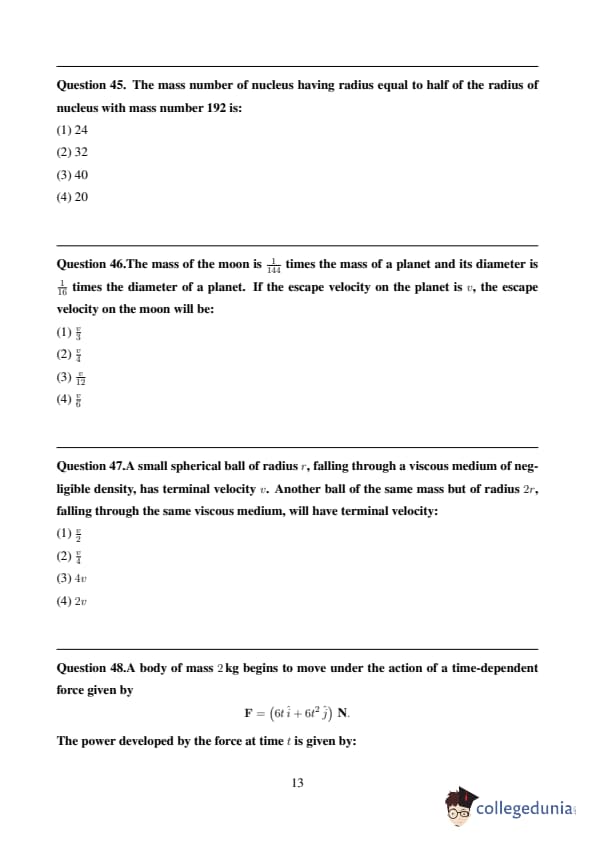
A particle of mass m is projected with a velocity u making an angle of 30° with the horizontal. The magnitude of the angular momentum of the projectile about the point of projection when the particle is at its maximum height is:
View Solution
At which temperature does the r.m.s. velocity of a hydrogen molecule equal that of an oxygen molecule at 47°C?
View Solution
A series L-R circuit connected to an AC source E = 25 sin(1000 t) V has a power factor of 1/√2. If the source of emf is changed to E = 20 sin(2000 t) V, the new power factor of the circuit will be:
View Solution
The horizontal component of Earth’s magnetic field at a place is 3.5 × 10⁻⁵ T. A very long straight conductor carrying a current of √2 A is placed from South East to North West. The force per unit length experienced by the conductor is:
View Solution
Two cells are connected in opposition. Cell E1 has 8 V emf and 2 Ω internal resistance. Cell E2 has 2 V emf and 4 Ω internal resistance. The terminal potential difference of cell E2 is:
View Solution
An electron in a hydrogen atom has energy En = −0.85 eV in an excited state. The maximum number of allowed transitions to lower energy levels is:
View Solution
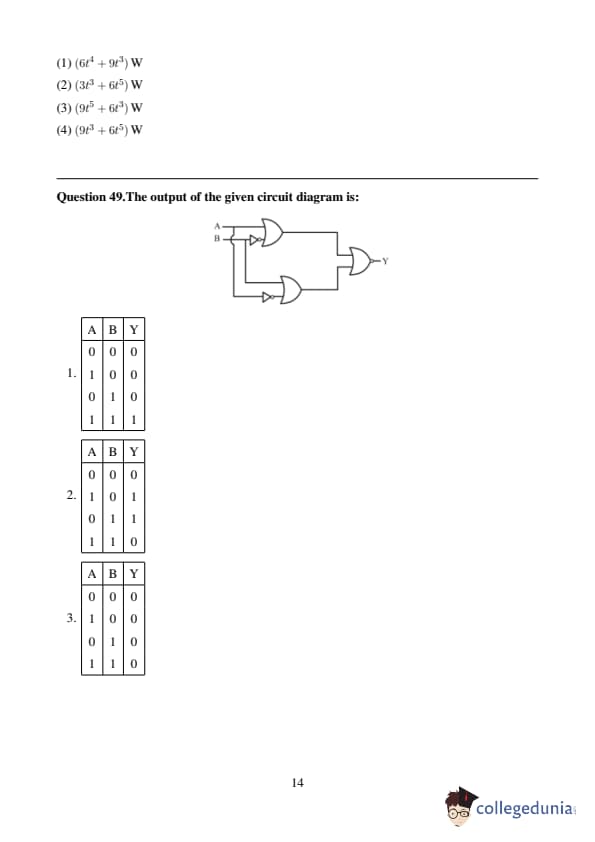
Each of three blocks P, Q, and R (each 3 kg) is attached to a wire. Wires A and B each have a cross-sectional area of 0.005 cm² and Young’s modulus of 2 × 10¹¹ N/m². Neglecting friction, the longitudinal strain on wire B is ×10−4:
View Solution
The distance between the object and its image (which is twice the size of the object) formed by a convex lens is 45 cm. The focal length of the lens is:
View Solution
The displacement and the increase in the velocity of a moving particle in the time interval from t to (t+1) seconds are 125 m and 50 m/s, respectively. The distance travelled by the particle in the (t+2)th second is:
View Solution
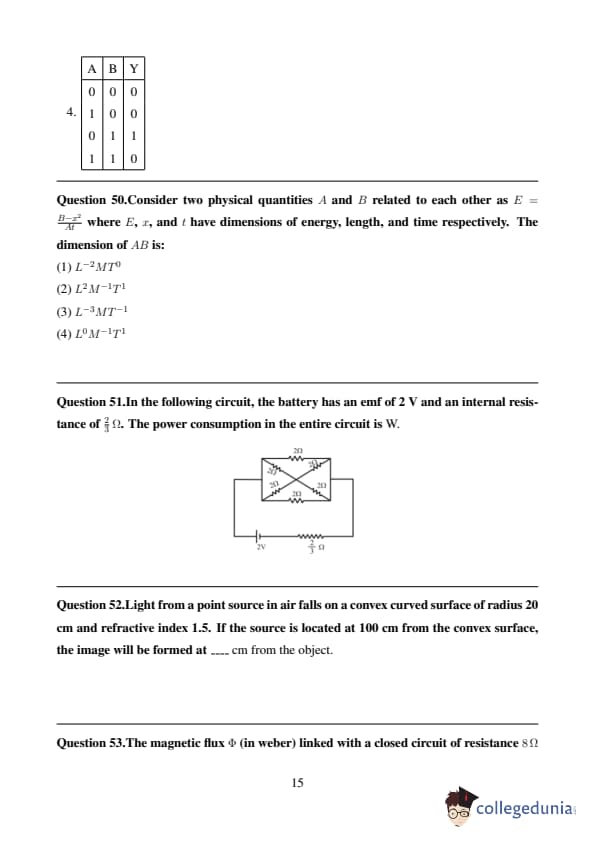
A capacitor of capacitance C and potential V has energy E. It is connected to another capacitor of capacitance 2C and potential 2V. Then the loss of energy is x/3E, where x is:
View Solution
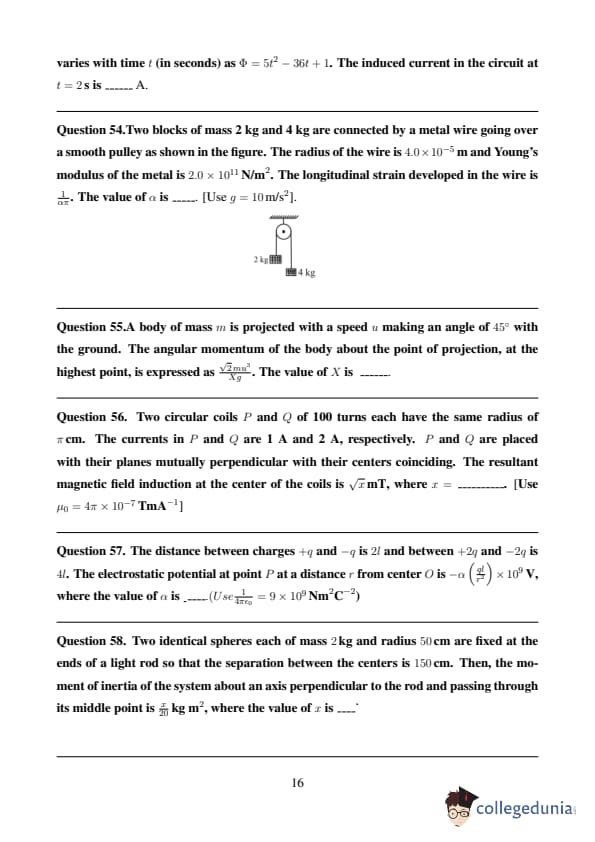
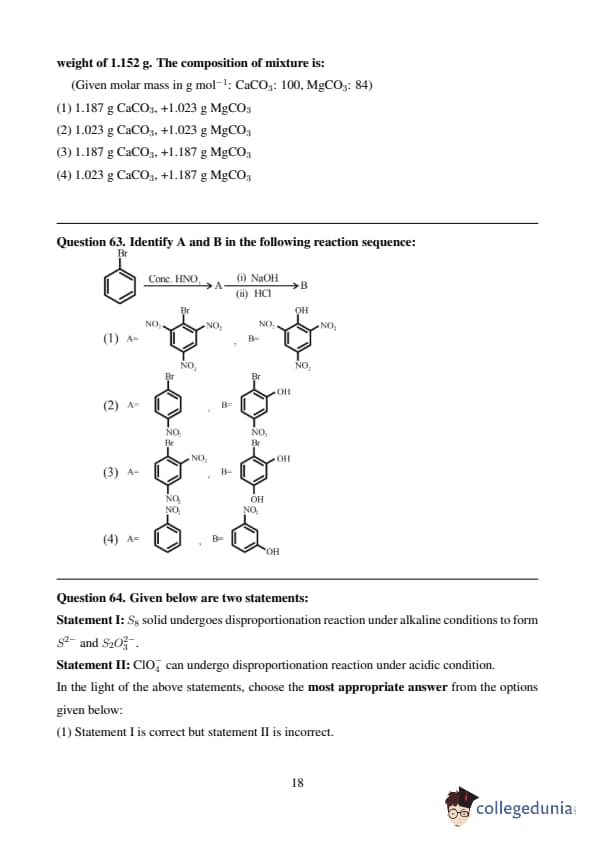
Consider a disc of mass 5 kg, radius 2 m, rotating with angular velocity of 10 rad/s about an axis perpendicular to the plane of rotation. An identical disc is gently placed over the rotating disc along the same axis. The energy dissipated so that both discs continue to rotate together without slipping is:
View Solution
In a closed organ pipe, the frequency of the fundamental note is 30 Hz. A certain amount of water is now poured in the organ pipe so that the fundamental frequency is increased to 110 Hz. If the organ pipe has a cross-sectional area of 2 cm², the amount of water poured in the organ pipe is x grams. (Take speed of sound in air as 330 m/s)
View Solution
A ceiling fan having 3 blades of length 80 cm each is rotating with an angular velocity of 1200 rpm. The magnetic field of Earth in that region is 0.5 G and the angle of dip is 30°. The emf induced across the blades is Nπ × 10⁻⁵ V. The value of N is:
View Solution
Given below are two statements:
Statement-I: The gas liberated on warming a salt with dilute H₂SO₄, turns a piece of paper dipped in lead acetate into black; it is a confirmatory test for sulphide ion.
Statement-II: In statement-I the colour of paper turns black because of formation of lead sulphide.
Choose the most appropriate answer from the options below:
View Solution
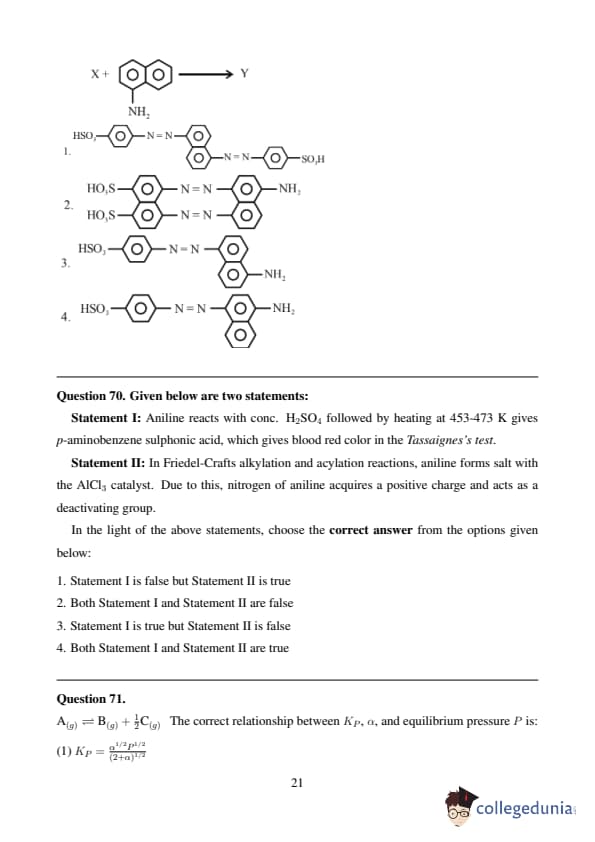
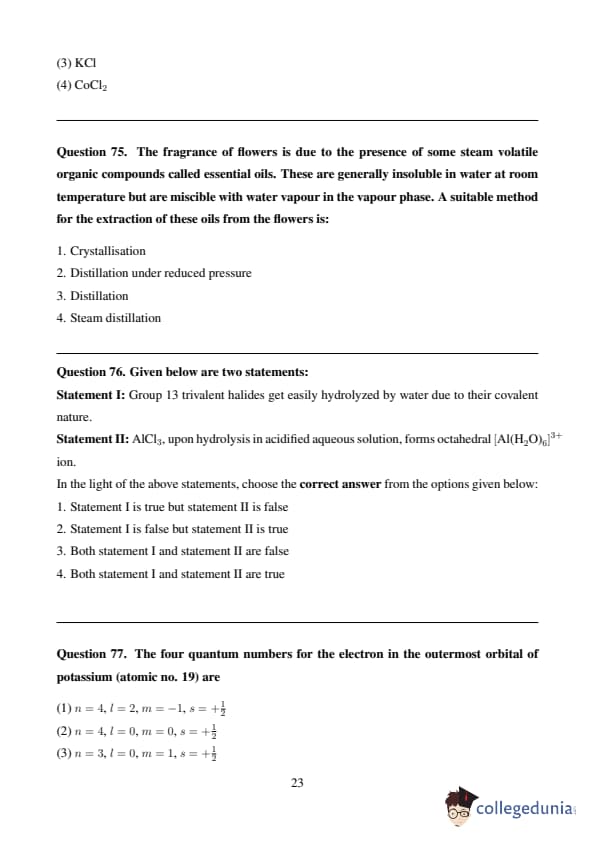
This reduction reaction is known as:
View Solution
Sugar which does not give reddish brown precipitate with Fehling’s reagent is:
View Solution
Given below are the two statements: one is labeled as Assertion (A) and the other is labeled as Reason (R).
Assertion (A): There is a considerable increase in covalent radius from N to P. However, from As to Bi only a small increase in covalent radius is observed.
Reason (R): Covalent and ionic radii in a particular oxidation state increase down the group.
Choose the most appropriate answer from the options below:
View Solution
Which of the following molecule/species is most stable?
View Solution
Diamagnetic Lanthanoid ions are:
View Solution
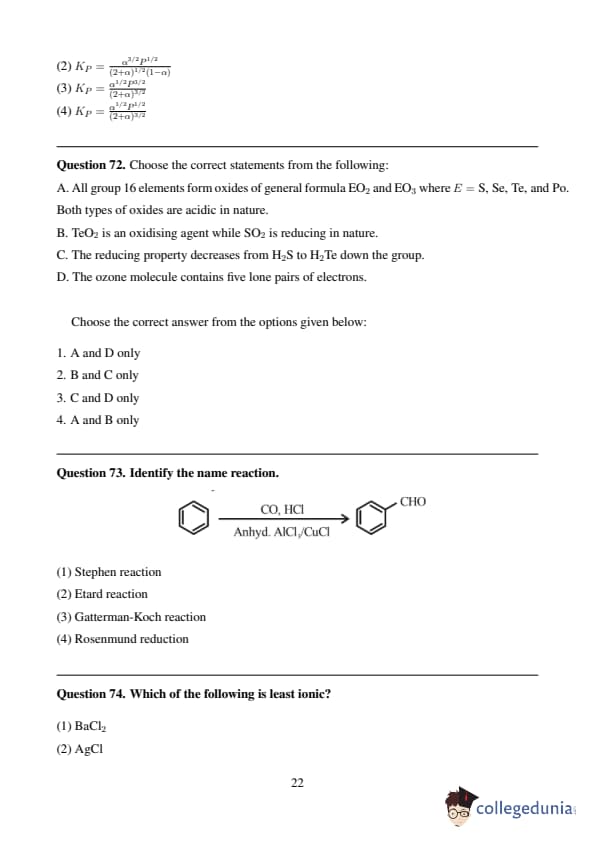
Aluminium chloride in acidified aqueous solution forms an ion having geometry:
View Solution
Given below are two statements:
Statement-I: The orbitals having the same energy are called as degenerate orbitals.
Statement-II: In hydrogen atom, 3p and 3d orbitals are not degenerate orbitals.
Choose the most appropriate answer from the options below:
View Solution
Example of vinylic halide is:
View Solution
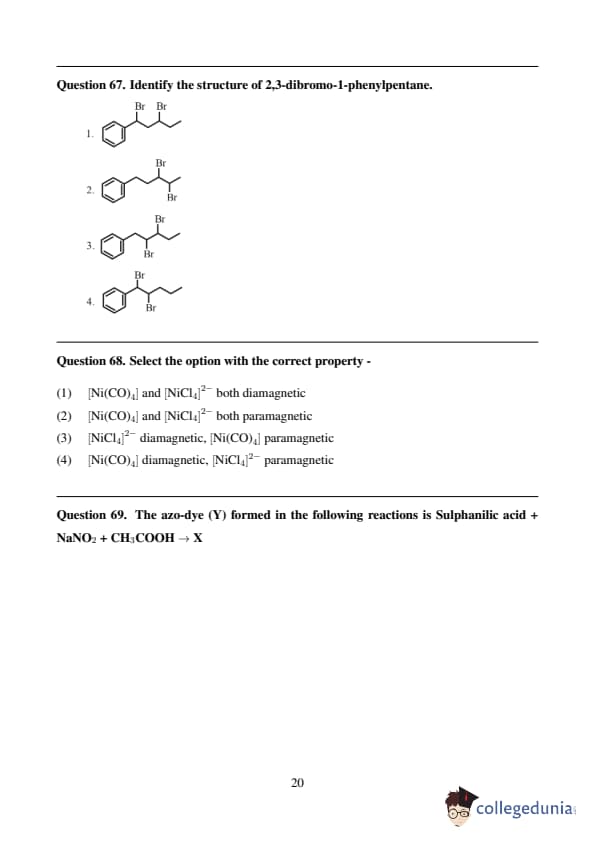
Structure of 4-Methylpent-2-enal is:
View Solution
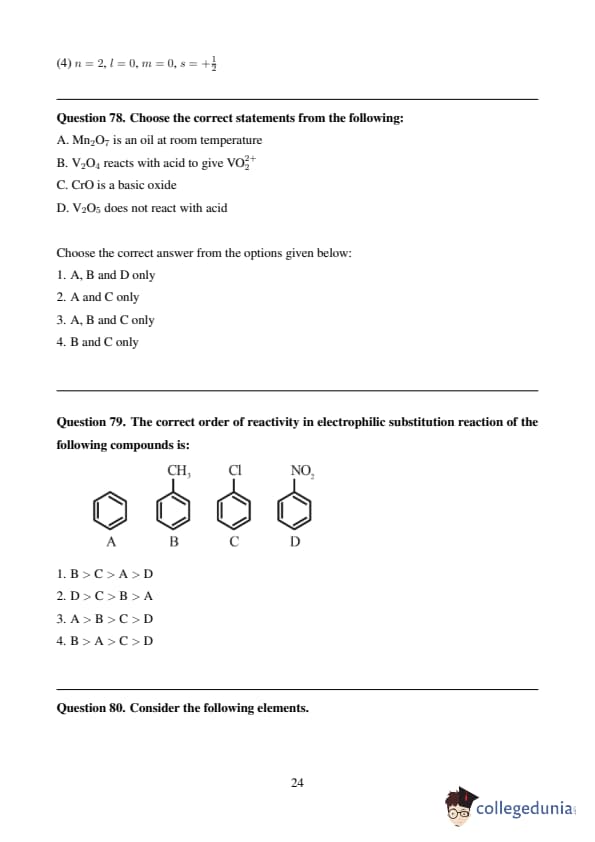
Match List-I with List-II:
List-I (Molecule) | List-II (Shape)
(A) BrF₅ | (I) T-shape
(B) H₂O | (II) See-saw
(C) ClF₃ | (III) Bent
(D) SF₄ | (IV) Square pyramidal
Choose the correct answer from the options below:
View Solution
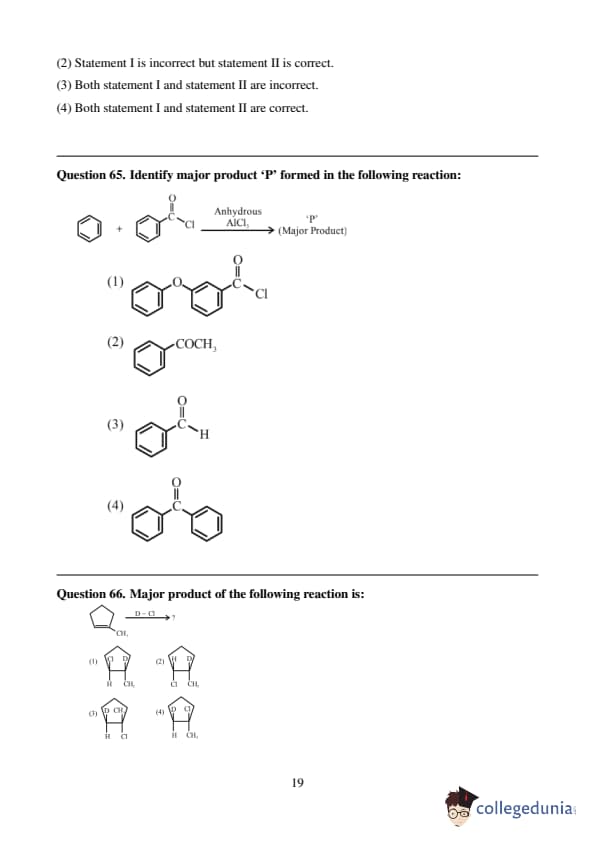
The final product A, formed in the following multistep reaction sequence is:
CH₃ - C≡CH + Na → A
B → CH₃ - C≡C - CH₂ - CH₂ - CH₃ + NaBr
Choose the correct answer from the options below:
View Solution
In the given reactions, identify the reagent A and reagent B:
CH₃ - C≡CH + Na → A
B → CH₃ - C≡C - CH₂ - CH₂ - CH₃ + NaBr
(1) A-CrO₃, B-CrO₃
(2) A-CrO₃, B-CrO₂Cl₂
(3) A-CrO₂Cl₂, B-CrO₂Cl₂
(4) A-CrO₂Cl₂, B-CrO₃
View Solution
Given below are two statements: one is labeled as Assertion (A) and the other is labeled as Reason (R).
Assertion (A): CH₂=CH−CH₂−Cl is an example of allyl halide.
Reason (R): Allyl halides are the compounds in which the halogen atom is attached to an sp² hybridised carbon atom.
Choose the most appropriate answer from the options below:
View Solution
What happens to the freezing point of benzene when a small quantity of naphthalene is added to benzene?
View Solution
Match List-I with List-II:
List-I (Species) | List-II (Electronic Distribution)
(A) Cr²⁺ | (I) 3d⁸
(B) Mn⁺ | (II) 3d⁵4s¹
(C) Ni²⁺ | (III) 3d⁴
(D) V⁺ | (IV) 3d³4s¹
Choose the correct answer from the options below:
View Solution
Compound A formed in the following reaction reacts with B, giving the product C.
CH₃−C≡CH + Na → A
B → CH₃−C≡C−CH₂−CH₂−CH₃ + NaBr
Find out A and B.
View Solution
Following is a confirmatory test for aromatic primary amines. Identify reagent (A) and (B).
A: NaNO₂ + HCl, 0–5°C
B: Phenol
Find out A and B.
View Solution
The Lassaigne’s extract is boiled with dilute HNO₃ before testing for halogens because:
View Solution
Choose the correct statements from the following:
(A) Ethane-1,2-diamine is a chelating ligand.
(B) Metallic aluminium is produced by electrolysis of aluminium oxide in presence of cryolite.
(C) Cyanide ion is used as ligand for leaching of silver.
(D) Phosphine acts as a ligand in Wilkinson catalyst.
(E) The stability constants of Ca²⁺ and Mg²⁺ are similar with EDTA complexes.
View Solution
The rate of a first-order reaction is 0.04 mol·L−1·s−1 at 10 minutes and 0.03 mol·L−1·s−1 at 20 minutes after initiation. The half-life of the reaction is:
View Solution
The pH at which Mg(OH)₂ [Ksp = 1 × 10⁻¹¹] begins to precipitate from a solution containing 0.10 M Mg²⁺ ions is:
View Solution
An ideal gas undergoes a cyclic transformation starting from the point A and coming back to the same point by tracing the path A → B → C → A as shown in the diagram. The total work done in the process is:
View Solution
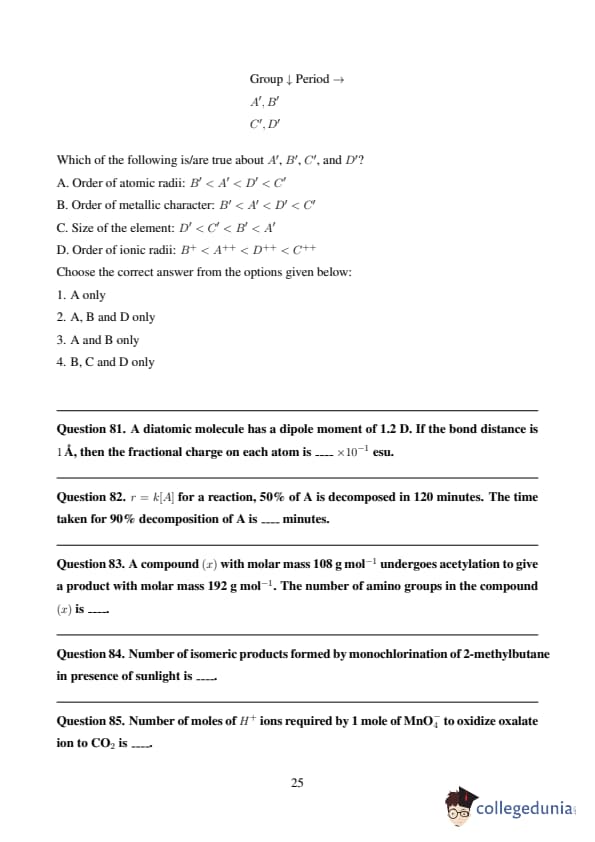
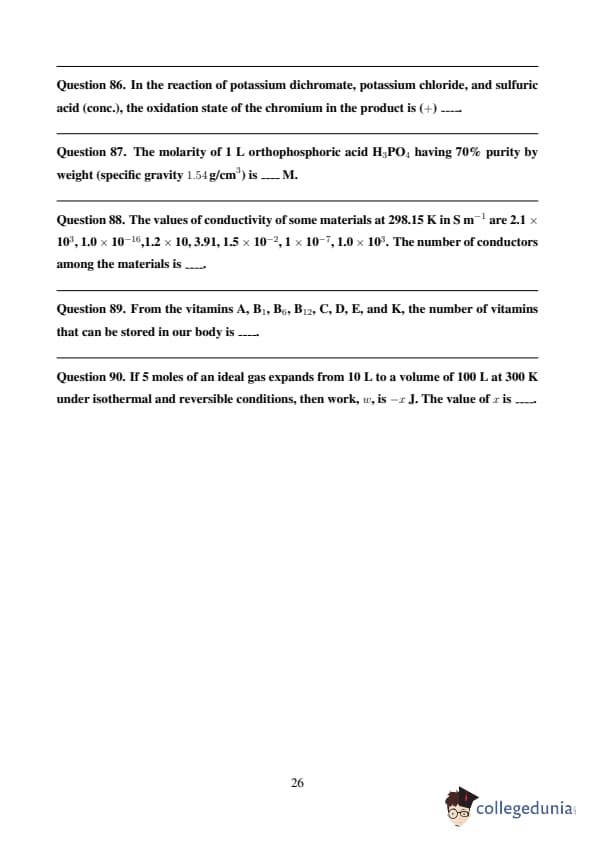
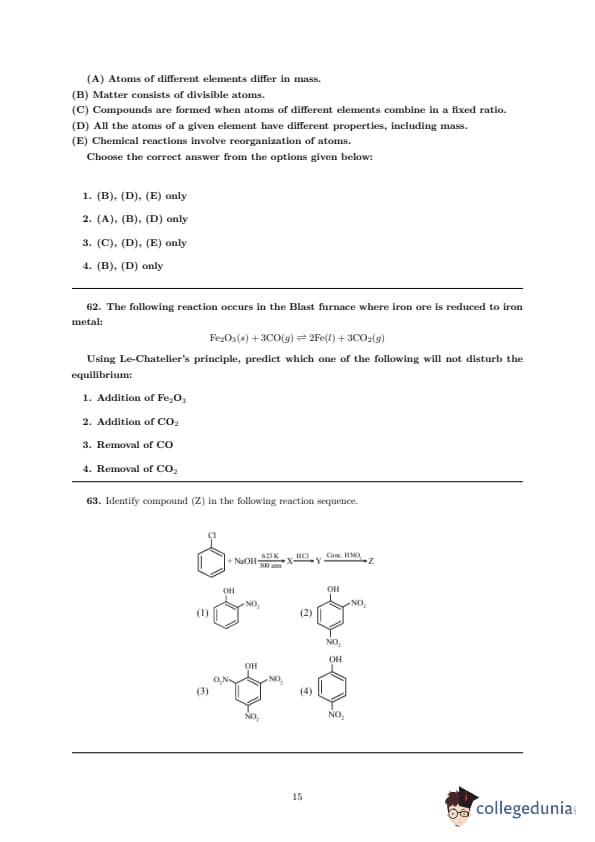
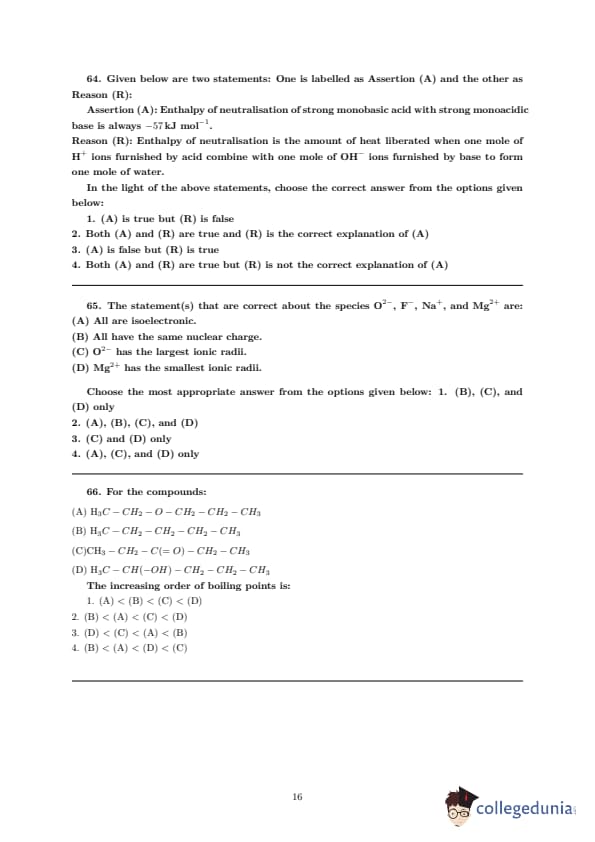
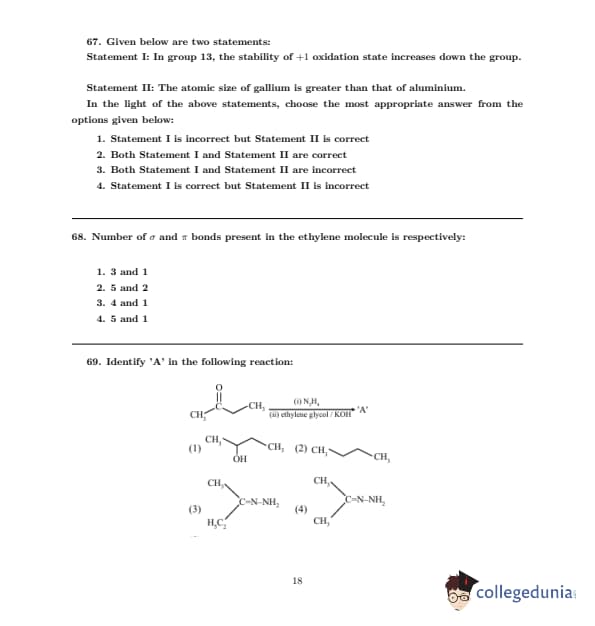
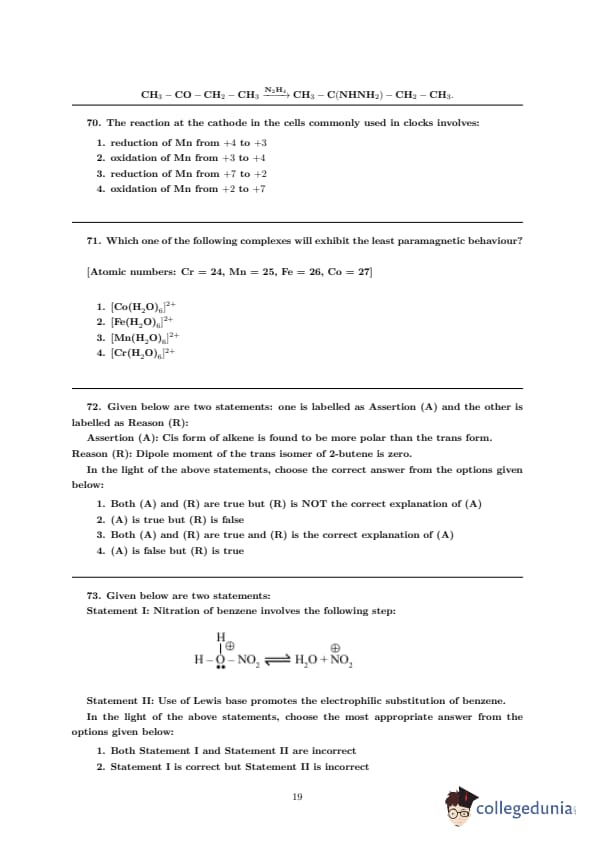
If the IUPAC name of an element is "Unununnium", then the element belongs to nth group of the periodic table. The value of n is:
View Solution
The total number of molecular orbitals formed from 2s and 2p atomic orbitals of a diatomic molecule is:
View Solution
On a thin layer chromatographic plate, an organic compound moved by 3.5 cm, while the solvent moved by 5 cm. The retardation factor of the organic compound is ×10−1:
View Solution
The compound formed by the reaction of ethanol with semicarbazide contains number of nitrogen atoms.
View Solution
A 0.05 cm thick coating of silver is deposited on a plate of 0.05 m² area. The number of silver atoms deposited on the plate is ×1023 (At. mass Ag = 108, d = 7.9 g/cm³):
View Solution
2MnO₄⁻ + 6I⁻ + 4H₂O → 3I₂ + 2MnO₂ + 8OH⁻. If the above equation is balanced with integer coefficients, the value of z is:
View Solution
The mass of sodium acetate (CH3COONa) required to prepare 250 mL of 0.35 M aqueous solution is (in grams). (Molar mass of CH3COONa is 82.02 g/mol)
View Solution
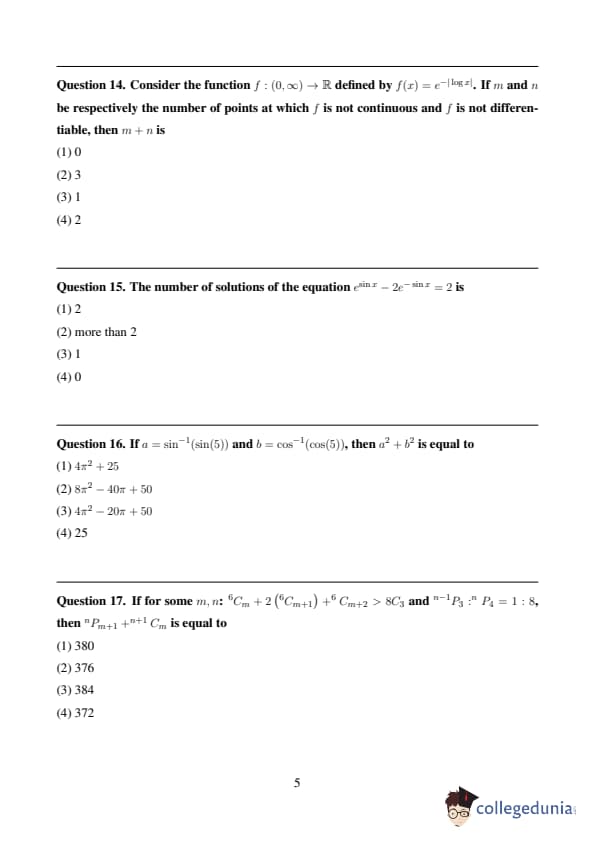
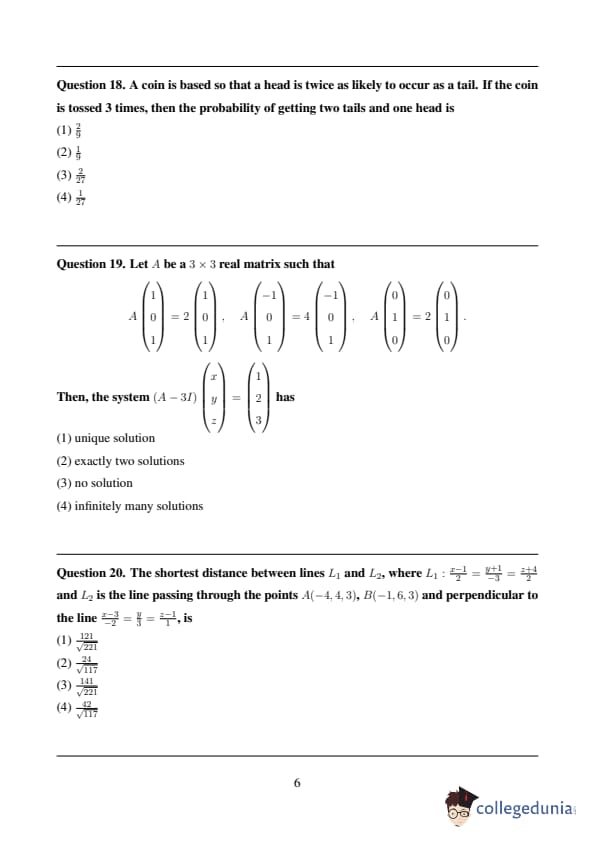
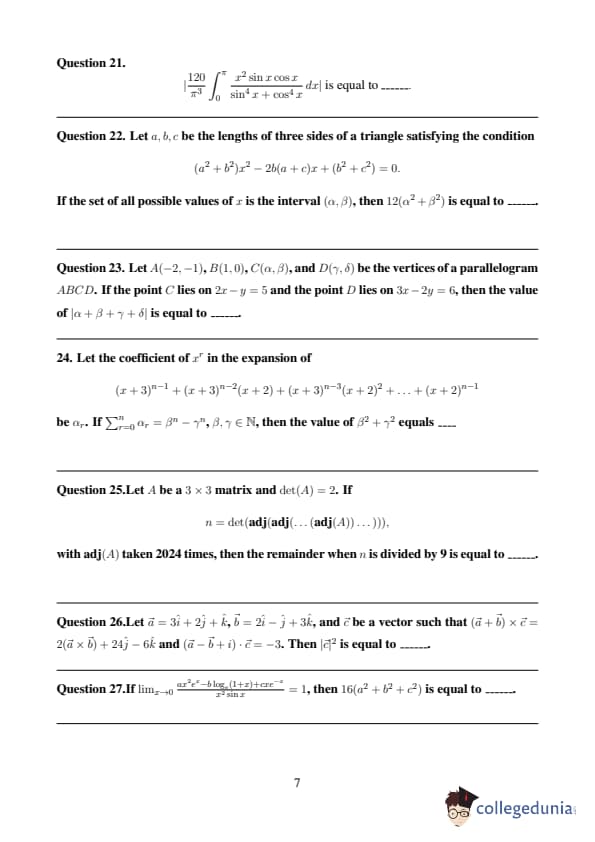
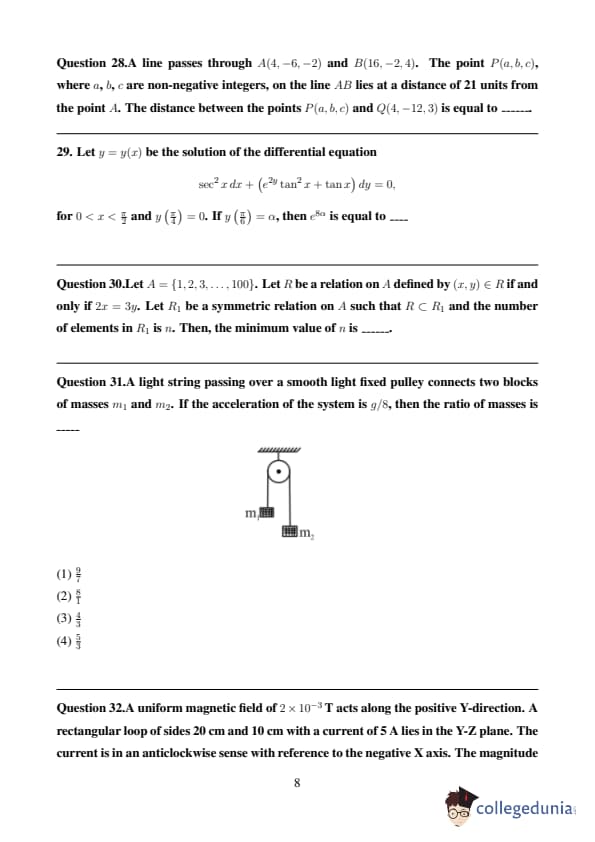
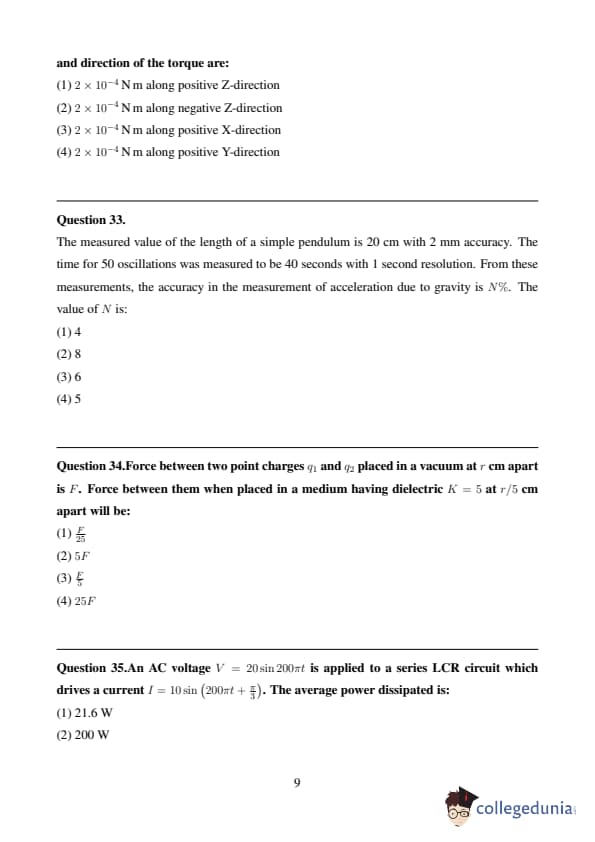
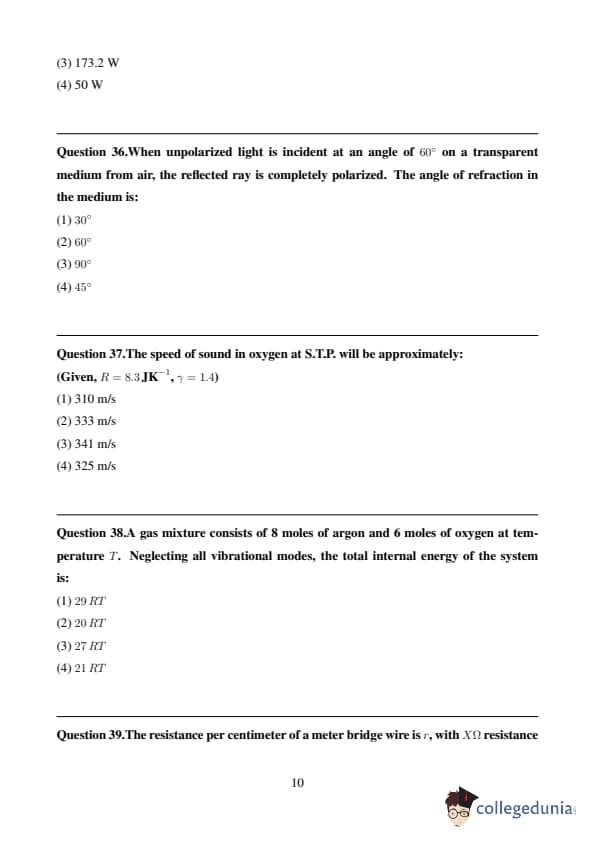
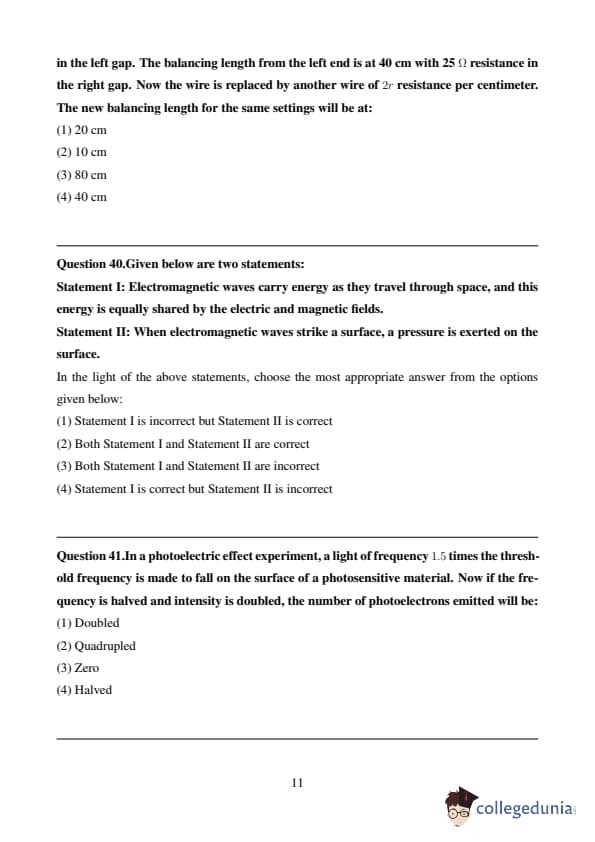
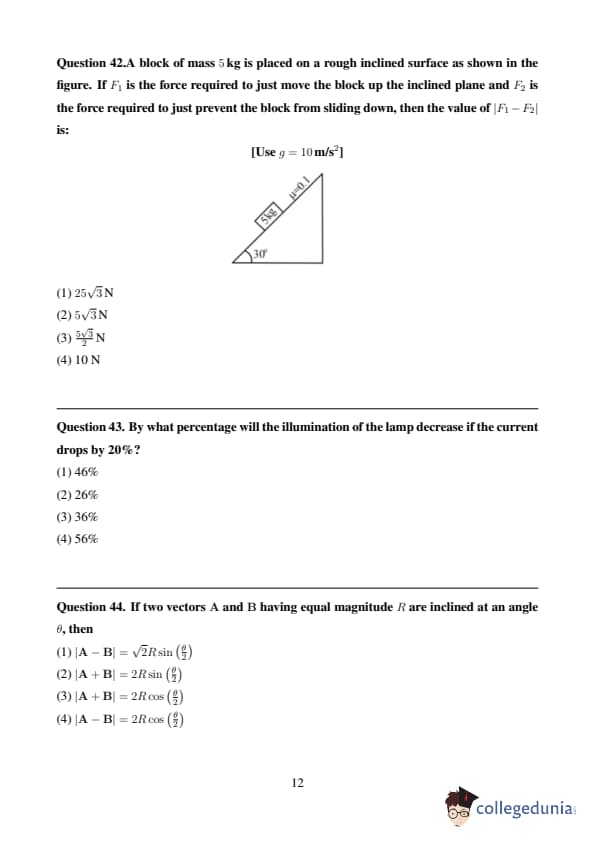
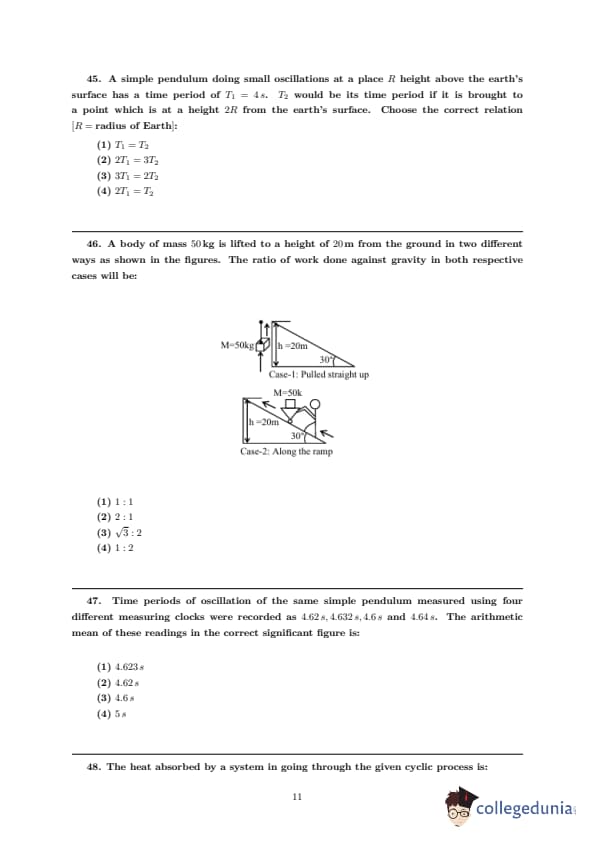
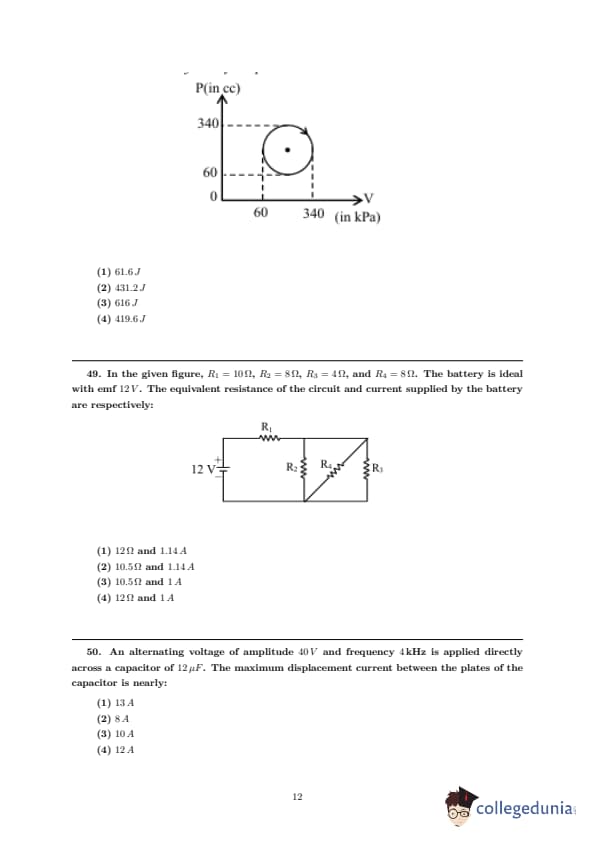
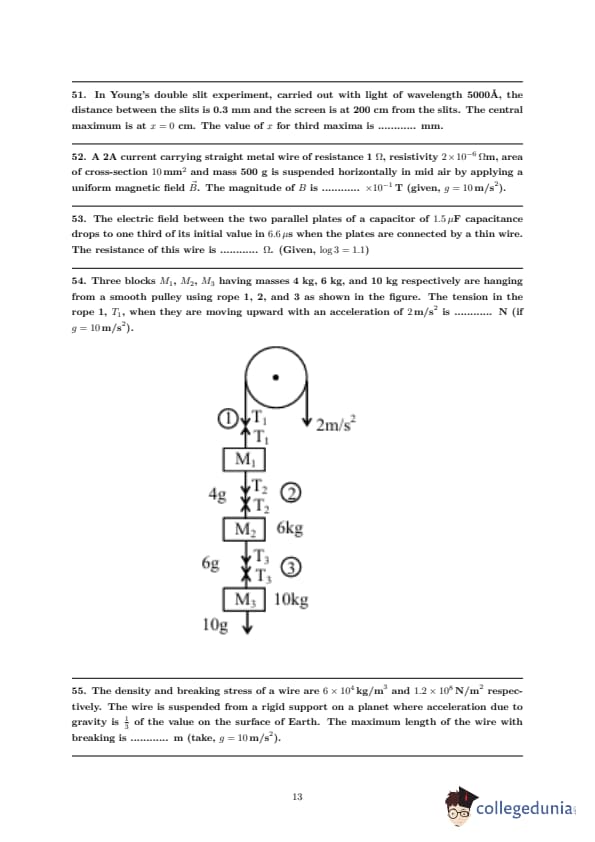
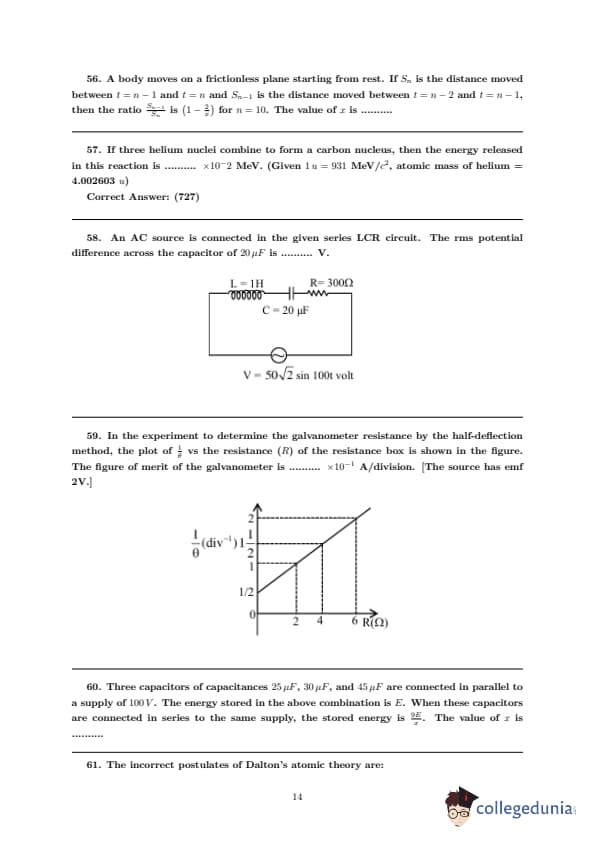
JEE Main 2024 Question Paper Session 2 (April)
Check JEE Main 2024 Question Paper Session 2 for other shifts.
JEE Main 2024 Question Paper Session 1 (January)
Those appearing for JEE Main 2024 can use the links below to practice and keep track of their exam preparation level by attempting the shift-wise JEE Main 2024 question paper provided below.
| Exam Date and Shift | Question Paper PDF |
|---|---|
| JEE Main 27 Jan Shift 1 2024 Question Paper | Check Here |
| JEE Main 27 Jan Shift 2 2024 Question Paper | Check Here |
| JEE Main 29 Jan Shift 1 2024 Question Paper | Check Here |
| JEE Main 29 Jan Shift 2 2024 Question Paper | Check Here |
| JEE Main 30 Jan Shift 1 2024 Question Paper | Check Here |
| JEE Main 30 Jan Shift 2 2024 Question Paper | Check Here |
| JEE Main 31 Jan Shift 1 2024 Question Paper | Check Here |
| JEE Main 31 Jan Shift 2 2024 Question Paper | Check Here |
| JEE Main 1 Feb Shift 1 2024 Question Paper | Check Here |
| JEE Main 1 Feb Shift 2 2024 Question Paper | Check Here |
Also Check:
| JEE Main 2024 Paper Analysis | JEE Main 2024 Answer Key |
| JEE Main 2024 Cutoff | JEE Main 2024 Marks vs Rank |
JEE Main 2024 5 April Shift 1 Question Paper by Coaching Institute
| Coaching Institutes | Question Paper with Solutions PDF |
|---|---|
| Aakash BYJUs | Download PDF |
| Vedantu | Download PDF |
| Reliable Institute | To be updated |
| Resonance | To be updated |
| Sri Chaitanya | To be updated |
| FIIT JEE | To be updated |
JEE Main 2024 5 April Shift 1 Paper Analysis
JEE Main 2024 5 April Shift 1 paper analysis for B.E./ B.Tech is updated here with details on the difficulty level of the exam, topics with the highest weightage in the exam, section-wise difficulty level, etc.
JEE Main 2024 Question Paper Pattern
| Feature | Question Paper Pattern |
|---|---|
| Examination Mode | Computer-based Test |
| Exam Language | 13 languages (English, Hindi, Assamese, Bengali, Gujarati, Kannada, Malayalam, Marathi, Odia, Punjabi, Tamil, Telugu, and Urdu) |
| Number of Sections | Three- Physics, Chemistry, Mathematics |
| Exam Duration | 3 hours |
| Sectional Time Limit | None |
| Total Marks | 300 marks |
| Total Number of Questions Asked | 90 Questions |
| Total Number of Questions to be Answered | 75 questions |
| Type of Questions | MCQs and Numerical Answer Type Questions |
| Section-wise Number of Questions | Physics- 20 MCQs and 10 numerical type, Chemistry- 20 MCQs and 10 numerical type, Mathematics- 20 MCQs and 10 numerical type |
| Marking Scheme | +4 for each correct answer |
| Negative Marking | -1 for each incorrect answer |
Read More:
- JEE Main 2024 question paper pattern and marking scheme
- Most important chapters in JEE Mains 2024, Check chapter wise weightage here





Comments