




JEE Main 2025 April 4 Maths Question Paper is available for download. NTA conducted JEE Main 2025 Shift 1 B.Tech Exam on 3rd April 2025 from 9:00 AM to 12:00 PM and for JEE Main 2025 B.Tech Shift 2 appearing candidates from 3:00 PM to 6:00 PM. The JEE Main 2025 3rd April B.Tech Question Paper was Moderate to Tough.
Also Check: JEE Main 2025 Question Paper with Solution PDF Download
JEE Main 2025 April 4 Shift 2 Maths Question Paper with Solutions
| JEE Main 2025 April 3 Shift 2 Maths Question Paper Pdf | Download PDF | View Solution |

JEE Main 2025 Mathematics Questions with Solutions
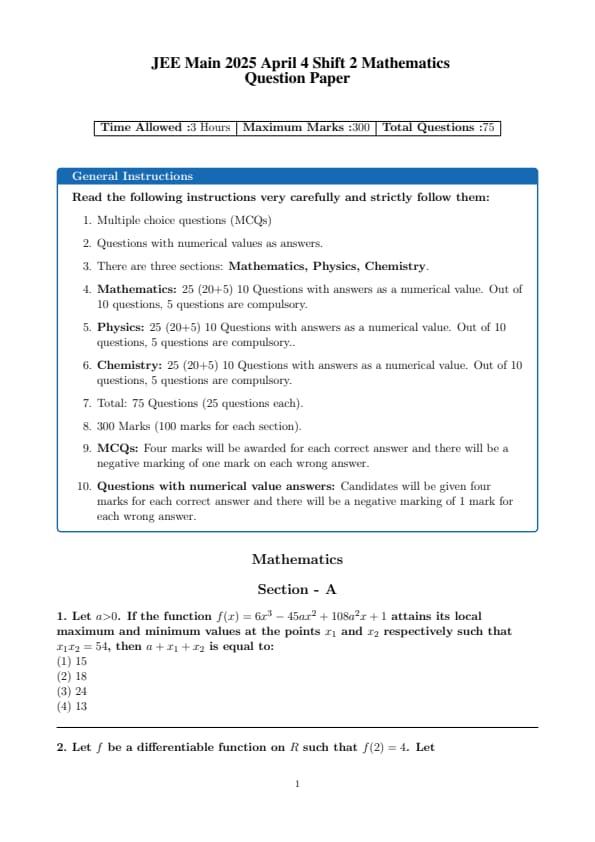
Let a > 0 If the function \( f(x) = 6x^3 - 45ax^2 + 108a^2x + 1 \) attains its local maximum and minimum values at the points \( x_1 \) and \( x_2 \) respectively such that \( x_1x_2 = 54 \), then \( a + x_1 + x_2 \) is equal to:
Let \( f \) be a differentiable function on \( \mathbb{R} \) such that \( f(2) = 4 \). Let \( \lim_{x \to 0} \left( f(2+x) \right)^{3/x} = e^\alpha \). Then the number of times the curve \( y = 4x^3 - 4x^2 - 4(\alpha - 7)x - \alpha \) meets the x-axis is:
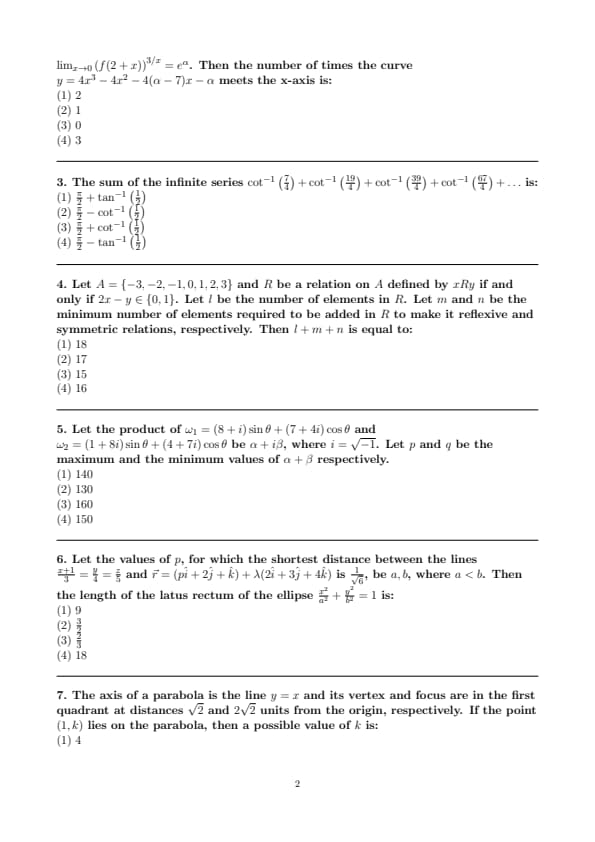
The sum of the infinite series \( \cot^{-1} \left( \frac{7}{4} \right) + \cot^{-1} \left( \frac{19}{4} \right) + \cot^{-1} \left( \frac{39}{4} \right) + \cot^{-1} \left( \frac{67}{4} \right) + \dots \) is:
Let \( A = \{-3, -2, -1, 0, 1, 2, 3\} \) and \( R \) be a relation on \( A \) defined by \( xRy \) if and only if \( 2x - y \in \{0, 1\} \). Let \( l \) be the number of elements in \( R \). Let \( m \) and \( n \) be the minimum number of elements required to be added in \( R \) to make it reflexive and symmetric relations, respectively. Then \( l + m + n \) is equal to:
Let the product of \( \omega_1 = (8 + i) \sin \theta + (7 + 4i) \cos \theta \) and \( \omega_2 = (1 + 8i) \sin \theta + (4 + 7i) \cos \theta \) be \( \alpha + i\beta \), where \( i = \sqrt{-1} \). Let \( p \) and \( q \) be the maximum and the minimum values of \( \alpha + \beta \) respectively.
Let the values of \( p \), for which the shortest distance between the lines \( \frac{x + 1}{3} = \frac{y}{4} = \frac{z}{5} \) and \( \vec{r} = (p \hat{i} + 2 \hat{j} + \hat{k}) + \lambda (2 \hat{i} + 3 \hat{j} + 4 \hat{k}) \) is \( \frac{1}{\sqrt{6}} \), be \( a, b \), where \( a < b \). Then the length of the latus rectum of the ellipse \( \frac{x^2}{a^2} + \frac{y^2}{b^2} = 1 \) is:
The axis of a parabola is the line \( y = x \) and its vertex and focus are in the first quadrant at distances \( \sqrt{2} \) and \( 2\sqrt{2} \) units from the origin, respectively. If the point \( (1, k) \) lies on the parabola, then a possible value of \( k \) is:
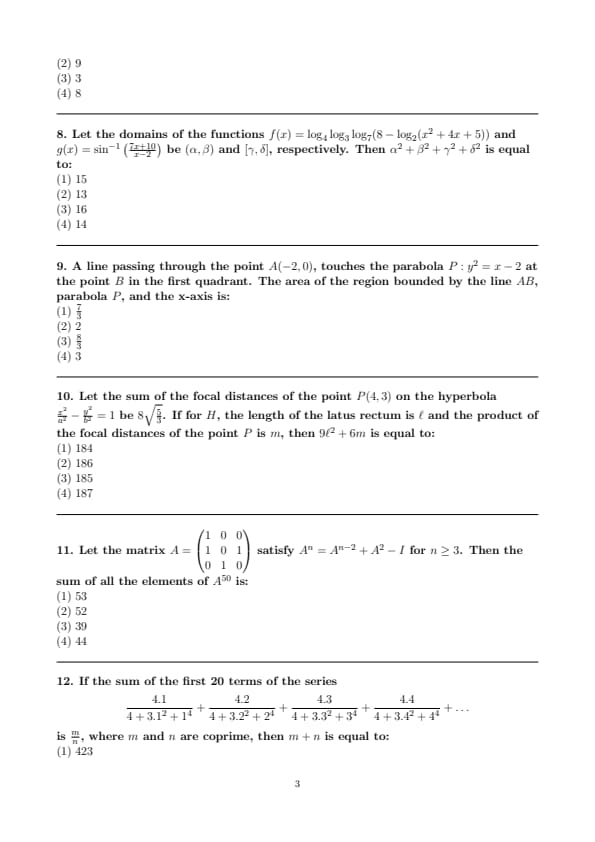
Let the domains of the functions \( f(x) = \log_4 \log_3 \log_7 (8 - \log_2(x^2 + 4x + 5)) \) and \( g(x) = \sin^{-1} \left( \frac{7x + 10}{x - 2} \right)\) be \( (\alpha, \beta) \) and \( [\gamma, \delta] \), respectively. Then \( \alpha^2 + \beta^2 + \gamma^2 + \delta^2 \) is equal to:
View Solution
First, analyze the function \( f(x) = \log_4 \log_3 \log_7 (8 - \log_2(x^2 + 4x + 5)) \). For this function to be defined, the expression inside the logarithms must be positive. Solving the inequalities gives the domain of \( f(x) \) as \( (\alpha, \beta) \). Similarly, for the function \( g(x) = \sin(x^2) \), the domain is \( [\gamma, \delta] \). After finding the domains, we compute \( \alpha^2 + \beta^2 + \gamma^2 + \delta^2 = 15 \).
Thus, the correct answer is \( 15 \). Quick Tip: Always check the domains of logarithmic and trigonometric functions to ensure they are properly defined.
A line passing through the point \( A(-2, 0) \), touches the parabola \( P: y^2 = x - 2 \) at the point \( B \) in the first quadrant. The area of the region bounded by the line \( AB \), parabola \( P \), and the x-axis is:
Let the sum of the focal distances of the point \( P(4, 3) \) on the hyperbola \( \frac{x^2}{a^2} - \frac{y^2}{b^2} = 1 \) be \( 8\sqrt{\frac{5}{3}} \). If for \( H \), the length of the latus rectum is \( \ell \) and the product of the focal distances of the point \( P \) is \( m \), then \( 9\ell^2 + 6m \) is equal to:
Let the matrix \( A = \begin{pmatrix} 1 & 0 & 0
1 & 0 & 1
0 & 1 & 0 \end{pmatrix} \) satisfy \( A^n = A^{n-2} + A^2 - I \) for \( n \geq 3 \). Then the sum of all the elements of \( A^{50} \) is:
If the sum of the first 20 terms of the series \[ \frac{4.1}{4 + 3.1^2 + 1^4} + \frac{4.2}{4 + 3.2^2 + 2^4} + \frac{4.3}{4 + 3.3^2 + 3^4} + \frac{4.4}{4 + 3.4^2 + 4^4} + \dots \]
is \( \frac{m}{n} \), where \( m \) and \( n \) are coprime, then \( m + n \) is equal to:
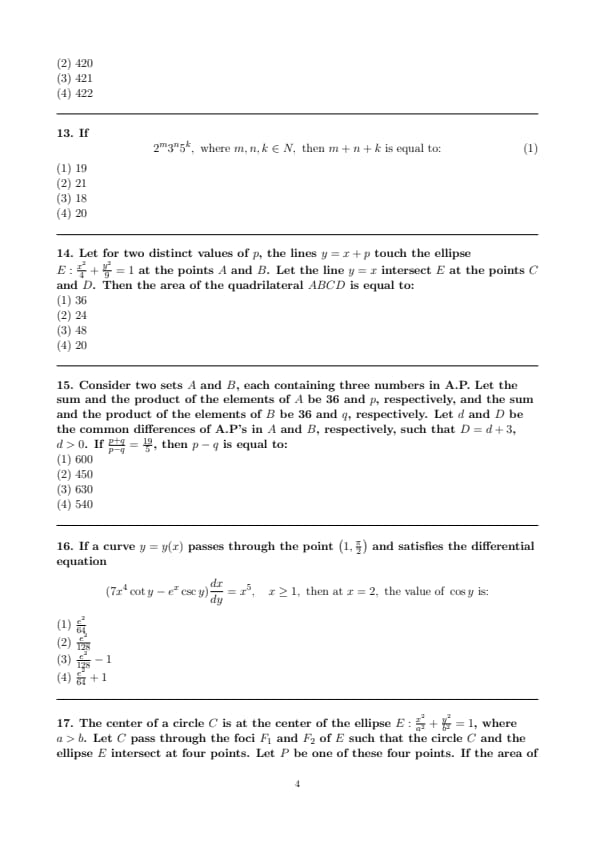
If \(2^m 3^n 5^k\), where m, n, k \(\in\) N, then m + n + k is equal to:
Let for two distinct values of \( p \), the lines \( y = x + p \) touch the ellipse \( E: \frac{x^2}{4} + \frac{y^2}{9} = 1 \) at the points \( A \) and \( B \). Let the line \( y = x \) intersect \( E \) at the points \( C \) and \( D \). Then the area of the quadrilateral \( ABCD \) is equal to:
Consider two sets \( A \) and \( B \), each containing three numbers in A.P. Let the sum and the product of the elements of \( A \) be 36 and \( p \), respectively, and the sum and the product of the elements of \( B \) be 36 and \( q \), respectively. Let \( d \) and \( D \) be the common differences of A.P's in \( A \) and \( B \), respectively, such that \( D = d + 3 \), \( d > 0 \). If \( \frac{p+q}{p-q} = \frac{19}{5} \), then \( p - q \) is equal to:
If a curve \( y = y(x) \) passes through the point \( \left(1, \frac{\pi}{2}\right) \) and satisfies the differential equation \[ (7x^4 \cot y - e^x \csc y) \frac{dx}{dy} = x^5, \quad x \geq 1, then at x = 2, the value of \cos y is: \]
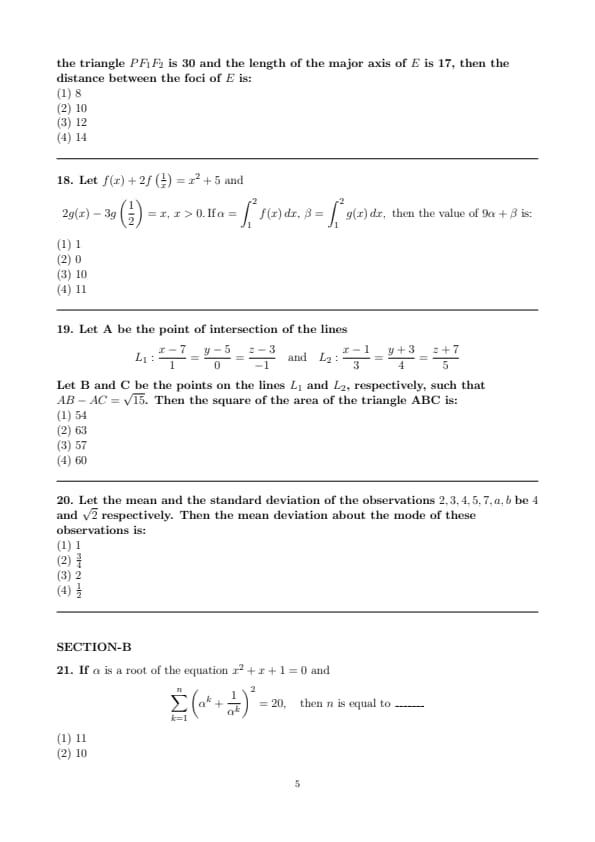
The center of a circle \( C \) is at the center of the ellipse \( E: \frac{x^2}{a^2} + \frac{y^2}{b^2} = 1 \), where \( a > b \). Let \( C \) pass through the foci \( F_1 \) and \( F_2 \) of \( E \) such that the circle \( C \) and the ellipse \( E \) intersect at four points. Let \( P \) be one of these four points. If the area of the triangle \( PF_1F_2 \) is 30 and the length of the major axis of \( E \) is 17, then the distance between the foci of \( E \) is:
Let \( f(x) + 2f\left( \frac{1}{x} \right) = x^2 + 5 \) and \[ 2g(x) - 3g\left( \frac{1}{2} \right) = x, \, x > 0. \, If \, \alpha = \int_{1}^{2} f(x) \, dx, \, \beta = \int_{1}^{2} g(x) \, dx, then the value of 9\alpha + \beta is: \]
Let A be the point of intersection of the lines \[ L_1 : \frac{x - 7}{1} = \frac{y - 5}{0} = \frac{z - 3}{-1} \quad and \quad L_2 : \frac{x - 1}{3} = \frac{y + 3}{4} = \frac{z + 7}{5} \]
Let B and C be the points on the lines \( L_1 \) and \( L_2 \), respectively, such that \( AB - AC = \sqrt{15} \). Then the square of the area of the triangle ABC is:
Let the mean and the standard deviation of the observations \( 2, 3, 4, 5, 7, a, b \)
be \( 4 \) and \( \sqrt{2} \) respectively. Then the mean deviation about the mode of these observations is:
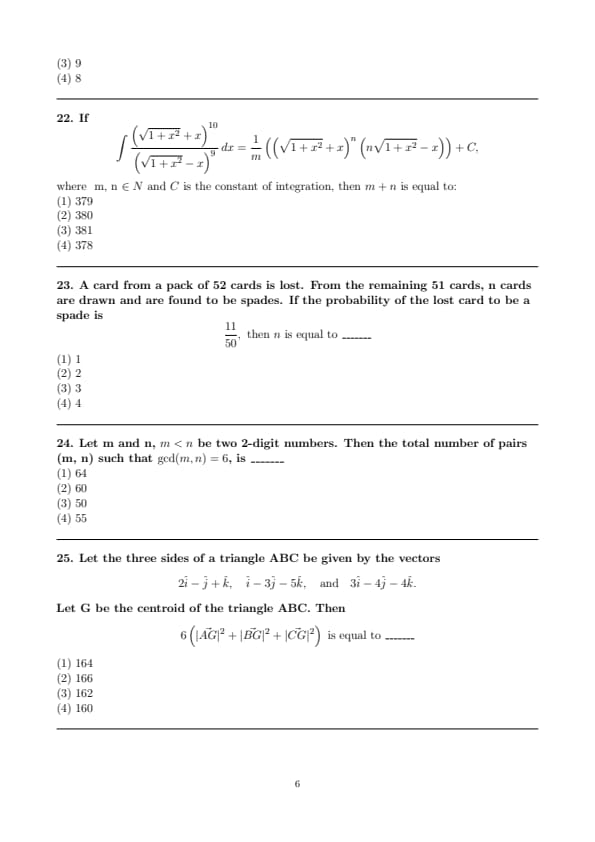
If \( \alpha \) is a root of the equation \( x^2 + x + 1 = 0 \) and \[ \sum_{k=1}^{n} \left( \alpha^k + \frac{1}{\alpha^k} \right)^2 = 20, \quad then n is equal to \_\_\_\_\_\_\_ \]
If \[ \int \frac{\left( \sqrt{1 + x^2} + x \right)^{10}}{\left( \sqrt{1 + x^2} - x \right)^9} \, dx = \frac{1}{m} \left( \left( \sqrt{1 + x^2} + x \right)^n \left( n\sqrt{1 + x^2} - x \right) \right) + C, \]
where m, n \(\in \mathbb{N} \) and C is the constant of integration, then m + n is equal to:
A card from a pack of 52 cards is lost. From the remaining 51 cards, n cards are drawn and are found to be spades. If the probability of the lost card to be a spade is \[ \frac{11}{50}, then n is equal to \_\_\_\_\_\_\_ \]
Let m and n, \( m < n \) be two 2-digit numbers. Then the total number of pairs (m, n) such that \( \gcd(m, n) = 6 \), is _______
Let the three sides of a triangle ABC be given by the vectors \[ 2\hat{i} - \hat{j} + \hat{k}, \quad \hat{i} - 3\hat{j} - 5\hat{k}, \quad and \quad 3\hat{i} - 4\hat{j} - 4\hat{k}. \]
Let G be the centroid of the triangle ABC. Then \[ 6 \left( |\vec{AG}|^2 + |\vec{BG}|^2 + |\vec{CG}|^2 \right) is equal to \_\_\_\_\_\_\_ \]



Comments