




JEE Main 2025 April 7 Chemistry Question Paper is available for download. NTA conducted JEE Main 2025 Shift 1 B.Tech Exam on 3rd April 2025 from 9:00 AM to 12:00 PM and for JEE Main 2025 B.Tech Shift 2 appearing candidates from 3:00 PM to 6:00 PM. The JEE Main 2025 3rd April B.Tech Question Paper was Moderate to Tough.
Also Check: JEE Main 2025 Question Paper with Solution PDF Download
JEE Main 2025 April 7 Shift 1 Chemistry Question Paper with Solutions
| JEE Main 2025 April 7 Shift 1 Chemistry Question Paper Pdf | Download PDF | View Solution |

JEE Main 2025 Chemistry Questions with Solutions
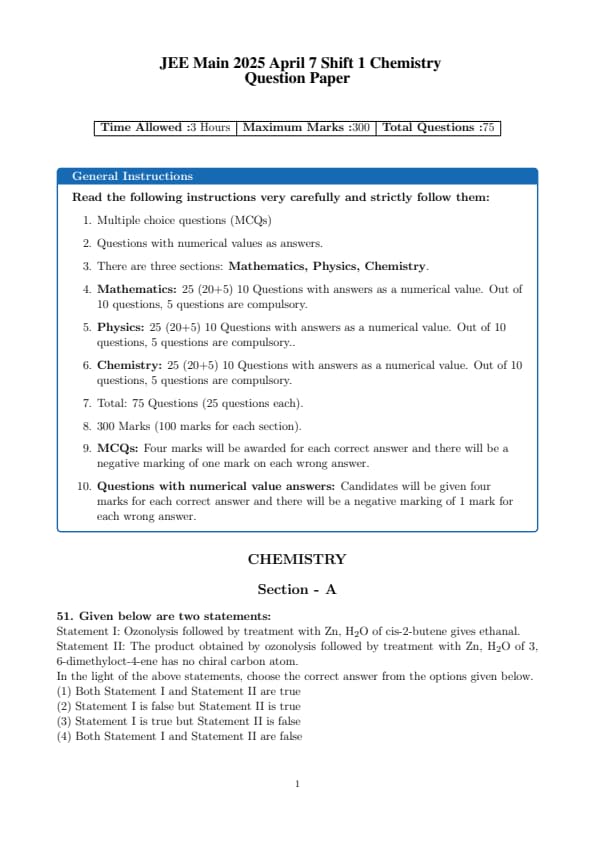
Question 1:
Given below are two statements:
Statement I: Ozonolysis followed by treatment with Zn, H\(_2\)O of cis-2-butene gives ethanal.
Statement II: The product obtained by ozonolysis followed by treatment with Zn, H\(_2\)O of 3, 6-dimethyloct-4-ene has no chiral carbon atom.
In the light of the above statements, choose the correct answer from the options given below.
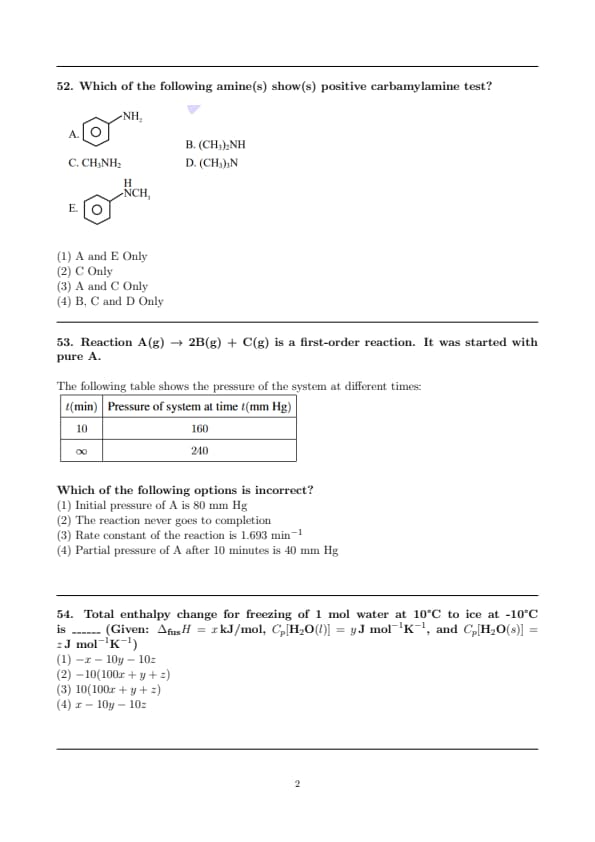
Which of the following amine(s) show(s) positive carbamylamine test?

Reaction A(g) → 2B(g) + C(g) is a first-order reaction. It was started with pure A.
The following table shows the pressure of the system at different times:

Which of the following options is incorrect?
Total enthalpy change for freezing of 1 mol water at 10°C to ice at -10°C is ______
(Given: \( \Delta_{fus}H = x \, kJ/mol \), \( C_p[H_2O(l)] = y \, J mol^{-1} K^{-1} \), and \( C_p[H_2O(s)] = z \, J mol^{-1} K^{-1} \))
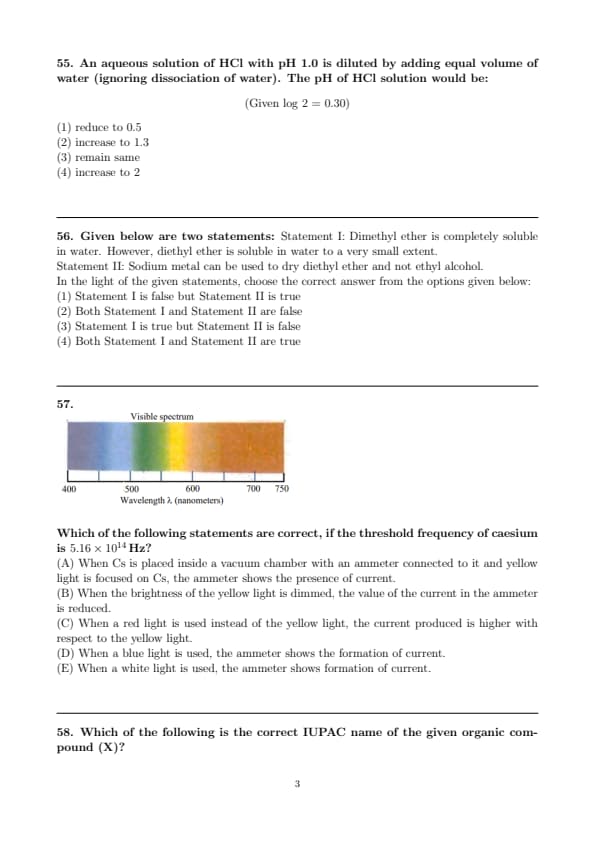
An aqueous solution of HCl with pH 1.0 is diluted by adding equal volume of water (ignoring dissociation of water). The pH of HCl solution would be: \[ (Given log 2 = 0.30) \]
Given below are two statements:
Statement I: Dimethyl ether is completely soluble in water. However, diethyl ether is soluble in water to a very small extent.
Statement II: Sodium metal can be used to dry diethyl ether and not ethyl alcohol.
In the light of the given statements, choose the correct answer from the options given below:

Which of the following statements are correct, if the threshold frequency of caesium is \( 5.16 \times 10^{14} \, Hz \)?
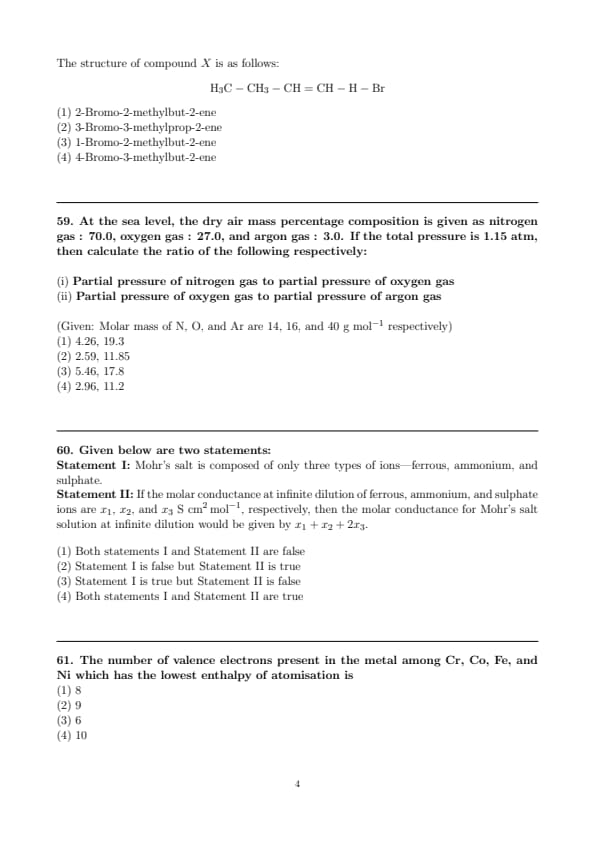
Which of the following is the correct IUPAC name of the given organic compound (X)?
The structure of compound \( X \) is as follows: \[ H_3C - CH_3 - CH = CH - H - Br \]
At the sea level, the dry air mass percentage composition is given as nitrogen gas : 70.0, oxygen gas : 27.0, and argon gas : 3.0. If the total pressure is 1.15 atm, then calculate the ratio of the following respectively:
(i) Partial pressure of nitrogen gas to partial pressure of oxygen gas
(ii) Partial pressure of oxygen gas to partial pressure of argon gas
(Given: Molar mass of N, O, and Ar are 14, 16, and 40 g mol\(^{-1\) respectively)
Given below are two statements:
Statement I: Mohr's salt is composed of only three types of ions—ferrous, ammonium, and sulphate.
Statement II: If the molar conductance at infinite dilution of ferrous, ammonium, and sulphate ions are \( x_1 \), \( x_2 \), and \( x_3 \) \( S cm^2 \, mol^{-1} \), respectively, then the molar conductance for Mohr's salt solution at infinite dilution would be given by \( x_1 + x_2 + 2x_3 \).
The number of valence electrons present in the metal among Cr, Co, Fe, and Ni which has the lowest enthalpy of atomisation is
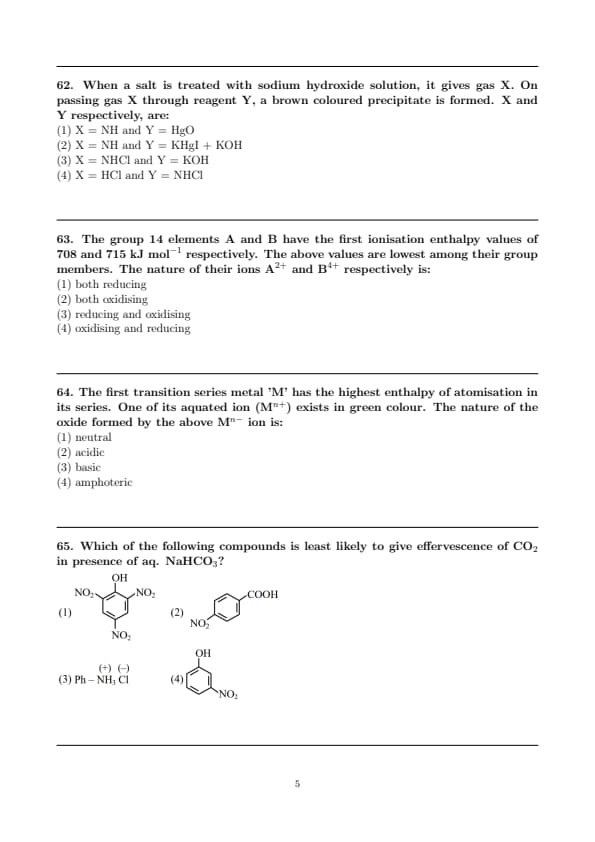
When a salt is treated with sodium hydroxide solution, it gives gas X. On passing gas X through reagent Y, a brown coloured precipitate is formed. X and Y respectively, are:
The group 14 elements A and B have the first ionisation enthalpy values of 708 and 715 kJ mol\(^{-1}\) respectively. The above values are lowest among their group members. The nature of their ions A\(^{2+}\) and B\(^{4+}\) respectively is:
The first transition series metal 'M' has the highest enthalpy of atomisation in its series. One of its aquated ion (M\(^{n+}\)) exists in green colour. The nature of the oxide formed by the above M\(^{n-}\) ion is:
Which of the following compounds is least likely to give effervescence of CO\(_2\) in presence of aq. NaHCO\(_3\)?

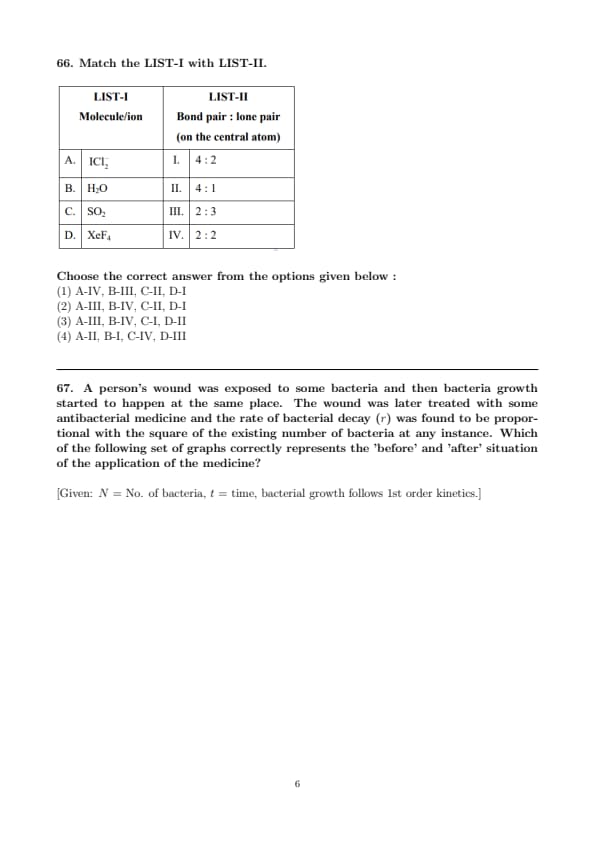
Match the LIST-I with LIST-II.

Choose the correct answer from the options given below :
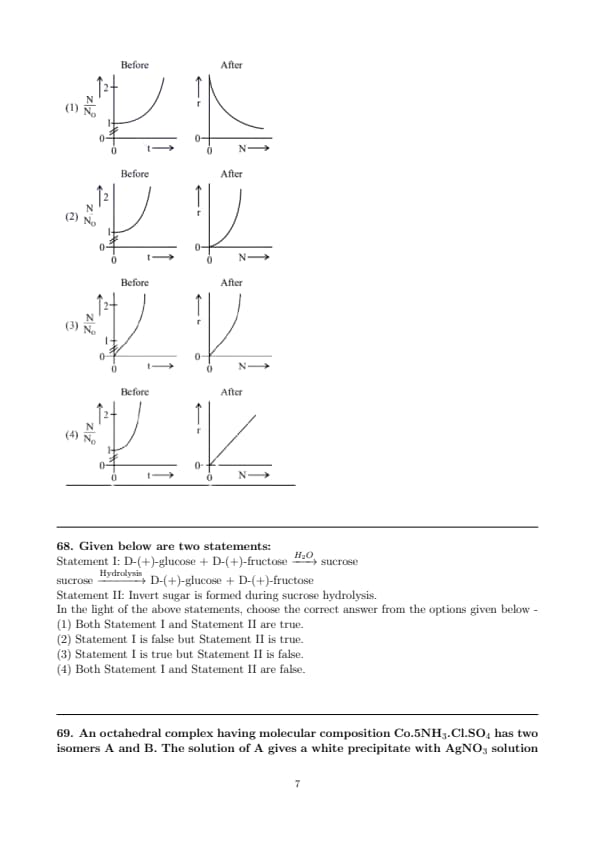
A person's wound was exposed to some bacteria and then bacteria growth started to happen at the same place. The wound was later treated with some antibacterial medicine and the rate of bacterial decay (\(r\)) was found to be proportional with the square of the existing number of bacteria at any instance. Which of the following set of graphs correctly represents the 'before' and 'after' situation of the application of the medicine?
[Given: \( N \) = No. of bacteria, \( t \) = time, bacterial growth follows 1st order kinetics.]

Given below are two statements:
Statement I: D-(+)-glucose + D-(+)-fructose \(\xrightarrow{H_2O}\) sucrose
sucrose \(\xrightarrow{Hydrolysis}\) D-(+)-glucose + D-(+)-fructose
Statement II: Invert sugar is formed during sucrose hydrolysis.
In the light of the above statements, choose the correct answer from the options given below -
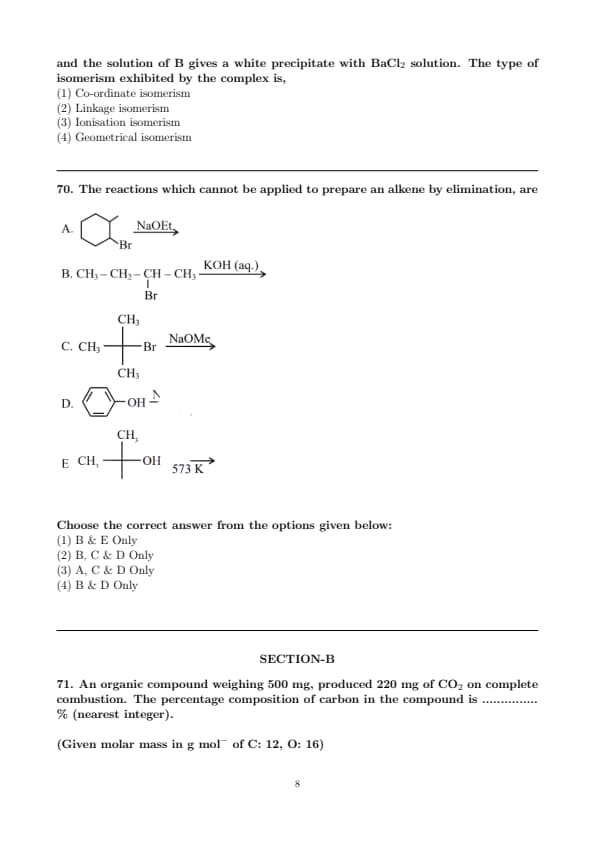
An octahedral complex having molecular composition Co.5NH\(_3\).Cl.SO\(_4\) has two isomers A and B. The solution of A gives a white precipitate with AgNO\(_3\) solution and the solution of B gives a white precipitate with BaCl\(_2\) solution. The type of isomerism exhibited by the complex is,
The reactions which cannot be applied to prepare an alkene by elimination, are

Choose the correct answer from the options given below:
An organic compound weighing 500 mg, produced 220 mg of CO\(_2\) on complete combustion. The percentage composition of carbon in the compound is ............... % (nearest integer).
(Given molar mass in g mol\(^-\) of C: 12, O: 16)
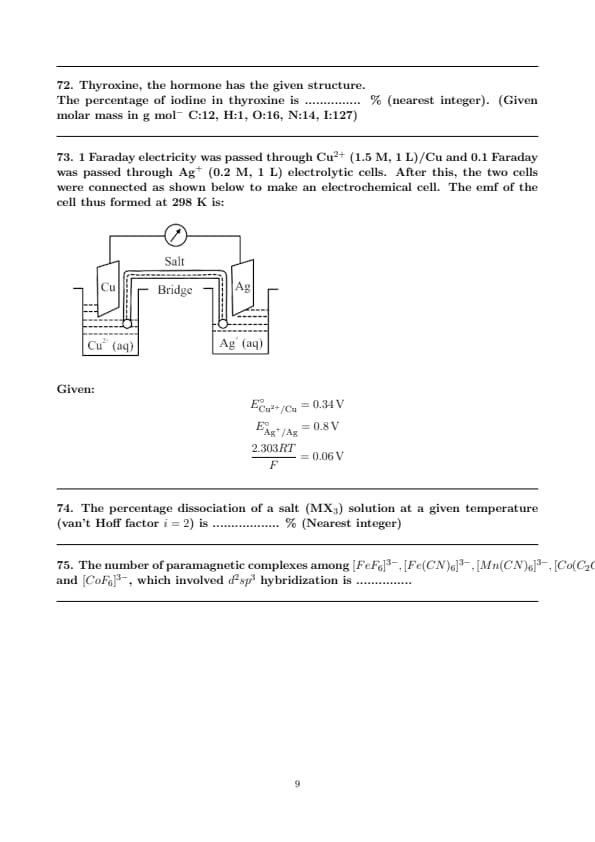
Thyroxine, the hormone has the given structure.
The percentage of iodine in thyroxine is ............... % (nearest integer).
(Given molar mass in g mol\(^-\) C:12, H:1, O:16, N:14, I:127)
1 Faraday electricity was passed through Cu\(^{2+}\) (1.5 M, 1 L)/Cu and 0.1 Faraday was passed through Ag\(^+\) (0.2 M, 1 L) electrolytic cells. After this, the two cells were connected as shown below to make an electrochemical cell. The emf of the cell thus formed at 298 K is:

Given: \[ E^\circ_{Cu^{2+}/Cu} = 0.34 \, V \] \[ E^\circ_{Ag^+/ Ag} = 0.8 \, V \] \[ \frac{2.303RT}{F} = 0.06 \, V \]
The percentage dissociation of a salt (MX\(_3\)) solution at a given temperature (van't Hoff factor \(i = 2\)) is .................. % (Nearest integer)
The number of paramagnetic complexes among \([FeF_6]^{3-}, [Fe(CN)_6]^{3-}, [Mn(CN)_6]^{3-}, [Co(C_2O_4)_3]^{3-}, [MnCl_6]^{3-}\) and \([CoF_6]^{3-}\), which involved \(d^2sp^3\) hybridization is ...............




Comments