




JEE Main 2025 April 7 Maths Question Paper is available for download. NTA conducted JEE Main 2025 Shift 1 B.Tech Exam on 3rd April 2025 from 9:00 AM to 12:00 PM and for JEE Main 2025 B.Tech Shift 2 appearing candidates from 3:00 PM to 6:00 PM. The JEE Main 2025 3rd April B.Tech Question Paper was Moderate to Tough.
Also Check: JEE Main 2025 Question Paper with Solution PDF Download
JEE Main 2025 April 7 Shift 1 Maths Question Paper with Solutions
| JEE Main 2025 April 7 Shift 1 Maths Question Paper Pdf | Download PDF | View Solution |

JEE Main 2025 Mathematics Questions with Solutions
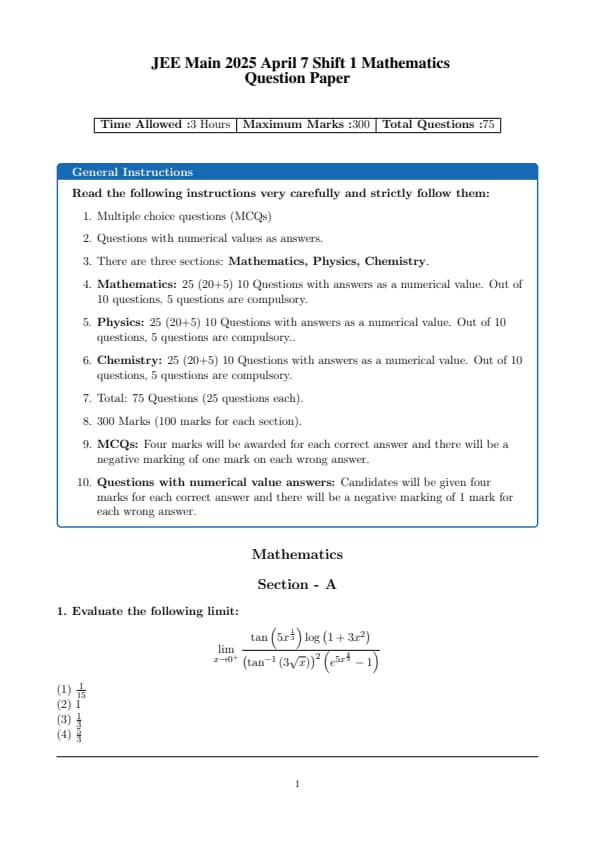
Question 1:
Evaluate the following limit: \[ \lim_{x \to 0^+} \frac{\tan\left(5x^{\frac{1}{3}}\right) \log\left(1 + 3x^2\right)}{\left(\tan^{-1}\left(3\sqrt{x}\right)\right)^2 \left(e^{5x^{\frac{4}{3}}} - 1\right)} \]
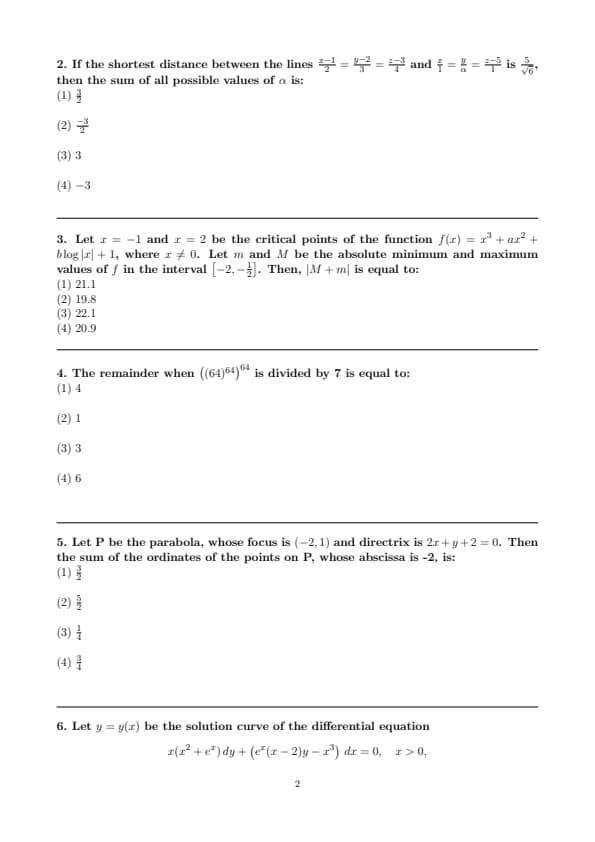
If the shortest distance between the lines \( \frac{x-1}{2} = \frac{y-2}{3} = \frac{z-3}{4} \) and \( \frac{x}{1} = \frac{y}{\alpha} = \frac{z-5}{1} \) is \( \frac{5}{\sqrt{6}} \), then the sum of all possible values of \( \alpha \) is:
Let \( x = -1 \) and \( x = 2 \) be the critical points of the function \( f(x) = x^3 + ax^2 + b \log|x| + 1 \), where \( x \neq 0 \). Let \( m \) and \( M \) be the absolute minimum and maximum values of \( f \) in the interval \( \left[-2, -\frac{1}{2}\right] \). Then, \( |M + m| \) is equal to:
The remainder when \( \left( (64)^{64} \right)^{64} \) is divided by 7 is equal to:
Let P be the parabola, whose focus is \( (-2, 1) \) and directrix is \( 2x + y + 2 = 0 \). Then the sum of the ordinates of the points on P, whose abscissa is -2, is:
Let \( y = y(x) \) be the solution curve of the differential equation \[ x(x^2 + e^x) \, dy + \left( e^x(x - 2) y - x^3 \right) \, dx = 0, \quad x > 0, \]
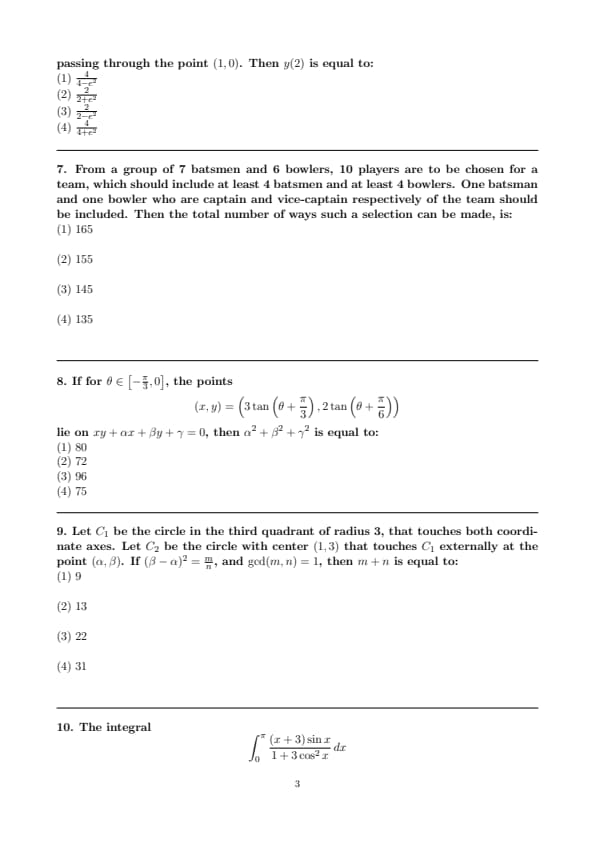
passing through the point \( (1, 0) \). Then \( y(2) \) is equal to:
From a group of 7 batsmen and 6 bowlers, 10 players are to be chosen for a team, which should include at least 4 batsmen and at least 4 bowlers. One batsman and one bowler who are captain and vice-captain respectively of the team should be included. Then the total number of ways such a selection can be made, is:
If for \( \theta \in \left[ -\frac{\pi}{3}, 0 \right] \), the points \[ (x, y) = \left( 3 \tan\left( \theta + \frac{\pi}{3} \right), 2 \tan\left( \theta + \frac{\pi}{6} \right) \right) \]
lie on \( xy + \alpha x + \beta y + \gamma = 0 \), then \( \alpha^2 + \beta^2 + \gamma^2 \) is equal to:
Let \( C_1 \) be the circle in the third quadrant of radius 3, that touches both coordinate axes. Let \( C_2 \) be the circle with center \( (1, 3) \) that touches \( C_1 \) externally at the point \( (\alpha, \beta) \). If \( (\beta - \alpha)^2 = \frac{m}{n} \), and \( \gcd(m, n) = 1 \), then \( m + n \) is equal to:
The integral \[ \int_0^\pi \frac{(x + 3) \sin x}{1 + 3 \cos^2 x} \, dx \]
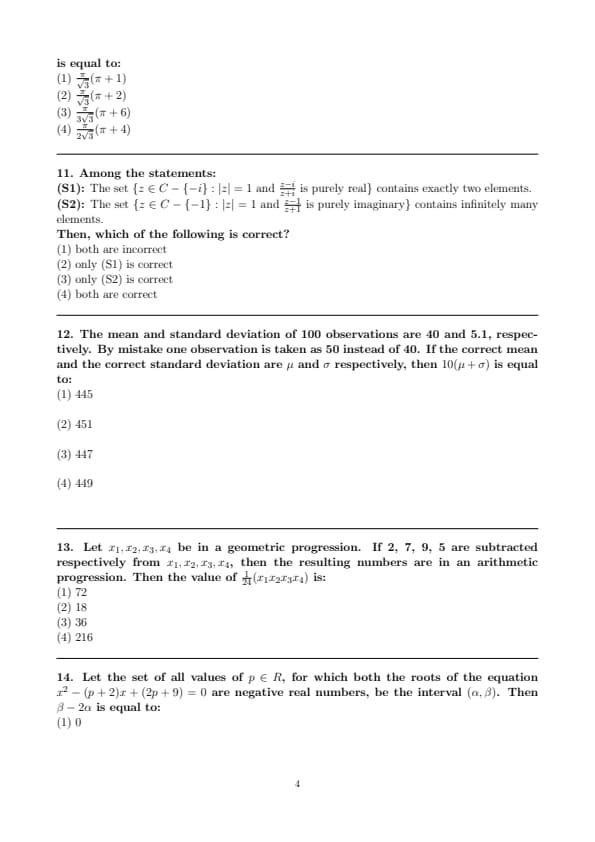
is equal to:
Among the statements:
(S1): The set \( \{ z \in \mathbb{C} - \{-i\} : |z| = 1 and \frac{z - i}{z + i} is purely real \} \) contains exactly two elements.
(S2): The set \( \{ z \in \mathbb{C} - \{-1\} : |z| = 1 and \frac{z - 1}{z + 1} is purely imaginary \} \) contains infinitely many elements.
Then, which of the following is correct?
The mean and standard deviation of 100 observations are 40 and 5.1, respectively. By mistake one observation is taken as 50 instead of 40. If the correct mean and the correct standard deviation are \( \mu \) and \( \sigma \) respectively, then \( 10(\mu + \sigma) \) is equal to:
Let \( x_1, x_2, x_3, x_4 \) be in a geometric progression. If 2, 7, 9, 5 are subtracted respectively from \( x_1, x_2, x_3, x_4 \), then the resulting numbers are in an arithmetic progression. Then the value of \( \frac{1}{24} (x_1 x_2 x_3 x_4) \) is:
Let the set of all values of \( p \in \mathbb{R} \), for which both the roots of the equation \( x^2 - (p + 2)x + (2p + 9) = 0 \) are negative real numbers, be the interval \( (\alpha, \beta) \). Then \( \beta - 2\alpha \) is equal to:
Let \( A \) be a \( 3 \times 3 \) matrix such that \[ | adj (adj A) | = 81. \]
If \[ S = \left\{ n \in \mathbb{Z}: \left| adj (adj A) \right|^{\frac{(n - 1)^2}{2}} = |A|^{(3n^2 - 5n - 4)} \right\}, \]
then the value of \[ \sum_{n \in S} |A| (n^2 + n) \]
is:
If the area of the region bounded by the curves \( y = 4 - \frac{x^2}{4} \) and \( y = \frac{x - 4}{2} \) is equal to \( \alpha \), then \( 6\alpha \) equals:
Let the system of equations be: \[ 2x + 3y + 5z = 9, \] \[ 7x + 3y - 2z = 8, \] \[ 12x + 3y - (4 + \lambda)z = 16 - \mu, \]
which has infinitely many solutions. Then the radius of the circle centered at \( (\lambda, \mu) \) and touching the line \( 4x = 3y \) is:
Let the line \( L \) pass through \( (1, 1, 1) \) and intersect the lines \[ \frac{x - 1}{2} = \frac{y + 1}{3} = \frac{z - 1}{4} \]
and \[ \frac{x - 3}{1} = \frac{y - 4}{2} = \frac{z}{1}. \]
Then, which of the following points lies on the line \( L \)?
Let the angle \( \theta, 0 < \theta < \frac{\pi}{2} \) between two unit vectors \( \hat{a} \) and \( \hat{b} \) be \( \sin^{-1} \left( \frac{\sqrt{65}}{9} \right) \). If the vector \( \vec{c} = 3\hat{a} + 6\hat{b} + 9(\hat{a} \times \hat{b}) \), then the value of \( 9(\vec{c} \cdot \hat{a}) - 3(\vec{c} \cdot \hat{b}) \) is:
Let \( ABC \) be the triangle such that the equations of lines \( AB \) and \( AC \) are: \[ 3y - x = 2 \quad and \quad x + y = 2, \]
respectively, and the points \( B \) and \( C \) lie on the x-axis. If \( P \) is the orthocentre of the triangle \( ABC \), then the area of the triangle \( PBC \) is equal to:
The number of points of discontinuity of the function \[ f(x) = \left\lfloor \frac{x^2}{2} \right\rfloor - \left\lfloor \sqrt{x} \right\rfloor, \quad x \in [0, 4], \]
where \( \left\lfloor \cdot \right\rfloor \) denotes the greatest integer function, is:
The number of relations on the set \( A = \{1, 2, 3\} \) containing at most 6 elements including \( (1, 2) \), which are reflexive and transitive but not symmetric, is:
Consider the hyperbola \[ \frac{x^2}{a^2} - \frac{y^2}{b^2} = 1, \]
having one of its foci at \( P(-3, 0) \). If the latus rectum through its other focus subtends a right angle at \( P \), and \[ a^2b^2 = \alpha\sqrt{2} - \beta, \quad \alpha, \beta \in \mathbb{N}, \]
then find \( \alpha \) and \( \beta \).
The number of singular matrices of order 2, whose elements are from the set \( \{2, 3, 6, 9\} \) is:
For \( n \geq 2 \), let \( S_n \) denote the set of all subsets of \( \{1, 2, 3, \ldots, n\} \) with no two consecutive numbers. For example, \( \{1, 3, 5\} \in S_6 \), but \( \{1, 2, 4\} \notin S_6 \). Then, find \( n(S_5) \).



Comments