




JEE Main 2025 April 7 Physics Question Paper is available for download. NTA conducted JEE Main 2025 Shift 1 B.Tech Exam on 3rd April 2025 from 9:00 AM to 12:00 PM and for JEE Main 2025 B.Tech Shift 2 appearing candidates from 3:00 PM to 6:00 PM. The JEE Main 2025 3rd April B.Tech Question Paper was Moderate to Tough.
Also Check: JEE Main 2025 Question Paper with Solution PDF Download
JEE Main 2025 April 7 Shift 1 Physics Question Paper with Solutions
| JEE Main 2025 April 7 Shift 1 Physics Question Paper Pdf | Download PDF | View Solution |
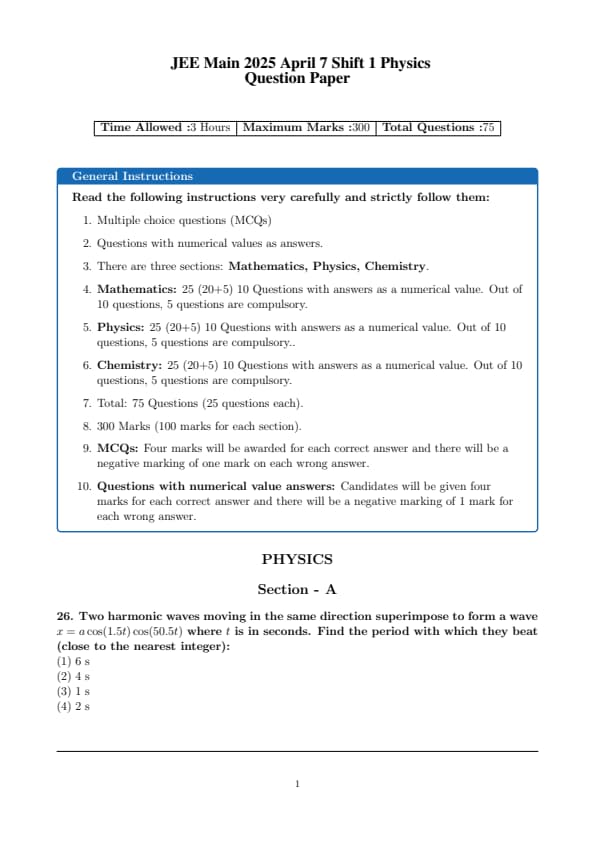
Two harmonic waves moving in the same direction superimpose to form a wave \( x = a \cos(1.5t) \cos(50.5t) \) where \( t \) is in seconds. Find the period with which they beat (close to the nearest integer):
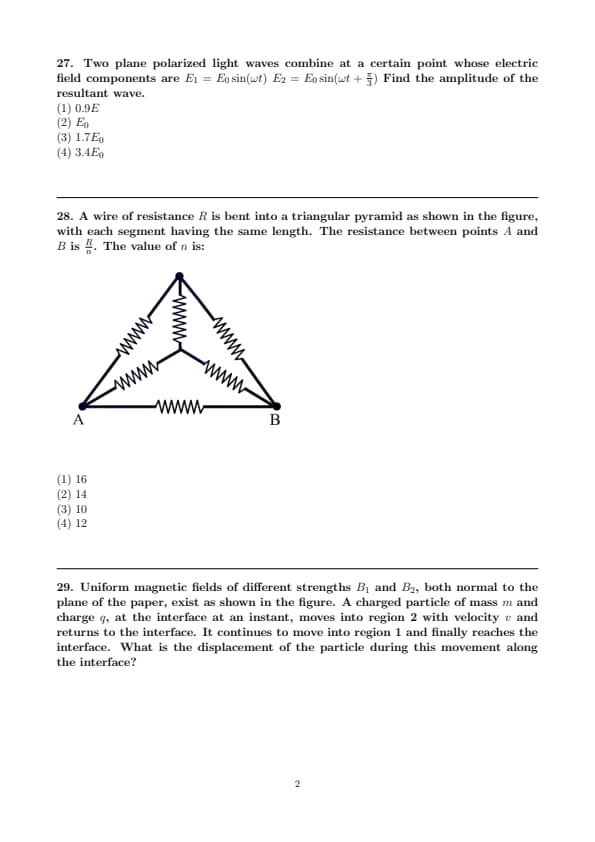
Two plane polarized light waves combine at a certain point whose electric field components are \( E_1 = E_0 \sin(\omega t) \) \( E_2 = E_0 \sin(\omega t + \frac{\pi}{3}) \)
Find the amplitude of the resultant wave.
A wire of resistance \( R \) is bent into a triangular pyramid as shown in the figure, with each segment having the same length. The resistance between points \( A \) and \( B \) is \( \frac{R}{n} \). The value of \( n \) is:

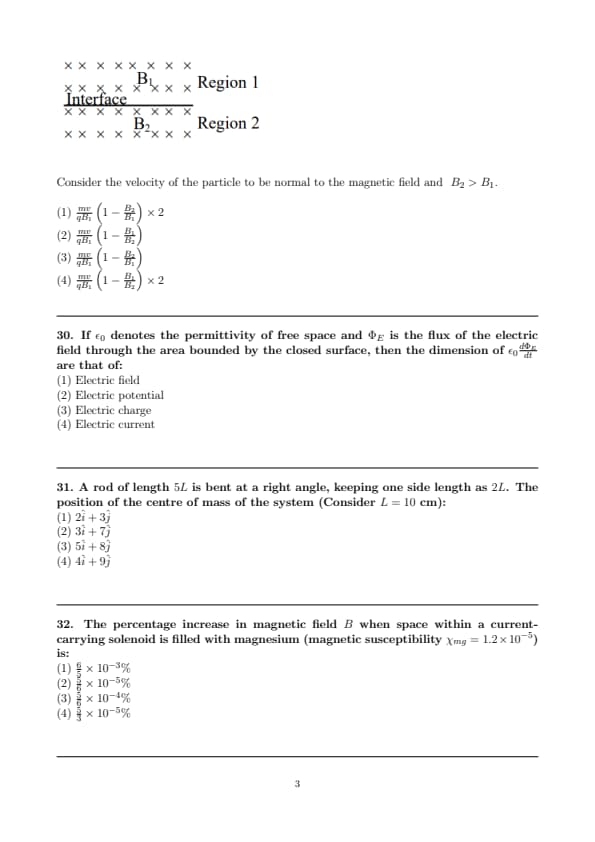
Uniform magnetic fields of different strengths \( B_1 \) and \( B_2 \), both normal to the plane of the paper, exist as shown in the figure. A charged particle of mass \( m \) and charge \( q \), at the interface at an instant, moves into region 2 with velocity \( v \) and returns to the interface. It continues to move into region 1 and finally reaches the interface. What is the displacement of the particle during this movement along the interface?

\text{Consider the velocity of the particle to be normal to the magnetic field and \( B_2 > B_1 \).
If \( \epsilon_0 \) denotes the permittivity of free space and \( \Phi_E \) is the flux of the electric field through the area bounded by the closed surface, then the dimension of \( \epsilon_0 \frac{d\Phi_E}{dt} \) are that of:
A rod of length \( 5L \) is bent at a right angle, keeping one side length as \( 2L \).
The position of the centre of mass of the system (Consider \( L = 10 \) cm):
The percentage increase in magnetic field \( B \) when space within a current-carrying solenoid is filled with magnesium (magnetic susceptibility \( \chi_{mg} = 1.2 \times 10^{-5} \)) is:
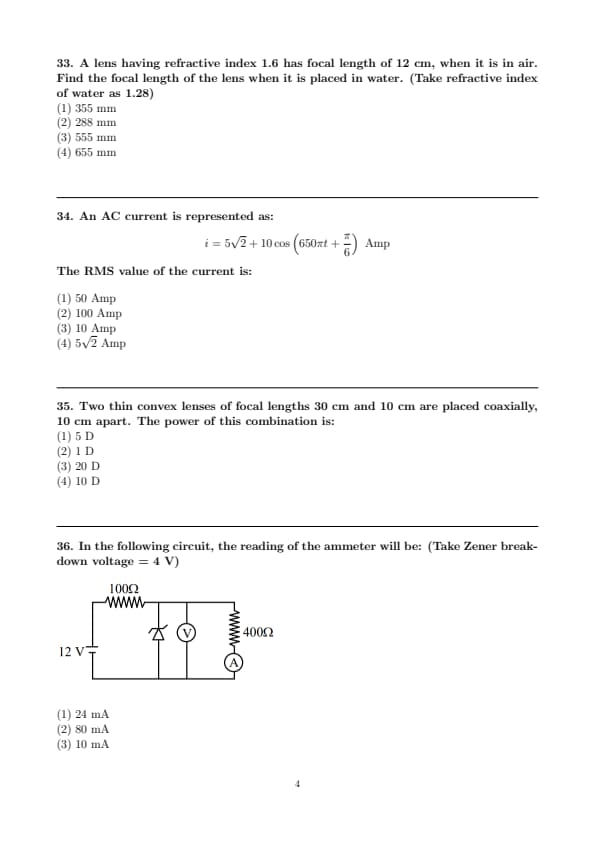
A lens having refractive index 1.6 has focal length of 12 cm, when it is in air. Find the focal length of the lens when it is placed in water.
(Take refractive index of water as 1.28)
An AC current is represented as: \[ i = 5\sqrt{2} + 10 \cos\left(650\pi t + \frac{\pi}{6}\right) Amp \]
The RMS value of the current is:
Two thin convex lenses of focal lengths 30 cm and 10 cm are placed coaxially, 10 cm apart. The power of this combination is:
In the following circuit, the reading of the ammeter will be: (Take Zener breakdown voltage = 4 V)

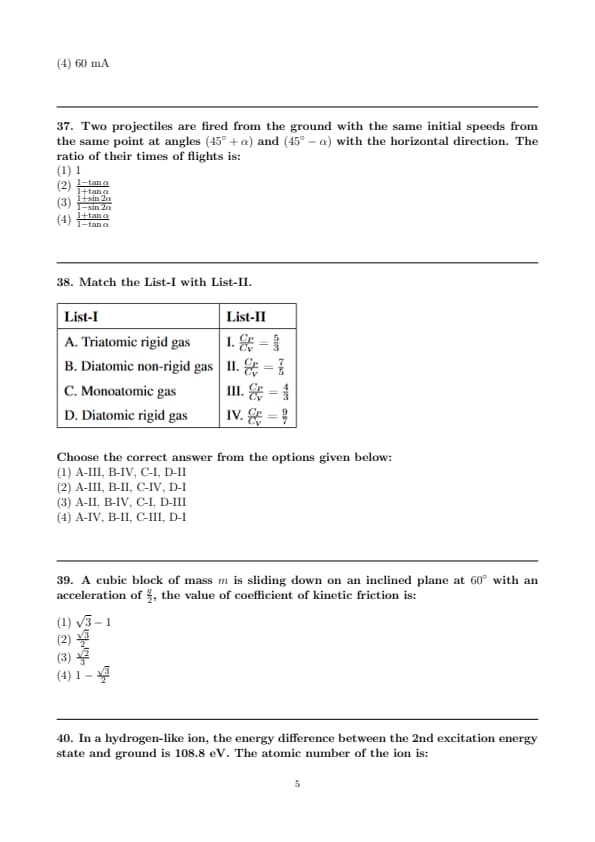
Two projectiles are fired from the ground with the same initial speeds from the same point at angles \( (45^\circ + \alpha) \) and \( (45^\circ - \alpha) \) with the horizontal direction. The ratio of their times of flights is:
Match the List-I with List-II.

Choose the correct answer from the options given below:
A cubic block of mass \( m \) is sliding down on an inclined plane at \( 60^\circ \) with an acceleration of \( \frac{g}{2} \), the value of coefficient of kinetic friction is:
In a hydrogen-like ion, the energy difference between the 2nd excitation energy state and ground is 108.8 eV. The atomic number of the ion is:
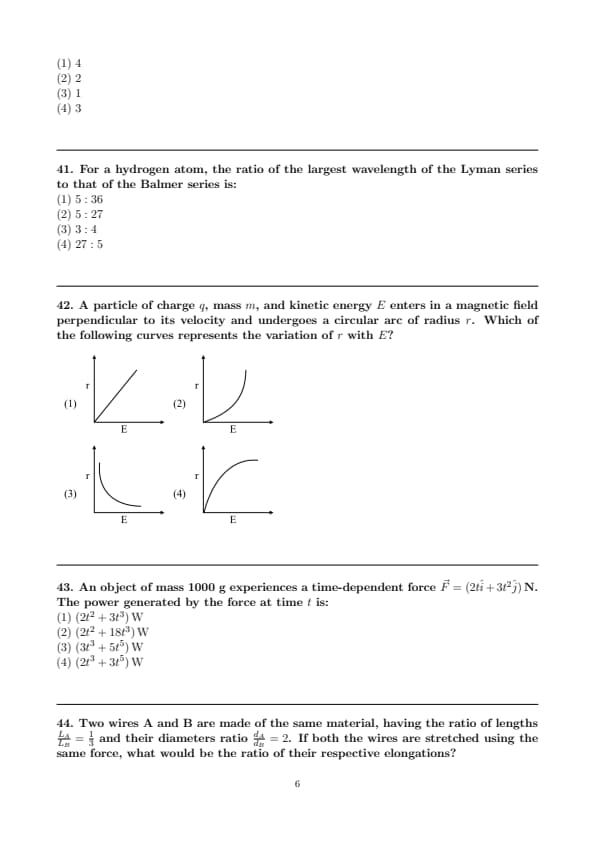
For a hydrogen atom, the ratio of the largest wavelength of the Lyman series to that of the Balmer series is:
A particle of charge \( q \), mass \( m \), and kinetic energy \( E \) enters in a magnetic field perpendicular to its velocity and undergoes a circular arc of radius \( r \). Which of the following curves represents the variation of \( r \) with \( E \)?

An object of mass 1000 g experiences a time-dependent force \( \vec{F} = (2t \hat{i} + 3t^2 \hat{j}) \, N \). The power generated by the force at time \( t \) is:
Two wires A and B are made of the same material, having the ratio of lengths \( \frac{L_A}{L_B} = \frac{1}{3} \) and their diameters ratio \( \frac{d_A}{d_B} = 2 \). If both the wires are stretched using the same force, what would be the ratio of their respective elongations?
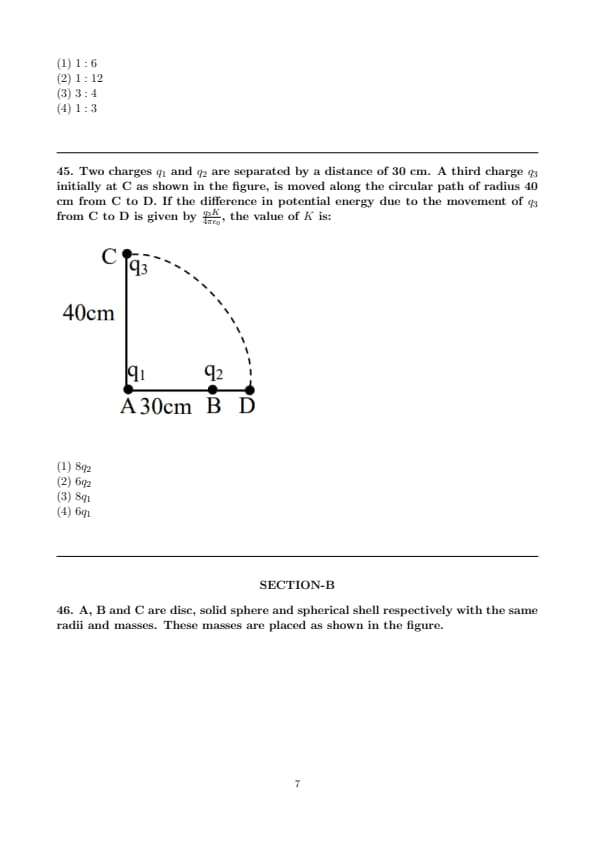
Two charges \( q_1 \) and \( q_2 \) are separated by a distance of 30 cm. A third charge \( q_3 \) initially at C as shown in the figure, is moved along the circular path of radius 40 cm from C to D. If the difference in potential energy due to the movement of \( q_3 \) from C to D is given by \( \frac{q_3 K}{4 \pi \epsilon_0} \), the value of \( K \) is:

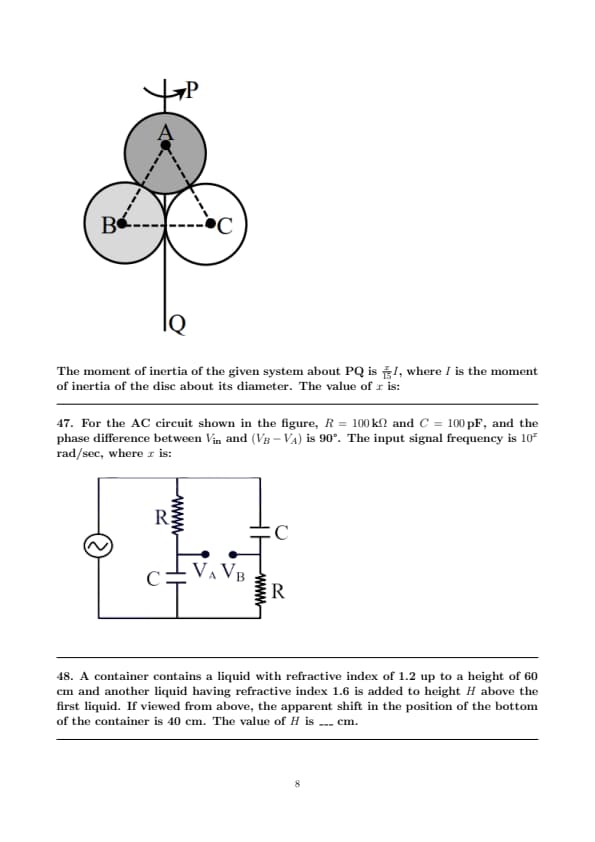
A, B and C are disc, solid sphere and spherical shell respectively with the same radii and masses. These masses are placed as shown in the figure.

The moment of inertia of the given system about PQ is \( \frac{x}{15} I \), where \( I \) is the moment of inertia of the disc about its diameter. The value of \( x \) is:
For the AC circuit shown in the figure, \( R = 100 \, k\Omega \) and \( C = 100 \, pF \), and the phase difference between \( V_{in} \) and \( (V_B - V_A) \) is 90°. The input signal frequency is \( 10^x \) rad/sec, where \( x \) is:

A container contains a liquid with refractive index of 1.2 up to a height of 60 cm and another liquid having refractive index 1.6 is added to height \( H \) above the first liquid. If viewed from above, the apparent shift in the position of the bottom of the container is 40 cm. The value of \( H \) is ___ cm.
A wire of length 10 cm and diameter 0.5 mm is used in a bulb. The temperature of the wire is 1727°C and power radiated by the wire is 94.2 W. Its emissivity is \( \frac{x}{8} \), where \( x = \ldots \)
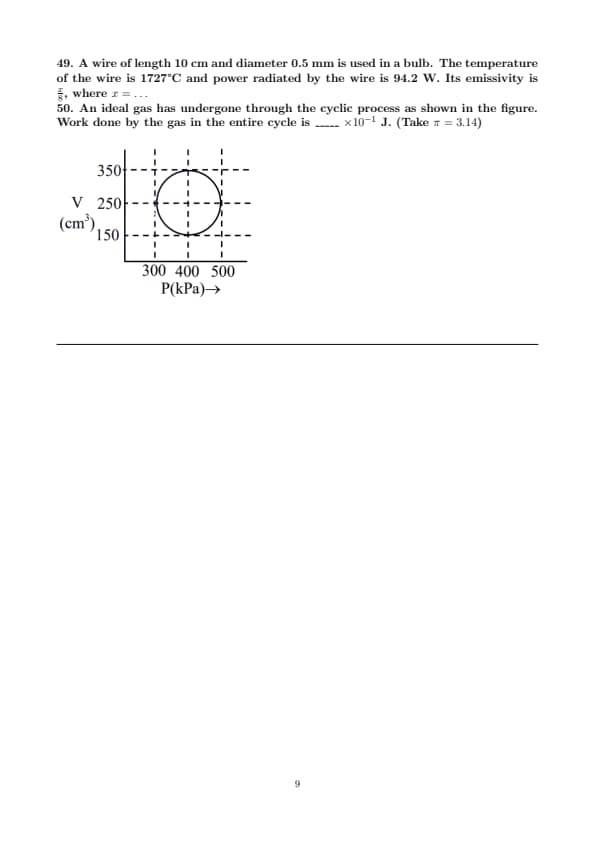
An ideal gas has undergone through the cyclic process as shown in the figure. Work done by the gas in the entire cycle is _____\ \( \times 10^{-1} \) J. (Take \( \pi = 3.14 \))






Comments