




JEE Main 2025 April 7 Maths Question Paper is available for download. NTA conducted JEE Main 2025 Shift 1 B.Tech Exam on 3rd April 2025 from 9:00 AM to 12:00 PM and for JEE Main 2025 B.Tech Shift 2 appearing candidates from 3:00 PM to 6:00 PM. The JEE Main 2025 3rd April B.Tech Question Paper was Moderate to Tough.
Also Check: JEE Main 2025 Question Paper with Solution PDF Download
JEE Main 2025 April 7 Shift 2 Maths Question Paper with Solutions
| JEE Main 2025 April 7 Shift 2 Maths Question Paper Pdf | Download PDF | View Solution |

JEE Main 2025 Mathematics Questions with Solutions
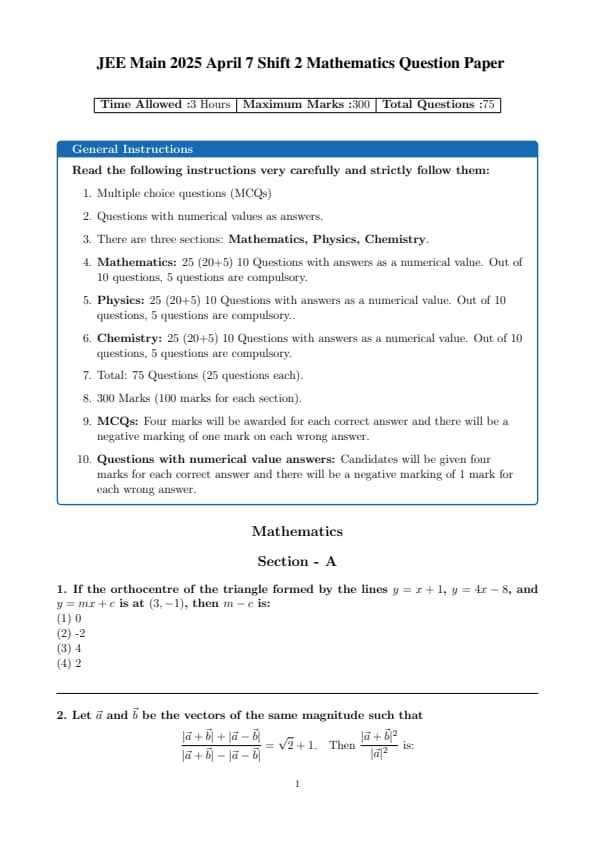
If the orthocentre of the triangle formed by the lines \( y = x + 1 \), \( y = 4x - 8 \), and \( y = mx + c \) is at \( (3, -1) \), then \( m - c \) is:
Let \( \vec{a} \) and \( \vec{b} \) be the vectors of the same magnitude such that \[ \frac{| \vec{a} + \vec{b} | + | \vec{a} - \vec{b} |}{| \vec{a} + \vec{b} | - | \vec{a} - \vec{b} |} = \sqrt{2} + 1. \quad Then \frac{| \vec{a} + \vec{b} |^2}{| \vec{a} |^2} is: \]
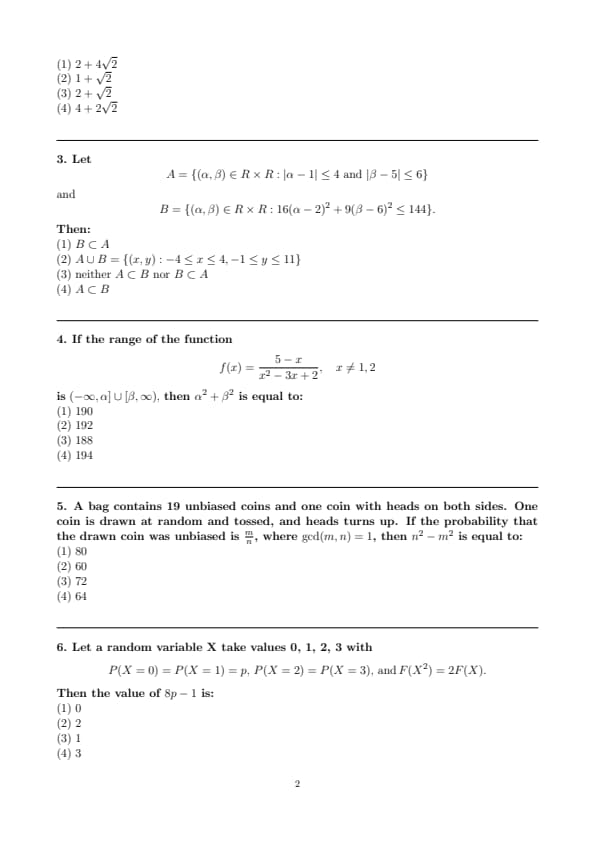
Let \[ A = \{(\alpha, \beta) \in \mathbb{R} \times \mathbb{R} : |\alpha - 1| \leq 4 and |\beta - 5| \leq 6\} \]
and \[ B = \{(\alpha, \beta) \in \mathbb{R} \times \mathbb{R} : 16(\alpha - 2)^2 + 9(\beta - 6)^2 \leq 144\}. \]
Then:
If the range of the function \[ f(x) = \frac{5 - x}{x^2 - 3x + 2}, \quad x \neq 1, 2 \]
is \( (-\infty, \alpha] \cup [\beta, \infty) \), then \( \alpha^2 + \beta^2 \) is equal to:
A bag contains 19 unbiased coins and one coin with heads on both sides. One coin is drawn at random and tossed, and heads turns up. If the probability that the drawn coin was unbiased is \( \frac{m}{n} \), where \( \gcd(m, n) = 1 \), then \( n^2 - m^2 \) is equal to:
Let a random variable X take values 0, 1, 2, 3 with \[ P(X = 0) = P(X = 1) = p, \, P(X = 2) = P(X = 3), \, and \, F(X^2) = 2F(X). \]
Then the value of \( 8p - 1 \) is:
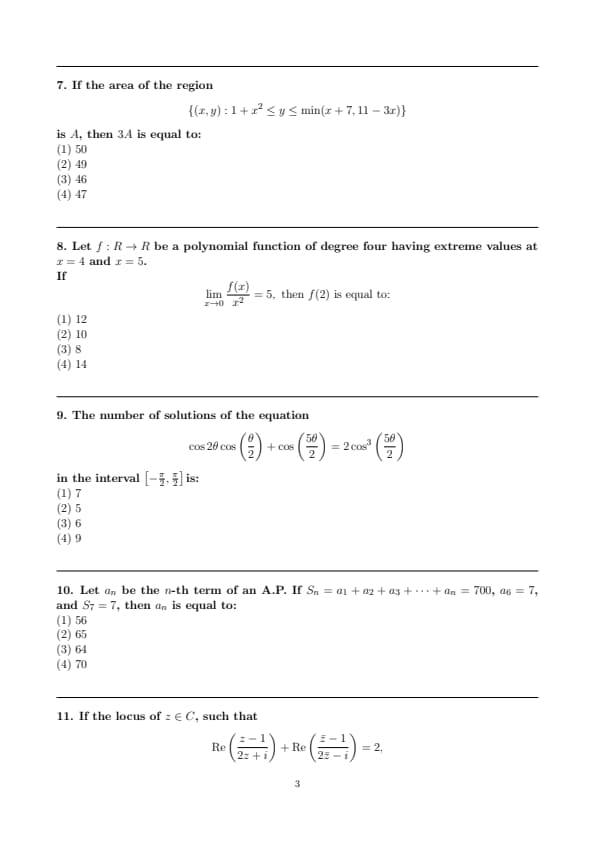
If the area of the region \[ \{(x, y) : 1 + x^2 \leq y \leq \min(x + 7, 11 - 3x)\} \]
is \( A \), then \( 3A \) is equal to:
Let \( f : \mathbb{R} \to \mathbb{R} \) be a polynomial function of degree four having extreme values at \( x = 4 \) and \( x = 5 \).
If \[ \lim_{x \to 0} \frac{f(x)}{x^2} = 5, then f(2) is equal to: \]
The number of solutions of the equation \[ \cos 2\theta \cos \left( \frac{\theta}{2} \right) + \cos \left( \frac{5\theta}{2} \right) = 2 \cos^3 \left( \frac{5\theta}{2} \right) \]
in the interval \( \left[ -\frac{\pi{2, \frac{\pi{2 \right] is:
Let \( a_n \) be the \( n \)-th term of an A.P. If \( S_n = a_1 + a_2 + a_3 + \cdots + a_n = 700 \), \( a_6 = 7 \), and \( S_7 = 7 \), then \( a_n \) is equal to:
If the locus of \( z \in \mathbb{C} \), such that \[ Re \left( \frac{z - 1}{2z + i} \right) + Re \left( \frac{ \bar{z} - 1}{2 \bar{z} - i} \right) = 2, \]
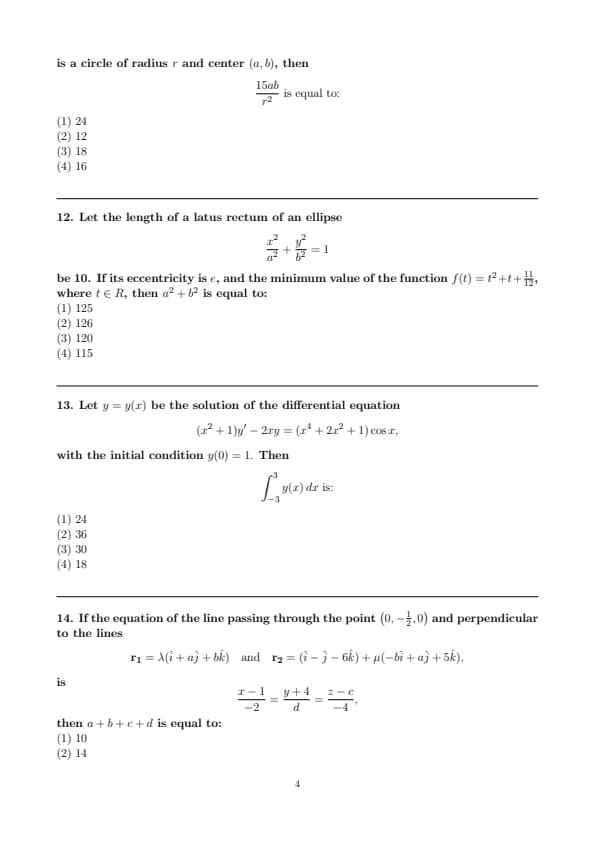
is a circle of radius \( r \) and center \( (a, b) \), then \[ \frac{15ab}{r^2} is equal to: \]
Let the length of a latus rectum of an ellipse \[ \frac{x^2}{a^2} + \frac{y^2}{b^2} = 1 \]
be 10. If its eccentricity is \( e \), and the minimum value of the function \( f(t) = t^2 + t + \frac{11}{12} \), where \( t \in \mathbb{R} \), then \( a^2 + b^2 \) is equal to:
Let \( y = y(x) \) be the solution of the differential equation \[ (x^2 + 1)y' - 2xy = (x^4 + 2x^2 + 1)\cos x, \]
with the initial condition \( y(0) = 1 \). Then \[ \int_{-3}^{3} y(x) \, dx is: \]
If the equation of the line passing through the point \( \left( 0, -\frac{1}{2}, 0 \right) \) and perpendicular to the lines \[ \mathbf{r_1} = \lambda ( \hat{i} + a \hat{j} + b \hat{k}) \quad and \quad \mathbf{r_2} = ( \hat{i} - \hat{j} - 6 \hat{k} ) + \mu( -b \hat{i} + a \hat{j} + 5 \hat{k}), \]
is \[ \frac{x - 1}{-2} = \frac{y + 4}{d} = \frac{z - c}{-4}, \]
then \( a + b + c + d \) is equal to:
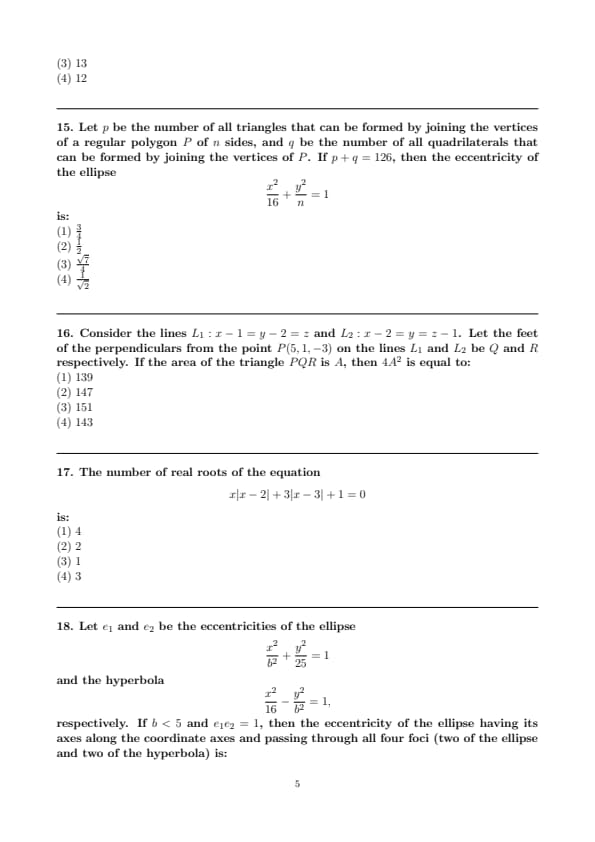
Let \( p \) be the number of all triangles that can be formed by joining the vertices of a regular polygon \( P \) of \( n \) sides, and \( q \) be the number of all quadrilaterals that can be formed by joining the vertices of \( P \). If \( p + q = 126 \), then the eccentricity of the ellipse \[ \frac{x^2}{16} + \frac{y^2}{n} = 1 \]
is:
Consider the lines \( L_1: x - 1 = y - 2 = z \) and \( L_2: x - 2 = y = z - 1 \). Let the feet of the perpendiculars from the point \( P(5, 1, -3) \) on the lines \( L_1 \) and \( L_2 \) be \( Q \) and \( R \) respectively. If the area of the triangle \( PQR \) is \( A \), then \( 4A^2 \) is equal to:
The number of real roots of the equation \[ x|x-2| + 3|x-3| + 1 = 0 \]
is:
Let \( e_1 \) and \( e_2 \) be the eccentricities of the ellipse \[ \frac{x^2}{b^2} + \frac{y^2}{25} = 1 \]
and the hyperbola \[ \frac{x^2}{16} - \frac{y^2}{b^2} = 1, \]
respectively. If \( b < 5 \) and \( e_1 e_2 = 1 \), then the eccentricity of the ellipse having its axes along the coordinate axes and passing through all four foci (two of the ellipse and two of the hyperbola) is:
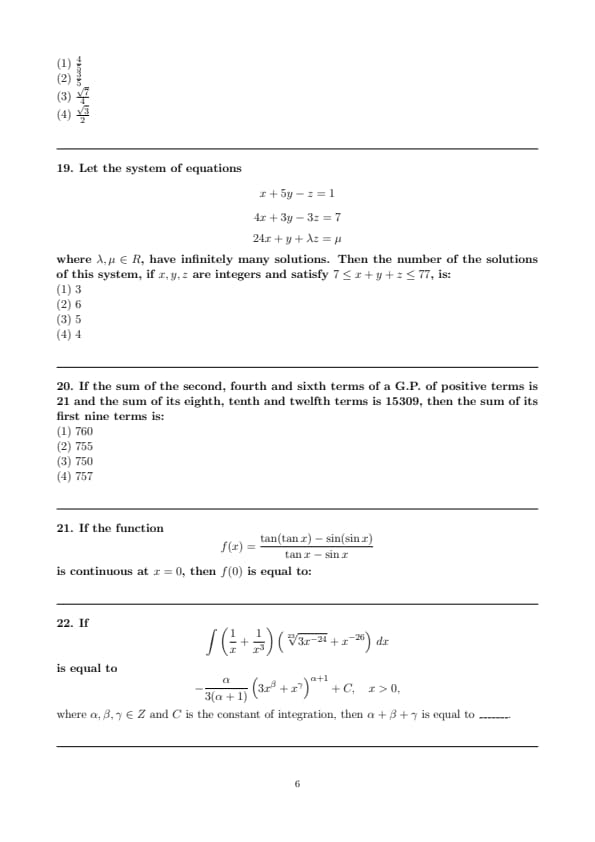
Let the system of equations \[ x + 5y - z = 1 \] \[ 4x + 3y - 3z = 7 \] \[ 24x + y + \lambda z = \mu \]
where \( \lambda, \mu \in \mathbb{R} \), have infinitely many solutions. Then the number of the solutions of this system, if \(x, y, z\) are integers and satisfy \(7 \leq x + y + z \leq 77\), is:
If the sum of the second, fourth and sixth terms of a G.P. of positive terms is 21 and the sum of its eighth, tenth and twelfth terms is 15309, then the sum of its first nine terms is:
If the function \[ f(x) = \frac{\tan(\tan x) - \sin(\sin x)}{\tan x - \sin x} \]
is continuous at \( x = 0 \), then \( f(0) \) is equal to:
If \[ \int \left( \frac{1}{x} + \frac{1}{x^3} \right) \left( \sqrt[23]{3x^{-24}} + x^{-26} \right) \, dx \]
is equal to \[ -\frac{\alpha}{3(\alpha + 1)} \left( 3x^\beta + x^\gamma \right)^{\alpha + 1} + C, \quad x > 0, \]
where \( \alpha, \beta, \gamma \in \mathbb{Z} \) and \( C \) is the constant of integration, then \( \alpha + \beta + \gamma \) is equal to _______.
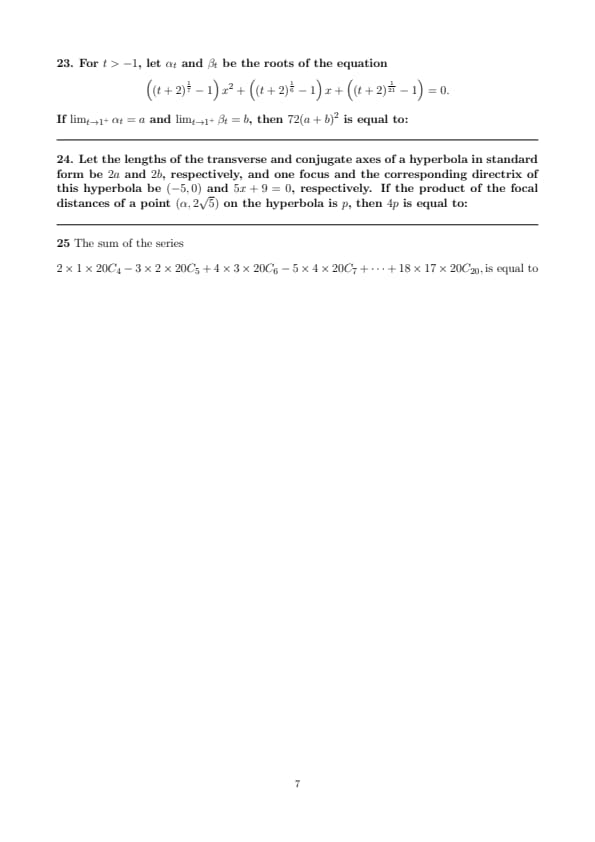
For \( t > -1 \), let \( \alpha_t \) and \( \beta_t \) be the roots of the equation \[ \left( (t + 2)^{\frac{1}{7}} - 1 \right)x^2 + \left( (t + 2)^{\frac{1}{6}} - 1 \right)x + \left( (t + 2)^{\frac{1}{21}} - 1 \right) = 0. \]
If \( \lim_{t \to 1^+} \alpha_t = a \) and \( \lim_{t \to 1^+} \beta_t = b \), then \( 72(a + b)^2 \) is equal to:
Let the lengths of the transverse and conjugate axes of a hyperbola in standard form be \( 2a \) and \( 2b \), respectively, and one focus and the corresponding directrix of this hyperbola be \( (-5, 0) \) and \( 5x + 9 = 0 \), respectively. If the product of the focal distances of a point \( (\alpha, 2\sqrt{5}) \) on the hyperbola is \( p \), then \( 4p \) is equal to:
The sum of the series \[ 2 \times 1 \times 20C_4 - 3 \times 2 \times 20C_5 + 4 \times 3 \times 20C_6 - 5 \times 4 \times 20C_7 + \dots + 18 \times 17 \times 20C_{20}, is equal to \]





Comments