




JEE Main 2025 April 8 Maths Question Paper is available for download. NTA conducted JEE Main 2025 Shift 1 B.Tech Exam on 3rd April 2025 from 9:00 AM to 12:00 PM and for JEE Main 2025 B.Tech Shift 2 appearing candidates from 3:00 PM to 6:00 PM. The JEE Main 2025 8th April B.Tech Question Paper was Moderate to Tough.
Also Check: JEE Main 2025 Question Paper with Solution PDF Download
JEE Main 2025 April 8 Shift 2 Maths Question Paper with Solutions
| JEE Main 2025 April 8 Shift 2 Maths Question Paper Pdf | Download PDF | View Solution |

JEE Main 2025 Mathematics Questions with Solutions
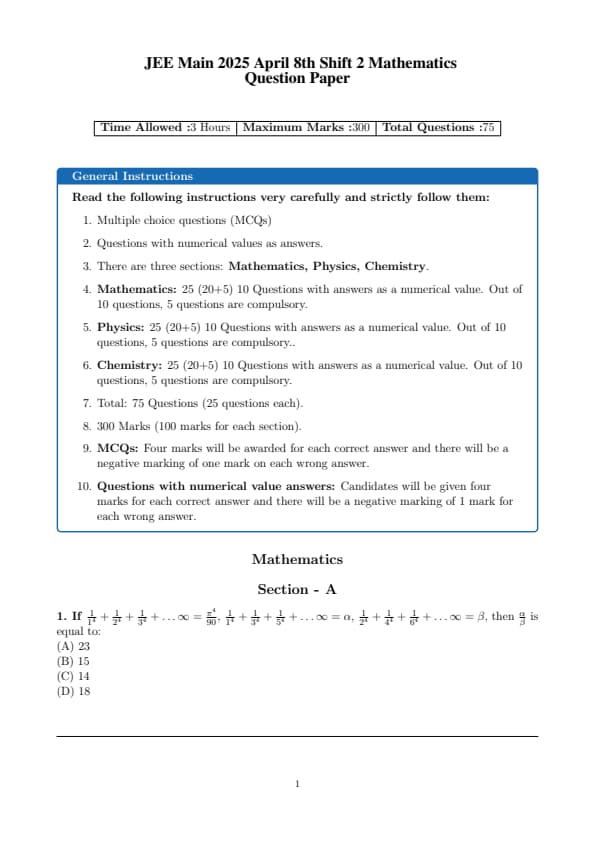
If \( \frac{1}{1^4} + \frac{1}{2^4} + \frac{1}{3^4} + \dots \infty = \frac{\pi^4}{90},\) \( \frac{1}{1^4} + \frac{1}{3^4} + \frac{1}{5^4} + \dots \infty = \alpha, \) \( \frac{1}{2^4} + \frac{1}{4^4} + \frac{1}{6^4} + \dots \infty = \beta, \)
then \( \frac{\alpha}{\beta} \) is equal to:
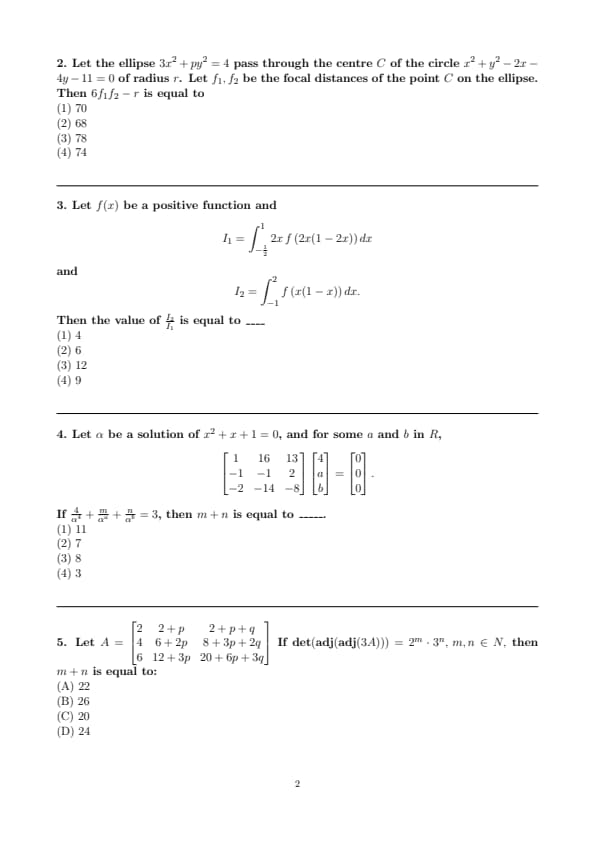
Let the ellipse \( 3x^2 + py^2 = 4 \) pass through the centre \( C \) of the circle \( x^2 + y^2 - 2x - 4y - 11 = 0 \) of radius \( r \). Let \( f_1, f_2 \) be the focal distances of the point \( C \) on the ellipse. Then \( 6f_1 f_2 - r \) is equal to
Let \( f(x) \) be a positive function and \[I_1 = \int_{-\frac{1}{2}}^1 2x \, f\left(2x(1-2x)\right) dx\]
and \[I_2 = \int_{-1}^2 f\left(x(1-x)\right) dx.\]
Then the value of \(\frac{I_2}{I_1}\) is equal to ____
Let \(\alpha\) be a solution of \(x^2 + x + 1 = 0\), and for some \(a\) and \(b\) in \(\mathbb{R}\), \[ \begin{bmatrix} 1 & 16 & 13
-1 & -1 & 2
-2 & -14 & -8 \end{bmatrix} \begin{bmatrix} 4
a
b \end{bmatrix} = \begin{bmatrix} 0
0
0 \end{bmatrix}. \]
If \(\frac{4}{\alpha^4} + \frac{m}{\alpha^a} + \frac{n}{\alpha^b} = 3\), then \(m + n\) is equal to _____.
Let \( A = \begin{bmatrix} 2 & 2 + p & 2 + p + q
4 & 6 + 2p & 8 + 3p + 2q
6 & 12 + 3p & 20 + 6p + 3q \end{bmatrix} \)
If \( det(adj(adj(3A))) = 2^m \cdot 3^n, \, m, n \in \mathbb{N}, \) then \( m + n \) is equal to:
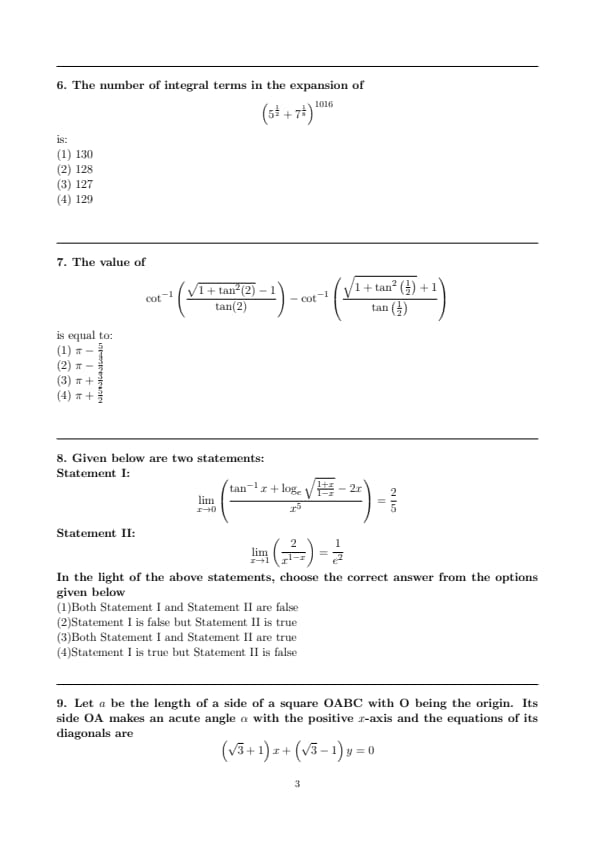
The number of integral terms in the expansion of \[ \left( 5^{\frac{1}{2}} + 7^{\frac{1}{8}} \right)^{1016} \]
is:
The value of \[ \cot^{-1} \left( \frac{\sqrt{1 + \tan^2(2)} - 1}{\tan(2)} \right) - \cot^{-1} \left( \frac{\sqrt{1 + \tan^2 \left( \frac{1}{2} \right)} + 1}{\tan \left( \frac{1}{2} \right)} \right) \]
is equal to:
Given below are two statements:
Statement I: \[\lim_{x \to 0} \left( \frac{\tan^{-1} x + \log_e \sqrt{\frac{1+x}{1-x}} - 2x}{x^5} \right) = \frac{2}{5}\]
Statement II: \[\lim_{x \to 1} \left( \frac{2}{x^{1-x}} \right) = \frac{1}{e^2}\]
In the light of the above statements, choose the correct answer from the options given below
Let \( a \) be the length of a side of a square OABC with O being the origin. Its side OA makes an acute angle \( \alpha \) with the positive \( x \)-axis and the equations of its diagonals are \[\left( \sqrt{3} + 1 \right) x + \left( \sqrt{3} - 1 \right) y = 0\]
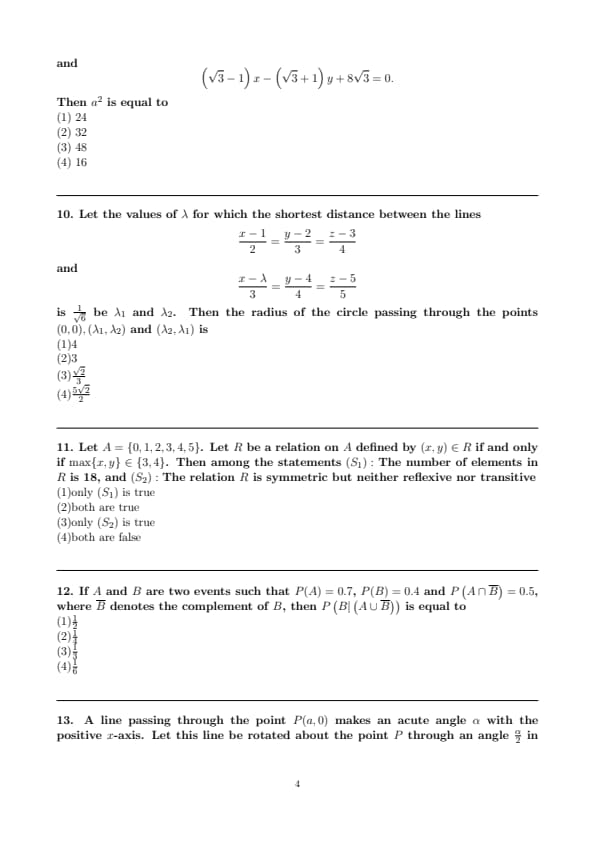
and \[\left( \sqrt{3} - 1 \right) x - \left( \sqrt{3} + 1 \right) y + 8\sqrt{3} = 0.\]
Then \( a^2 \) is equal to
Let the values of \(\lambda\) for which the shortest distance between the lines \[\frac{x-1}{2} = \frac{y-2}{3} = \frac{z-3}{4}\]
and \[\frac{x-\lambda}{3} = \frac{y-4}{4} = \frac{z-5}{5}\]
is \(\frac{1}{\sqrt{6}}\) be \(\lambda_1\) and \(\lambda_2\). Then the radius of the circle passing through the points \((0, 0), (\lambda_1, \lambda_2)\) and \((\lambda_2, \lambda_1)\) is
Let \( A = \{0, 1, 2, 3, 4, 5\} \). Let \( R \) be a relation on \( A \) defined by \((x, y) \in R\) if and only if \(\max\{x, y\} \in \{3, 4\}\). Then among the statements \( (S_1) : \) The number of elements in \( R \) is 18, and \( (S_2) : \) The relation \( R \) is symmetric but neither reflexive nor transitive
If \( A \) and \( B \) are two events such that \( P(A) = 0.7 \), \( P(B) = 0.4 \) and \( P\left( A \cap \overline{B} \right) = 0.5 \), where \(\overline{B}\) denotes the complement of \( B \), then \( P\left( B | \left( A \cup \overline{B} \right) \right) \) is equal to
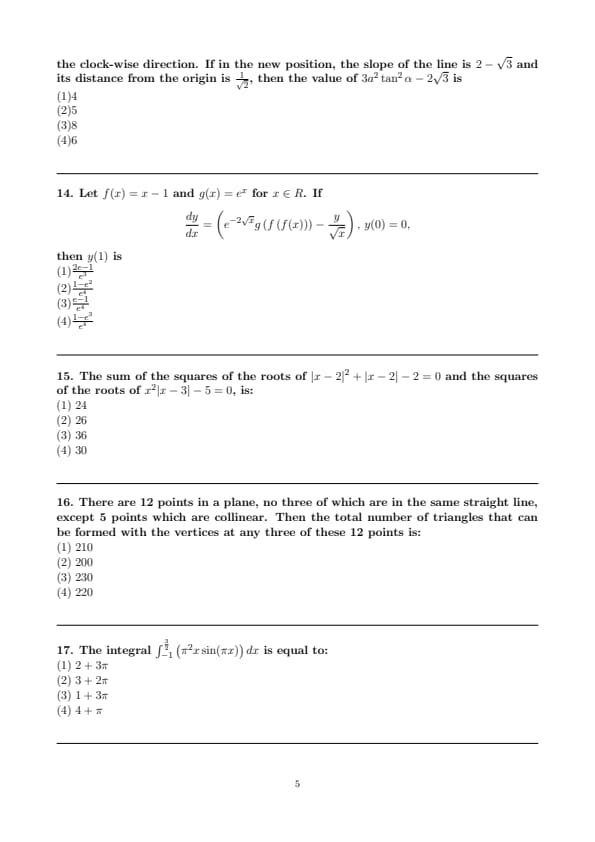
A line passing through the point \( P(a, 0) \) makes an acute angle \( \alpha \) with the positive \( x \)-axis. Let this line be rotated about the point \( P \) through an angle \( \frac{\alpha}{2} \) in the clock-wise direction. If in the new position, the slope of the line is \( 2 - \sqrt{3} \) and its distance from the origin is \( \frac{1}{\sqrt{2}} \), then the value of \( 3a^2 \tan^2 \alpha - 2\sqrt{3} \) is
Let \( f(x) = x - 1 \) and \( g(x) = e^x \) for \( x \in \mathbb{R} \). If \[\frac{dy}{dx} = \left( e^{-2\sqrt{x}} g\left(f\left(f(x)\right)\right) - \frac{y}{\sqrt{x}} \right), \, y(0) = 0,\]
then \( y(1) \) is
The sum of the squares of the roots of \( |x - 2|^2 + |x - 2| - 2 = 0 \) and the squares of the roots of \( x^2 |x - 3| - 5 = 0 \), is:
There are 12 points in a plane, no three of which are in the same straight line, except 5 points which are collinear. Then the total number of triangles that can be formed with the vertices at any three of these 12 points is:
The integral \( \int_{-1}^{\frac{3}{2}} \left( \pi^2 x \sin(\pi x) \right) dx \) is equal to:
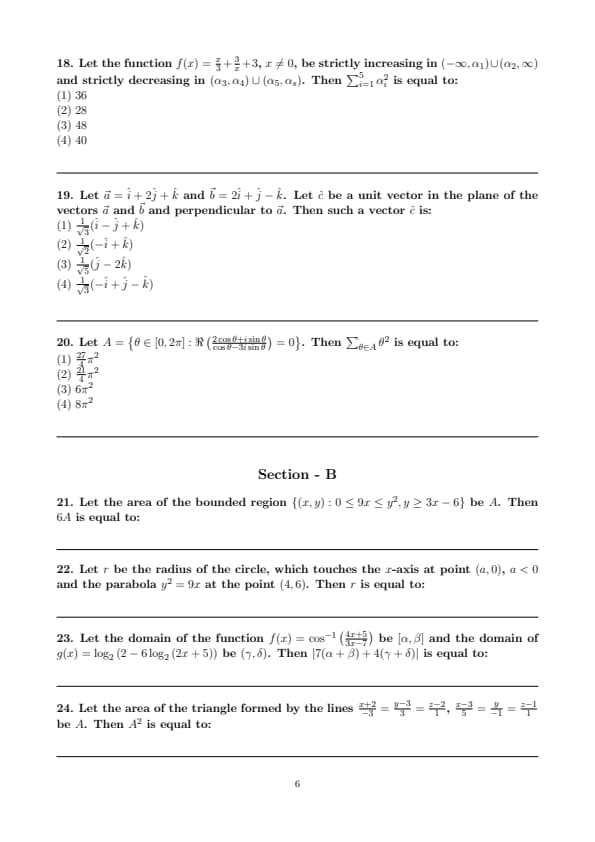
Let the function \( f(x) = \frac{x}{3} + \frac{3}{x} + 3 \), \( x \neq 0 \), be strictly increasing in \( (-\infty, \alpha_1) \cup (\alpha_2, \infty) \) and strictly decreasing in \( (\alpha_3, \alpha_4) \cup (\alpha_5, \alpha_s) \). Then \( \sum_{i=1}^{5} \alpha_i^2 \) is equal to:
Let \( \vec{a} = \hat{i} + 2 \hat{j} + \hat{k} \) and \( \vec{b} = 2 \hat{i} + \hat{j} - \hat{k} \). Let \( \hat{c} \) be a unit vector in the plane of the vectors \( \vec{a} \) and \( \vec{b} \) and perpendicular to \( \vec{a} \). Then such a vector \( \hat{c} \) is:
Let \( A = \left\{ \theta \in [0, 2\pi] : \Re\left( \frac{2 \cos \theta + i \sin \theta}{\cos \theta - 3i \sin \theta} \right) = 0 \right\} \). Then \( \sum_{\theta \in A} \theta^2 \) is equal to:
Let the area of the bounded region \( \{(x, y) : 0 \leq 9x \leq y^2, y \geq 3x - 6 \} \) be \( A \). Then \( 6A \) is equal to:
Let \( r \) be the radius of the circle, which touches the \( x \)-axis at point \( (a, 0) \), \( a < 0 \) and the parabola \( y^2 = 9x \) at the point \( (4, 6) \). Then \( r \) is equal to:
Let the domain of the function \( f(x) = \cos^{-1} \left( \frac{4x + 5}{3x - 7} \right) \) be \( [\alpha, \beta] \) and the domain of \( g(x) = \log_2 \left( 2 - 6 \log_2 \left( 2x + 5 \right) \right) \) be \( (\gamma, \delta) \). Then \( |7(\alpha + \beta) + 4(\gamma + \delta)| \) is equal to:
Let the area of the triangle formed by the lines \( \frac{x + 2}{-3} = \frac{y - 3}{3} = \frac{z - 2}{1} \), \( \frac{x - 3}{5} = \frac{y}{-1} = \frac{z - 1}{1} \) be \( A \). Then \( A^2 \) is equal to:
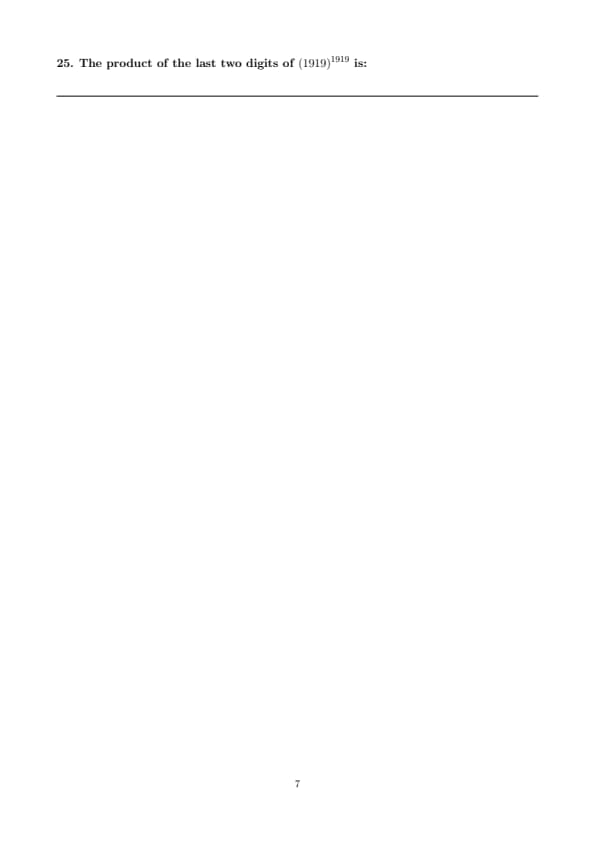
The product of the last two digits of \( (1919)^{1919} \) is:





Comments