




NTA conducted JEE Main 7 April Shift 2 from 3 pm to 6 pm. Question paper with solutions pdf is available here for download. In JEE Main April 7 Shift 2 students were required to attempt 75 questions out of 90 following a marking scheme of +4 for correct answers and -1 for incorrect ones.
JEE Main 7 April Shift 2 Subject- Wise Expected Difficulty :
- JEE Main Physics- Nearly 30–35% of the Physics questions in JEE Main are derived from mechanics, electrodynamics and modern physics. The section was moderate.
- JEE Main Mathematics- Mathematics weightage in JEE Main Paper 1 has increased by 35%. Questions were time consuming and tough in the calculation part.
- JEE Main Chemistry- Chemistry's weightage in JEE Main has been reduced by 22.5%, compared to other subjects in Paper 1. Easy to moderate questions were there from topics like - Atomic Structure and Solutions.
The Memory-Based Question Paper for JEE Main April 7 Shift 2 for B.E/B. Tech Paper is available for download.
Check JEE Main April 7 Shift 2 Answer Key
JEE Main 2025 April 7 Shift 2 Question Paper with Solutions
| JEE Main 2025 April 7 Shift 2 Question Paper Pdf | Download PDF | View Solutions |

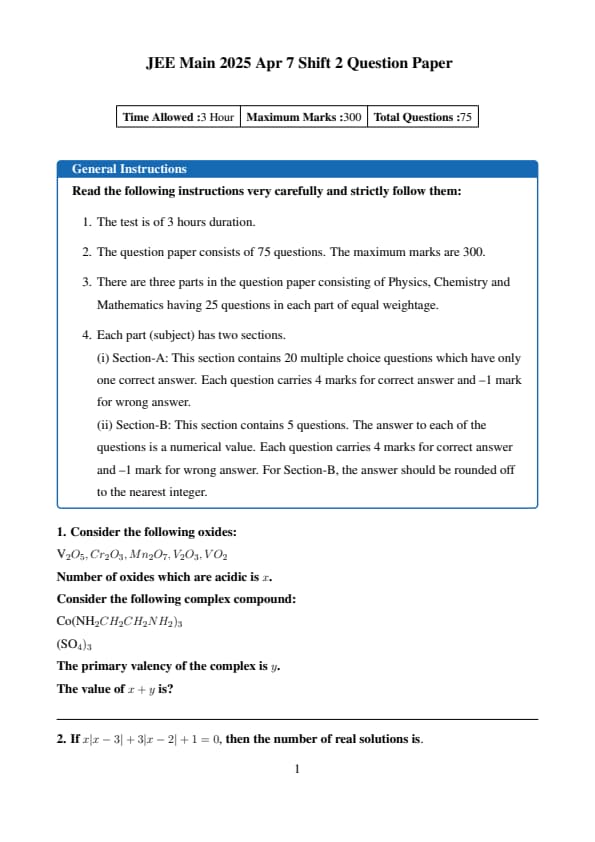
Question 1:
If the orthocentre of the triangle formed by the lines \( y = x + 1 \), \( y = 4x - 8 \), and \( y = mx + c \) is at \( (3, -1) \), then \( m - c \) is:
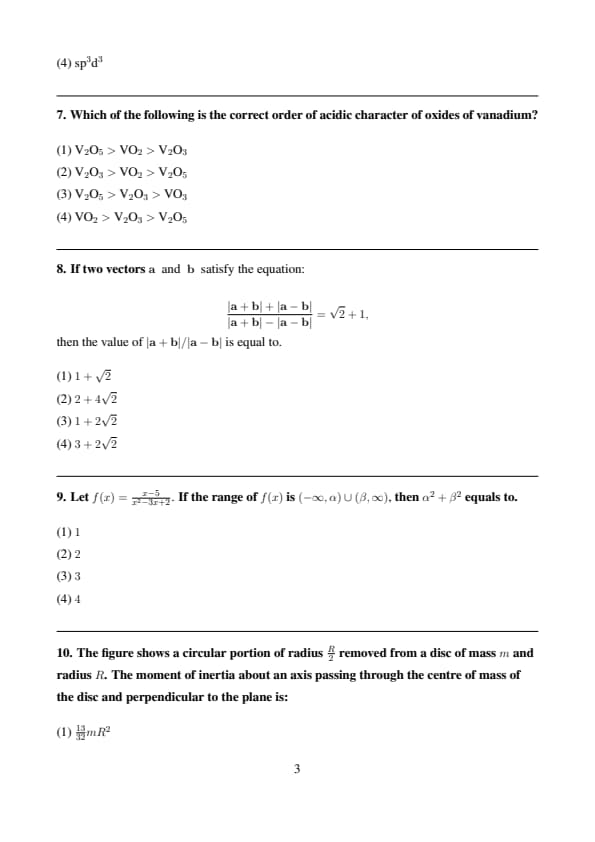
Let \( \vec{a} \) and \( \vec{b} \) be the vectors of the same magnitude such that \[ \frac{| \vec{a} + \vec{b} | + | \vec{a} - \vec{b} |}{| \vec{a} + \vec{b} | - | \vec{a} - \vec{b} |} = \sqrt{2} + 1. \quad Then \frac{| \vec{a} + \vec{b} |^2}{| \vec{a} |^2} is: \]
Let \[ A = \{(\alpha, \beta) \in \mathbb{R} \times \mathbb{R} : |\alpha - 1| \leq 4 and |\beta - 5| \leq 6\} \]
and \[ B = \{(\alpha, \beta) \in \mathbb{R} \times \mathbb{R} : 16(\alpha - 2)^2 + 9(\beta - 6)^2 \leq 144\}. \]
Then:
If the range of the function \[ f(x) = \frac{5 - x}{x^2 - 3x + 2}, \quad x \neq 1, 2 \]
is \( (-\infty, \alpha] \cup [\beta, \infty) \), then \( \alpha^2 + \beta^2 \) is equal to:
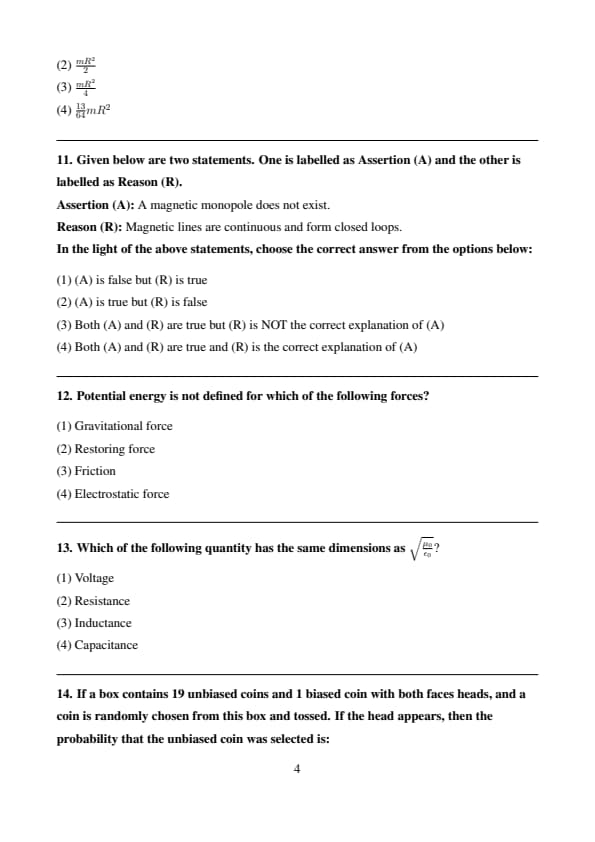
A bag contains 19 unbiased coins and one coin with heads on both sides. One coin is drawn at random and tossed, and heads turns up. If the probability that the drawn coin was unbiased is \( \frac{m}{n} \), where \( \gcd(m, n) = 1 \), then \( n^2 - m^2 \) is equal to:
Let a random variable X take values 0, 1, 2, 3 with \[ P(X = 0) = P(X = 1) = p, \, P(X = 2) = P(X = 3), \, and \, F(X^2) = 2F(X). \]
Then the value of \( 8p - 1 \) is:
If the area of the region \[ \{(x, y) : 1 + x^2 \leq y \leq \min(x + 7, 11 - 3x)\} \]
is \( A \), then \( 3A \) is equal to:
Let \( f : \mathbb{R} \to \mathbb{R} \) be a polynomial function of degree four having extreme values at \( x = 4 \) and \( x = 5 \).
If \[ \lim_{x \to 0} \frac{f(x)}{x^2} = 5, then f(2) is equal to: \]
The number of solutions of the equation \[ \cos 2\theta \cos \left( \frac{\theta}{2} \right) + \cos \left( \frac{5\theta}{2} \right) = 2 \cos^3 \left( \frac{5\theta}{2} \right) \]
in the interval \[ -\frac{\pi}{2}, \frac{\pi}{2} \] is:
Let \( a_n \) be the \( n \)-th term of an A.P. If \( S_n = a_1 + a_2 + a_3 + \cdots + a_n = 700 \), \( a_6 = 7 \), and \( S_7 = 7 \), then \( a_n \) is equal to:
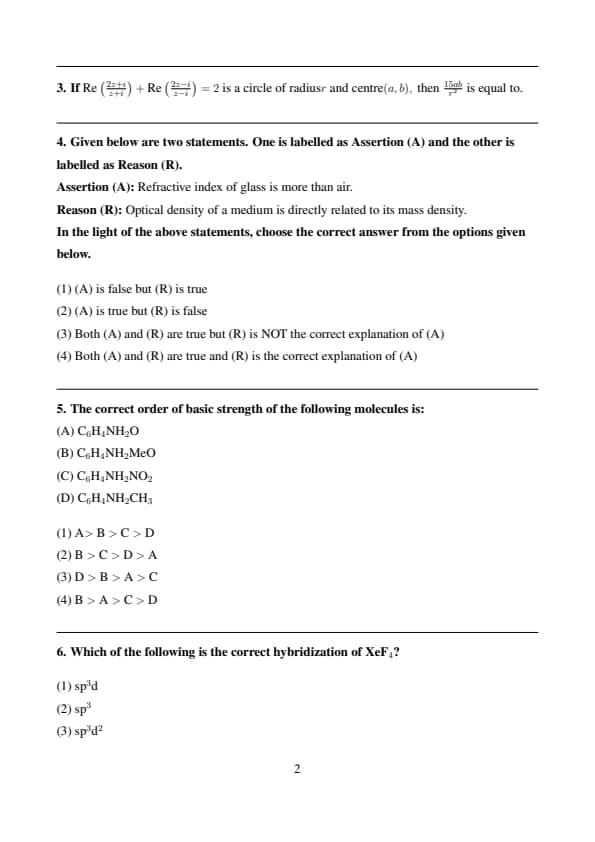
If the locus of \( z \in \mathbb{C} \), such that \[ Re \left( \frac{z - 1}{2z + i} \right) + Re \left( \frac{ \bar{z} - 1}{2 \bar{z} - i} \right) = 2, \]
is a circle of radius \( r \) and center \( (a, b) \), then \[ \frac{15ab}{r^2} is equal to: \]
Let the length of a latus rectum of an ellipse \[ \frac{x^2}{a^2} + \frac{y^2}{b^2} = 1 \]
be 10. If its eccentricity is \( e \), and the minimum value of the function \( f(t) = t^2 + t + \frac{11}{12} \), where \( t \in \mathbb{R} \), then \( a^2 + b^2 \) is equal to:
Let \( y = y(x) \) be the solution of the differential equation \[ (x^2 + 1)y' - 2xy = (x^4 + 2x^2 + 1)\cos x, \]
with the initial condition \( y(0) = 1 \). Then \[ \int_{-3}^{3} y(x) \, dx is: \]
If the equation of the line passing through the point \( \left( 0, -\frac{1}{2}, 0 \right) \) and perpendicular to the lines \[ \mathbf{r_1} = \lambda ( \hat{i} + a \hat{j} + b \hat{k}) \quad and \quad \mathbf{r_2} = ( \hat{i} - \hat{j} - 6 \hat{k} ) + \mu( -b \hat{i} + a \hat{j} + 5 \hat{k}), \]
is \[ \frac{x - 1}{-2} = \frac{y + 4}{d} = \frac{z - c}{-4}, \]
then \( a + b + c + d \) is equal to:
Let \( p \) be the number of all triangles that can be formed by joining the vertices of a regular polygon \( P \) of \( n \) sides, and \( q \) be the number of all quadrilaterals that can be formed by joining the vertices of \( P \). If \( p + q = 126 \), then the eccentricity of the ellipse \[ \frac{x^2}{16} + \frac{y^2}{n} = 1 \]
is:
Consider the lines \( L_1: x - 1 = y - 2 = z \) and \( L_2: x - 2 = y = z - 1 \). Let the feet of the perpendiculars from the point \( P(5, 1, -3) \) on the lines \( L_1 \) and \( L_2 \) be \( Q \) and \( R \) respectively. If the area of the triangle \( PQR \) is \( A \), then \( 4A^2 \) is equal to:
The number of real roots of the equation \[ x|x-2| + 3|x-3| + 1 = 0 \]
is:
Let \( e_1 \) and \( e_2 \) be the eccentricities of the ellipse \[ \frac{x^2}{b^2} + \frac{y^2}{25} = 1 \]
and the hyperbola \[ \frac{x^2}{16} - \frac{y^2}{b^2} = 1, \]
respectively. If \( b < 5 \) and \( e_1 e_2 = 1 \), then the eccentricity of the ellipse having its axes along the coordinate axes and passing through all four foci (two of the ellipse and two of the hyperbola) is:
Let the system of equations \[ x + 5y - z = 1 \] \[ 4x + 3y - 3z = 7 \] \[ 24x + y + \lambda z = \mu \]
where \( \lambda, \mu \in \mathbb{R} \), have infinitely many solutions. Then the number of the solutions of this system, if \(x, y, z\) are integers and satisfy \(7 \leq x + y + z \leq 77\), is:
If the sum of the second, fourth and sixth terms of a G.P. of positive terms is 21 and the sum of its eighth, tenth and twelfth terms is 15309, then the sum of its first nine terms is:
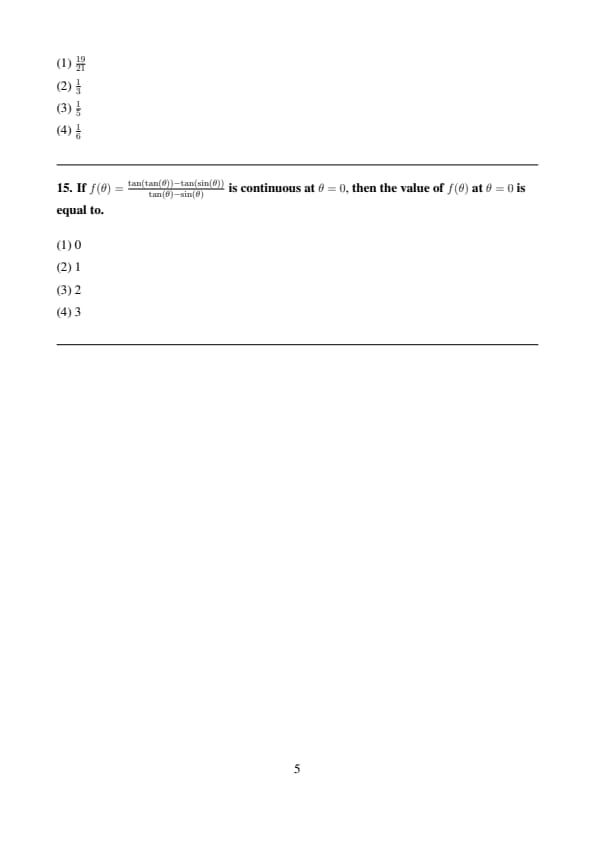
If the function \[ f(x) = \frac{\tan(\tan x) - \sin(\sin x)}{\tan x - \sin x} \]
is continuous at \( x = 0 \), then \( f(0) \) is equal to:
If \[ \int \left( \frac{1}{x} + \frac{1}{x^3} \right) \left( \sqrt[23]{3x^{-24}} + x^{-26} \right) \, dx \]
is equal to \[ -\frac{\alpha}{3(\alpha + 1)} \left( 3x^\beta + x^\gamma \right)^{\alpha + 1} + C, \quad x > 0, \]
where \( \alpha, \beta, \gamma \in \mathbb{Z} \) and \( C \) is the constant of integration, then \( \alpha + \beta + \gamma \) is equal to _______.
For \( t > -1 \), let \( \alpha_t \) and \( \beta_t \) be the roots of the equation \[ \left( (t + 2)^{\frac{1}{7}} - 1 \right)x^2 + \left( (t + 2)^{\frac{1}{6}} - 1 \right)x + \left( (t + 2)^{\frac{1}{21}} - 1 \right) = 0. \]
If \( \lim_{t \to 1^+} \alpha_t = a \) and \( \lim_{t \to 1^+} \beta_t = b \), then \( 72(a + b)^2 \) is equal to:
Let the lengths of the transverse and conjugate axes of a hyperbola in standard form be \( 2a \) and \( 2b \), respectively, and one focus and the corresponding directrix of this hyperbola be \( (-5, 0) \) and \( 5x + 9 = 0 \), respectively. If the product of the focal distances of a point \( (\alpha, 2\sqrt{5}) \) on the hyperbola is \( p \), then \( 4p \) is equal to:
The sum of the series \[ 2 \times 1 \times 20C_4 - 3 \times 2 \times 20C_5 + 4 \times 3 \times 20C_6 - 5 \times 4 \times 20C_7 + \dots + 18 \times 17 \times 20C_{20}, is equal to \]
Given below are two statements: one is labelled as Assertion (A) and the other is labelled as Reason (R).
Assertion (A): The outer body of an aircraft is made of metal which protects persons sitting inside from lightning strikes.
Reason (R): The electric field inside the cavity enclosed by a conductor is zero.
In the light of the above statements, choose the most appropriate answer from the options given below:
Given below are two statements: one is labelled as Assertion (A) and the other is labelled as Reason (R).
Assertion (A): The density of the copper (\(^{64}Cu\)) nucleus is greater than that of the carbon (\(^{12}C\)) nucleus.
Reason (R): The nucleus of mass number A has a radius proportional to \(A^{1/3}\).
In the light of the above statements, choose the most appropriate answer from the options given below:
The unit of \( \sqrt{\frac{2I}{\epsilon_0 c}} \) is:
(Where \( I \) is the intensity of an electromagnetic wave, and \( c \) is the speed of light)
The dimension of \( \sqrt{\frac{\mu_0}{\epsilon_0}} \) is equal to that of:
(Where \( \mu_0 \) is the vacuum permeability and \( \epsilon_0 \) is the vacuum permittivity)
A photo-emissive substance is illuminated with a radiation of wavelength \( \lambda_i \) so that it releases electrons with de-Broglie wavelength \( \lambda_e \). The longest wavelength of radiation that can emit photoelectron is \( \lambda_0 \). Expression for de-Broglie wavelength is given by :
(m : mass of the electron, h : Planck's constant and c : speed of light)
Given below are two statements : one is labelled as Assertion (A) and the other is labelled as Reason (R).
Assertion (A) : The radius vector from the Sun to a planet sweeps out equal areas in equal intervals of time and thus areal velocity of planet is constant.
Reason (R) : For a central force field the angular momentum is a constant.
In the light of the above statements, choose the most appropriate answer from the options given below :
The helium and argon are put in the flask at the same room temperature (300 K). The ratio of average kinetic energies (per molecule) of helium and argon is :
(Give : Molar mass of helium = 4 g/mol, Molar mass of argon = 40 g/ mol )
A capillary tube of radius 0.1 mm is partly dipped in water (surface tension 70 dyn/cm and glass water contact angle \( \approx 0^\circ \)) with \( 30^\circ \) inclined with vertical. The length of water risen in the capillary is ____ cm. (Take \( g = 9.8 \) m/s\(^2 \))
A mirror is used to produce an image with magnification of \( \frac{1}{4} \). If the distance between object and its image is 40 cm, then the focal length of the mirror is ____.
A dipole with two electric charges of \( 2 \, \mu C \) magnitude each, with separation distance \( 0.5 \, \mu m \), is placed between the plates of a capacitor such that its axis is parallel to an electric field established between the plates when a potential difference of \( 5 \, V \) is applied. Separation between the plates is \( 0.5 \, mm \). If the dipole is rotated by \( 30^\circ \) from the axis, it tends to realign in the direction due to a torque. The value of torque is :
Consider the following logic circuit.

The output is Y = 0 when :
Match List-I with List-II.

Choose the correct answer from the options given below :
The equation of a wave travelling on a string is \( y = \sin[20\pi x + 10\pi t] \), where x and t are distance and time in SI units. The minimum distance between two points having the same oscillating speed is :
Given below are two statements : one is labelled as Assertion (A) and the other is labelled as Reason (R)
Assertion (A) : Refractive index of glass is higher than that of air.
Reason (R) : Optical density of a medium is directly proportionate to its mass density which results in a proportionate refractive index.
In the light of the above statements, choose the most appropriate answer from the options given below :
Given below are two statements : one is labelled as Assertion (A) and the other is labelled as Reason (R)
Assertion (A) : Magnetic monopoles do not exist.
Reason (R) : Magnetic field lines are continuous and form closed loops.
In the light of the above statements, choose the most appropriate answer from the options given below :
Which one of the following forces cannot be expressed in terms of potential energy?
Match List-I with List-II.

Choose the correct answer from the options given below :
A helicopter flying horizontally with a speed of \( 360 \, km/h \) at an altitude of \( 2 \, km \), drops an object at an instant. The object hits the ground at a point O, \( 20 \, s \) after it is dropped. Displacement of 'O' from the position of helicopter where the object was released is :
(use acceleration due to gravity \( g = 10 \, m/s^2 \) and neglect air resistance)
An object with mass \( 500 \, g \) moves along x-axis with speed \( v = 4\sqrt{x} \, m/s \). The force acting on the object is :
A transparent block A having refractive index \( \mu_2 = 1.25 \) is surrounded by another medium of refractive index \( \mu_1 = 1.0 \) as shown in figure. A light ray is incident on the flat face of the block with incident angle \( \theta \) as shown in figure. What is the maximum value of \( \theta \) for which light suffers total internal reflection at the top surface of the block ?

A parallel plate capacitor has charge \( 5 \times 10^{-6} \, C \). A dielectric slab is inserted between the plates and almost fills the space between the plates. If the induced charge on one face of the slab is \( 4 \times 10^{-6} \, C \) then the dielectric constant of the slab is ____.
An inductor of reactance \( 100 \, \Omega \), a capacitor of reactance \( 50 \, \Omega \), and a resistor of resistance \( 50 \, \Omega \) are connected in series with an AC source of \( 10 \, V \), \( 50 \, Hz \). Average power dissipated by the circuit is ____ W.
Two cylindrical rods A and B made of different materials, are joined in a straight line. The ratio of lengths, radii and thermal conductivities of these rods are : \( \frac{L_A}{L_B} = \frac{1}{2} \), \( \frac{r_A}{r_B} = 2 \), and \( \frac{K_A}{K_B} = \frac{1}{2} \). The free ends of rods A and B are maintained at \( 400 \, K \), \( 200 \, K \), respectively. The temperature of rods interface is ____ K, when equilibrium is established.
The electric field in a region is given by \( \vec{E} = (2\hat{i} + 4\hat{j} + 6\hat{k}) \times 10^3 \, N/C \). The flux of the field through a rectangular surface parallel to x-z plane is \( 6.0 \, Nm^2C^{-1} \). The area of the surface is ____ \( cm^2 \).
M and R be the mass and radius of a disc. A small disc of radius R/3 is removed from the bigger disc as shown in figure. The moment of inertia of remaining part of bigger disc about an axis AB passing through the centre O and perpendicular to the plane of disc is \( \frac{4}{x} MR^2 \). The value of x is ____.
Given below are two statements :
Statement (I) : On hydrolysis, oligo peptides give rise to fewer number of \( \alpha \)-amino acids while proteins give rise to a large number of \( \beta \)-amino acids.
Statement (II) : Natural proteins are denatured by acids which convert the water soluble form of fibrous proteins to their water insoluble form.
In the light of the above statements, choose the most appropriate answer from the options given below :
Mixture of 1 g each of chlorobenzene, aniline and benzoic acid is dissolved in 50 mL ethyl acetate and placed in a separating funnel, 5 M NaOH (30 mL) was added in the same funnel. The funnel was shaken vigorously and then kept aside. The ethyl acetate layer in the funnel contains :
The hydration energies of \( K^+ \) and \( Cl^- \) are \( -x \) and \( -y \) kJ/mol respectively. If lattice energy of KCl is \( -z \) kJ/mol, then the heat of solution of KCl is :
A(g) \( \rightarrow \) B(g) + C(g) is a first order reaction.

The reaction was started with reactant A only. Which of the following expression is correct for rate constant k ?
"P" is an optically active compound with molecular formula \( C_6H_{12}O \). When "P" is treated with 2,4-dinitrophenylhydrazine, it gives a positive test. However, in presence of Tollens reagent, "P" gives a negative test. Predict the structure of "P".

Choose the incorrect trend in the atomic radii (r) of the elements :
Match List-I with List-II

Choose the correct answer from the options given below :
The correct statement amongst the following is :
Liquid A and B form an ideal solution. The vapour pressure of pure liquids A and B are 350 and 750 mm Hg respectively at the same temperature. If \( x_A \) and \( x_B \) are the mole fraction of A and B in solution while \( y_A \) and \( y_B \) are the mole fraction of A and B in vapour phase then :
'X' is the number of acidic oxides among \( VO_2, V_2O_3, CrO_3, V_2O_5 \) and \( Mn_2O_7 \). The primary valency of cobalt in \( [Co(H_2NCH_2CH_2NH_2)_3]_2 (SO_4)_3 \) is Y. The value of X + Y is :
The descending order of basicity of following amines is :

Choose the correct answer from the options given below :
Match List-I with List-II

Choose the correct answer from the options given below :
Match List-I with List-II

Choose the correct answer from the options given below :
In \( SO_2 \), \( NO_2^- \) and \( N_3^- \) the hybridizations at the central atom are respectively :
The number of unpaired electrons responsible for the paramagnetic nature of the following complex species are respectively : \( [Fe(CN)_6]^{3-}, [FeF_6]^{3-}, [CoF_6]^{3-}, [Mn(CN)_6]^{3-} \)
The number of optically active products obtained from the complete ozonolysis of the given compound is :

Given below are two statements :

In the light of the above statements, choose the most appropriate answer from the options given below :
The extra stability of half-filled subshell is due to
(A) Symmetrical distribution of electrons
(B) Smaller coulombic repulsion energy
(C) The presence of electrons with the same spin in non-degenerate orbitals
(D) Larger exchange energy
(E) Relatively smaller shielding of electrons by one another
Identify the correct statements
The correct statements from the following are :
(A) \( Tl^{3+} \) is a powerful oxidising agent
(B) \( Al^{3+} \) does not get reduced easily
(C) Both \( Al^{3+} \) and \( Tl^{3+} \) are very stable in solution
(D) \( Tl^+ \) is more stable than \( Tl^{3+} \)
(E) \( Al^{3+} \) and \( Tl^+ \) are highly stable
Choose the correct answer from the options given below :
Given below are two statements :
1 M aqueous solution of each of \( Cu(NO_3)_2 \), \( AgNO_3 \), \( Hg_2(NO_3)_2 \); \( Mg(NO_3)_2 \) are electrolysed using inert electrodes,
Given : \( E^0_{Ag^+/Ag} = 0.80V \), \( E^0_{Hg_2^{2+}/Hg} = 0.79V \), \( E^0_{Cu^{2+}/Cu} = 0.34V \) and \( E^0_{Mg^{2+}/Mg} = -2.37V \)
Statement (I) : With increasing voltage, the sequence of deposition of metals on the cathode will be Ag, Hg and Cu
Statement (II) : Magnesium will not be deposited at cathode instead oxygen gas will be evolved at the cathode.
In the light of the above statements, choose the most appropriate answer from the options given below :
Only litre buffer solution was prepared by adding 0.10 mol each of \( NH_3 \) and \( NH_4Cl \) in deionised water. The change in pH on addition of 0.05 mol of HCl to the above solution is _____ \( \times 10^{-2} \), (Nearest integer) (Given : \( pK_b \) of \( NH_3 = 4.745 \) and \( \log_{10}3 = 0.477 \))
In Dumas' method 292 mg of an organic compound released 50 mL of nitrogen gas (\( N_2 \)) at 300 K temperature and 715 mm Hg pressure. The percentage composition of 'N' in the organic compound is _____ % (Nearest integer) (Aqueous tension at 300 K = 15 mm Hg)
Butane reacts with oxygen to produce carbon dioxide and water following the equation given below:
\[ C_4H_{10}(g) + \frac{13}{2} O_2(g) \rightarrow 4CO_2(g) + 5H_2O(l) \]
If 174.0 kg of butane is mixed with 320.0 kg of \( O_2 \), the volume of water formed in litres is _____. (Nearest integer)
[Given: (a) Molar masses: C = 12, H = 1, O = 16 g \( mol^{-1} \); (b) Density of water = 1 g \( mL^{-1} \)]
The number of paramagnetic metal complex species among \( [Co(NH_3)_6]^{3+}, [Co(C_2O_4)_3]^{3-}, [MnCl_6]^{3-}, [Mn(CN)_6]^{3-}, [CoF_6]^{3-}, [Fe(CN)_6]^{3-} \) and \( [FeF_6]^{3-} \) with same number of unpaired electrons is _____.
Identify the structure of the final product (D) in the following sequence of the reactions :

Total number of \( sp^2 \) hybridised carbon atoms in product D is _____.
JEE Main April 7 Shift 2 Question Paper With Video Solutions
The JEE Main 2025 April 7 Question Paper with Video Solution is available here. Students can match their responses with the JEE Main 2025 April 7 Shift 2 Answer key with Solutions. Students who are appearing for JEE Main upcoming shifts can check the JEE Main April 7 Shift 2 Question Paper and video solution to understand the difficulty level of the exam.
JEE Main Session 2 Difficulty Level Analysis
| JEE Mains 2025 Session 2 exam dates | Paper | Exam Analysis |
|---|---|---|
| April 2, 2025 | Paper 1 (B.E/BTech) |
|
| April 3, 2025 | Paper 1 (B.E/BTech) |
|
| April 4, 2025 | Paper 1 (B.E/BTech) |
|
| April 7, 2025 | Paper 1 (B.E/BTech) | TBA |
| April 8, 2025 | Paper 1 (B.E/BTech) | TBA |
| April 9, 2025 | Paper 2A (BArch) and Paper 2B (BPlanning) | TBA |
Related Links:
- JEE Main 2025 Question Paper pdf with solutions
- JEE Main Previous Years Question Paper with Solution PDF
JEE Main Marking Scheme 2025
For JEE Main Paper 1(B.E/BTech), students are required to attempt 75 questions following a marking scheme of +4 for correct answers and -1 for incorrect ones. The marking scheme is the same across Physics, Chemistry, and Mathematics sections totaling to 300 marks.
| Paper | Sections | Questions | Marks | Marking Scheme |
|---|---|---|---|---|
| Paper 1 | Physics, Chemistry, Mathematics | 75 Questions (25 Physics, 25 Chemistry, 25 Mathematics) | 300 total |
|
Is there any negative marking in JEE Main Paper 1?
- If you choose the wrong answer in both Section A and Section B, you will lose 1 mark because of negative marking.
- In Section B, instead of choosing an option, you have to type the correct whole number using the on screen number pad. If your answer is a decimal, round it off to the nearest whole number before entering it.
Once you calculate your expected marks, you can review the JEE Main Question papers to improve your preparation.
You can check:
- JEE Main Previous Years Question Paper with Solution
- JEE Main 2024 Question Paper with Solution PDF
- JEE Main 2023 Question Paper with Solution PDF
- JEE Main 2022 Question Paper with Solution PDF
What to carry at the JEE Main Test Centre ?
Every aspirant must check the JEE Main exam day guidelines before the examination. The JEE Main exam instructions comprise of all the dos and don’ts to be followed for a hassle-free exam process. JEE Mains rules and regulations for the exam are provided below:
| What to Carry | What NOT to Carry |
| JEE Main 2025 Admit Card (Mandatory) | Electronic gadgets (Mobile phones, smartwatches, calculators, Bluetooth devices) |
| Valid ID Proof (Aadhaar Card, PAN Card, Voter ID, Passport, etc.) | Written/Printed Study Materials (Books, Notes, Papers) |
| A simple transparent ballpoint pen (for rough work) | Any type of rough paper (NTA will provide sheets) |
| A passport-size photograph (same as on the admit card) | Smart devices (Earphones, Digital Watches, Fitness Bands) |
| PwD Certificate (if applicable) | Geometry boxes, Log tables, or Any extra stationery items |
| A transparent water bottle (Optional) | Wallets, Purses, or Bags |
How to attempt JEE Main 2025 MCQ’s with Maximum Accuracy?
For accuracy in JEE Main MCQ’s concepts need to be well understood. On average, based on past JEE exams, almost 60 % of the incorrect answers are because of reading the question wrong or marking the wrong answers.
For numerical value questions, if the question requires you to round it off to the nearest integer, accuracy is important. It can cost 4 marks per question which can have a significant impact on your rank.
In revising an answer, many students choose to trade their initial answer for another incorrect alternative. Based on the past year trends, first solutions are accurate most of the time, a figure close to 70%. One should second-guess only on a sound reason for doubt about error.
Eliminating options can increase the probability of selecting the correct answer to 50%.




Comments