




JEE Main 2026 Syllabus Easy Chapters include: Statistics, Matrices, Units and Measurement, Kinematics, Modern Physics, Current Electricity, Bimolecules, Coordination Compounds, Periodicity.
- In Mathematics, easy chapters contribute 6-7 questions.
- Easy chapters from Physics account for 9-10 questions.
- Chemistry easy chapters help with 6-7 questions.
JEE Main 2026 Syllabus Easy Chapters are vital not only for these chapter-specific scores, but also for the foundation for difficult chapters. Getting perfect with these easy chapters will help with EE Mains and JEE Advanced. JEE Main 2026 Syllabus Easy Chapters alone help you score.
- 24-38 marks in Maths
- 36-40 marks in Physics
- 24-28 marks in Chemistry
| Subject | JEE Main 2026 Syllabus |
|---|---|
| Physics | Detailed Physics Syllabus |
| Chemistry | Detailed Chemistry Syllabus |
| Mathematics | Detailed Mathematics Syllabus |
| B.Arch and B.Planning | Detailed B.Arch and B.Planning Syllabus |
Related Articles
Key Summary
- Statistics, Matrices are the easiest chapters in Maths
- Units and Measurement, Kinematics, Modern Physics, and Current Electricity are considered easy in Physics.
- Bimolecules, Coordination Compounds, and Periodicity are generally regarded as easy chapters in Chemistry.
- Easy chapters scout for 22 out of 90 questions in JEE Main.
- 84-96 out of 300 can be scored with easy chapters.
- Physics gives 36-40 marks from easy chapters.
- Maths and Chemistry give 24-28 marks from easy chapters.
- 21-24 questions have appeared from these easy chapters in the past five years.
- Perfection with these chapters can even gain you an 80+ percentile.
JEE Main 2026 Syllabus Easy Chapters
- 28-32% of marks can be easily scored with easy chapters in JEE Main.
- Over the last 5 years, 21-24 questions have come from easy chapters.
- Many toppers suggest that Modern Physics, Biomolecules, and Probability as the low-effort and high-gain chapters.
- Coaching institutes suggest covering these easy chapters first.
- As these chapters are NCERT-centric, it is faster and easier to cover.
Also check
JEE Main Reduced Syllabus 2026JEE Main 2026 Syllabus Easy Chapters for Maths
| Chapter | Why It Is Easy |
|---|---|
| Statistics & Probability | Formula-based, similar pattern every year |
| Matrices & Determinants | Direct application of properties |
| Sets, Relations & Functions | Limited variety, concept-driven |
| Trigonometry | Identities and standard results, predictable |
| Vector Algebra | Straightforward use of formulas |
JEE Main 2026 Syllabus Easy Chapters for Physics
| Chapter | Why It Is Easy |
|---|---|
| Units & Measurements | Basic definitions and errors, straightforward |
| Kinematics | Graphical and formula use, less conceptual load |
| Laws of Motion | Standard Newtonian problems |
| Oscillations & Waves | Repeated patterns, formula-based |
| Current Electricity | Easy circuit applications |
| Modern Physics (Atoms, Nuclei, Dual Nature) | NCERT-centric, mostly theory |
Check:
Do PYQ Repeat in JEE MainJEE Main 2026 Syllabus Easy Chapters for Chemistry
| Branch | Chapter | Why It Is Easy |
|---|---|---|
| Physical | Some Basic Concepts of Chemistry | Mole concept, conversions, and direct formula use |
| Physical | Equilibrium | Mostly NCERT-based factual questions |
| Inorganic | Periodicity | Simple trends and properties |
| Inorganic | Coordination Compounds | Repeated patterns, predictable |
| Organic | Biomolecules | Fact-based, NCERT-driven |
| Organic | Practical Chemistry | Direct questions from experiments |
JEE Main 2026 Syllabus Easy Chapters: Weightage
| Subject | Easy Questions per Year | Approx. Marks |
|---|---|---|
| Mathematics | 5–7 | 20–32 |
| Physics | 8–10 | 32–40 |
| Chemistry | 6–7 | 24–32 |
| Total | 21–24 | 84–96 |
JEE Main Repeation of Easy chapters 2020-2024
- Easy chapters like Modern Physics, Probability Matrices, and Biomolecules have shown 100 percent recurrence in the last five years.
- At least 1-2 questions appear from this chapter in every session.
- 20-32 marks in mathematics come from easy chapters like probability, matrices, vectors, and sets and functions.
- 36 to 40 marks can be easily scored only with easy chapters from physics.
- 84 to 96 marks across physics, chemistry, and mathematics are given from the questions of easy chapters in JEE Main.
- JEE Main 2026 syllabus easy chapters contribute to 28 to 32% of the JEE Main paper.
| Subject | 2020 | 2021 | 2022 | 2023 | 2024 | Avg. Qs | Avg. Marks |
|---|---|---|---|---|---|---|---|
| Mathematics | 7 | 7 | 6 | 7 | 6 | 6–7 | 24–28 |
| Physics | 10 | 9 | 9 | 9 | 9 | 9–10 | 36–40 |
| Chemistry | 7 | 6 | 7 | 7 | 6 | 6–7 | 24–28 |
| Total | 24 | 22 | 22 | 23 | 21 | 21–24 | 84–96 |
Read more:
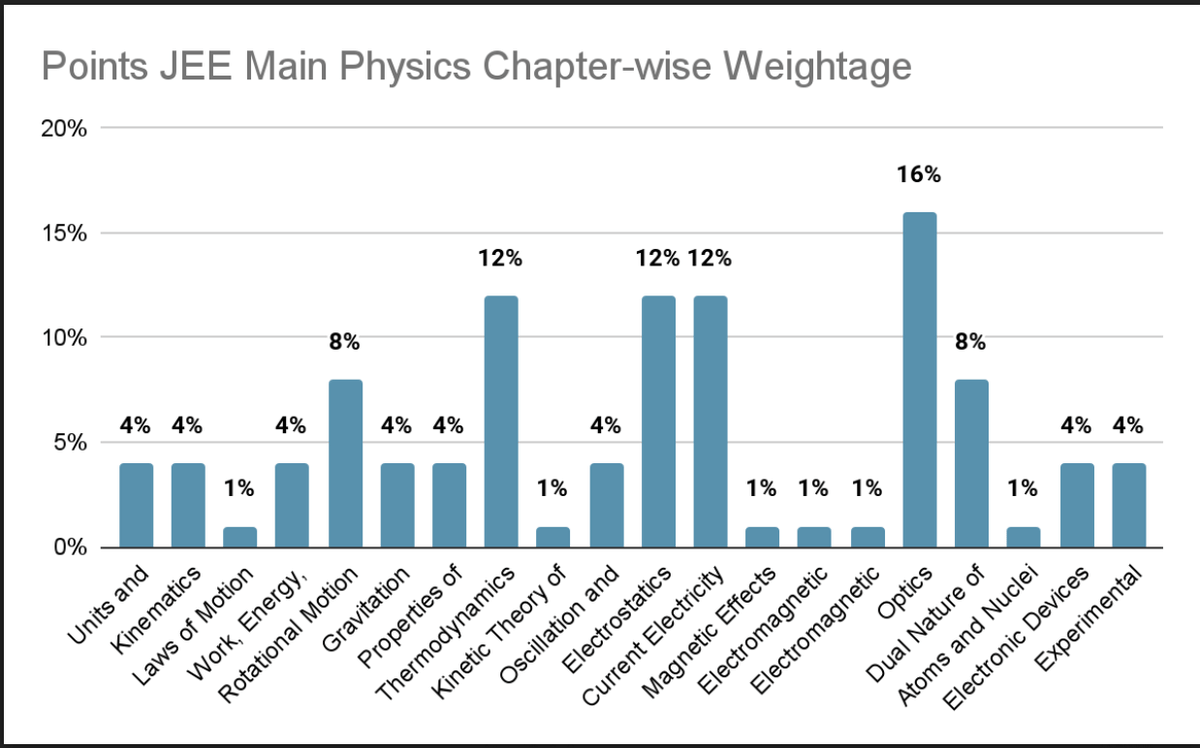
JEE Main Exam Pattern Change 2026JEE Main Physics Chapter-wise Weightage
| S. No. | JEE Main Physics Chapters | Approximate Weightage |
|---|---|---|
| 1 | Units and Measurements | 4% |
| 2 | Kinematics | 4% |
| 3 | Laws of Motion | 1% |
| 4 | Work, Energy, and Power | 4% |
| 5 | Rotational Motion | 8% |
| 6 | Gravitation | 4% |
| 7 | Properties of Solids and Liquids | 4% |
| 8 | Thermodynamics | 12% |
| 9 | Kinetic Theory of Gases | 1% |
| 10 | Oscillation and Waves | 4% |
| 11 | Electrostatics | 12% |
| 12 | Current Electricity | 12% |
| 13 | Magnetic Effects of Current & Magnetism | 1% |
| 14 | Electromagnetic Induction & Alternating Currents | 1% |
| 15 | Electromagnetic Waves | 1% |
| 16 | Optics | 16% |
| 17 | Dual Nature of Matter and Radiation | 8% |
| 18 | Atoms and Nuclei | 1% |
| 19 | Electronic Devices | 4% |
| 20 | Experimental Schemes | 4% |
JEE Main Chemistry Chapter-wise Weightage
| JEE Main Chemistry Chapters | ||||||
|---|---|---|---|---|---|---|
| S. No. | JEE Main Physical Chemistry Chapters | Approx% | JEE Inorganic Chemistry Chapters | Approx% | JEE Organic Chemistry Chapters | Approx% |
| 1 | Some Basic Concepts in Chemistry | 2% | Classification of Elements & Periodicity of Properties | 2% | Purification & Characterisation of Organic Compounds | 2% |
| 2 | Atomic Structure | 2% | The p-Block Elements | 6-8% | Some Basic Principles of Organic Chemistry (GOC) | 6-8% |
| 3 | Chemical Bonding & Molecular Structure | 5% | The d- and f-Block Elements | 2% | Hydrocarbons | 3-5% |
| 4 | Chemical Thermodynamics | 3-5% | Coordination Compounds | 5% | Organic Compounds containing Halogens | 2% |
| 5 | Solutions | 2% | Organic Compounds containing Oxygen | 5% | ||
| 6 | Equilibrium | 3-5% | Organic Compounds containing Nitrogen | 2% | ||
| 7 | Redox Reactions & Electrochemistry | 3-5% | Biomolecules | 2% | ||
| 8 | Chemical Kinetics | 2% | Principles related to Practical Chemistry | 2% | ||
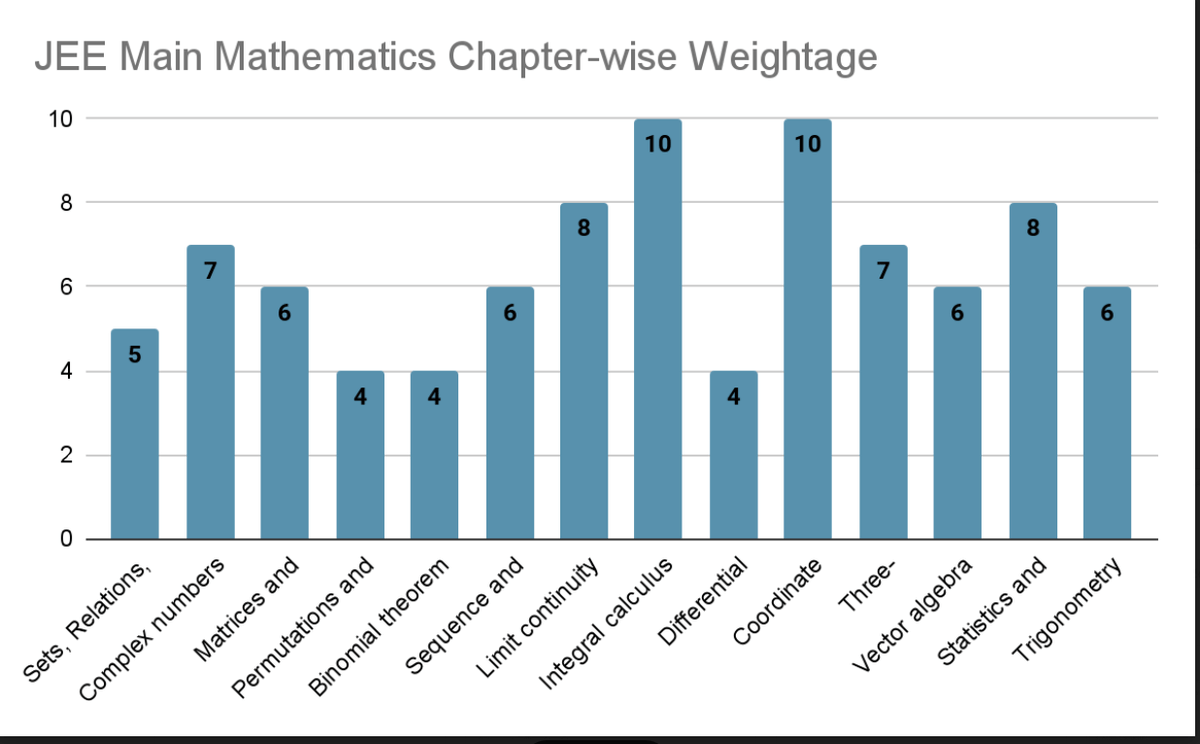
JEE Main Mathematics Chapter-wise Weightage
| Mathematics Chapters for JEE Mains | Approximate Weightage |
|---|---|
|
4-5% |
|
6-7% |
|
5-6% |
|
3-4% |
|
3-4% |
|
5-6% |
|
7-8% |
|
9-10% |
|
3-4% |
|
9-10% |
|
6-7% |
|
5-6% |
|
7-8% |
|
5-6% |
Also check
How to Crack JEE Main 2026What is JEE Main Syllabus 2026?
- The JEE Main Syllabus for 2026 has not yet been released.
- The official syllabus is expected to be released anytime between December 2025- February 2026.
- National Testing Agency (NTA) releases the official syllabus on https://jeemain.nta.nic.in
- It is expected that no changes will be made in the syllabus.
- The JEE Main 2025 syllabus is expected to continue for JEE Main 2026.
- Here is the official JEE Main 2025 syllabus.
- If not started yet, it is better to kick-start your preparation with the 2025 syllabus.
Practice JEE Main PYQs
Important Chapters for JEE Mains 2026
- 5-6 chapters in all subjects have high weightage for JEE 2026.
- 40-50% questions can be expected from these chapters.
- Electrostatics, Current Electricity, Optics, and Modern Physics account for 32-36 marks approximately.
- 30-35% of chemistry marks get distributed among Chemical Bonding, GOC, Aldehydes, Ketones, Coordination compounds, and Isomerism.
- 35-40 marks in Maths can be expected with Limits, Differentiation, 3D geometry, Integration, Vectors, Probability, and Matrices.
| Physics | Chemistry | Mathematics |
|---|---|---|
| Electrostatics | Chemical Bonding & Molecular Structure | Limits, Continuity & Differentiability |
| Current Electricity | Coordination Compounds | Define integration & Area under curve |
| Ray Optics & Wave Optics | Thermodynamics &Chemical Equilibrium | Matrices & Determinannts |
| Atoms, Nuclei, Photoelectric effect | GOC | 3D Geometry & Vectors |
| Thermodynamics | Aldehydes, Ketones & Carboxylic AcidsPhenols, Alcohols & Ethers | Probability |
| Rotational Motion | Chemical Kinetics & Electrochemistry | COmplex numbers |
Also, check
Do PYQ repeat in JEE MainJEE Main 2026 Syllabus Easy Chapters-FAQs
Ques: Which is the easiest chapter in JEE Mains?
Ans: Probability, Sets & Relations in Maths are easy.
- In Chemistry, biomolecules and coordination compounds are relatively easy chapters.
- Physics easy chapters are: Units and Measurements, Oscillations and Waves, Current Electricity, and WEP.
Ques: How many chapters for JEE Mains 2026?
Ans: JEE Mains has a total of 54 chapters.
- These are divided across Physics, Chemistry, and Mathematics.
- Physics: 20 Chapters
- Chemistry: 20 Chapters
- Maths:14 Chapters
Ques: Will JEE Mains 2026 be tough?
Ans: JEE Main is generally challenging.
- It was never completely easy.
- Ease comes with questions appearing as expected and practised.
- Regardless, JEE Main maintains a moderate difficulty level.
Ques: Is there any change in the JEE Mains 2026 syllabus?
Ans: It is expected that no changes will be made in the syllabus.
- The JEE Main 2025 syllabus is expected to continue for JEE Main 2026.
Ques: What is the difficulty level of JEE Main?
Ans: JEE Main is generally moderately difficult.
- By this, it means on the scale of 10, JEE Main’s difficulty level stands at 7-8.
- It is challenging enough.
Ques: Which year was JEE Main easier?
Ans: JEE 2021 February and JEE 2020 January are generally believed to be easier compared to recent years.
Ques: What is the hardest chapter in JEE?
Ans: Calculus in Maths is very depth and lengthy.
- Thermodynamics, Electromagnetic Induction, and Alternating Current are challenging in Physics.
- Hydrocarbons and Reactions are tricky in Chemistry.
Ques: Who sets the JEE Main paper?
Ans: JEE Main paper is set by NTA.
- National Testing Agency is the official conductor of JEE Main.
Ques: How to prepare for JEE 2026?
Ans: Get perfect with NCERTs.
- Practice 5-7 years’ PYQs.
- Dedicate 4-5 hours and use them efficiently.
- Take mocks- at least 10-20
- Pick any one comprehensive preparation book and start solving exam-style questions



Comments