




JEE Main 2026 January 22 Shift 1 Question Paper with Solutions is available. NTA conducted the second shift of JEE Main 2026 on January 22, 2026, from 9:00 AM to 12:00 PM. The paper included questions from Physics, Chemistry, and Mathematics, strictly based on the revised JEE Main syllabus.
The overall difficulty level of the Shift 1 paper was reported to be moderate, with Mathematics being comparatively lengthy, while Physics and Chemistry ranged from easy to moderate. Candidates can download the JEE Main 2026 Jan 22 Shift 1 question paper along with detailed solutions to analyze their performance and understand the exam pattern better.
Also Check:
- JEE Main 2026 April 2 Shift 1 Question Paper with Solutions
- Download JEE Main 2026 Session 2 Question Paper for all Shifts
JEE Main 2026 Jan 22 Shift 1 Question Paper with Solutions
| JEE Main 2026 Jan 22 Shift 1 Question Paper | Download | Check Solutions |

Two distinct numbers \(a\) and \(b\) are selected at random from \(1, 2, 3, \ldots, 50\). The probability that their product \(ab\) is divisible by \(3\) is
If a random variable \( x \) has the probability distribution
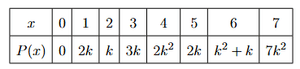
then \( P(3 < x \leq 6) \) is equal to
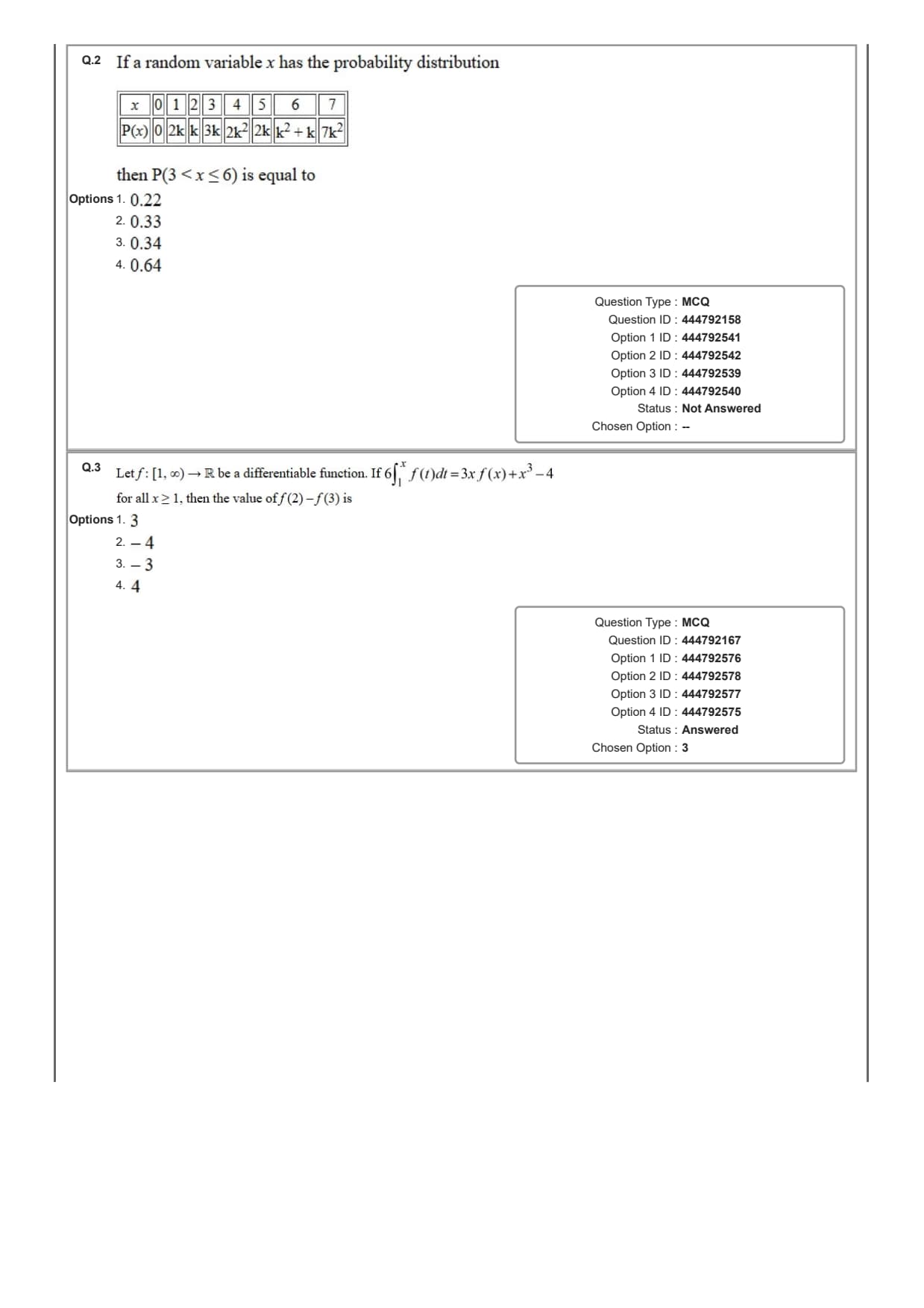
Let \( f : [1,\infty) \to \mathbb{R} \) be a differentiable function. If \[ 6\int_{1}^{x} f(t)\,dt = 3x f(x) + x^3 - 4 \]
for all \( x \ge 1 \), then the value of \( f(2) - f(3) \) is
If the image of the point \( P(1, 2, a) \) in the line \[ \frac{x - 6}{3} = \frac{y - 7}{2} = \frac{7 - z}{2} \]
is \( Q(5, b, c) \), then \( a^2 + b^2 + c^2 \) is equal to
If the chord joining the points \( P_1(x_1, y_1) \) and \( P_2(x_2, y_2) \) on the parabola \( y^2 = 12x \) subtends a right angle at the vertex of the parabola, then \( x_1x_2 - y_1y_2 \) is equal to
If the domain of the function \[ f(x)=\sin^{-1}\!\left(\frac{5-x}{3+2x}\right)+\frac{1}{\log_e(10-x)} \]
is \((-\infty,\alpha]\cup[\beta,\gamma)-\{\delta\, then 6(\alpha+\beta+\gamma+\delta) is equal to
Let \( P(\alpha, \beta, \gamma) \) be the point on the line \[ \frac{x-1}{2} = \frac{y+1}{-3} = z \]
at a distance \( 4\sqrt{14} \) from the point \( (1,-1,0) \) and nearer to the origin. Then the shortest distance between the lines \[ \frac{x-\alpha}{1} = \frac{y-\beta}{2} = \frac{z-\gamma}{3} \quad and \quad \frac{x+5}{2} = \frac{y-10}{1} = \frac{z-3}{1} \]
is equal to
If \[ A = \begin{bmatrix} 2 & 3
3 & 5 \end{bmatrix}, \]
then the determinant of the matrix \( A^{2025} - 3A^{2024} + A^{2023} \) is
Let the relation \( R \) on the set \( M = \{1, 2, 3, \ldots, 16\} \) be given by \[ R = \{(x, y) : 4y = 5x - 3,\; x, y \in M\}. \]
Then the minimum number of elements required to be added in \( R \), in order to make the relation symmetric, is equal to
Let the set of all values of \( r \), for which the circles \( (x + 1)^2 + (y + 4)^2 = r^2 \) and \( x^2 + y^2 - 4x - 2y - 4 = 0 \) intersect at two distinct points be the interval \( (\alpha, \beta) \). Then \( \alpha\beta \) is equal to
Let the solution curve of the differential equation \[ x\,dy - y\,dx = \sqrt{x^2+y^2}\,dx,\quad x>0, \]
with \(y(1)=0\), be \(y=y(x)\). Then \(y(3)\) is equal to
Let the line \( x = -1 \) divide the area of the region \[ \{(x,y): 1 + x^2 \le y \le 3 - x\} \]
in the ratio \( m:n \), where \( \gcd(m,n)=1 \). Then \( m+n \) is equal to
The number of solutions of \[ \tan^{-1}(4x) + \tan^{-1}(6x) = \frac{\pi}{6}, \]
where \[ -\frac{1}{2\sqrt{6}} < x < \frac{1}{2\sqrt{6}}, \]
is equal to
Let \( \overrightarrow{AB} = 2\hat{i} + 4\hat{j} - 5\hat{k} \) and \( \overrightarrow{AD} = \hat{i} + 2\hat{j} + \lambda \hat{k} \), \( \lambda \in \mathbb{R} \).
Let the projection of the vector \( \vec{v} = \hat{i} + \hat{j} + \hat{k} \) on the diagonal \( \overrightarrow{AC} \) of the parallelogram \( ABCD \) be of length one unit.
If \( \alpha, \beta \), where \( \alpha > \beta \), be the roots of the equation \( \lambda^2 x^2 - 6\lambda x + 5 = 0 \), then \( 2\alpha - \beta \) is equal to
The value of the integral \[ \int_{-\frac{\pi}{2}}^{\frac{\pi}{2}} \frac{1}{[x]+4}\,dx, \]
where \([\cdot]\) denotes the greatest integer function, is
Let \[ f(x)=x^{2025}-x^{2000},\quad x\in[0,1] \]
and the minimum value of the function \(f(x)\) in the interval \([0,1]\) be \[ (80)^{80}(n)^{-81}. \]
Then \(n\) is equal to
If the sum of the first four terms of an A.P. is \(6\) and the sum of its first six terms is \(4\), then the sum of its first twelve terms is
The coefficient of \(x^{48}\) in \[ (1+x) + 2(1+x)^2 + 3(1+x)^3 + \cdots + 100(1+x)^{100} \]
is equal to
The number of distinct real solutions of the equation \[ x|x + 4| + 3|x + 2| + 10 = 0 \]
is
If the line \( ax + 2y = 1 \), where \( a \in \mathbb{R} \), does not meet the hyperbola \( x^2 - 9y^2 = 9 \), then a possible value of \( a \) is:
Let \( A \) be a \( 3 \times 3 \) matrix such that \( A + A^{T} = O \). If
\[ A \begin{bmatrix} 1
-1
0 \end{bmatrix} = \begin{bmatrix} 3
3
2 \end{bmatrix}, \quad A^{2} \begin{bmatrix} 1
-1
0 \end{bmatrix} = \begin{bmatrix} -3
19
-24 \end{bmatrix} \]
and \[ \det\!\big(\operatorname{adj}(2\,\operatorname{adj}(A+I))\big) = 2^{\alpha}\,3^{\beta}\,11^{\gamma}, \]
where \( \alpha, \beta, \gamma \) are non-negative integers, then the value of \(\alpha + \beta + \gamma\) is ______.
Let \( \alpha = \dfrac{-1 + i\sqrt{3}}{2} \) and \( \beta = \dfrac{-1 - i\sqrt{3}}{2} \), where \( i = \sqrt{-1} \). If
\[ (7 - 7\alpha + 9\beta)^{20} + (9 + 7\alpha - 7\beta)^{20} + (-7 + 9\alpha + 7\beta)^{20} + (14 + 7\alpha + 7\beta)^{20} = m^{10}, \]
then the value of \( m \) is _______.
If \[ \int (\sin x)^{-\frac{11}{2}} (\cos x)^{-\frac{5}{2}} \, dx \]
is equal to \[ -\frac{p_1}{q_1}(\cot x)^{\frac{9}{2}} -\frac{p_2}{q_2}(\cot x)^{\frac{5}{2}} -\frac{p_3}{q_3}(\cot x)^{\frac{1}{2}} +\frac{p_4}{q_4}(\cot x)^{-\frac{3}{2}} + C, \]
where \( p_i, q_i \) are positive integers with \( \gcd(p_i,q_i)=1 \) for \( i=1,2,3,4 \), then the value of \[ \frac{15\,p_1 p_2 p_3 p_4}{q_1 q_2 q_3 q_4} \]
is ______.
If \[ \frac{\cos^2 48^\circ - \sin^2 12^\circ}{\sin^2 24^\circ - \sin^2 6^\circ} = \frac{\alpha + \beta\sqrt{5}}{2}, \]
where \( \alpha, \beta \in \mathbb{N} \), then the value of \( \alpha + \beta \) is ______.
Let \( ABC \) be a triangle. Consider four points \( p_1, p_2, p_3, p_4 \) on the side \( AB \), five points \( p_5, p_6, p_7, p_8, p_9 \) on the side \( BC \), and four points \( p_{10}, p_{11}, p_{12}, p_{13} \) on the side \( AC \). None of these points is a vertex of the triangle \( ABC \). Then the total number of pentagons that can be formed by taking all the vertices from the points \( p_1, p_2, \ldots, p_{13} \) is _______.
A projectile is thrown upward at an angle \(60^\circ\) with the horizontal. The speed of the projectile is \(20\) m/s when its direction of motion is \(45^\circ\) with the horizontal. The initial speed of the projectile is \underline{\hspace{1.5cm m/s.
Three identical coils \(C_1\), \(C_2\) and \(C_3\) are closely placed such that they share a common axis. \(C_2\) is exactly midway. \(C_1\) carries current \(I\) in anti-clockwise direction while \(C_3\) carries current \(I\) in clockwise direction. An induced current flows through \(C_2\) will be in clockwise direction when
A \(7.9\ MeV\) \(\alpha\)-particle scatters from a target material of atomic number \(79\). From the given data, the estimated diameter of the nuclei of the target material is (approximately) \hspace{1.5cm m.
\[ \left[\frac{1{4\pi\varepsilon_0}=9\times10^9\ Nm^2/C^2 and electron charge =1.6\times10^{-19}\ C\right] \]
Consider an equilateral prism (refractive index \( \sqrt{2} \)). A ray of light is incident on its one surface at a certain angle \( i \). If the emergent ray is found to graze along the other surface, then the angle of refraction at the incident surface is close to
Given below are two statements:
Statement I: Pressure of a fluid is exerted only on a solid surface in contact as the fluid-pressure does not exist everywhere in a still fluid.
Statement II: Excess potential energy of the molecules on the surface of a liquid, when compared to interior, results in surface tension.
In the light of the above statements, choose the correct answer from the options given below
The volume of an ideal gas increases \(8\) times and temperature becomes \(\left(\frac{1}{4}\right)^{th}\) of initial temperature during a reversible change. If there is no exchange of heat in this process \((\Delta Q=0)\), then identify the gas from the following options (Assuming the gases given in the options are ideal gases):
A meter bridge with two resistances \( R_1 \) and \( R_2 \) as shown in figure was balanced (null point) at 40 cm from the point \( P \).
The null point changed to 50 cm from the point \( P \), when a \( 16\,\Omega \) resistance is connected in parallel to \( R_2 \).
The values of resistances \( R_1 \) and \( R_2 \) are
Net gravitational force at the center of a square is found to be \( F_1 \) when four particles having masses \( M, 2M, 3M \) and \( 4M \) are placed at the four corners of the square as shown in figure, and it is \( F_2 \) when the positions of \( 3M \) and \( 4M \) are interchanged.
The ratio \( \dfrac{F_1}{F_2} = \dfrac{\alpha}{\sqrt{5}} \).
The value of \( \alpha \) is
\(XPQY\) is a vertical smooth long loop having a total resistance \(R\), where \(PX\) is parallel to \(QY\) and the separation between them is \(l\). A constant magnetic field \(B\) perpendicular to the plane of the loop exists in the entire space. A rod \(CD\) of length \(L\,(L>l)\) and mass \(m\) is made to slide down from rest under gravity as shown. The terminal speed acquired by the rod is _________ m/s.

The escape velocity from a spherical planet \(A\) is \(10\ km/s\). The escape velocity from another planet \(B\), whose density and radius are \(10%\) of those of planet \(A\), is _________ m/s.
A thin convex lens of focal length \(5\) cm and a thin concave lens of focal length \(4\) cm are combined together (without any gap) and this combination has magnification \(m_1\) when an object is placed \(10\) cm before the convex lens. Keeping the positions of convex lens and object undisturbed, a gap of \(1\) cm is introduced between the lenses by moving the concave lens away, which leads to a change in magnification of total lens system to \(m_2\). The value of \(\dfrac{m_1}{m_2}\) is
Rods \(x\) and \(y\) of equal dimensions but of different materials are joined as shown in figure. Temperatures of end points \(A\) and \(F\) are maintained at \(100^\circ\)C and \(40^\circ\)C respectively. Given the thermal conductivity of rod \(x\) is three times of that of rod \(y\), the temperature at junction points \(B\) and \(E\) are (close to):

Match the LIST-I with LIST-II
\[ \begin{array}{|c|l||c|l|} \hline List-I & & List-II &
\hline A. & Spring constant & I. & ML^2T^{-2}K^{-1}
B. & Thermal conductivity & II. & ML^0T^{-2}
C. & Boltzmann constant & III. & ML^2T^{-3}A^{-2}
D. & Inductive reactance & IV. & MLT^{-3}K^{-1}
\hline \end{array} \]
Choose the correct answer from the options given below:
Find the correct combination of A, B, C and D inputs which can cause the LED to glow.

Electric field in a region is given by \[ \vec{E} = A x\,\hat{i} + B y\,\hat{j}, \]
where \( A = 10 \,V/m^2 \) and \( B = 5 \,V/m^2 \). If the electric potential at a point \( (10, 20) \) is \(500\ V\), then the electric potential at origin is \underline{\hspace{1cm V.
A simple pendulum has a bob with mass \(m\) and charge \(q\). The pendulum string has negligible mass. When a uniform and horizontal electric field \( \vec{E} \) is applied, the tension in the string changes. The final tension in the string, when pendulum attains an equilibrium position is _________.
(\( g \): acceleration due to gravity)
Six point charges are kept \(60^\circ\) apart from each other on the circumference of a circle of radius \( R \) as shown in figure.
The net electric field at the center of the circle is ____.
(\( \varepsilon_0 \) is permittivity of free space)

A cylindrical tube \(AB\) of length \(l\), closed at both ends, contains an ideal gas of \(1\) mol having molecular weight \(M\). The tube is rotated in a horizontal plane with constant angular velocity \(\omega\) about an axis perpendicular to \(AB\) and passing through the edge at end \(A\), as shown in the figure. If \(P_A\) and \(P_B\) are the pressures at \(A\) and \(B\) respectively, then (consider the temperature to be same at all points in the tube)

A solid sphere of mass \(5\) kg and radius \(10\) cm is kept in contact with another solid sphere of mass \(10\) kg and radius \(20\) cm. The moment of inertia of this pair of spheres about the tangent passing through the point of contact is \underline{\hspace{1.5cm kg\(\cdot\)m\(^2\).
The minimum frequency of photon required to break a particle of mass \(15.348\) amu into \(4\) particles is \hspace{1.5cm kHz.
[Mass of He nucleus \(=4.002\) amu, \(1\) amu \(=1.66\times10^{-27\) kg, \(h=6.6\times10^{-34}\) J\(\cdot\)s and \(c=3\times10^8\) m/s]
A circular disc has radius \( R_1 \) and thickness \( T_1 \). Another circular disc made of the same material has radius \( R_2 \) and thickness \( T_2 \). If the moments of inertia of both the discs are same and \[ \frac{R_1}{R_2} = 2, \quad then \quad \frac{T_1}{T_2} = \frac{1}{\alpha}. \]
The value of \( \alpha \) is _____.
Inductance of a coil with \(10^4\) turns is \(10\,mH\) and it is connected to a DC source of \(10\,V\) with internal resistance \(10\,\Omega\). The energy density in the inductor when the current reaches \( \left(\frac{1}{e}\right) \) of its maximum value is \[ \alpha \pi \times \frac{1}{e^2}\ J m^{-3}. \]
The value of \( \alpha \) is _____.
\[ (\mu_0 = 4\pi \times 10^{-7}\ TmA^{-1}) \]
A parallel beam of light travelling in air (refractive index \(1.0\)) is incident on a convex spherical glass surface of radius of curvature \(50 \, cm\). Refractive index of glass is \(1.5\). The rays converge to a point at a distance \(x \, cm\) from the centre of curvature of the spherical surface. The value of \(x\) is _______.
The electric field of a plane electromagnetic wave, travelling in an unknown non-magnetic medium is given by,
\[ E_y = 20 \sin (3 \times 10^6 x - 4.5 \times 10^{14} t) \, V/m \]
(where \(x\), \(t\) and other values have S.I. units). The dielectric constant of the medium is _______.
Two loudspeakers (\(L_1\) and \(L_2\)) are placed with a separation of \(10 \, m\), as shown in the figure. Both speakers are fed with an audio input signal of the same frequency with constant volume. A voice recorder, initially at point \(A\), at equidistance to both loudspeakers, is moved by \(25 \, m\) along the line \(AB\) while monitoring the audio signal. The measured signal was found to undergo \(10\) cycles of minima and maxima during the movement. The frequency of the input signal is _______ Hz.

(Speed of sound in air is \(324 \, m/s\) and \( \sqrt{5} = 2.23 \))
The correct order of reactivity of CH\(_3\)Br in methanol with the following nucleophiles is
\( \mathrm{F^- ,\ I^- ,\ C_2H_5O^- \ and\ C_6H_5O^- }\)
Match the LIST-I with LIST-II

Choose the correct answer from the options given below:
As compared with chlorocyclohexane, which of the following statements correctly apply to chlorobenzene?
[label=\Alph*.]
The magnitude of negative charge is more on chlorine atom.
The C--Cl bond has partial double bond character.
C--Cl bond is less polar.
C--Cl bond is longer due to repulsion between delocalised electrons of the aromatic ring and lone pairs of electrons of chlorine.
The C--Cl bond is formed using \(sp^2\) hybridised orbital of carbon.
Choose the correct answer from the options given below:
The energy required by electrons, present in the first Bohr orbit of hydrogen atom, to be excited to second Bohr orbit is \hspace{1.5cm} J mol\(^{-1}\).
Given: \(R_H = 2.18 \times 10^{-11}\) ergs.
Consider the transition metal ions \( Mn^{3+}, Cr^{3+}, Fe^{3+} \) and \( Co^{3+} \) and all form low spin octahedral complexes. The correct decreasing order of unpaired electrons in their respective \(d\)-orbitals of the complexes is
A first row transition metal (M) does not liberate \( \mathrm{H_2} \) gas from dilute HCl. 1 mol of aqueous solution of \( \mathrm{MSO_4} \) is treated with excess of aqueous KCN and then \( \mathrm{H_2S(g)} \) is passed through the solution. The amount of \( \mathrm{MS} \) (metal sulphide) formed from the above reaction is \underline{\hspace{1cm mol.
Given below are two statements:
Statement I: Benzene is nitrated to give nitrobenzene, which on further treatment with \( CH_3COCl / AlCl_3 \) will give the product shown.

Statement II: \( -NO_2 \) group is a meta-directing and deactivating group.
In the light of the above statements, choose the most appropriate answer from the options given below.
Given below are two statements:
Statement I: The Henry’s law constant \( K_H \) is constant with respect to variations in solution concentration over the range for which the solution is ideally dilute.
Statement II: \( K_H \) does not differ for the same solute in different solvents.
In the light of the above statements, choose the correct answer from the options given below.
Two \(p\)-block elements \(X\) and \(Y\) form fluorides of the type \(EF_3\). The fluoride compound \(XF_3\) is a Lewis acid and \(YF_3\) is a Lewis base. The hybridizations of the central atoms of \(XF_3\) and \(YF_3\) respectively are
A \(p\)-block element \(E\) and hydrogen form a binary cation \( (EH_x)^+ \), while \(EH_3\) on treatment with \(K_2HgI_4\) in alkaline medium gives a precipitate of basic mercury(II) amido-iodide. Given below are first ionisation enthalpy values (kJ mol\(^{-1}\)) for the first elements each from groups 13, 14, 15 and 16. Identify the correct first ionisation enthalpy value for element \(E\).
In the reaction, \[ 2Al(s) + 6HCl(aq) \rightarrow 2Al^{3+}(aq) + 6Cl^-(aq) + 3H_2(g) \]
Consider a solution of CO\(_2\)(g) dissolved in water in a closed container. Which one of the following plots correctly represents variation of \(\log\) (partial pressure of CO\(_2\) in vapour phase above water) [y-axis] with \(\log\) (mole fraction of CO\(_2\) in water) [x-axis] at \(25^\circ\)C?
The formal charges on the atoms marked as (1) to (4) in the Lewis representation of \( \mathrm{HNO_3} \) molecule respectively are

Given below are two statements:
Statement I: The halogen that makes longest bond with hydrogen in HX, has the smallest covalent radius in its group.
Statement II: A group 15 element's hydride \(EH_3\) has the lowest boiling point among corresponding hydrides of other group 15 elements. The maximum covalency of that element \(E\) is 4.
In the light of the above statements, choose the correct answer from the options given below.
The correct order of the rate of reaction of the following reactants with nucleophile by \( \mathrm{S_N1} \) mechanism is:

(Given: Structures I and II are rigid)
Given below are two statements:
Statement I: Phenol on treatment with \( \mathrm{CHCl_3/aq.\ KOH} \) under refluxing condition, followed by acidification produces p-hydroxy benzaldehyde as the major product and o-hydroxy benzaldehyde as the minor product.
Statement II: The mixture of p-hydroxybenzaldehyde and o-hydroxybenzaldehyde can be easily separated through steam distillation.
In the light of the above statements, choose the correct answer from the options given below
Given below are two statements:
Statement I: Sucrose is dextrorotatory. However, sucrose upon hydrolysis gives a solution having mixture of products. This solution shows laevorotation.
Statement II: Hydrolysis of sucrose gives glucose and fructose. Since the laevorotation of glucose is more than the dextrorotation of fructose, the resulting solution becomes laevorotatory.
In the light of the above statements, choose the correct answer from the options given below.
Match the LIST-I with LIST-II.

Choose the correct answer from the options given below:
\(A \rightarrow Product\) (First order reaction).
Three sets of experiments were performed for a reaction under similar experimental conditions:
\[ Run 1 \Rightarrow 100\ mL of 10\ M solution of reactant A \] \[ Run 2 \Rightarrow 200\ mL of 10\ M solution of reactant A \] \[ Run 3 \Rightarrow 100\ mL of 10\ M solution of reactant A + 100\ mL of H_2O \]
The correct variation of rate of reaction is
\(A\) is a neutral organic compound (M.F.: \(C_8H_9ON\)). On treatment with aqueous \(Br_2/HO^-\), \(A\) forms a compound \(B\) which is soluble in dilute acid. \(B\) on treatment with aqueous \(NaNO_2/HCl\) (0--5\(^\circ\)C) produces a compound \(C\) which on treatment with \(CuCN/NaCN\) produces \(D\). Hydrolysis of \(D\) produces \(E\) which is also obtainable from the hydrolysis of \(A\). \(E\) on treatment with acidified \(KMnO_4\) produces \(F\). \(F\) contains two different types of hydrogen atoms. The structure of \(A\) is

The temperature at which the rate constants of the given below two gaseous reactions become equal is ______ K (Nearest integer).
\[ X \longrightarrow Y, \qquad k_1 = 10^{6} e^{-\frac{30000}{T}} \]
\[ P \longrightarrow Q, \qquad k_2 = 10^{4} e^{-\frac{24000}{T}} \]
Given: \( \ln 10 = 2.303 \)
Consider the following electrochemical cell at \(298\,K\):
\[ Pt \, | \, \mathrm{HSnO_2^- (aq)} \, | \, \mathrm{Sn(OH)_6^{2-} (aq)} \, | \, \mathrm{OH^- (aq)} \, | \, \mathrm{Bi_2O_3 (s)} \, | \, \mathrm{Bi (s)} \]
If the reaction quotient at a given time is \(10^6\), then the cell EMF
(\(E_{cell}\)) is ______ \( \times 10^{-1} \) V (Nearest integer).
Given:
\[ E^\circ_{\mathrm{Bi_2O_3/Bi,OH^-}} = -0.44\ V, \quad E^\circ_{\mathrm{Sn(OH)_6^{2-}/HSnO_2^-,OH^-}} = -0.90\ V \]
The cycloalkene (X) on bromination consumes one mole of bromine per mole of (X) and gives the product (Y) in which C : Br ratio is \(3:1\). The percentage of bromine in the product (Y) is ______ % (Nearest integer).
Given:
\[ H = 1,\quad C = 12,\quad O = 16,\quad Br = 80 \]
Dissociation of a gas \( A_2 \) takes place according to the following chemical reaction. At equilibrium, the total pressure is \(1 \, bar\) at \(300 \, K\).
\[ A_2(g) \rightleftharpoons 2A(g) \]
The standard Gibbs energy of formation of the involved substances is given below:
\begin{tabular{|c|c|
\hline
Substance & \( \Delta G_f^\circ \) (kJ mol\(^{-1}\))
\hline \(A_2\) & \(-100.00\)
\(A\) & \(-50.832\)
\hline
\end{tabular
The degree of dissociation of \(A_2(g)\) is given by \[ (x \times 10^{-2})^{1/2} \]
where \(x =\) _______ (Nearest integer).
[Given: \(R = 8 \, J mol^{-1}K^{-1}\), \(\log 2 = 0.3010\), \(\log 3 = 0.48\). Assume degree of dissociation is not negligible.]
Sodium fusion extract of an organic compound (Y) with CHCl\(_3\) and chlorine water gives violet colour to the CHCl\(_3\) layer. \(0.15\,g\) of (Y) gave \(0.12\,g\) of the silver halide precipitate in Carius method. Percentage of halogen in the compound (Y) is ______ (Nearest integer).
Given:
\[ C = 12,\quad H = 1,\quad Cl = 35.5,\quad Br = 80,\quad I = 127 \]



Also Check:
- JEE Main 2026 23rd Jan Shift 2 Question Paper – Download PDF with Solutions
- JEE Main 2026 23rd Jan Shift 1 Question Paper – Download PDF with Solutions
Students can check the detailed paper analysis for JEE Main Jan 22nd Shift 1 here.





Comments