




JEE Main 2026 Jan 23 Shift 2 question paper is available here with answer key and solutions. NTA has conducred the 2nd shift of the day on Jan 23, 2026, from 3 PM to 6 PM.
Also Check:
- JEE Main 2026 24th Jan Shift 1 Question Paper with Solution PDF
- JEE Main 2026 24th Jan Shift 2 Question Paper with Solution PDF
JEE Main 2026 23rd Jan Shift 2 Question Paper with Solution PDF
| JEE Main 2026 23rd Jan Shift 2 Question Paper with Solution PDF | Download PDF | View Solution |
Check JEE Main Jan 23rd Shift 2 Answer Key

Based on previous year analysis, JEE Main Jan 23rd Shift 2 was to be Moderate to Semi-Difficult, where Mathematics remains the lengthiest section. Students can access the JEE Main Jan 23 Shift 2 official questions with answer keys here.
Students can check the detailed paper analysis for JEE Main Jan 23rd Shift 2 here.

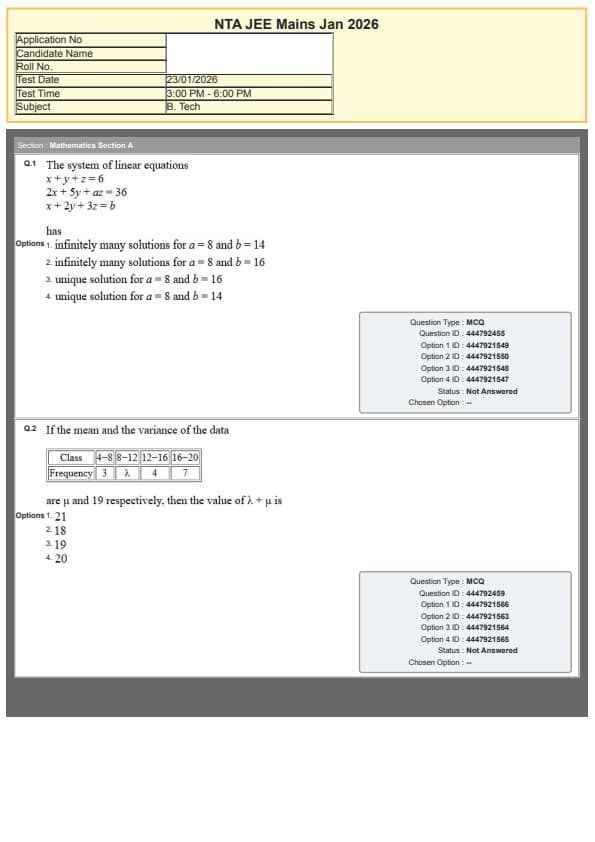
The system of linear equations
\(x + y + z = 6\)
\(2x + 5y + az = 36\)
\(x + 2y + 3z = b\)
has
If the mean and the variance of the data
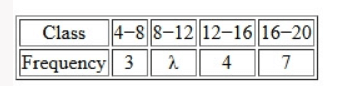
are \(\mu\) and 19 respectively, then the value of \(\lambda + \mu\) is
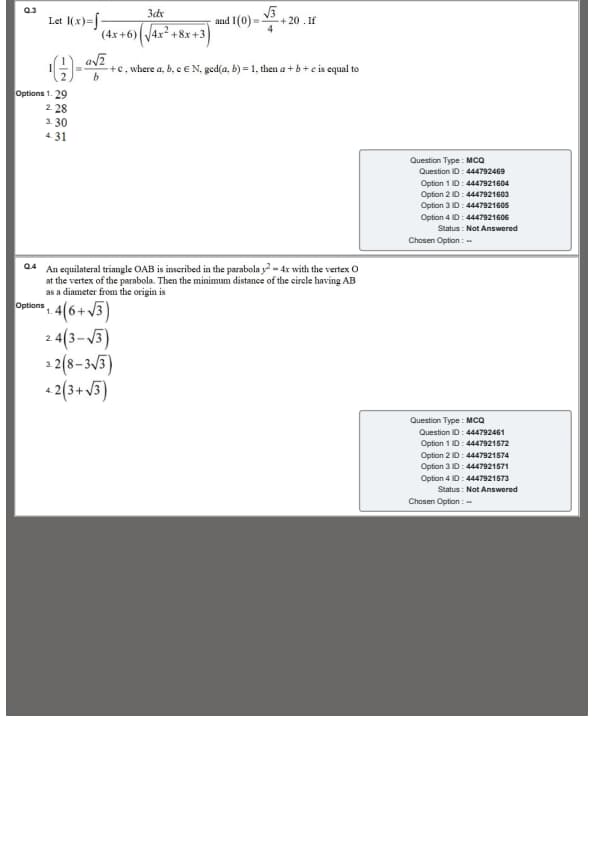
Let \(I(x) = \int \frac{3dx}{(4x+6)\sqrt{4x^2+8x+3}}\) and \(I(0) = \frac{\sqrt{3}}{4} + 20\). If \(I\left(\frac{1}{2}\right) = \frac{a\sqrt{2}}{b} + c\), where \(a, b, c \in \mathbb{N}, \gcd(a, b) = 1\), then \(a+b+c\) is equal to
An equilateral triangle OAB is inscribed in the parabola \(y^2 = 4x\) with the vertex O at the vertex of the parabola. Then the minimum distance of the circle having AB as a diameter from the origin is
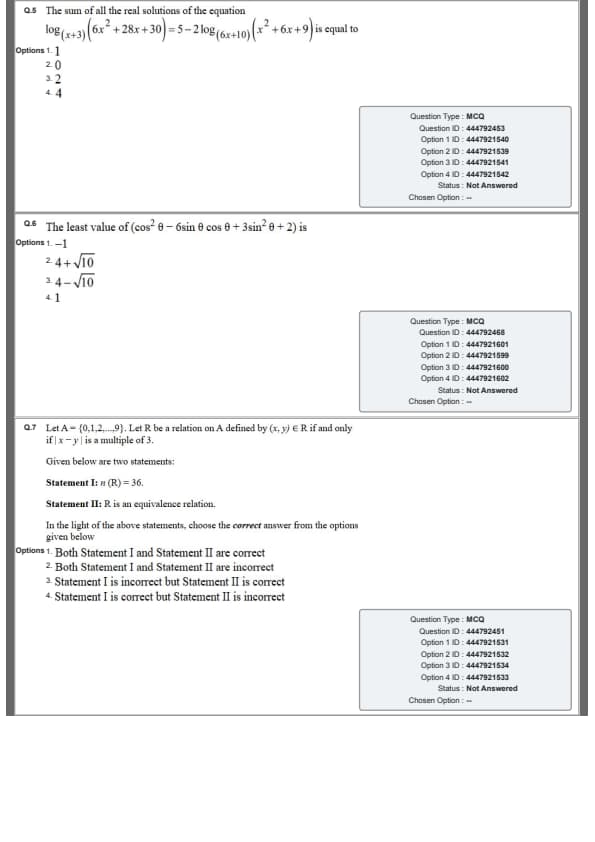
The sum of all the real solutions of the equation
\(\log_{(x+3)}(6x^2 + 28x + 30) = 5 - 2\log_{(6x+10)}(x^2 + 6x + 9)\) is equal to
The least value of \((\cos^2 \theta - 6\sin \theta \cos \theta + 3\sin^2 \theta + 2)\) is
Let \(A = \{0, 1, 2, ..., 9\}\). Let R be a relation on A defined by \((x, y) \in R\) if and only if \(|x - y|\) is a multiple of 3.
Statement I: \(n(R) = 36\).
Statement II: R is an equivalence relation.
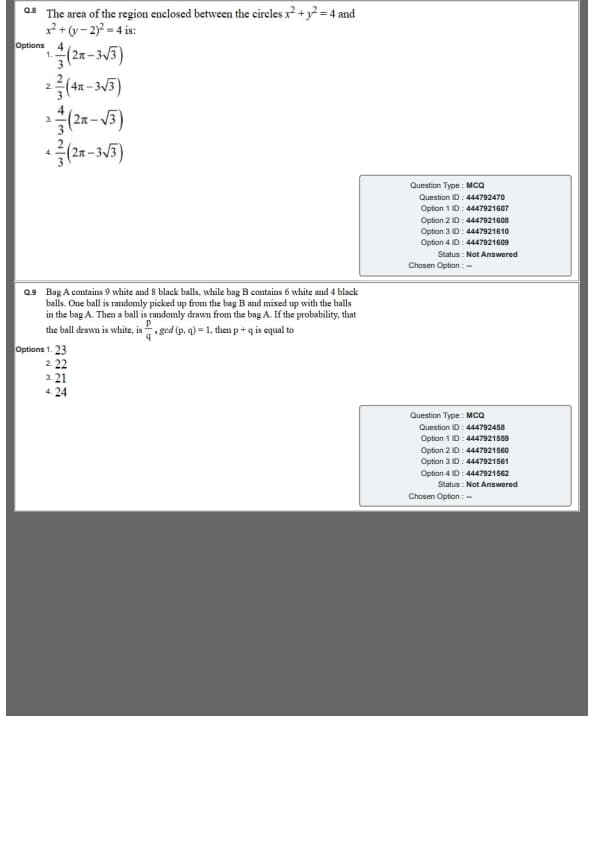
The area of the region enclosed between the circles \(x^2 + y^2 = 4\) and \(x^2 + (y - 2)^2 = 4\) is:
Bag A contains 9 white and 8 black balls, while bag B contains 6 white and 4 black balls. One ball is picked from B and put in A. Then a ball is drawn from A. Probability it is white is \(p/q\). Find \(p+q\).
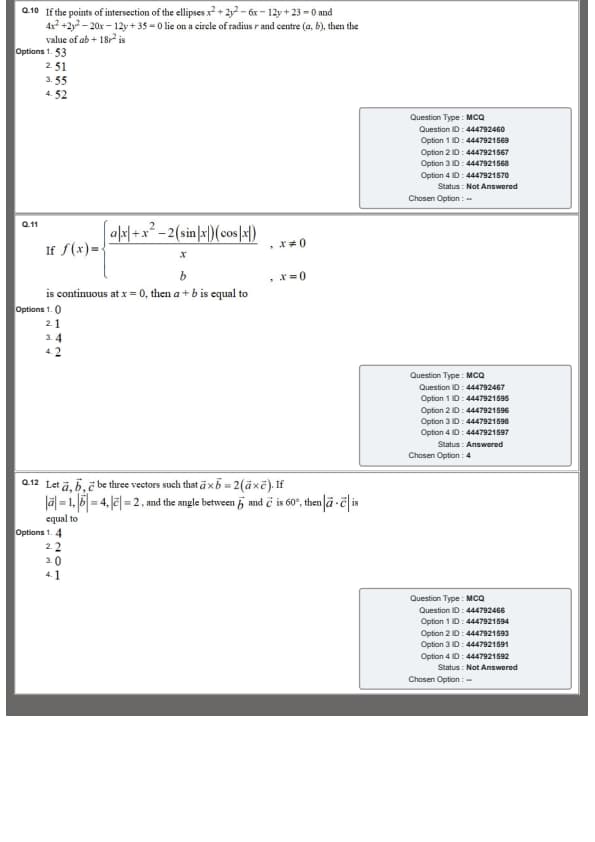
Points of intersection of ellipses \(x^2 + 2y^2 - 6x - 12y + 23 = 0\) and \(4x^2 + 2y^2 - 20x - 12y + 35 = 0\) lie on a circle. Value of \(ab + 18r^2\) is
If \(f(x) = \begin{cases} \frac{a|x| + x^2 - 2(\sin|x|)(\cos|x|)}{x} & , x \neq 0
b & , x = 0 \end{cases}\) is continuous at \(x=0\), then \(a+b\) is equal to
Let \(\vec{a}, \vec{b}, \vec{c}\) be vectors such that \(\vec{a} \times \vec{b} = 2(\vec{a} \times \vec{c})\). \(|\vec{a}|=1, |\vec{b}|=4, |\vec{c}|=2\), angle between \(\vec{b}, \vec{c}\) is \(60^\circ\). Find \(|\vec{b} - 2\vec{c}|\).
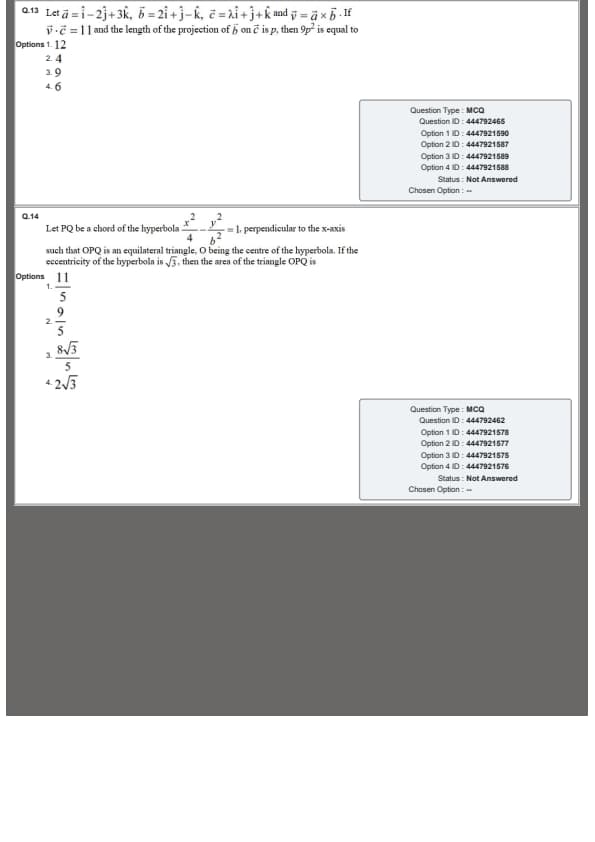
Let \(\vec{a}, \vec{b}, \vec{c}\) be defined. \(\vec{v} = \vec{a} \times \vec{b}\). \(\vec{v} \cdot \vec{c} = 11\). Projection of \(\vec{b}\) on \(\vec{c}\) is \(p\). Find \(9p^2\).
PQ is chord of hyperbola \(\frac{x^2}{4} - \frac{y^2}{b^2} = 1\) perpendicular to x-axis. \(\triangle OPQ\) is equilateral (\(e=\sqrt{3}\)). Area OPQ is
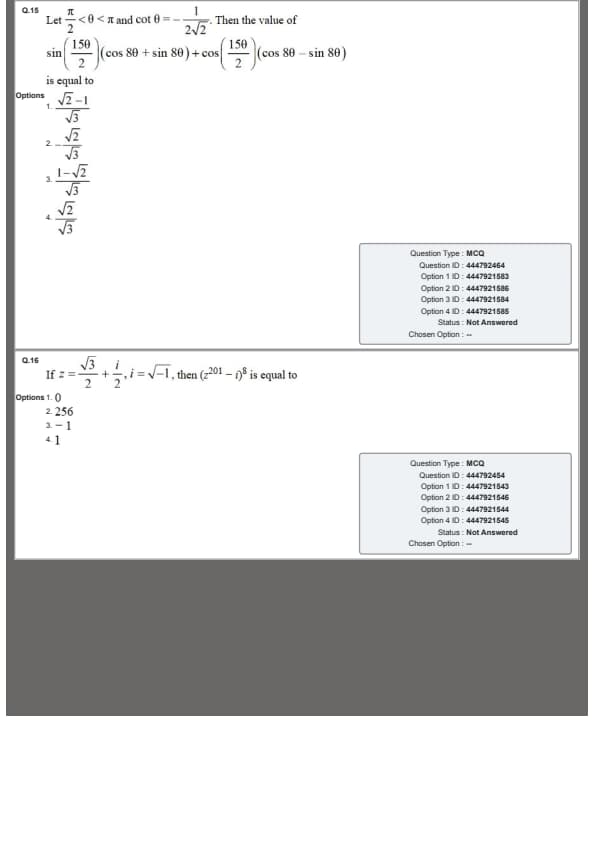
Let \(\frac{\pi}{2} < \theta < \pi\) and \(\cot \theta = -\frac{1}{2\sqrt{2}}\). Value of expression involving \(\frac{15\theta}{2}\) and \(8\theta\).
If \(z = \frac{\sqrt{3}}{2} + \frac{i}{2}\), then \((z^{201} - i)^8\) is equal to
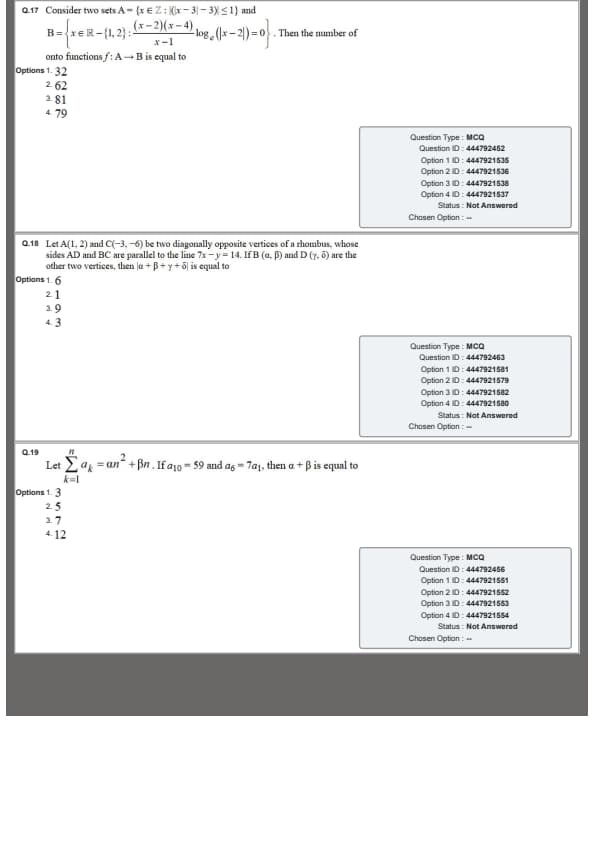
Sets \(A = \{x \in Z : ||x-3|-3| \le 1\}\) and \(B = \{x : roots of eq\}\). Number of onto functions \(A \to B\).
Rhombus vertices A(1,2), C(-3,-6). Line AD parallel to \(7x-y=14\). Find \(|\alpha+\beta+\gamma+\delta|\).
\(\sum_{k=1}^n a_k = \alpha n^2 + \beta n\). \(a_{10}=59, a_6=7a_1\). Find \(\alpha+\beta\).
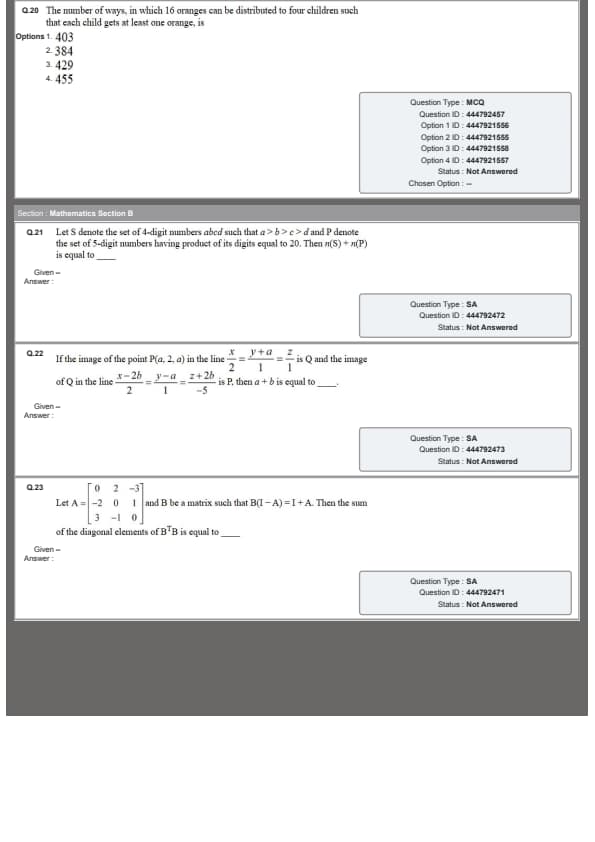
The number of ways 16 oranges distributed to 4 children, each gets at least one.
Let S denote the set of 4-digit numbers abcd such that \(a > b > c > d\) and P denote the set of 5-digit numbers having product of its digits equal to 20. Then \(n(S) + n(P)\) is equal to ___
If the image of the point P(a, 2, a) in the line \(\frac{x}{2} = \frac{y+a}{1} = \frac{z}{1}\) is Q and the image of Q in the line \(\frac{x-2b}{2} = \frac{y-a}{1} = \frac{z+2b}{-5}\) is P, then a + b is equal to ___.
Let \(A = \begin{bmatrix} 0 & 2 & -3
-2 & 0 & 1
3 & -1 & 0 \end{bmatrix}\) and B be a matrix such that \(B(I - A) = I + A\). Then the sum of the diagonal elements of \(B^T B\) is equal to ___
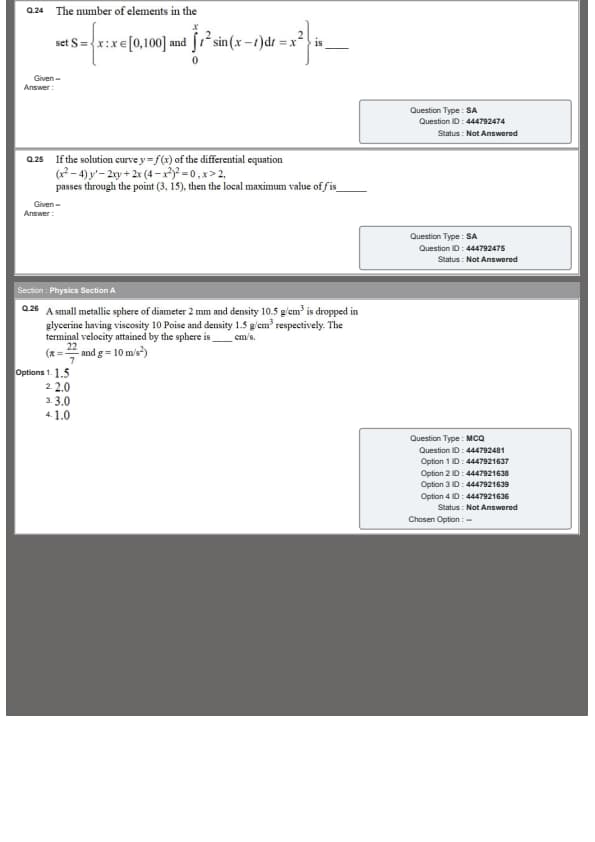
The number of elements in the set \(S = \{ x : x \in [0, 100] and \int_0^x t^2 \sin(x-t) dt = x^2 \}\) is ___
If the solution curve \(y = f(x)\) of the differential equation \((x^2 - 4) y' - 2xy + 2x(4 - x^2)^2 = 0, x > 2\), passes through the point \((3, 15)\), then the local maximum value of \(f\) is ___
A small metallic sphere of diameter 2 mm and density 10.5 g/cm\(^3\) is dropped in glycerine having viscosity 10 Poise and density 1.5 g/cm\(^3\) respectively. The terminal velocity attained by the sphere is ___ cm/s. (\(\pi = \frac{22}{7}\) and \(g = 10\) m/s\(^2\))
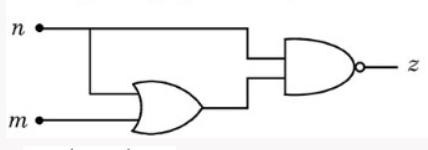
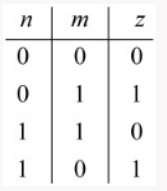
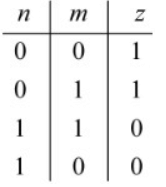
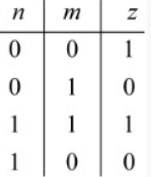
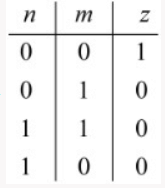
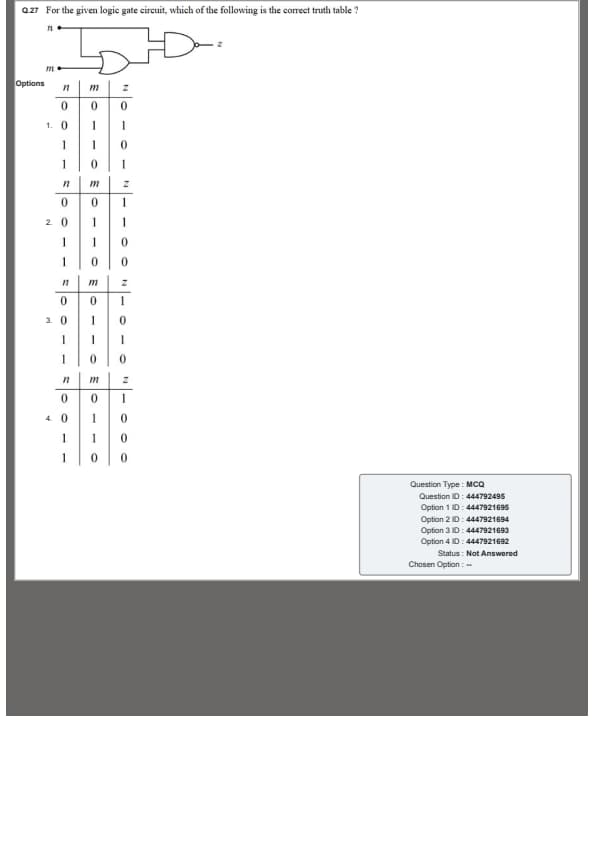
For the given logic gate circuit, which of the following is the correct truth table ?
- (A)
![]()
- (B)
![]()
- (C)
![]()
- (D)
![]()
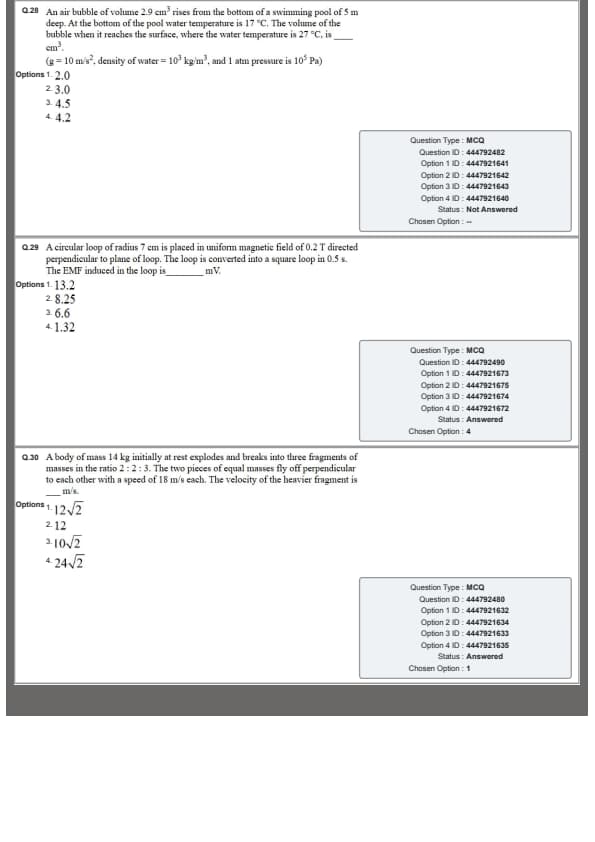
An air bubble of volume 2.9 cm\(^3\) rises from the bottom of a swimming pool of 5 m deep. At the bottom of the pool water temperature is 17 \(^\circ\)C. The volume of the bubble when it reaches the surface, where the water temperature is 27 \(^\circ\)C, is ___ cm\(^3\).
A circular loop of radius 7 cm is placed in uniform magnetic field of 0.2 T directed perpendicular to plane of loop. The loop is converted into a square loop in 0.5 s. The EMF induced in the loop is ___ mV.
A body of mass 14 kg initially at rest explodes and breaks into three fragments of masses in the ratio 2 : 2 : 3. The two pieces of equal masses fly off perpendicular to each other with a speed of 18 m/s each. The velocity of the heavier fragment is ___ m/s.
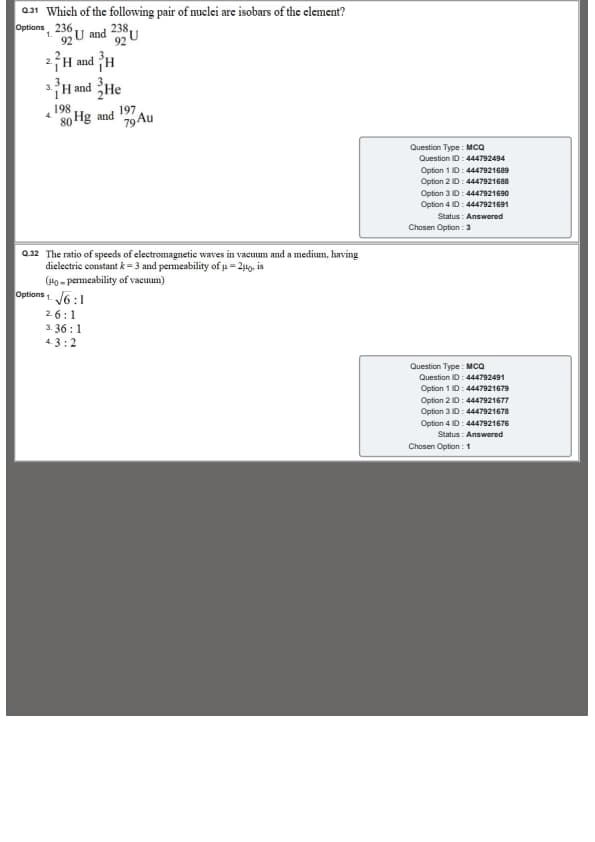
Which of the following pair of nuclei are isobars of the element?
The ratio of speeds of electromagnetic waves in vacuum and a medium, having dielectric constant k = 3 and permeability of \(\mu = 2\mu_0\), is (\(\mu_0\) = permeability of vacuum)
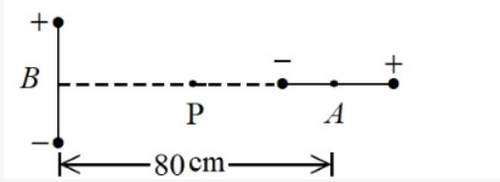
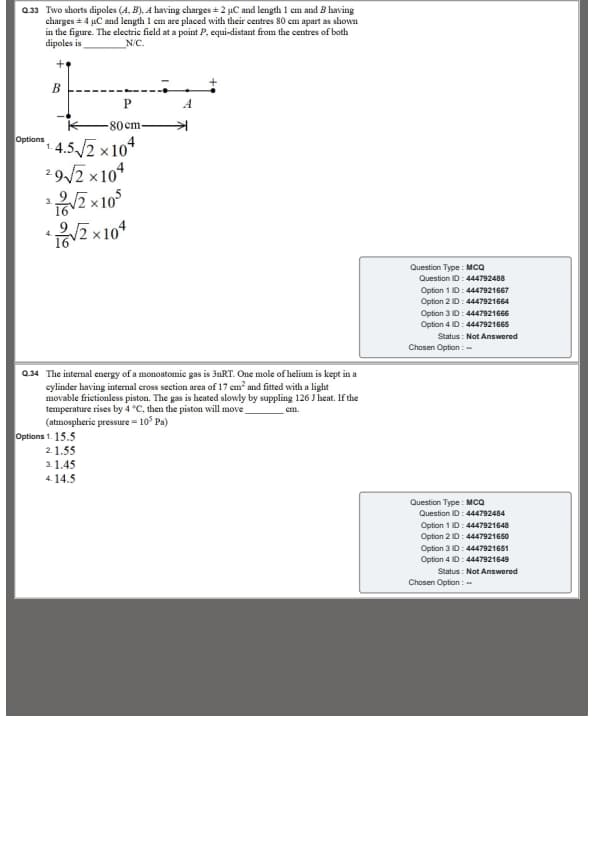
Two shorts dipoles (A, B). A having charges \(\pm 2 \mu C\) and length 1 cm and B having charges \(\pm 4 \mu C\) and length 1 cm are placed with their centres 80 cm apart as shown in the figure. The electric field at a point P, equi-distant from the centres of both dipoles is ___ N/C.
The internal energy of a monoatomic gas is 3nRT. One mole of helium... heated slowly by supplying 126 J heat... piston will move ___ cm.
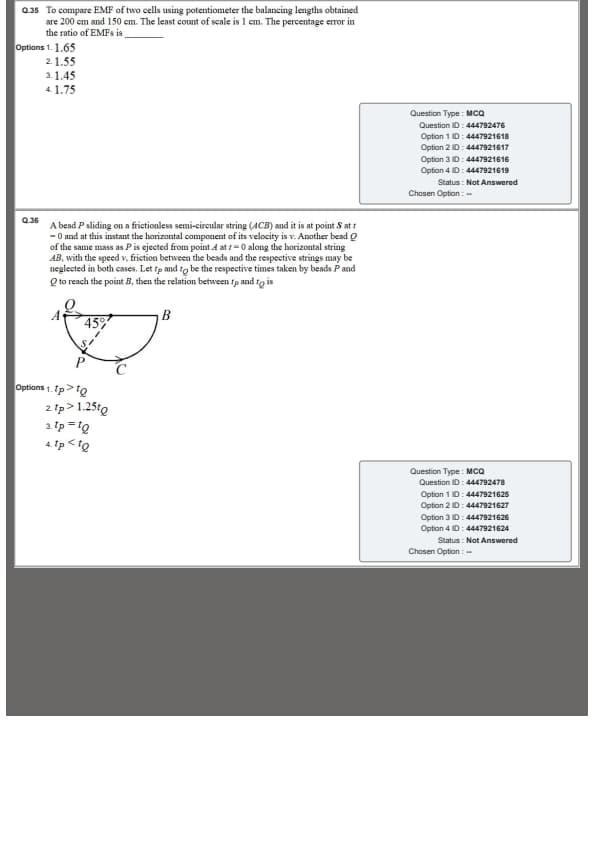
To compare EMF of two cells using potentiometer... 200 cm and 150 cm... percentage error in the ratio of EMFs is _________.
A bead P sliding on a frictionless semi-circular string... bead Q ejected... relation between \(t_P\) and \(t_Q\) is
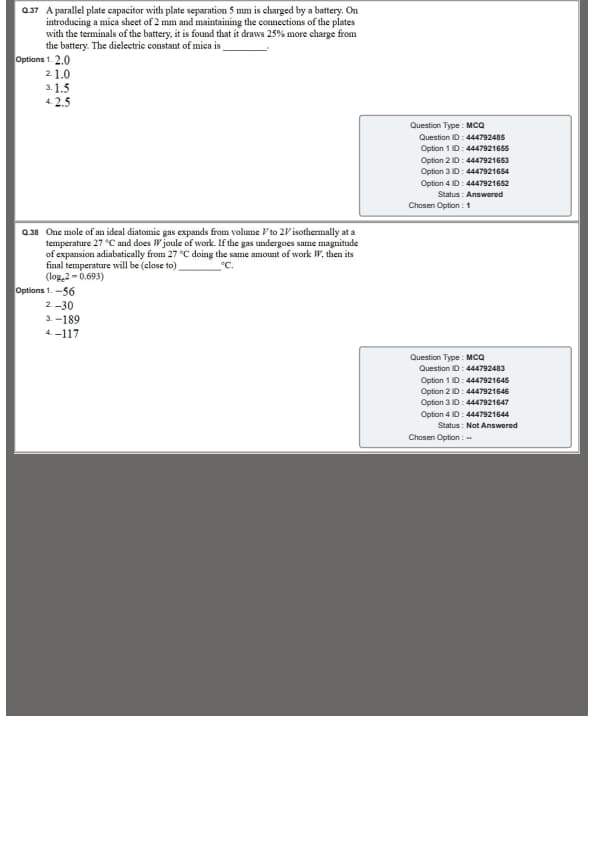
Parallel plate capacitor... separation 5 mm... mica sheet 2 mm... draws 25% more charge. Dielectric constant is ___.
One mole of ideal diatomic gas expands... final temperature will be (close to) ___ \(^\circ\)C.
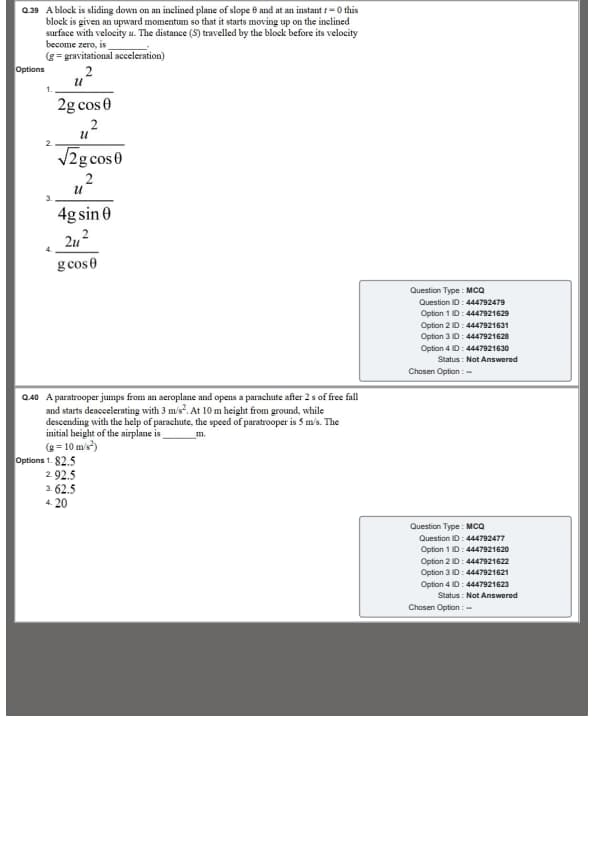
Block sliding down... moving up... distance S before stopping is _____.
Paratrooper jumps... opens parachute after 2s... initial height is ___ m.
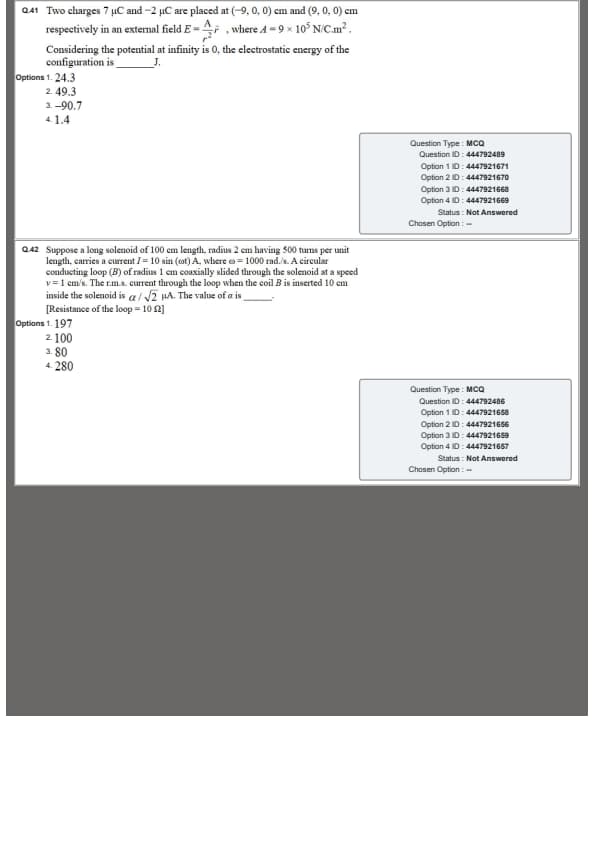
Two charges \(7 \mu C\) and \(-2 \mu C\) are placed at \((-9, 0, 0)\) cm and \((9, 0, 0)\) cm respectively in an external field \(E = \frac{A}{r^2}\hat{r}\), where \(A = 9 \times 10^5 N/C.m^2\). Considering the potential at infinity is 0, the electrostatic energy of the configuration is ___ J.
Suppose a long solenoid of 100 cm length, radius 2 cm having 500 turns per unit length, carries a current \(I = 10 \sin (\omega t)\) A, where \(\omega = 1000\) rad./s. A circular conducting loop (B) of radius 1 cm coaxially slided through the solenoid at a speed \(v = 1\) cm/s. The r.m.s. current through the loop when the coil B is inserted 10 cm inside the solenoid is \(\alpha / \sqrt{2} \mu A\). The value of \(\alpha\) is ___. [Resistance of the loop = 10 \(\Omega\)]
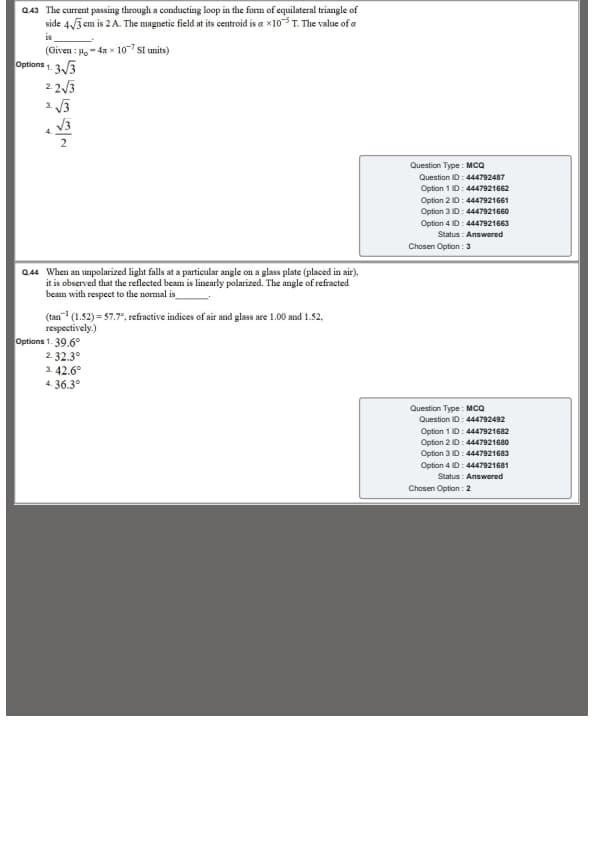
The current passing through a conducting loop in the form of equilateral triangle of side \(4\sqrt{3}\) cm is 2 A. The magnetic field at its centroid is \(\alpha \times 10^{-5}\) T. The value of \(\alpha\) is ___. (Given : \(\mu_0 = 4\pi \times 10^{-7}\) SI units)
When an unpolarized light falls at a particular angle on a glass plate (placed in air), it is observed that the reflected beam is linearly polarized. The angle of refracted beam with respect to the normal is ___. (\(\tan^{-1}(1.52) = 57.7^\circ\), refractive indices of air and glass are 1.00 and 1.52, respectively.)
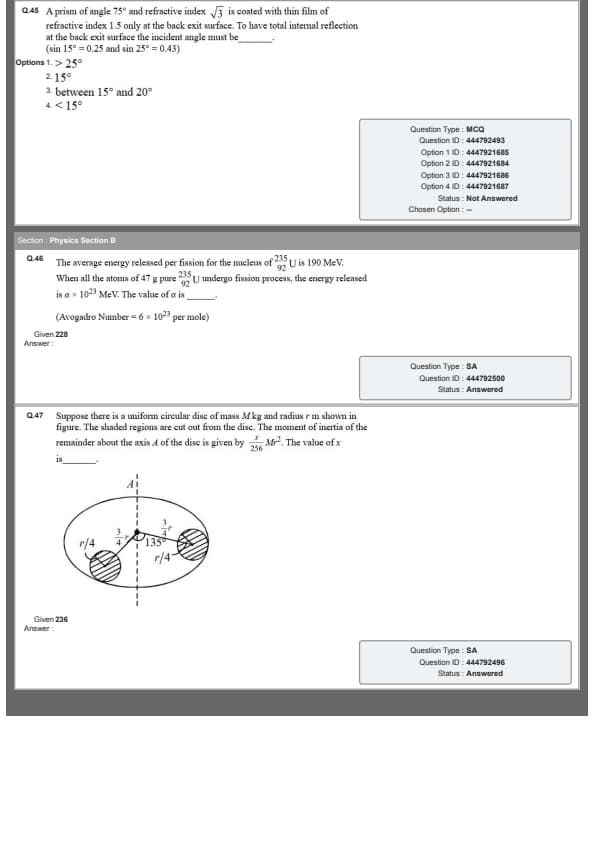
A prism of angle \(75^\circ\) and refractive index \(\sqrt{3}\) is coated with thin film of refractive index 1.5 only at the back exit surface. To have total internal reflection at the back exit surface the incident angle angle must be ___. (\(\sin 15^\circ = 0.25\) and \(\sin 25^\circ = 0.43\))
The average energy released per fission for the nucleus of \(^{235}_{92}U\) is 190 MeV. When all the atoms of 47 g pure \(^{235}_{92}U\) undergo fission process, the energy released is \(\alpha \times 10^{23}\) MeV. The value of \(\alpha\) is ___. (Avogadro Number \(= 6 \times 10^{23}\) per mole)
Suppose there is a uniform circular disc of mass M kg and radius r m shown in figure. The shaded regions are cut out from the disc. The moment of inertia of the remainder about the axis A of the disc is given by \(\frac{x}{256} Mr^2\). The value of x is ___.
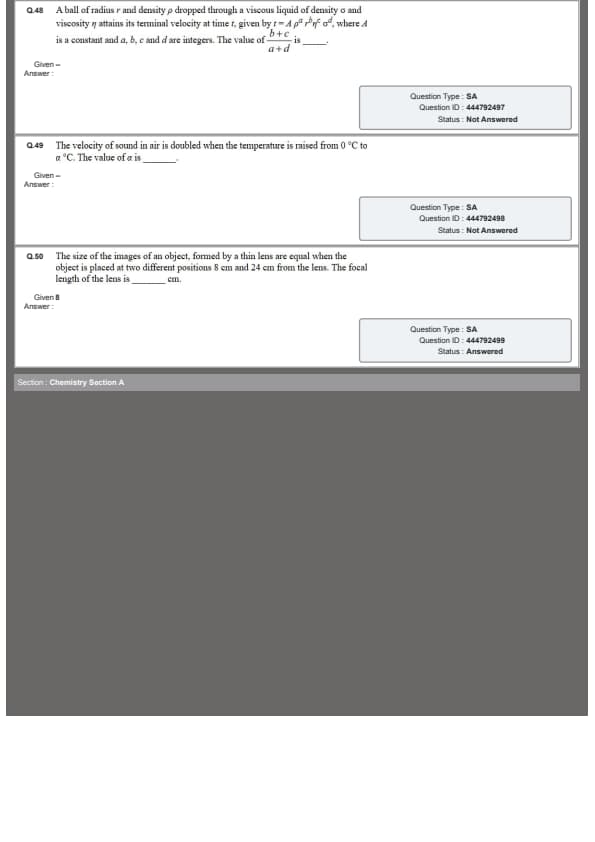
A ball of radius r and density \(\rho\) dropped through a viscous liquid of density \(\sigma\) and viscosity \(\eta\) attains its terminal velocity at time t, given by \(t = A \rho^a r^b \eta^c \sigma^d\), where A is a constant and a, b, c and d are integers. The value of \(\frac{b+c}{a+d}\) is ___.
The velocity of sound in air is doubled when the temperature is raised from \(0 ^\circ\)C to \(a ^\circ\)C. The value of a is ___.
The size of the images of an object, formed by a thin lens are equal when the object is placed at two different positions 8 cm and 24 cm from the lens. The focal length of the lens is ___ cm.
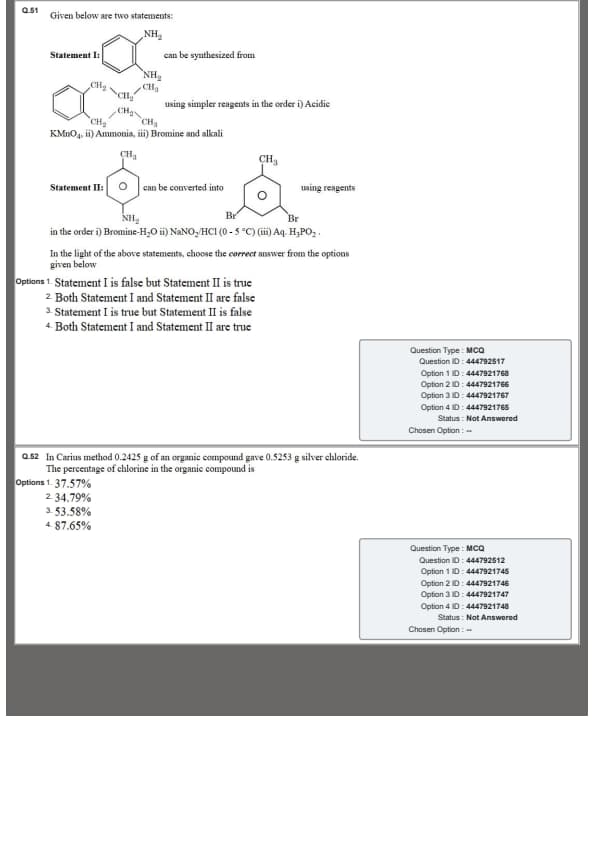
Given below are two statements:
Statement I: Aniline can be synthesized from propylbenzene using simpler reagents in the order i) Acidic KMnO4, ii) Ammonia, iii) Bromine and alkali
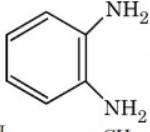
Statement II: Aniline can be converted into 1,3,5-tribromobenzene using reagents in the order i) Bromine-H2O ii) NaNO2/HCl (0 - 5 C) (iii) H3PO2.
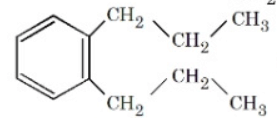
In the light of the above statements, choose the correct answer from the options given below
In Carius method 0.2425 g of an organic compound gave 0.5253 g silver chloride. The percentage of chlorine in the organic compound is
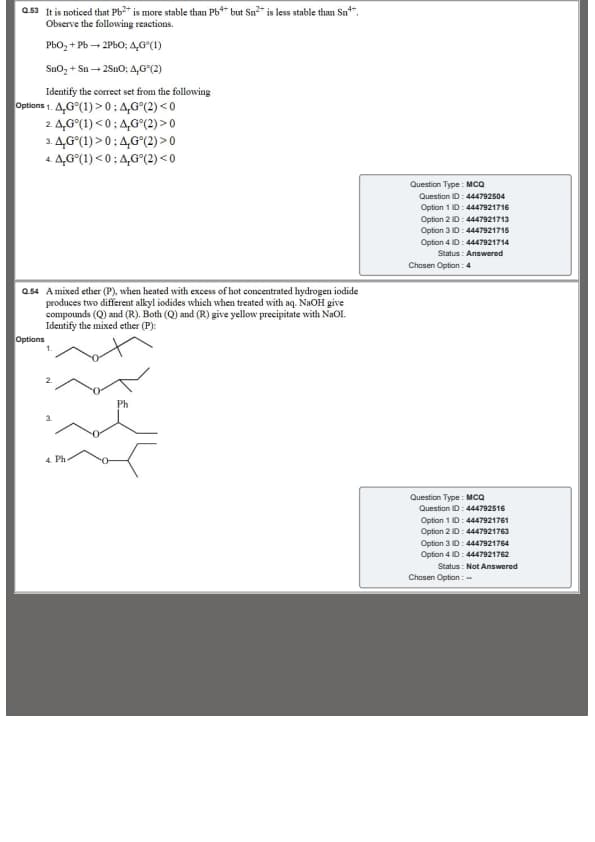
It is noticed that \(Pb^{2+}\) is more stable than \(Pb^{4+}\) but \(Sn^{2+}\) is less stable than \(Sn^{4+}\). Observe the following reactions.
\(PbO_2 + Pb \to 2PbO ; \Delta_rG^\circ(1)\)
\(SnO_2 + Sn \to 2SnO ; \Delta_rG^\circ(2)\)
Identify the correct set from the following
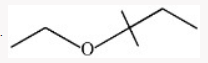
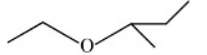
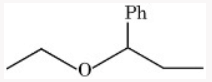
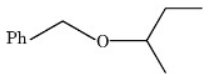
A mixed ether (P), when heated with excess of hot concentrated hydrogen iodide produces two different alkyl iodides which when treated with aq. NaOH give compounds (Q) and (R) give yellow precipitate with NaOI. Identify the mixed ether (P):
- (A)
![]()
- (B)
![]()
- (C)
![]()
- (D)
![]()
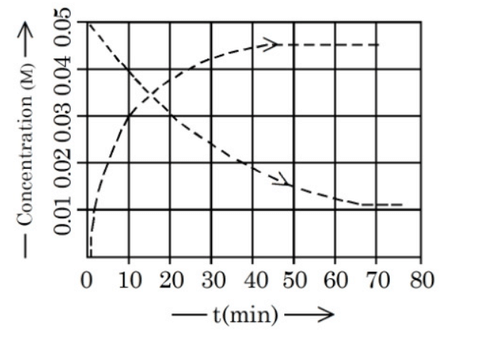
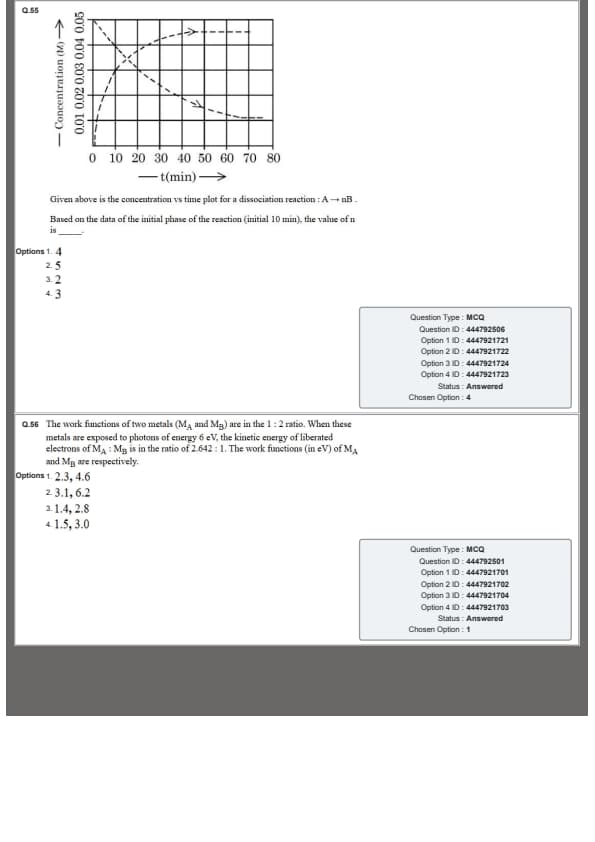
Given above is the concentration vs time plot for a dissociation reaction : \(A \to nB\). Based on the data of the initial phase of the reaction (initial 10 min), the value of n is ____.
The work functions of two metals (\(M_A\) and \(M_B\)) are in the 1 : 2 ratio. When these metals are exposed to photons of energy 6 eV, the kinetic energy of liberated electrons of \(M_A\) : \(M_B\) is in the ratio of 2.642 : 1. The work functions (in eV) of \(M_A\) and \(M_B\) are respectively.
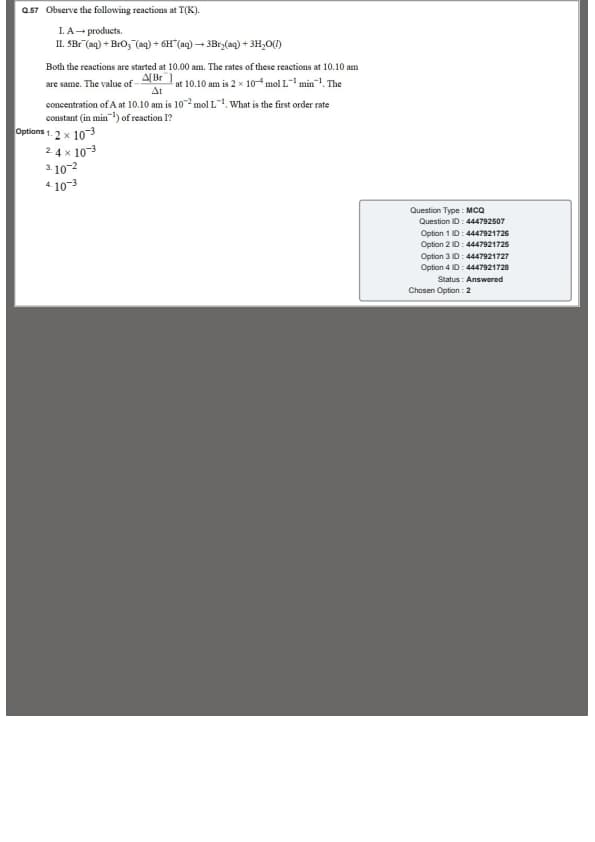
Observe the following reactions at T(K).
I. \(A \to\) products.
II. \(5Br^- + BrO_3^- + 6H^+ \to 3Br_2 + 3H_2O\).
Both the reactions are started at 10.00 am. The rates of these reactions at 10.10 am are same. The value of \(-\frac{d[Br^-]}{dt}\) at 10.10 am is \(2 \times 10^{-4} mol L^{-1} min^{-1}\). The concentration of A at 10.10 am is \(10^{-2} mol L^{-1}\). What is the first order rate constant (in \(min^{-1}\)) of reaction I?
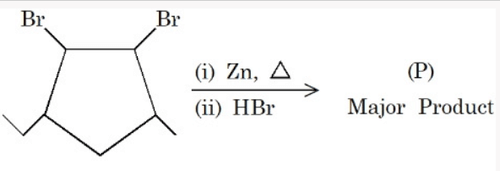
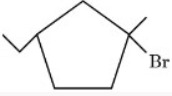
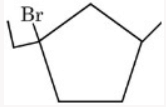
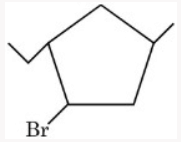
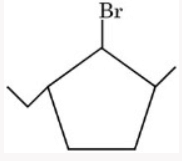
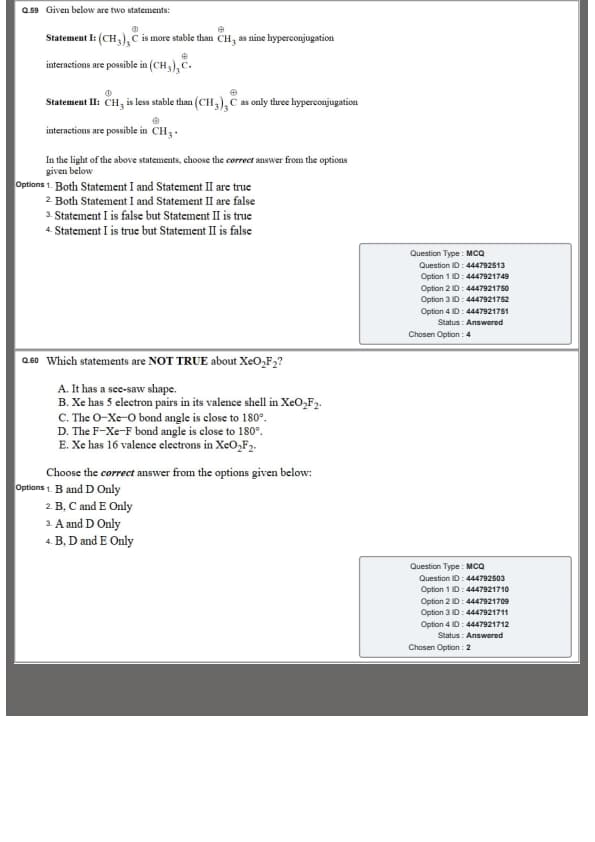
Given below are two statements:
Statement I: \(CH_3)_3C^+\) is more stable than \(CH_3CH_2^+\) as nine hyperconjugation interactions are possible in \((CH_3)_3C^+\).
Statement II: \(CH_3^+\) is less stable than \((CH_3)_3C^+\) as only three hyperconjugation interactions are possible in \(CH_3^+\).
In the light of the above statements, choose the correct answer...
Which statements are NOT TRUE about \(XeO_2F_2\)?
A. It has a see-saw shape.
B. Xe has 5 electron pairs in its valence shell in \(XeO_2F_2\).
C. The O-Xe-O bond angle is close to \(180^\circ\).
D. The F-Xe-F bond angle is close to \(180^\circ\).
E. Xe has 16 valence electrons in \(XeO_2F_2\).
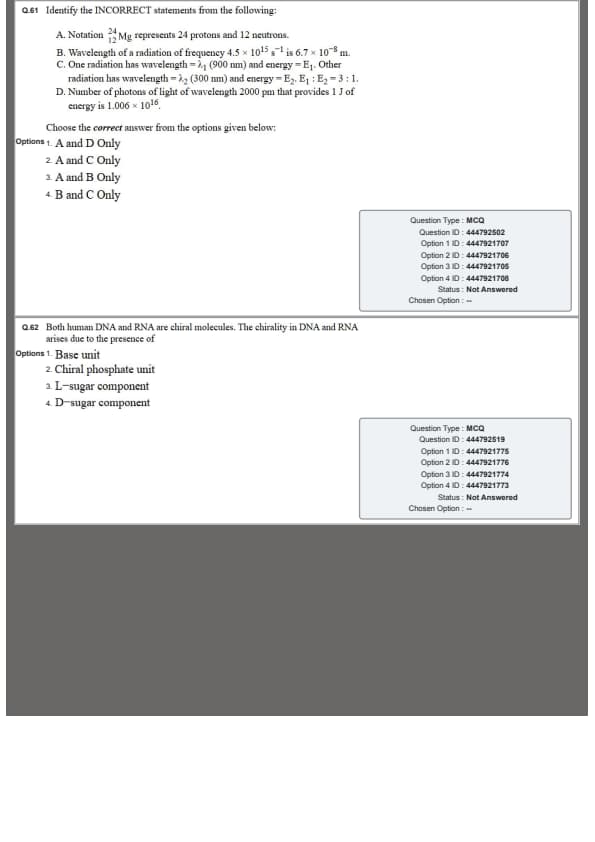
Identify the INCORRECT statements from the following:
A. Notation \(^{24}_{12}Mg\) represents 24 protons and 12 neutrons.
B. Wavelength of a radiation of frequency \(4.5 \times 10^{15} s^{-1}\) is \(6.7 \times 10^{-8} m\).
C. One radiation has wavelength \(\lambda_1\) (900 nm) and energy \(E_1\). Other radiation has wavelength \(\lambda_2\) (300 nm) and energy \(E_2\). \(E_1 : E_2 = 3 : 1\).
D. Number of photons of light of wavelength 2000 pm that provides 1 J of energy is \(1.006 \times 10^{16}\).
Both human DNA and RNA are chiral molecules. The chirality in DNA and RNA arises due to the presence of ___
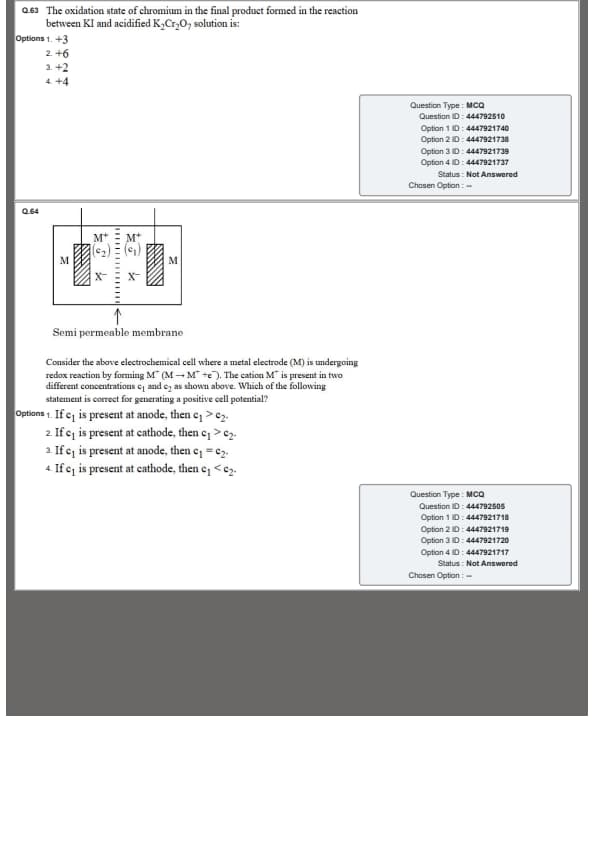
The oxidation state of chromium in the final product formed in the reaction between KI and acidified \(K_2Cr_2O_7\) solution is:
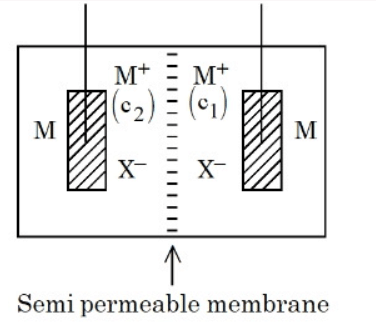
Consider the above electrochemical cell where a metal electrode (M) is undergoing redox reaction by forming \(M^+\) (\(M \to M^+ + e^-\)). The cation \(M^+\) is present in two different concentrations \(c_1\) and \(c_2\) as shown above. Which of the following statement is correct for generating a positive cell potential?
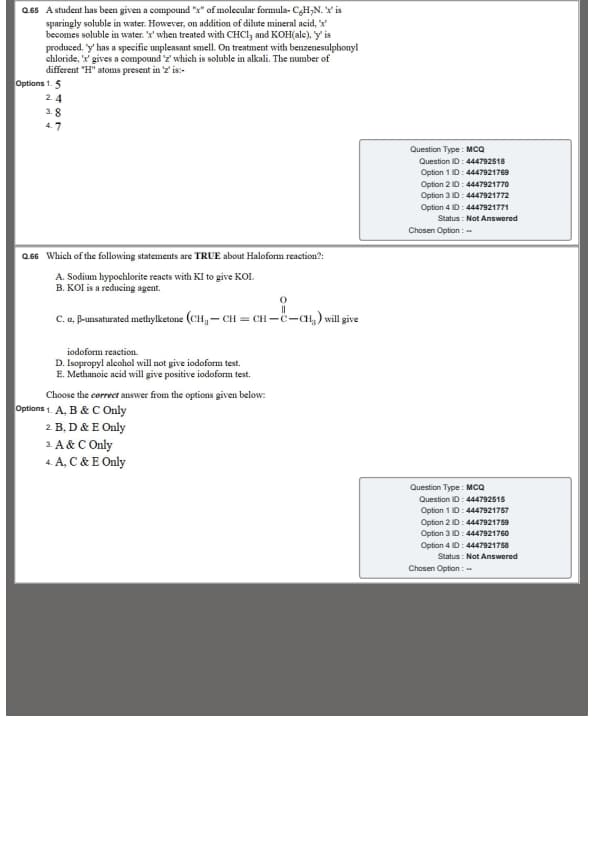
A student has been given a compound "x" of molecular formula- \(C_6H_7N\). 'x' is sparingly soluble in water... On treatment with benzenesulphonyl chloride, 'x' gives a compound 'z' which is soluble in alkali. The number of different "H" atoms present in 'z' is:-
Which of the following statements are TRUE about Haloform reaction?:
A. Sodium hypochlorite reacts with KI to give KOI.
B. KOI is a reducing agent.
C. \(\alpha, \beta\)-unsaturated methylketone (\(CH_3-CH=CH-C=O-CH_3\)) will give iodoform reaction.
D. Isopropyl alcohol will not give iodoform test.
E. Methanoic acid will give positive iodoform test.
Elements X and Y belong to Group 15. The difference between the electronegativity values of 'X' and phosphorus is higher than that of the difference between phosphorus and 'Y'. 'X' \& 'Y' are respectively
Iodoform test can differentiate between
A. Methanol and Ethanol
B. \(CH_3COOH\) and \(CH_3CH_2COOH\)
C. Cyclohexene and cyclohexanone
D. Diethyl ether and Pentan-3-one
E. Anisole and acetone
Identify the CORRECT set of details from the following:
A. \([Co(NH_3)_6]^{3+}\): Inner orbital complex; \(d^2sp^3\) hybridized
B. \([MnCl_6]^{3-}\): Outer orbital complex; \(sp^3d^2\) hybridized
C. \([CoF_6]^{3-}\): Outer orbital complex; \(d^2sp^3\) hybridized
D. \([FeF_6]^{3-}\): Outer orbital complex; \(sp^3d^2\) hybridized
E. \([Ni(CN)_4]^{2-}\): Inner orbital complex; \(sp^3\) hybridized
Given below are two statements:
Statement I: The second ionisation enthalpy of Na is larger than the corresponding ionisation enthalpy of Mg.
Statement II: The ionic radius of \(O^{2-}\) is larger than that of \(F^-\).
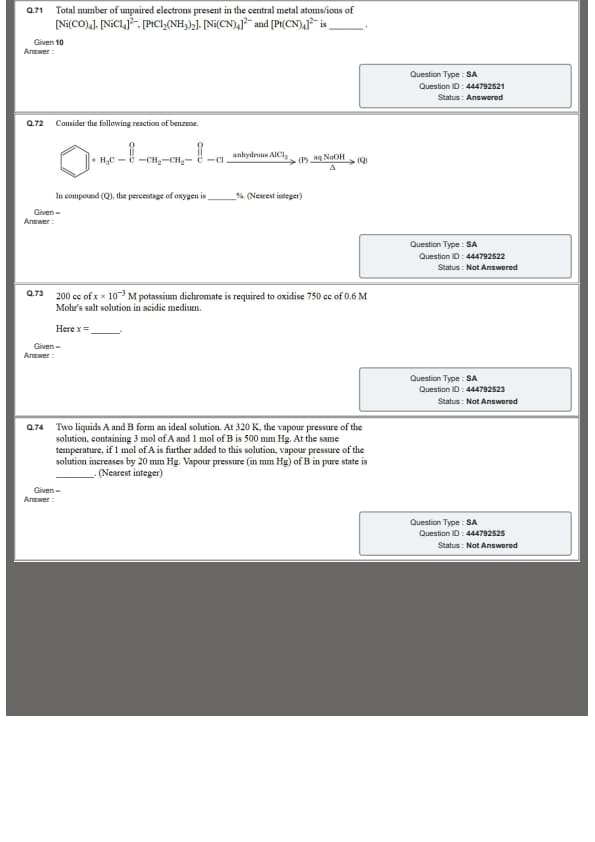
Total number of unpaired electrons present in the central metal atoms/ions of \([Ni(CO)_4]\), \([NiCl_4]^{2-}\), \([PtCl_2(NH_3)_2]\), \([Ni(CN)_4]^{2-}\) and \([Pt(CN)_4]^{2-}\) is ___.
Consider the following reaction of benzene. the percentage of oxygen is ___ %. (Nearest integer)

200 cc of \(x \times 10^{-3}\) M potassium dichromate is required to oxidise 750 cc of 0.6 M Mohr's salt solution in acidic medium. Here \(x = \_\_\_\).
Two liquids A and B form an ideal solution. At 320 K, the vapour pressure of the solution, containing 3 mol of A and 1 mol of B is 500 mm Hg. At the same temperature, if 1 mol of A is further added... vapour pressure of B in pure state is ___ mm Hg. (Nearest integer)
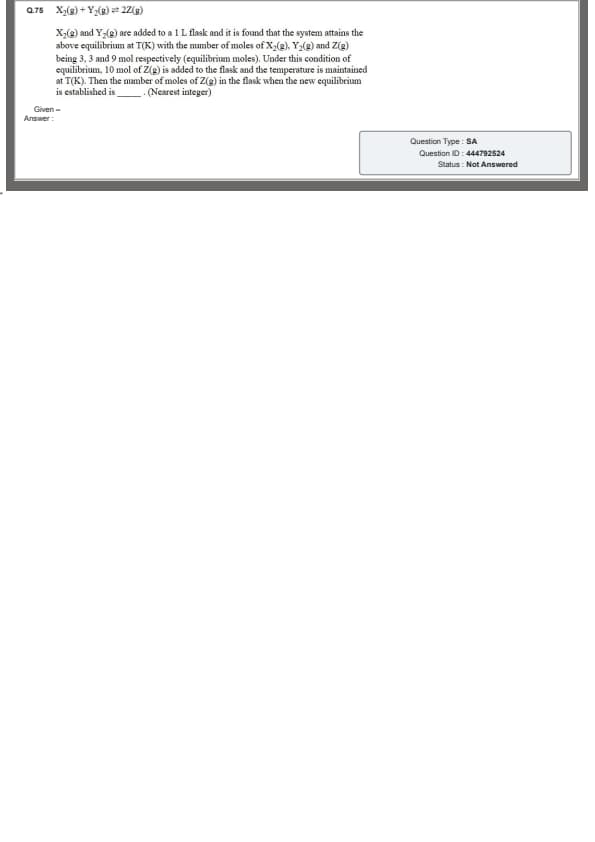
\(X_2(g) + Y_2(g) \rightleftharpoons 2Z(g)\). Equilibrium moles of \(X_2, Y_2, Z\) are 3, 3, 9 mol (in 1 L). 10 mol of Z(g) is added. New equilibrium moles of Z(g) is ___. (Nearest integer)





Comments