




NTA has released JEE Main 2026 official question papers on their website jeemain.nta.nic.in. JEE Main 2026 April 2 Shift 1 Question Paper with Answer Key and Solution PDF is available here.
NTA conducted JEE Main 2026 April 2 Shift 1 from 9 AM to 12 PM in CBT Mode in 3 sections: Physics, Chemistry, and Mathematics according to the latest JEE Main exam pattern.
Also Check:
JEE Main 2026 April 2 Shift 1 Question Paper with Solution PDF


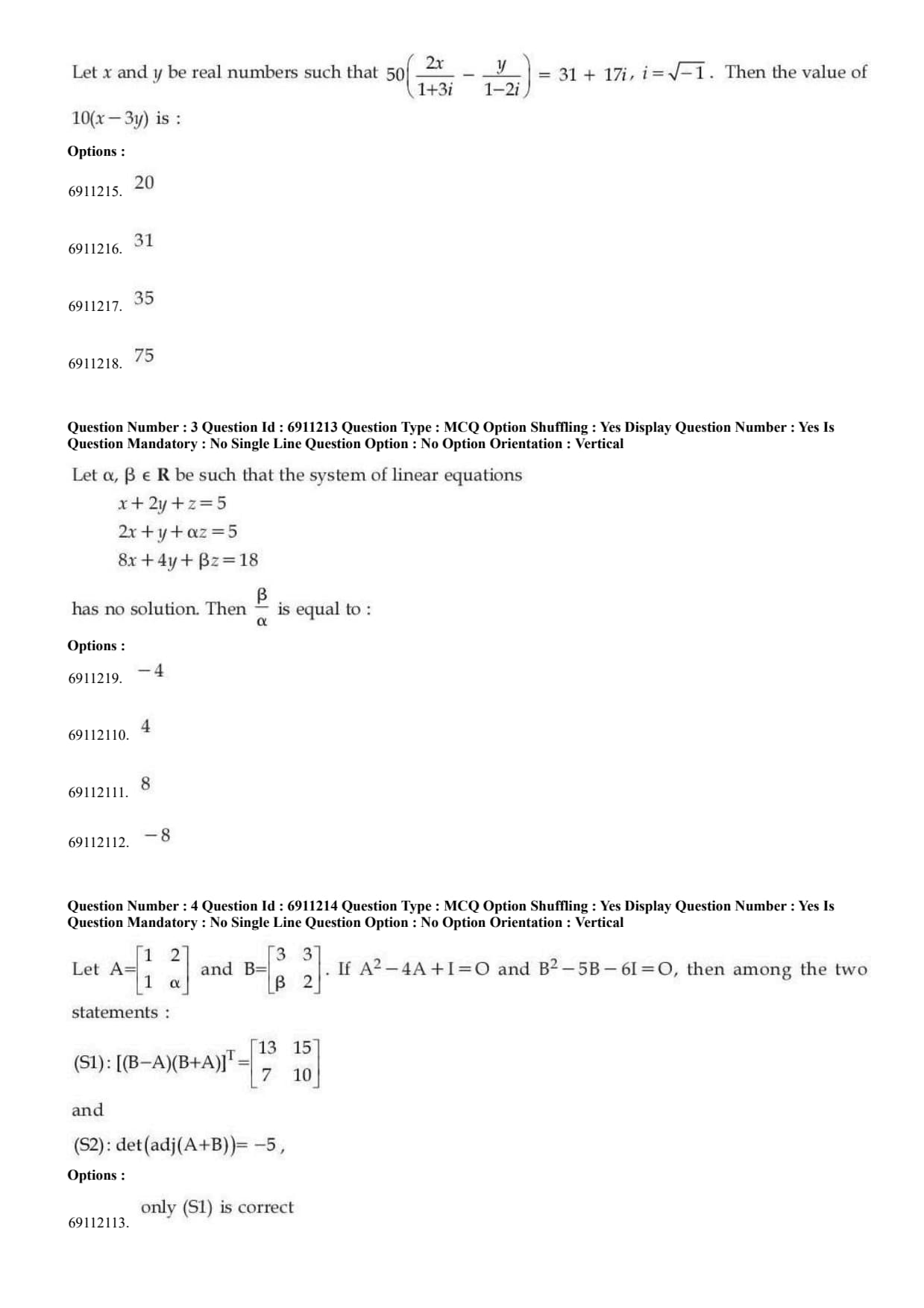


Let \( \alpha, \alpha + 2 \in \mathbb{Z} \) be the roots of the quadratic equation \[ x(x+2) + (x+1)(x+3) + (x+2)(x+4) + \cdots + (x+n-1)(x+n+1) = 4n \]
for some \( n \in \mathbb{N} \). Then \( n + \alpha \) is equal to:
Let \(x\) and \(y\) be real numbers such that \[ 50\left(\frac{2x}{1+3i} - \frac{y}{1-2i}\right) = 31 + 17i, \qquad i = \sqrt{-1}. \]
Then the value of \(10(x-3y)\) is:
Let \( \alpha, \beta \in \mathbb{R} \) be such that the system of linear equations \[ x + 2y + z = 5 \] \[ 2x + y + \alpha z = 5 \] \[ 8x + 4y + \beta z = 18 \]
has no solution. Then \( \frac{\beta}{\alpha} \) is equal to:
Let \[ A= \begin{bmatrix} 1 & 2
1 & \alpha \end{bmatrix} \quad and \quad B= \begin{bmatrix} 3 & 3
\beta & 2 \end{bmatrix}. \]
If \(A^2-4A+I=O\) and \(B^2-5B-6I=O\), then among the following statements:
(S1): \[ [(B-A)(B+A)]^T= \begin{bmatrix} 13 & 15
7 & 10 \end{bmatrix} \]
(S2): \[ \det(\operatorname{adj}(A+B))=-5 \]
Choose the correct option:
Let \(A\) be the set of first \(101\) terms of an A.P., whose first term is \(1\) and the common difference is \(5\), and let \(B\) be the set of first \(71\) terms of an A.P., whose first term is \(9\) and the common difference is \(7\). Then the number of elements in \(A \cap B\), which are divisible by \(3\), is:
The number of seven-digit numbers that can be formed by using the digits \(1,2,3,5,7\) such that each digit is used at least once, is:
The number of elements in the set \[ S=\left\{(r,k): k\in \mathbb{Z} and {^{36}C_{r+1}}=\frac{6\left({^{35}C_r}\right)}{k^2-3}\right\} \]
is:
If the mean of the following grouped data is \(21\):

then \(k\) is one of the roots of the equation:
Let the midpoints of the sides of a triangle \(ABC\) be \( \left(\frac{5}{2},7\right), \left(\frac{5}{2},3\right)\) and \( (4,5) \). If its incentre is \((h,k)\), then \(3h+k\) is equal to:
Let an ellipse \[ \frac{x^2}{a^2}+\frac{y^2}{b^2}=1,\quad apass through the point \((4,3)\) and have eccentricity \( \frac{\sqrt5}{3} \). Then the length of its latus rectum is:
If \[ \sin\left(\frac{\pi}{18}\right)\sin\left(\frac{5\pi}{18}\right)\sin\left(\frac{7\pi}{18}\right)=K, \]
then the value of \[ \sin\left(\frac{10K\pi}{3}\right) \]
is:
Let \[ S=\{x\in[-\pi,\pi]:\sin x(\sin x+\cos x)=a,\; a\in\mathbb{Z}\}. \]
Then \(n(S)\) is equal to:
If the point of intersection of the lines \[ \frac{x+1}{3}=\frac{y+a}{5}=\frac{z+b+1}{7} \] \[ \frac{x-2}{1}=\frac{y-b}{4}=\frac{z-2a}{7} \]
lies on the \(xy\)-plane, then the value of \(a+b\) is:
If \(|\vec a|=2\) and \(|\vec b|=3\), then the maximum value of
\[ 3\left|\left(\vec a+2\vec b\right)\right| + 4\left|\left(3\vec a-2\vec b\right)\right| \]
is:
Let a line \(L\) passing through the point \((1,1,1)\) be perpendicular to both the vectors \(2\hat{i}+2\hat{j}+\hat{k}\) and \(\hat{i}+2\hat{j}+2\hat{k}\). If \((a,b,c)\) is the foot of perpendicular from the origin on the line \(L\), then the value of \(34(a+b+c)\) is:
If \[ \lim_{x\to 2}\frac{\sin(x^3-5x^2+ax+b)}{(\sqrt{x-1}-1)\log_e(x-1)}=m, \]
then \(a+b+m\) is equal to:
If the curve \(y=f(x)\) passes through the point \((1,e)\) and satisfies the differential equation \[ dy=y(2+\log_e x)\,dx,\quad x>0, \]
then \(f(e)\) is equal to:
The number of critical points of the function \[ f(x)= \begin{cases} \dfrac{|\sin x|}{x}, & x\neq0
1, & x=0 \end{cases} \]
in the interval \((-2\pi,2\pi)\) is equal to:
Let \([\,]\) denote the greatest integer function. Then the value of \[ \int_{0}^{3}\left(\frac{e^x+e^{-x}}{[x]!}\right)dx \]
is:
Let \(y=y(x)\) be the solution curve of the differential equation \[ (1+\sin x)\frac{dy}{dx}+(y+1)\cos x=0,\qquad y(0)=0. \]
If the curve passes through the point \( \left(\alpha,-\frac12\right) \), then a value of \( \alpha \) is:
If the domain of the function \[ f(x)=\sqrt{\log_{0.6}\left(\left|\frac{2x-5}{x^2-4}\right|\right)} \]
is \((-\infty,a] \cup \{b\} \cup [c,d) \cup (e,\infty)\), then the value of \(a+b+c+d+e\) is _______.
If \[ \sum_{k=1}^{n} a_k = 6n^3, \]
then \[ \sum_{k=1}^{6}\left(\frac{a_{k+1}-a_k}{36}\right)^2 \]
is equal to _______.
Let \(a,b,c \in \{1,2,3,4\}\). If the probability that \[ ax^2 + 2\sqrt{2}\,bx + c > 0 \quad for all x \in \mathbb{R} \]
is \( \frac{m}{n} \), where \(\gcd(m,n)=1\), then \(m+n\) is equal to _____.
Let a circle \(C\) have its centre in the first quadrant, intersect the coordinate axes at exactly three points and cut off equal intercepts from the coordinate axes. If the length of the chord of \(C\) on the line \(x+y=1\) is \(\sqrt{14}\), then the square of the radius of \(C\) is _____.
If \[ \alpha=\int_{0}^{2\sqrt{3}} \log_2(x^2+4)\,dx + \int_{2}^{4} \sqrt{2^x-4}\,dx, \]
then \(\alpha^2\) is equal to _____.
The dimensional formula of \( \frac{1}{2}\varepsilon_0 E^2 \) (\(\varepsilon_0\) = permittivity of vacuum and \(E\) = electric field) is \(M^aL^bT^c\). The value of \(2a-b+c\) is:
The diameter of a wire measured by a screw gauge of least count \(0.001\) cm is \(0.08\) cm. The length measured by a scale of least count \(0.1\) cm is \(150\) cm. When a weight of \(100\) N is applied to the wire, the extension in length is \(0.5\) cm measured by a micrometer of least count \(0.001\) cm. The error in the measured Young’s modulus is \(\alpha \times 10^9\) N/m\(^2\). The value of \(\alpha\) is:
The velocity of a particle is given as \[ \vec{v}=-x\hat{i}+2y\hat{j}-z\hat{k}\ m/s. \]
The magnitude of acceleration at the point \((1,2,4)\) is _____ m/s\(^2\).
The position of an object having mass \(0.1\) kg as a function of time \(t\) is given as
\[ \vec r = (10t^2\hat{i}+5t^3\hat{j})\ m. \]
At \(t=1\) s, which of the following statements are correct?
A. Linear momentum \( \vec p = (2\hat{i}+1.5\hat{j})\) kg m/s.
B. Force acting on the object \( \vec F = (2\hat{i}+3\hat{j})\) N.
C. Angular momentum about origin \( \vec L = 15\hat{k}\) J s.
D. Torque about origin \( \vec \tau = 20\hat{k}\) N m.
Choose the correct answer.
A planet \(P_1\) is moving around a star of mass \(2M\) in an orbit of radius \(R\). Another planet \(P_2\) is moving around another star of mass \(4M\) in an orbit of radius \(2R\). The ratio of time periods of revolution of \(P_2\) and \(P_1\) is:
A particle is rotating in a circular path and at any instant its motion can be described as
\[ \theta=\frac{5t^4}{40}-\frac{t^3}{3}. \]
The angular acceleration of the particle after \(10\) seconds is ____ rad/s\(^2\).
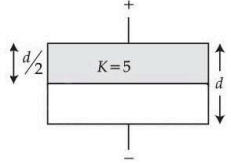
A parallel plate air capacitor has a capacitance \(C\). When it is half filled as shown in the figure with a dielectric constant \(K=5\), the percentage increase in the capacitance is:
Heat is supplied to a diatomic gas at constant pressure. Then the ratio of \( \Delta Q : \Delta U : \Delta W \) is:
Two charged conducting spheres \(S_1\) and \(S_2\) of radii \(8\) cm and \(18\) cm are connected to each other by a wire. After equilibrium is established, the ratio of electric fields on \(S_1\) and \(S_2\) spheres are \(E_{S_1}\) and \(E_{S_2}\) respectively. The value of \( \dfrac{E_{S_1}}{E_{S_2}} \) is:
The equation of a plane progressive wave is given by
\[ y = 5\cos\pi\left(200t - \frac{x}{150}\right) \]
where \(x\) and \(y\) are in cm and \(t\) is in seconds. The velocity of the wave is ____ m/s.
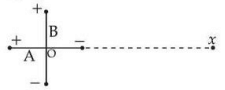
Two short electric dipoles \(A\) and \(B\) having dipole moments \(p_1\) and \(p_2\) respectively are placed with their axes mutually perpendicular as shown in the figure. The resultant electric field at a point \(x\) is making an angle of \(60^\circ\) with the line joining points \(O\) and \(x\). The ratio of dipole moments \( \dfrac{p_2}{p_1} \) is:
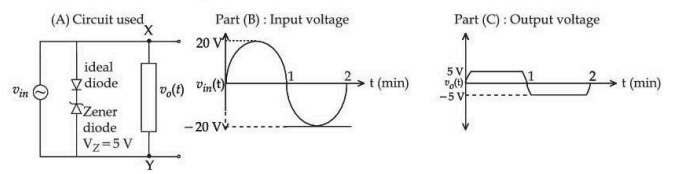
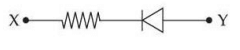
For the given circuit (shown in part A) the time dependent input voltage \(v_{in}(t)\) and corresponding output \(v_o(t)\) are shown in parts (B) and (C), respectively. Identify the components that are used in the circuit between \(X\) and \(Y\).
- (A)
![]()
- (B)
![]()
- (C)
![]()
- (D)
![]()



When a coil is placed in a time dependent magnetic field the power dissipated in it is \(P\). The number of turns, area of the coil and radius of the coil wire are \(N, A\) and \(r\) respectively. For a second coil the number of turns, area of the coil and radius of the coil wire are \(2N, 2A\) and \(3r\) respectively. If the first coil is replaced with second coil the power dissipated in it is \(\sqrt{2}\alpha P\). The value of \(\alpha\) is:
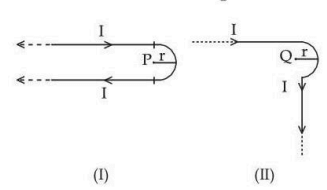
Two identical long current carrying wires are bent into the shapes shown. If the magnitude of magnetic fields at the centres \(P\) and \(Q\) of a semicircular arc are \(B_1\) and \(B_2\) respectively, then the ratio \( \dfrac{B_1}{B_2} \) is:
For a thin symmetric prism made of glass (refractive index \(1.5\)), the ratio of incident angle and minimum deviation will be _____.
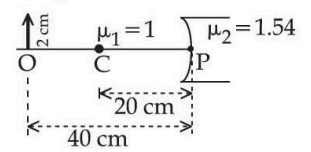
Refer the figure below. \( \mu_1 \) and \( \mu_2 \) are refractive indices of air and lens material respectively. The height of image will be _____ cm.
For a certain metal, when monochromatic light of wavelength \(\lambda\) is incident, the stopping potential for photoelectrons is \(3V_0\). When the same metal is illuminated by light of wavelength \(2\lambda\), the stopping potential becomes \(V_0\). The threshold wavelength for photoelectric emission for the given metal is \(\alpha \lambda\). The value of \(\alpha\) is:
An electromagnetic wave travelling in \(x\)-direction is described by the field equation
\[ E_y = 300 \sin \omega\left(t - \frac{x}{c}\right). \]
If the electron is restricted to move in \(y\)-direction only with speed \(1.5 \times 10^6\) m/s, then the ratio of maximum electric and magnetic forces acting on the electron is:
Angular momentum of an electron in a hydrogen atom is \( \dfrac{3h}{\pi} \). Then the energy of the electron is ____ eV.
A liquid drop of diameter \(2\) mm breaks into \(512\) droplets. The change in surface energy is \( \alpha \times 10^{-6} \) J. (Take surface tension of liquid = \(0.08\) N/m). The value of \(\alpha\) is ____.
In single slit diffraction pattern, the wavelength of light used is \(628\) nm and slit width is \(0.2\) mm. The angular width of central maximum is \(\alpha \times 10^{-2}\) degrees. The value of \(\alpha\) is ____.
A vessel contains \(0.15\,m^3\) of a gas at pressure \(8\) bar and temperature \(140^\circC\) with \(c_p=3R\) and \(c_v=2R\). It expands adiabatically till pressure falls to \(1\) bar. The work done during this process is ____ kJ. (R is gas constant)
A \(1\,\muC\) charge moving with velocity \[ \vec{v} = (\hat{i} - 2\hat{j} + 3\hat{k}) \, m/s \]
in the region of magnetic field \[ \vec{B} = (2\hat{i} + 3\hat{j} - 5\hat{k}) \, T \]
The magnitude of force acting on it is \( \sqrt{\alpha} \times 10^{-6} \) N. The value of \(\alpha\) is ____.
A uniform wire of length \(l\) of weight \(w\) is suspended from the roof with a weight \(W\) at the other end. The stress in the wire at \( \frac{l}{3} \) distance from the top is \[ \left(\frac{W}{A} + \frac{2}{\gamma}\frac{w}{A}\right) \]
where \(A\) is the cross sectional area of the wire. The value of \(\gamma\) is ____.
A tub is filled with water and a wooden cube \(10\,cm \times 10\,cm \times 10\,cm\) is placed in the water. The wooden cube is found to float on the water with a part of it submerged in water. When a metal coin is placed on the wooden cube, the submerged part is increased by \(3.87\) cm. The mass of the metal coin is ____ gram. (Take water density \(=1\,g/cm^3\) and density of wood as \(0.4\,g/cm^3\)).
The mass of iron converted into \(Fe_3O_4\) by the action of \(18\) g of steam is: (Given: Molar mass of H, O and Fe are \(1, 16\) and \(56\) g mol\(^{-1}\) respectively). Assume iron is present in excess.
What is the energy (in J atom\(^{-1}\)) required for the following process?
\[ Li^{2+}(g) \rightarrow Li^{3+}(g) + e^{-} \]
(Take the ionization energy for the H atom in the ground state as \(2.18 \times 10^{-18}\) J atom\(^{-1}\)).
Given below are two statements:
Statement (I): The correct sequence of bond lengths in the following species is: \[ O_2^+ < O_2 < O_2^- < O_2^{2-} \]
Statement (II): The correct sequence of number of unpaired electrons in the following species is: \[ O_2 > O_2^+ > O_2^- > O_2^{2-} \]
In the light of the above statements, choose the correct answer.
Consider the following equations:
(i) \[ 2Al(s) + 6HCl(aq) \rightarrow Al_2Cl_6(aq) + 3H_2(g) + 1200 \, kJ/mol \]
(ii) \[ H_2(g) + Cl_2(g) \rightarrow 2HCl(g) + 164 \, kJ/mol \]
(iii) \[ HCl(g) + aq \rightarrow HCl(aq) + 83 \, kJ/mol \]
(iv) \[ Al_2Cl_6(s) + aq \rightarrow Al_2Cl_6(aq) + 663 \, kJ/mol \]
The enthalpy of formation of anhydrous solid \(Al_2Cl_6\) is:
19.5 g of fluoro acetic acid (molar mass = 78 g mol\(^{-1}\)) is dissolved in 500 g of water at 298 K. The depression in the freezing point of water was \(1^\circ C\). What is \(K_a\) of fluoro acetic acid? (For water, \(K_f = 1.86\, K\,kg\,mol^{-1}\)). Assume molarity and molality to have same values.
The solubility product constants of \(Ag_2CrO_4\) and \(AgBr\) are \(32x\) and \(4y\) respectively at 298 K. The value of
\[ \left(\frac{molarity of Ag_2CrO_4}{molarity of AgBr}\right) \]
can be expressed as:
An electrochemical cell is constructed using half cells in the direction of spontaneous change
\[ Fe(OH)_2(s) + 2e^- \rightarrow Fe(s) + 2OH^- (aq) \qquad E^\circ = -0.88\,V \]
\[ AgBr(s) + e^- \rightarrow Ag(s) + Br^- (aq) \qquad E^\circ = +0.07\,V \]
Which of the following option is correct?
\(t_{100%}\) is the time required for the 100% completion of the reaction while \(t_{1/2}\) is the time required for 50% of the reaction to be completed. Which of the following correctly represents the relation between \(t_{100%}\) and \(t_{1/2}\) for zero and first order reactions respectively?
Given below are two statements:
Statement (I): The first ionisation enthalpy of the elements Na, Mg, Cl and Ar follows the order \[ Na > Mg > Cl > Ar \]
Statement (II): Among Ca, Al, Fe and B, the third ionisation enthalpy is very high for Ca.
In the light of the above statements, choose the correct answer from the options given below:
Given below are two statements:
Statement (I): Oxidising power of halogens decreases in the order \[ F_2 > Cl_2 > Br_2 > I_2 \]
which is the basis of the “Layer test”.
Statement (II): “Layer test” to identify \(Br_2\) and \(I_2\) in aqueous solution involves the oxidation of bromide or iodide into \(Br_2\) or \(I_2\) respectively with \(Cl_2\), which is a type of displacement redox reaction.
In the light of the above statements, choose the correct answer:
Which of the following sets includes all the species that will change the orange colour of \(K_2Cr_2O_7\) in acidic medium?
Match List-I with List-II.
List-I (Chromium(III) complexes, en = ethylenediamine)
A. \([Cr(CN)_6]^{3-}\)
B. \([CrF_6]^{3-}\)
C. \([Cr(H_2O)_6]^{3+}\)
D. \([Cr(en)_3]^{3+}\)
List-II (\(\Delta_0\) in cm\(^{-1}\))
I. 15,060
II. 17,400
III. 22,300
IV. 26,600
View Solution
Concept:
Crystal field splitting depends on ligand strength.
Spectrochemical series:
\[ CN^- > en > H_2O > F^- \]
Thus the splitting energy order:
\[ [Cr(CN)_6]^{3-} > [Cr(en)_3]^{3+} > [Cr(H_2O)_6]^{3+} > [CrF_6]^{3-} \]
Step 1: Arrange \(\Delta_0\)
Largest \(\Delta_0\):
\[ 26,600 \]
Smallest \(\Delta_0\):
\[ 15,060 \]
Step 2: Match complexes
\[ [Cr(CN)_6]^{3-} \rightarrow 26,600 \]
\[ [Cr(en)_3]^{3+} \rightarrow 22,300 \]
\[ [Cr(H_2O)_6]^{3+} \rightarrow 17,400 \]
\[ [CrF_6]^{3-} \rightarrow 15,060 \]
Thus
\[ A-IV,\ B-I,\ C-II,\ D-III \]
\[ \boxed{A-IV,\ B-I,\ C-II,\ D-III} \] Quick Tip: Ligand field strength increases in the order \(F^- < H_2O < en < CN^-\).
Given below are two statements:
Statement (I): 1,2,3–Trihydroxypropane can be separated from water by simple distillation.
Statement (II): An azeotropic mixture cannot be separated by fractional distillation.
In the light of the above statements, choose the correct answer from the options given below:
Given below are two statements:
Statement (I): Benzyl chloride reacts faster in \(S_N1\) mechanism than ethyl chloride.
Statement (II): Ethyl carbocation intermediate is less stabilized by hyperconjugation than benzyl carbocation by resonance.
In the light of the above statements, choose the correct answer from the options given below:
In IUPAC names the correct order of decreasing priority of functional groups is:
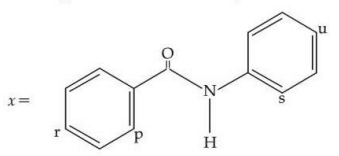
For the given molecule \(X\), the preferred site for the attack of the electrophile is:
Match List–I with List–II.
List–I (Mixture of Compounds)
A. Diethyl amine + Ethyl amine
B. Acetaldehyde + Acetone
C. Ethanol + Phenol
D. Benzoic acid + Cinnamic acid
List–II (Reagent used to distinguish)
I. Bromine water
II. \(CHCl_3 + KOH,\ \Delta\)
III. Neutral \(FeCl_3\)
IV. Ammoniacal silver nitrate
Choose the correct answer.
View Solution
Concept:
Different functional groups respond differently to specific qualitative reagents.
Step 1: A. Diethyl amine vs Ethyl amine
Ethyl amine is a primary amine and gives the carbylamine test.
\[ CHCl_3 + KOH,\ \Delta \]
Thus
\[ A \rightarrow II \]
Step 2: B. Acetaldehyde vs Acetone
Acetaldehyde gives Tollens' test but acetone does not.
Reagent:
\[ Ammoniacal silver nitrate \]
Thus
\[ B \rightarrow IV \]
Step 3: C. Ethanol vs Phenol
Phenol gives a violet complex with neutral \(FeCl_3\).
Thus
\[ C \rightarrow III \]
Step 4: D. Benzoic acid vs Cinnamic acid
Cinnamic acid has a C=C double bond which decolorizes bromine water.
Thus
\[ D \rightarrow I \]
Hence the correct match is:
\[ A-II,\ B-IV,\ C-III,\ D-I \]
\[ \boxed{A-II,\ B-IV,\ C-III,\ D-I} \] Quick Tip: Carbylamine test identifies primary amines, Tollens' test identifies aldehydes, and \(FeCl_3\) test identifies phenols.
Consider the three aromatic molecules (P, Q and R). The correct order regarding the reactivity of these compounds with \(Ph{-}N=N^+Cl^-\) under optimum but slightly acidic medium is:
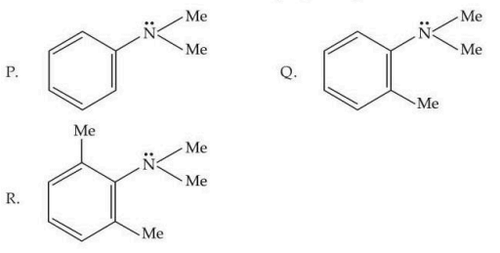
Match List–I with List–II.
List–I (Vitamin)
A. Vitamin \(B_1\)
B. Vitamin \(B_2\)
C. Vitamin \(B_6\)
D. Vitamin \(C\)
List–II (Name)
I. Pyridoxine
II. Ascorbic acid
III. Thiamine
IV. Riboflavin
Choose the correct answer from the options given below:
View Solution
Concept:
Different vitamins have specific chemical names.
Step 1: Identify names
\[ Vitamin B_1 = Thiamine \]
\[ Vitamin B_2 = Riboflavin \]
\[ Vitamin B_6 = Pyridoxine \]
\[ Vitamin C = Ascorbic acid \]
Step 2: Match
\[ A \rightarrow III \]
\[ B \rightarrow IV \]
\[ C \rightarrow I \]
\[ D \rightarrow II \]
Thus
\[ \boxed{A-III,\ B-IV,\ C-I,\ D-II} \] Quick Tip: Vitamin \(B_1\) = Thiamine, \(B_2\) = Riboflavin, \(B_6\) = Pyridoxine, and Vitamin C = Ascorbic acid.
A salt with few drops of HCl gives apple green colour on flame test. The group precipitate of the salt if dissolved in acetic acid and treated with \(K_2CrO_4\) gives yellow precipitate. When the sodium carbonate extract of the salt solution is heated with conc. \(HNO_3\) and ammonium molybdate, it results in a canary yellow precipitate. The cation and anion present in the salt are respectively:
5.33 g of \(CrCl_3 \cdot 6H_2O\), which is a 1:3 electrolyte, is dissolved in water and is passed through a cation exchanger. The chloride ions in the eluted solution, on treatment with \(AgNO_3\), results in 8.61 g of \(AgCl\). The ratio of moles of complex reacted and moles of \(AgCl\) formed is ______ \(\times 10^{-2}\). (Nearest integer)
\[ [Molar\ mass: Cr = 52,\ Ag = 108,\ Cl = 35.5,\ H = 1,\ O = 16] \]
Consider the isomers of hydrocarbon with molecular formula \(C_5H_{10}\). These isomers do not decolourise \(KMnO_4\) solution. These isomers are subjected to chlorination with chlorine in presence of light to give monochloro compounds. The total number of monochloro compounds (structural isomers only) formed is ______.
One mole of an alkane (\(x\)) requires 8 mole oxygen for complete combustion. Sum of number of carbon and hydrogen atoms in the alkane (\(x\)) is ______.
For reaction \(A \rightarrow P\), rate constant \(k = 1.5 \times 10^3\ s^{-1}\) at \(27^\circ C\). If activation energy for the above reaction is \(60\ kJ\ mol^{-1}\), then the temperature (in \(^{\circ}C\)) at which rate constant \(k = 4.5 \times 10^3\ s^{-1}\) is ______. (Nearest integer)
\[ Given: \log 2 = 0.30,\ \log 3 = 0.48,\ R = 8.3\ J\ K^{-1}\ mol^{-1},\ \ln 10 = 2.3 \]
At the transition temperature \(T\), \(A \rightleftharpoons B\) and \(\Delta G^\circ = 105 - 35\log T\), where \(A\) and \(B\) are two states of substance \(X\).
The transition temperature in \(^{\circ}C\) when pressure is 1 atm is ______.
JEE Main 2026 Exam Pattern
| Particulars | Details |
|---|---|
| Exam Mode | Online (Computer-Based Test) |
| Paper | B.E./B.Tech |
| Medium of Exam | 13 languages: English, Hindi, Gujarati, Bengali, Tamil, Telugu, Kannada, Marathi, Malayalam, Odia, Punjabi, Assamese, Urdu |
| Duration | 3 hours (180 minutes) |
| Type of Questions | Multiple Choice Questions (MCQs) + Numerical Value Questions |
| Total Marks | 300 marks |
| Subjects | Mathematics, Physics, Chemistry |
| Marking Scheme | +4 for correct answer & -1 for incorrect MCQ and Numerical Value-based Questions |
| Total Questions | 75 Questions |
| Eligibility | Passed or appearing in Class 12 with Physics, Chemistry, and Mathematics |





Comments