




JEE Main 2026 April 2 Shift 2 physics question paper is available here with answer key and solutions. NTA conducted the second shift of the day on April 2, 2026, from 3:00 PM to 6:00 PM.
- The JEE Main Physics Question Paper contains a total of 25 questions.
- Each correct answer gets you 4 marks while incorrect answers gets you a negative mark of 1.
Candidates can download the JEE Main 2026 April 2 Shift 2 physics question paper along with detailed solutions to analyze their performance and understand the exam pattern better.
Also Check:
- JEE Main 2026 April 4 Shift 1 Question Paper with Solutions
- Download JEE Main 2026 Session 2 Question Paper for all Shifts
JEE Main 2026 April 2 Shift 2 Physics Question Paper with Solution PDF
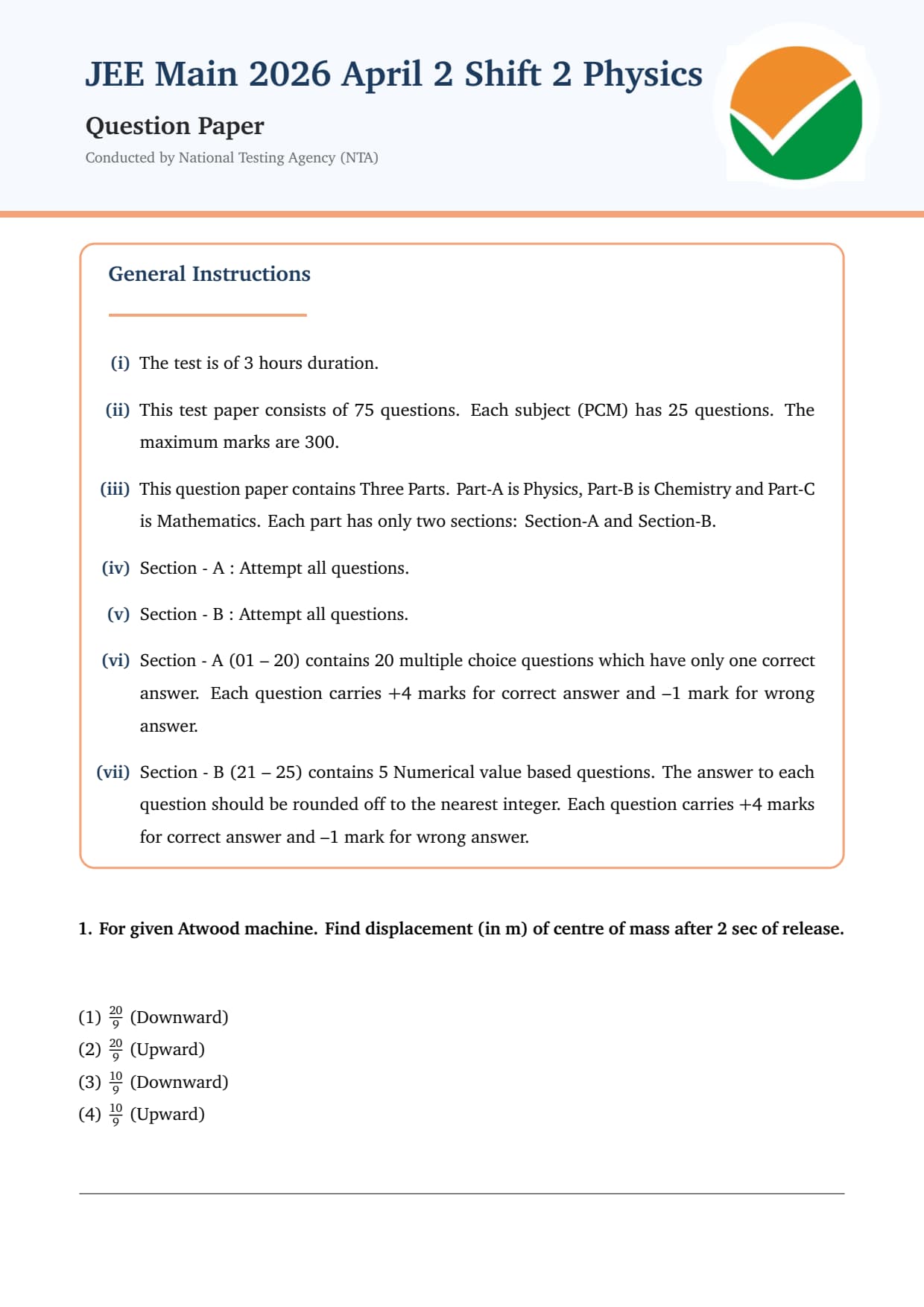



For given Atwood machine, find displacement (in m) of centre of mass after 2 sec of release.

View Solution
Step 1: Identify given masses and system.
This is an Atwood machine with masses \( m_1 = 2\,kg \) and \( m_2 = 1\,kg \). The heavier mass (2 kg) will move downward and the lighter mass (1 kg) will move upward.
Step 2: Find acceleration of the system.
Acceleration of Atwood machine is given by:
\[ a = \frac{(m_1 - m_2)g}{m_1 + m_2} \]
Substituting values:
\[ a = \frac{(2 - 1)g}{2 + 1} = \frac{g}{3} \]
Taking \( g = 10\,m/s^2 \):
\[ a = \frac{10}{3}\,m/s^2 \]
Step 3: Find displacement of each mass in 2 seconds.
Using equation of motion:
\[ s = \frac{1}{2}at^2 \]
\[ s = \frac{1}{2} \cdot \frac{10}{3} \cdot (2)^2 = \frac{1}{2} \cdot \frac{10}{3} \cdot 4 = \frac{20}{3}\,m \]
So, 2 kg moves downward \( \frac{20}{3} \) m and 1 kg moves upward \( \frac{20}{3} \) m.
Step 4: Find displacement of centre of mass.
Displacement of centre of mass is given by:
\[ y_{cm} = \frac{m_1 y_1 + m_2 y_2}{m_1 + m_2} \]
Take downward as positive:
\[ y_1 = \frac{20}{3}, \quad y_2 = -\frac{20}{3} \]
\[ y_{cm} = \frac{2 \cdot \frac{20}{3} + 1 \cdot \left(-\frac{20}{3}\right)}{3} \]
\[ = \frac{\frac{40}{3} - \frac{20}{3}}{3} = \frac{\frac{20}{3}}{3} = \frac{20}{9}\,m \]
Step 5: Direction of displacement.
Since the result is positive (downward taken positive), the centre of mass moves downward.
Final Answer: \( \frac{20}{9} \) m downward. Quick Tip: In Atwood machine problems, always take consistent sign convention. Centre of mass moves in the direction of the heavier mass because it dominates the system.
At any instant, if \( \vec{B} = -2 \times 10^{-7} \hat{j} \, T \) and \( \vec{C} \) is along the +x axis, then \( \vec{E} \) at this instant is:
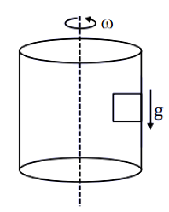
A hollow cylinder of radius 1m is rotating with angular velocity \( \omega = 10 \) rad/sec. Find minimum coefficient of friction \( \mu \) so that the block remains at rest w.r.t. the cylinder.
An air bubble of radius 1 mm is rising up with constant speed of 0.5 cm/s in a liquid of density \( \rho_{liq} = 2000 \, kg/m^3 \). Find the coefficient of viscosity \( \eta \) in poise.
Work function for an object is 2.3 eV. If maximum kinetic energy of ejected electrons is 0.18 eV, find wavelength \( \lambda \) of incident photon on object.
Position of a particle is given by \( x = A \sin \left( 50t + \frac{\pi}{3} \right) \). If speed and acceleration become 0 for the first time at \( t_1 \) and \( t_2 \) sec respectively, then find \( t_1 \) and \( t_2 \) (in sec):
Find \( \left( \dfrac{\mathrm{BE}}{A} \right) \) of \( {}_{83}\mathrm{Bi}^{209} \).
Given : \( M_{\mathrm{Bi}} = 208.9804 \,\mathrm{amu}, \; m_p = 1.007276 \,\mathrm{amu}, \; m_n = 1.008665 \,\mathrm{amu}, \; 1\,\mathrm{amu} = 931\,\mathrm{MeV} \)
View Solution
Step 1: Write the formula for binding energy.
For a nucleus \( {}_{Z}X^{A} \), the total binding energy is calculated by using the mass defect formula:
\[ \mathrm{BE} = \left[ Zm_p + (A-Z)m_n - M_{nucleus} \right] \times 931 \,\mathrm{MeV} \]
Here, for \( {}_{83}\mathrm{Bi}^{209} \):
\[ Z = 83, \qquad A = 209 \]
So, number of neutrons is:
\[ N = A - Z = 209 - 83 = 126 \]
Step 2: Calculate the mass of separated nucleons.
Mass of \( 83 \) protons:
\[ 83 \times 1.007276 = 83.603908 \]
Mass of \( 126 \) neutrons:
\[ 126 \times 1.008665 = 127.091790 \]
Therefore, total mass of separated nucleons is:
\[ 83.603908 + 127.091790 = 210.695698 \,\mathrm{amu} \]
Step 3: Find the mass defect.
Given mass of bismuth nucleus is:
\[ M_{\mathrm{Bi}} = 208.9804 \,\mathrm{amu} \]
Hence, mass defect is:
\[ \Delta m = 210.695698 - 208.9804 \] \[ \Delta m = 1.715298 \,\mathrm{amu} \]
Step 4: Calculate total binding energy.
Now convert mass defect into energy:
\[ \mathrm{BE} = 1.715298 \times 931 \] \[ \mathrm{BE} = 1596.942438 \,\mathrm{MeV} \]
Step 5: Calculate binding energy per nucleon.
Binding energy per nucleon is:
\[ \frac{\mathrm{BE}}{A} = \frac{1596.942438}{209} \] \[ \frac{\mathrm{BE}}{A} = 7.6408729 \,\mathrm{MeV/A} \]
Step 6: Conclusion.
Therefore, the binding energy per nucleon of \( {}_{83}\mathrm{Bi}^{209} \) is \( 7.6408729 \,\mathrm{MeV/A} \), which matches option (D).
Final Answer: \( 7.6408729 \,\mathrm{MeV/A} \). Quick Tip: To find binding energy per nucleon, first calculate the total mass of all separate protons and neutrons, subtract the actual nuclear mass to get mass defect, convert it into energy using \( 1\,\mathrm{amu} = 931\,\mathrm{MeV} \), and then divide by the mass number \( A \).
A screw gauge has a pitch of 0.1 mm and 100 divisions on its circular scale. When its both jaws touch, the fifth division of its circular scale coincides with zero. When a sphere is placed between the jaws, the reading of the linear scale is 5 mm and the 50th division of the circular scale coincides with zero of the main scale. Find the diameter of the sphere.
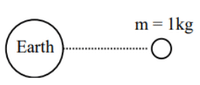
Find speed of 1 kg object when it reaches close to Earth's surface from a long distance after it is released from rest as shown in the diagram. [Given \( R_e = 6400 \, km, g_s = 9.8 \, m/s^2 \)]
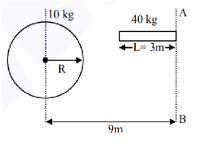
If moment of inertia of rod about axis AB is equal to moment of inertia of solid sphere about an axis parallel to AB which is at 9m from AB axis as shown in the figure. If \( R =\sqrt{ \frac{\alpha}{2}} \), then find \( \alpha \).
Surface tension of soap bubble is 0.03 N/m. The work done in increasing the diameter of bubble from 2 cm to 6 cm is \( \alpha \pi \times 10^{-4} \) J. Find the value of \( \alpha \).
View Solution
Step 1: Work done in expanding the bubble.
The work done in increasing the surface area of the soap bubble is given by the formula: \[ W = 4 \pi \gamma \left( r_2^2 - r_1^2 \right) \]
where \( \gamma \) is the surface tension, \( r_1 \) is the initial radius, and \( r_2 \) is the final radius.
Step 2: Substitute the values.
Given: \[ \gamma = 0.03 \, N/m, \quad r_1 = 2 \, cm = 0.02 \, m, \quad r_2 = 6 \, cm = 0.06 \, m \]
Substitute into the formula: \[ W = 4 \pi \times 0.03 \times \left( (0.06)^2 - (0.02)^2 \right) \]
Step 3: Simplify the expression.
\[ W = 4 \pi \times 0.03 \times \left( 0.0036 - 0.0004 \right) \] \[ W = 4 \pi \times 0.03 \times 0.0032 \] \[ W = 4 \pi \times 0.000096 = 0.000384 \pi \, J \]
Step 4: Compare with given expression.
We are given that the work done is \( \alpha \pi \times 10^{-4} \) J. Comparing both expressions: \[ 0.000384 \pi = \alpha \pi \times 10^{-4} \] \[ \alpha = 3.84 \] Quick Tip: To calculate the work done by surface tension, use the formula \( W = 4 \pi \gamma (r_2^2 - r_1^2) \), where \( \gamma \) is surface tension and \( r_1, r_2 \) are the initial and final radii.
A paper is placed in front of lens at a distance \(30\ cm\), such that paper gets burn in minimum time. Radius of curvature of bi-convex lens is \(60\ cm\). If refractive index of lens is \(\mu = \dfrac{\alpha}{10}\), then value of \(\alpha\) is
View Solution
Step 1: Use the condition for burning in minimum time.
A paper burns in minimum time when the image of the Sun is formed on it with maximum concentration of energy. Since the Sun is effectively at infinity, the image is formed at the focus of the lens.
Therefore, the paper must be placed at the focal length of the lens.
Given distance of paper from lens \(= 30\ cm\), so
\[ f = 30\ cm \]
Step 2: Write the lens maker's formula.
For a thin lens in air, lens maker's formula is
\[ \frac{1}{f} = (\mu - 1)\left(\frac{1}{R_1} - \frac{1}{R_2}\right) \]
For a bi-convex lens, taking light from left to right,
\[ R_1 = +60\ cm, \qquad R_2 = -60\ cm \]
Step 3: Substitute the radii of curvature.
Putting these values into the formula,
\[ \frac{1}{f} = (\mu - 1)\left(\frac{1}{60} - \frac{1}{-60}\right) \] \[ \frac{1}{f} = (\mu - 1)\left(\frac{1}{60} + \frac{1}{60}\right) \] \[ \frac{1}{f} = (\mu - 1)\left(\frac{2}{60}\right) \] \[ \frac{1}{f} = \frac{\mu - 1}{30} \]
Step 4: Use the given focal length \(f = 30\ cm\).
Since \(f = 30\ cm\),
\[ \frac{1}{30} = \frac{\mu - 1}{30} \]
Multiplying both sides by \(30\), we get
\[ 1 = \mu - 1 \] \[ \mu = 2 \]
Step 5: Find the value of \(\alpha\).
Given,
\[ \mu = \frac{\alpha}{10} \]
Substituting \(\mu = 2\),
\[ 2 = \frac{\alpha}{10} \] \[ \alpha = 20 \]
Final Answer:
\[ \boxed{20} \] Quick Tip: To burn a paper quickly using a convex lens, place the paper at the focal point because parallel rays from the Sun converge there and produce maximum heat concentration.
Consider Bohr's model of a H-atom. If magnetic field at center due to electron in 2\(^n\) orbit is \( B_1 \), and magnetic field due to electron in 4\(^t\) orbit is \( B_2 \). Find \( \frac{B_1}{B_2} \).
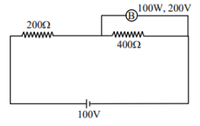
Find potential difference across bulb as shown in the figure.
Force on a charge \( q = 10^{-9} \, C \) in uniform electric and magnetic field is \( \vec{F} = (2 \times 10^{-10} \hat{i} + 3 \times 10^{-10} \hat{j}) \, N \).
Find velocity (in m/s) of charge if value of electric field is \( 0.4 \hat{j} \, V/m \) and magnetic field is \( 2 \times 10^{-3} \hat{k} \, T \).
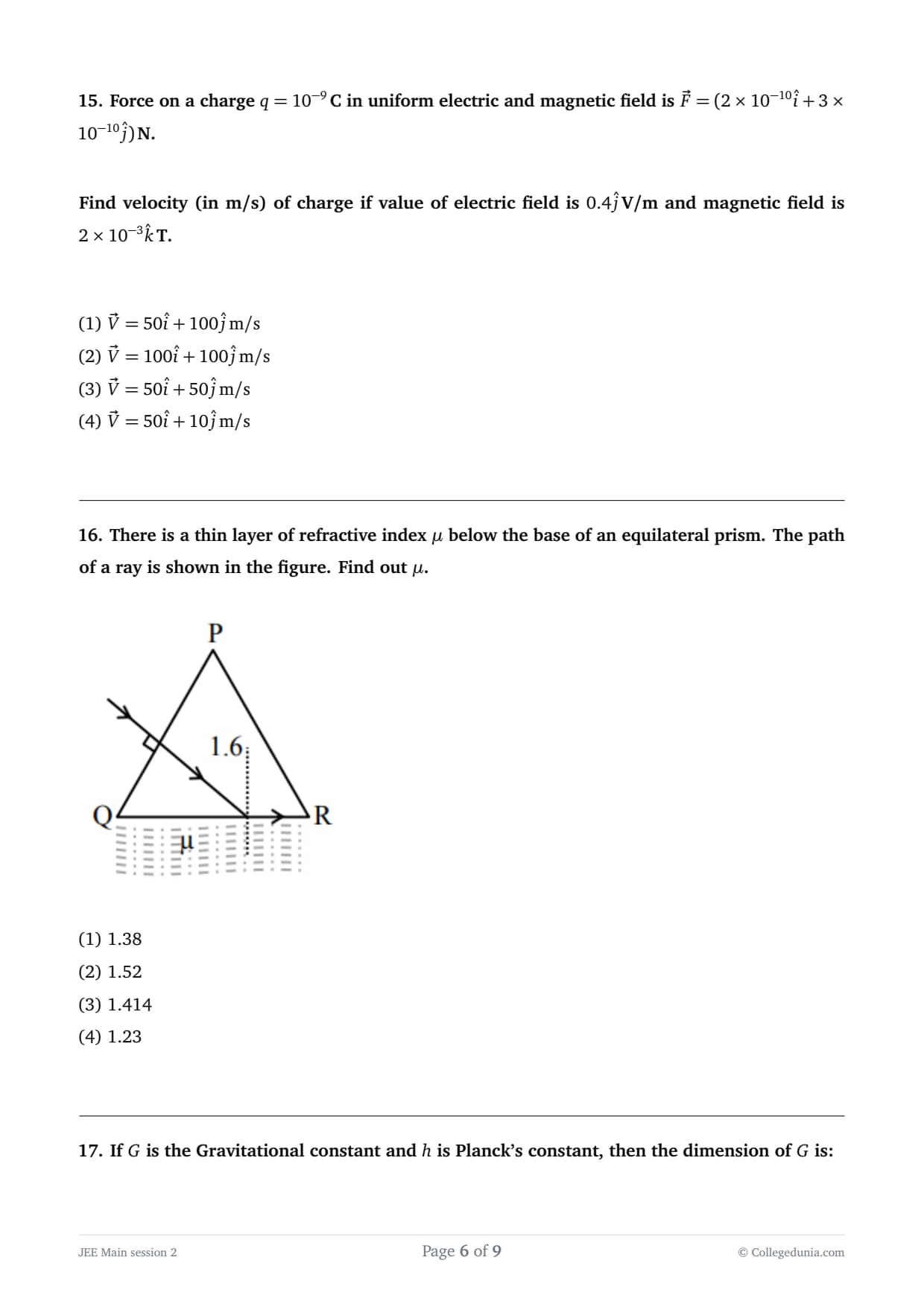
There is a thin layer of refractive index \( \mu \) below the base of an equilateral prism. The path of a ray is shown in the figure. Find out \( \mu \).

View Solution
\textcolor{red{Step 1: Understand the path of the incident ray.
The prism is an equilateral prism, so each angle of the prism is \( 60^\circ \). The refractive index of the prism material is \( 1.6 \), as shown in the figure.
The small square mark on the left face indicates that the incident ray is perpendicular to that face. Therefore, the ray enters the prism without deviation. This means the ray inside the prism travels along the normal to the left face.
\textcolor{red{Step 2: Find the angle of incidence at the base of the prism.
In an equilateral prism, the angle between the left slant face and the base is \( 60^\circ \). Since the ray travels along the normal to the left face, the ray makes an angle of \( 30^\circ \) with the base.
Now the normal to the base is perpendicular to the base, so the angle of incidence at the base is:
\[ i = 90^\circ - 30^\circ = 60^\circ \]
Thus, the angle of incidence at the prism-base interface is \( 60^\circ \).
\textcolor{red{Step 3: Use the condition shown by the refracted ray.
The refracted ray is shown moving along the base. This means the angle of refraction is \( 90^\circ \).
Hence, the angle of incidence \( 60^\circ \) is actually the critical angle for the interface between prism \( (n = 1.6) \) and the thin layer \( (\mu) \).
For critical angle, we use:
\[ \sin C = \frac{\mu}{1.6} \]
Since \( C = 60^\circ \), we get:
\[ \sin 60^\circ = \frac{\mu}{1.6} \]
\[ \frac{\sqrt{3}}{2} = \frac{\mu}{1.6} \]
\textcolor{red{Step 4: Calculate the value of \( \mu \).
\[ \mu = 1.6 \times \frac{\sqrt{3}}{2} \]
\[ \mu = 0.8\sqrt{3} \]
\[ \mu \approx 0.8 \times 1.732 = 1.3856 \]
\[ \mu \approx 1.38 \]
\textcolor{red{Step 5: Conclusion.
Therefore, the refractive index of the thin layer below the prism is \( 1.38 \). This matches option (A).
\textcolor{red{ Final Answer: \( 1.38 \). Quick Tip: If the refracted ray travels along the boundary, then the incident angle is the critical angle. In prism problems, always use the prism geometry first to find the angle of incidence at the surface.
If \( G \) is the Gravitational constant and \( h \) is Planck's constant, then the dimension of \( G \) is:
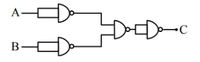
For given logic gate circuit, an equivalent gate will be
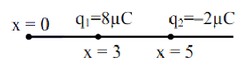
Find the ratio of electric flux passing through two spheres centered at the origin, having radii 4 m and 6 m respectively, with charges \( q_1 = 8 \, \mu C \) and \( q_2 = 2 \, \mu C \) respectively.
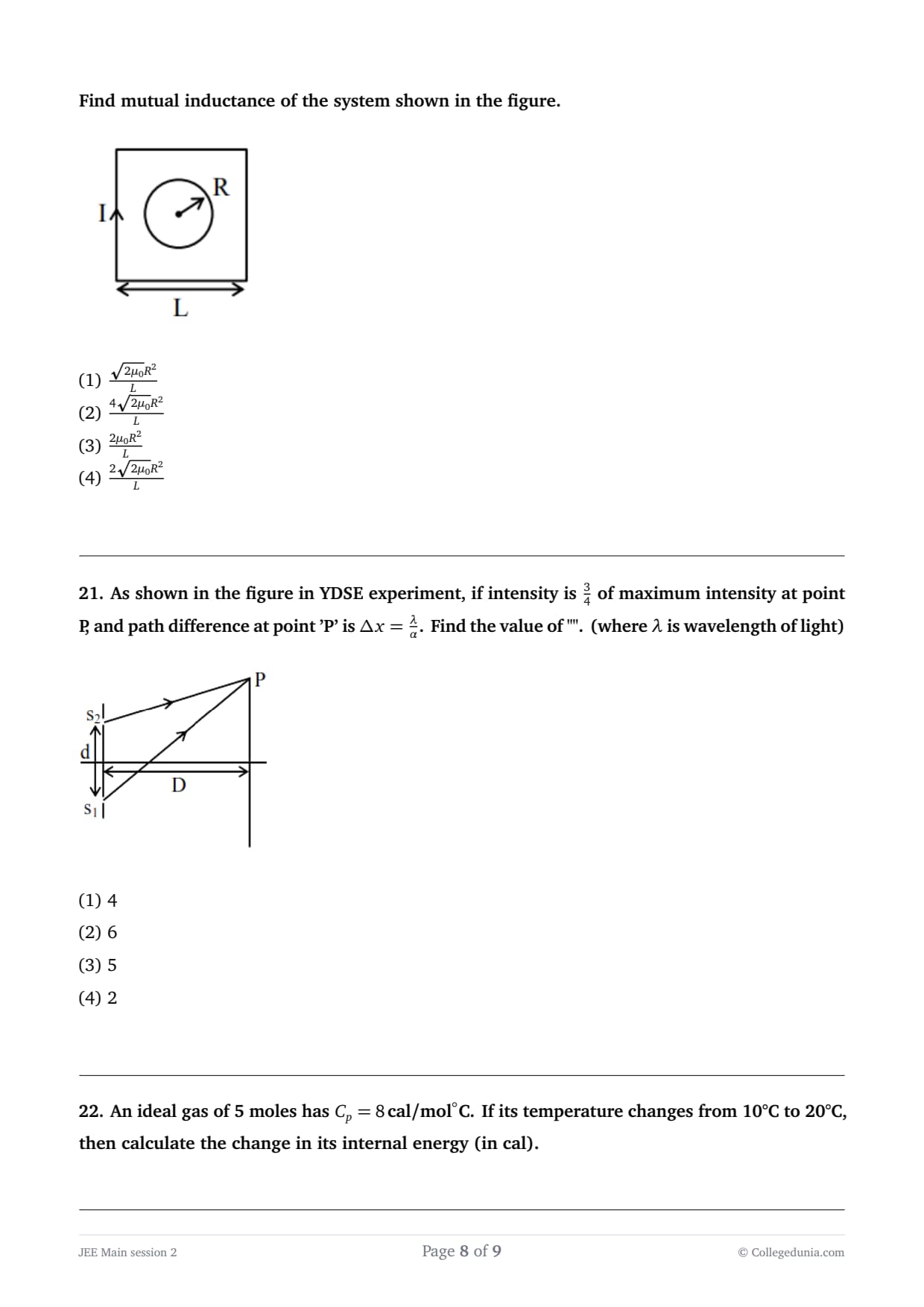
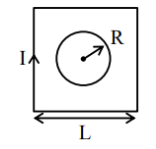
Side of square is \( L \) and \( R \ll L \).
Find mutual inductance of the system shown in the figure.
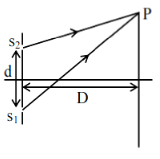
As shown in the figure in YDSE experiment, if intensity is \( \frac{3}{4} \) of maximum intensity at point P, and path difference at point 'P' is \( \Delta x = \frac{\lambda}{\alpha} \). Find the value of "α". (where \( \lambda \) is wavelength of light)
An ideal gas of 5 moles has \( C_p = 8 \, cal/mol^\circ C \). If its temperature changes from 10°C to 20°C, then calculate the change in its internal energy (in cal).
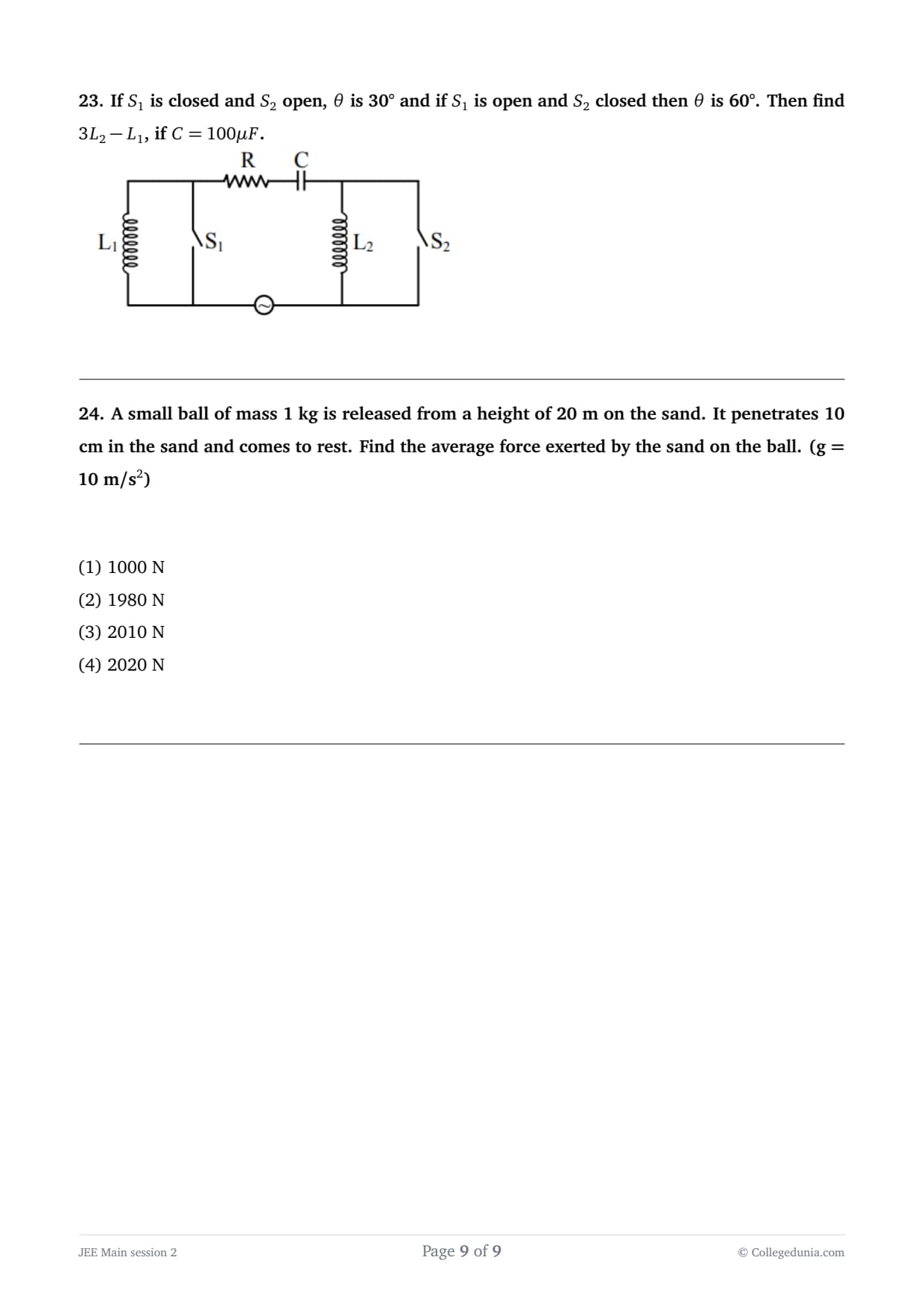
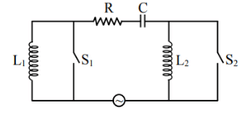
If \( S_1 \) is closed and \( S_2 \) open, \( \theta \) is 30° and if \( S_1 \) is open and \( S_2 \) closed then \( \theta \) is 60°. Then find \( 3L_2 - L_1 \), if \( C = 100 \mu F \).
A small ball of mass 1 kg is released from a height of 20 m on the sand. It penetrates 10 cm in the sand and comes to rest. Find the average force exerted by the sand on the ball. (g = 10 m/s\(^2\))
Also Check:
JEE Main 2026 Physics Exam Pattern
| Particulars | Details |
|---|---|
| Exam Mode | Online (Computer-Based Test) |
| Paper | B.E./B.Tech |
| Medium of Exam | 13 languages: English, Hindi, Gujarati, Bengali, Tamil, Telugu, Kannada, Marathi, Malayalam, Odia, Punjabi, Assamese, Urdu |
| Type of Questions | Multiple Choice Questions (MCQs) + Numerical Value Questions |
| Total Marks | 100 marks |
| Marking Scheme | +4 for correct answer & -1 for incorrect MCQ and Numerical Value-based Questions |
| Total Questions | 25 Questions |
JEE Main 2026 Physics Revision





Comments