




NTA has released JEE Main 2026 official question papers on their website jeemain.nta.nic.in. JEE Main 2026 April 2 Shift 2 Question Paper is available here with answer key and solution pdf. NTA conducted the second shift on April 2, 2026, from 3:00 PM to 6:00 PM.
Candidates can download the JEE Main 2026 April 2 Shift 2 question paper along with detailed solutions to analyze their performance and understand the exam pattern better.
Also Check:
JEE Main 2026 April 2 Shift 2 Question Paper with Solution PDF

Question 1:
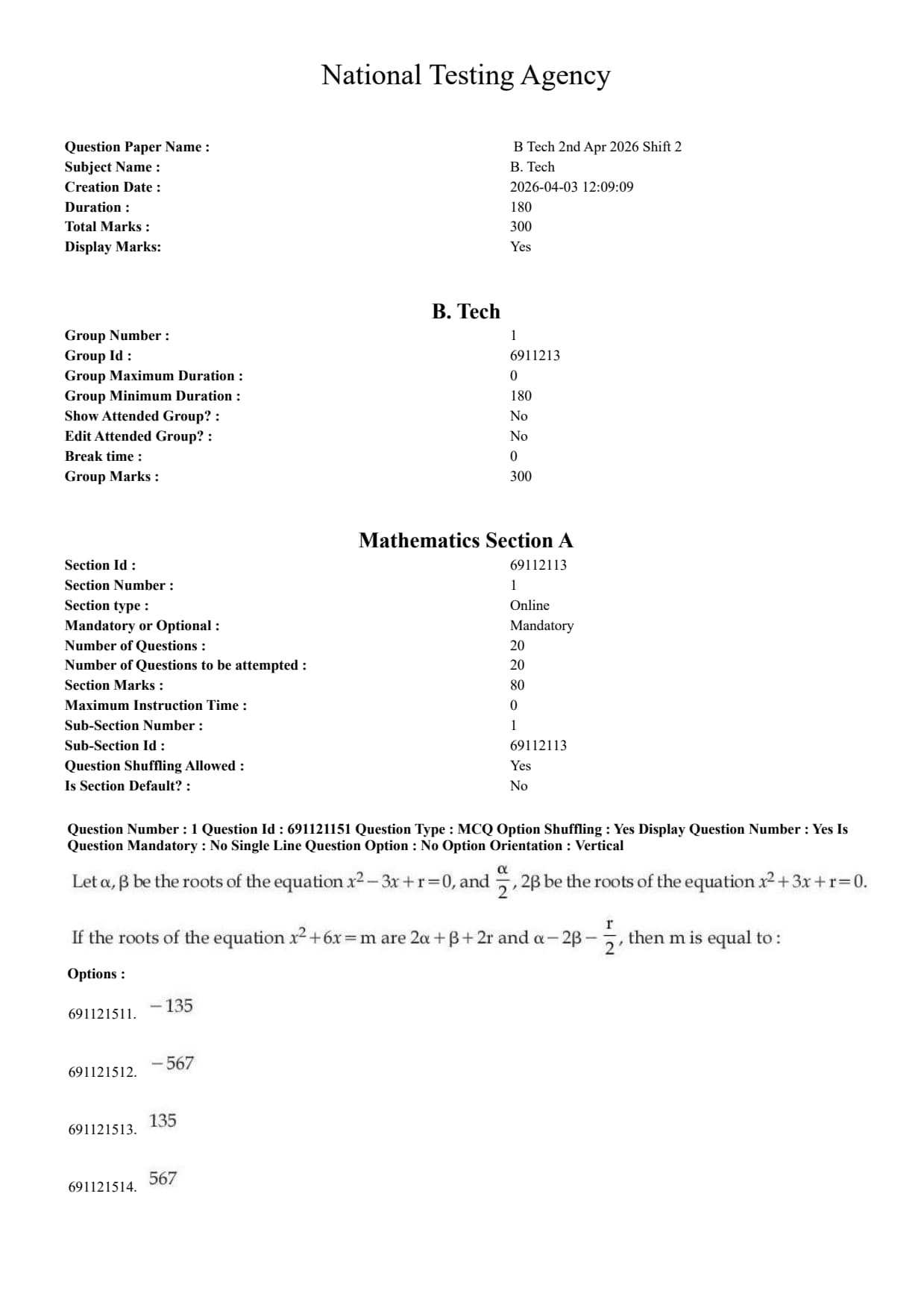
Let \( \alpha, \beta \) be the roots of the equation \( x^2 - 3x + r = 0 \), and \( \frac{\alpha}{2}, 2\beta \) be the roots of the equation \( x^2 + 3x + r = 0 \).
If the roots of the equation \( x^2 + 6x = m \) are \( 2\alpha + \beta + 2r \) and \( \alpha - 2\beta - \frac{r}{2} \), then \( m \) is equal to:
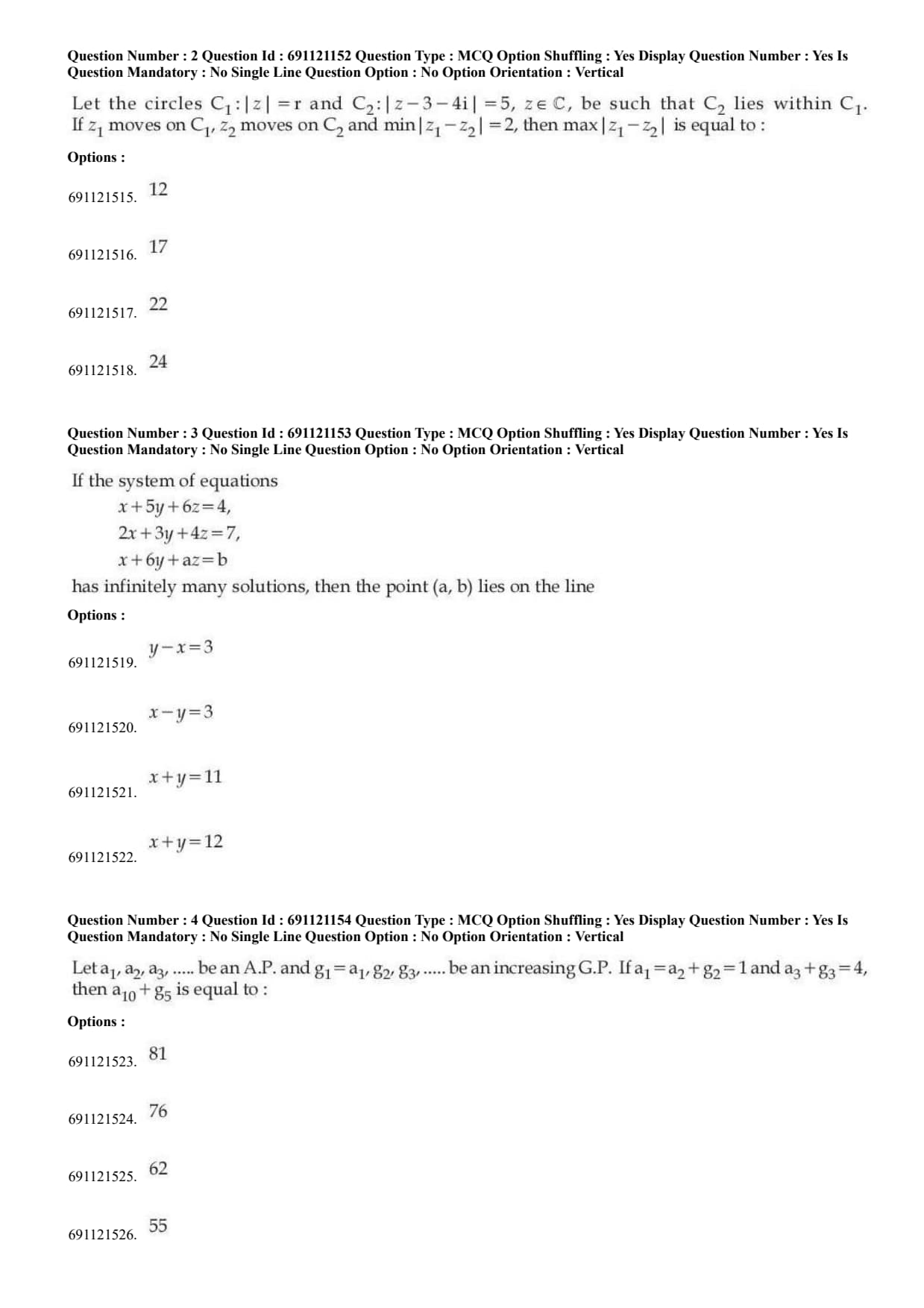
Let the circles \( C_1 : |z| = r \) and \( C_2 : |z - 3 - 4i| = 5, z \in \mathbb{C} \), be such that \( C_2 \) lies within \( C_1 \). If \( z_1 \) moves on \( C_1 \), \( z_2 \) moves on \( C_2 \) and \( \min |z_1 - z_2| = 2 \), then \( \max |z_1 - z_2| \) is equal to:
If the system of equations
\[ x + 5y + 6z = 4 \] \[ 2x + 3y + 4z = 7 \] \[ x + 6y + az = b \]
has infinitely many solutions, then the point \( (a, b) \) lies on the line
Let \( a_1, a_2, a_3, \dots \) be an A.P. and \( g_1 = a_1, g_2 = a_2, g_3 = a_3, \dots \) be an increasing G.P. If \( a_1 = a_2 + g_2 = 1 \) and \( a_3 + g_3 = 4 \), then \( a_{10} + g_5 \) is equal to:
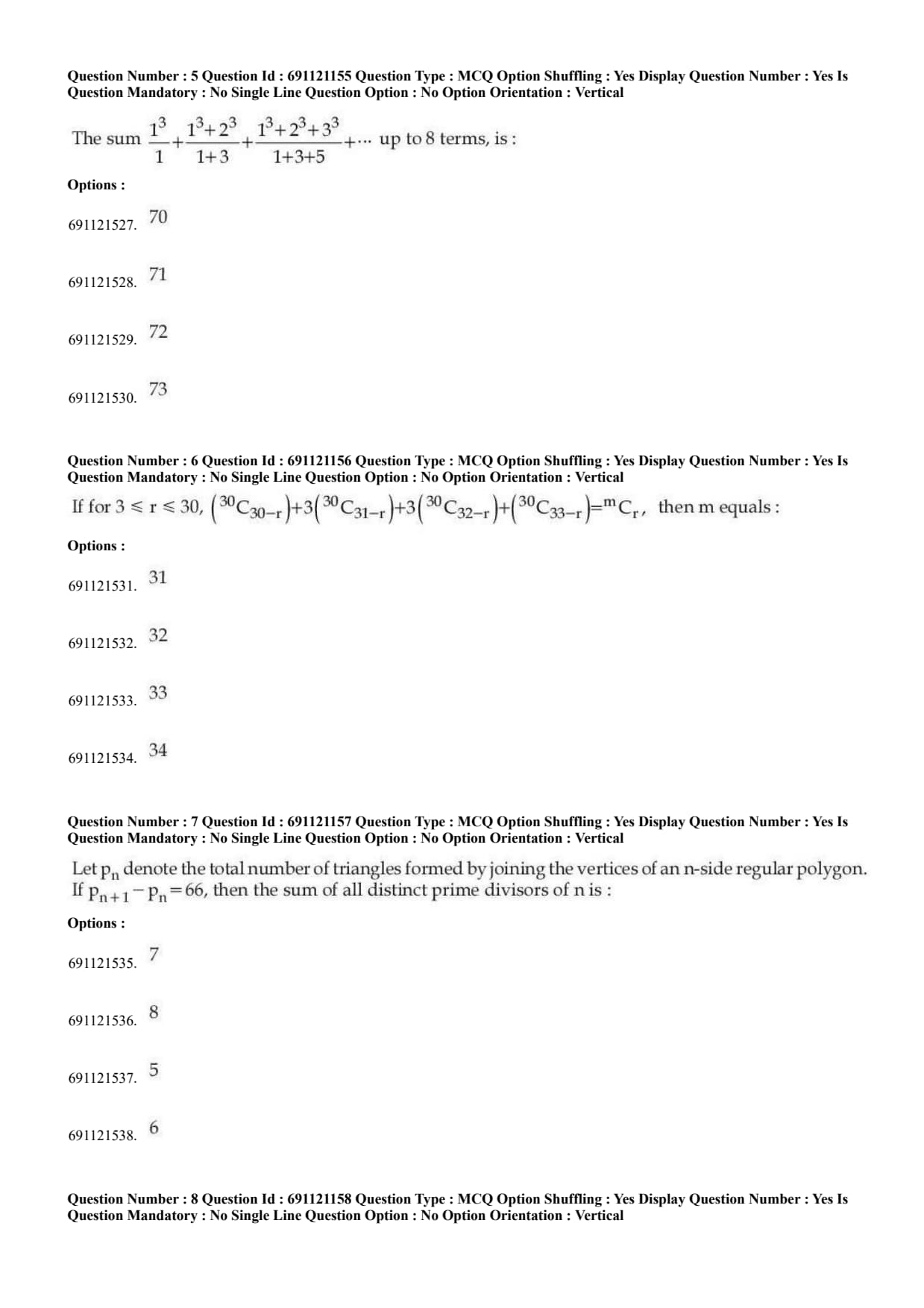
The sum \( \frac{1^3}{1} + \frac{2^3}{1+3} + \frac{3^3}{1+3+5} + \cdots \) up to 8 terms is:
If for \( 3 \leq r \leq 30 \),
\[ \left( 30C_{30-r} \right) + 3 \left( 30C_{31-r} \right) + 3 \left( 30C_{32-r} \right) + 3 \left( 30C_{33-r} \right) = mC_{r},
then m equals: \]
Let \( p_n \) denote the total number of triangles formed by joining the vertices of an \( n \)-side regular polygon. If \( p_{n+1} - p_n = 66 \), then the sum of all distinct prime divisors of \( n \) is:
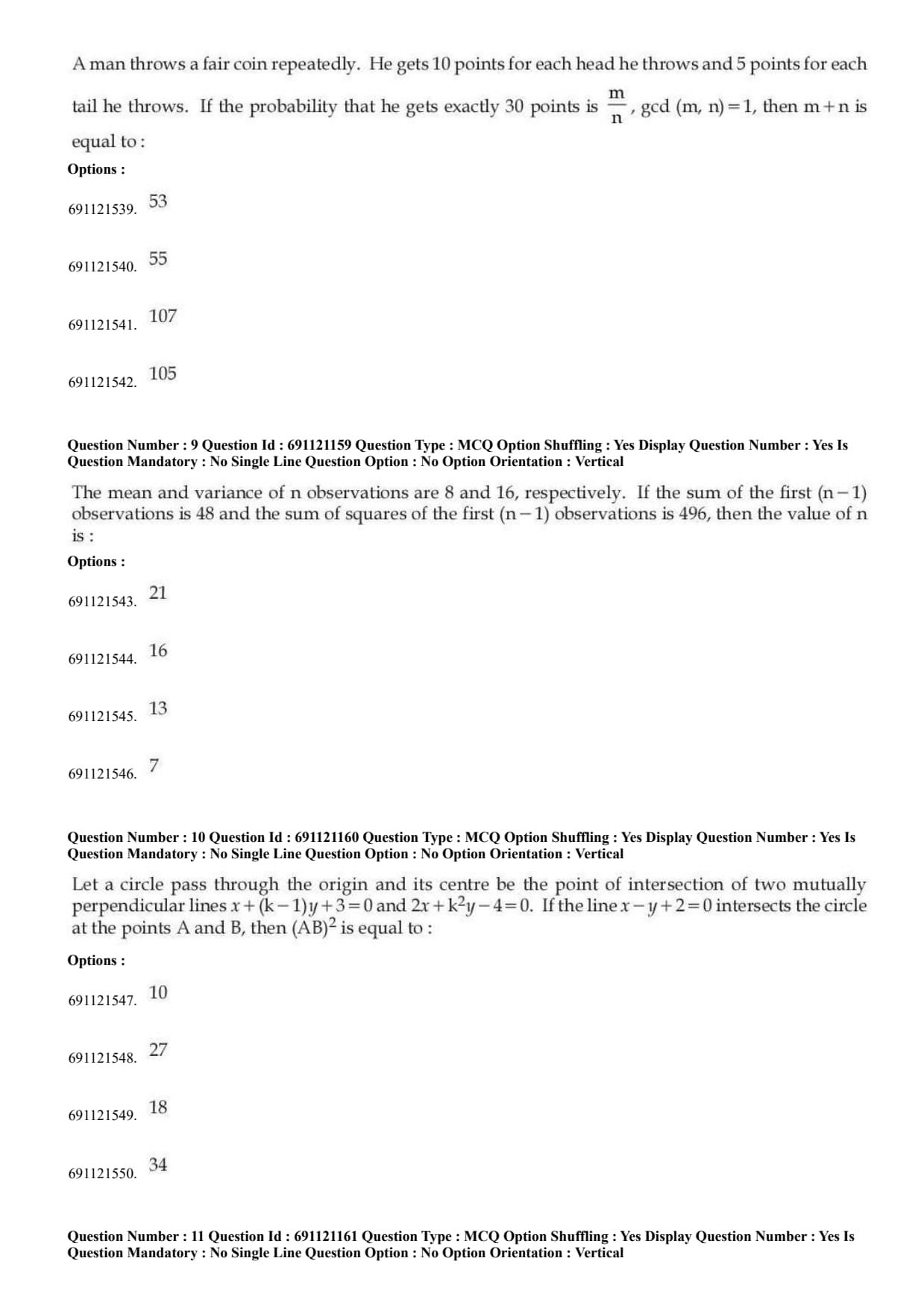
A man throws a fair coin repeatedly. He gets 10 points for each head he throws and 5 points for each tail he throws. If the probability that he gets exactly 30 points is \( \frac{m}{n} \), gcd \( (m, n) = 1 \), then \( m + n \) is equal to:
The mean and variance of \( n \) observations are 8 and 16, respectively. If the sum of the first \( (n-1) \) observations is 48 and the sum of squares of the first \( (n-1) \) observations is 496, then the value of \( n \) is:
Let a circle pass through the origin and its center be the point of intersection of two mutually perpendicular lines \( x + (k-1)y + 3 = 0 \) and \( 2x + k2y - 4 = 0 \). If the line \( x - y + 2 = 0 \) intersects the circle at the points A and B, then \( (AB)^2 \) is equal to:
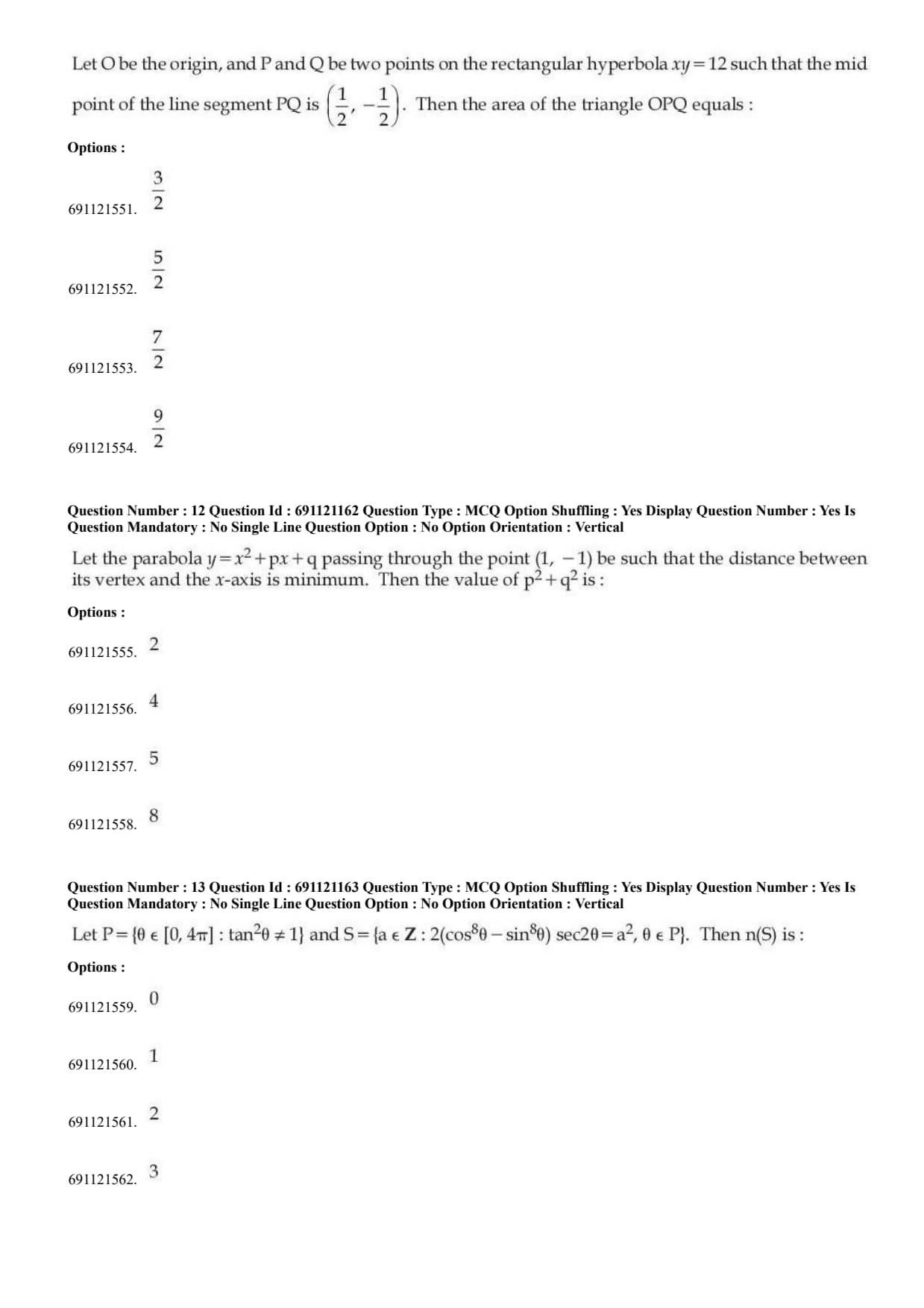
Let O be the origin, and P and Q be two points on the rectangular hyperbola \( xy = 12 \) such that the midpoint of the line segment PQ is \( \left( \frac{1}{2}, -\frac{1}{2} \right) \). Then the area of the triangle OPQ equals:
Let the parabola \( y = x^2 + px + q \) passing through the point \( (1, -1) \) be such that the distance between its vertex and the x-axis is minimum. Then the value of \( p^2 + q^2 \) is:
Let \( P = \{ \theta \in [0, 4\pi] : \tan^2\theta \neq 1 \} \) and \( S = \{ a \in \mathbb{Z} : 2(\cos^8\theta - \sin^8\theta) \sec 2\theta = a^2, \theta \in P \} \). Then \( n(S) \) is:
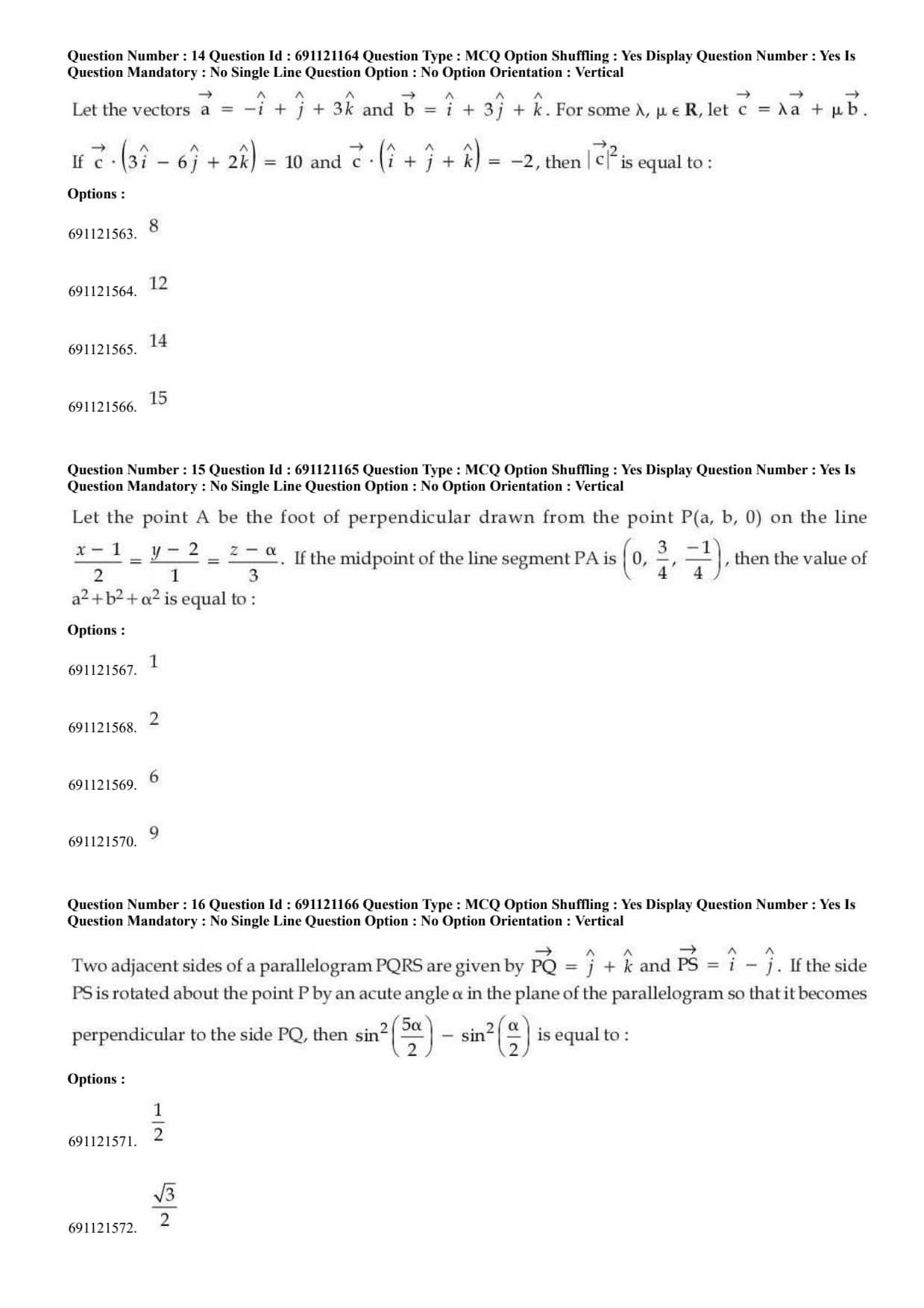
Let the vectors \( \mathbf{a} = -\hat{i} + \hat{j} + 3\hat{k} \) and \( \mathbf{b} = \hat{i} + 3\hat{j} + \hat{k} \). For some \( \lambda, \mu \in \mathbb{R} \), let \( \mathbf{c} = \lambda \mathbf{a} + \mu \mathbf{b} \). If \( \mathbf{c} \cdot (3\hat{i} - 6\hat{j} + 2\hat{k}) = 10 \) and \( \mathbf{c} \cdot (\hat{i} + \hat{j} + \hat{k}) = -2 \), then \( |\mathbf{c}|^2 \) is equal to:
Let the point \( A \) be the foot of perpendicular drawn from the point \( P(a, b, 0) \) on the line
\[ \frac{x - 1}{2} = \frac{y - 2}{1} = \frac{z - \alpha}{3}. \]
If the midpoint of the line segment \( PA \) is \( \left( \frac{3}{4}, \frac{4}{3}, -\frac{1}{4} \right) \), then the value of \( a^2 + b^2 + \alpha^2 \) is:
Two adjacent sides of a parallelogram PQRS are given by \( \overrightarrow{PQ} = \hat{i} + \hat{j} + \hat{k} \) and \( \overrightarrow{PS} = \hat{i} - \hat{j} \). If the side PS is rotated about the point P by an acute angle \( \alpha \) in the plane of the parallelogram so that it becomes perpendicular to the side PQ, then \( \sin^2 \left( \frac{5\alpha}{2} \right) - \sin^2 \left( \frac{\alpha}{2} \right) \) is equal to:
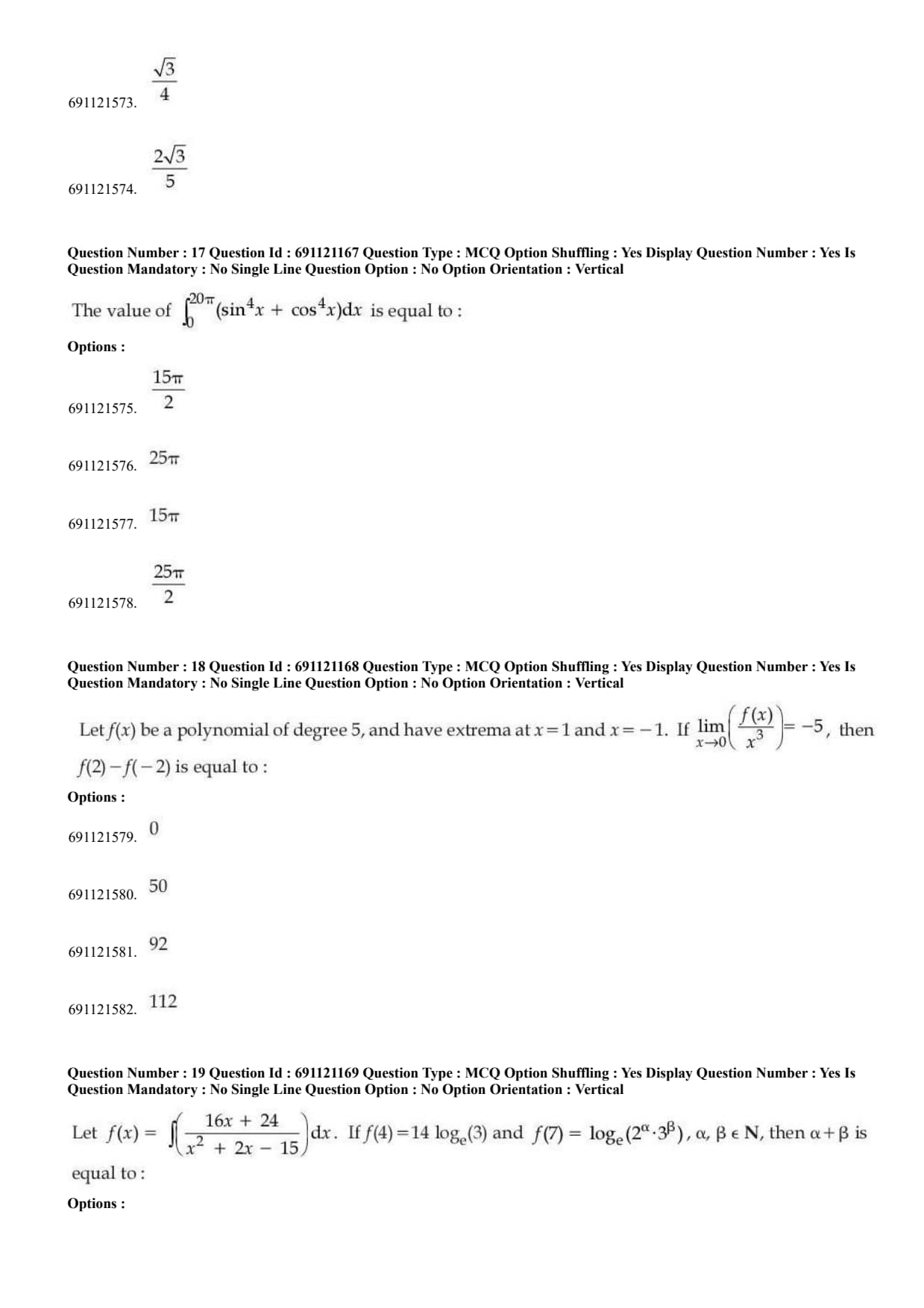
The value of \( \int_0^{20} (\sin 4x + \cos 4x) \, dx \) is equal to:
Let \( f(x) \) be a polynomial of degree 5, and have extrema at \( x = 1 \) and \( x = -1 \). If \( \lim_{x \to 0} \frac{f(x)}{x^3} = -5 \), then \( f(2) - f(-2) \) is equal to:
Let \( f(x) = \int_{} \frac{16x + 24}{x^2 + 2x - 15} \, dx \). If \( f(4) = 14 \log_e(3) \) and \( f(7) = \log_e(2^\alpha \cdot 3^\beta) \), where \( \alpha, \beta \in \mathbb{N} \), then \( \alpha + \beta \) is:
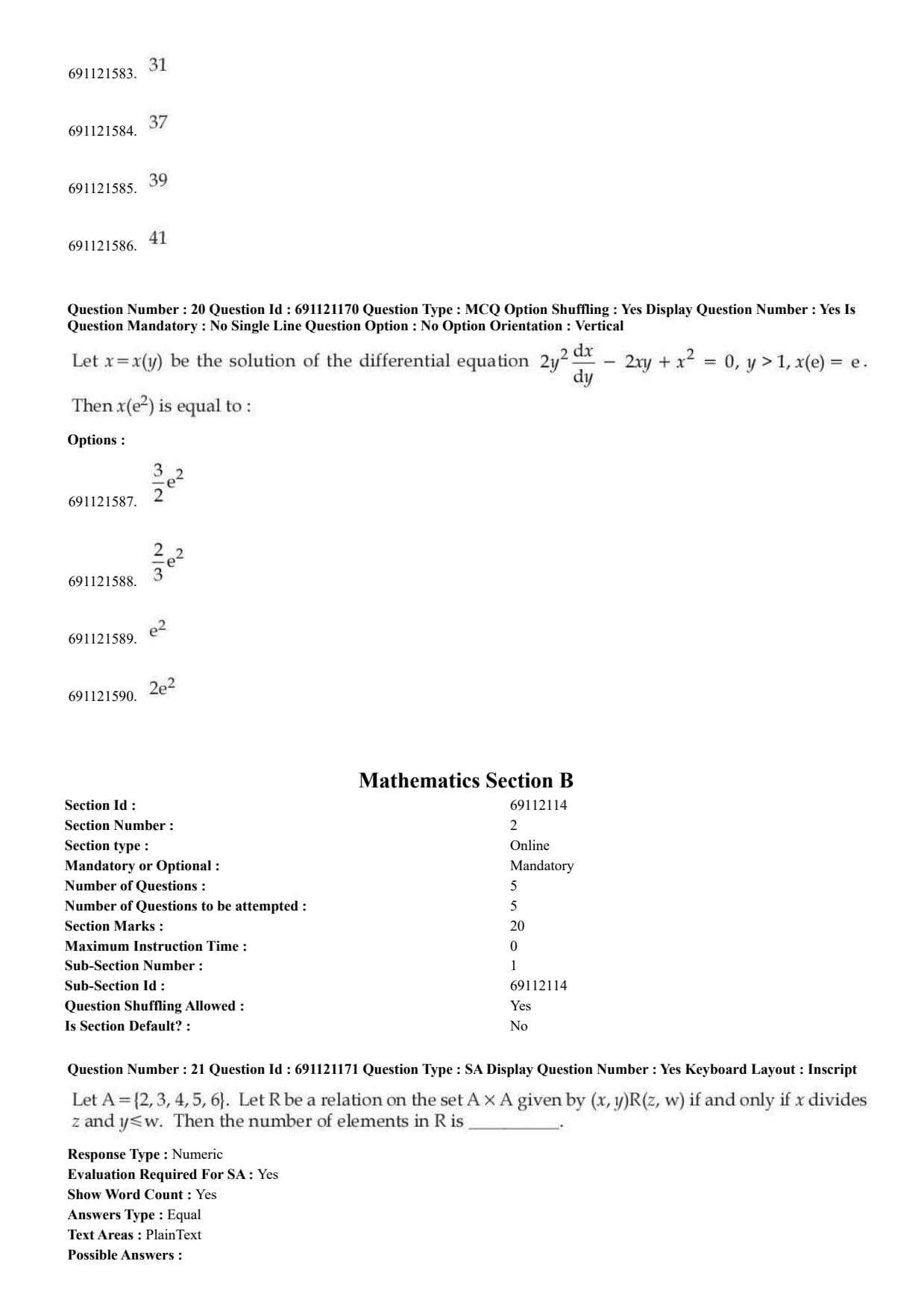
Let \( x = x(y) \) be the solution of the differential equation \[ 2y^2 \frac{dx}{dy} - 2xy + x^2 = 0, \quad y > 1, \quad x(e) = e. \]
Then \( x(e^2) \) is equal to:
Let \( A = \{2, 3, 4, 5, 6\} \). Let \( R \) be a relation on the set \( A \times A \) given by \( (x, y) R (z, w) \) if and only if \( x \) divides \( z \) and \( y \leq w \). Then the number of elements in \( R \) is _______.
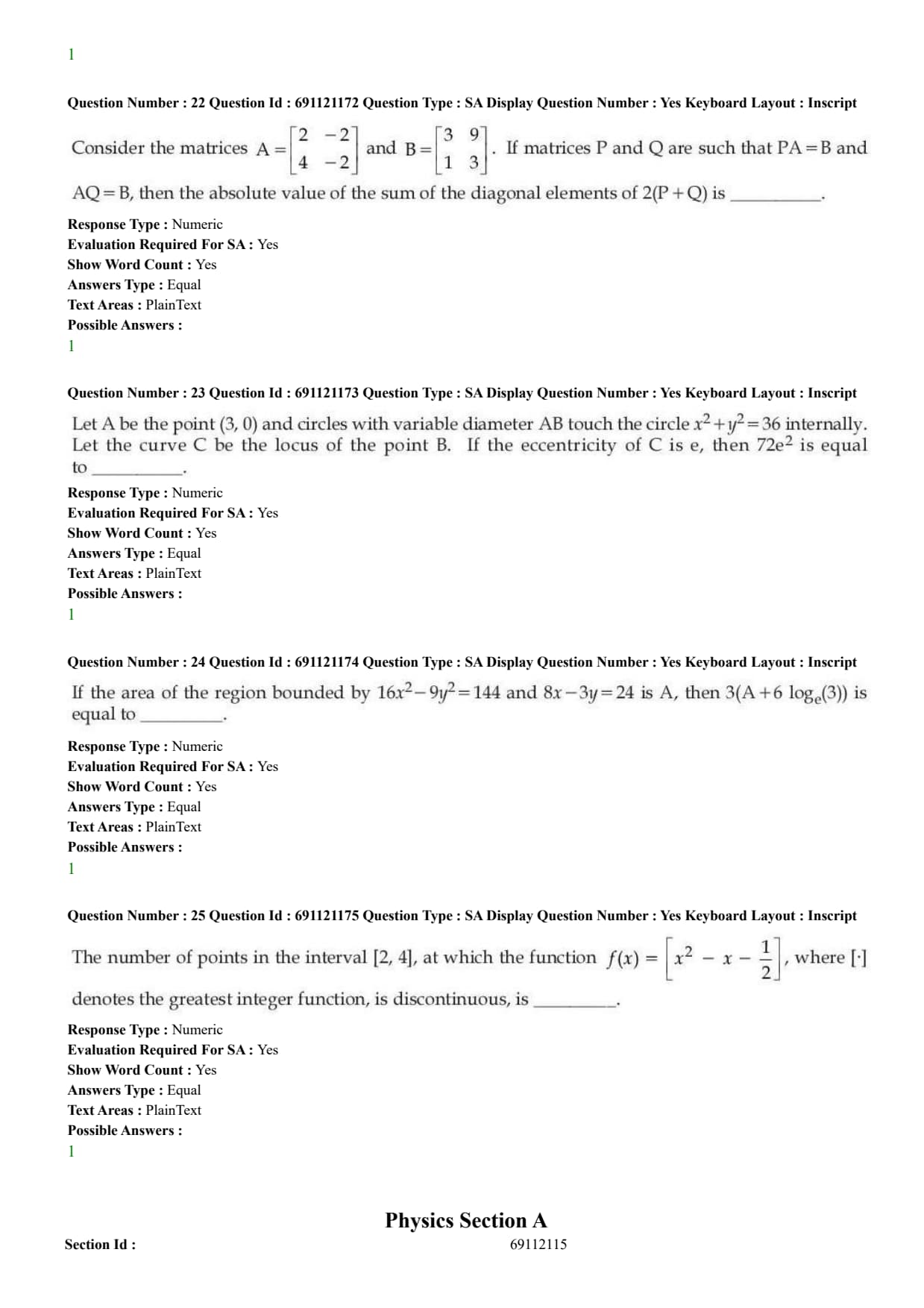
Consider the matrices \[ A = \begin{bmatrix} 2 & -2 \\
4 & -2 \end{bmatrix}, \quad B = \begin{bmatrix} 3 & 9 \\
1 & 3 \end{bmatrix}. \]
If matrices \( P \) and \( Q \) are such that \( PA = B \) and \( AQ = B \), then the absolute value of the sum of the diagonal elements of \( 2(P + Q) \) is _____ .
Let A be the point \( (3, 0) \) and circles with variable diameter AB touch the circle \( x^2 + y^2 = 36 \) internally. Let the curve \( C \) be the locus of the point B. If the eccentricity of \( C \) is \( e \), then \( 72e^2 \) is equal to _______.
If the area of the region bounded by \(16x^2 - 9y^2 = 144\) and \(8x - 3y = 24\) is \(A\), then \(3(A + 6 \log_e(3))\) is equal to _______.
The number of points in the interval \( [2, 4] \), at which the function \( f(x) = \left\lfloor x^2 - x - \frac{1}{2} \right\rfloor \), where \( \left\lfloor \cdot \right\rfloor \) denotes the greatest integer function, is discontinuous, is _______.
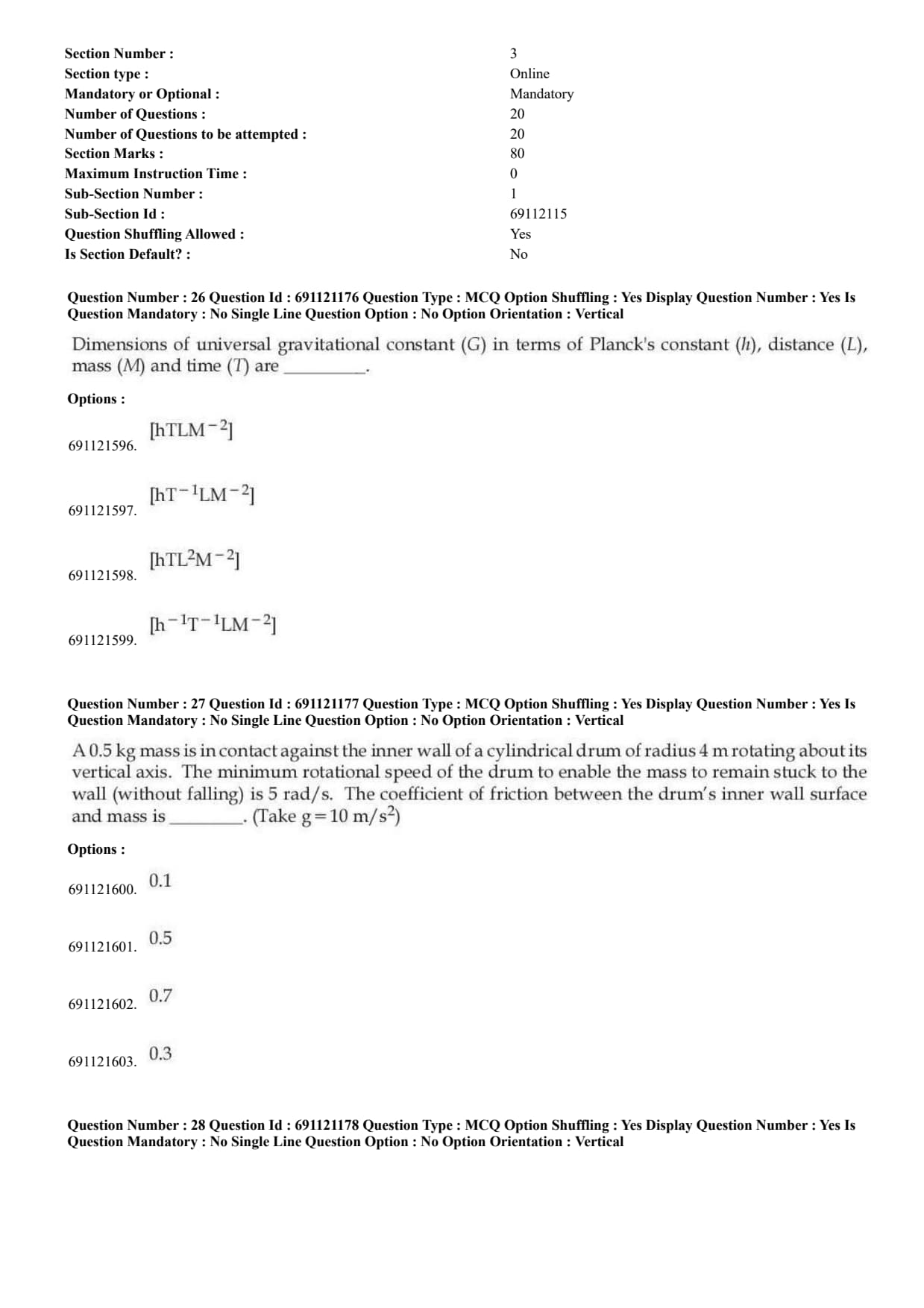
Dimensions of universal gravitational constant (G) in terms of Planck's constant (h), distance (L), mass (M) and time (T) are:
A 0.5 kg mass is in contact against the inner wall of a cylindrical drum of radius 4 m rotating about its vertical axis. The minimum rotational speed of the drum to enable the mass to remain stuck to the wall (without falling) is 5 rad/s. The coefficient of friction between the drum's inner wall surface and mass is _______. (Take \( g = 10 \, m/s^2 \))
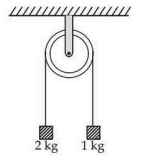
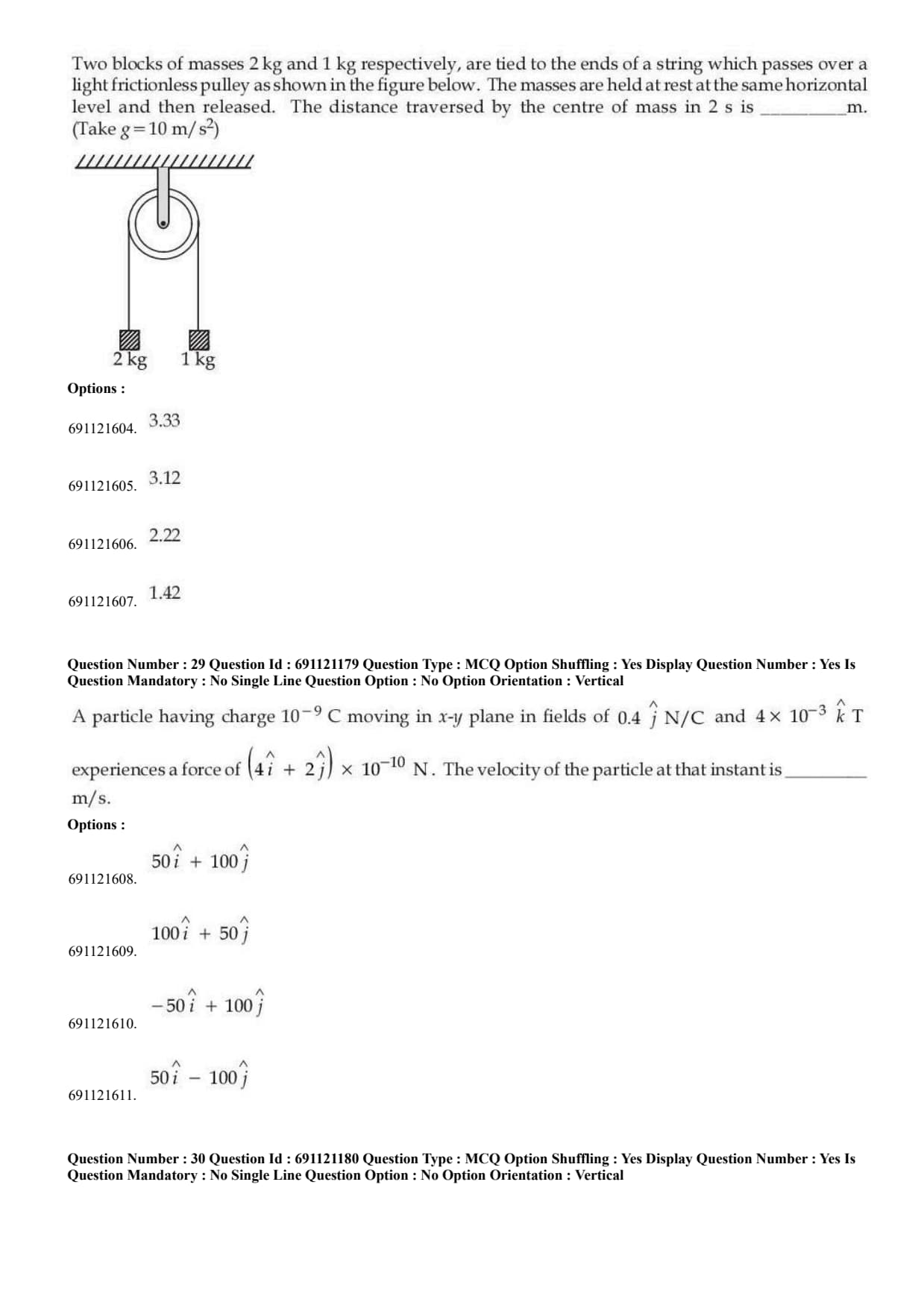
Two blocks of masses 2 kg and 1 kg respectively are tied to the ends of a string which passes over a light frictionless pulley as shown in the figure below. The masses are held at rest at the same horizontal level and then released. The distance traversed by the centre of mass in 2 s is _______ m.
A particle having charge \( 10^{-9} \, C \) moving in \( x \)-\( y \) plane in fields of \( 0.4 \hat{j} \, N/C \) and \( 4 \times 10^{-3} \hat{k} \, T \) experiences a force of \( \left( 4 \hat{i} + 2 \hat{j} \right) \times 10^{-10} \, N \). The velocity of the particle at that instant is _______ m/s.
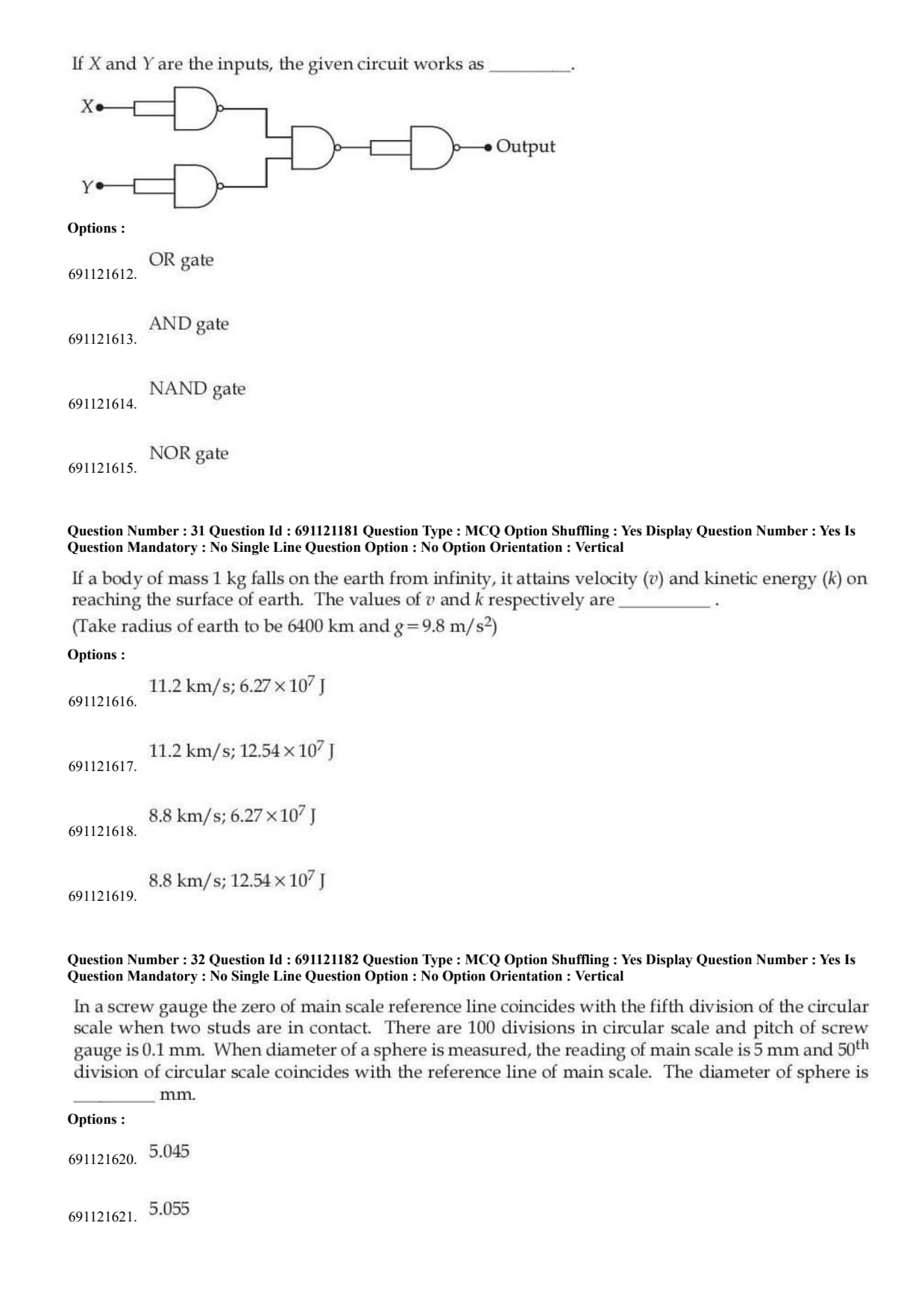
If X and Y are the inputs, the given circuit works as _______.

If a body of mass 1 kg falls on the earth from infinity, it attains velocity \( v \) and kinetic energy \( k \) on reaching the surface of the earth. The values of \( v \) and \( k \) respectively are _____ .
In a screw gauge the zero of main scale reference line coincides with the fifth division of the circular scale when two studs are in contact. There are 100 divisions in circular scale and pitch of screw gauge is 0.1 mm. When diameter of a sphere is measured, the reading of main scale is 5 mm and 50th division of circular scale coincides with the reference line of main scale. The diameter of sphere is _____ mm.
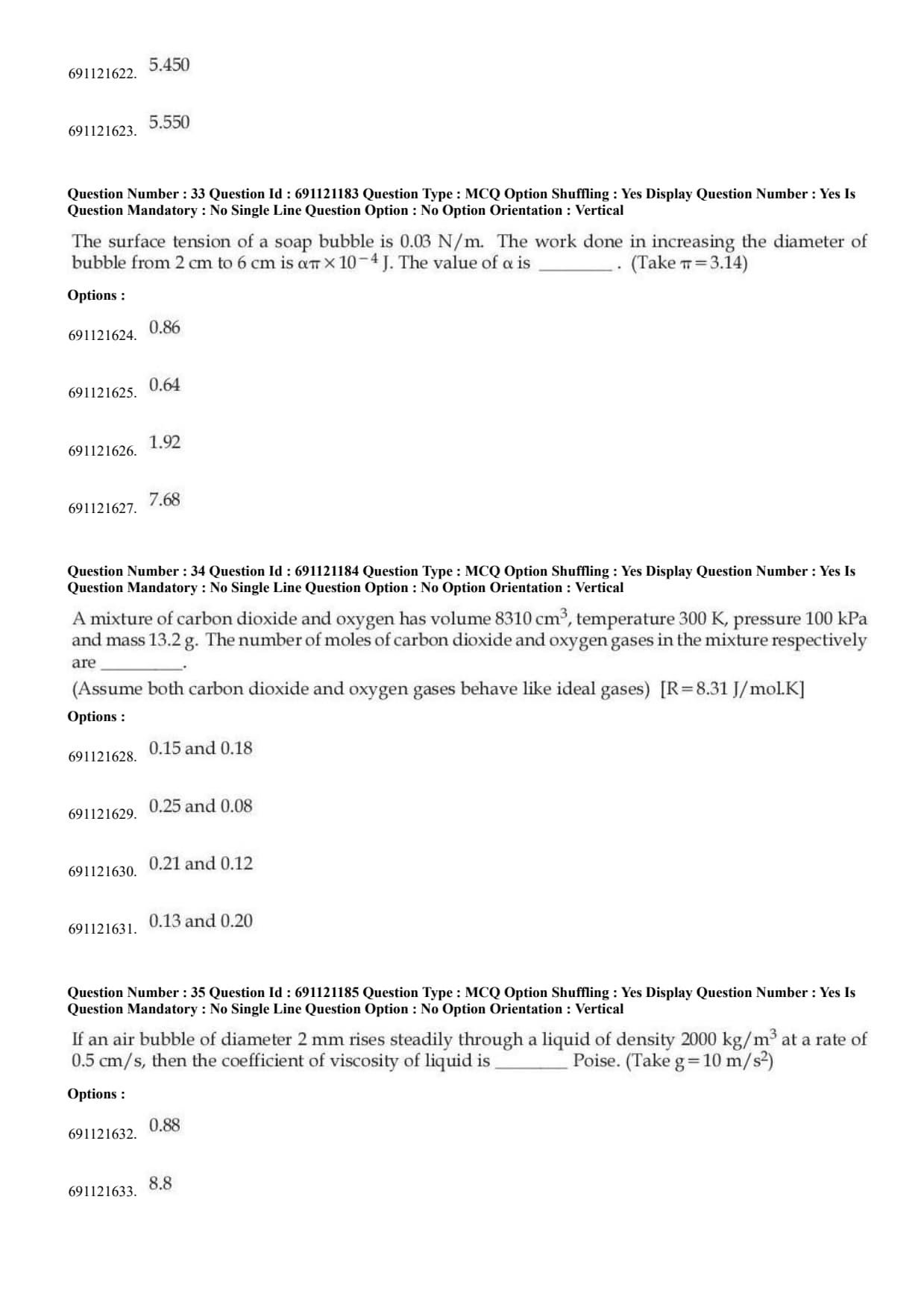
The surface tension of a soap bubble is 0.03 N/m. The work done in increasing the diameter of bubble from 2 cm to 6 cm is \( \alpha \times 10^{-4} \) J. The value of \( \alpha \) is _____ . (Take \( \pi = 3.14 \))
A mixture of carbon dioxide and oxygen has volume 8310 cm³, temperature 300 K, pressure 100 kPa and mass 13.2 g. The number of moles of carbon dioxide and oxygen gases in the mixture respectively are _____ .
If an air bubble of diameter 2 mm rises steadily through a liquid of density 2000 kg/m³ at a rate of 0.5 cm/s, then the coefficient of viscosity of the liquid is _____ Poise.
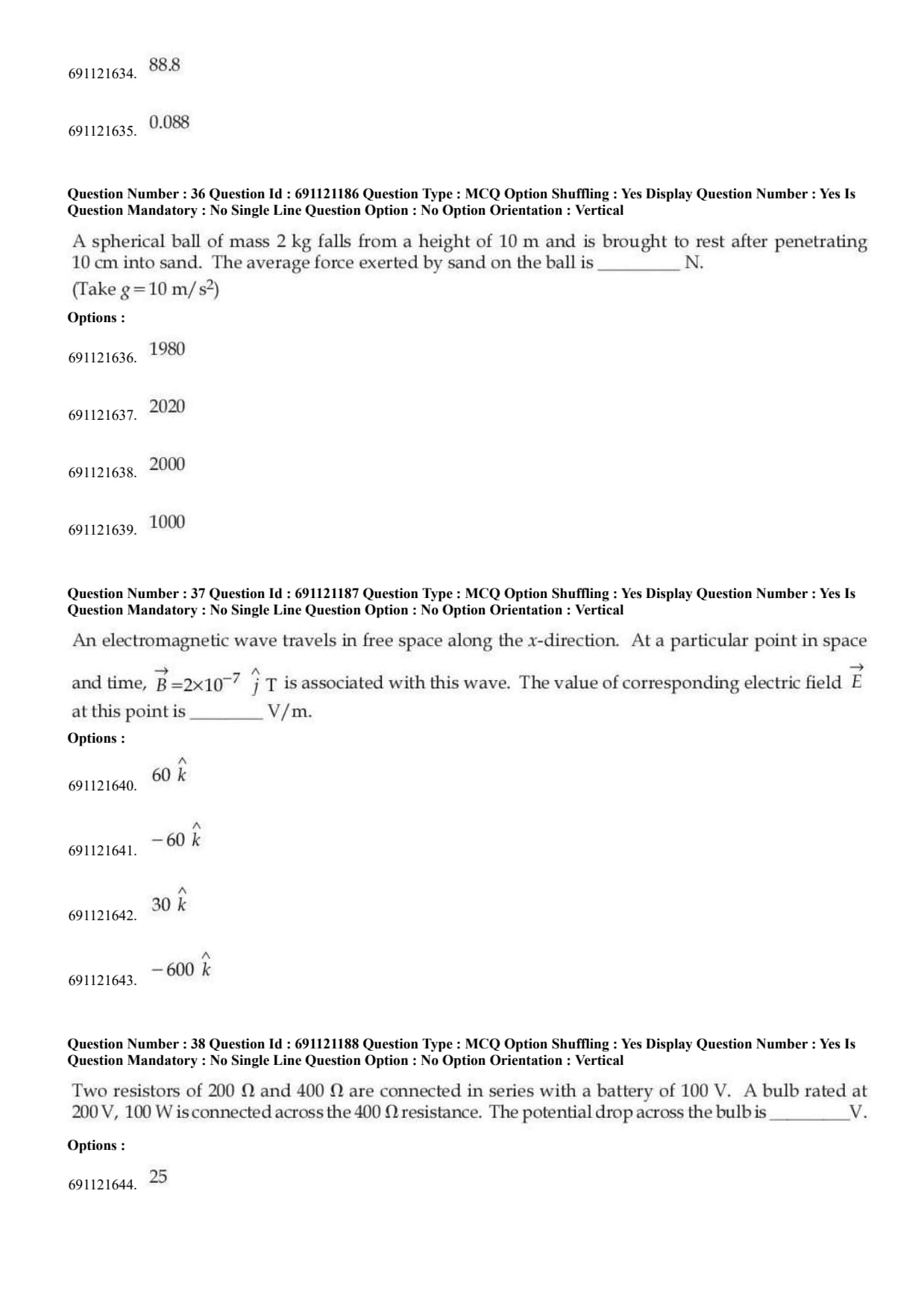
A spherical ball of mass 2 kg falls from a height of 10 m and is brought to rest after penetrating 10 cm into sand. The average force exerted by sand on the ball is ______ N.
An electromagnetic wave travels in free space along the x-direction. At a particular point in space and time, \( B = 2 \times 10^{-7} \hat{j} \) T is associated with this wave. The value of the corresponding electric field \( E \) at this point is _______ V/m.
Two resistors of 200 \( \Omega \) and 400 \( \Omega \) are connected in series with a battery of 100 V. A bulb rated at 200 W, 100 V is connected across the 400 \( \Omega \) resistance. The potential drop across the bulb is _______ V.
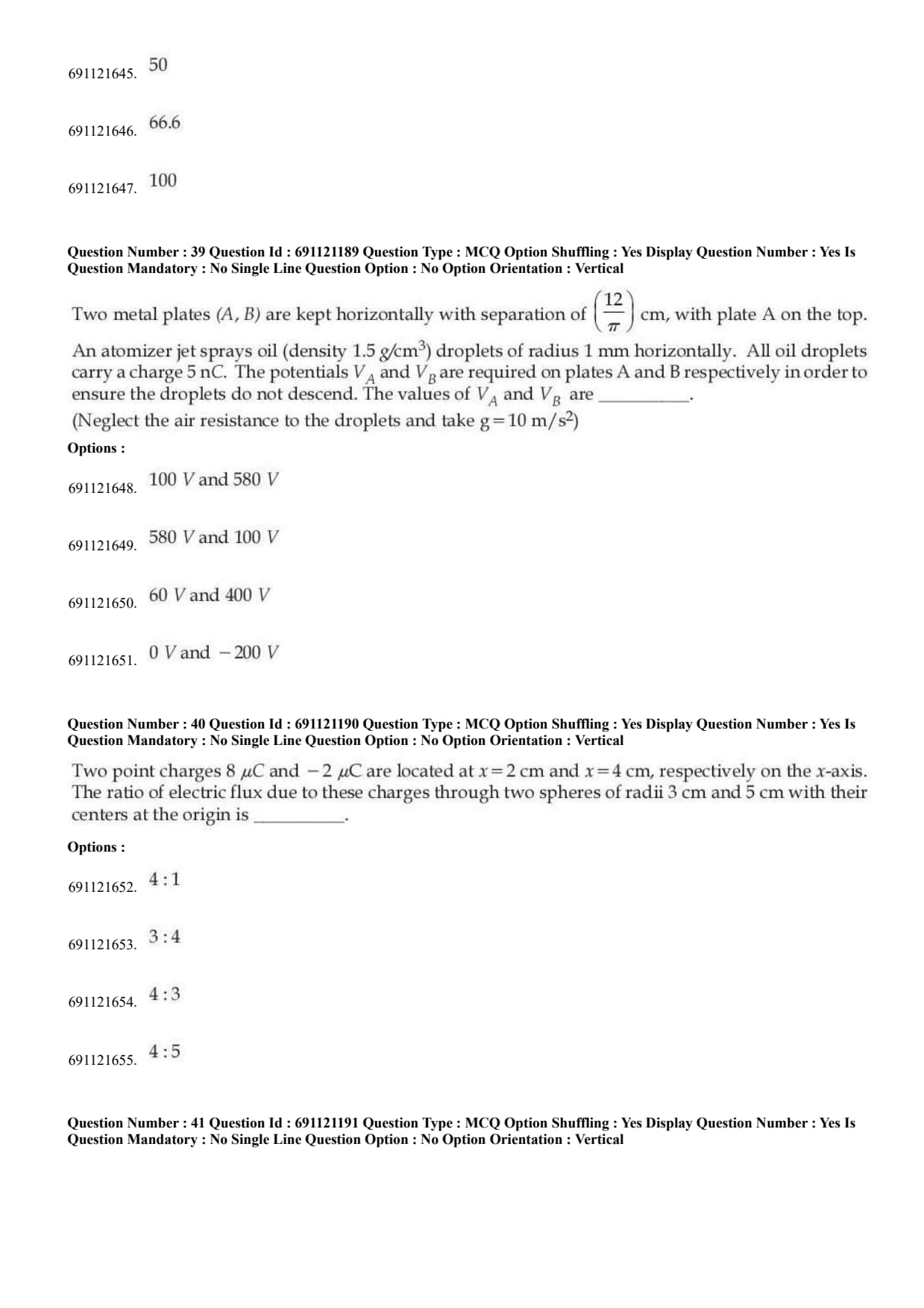
Two metal plates (A, B) are kept horizontally with separation of \( \frac{12}{\pi} \) cm, with plate A on the top.
An atomizer jet sprays oil (density \( 1.5 \, g/cm^3 \)) droplets of radius 1 mm horizontally. All oil droplets carry a charge 5 nC. The potentials \( V_A \) and \( V_B \) are required on plates A and B respectively in order to ensure the droplets do not descend. The values of \( V_A \) and \( V_B \) are _______. (Neglect the air resistance to the droplets and take \( g = 10 \, m/s^2 \))
Two point charges \( 8 \, \mu C \) and \( -2 \, \mu C \) are located at \( x = 2 \, cm \) and \( x = 4 \, cm \), respectively on the x-axis. The ratio of electric flux due to these charges through two spheres of radii 3 cm and 5 cm with their centers at the origin is _______.
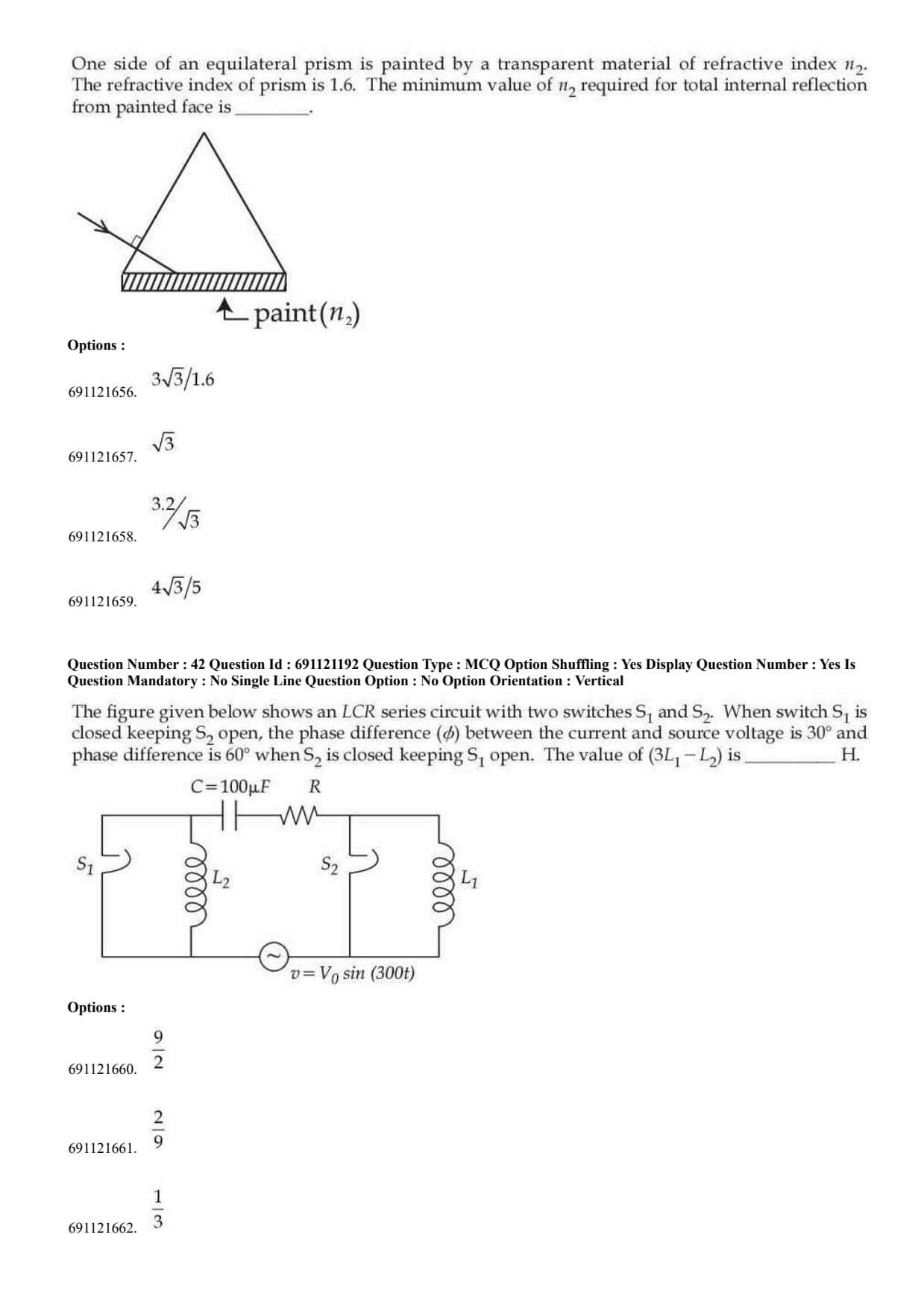
One side of an equilateral prism is painted by a transparent material of refractive index \( n_2 \). The refractive index of prism is 1.6. The minimum value of \( n_2 \) required for total internal reflection from the painted face is ______ .

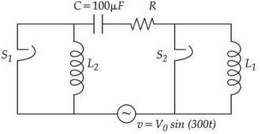
The figure given below shows an LCR series circuit with two switches \( S_1 \) and \( S_2 \). When switch \( S_1 \) is closed keeping \( S_2 \) open, the phase difference \( \phi \) between the current and source voltage is 30° and phase difference is 60° when \( S_2 \) is closed keeping \( S_1 \) open. The value of \( (3L_1 - L_2) \) is _______ H.
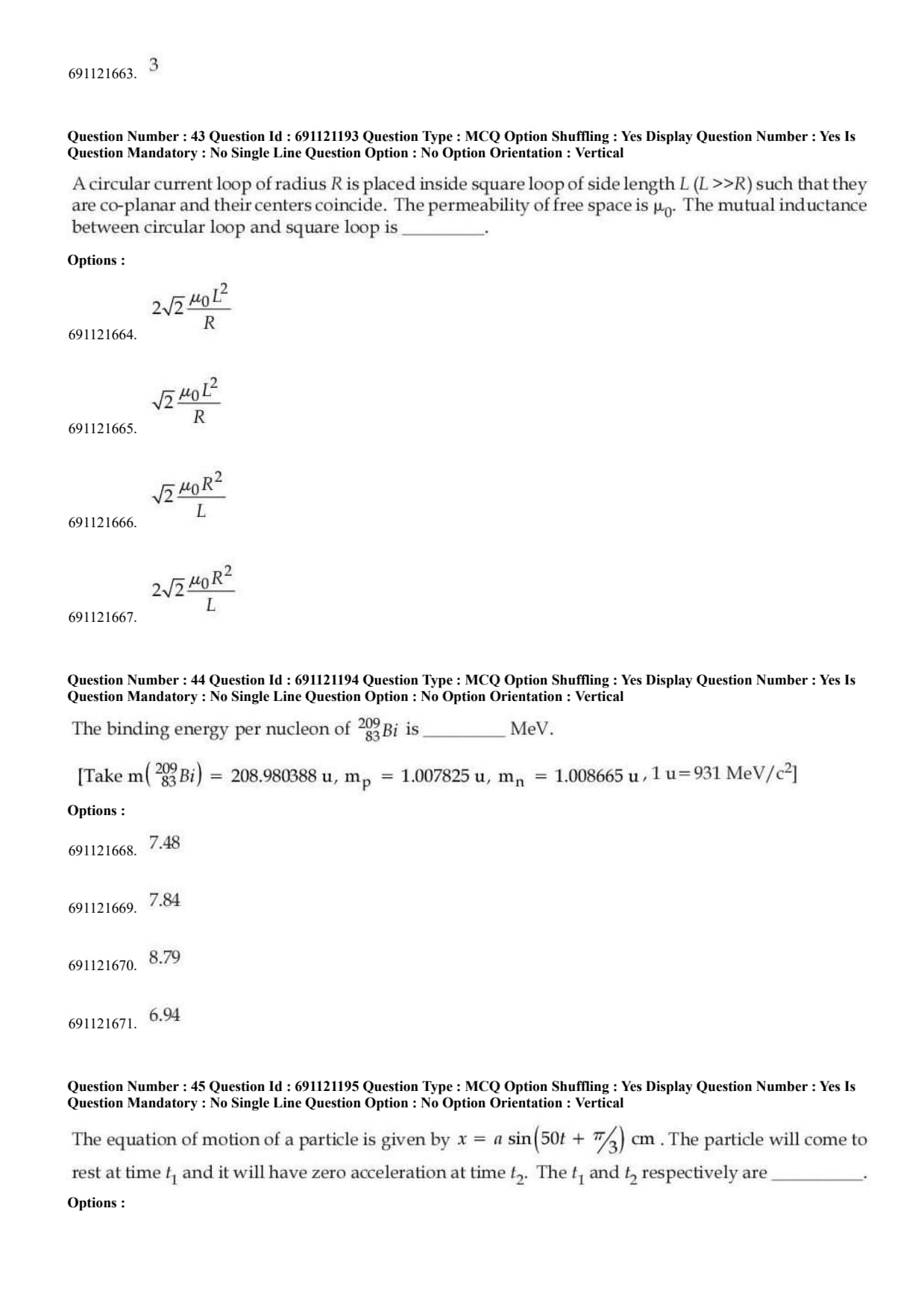
A circular current loop of radius \( R \) is placed inside square loop of side length \( L \) (where \( L \gg R \)) such that they are co-planar and their centers coincide. The permeability of free space is \( \mu_0 \). The mutual inductance between the circular loop and square loop is _____ .
The binding energy per nucleon of \( \,^{209} Bi \) is ______ MeV.
\[ Take m(^{209} Bi) = 208.98038 \, u, \, m_p = 1.007825 \, u, \, m_n = 1.008665 \, u, \, 1 \, u = 931 \, MeV/c^2. \]
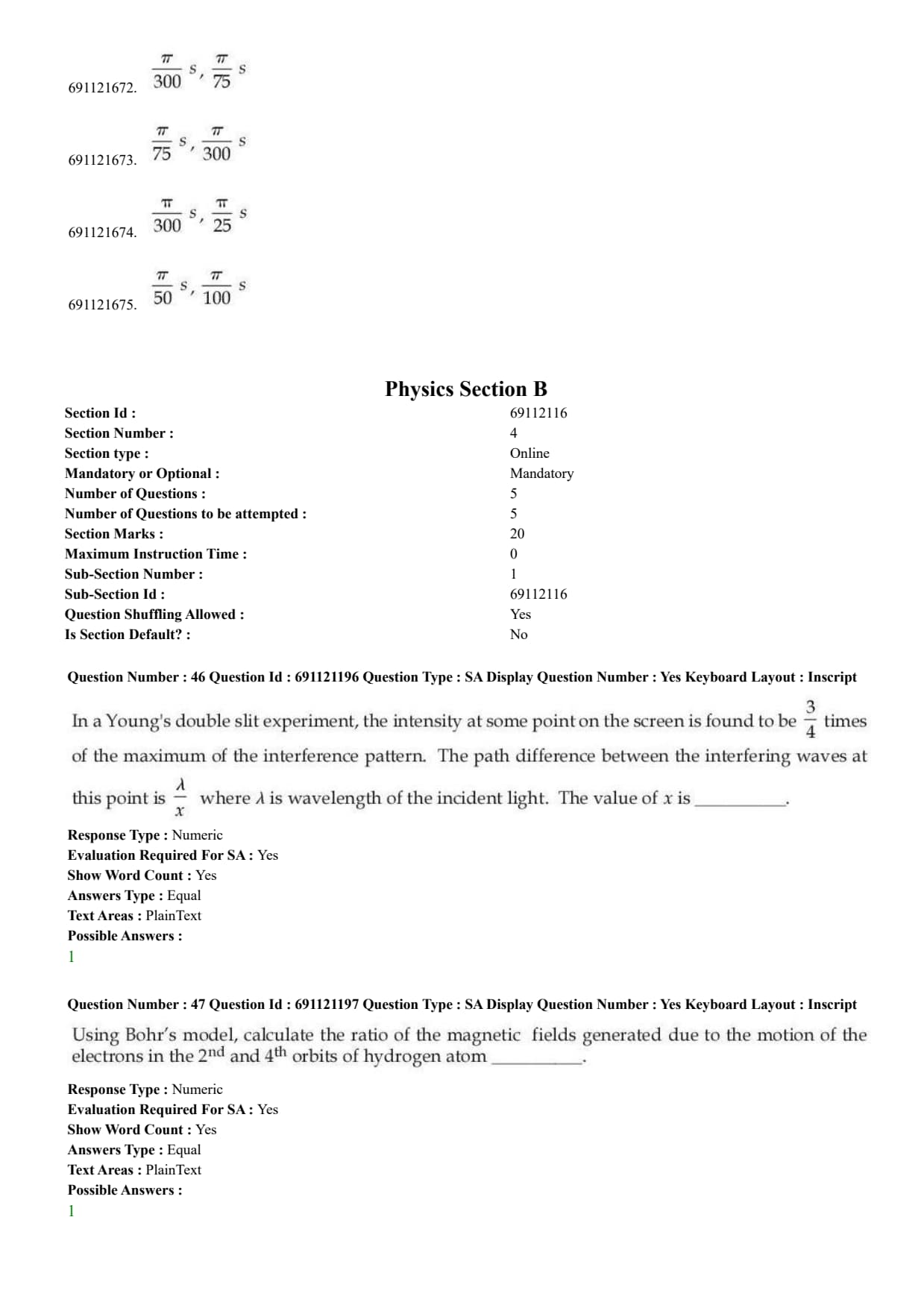
The equation of motion of a particle is given by \( x = a \sin \left( 50t + \frac{\pi}{3} \right) \, cm. \) The particle will come to rest at time \( t_1 \) and it will have zero acceleration at time \( t_2 \). The \( t_1 \) and \( t_2 \) respectively are _______.
In a Young's double slit experiment, the intensity at some point on the screen is found to be \( \frac{3}{4} \) times of the maximum of the interference pattern. The path difference between the interfering waves at this point is \( \frac{\lambda}{x} \), where \( \lambda \) is the wavelength of the incident light. The value of \( x \) is _____ .
Using Bohr's model, calculate the ratio of the magnetic fields generated due to the motion of the electrons in the 2nd and 4th orbits of a hydrogen atom.
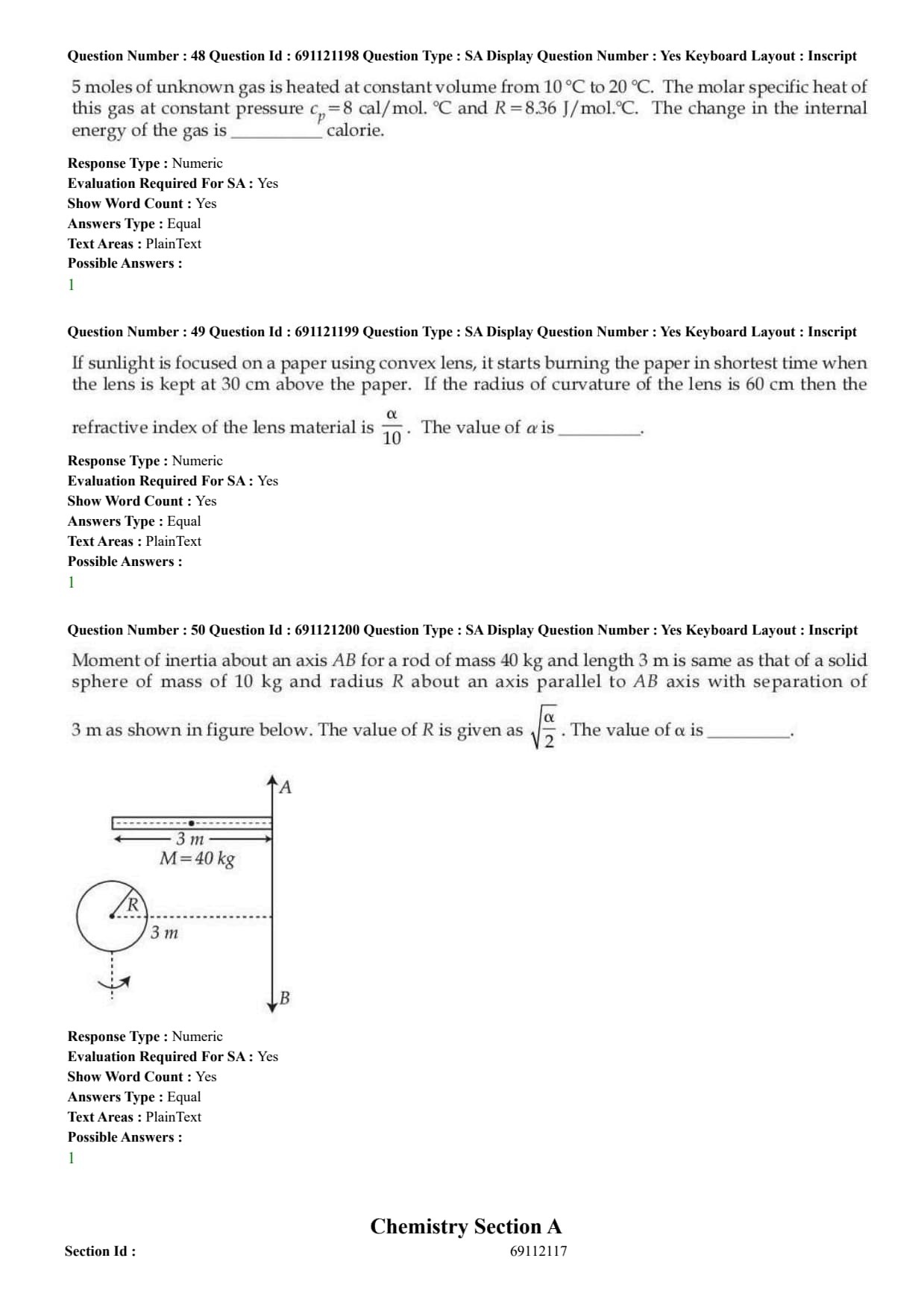
5 moles of unknown gas is heated at constant volume from 10°C to 20°C. The molar specific heat of this gas at constant pressure \( c_p = 8 \) cal/mol·°C and \( R = 8.36 \) J/mol·°C. The change in the internal energy of the gas is _____ calorie.
If sunlight is focused on a paper using a convex lens, it starts burning the paper in the shortest time when the lens is kept at 30 cm above the paper. If the radius of curvature of the lens is 60 cm, then the refractive index of the lens material is \( \frac{\alpha}{10} \). The value of \( \alpha \) is _____ .
Moment of inertia about an axis \( AB \) for a rod of mass 40 kg and length 3 m is same as that of a solid sphere of mass 10 kg and radius \( R \) about an axis parallel to \( AB \) axis with separation of 3 m as shown in the figure below. The value of \( R \) is given as \( \sqrt{\frac{\alpha}{2}} \). The value of \( \alpha \) is _____ .

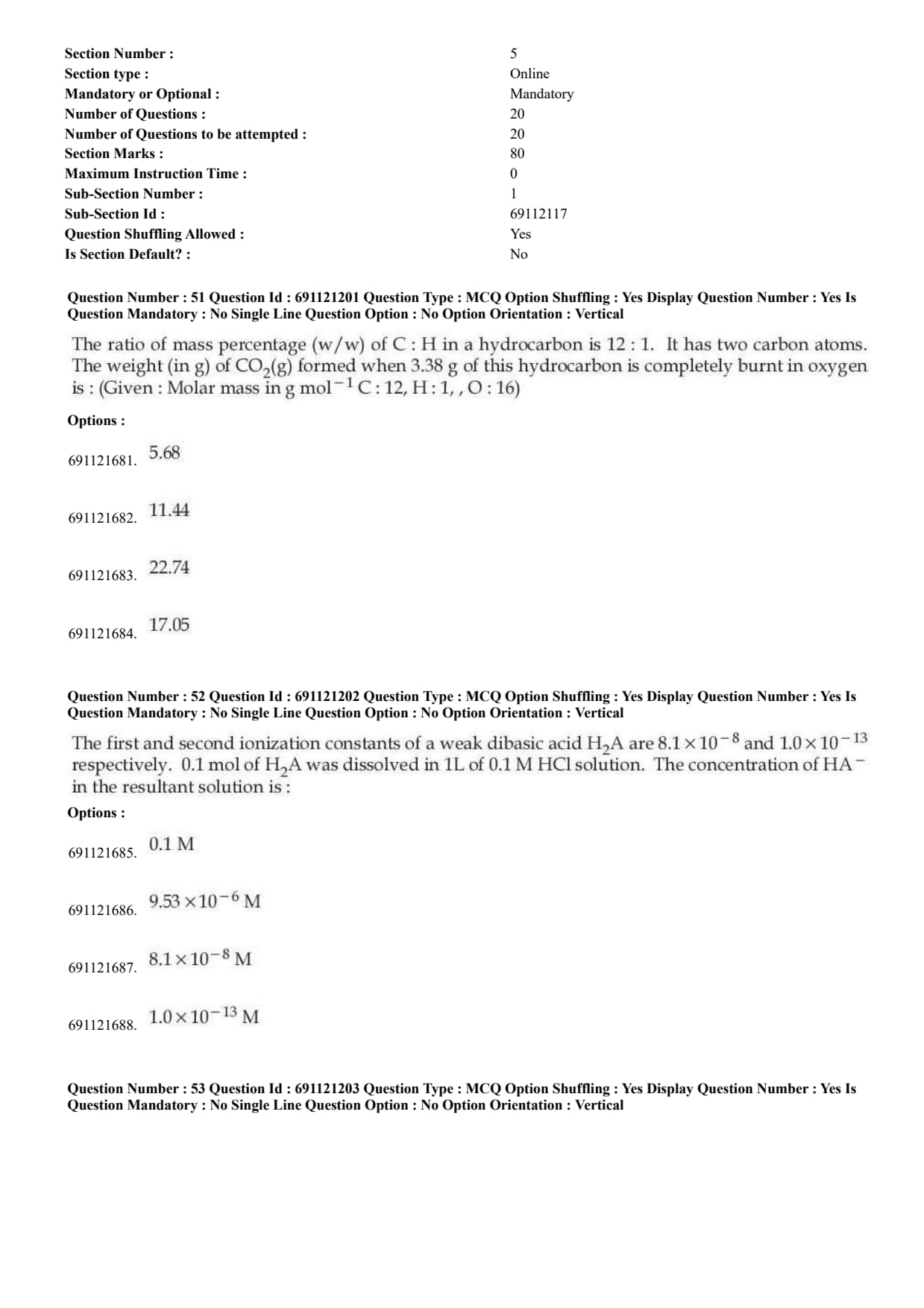
The ratio of mass percentage (w/w) of C : H in a hydrocarbon is 12 : 1. It has two carbon atoms. The weight (in g) of CO2(g) formed when 3.38 g of this hydrocarbon is completely burnt in oxygen is: (Given: Molar mass in g mol\(^{-1}\): C: 12, H: 1, O: 16)
The first and second ionization constants of a weak dibasic acid \( H_2A \) are \( 8.1 \times 10^{-8} \) and \( 1.0 \times 10^{-13} \) respectively. 0.1 mol of \( H_2A \) was dissolved in 1L of 0.1 M HCl solution. The concentration of \( HA^- \) in the resultant solution is:
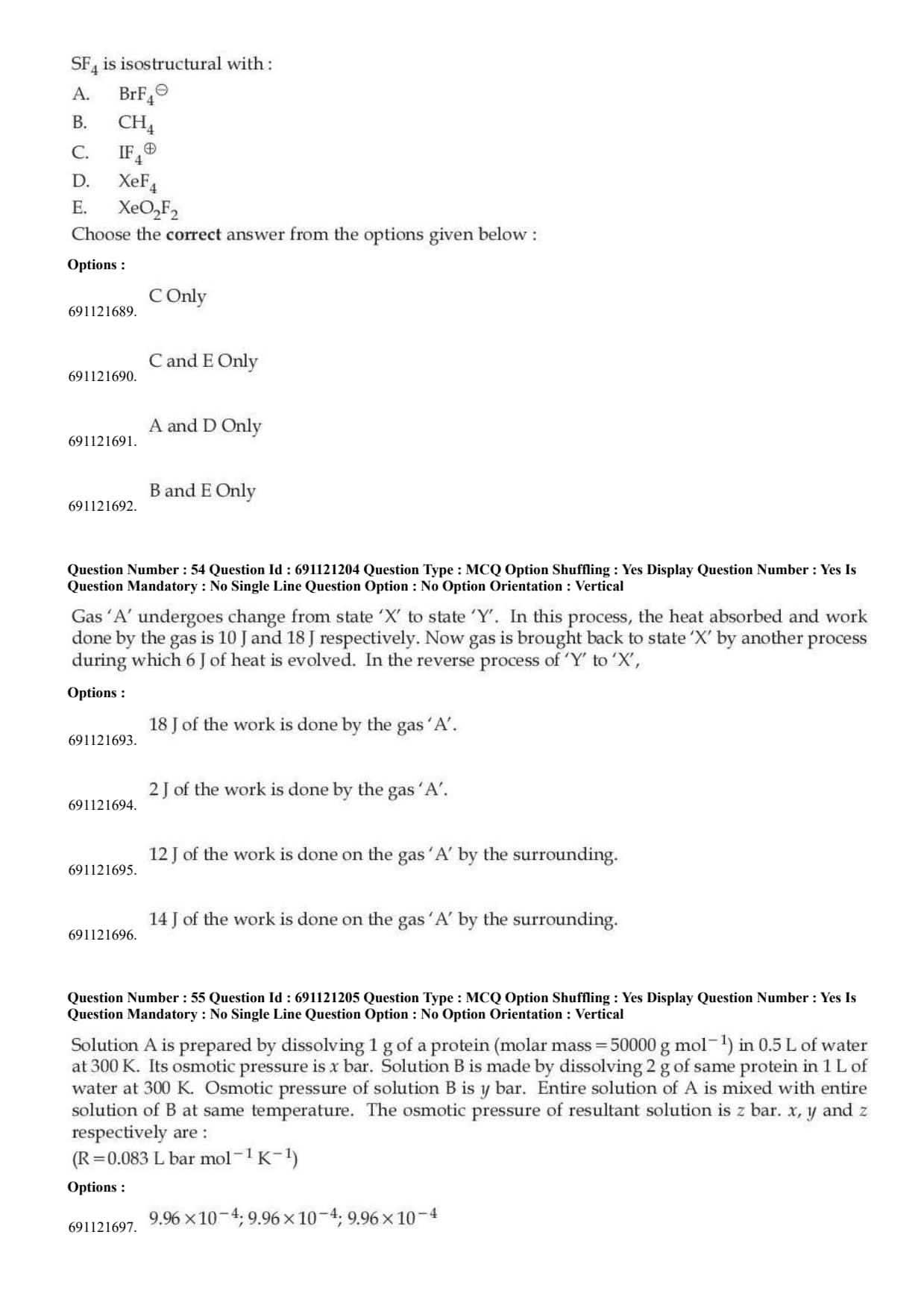
\( SF_4 \) is isostructural with:
Gas ‘A’ undergoes change from state ‘X’ to state ‘Y’. In this process, the heat absorbed and work done by the gas is 10 J and 18 J respectively. Now gas is brought back to state ‘X’ by another process during which 6 J of heat is evolved. In the reverse process of ‘Y’ to ‘X’, the work done is:
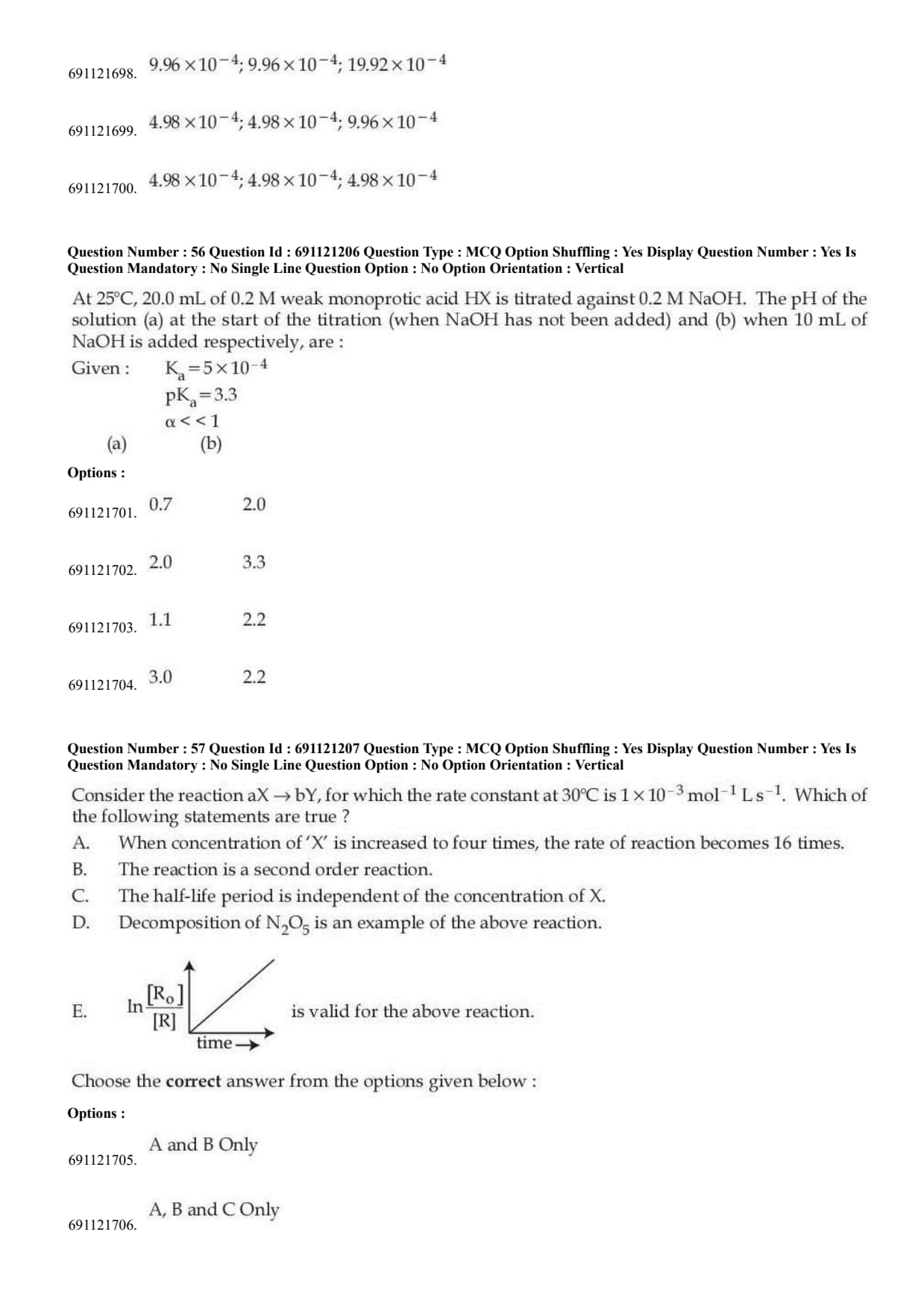
Solution A is prepared by dissolving 1 g of a protein (molar mass = 50000 g mol\(^{-1}\)) in 0.5 L of water at 300 K. Its osmotic pressure is \( x \) bar. Solution B is made by dissolving 2 g of the same protein in 1 L of water at 300 K. Osmotic pressure of solution B is \( y \) bar. Entire solution of A is mixed with entire solution of B at same temperature. The osmotic pressure of resultant solution is \( z \) bar. \( x \), \( y \), and \( z \) respectively are:
At 25°C, 20.0 mL of 0.2 M weak monoprotic acid HX is titrated against 0.2 M NaOH. The pH of the solution (a) at the start of the titration (when NaOH has not been added) and (b) when 10 mL of NaOH is added respectively are:
Consider the reaction \( aX \rightarrow bY \), for which the rate constant at 30°C is \( 1 \times 10^{-3} \, mol^{-1} \, L \, s^{-1} \). Which of the following statements are true?
(A) When concentration of \( X \) is increased to four times, the rate of reaction becomes 16 times.
(B) The reaction is a second order reaction.
(C) The half-life period is independent of the concentration of \( X \).
(D) Decomposition of \( N_2O_5 \) is an example of the above reaction.
(E) 
Choose the correct answer from the options given below:
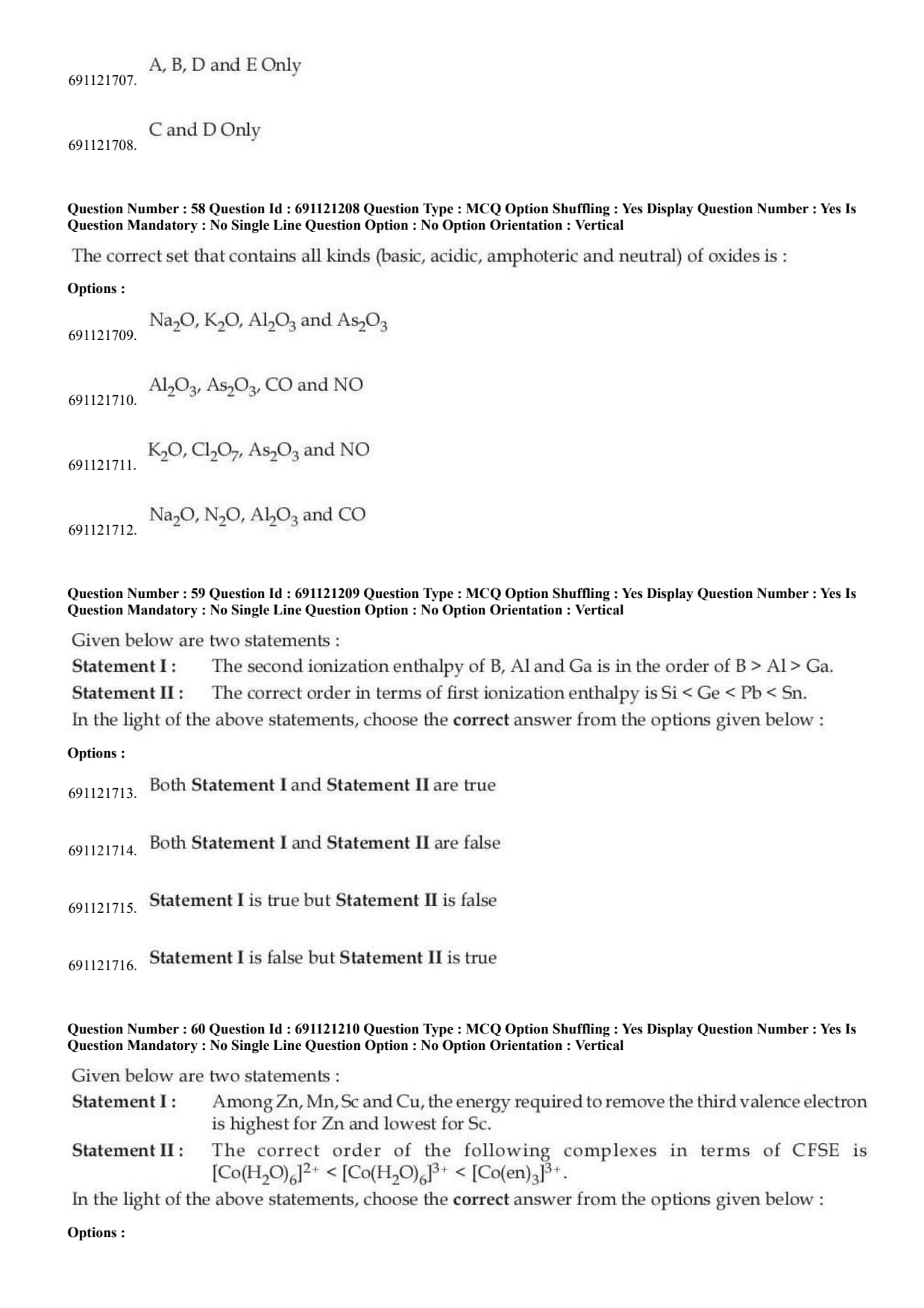
The correct set that contains all kinds (basic, acidic, amphoteric and neutral) of oxides is:
Given below are two statements:
Statement I: The second ionization enthalpy of B, Al and Ga is in the order of B > Al > Ga.
Statement II: The correct order in terms of first ionization enthalpy is Si < Ge < Pb < Sn.
In light of the above statements, choose the correct answer from the options given below:
Given below are two statements:
Statement I: Among Zn, Mn, Sc and Cu, the energy required to remove the third valence electron is highest for Zn and lowest for Sc.
Statement II: The correct order of the following complexes in terms of CFSE is [Co(H₂O)₆]²⁺ < [Co(H₂O)₆]³⁺ < [Co(en)₃]³⁺.
In light of the above statements, choose the correct answer from the options given below:
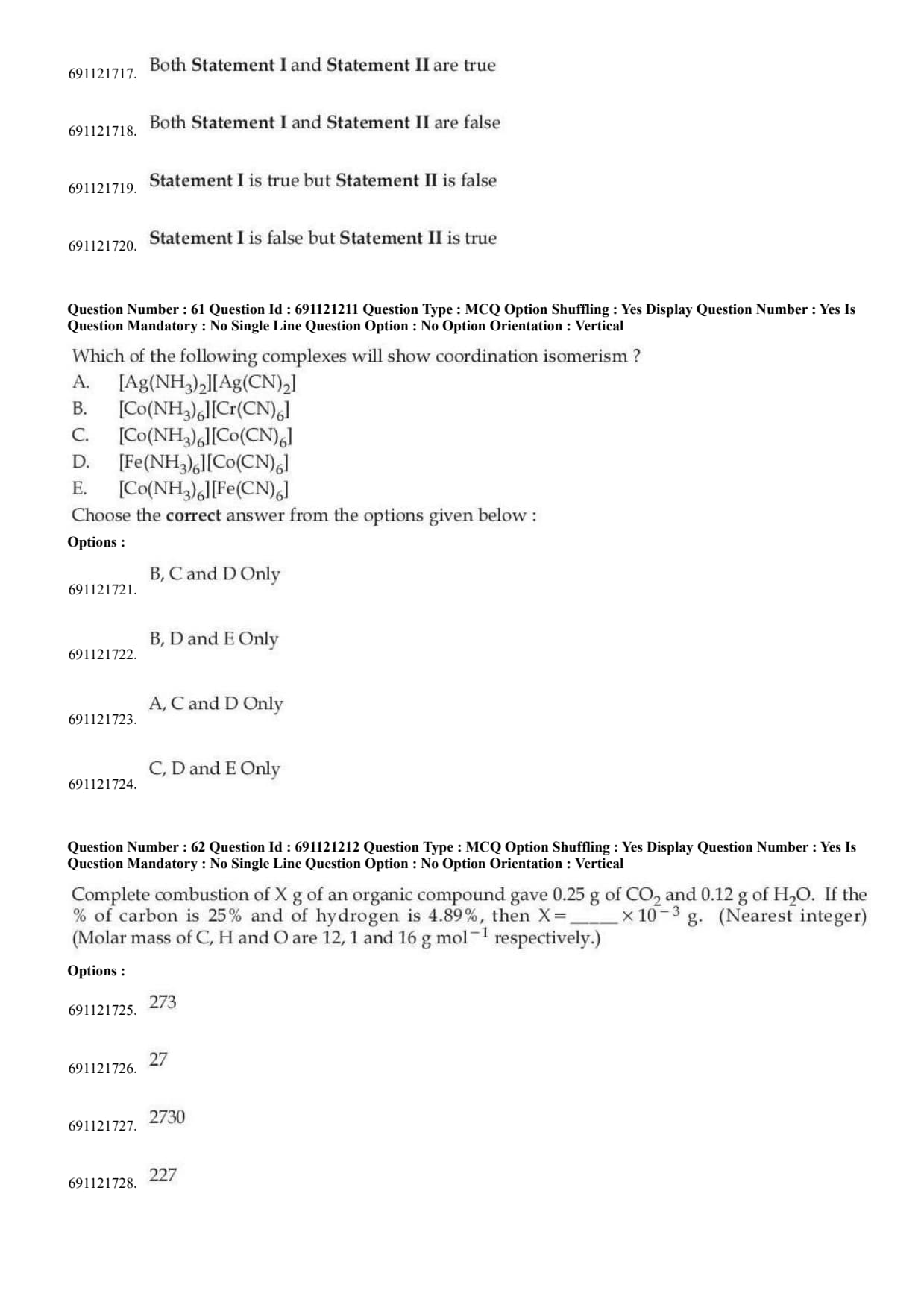
Which of the following complexes will show coordination isomerism?
(A) \( [Ag(NH_3)_2][Ag(CN)_2] \)
(B) \( [Co(NH_3)_6][Cr(CN)_6] \)
(C) \( [Co(NH_3)_6][Co(CN)_6] \)
(D) \( [Fe(NH_3)_6][Co(CN)_6] \)
(E) \( [Co(NH_3)_6][Fe(CN)_6] \)
Choose the correct answer from the options given below:
Complete combustion of \( X \) g of an organic compound gave 0.25 g of CO\(_2\) and 0.12 g of H\(_2\)O. If the percent of carbon is 25% and of hydrogen is 4.8%, then \( X = \) _____ g (Nearest integer).
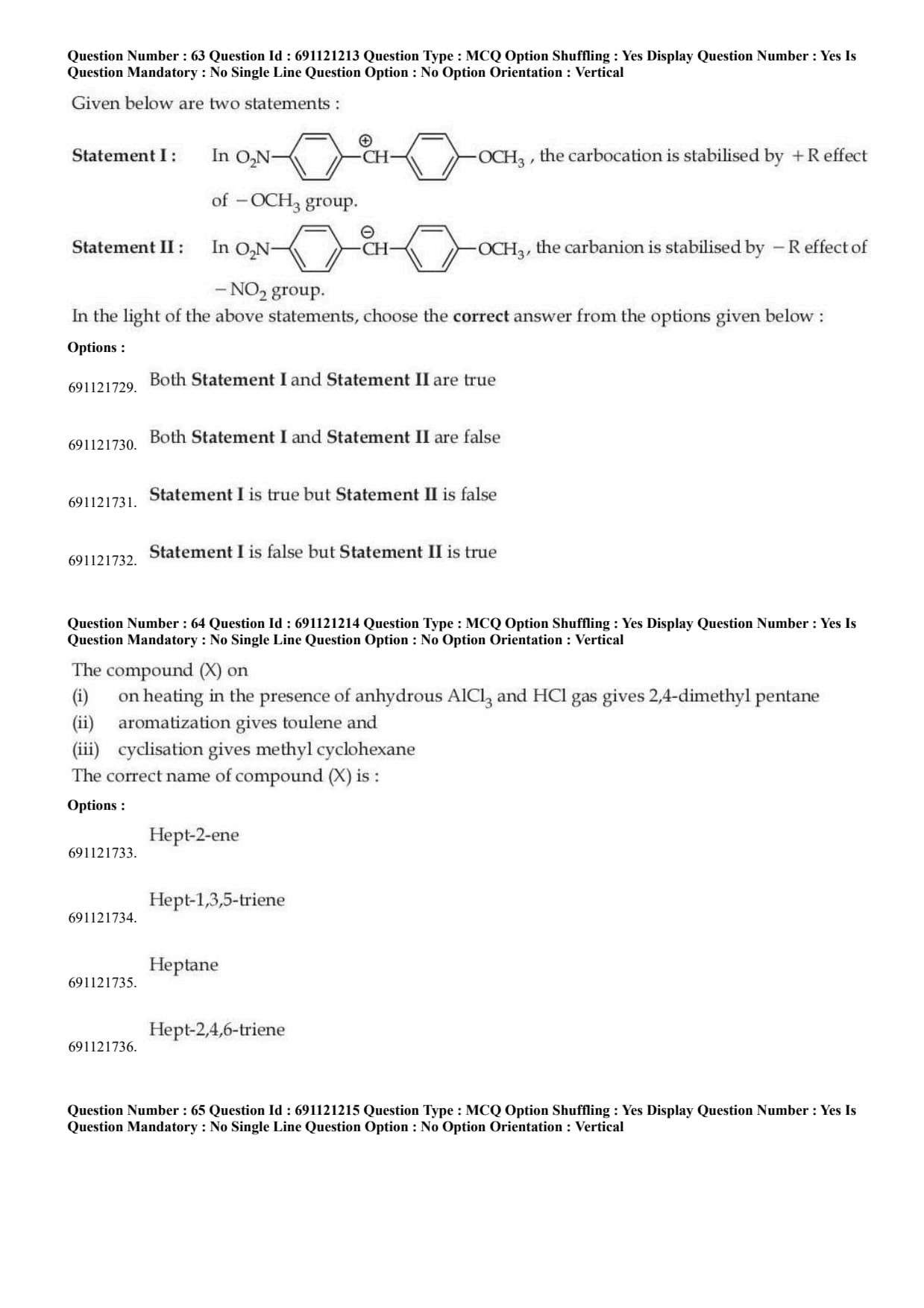
Given below are two statements:
Statement I: In  , the carbocation is stabilized by the \( +R \) effect of the \( OCH_3 \) group.
Statement II: In  , the carbanion is stabilized by the \( -R \) effect of the \( NO_2 \) group.
In light of the above statements, choose the correct answer from the options given below:
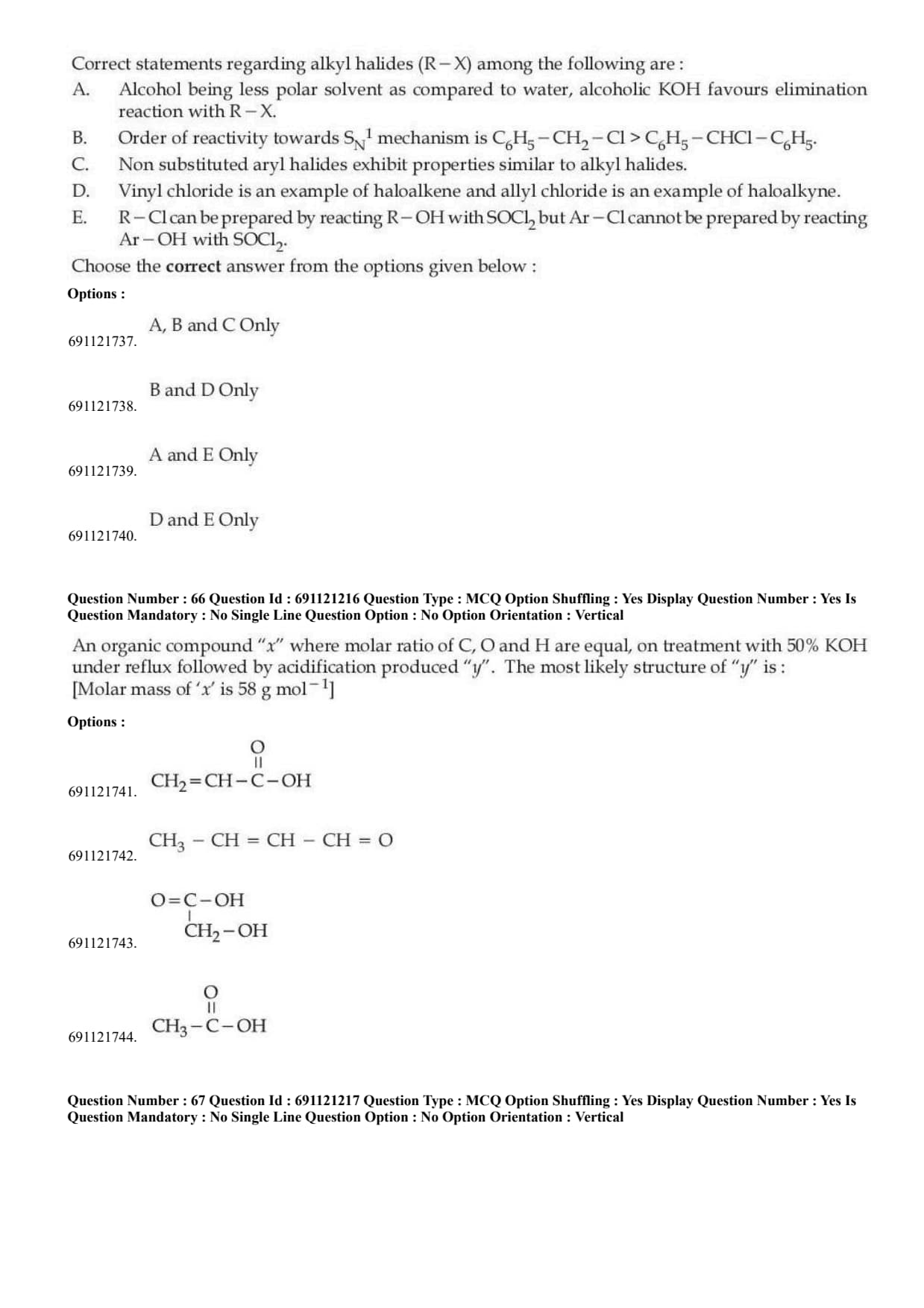
The compound \( X \) on:
(i) On heating in the presence of anhydrous \( AlCl_3 \) and \( HCl \) gas gives 2,4-dimethyl pentane.
(ii) Aromatization gives toluene and
(iii) Cyclisation gives methyl cyclohexane.
The correct name of compound \( X \) is:
Correct statements regarding alkyl halides (R–X) among the following are:
A. Alcohol being less polar solvent as compared to water, alcoholic KOH favours elimination reaction with R–X.
B. Order of reactivity towards \(S_N1\) mechanism is \(C_6H_5-CH_2-Cl > C_6H_5-CHCl-C_6H_5\).
C. Non-substituted aryl halides exhibit properties similar to alkyl halides.
D. Vinyl chloride is an example of haloalkene and allyl chloride is an example of haloalkyne.
E. \(R-Cl\) can be prepared by reacting \(R-OH\) with \(SOCl_2\) but \(Ar-OH\) cannot be prepared by reacting \(Ar-OH\) with \(SOCl_2\).
An organic compound "x" where molar ratio of C, O and H are equal, on treatment with 50% KOH under reflux followed by acidification produced "y". The most likely structure of "y" is:
Options
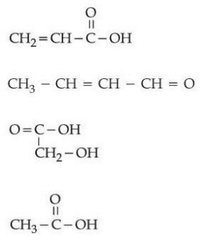
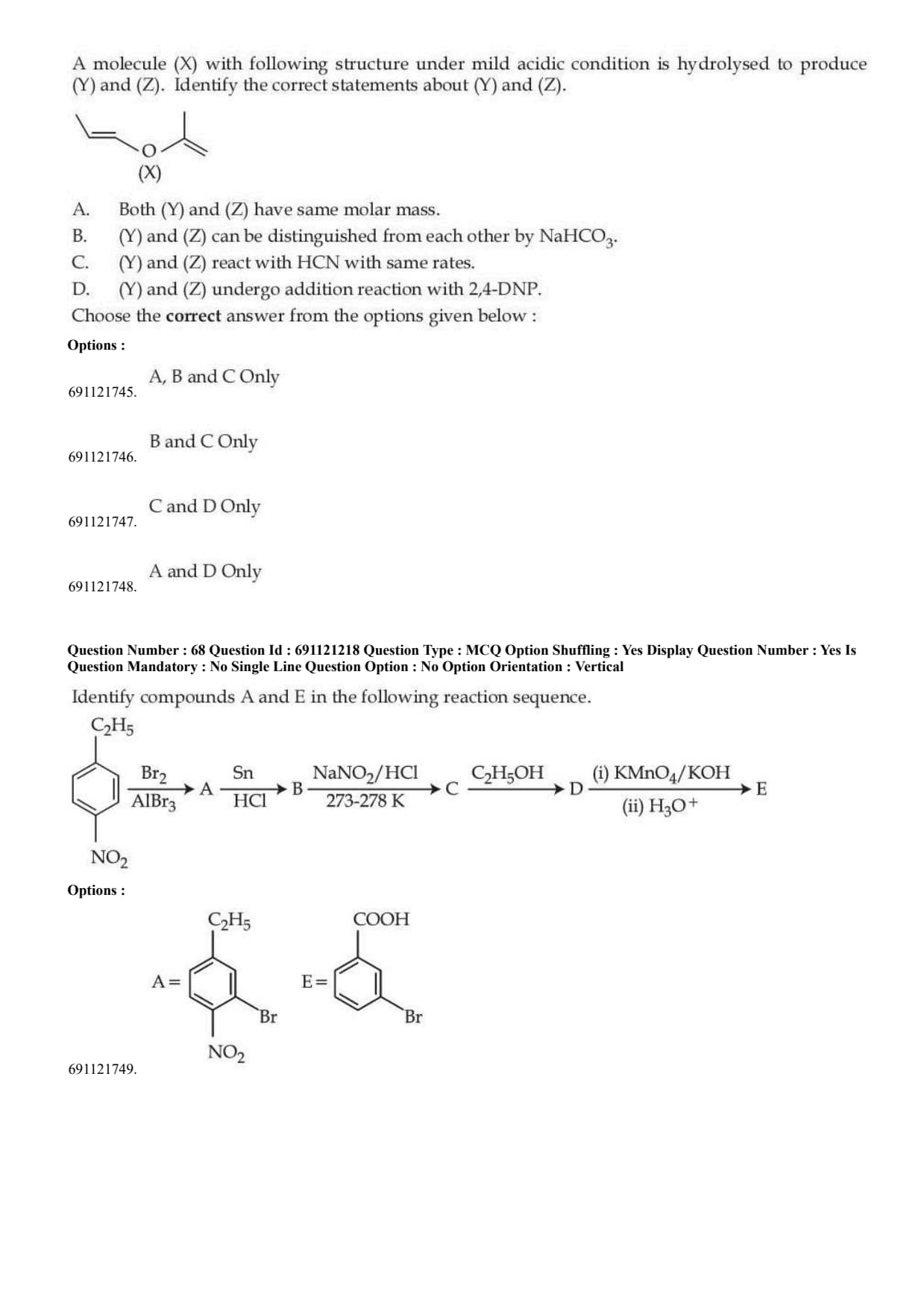
A molecule \( (X) \) with the following structure under mild acidic conditions is hydrolyzed to produce \( (Y) \) and \( (Z) \). Identify the correct statements about \( (Y) \) and \( (Z) \).

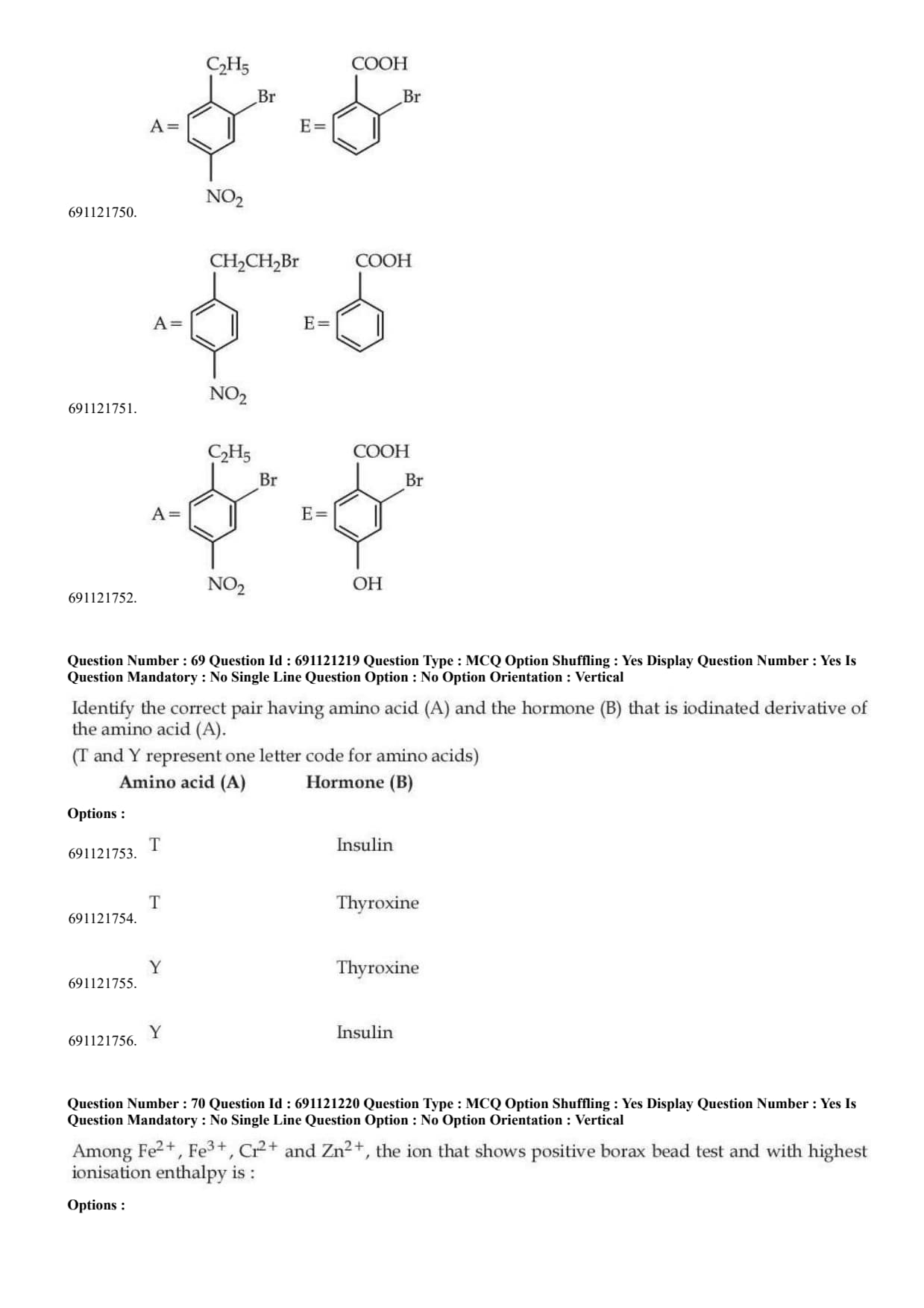
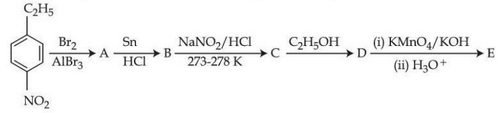
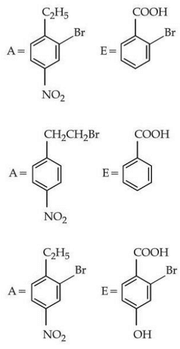
Identify compounds A and E in the following reaction sequence.
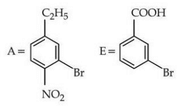
Identify the correct pair having amino acid (A) and the hormone (B) that is iodinated derivative of the amino acid (A).
Choose the correct answer from the options given below:
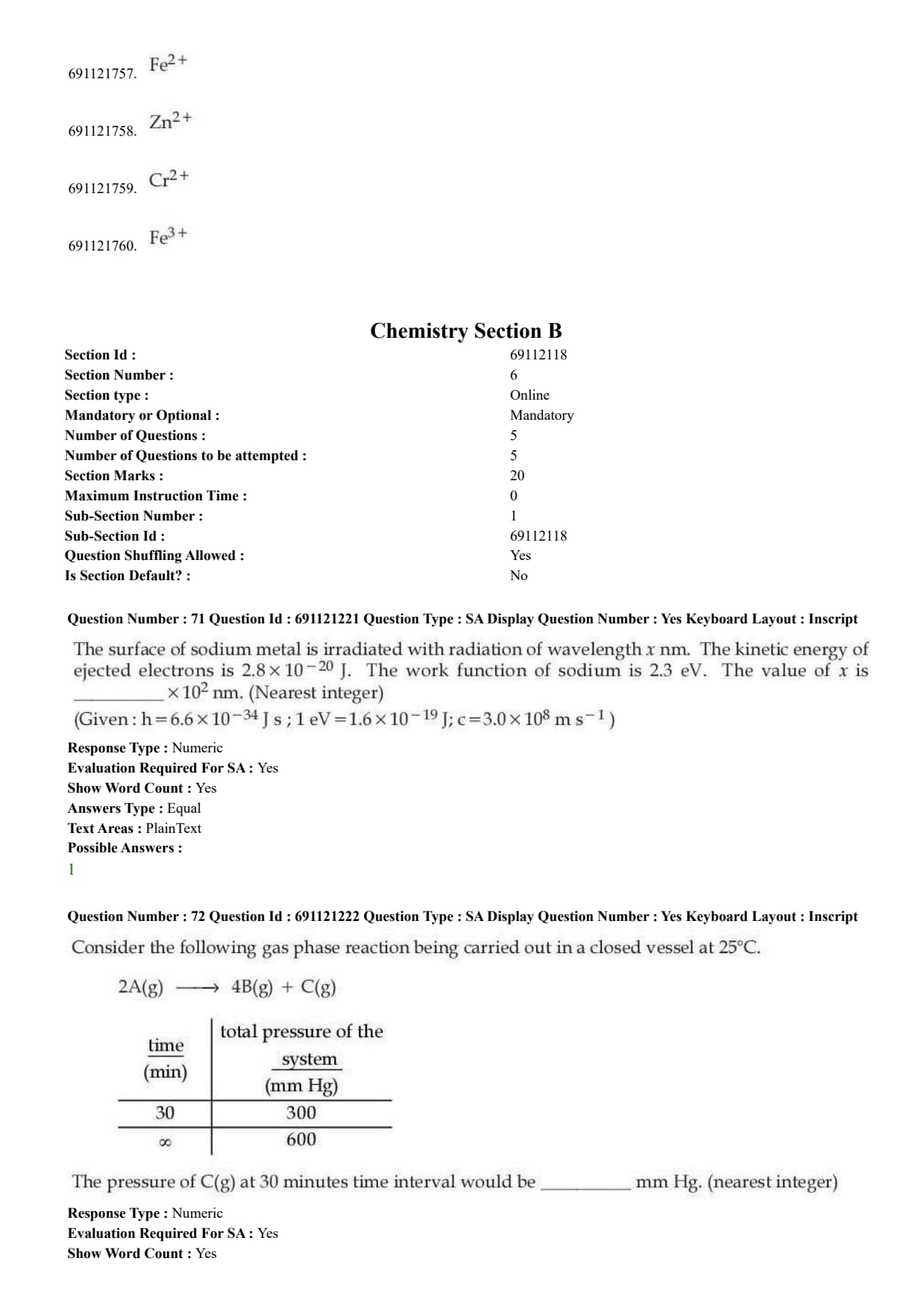
Among \( Fe^{2+}, Fe^{3+}, Cr^{2+} \) and \( Zn^{2+} \), the ion that shows positive borax bead test and with highest ionisation enthalpy is:
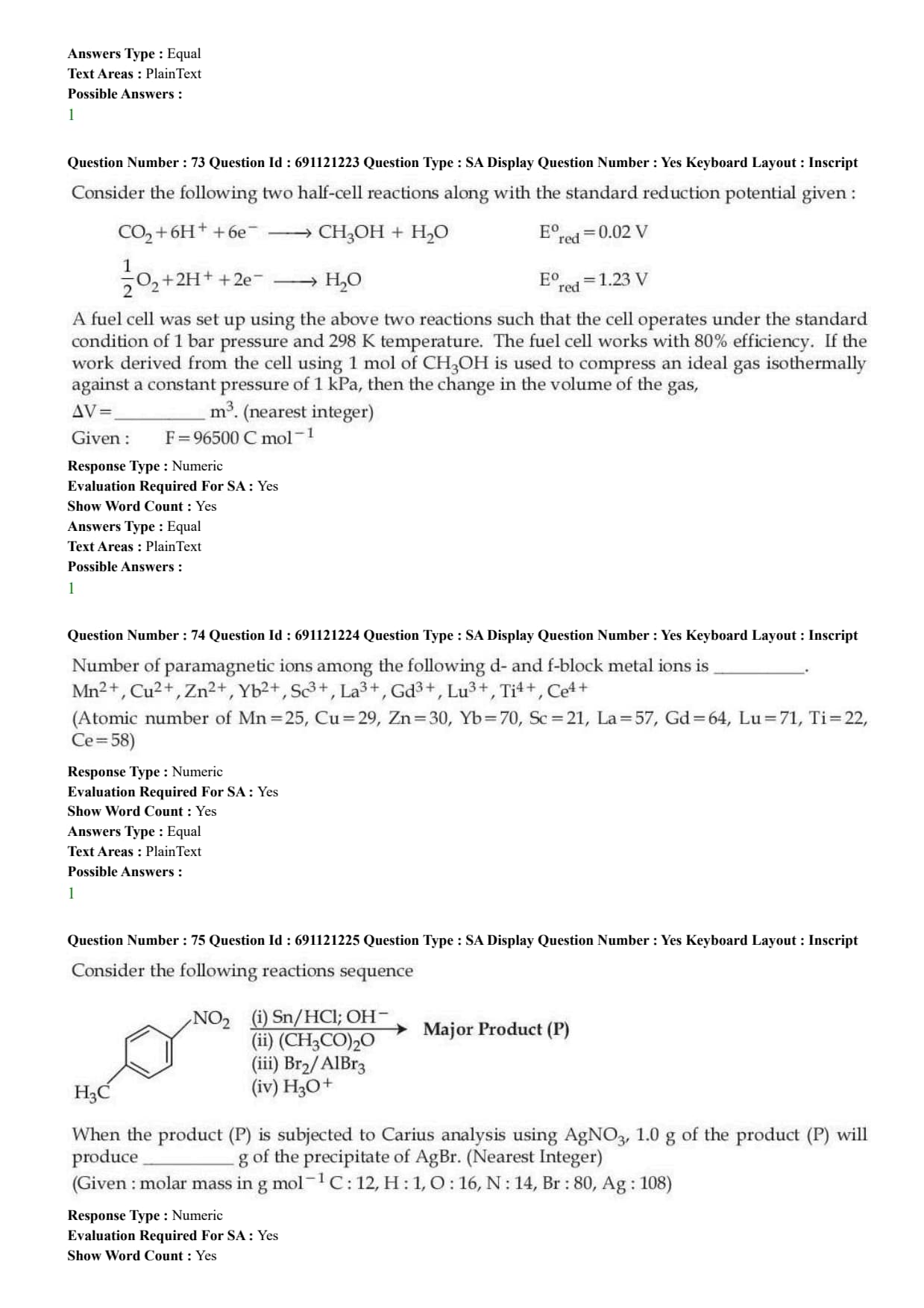
The surface of sodium metal is irradiated with radiation of wavelength \( x \) nm. The kinetic energy of ejected electrons is \( 2.8 \times 10^{-20} \) J. The work function of sodium is 2.3 eV. The value of \( x \) is _______ \( \times 10^2 \) nm. (Nearest integer)
Consider the following gas phase reaction being carried out in a closed vessel at 25°C:
\[ 2A(g) \longrightarrow 4B(g) + C(g) \]
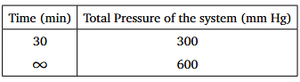
We need to find the pressure of \( C(g) \) at the 30 minutes time interval.
Consider the following two half-cell reactions along with the standard reduction potential given: \[ CO_2 + 6H^+ + 6e^- \rightarrow CH_3OH + H_2O \quad E^\circ_{red} = 0.02 \, V \] \[ \frac{1}{2} O_2 + 2H^+ + 2e^- \rightarrow H_2O \quad E^\circ_{red} = 1.23 \, V \]
A fuel cell was set up using the above two reactions such that the cell operates under the standard condition of 1 bar pressure and 298 K temperature. The fuel cell works with 80% efficiency. If the work derived from the cell using 1 mol of CH\(_3\)OH is used to compress an ideal gas isothermally against a constant pressure of 1 kPa, then the change in the volume of the gas, \( \Delta V = \) _______ m\(^3\) (nearest integer).
Number of paramagnetic ions among the following d- and f-block metal ions is _______.
\[ Mn^{2+}, \, Cu^{2+}, \, Zn^{2+}, \, Yb^{2+}, \, Sc^{3+}, \, La^{3+}, \, Gd^{3+}, \, Lu^{3+}, \, Ti^{4+}, \, Ce^{4+} \]
\text{(Atomic number of Mn = 25, Cu = 29, Zn = 30, Yb = 70, Sc = 21, La = 57, Gd = 64, Lu = 71, Ti = 22, Ce = 58)
Consider the following reactions sequence:

When the product (P) is subjected to Carius analysis using \( AgNO_3 \), 1.0 g of the product (P) will produce _______ g of the precipitate of \( AgBr \). (Nearest integer)
JEE Main 2026 Exam Pattern
| Particulars | Details |
|---|---|
| Exam Mode | Online (Computer-Based Test) |
| Paper | B.E./B.Tech |
| Medium of Exam | 13 languages: English, Hindi, Gujarati, Bengali, Tamil, Telugu, Kannada, Marathi, Malayalam, Odia, Punjabi, Assamese, Urdu |
| Duration | 3 hours (180 minutes) |
| Type of Questions | Multiple Choice Questions (MCQs) + Numerical Value Questions |
| Total Marks | 300 marks |
| Subjects | Mathematics, Physics, Chemistry |
| Marking Scheme | +4 for correct answer & -1 for incorrect MCQ and Numerical Value-based Questions |
| Total Questions | 75 Questions |
| Eligibility | Passed or appearing in Class 12 with Physics, Chemistry, and Mathematics |
JEE Main 2026 Preparation




Comments