




JEE Main 2026 April 4 Shift 1 physics question paper is available here with answer key and solutions. NTA conducted the first shift of the day on April 4, 2026, from 9:00 AM to 12:00 PM.
- The JEE Main Physics Question Paper contains a total of 25 questions.
- Each correct answer gets you 4 marks while incorrect answers gets you a negative mark of 1.
Candidates can download the JEE Main 2026 April 4 Shift 1 physics question paper along with detailed solutions to analyze their performance and understand the exam pattern better.
JEE Main 2026 April 4 Shift 1 Physics Question Paper with Solution PDF

Also Check:


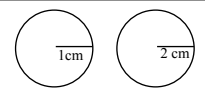
Find the work done in expanding a soap bubble from radius \(1\,cm\) to \(2\,cm\). Surface tension is \( \gamma = 7.2 \times 10^{-2}\,N/m \).
View Solution
Concept:
For a soap bubble, there are two surfaces (inner and outer). Therefore, the work done in expanding the bubble equals the increase in surface energy of both surfaces.
Surface energy: \[ U = 2 \gamma A \]
Work done in expansion: \[ W = \Delta U = 2\gamma (A_2 - A_1) \]
Area of a sphere: \[ A = 4\pi r^2 \]
Thus, \[ W = 2\gamma \left[4\pi r_2^2 - 4\pi r_1^2 \right] \]
Step 1: Write the expression for work done.
\[ W = 2\gamma \left[4\pi (r_2^2 - r_1^2)\right] \]
\[ W = 8\pi\gamma (r_2^2 - r_1^2) \]
Step 2: Substitute the given values.
\[ \gamma = 7.2 \times 10^{-2}\, N/m \]
\[ r_1 = 1\,cm = 1\times10^{-2}\,m \]
\[ r_2 = 2\,cm = 2\times10^{-2}\,m \]
\[ W = 8\pi \times 7.2 \times 10^{-2} \left[(2\times10^{-2})^2 - (1\times10^{-2})^2\right] \]
Step 3: Simplify the expression.
\[ (2\times10^{-2})^2 = 4\times10^{-4} \]
\[ (1\times10^{-2})^2 = 1\times10^{-4} \]
\[ r_2^2 - r_1^2 = 3\times10^{-4} \]
\[ W = 8\pi \times 7.2 \times 10^{-2} \times 3\times10^{-4} \]
\[ W = 542.6 \times 10^{-6}\,J \] Quick Tip: For a \textbf{soap bubble}, two surfaces exist (inside and outside), so the surface energy is \(U = 2\gamma A\). Always multiply by \(2\) when calculating work done due to surface tension in soap bubbles.
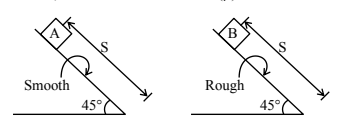
Two blocks \(A\) and \(B\) are released from rest on two inclined planes of the same inclination. One inclined plane is smooth while the other is rough as shown in the figure. If block \(B\) takes \(50%\) more time to reach the bottom than block \(A\), find the coefficient of friction \((\mu)\). The inclination of the plane is \(45^\circ\).
View Solution
Concept:
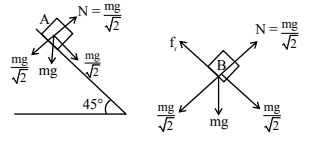
For motion down an inclined plane:
Acceleration on a smooth incline \[ a = g\sin\theta \]
Acceleration on a rough incline \[ a = g(\sin\theta - \mu\cos\theta) \]
If a body starts from rest and moves a distance \(S\), \[ S = \frac{1}{2}at^2 \]
Thus, \[ t = \sqrt{\frac{2S}{a}} \]
Hence time is inversely proportional to the square root of acceleration.
\[ t \propto \frac{1}{\sqrt{a}} \]
Step 1: Acceleration of block \(A\) (smooth plane).
\[ a_A = g\sin45^\circ \]
\[ a_A = \frac{g}{\sqrt{2}} \]
Step 2: Acceleration of block \(B\) (rough plane).
\[ a_B = g(\sin45^\circ - \mu\cos45^\circ) \]
\[ a_B = g\left(\frac{1}{\sqrt{2}} - \mu\frac{1}{\sqrt{2}}\right) \]
\[ a_B = \frac{g}{\sqrt{2}}(1-\mu) \]
Step 3: Using the relation between time and acceleration.
\[ t \propto \frac{1}{\sqrt{a}} \]
\[ \frac{t_B}{t_A} = \sqrt{\frac{a_A}{a_B}} \]
Given \(B\) takes \(50%\) more time:
\[ t_B = 1.5\, t_A \]
\[ \frac{t_B}{t_A} = \frac{3}{2} \]
Step 4: Substitute accelerations.
\[ \frac{3}{2} = \sqrt{\frac{\frac{g}{\sqrt{2}}}{\frac{g}{\sqrt{2}}(1-\mu)}} \]
\[ \frac{3}{2} = \sqrt{\frac{1}{1-\mu}} \]
Step 5: Solve for \(\mu\).
\[ \left(\frac{3}{2}\right)^2 = \frac{1}{1-\mu} \]
\[ \frac{9}{4} = \frac{1}{1-\mu} \]
\[ 1-\mu = \frac{4}{9} \]
\[ \mu = \frac{5}{9} \] Quick Tip: For bodies starting from rest on an inclined plane, \(S=\frac{1}{2}at^2\). If distances are same, \(t \propto \frac{1}{\sqrt{a}}\). This relation greatly simplifies comparison problems involving different accelerations.
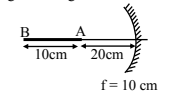
Find the length of image of rod \(AB\). The rod is placed in front of a concave mirror of focal length \(f = 10\,cm\). End \(A\) is \(20\,cm\) from the mirror and the length \(AB = 10\,cm\).
View Solution
Concept:
For mirrors, the mirror formula relates object distance \(u\), image distance \(v\), and focal length \(f\):
\[ \frac{1}{v} + \frac{1}{u} = \frac{1}{f} \]
Using the mirror sign convention:
Object distance \(u\) is negative.
Focal length \(f\) is negative for a concave mirror.
The image length of the rod equals the difference between the image positions of its two ends.
Step 1: Image position of point \(A\).
Distance of \(A\) from mirror: \[ u_A = -20\,cm, \quad f = -10\,cm \]
Using mirror formula:
\[ \frac{1}{v_A} + \frac{1}{u_A} = \frac{1}{f} \]
\[ \frac{1}{v_A} + \frac{1}{-20} = \frac{1}{-10} \]
\[ \frac{1}{v_A} = -\frac{1}{10} + \frac{1}{20} \]
\[ \frac{1}{v_A} = -\frac{1}{20} \]
\[ v_A = -20\,cm \]
Step 2: Image position of point \(B\).
Since \(AB = 10\,cm\),
\[ u_B = -30\,cm \]
Applying mirror formula:
\[ \frac{1}{v_B} + \frac{1}{u_B} = \frac{1}{f} \]
\[ \frac{1}{v_B} + \frac{1}{-30} = \frac{1}{-10} \]
\[ \frac{1}{v_B} = -\frac{1}{10} + \frac{1}{30} \]
\[ \frac{1}{v_B} = -\frac{2}{30} \]
\[ v_B = -15\,cm \]
Step 3: Length of the image of the rod.
\[ Image length = |v_A - v_B| \]
\[ = |-20 - (-15)| \]
\[ = 5\,cm \]
Thus, the length of the image of the rod is:
\[ \boxed{5\,cm} \] Quick Tip: When an extended object is placed along the principal axis of a mirror, calculate the image position of both ends separately using the mirror formula. The difference between their image positions gives the length of the image.
Nuclei \(A\) and \(B\) form a nucleus \(C\). Binding energy per nucleon for \(A, B\) and \(C\) are \(3\,MeV, 7\,MeV\) and \(6\,MeV\) respectively. Find the energy produced in the reaction:
\[ 2A^{3} + B^{4} \rightarrow C^{10} \]
View Solution
Concept:
Energy released in a nuclear reaction equals the difference between the total binding energy of the products and the total binding energy of the reactants.
\[ Q = BE_{products} - BE_{reactants} \]
Binding energy of a nucleus:
\[ BE = (Binding energy per nucleon) \times (Number of nucleons) \]
Step 1: Calculate total binding energy of reactants.
For nucleus \(A^3\):
\[ BE = 3 \times 3 = 9\,MeV \]
Since there are two \(A\) nuclei:
\[ BE_{A} = 2 \times 9 = 18\,MeV \]
For nucleus \(B^4\):
\[ BE_{B} = 4 \times 7 = 28\,MeV \]
Total binding energy of reactants:
\[ BE_{LHS} = 18 + 28 = 46\,MeV \]
Step 2: Calculate total binding energy of product.
For nucleus \(C^{10}\):
\[ BE_{RHS} = 10 \times 6 = 60\,MeV \]
Step 3: Calculate energy released.
\[ Q = BE_{RHS} - BE_{LHS} \]
\[ Q = 60 - 46 \]
\[ Q = 14\,MeV \] Quick Tip: Energy released in nuclear reactions is calculated using binding energies: \(Q = BE_{products} - BE_{reactants}\). If the result is positive, energy is released.
If force \( \vec{F} = 2t\,\hat{i} + 3t^2\,\hat{j} \) acts on a particle of mass \(m = 2\,kg\), find the power at \(t = 2\,s\) if the particle was initially at rest.
View Solution
Concept:
Power delivered by a force is given by the dot product of force and velocity.
\[ P = \vec{F} \cdot \vec{v} \]
Acceleration is related to force by Newton's second law:
\[ \vec{a} = \frac{\vec{F}}{m} \]
Velocity can be obtained by integrating acceleration.
Step 1: Find acceleration.
\[ \vec{a} = \frac{\vec{F}}{m} \]
\[ \vec{a} = \frac{2t}{2}\hat{i} + \frac{3t^2}{2}\hat{j} \]
\[ \vec{a} = t\,\hat{i} + \frac{3t^2}{2}\hat{j} \]
Step 2: Find velocity by integrating acceleration.
\[ \vec{v} = \int \vec{a}\,dt \]
\[ \vec{v} = \int t\,dt\,\hat{i} + \int \frac{3t^2}{2}\,dt\,\hat{j} \]
\[ \vec{v} = \frac{t^2}{2}\hat{i} + \frac{t^3}{2}\hat{j} \]
Step 3: Compute power.
\[ P = \vec{F} \cdot \vec{v} \]
\[ P = (2t\,\hat{i} + 3t^2\,\hat{j}) \cdot \left(\frac{t^2}{2}\hat{i} + \frac{t^3}{2}\hat{j}\right) \]
\[ P = t^3 + \frac{3}{2}t^5 \]
Step 4: Substitute \(t = 2\,s\).
\[ P = 2^3 + \frac{3}{2}(2^5) \]
\[ P = 8 + \frac{3}{2}\times 32 \]
\[ P = 8 + 48 \]
\[ P = 56\,W \] Quick Tip: Instantaneous power delivered by a force is \(P = \vec{F}\cdot\vec{v}\). First find velocity by integrating acceleration obtained from \( \vec{F} = m\vec{a} \), then take the dot product.
Two projectiles \(A\) and \(B\) are launched with the same speed at angles \(15^\circ\) and \(30^\circ\) respectively. Find the ratio of range \(A\) to range \(B\).
View Solution
Concept:
The horizontal range of a projectile launched with speed \(u\) at an angle \(\theta\) with the horizontal is given by
\[ R = \frac{u^2 \sin 2\theta}{g} \]
Thus, when the initial speeds are the same, the ratio of ranges depends only on \(\sin 2\theta\).
Step 1: Write the range expressions for both projectiles.
\[ R_A = \frac{u^2 \sin 2\theta_A}{g} \]
\[ R_B = \frac{u^2 \sin 2\theta_B}{g} \]
Step 2: Take the ratio of ranges.
\[ \frac{R_A}{R_B} = \frac{\frac{u^2 \sin 2\theta_A}{g}} {\frac{u^2 \sin 2\theta_B}{g}} \]
\[ \frac{R_A}{R_B} = \frac{\sin 2\theta_A}{\sin 2\theta_B} \]
Step 3: Substitute the given angles.
\[ \theta_A = 15^\circ, \qquad \theta_B = 30^\circ \]
\[ \frac{R_A}{R_B} = \frac{\sin 30^\circ}{\sin 60^\circ} \]
\[ = \frac{\frac{1}{2}}{\frac{\sqrt{3}}{2}} \]
\[ \frac{R_A}{R_B} = \frac{1}{\sqrt{3}} \] Quick Tip: For projectiles with the same initial speed, the range depends on \( \sin 2\theta \). Angles \( \theta \) and \( (90^\circ - \theta) \) produce the same range.
Find the voltage \(V_{AB}\) and the current \(i_{BA}\) in the given circuit.
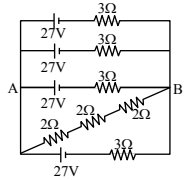
View Solution
Concept:
When several cells with internal resistances are connected in parallel, the equivalent emf and equivalent resistance are given by
\[ E_{eq} = \frac{\sum \frac{E_i}{r_i}}{\sum \frac{1}{r_i}} \]
\[ r_{eq} = \frac{1}{\sum \frac{1}{r_i}} \]
This allows the complex network between \(A\) and \(B\) to be reduced to a single equivalent source.
Step 1: Write the equivalent emf expression.
\[ E_{eq} = \frac{\frac{27}{3}+\frac{27}{3}+\frac{27}{3}+\frac{0}{6}+\frac{27}{3}} {\frac{1}{3}+\frac{1}{3}+\frac{1}{3}+\frac{1}{6}+\frac{1}{3}} \]
\[ E_{eq} = \frac{36}{9/6} \]
\[ E_{eq} = 24\,V \]
Thus,
\[ V_{AB} = 24\,V \]
Step 2: Find equivalent resistance.
\[ r_{eq} = \frac{1} {\frac{1}{3}+\frac{1}{3}+\frac{1}{3}+\frac{1}{6}+\frac{1}{3}} \]
\[ r_{eq} = \frac{2}{3}\,\Omega \]
Step 3: Find current \(i_{BA}\).
The external resistor between the equivalent source and point \(B\) is \(3\,\Omega\).
Total resistance:
\[ R_{total} = 3 + \frac{2}{3} \]
Using Ohm's law:
\[ i_{BA} = \frac{E_{eq}}{R_{total}} \]
\[ i_{BA} = \frac{24}{3+\frac{2}{3}} \]
\[ i_{BA} = \frac{24}{\frac{11}{3}} \]
\[ i_{BA} \approx 1\,A \]
Thus,
\[ V_{AB} = 24\,V, \qquad i_{BA} = 1\,A \] Quick Tip: For cells connected in parallel with internal resistances, use \(E_{eq} = \frac{\sum (E/r)}{\sum (1/r)}\) and \(r_{eq} = \frac{1}{\sum (1/r)}\). This converts a complicated network into a single equivalent source.
In an AC circuit a resistor \(100\Omega\), inductor \(0.1\,mH\) and a capacitor are connected in series across an AC source of \(220\,V,\,50\,Hz\). If the power factor of the circuit is \( \frac{1}{2} \) and \( |X_L - X_C| = \alpha\sqrt{3}\,\Omega \), find \(\alpha\).
View Solution
Concept:
For a series AC circuit, the power factor is
\[ \cos\phi = \frac{R}{Z} \]
where \(Z\) is the impedance. Also,
\[ \tan\phi = \frac{|X_L - X_C|}{R} \]
These relations allow determination of the net reactance.
Step 1: Use the given power factor.
\[ \cos\phi = \frac{1}{2} \]
\[ \phi = 60^\circ \]
Step 2: Use the tangent relation.
\[ \tan\phi = \frac{|X_L - X_C|}{R} \]
\[ \tan 60^\circ = \frac{|X_L - X_C|}{100} \]
\[ \sqrt{3} = \frac{|X_L - X_C|}{100} \]
Step 3: Calculate net reactance.
\[ |X_L - X_C| = 100\sqrt{3} \]
Given
\[ |X_L - X_C| = \alpha\sqrt{3} \]
Thus,
\[ \alpha = 100 \] Quick Tip: In a series AC circuit, power factor relations are very useful: \( \cos\phi = R/Z \) and \( \tan\phi = (X_L - X_C)/R \). These directly connect reactance with resistance.
A solid sphere of mass \(M\) and radius \(R\) is split into two pieces of masses \( \frac{7M}{8} \) and \( \frac{M}{8} \). The piece of mass \( \frac{7M}{8} \) is converted into a disc of radius \(2R\) and thickness \(t\) whose moment of inertia is \(I_1\). The other piece is made into a solid sphere with moment of inertia \(I_2\). Find \( \frac{I_1}{I_2} \).
View Solution
Concept:
Moment of inertia formulas:
\[ I_{disc} = \frac{1}{2}MR^2 \]
\[ I_{sphere} = \frac{2}{5}MR^2 \]
Mass and volume relations are used to determine the radius of the smaller sphere.
Step 1: Find density of the original sphere.
\[ M = \frac{4}{3}\pi R^3 \rho \]
\[ \rho = \frac{3M}{4\pi R^3} \]
Step 2: Find radius of smaller sphere of mass \(M/8\).
\[ \frac{M}{8} = \frac{4}{3}\pi r^3 \rho \]
Substitute \(\rho\):
\[ \frac{M}{8} = \frac{4}{3}\pi r^3 \left(\frac{3M}{4\pi R^3}\right) \]
\[ \frac{M}{8} = M\frac{r^3}{R^3} \]
\[ r^3 = \frac{R^3}{8} \]
\[ r = \frac{R}{2} \]
Step 3: Moment of inertia of disc formed from mass \(7M/8\).
\[ I_1 = \frac{1}{2}\left(\frac{7M}{8}\right)(2R)^2 \]
\[ I_1 = \frac{7MR^2}{4} \]
Step 4: Moment of inertia of smaller sphere.
\[ I_2 = \frac{2}{5}\left(\frac{M}{8}\right)\left(\frac{R}{2}\right)^2 \]
\[ I_2 = \frac{MR^2}{80} \]
Step 5: Find the ratio.
\[ \frac{I_1}{I_2} = \frac{\frac{7MR^2}{4}}{\frac{MR^2}{80}} \]
\[ \frac{I_1}{I_2} = 140 \] Quick Tip: When objects are reshaped, mass remains constant but geometry changes. Use density and volume relations to determine new dimensions before applying moment of inertia formulas.
Length of rods are \( \ell \) and \(2\ell\) respectively and their Young's modulus are \( \gamma \) and \(2\gamma\) respectively.
Given:
\[ \ell = 0.314\,m, \quad R = 0.2\,mm \,(same), \quad \gamma = 2\times10^9 \]
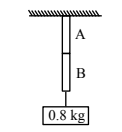
Find the total extension \( \Delta \ell \).
View Solution
Concept:
Extension of a wire under load is given by
\[ \Delta L = \frac{FL}{AY} \]
where \(F\) = applied force, \(L\) = length of wire, \(A\) = cross-sectional area, \(Y\) = Young's modulus.
For rods connected in series, total extension equals the sum of individual extensions.
\[ \Delta \ell = \Delta \ell_1 + \Delta \ell_2 \]
Step 1: Write extension expressions for both rods.
\[ \Delta \ell_1 = \frac{MgL_1}{A\gamma} \]
\[ \Delta \ell_2 = \frac{MgL_2}{A(2\gamma)} \]
Step 2: Add the extensions.
\[ \Delta \ell = \frac{MgL}{A\gamma} + \frac{Mg(2L)}{A(2\gamma)} \]
\[ \Delta \ell = \frac{Mg}{A}\left(\frac{L}{\gamma}+\frac{2L}{2\gamma}\right) \]
\[ \Delta \ell = \frac{2MgL}{A\gamma} \]
Step 3: Substitute numerical values.
Mass \(m = 0.8\,kg\)
\[ A = \pi R^2 \]
\[ R = 0.2\,mm = 2\times10^{-4}\,m \]
\[ A = \pi (2\times10^{-4})^2 \]
Substitute:
\[ \Delta \ell = \frac{0.8\times10}{\pi\times4\times10^{-6}} \left(\frac{2\times0.314}{2\times10^9}\right) \]
\[ \Delta \ell = 2\times10^{-4}\,m \]
\[ \Delta \ell = 0.2\,mm \] Quick Tip: For rods connected in series under the same load, total extension is simply the sum of individual extensions: \(\Delta L_{total} = \Delta L_1 + \Delta L_2\).
The graph shows stopping potential \(V_s\) versus frequency \(f\) of incident light for three different metals \(X_1, X_2,\) and \(X_3\). Choose the metal which will eject photoelectrons with maximum kinetic energy for a given frequency.
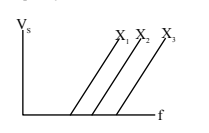
View Solution
Concept:
According to Einstein’s photoelectric equation,
\[ K_{max} = eV_s = hf - \phi \]
where \(K_{max}\) = maximum kinetic energy of emitted electrons, \(V_s\) = stopping potential, \(h\) = Planck’s constant, \(f\) = frequency of incident light, \(\phi\) = work function of the metal.
The threshold frequency \(f_0\) is related to work function as:
\[ \phi = hf_0 \]
Thus,
\[ K_{max} = h(f - f_0) \]
For a fixed incident frequency, the metal with the lowest threshold frequency (or lowest work function) will give the maximum kinetic energy.
Step 1: Interpret the graph.
In a stopping potential vs frequency graph:
All metals have the same slope \( \frac{h}{e} \).
The intercept on the frequency axis represents the threshold frequency.
Step 2: Identify the smallest threshold frequency.
From the graph, the line corresponding to \(X_1\) intersects the frequency axis first.
Thus,
\[ f_{0(X_1)} < f_{0(X_2)} < f_{0(X_3)} \]
Step 3: Determine which metal gives maximum kinetic energy.
Since
\[ K_{max} = h(f - f_0) \]
smaller \(f_0\) gives larger \(K_{max}\).
Therefore,
\[ X_1 produces the maximum kinetic energy. \] Quick Tip: In a stopping potential vs frequency graph, the slope is constant \(h/e\). The metal with the \textbf{smallest threshold frequency} (leftmost intercept) produces electrons with the \textbf{maximum kinetic energy}.
If the right plate of a parallel plate capacitor is pulled with constant velocity as shown in the figure, find how the rate of change of energy stored in the capacitor depends on the separation \(x\).
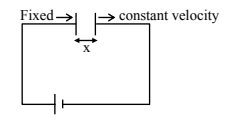
View Solution
Concept:
Capacitance of a parallel plate capacitor is given by
\[ C = \frac{\varepsilon_0 A}{x} \]
where \(x\) is the separation between the plates.
Energy stored in a capacitor connected to a constant voltage source is
\[ U = \frac{1}{2}CV^2 \]
Since the capacitor remains connected to the battery, the voltage \(V\) remains constant.
Step 1: Substitute the capacitance expression into energy formula.
\[ U = \frac{1}{2}\left(\frac{\varepsilon_0 A}{x}\right)V^2 \]
\[ U = \frac{1}{2}\frac{\varepsilon_0 A V^2}{x} \]
Step 2: Differentiate with respect to time.
\[ \frac{dU}{dt} = \frac{1}{2}\varepsilon_0 A V^2 \frac{d}{dt}\left(\frac{1}{x}\right) \]
\[ \frac{dU}{dt} = \frac{1}{2}\varepsilon_0 A V^2 \left(-\frac{1}{x^2}\right)\frac{dx}{dt} \]
Step 3: Use constant velocity condition.
Since the plate moves with constant velocity,
\[ \frac{dx}{dt} = constant \]
Thus,
\[ \frac{dU}{dt} \propto \frac{1}{x^2} \] Quick Tip: For a capacitor connected to a battery, voltage remains constant. Since \(C = \frac{\varepsilon_0 A}{x}\), the stored energy \(U = \frac{1}{2}CV^2\) varies inversely with plate separation.
Two 4-bit binary numbers \(A = 1101\) and \(B = 1010\) are given in the input logic circuit. Find the output \(Y\).
View Solution
Concept:
From the circuit:
Input \(B\) first passes through a NOT gate giving \(\overline{B}\).
The output then enters a NAND gate with \(A\).
Thus,
\[ Y = \overline{A \cdot \overline{B}} \]
Using De Morgan’s theorem:
\[ Y = \overline{A} + B \]
Step 1: Write the given binary numbers.
\[ A = 1101 \]
\[ B = 1010 \]
Step 2: Find complement of \(B\).
\[ \overline{B} = 0101 \]
Step 3: Apply the Boolean expression.
\[ Y = A + \overline{B} \]
Performing OR operation:
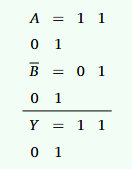
Quick Tip: A NAND gate with one complemented input often simplifies using De Morgan’s theorem. \(\overline{A\cdot B} = \overline{A} + \overline{B}\).
Resolving power of a telescope is \(5\times10^{-7}\,rad\). If wavelength of incident light is \(500\,nm\), find the diameter of the aperture of the telescope.
View Solution
Concept:
Resolving power of a telescope is given by Rayleigh’s criterion:
\[ \theta = \frac{1.22\lambda}{D} \]
where \(\theta\) = angular resolution, \(\lambda\) = wavelength of light, \(D\) = diameter of the objective lens.
Step 1: Substitute the given values.
\[ \theta = 5\times10^{-7}\,rad \]
\[ \lambda = 500\,nm = 500\times10^{-9}\,m \]
\[ 5\times10^{-7} = \frac{1.22\times500\times10^{-9}}{D} \]
Step 2: Solve for \(D\).
\[ D = \frac{1.22\times500\times10^{-9}}{5\times10^{-7}} \]
\[ D = 1.22\,m \] Quick Tip: Rayleigh’s criterion for telescope resolution is \(\theta = \frac{1.22\lambda}{D}\). Smaller \(\theta\) (better resolution) requires a larger aperture \(D\).
An ideal gas has number of moles \(n=2\), initial volume \(V_0\) and pressure \[ P=P_0\left[1+\left(\frac{V_0}{V}\right)^2\right]^{-1}. \]
The gas goes from state \(A\) (initial) to \(B\) (final) such that volume becomes \(3V_0\). Find \(T_A-T_B\).
View Solution
Concept:
For an ideal gas,
\[ PV=nRT \]
Here \(n=2\). Thus temperature can be found from
\[ T=\frac{PV}{2R} \]
Step 1: Find temperature at state \(A\).
At \(V=V_0\),
\[ P=\frac{P_0}{1+(V_0/V_0)^2} =\frac{P_0}{2} \]
Using ideal gas equation:
\[ \frac{P_0}{2}\times V_0 = 2R\,T_A \]
\[ T_A=\frac{P_0V_0}{4R} \]
Step 2: Find temperature at state \(B\).
At \(V=3V_0\),
\[ P=\frac{P_0}{1+\left(\frac{V_0}{3V_0}\right)^2} =\frac{P_0}{1+\frac{1}{9}} =\frac{9P_0}{10} \]
Using ideal gas equation:
\[ \frac{9P_0}{10}\times3V_0 =2R\,T_B \]
\[ T_B=\frac{27P_0V_0}{20R} \]
Step 3: Find temperature difference.
\[ T_B-T_A= \frac{27P_0V_0}{20R}-\frac{P_0V_0}{4R} \]
\[ =\frac{27P_0V_0}{20R}-\frac{5P_0V_0}{20R} \]
\[ =\frac{11P_0V_0}{10R} \] Quick Tip: Whenever pressure is given as a function of volume, substitute the specific volume into the relation first to obtain \(P\), then use the ideal gas law \(PV=nRT\) to find the temperature.
A slit of width \(a\) is illuminated by light of wavelength \(\lambda\). The linear separation between the 1st and 3rd minima in the diffraction pattern produced on a screen placed at a distance \(D\) from the slit is:
View Solution
Concept:
For single slit diffraction, the position of minima on the screen is
\[ y_n=\frac{nD\lambda}{a}, \qquad n=1,2,3,... \]
Step 1: Position of the first minima.
\[ y_1=\frac{D\lambda}{a} \]
Step 2: Position of the third minima.
\[ y_3=\frac{3D\lambda}{a} \]
Step 3: Find the separation.
\[ Separation=y_3-y_1 \]
\[ =\frac{3D\lambda}{a}-\frac{D\lambda}{a} \]
\[ =\frac{2D\lambda}{a} \] Quick Tip: For single slit diffraction minima, use \(y_n=\frac{nD\lambda}{a}\). The separation between two minima is simply the difference of their positions.
In a screw gauge, when the circular scale is given five complete rotations, it moves linearly by \(2.5\,mm\). If the circular scale has 100 divisions, the least count of the screw gauge is:
View Solution
Concept:
Least count of a screw gauge is given by
\[ Least Count = \frac{Pitch}{Number of divisions on circular scale} \]
Pitch is the linear distance moved by the screw in one complete rotation.
Step 1: Find the pitch.
Given 5 rotations move the screw by \(2.5\,mm\):
\[ Pitch=\frac{2.5}{5} \]
\[ Pitch=0.5\,mm \]
\[ =5\times10^{-4}\,m \]
Step 2: Calculate the least count.
Number of divisions on circular scale \(=100\)
\[ L.C.=\frac{Pitch}{Number of divisions} \]
\[ =\frac{5\times10^{-4}}{100}\,m \]
\[ =5\times10^{-6}\,m \]
Step 3: Convert into millimetres.
\[ 5\times10^{-6}\,m=5\times10^{-3}\,mm \] Quick Tip: For screw gauges, always remember: Pitch \(=\) distance moved in one rotation, and Least Count \(=\frac{Pitch}{Number of circular scale divisions}\).
There is a spiral which has \(r_i=3\,cm\), \(r_{ext}=6\,cm\), \(I=20\,mA\) and \(N=200\), where \(r_i\) : internal radius \(r_{ext}\) : external radius \(N\) : number of turns \(I\) : current.
Find the magnetic moment of the spiral.
View Solution
Concept:
Magnetic moment of a current loop is
\[ M = I \times A \]
For a spiral coil with continuously varying radius, the total magnetic moment is obtained by integrating the contribution of small circular loops.
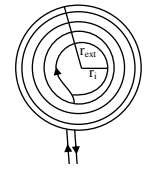
Step 1: Magnetic moment of a small ring.
For a small ring of radius \(r\),
\[ dM = I\,dA \]
\[ dM = I(\pi r^2) \]
If the number of turns changes continuously,
\[ dM = I(dN)\pi r^2 \]
Step 2: Relate \(dN\) with radius.
Since \(N\) turns are distributed between \(r_i\) and \(r_{ext}\),
\[ dN=\frac{N}{r_{ext}-r_i}\,dr \]
Substitute:
\[ dM = I\pi r^2 \frac{N}{r_{ext}-r_i}dr \]
Step 3: Integrate between the limits.
\[ M = \int_{r_i}^{r_{ext}} I\pi r^2 \frac{N}{r_{ext}-r_i}dr \]
\[ M = \frac{I\pi N}{r_{ext}-r_i}\int_{r_i}^{r_{ext}} r^2 dr \]
\[ M = \frac{I\pi N}{r_{ext}-r_i}\left[\frac{r^3}{3}\right]_{r_i}^{r_{ext}} \]
\[ M = \frac{I\pi N}{3(r_{ext}-r_i)}(r_{ext}^3-r_i^3) \]
Step 4: Substitute numerical values.
\[ I = 20\times10^{-3}\,A \]
\[ N = 200 \]
\[ r_{ext}=6\times10^{-2}\,m \]
\[ r_i=3\times10^{-2}\,m \]
\[ M= \frac{20\times10^{-3}\times3.14\times200}{3(6-3)\times10^{-2}} (6^3-3^3)\times10^{-6} \]
\[ M = 2.64\times10^{-2}\,A m^2 \] Quick Tip: Magnetic moment of a loop is \(M=IA\). For spiral coils with varying radius, integrate \(I\pi r^2\) over the turns.
Two forces are acting on a body:
\[ \vec{F}_1 = 3\hat{i} -5\hat{j} +2\hat{k} \]
\[ \vec{F}_2 = 8\hat{i} +2\hat{j} -3\hat{k} \]
The displacement of the body is \(25\,m\) along the direction \(3\hat{i}-4\hat{j}\). Find the work done.
View Solution
Concept:
Work done by a force is given by the dot product of force and displacement.
\[ W = \vec{F}\cdot\vec{S} \]
If multiple forces act simultaneously, the resultant force is
\[ \vec{F}_{net}=\vec{F}_1+\vec{F}_2 \]
Step 1: Find the resultant force.
\[ \vec{F}_{net} = (3+8)\hat{i}+(-5+2)\hat{j}+(2-3)\hat{k} \]
\[ \vec{F}_{net}=11\hat{i}-3\hat{j}-\hat{k} \]
Step 2: Find the displacement vector.
Direction vector:
\[ 3\hat{i}-4\hat{j} \]
Magnitude of this direction:
\[ \sqrt{3^2+4^2}=5 \]
Unit vector:
\[ \frac{3\hat{i}-4\hat{j}}{5} \]
Since displacement magnitude is \(25\,m\),
\[ \vec{S}=25\left(\frac{3\hat{i}-4\hat{j}}{5}\right) \]
\[ \vec{S}=15\hat{i}-20\hat{j} \]
Step 3: Calculate the work done.
\[ W=\vec{F}_{net}\cdot\vec{S} \]
\[ =(11\hat{i}-3\hat{j}-\hat{k})\cdot(15\hat{i}-20\hat{j}) \]
\[ W=11\times15 + (-3)(-20) + (-1)(0) \]
\[ W=165+60 \]
\[ W=225\,J \] Quick Tip: When displacement is given along a direction, first convert the direction into a unit vector and multiply it by the magnitude to obtain the displacement vector.
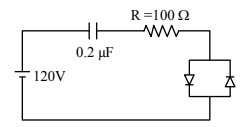
Each diode in the circuit has \(10\Omega\) resistance in forward bias and infinite resistance in reverse bias. Find the time constant of the circuit.
Given: \(R=100\Omega\), \(C=0.2\,\mu F\).
View Solution
Concept:
The time constant of an RC circuit is
\[ \tau = RC \]
where \(R\) is the effective resistance in the circuit and \(C\) is the capacitance.
Step 1: Determine effective resistance.
The circuit contains a resistor \(R=100\Omega\) and a diode.
Only one diode conducts in forward bias, contributing a resistance of \(10\Omega\).
Thus,
\[ R_{eq}=100+10=110\Omega \]
Step 2: Calculate the time constant.
\[ \tau = RC \]
\[ \tau = 110 \times 0.2\times10^{-6} \]
\[ \tau = 22\times10^{-6}\,s \]
\[ \tau = 22\,\mu s \] Quick Tip: Time constant of an RC circuit is \( \tau = RC \). When diodes are present, first determine which diode is forward biased and include its resistance in the effective resistance.
Find the final temperature of a mixture of two gases.
If one gas has pressure \(P_1\), temperature \(T_1\), number of moles \(n_1\) and volume \(V_1\); and the second gas has pressure \(P_2\), temperature \(T_2\), number of moles \(n_2\) and volume \(V_2\).
If the final pressure is \(P\) and final volume is \(V\), find the final temperature of the mixture.
View Solution
Concept:
For an ideal gas,
\[ PV = nRT \]
Thus,
\[ n = \frac{PV}{RT} \]
When two gases mix, the total number of moles is conserved.
\[ n = n_1 + n_2 \]
Step 1: Write number of moles for each gas.
\[ n_1 = \frac{P_1V_1}{RT_1} \]
\[ n_2 = \frac{P_2V_2}{RT_2} \]
Step 2: Write total number of moles after mixing.
\[ n = \frac{PV}{RT_f} \]
Step 3: Use mole conservation.
\[ \frac{PV}{RT_f} = \frac{P_1V_1}{RT_1} + \frac{P_2V_2}{RT_2} \]
Cancel \(R\):
\[ \frac{PV}{T_f} = \frac{P_1V_1}{T_1} + \frac{P_2V_2}{T_2} \]
Step 4: Solve for \(T_f\).
\[ T_f = \frac{PV}{\frac{P_1V_1}{T_1} + \frac{P_2V_2}{T_2}} \] Quick Tip: For mixing of ideal gases, total number of moles remains conserved. Always express moles using \(n=\frac{PV}{RT}\) and then apply \(n=n_1+n_2\).
A particle is moving along the \(x\)-axis where the speed varies as
\[ v^2 = 100 - x^2 \]
Determine the time period.
View Solution
Concept:
For simple harmonic motion (SHM), velocity as a function of displacement is
\[ v = \omega\sqrt{A^2 - x^2} \]
where \(A\) = amplitude, \(\omega\) = angular frequency.
Step 1: Rewrite the given equation.
\[ v^2 = 100 - x^2 \]
\[ v = \sqrt{100 - x^2} \]
Step 2: Compare with SHM velocity relation.
\[ v = \omega\sqrt{A^2 - x^2} \]
Comparing,
\[ A^2 = 100 \]
\[ A = 10 \]
and
\[ \omega = 1 \]
Step 3: Find the time period.
\[ T = \frac{2\pi}{\omega} \]
\[ T = \frac{2\pi}{1} \]
\[ T = 2\pi \] Quick Tip: In SHM, velocity-displacement relation is \(v=\omega\sqrt{A^2-x^2}\). Comparing the given equation with this form directly gives amplitude and angular frequency.
JEE Main 2026 Physics Exam Pattern
| Particulars | Details |
|---|---|
| Exam Mode | Online (Computer-Based Test) |
| Paper | B.E./B.Tech |
| Medium of Exam | 13 languages: English, Hindi, Gujarati, Bengali, Tamil, Telugu, Kannada, Marathi, Malayalam, Odia, Punjabi, Assamese, Urdu |
| Type of Questions | Multiple Choice Questions (MCQs) + Numerical Value Questions |
| Total Marks | 100 marks |
| Marking Scheme | +4 for correct answer & -1 for incorrect MCQ and Numerical Value-based Questions |
| Total Questions | 25 Questions |




Comments