




NTA has released JEE Main 2026 official question papers on their website jeemain.nta.nic.in. JEE Main 2026 April 4 Shift 1 Question Paper with Answer Key and Solution PDF is available here.
NTA conducted JEE Main 2026 April 4 Shift 1 from 9 AM to 12 PM in CBT Mode in 3 sections: Physics, Chemistry, and Mathematics, prepared according to the latest JEE Main exam pattern.
Also Check:
JEE Main 2026 April 4 Shift 1 Question Paper with Solution PDF






Let [·] denote the greatest integer function. If the domain of the function \[ f(x) = \cos^{-1}\left(\frac{4x + 2\lfloor x \rfloor}{3}\right) \] is \([\alpha, \beta]\), then \(12(\alpha + \beta)\) is equal to:
If the set of all solutions of \(|x^2 + x - 9| = |x| + |x^2 - 9|\) is \([\alpha, \beta] \cup [\gamma, \infty)\), then \((\alpha^2 + \beta^2 + \gamma^2)\) is equal to:
Let \(z\) be a complex number such that \(|z + 2| = |z - 2|\) and \(\arg\left(\frac{z+3}{z-i}\right) = \frac{\pi}{4}\). Then \(|z|^2\) is equal to:
The number of functions \(f: \{1, 2, 3, 4\} \rightarrow \{a, b, c\}\), which are not onto, is:
Let \(S = \left\{ A = \begin{bmatrix} a & b
c & d \end{bmatrix} : a, b, c, d \in \{0, 1, 2, 3, 4\} and A^2 - 4A + 3I = 0 \right\}\) be a set of \(2 \times 2\) matrices. Then the number of matrices in \(S\), for which the sum of the diagonal elements is equal to 4, is:
Let \(A = \begin{bmatrix} 1 & 1 & 2
-2 & 0 & 1
1 & 3 & 5 \end{bmatrix}\). Then the sum of all elements of the matrix \(\operatorname{adj}(\operatorname{adj}(2(\operatorname{adj}A)^{-1}))\) is equal to:
The first term of an A.P. of 30 non-negative terms is \(\frac{10}{3}\). If the sum of this A.P. is the cube of its last term, then its common difference is:
The number of ways of forming a queue of 4 boys and 3 girls such that all the girls are not together, is:
Let the smallest value of \(k \in \mathbb{N}\), for which the coefficient of \(x^3\) in \((1+x)^3 + (1+x)^4 + (1+x)^5 + \dots + (1+x)^{99} + (1 + kx)^{100}\), \(x \neq 0\), is \((43n + \frac{101}{4}) \binom{100}{3}\) for some \(n \in \mathbb{N}\), be \(p\). Then the value of \(p + n\) is:
Suppose that the mean and median of the non-negative numbers 21, 8, 17, \(a\), 51, 103, \(b\), 13, 67, \((a > b)\), are 40 and 21, respectively. If the mean deviation about the median is 26, then \(2a\) is equal to:
Let the line \(L_1 : x + 3 = 0\) intersect the lines \(L_2 : x - y = 0\) and \(L_3 : 3x + y = 0\) at the points A and B, respectively. Let the bisector of the obtuse angle between the lines \(L_2\) and \(L_3\) intersect the line \(L_1\) at the point C. Then \(BC^2 : AC^2\) is equal to:
Let the vertex A of a triangle ABC be (1, 2), and the mid-point of the side AB be (5, -1). If the centroid of this triangle is (3, 4) and its circumcenter is \((\alpha, \beta)\), then \(2(10\alpha + \beta)\) is equal to:
Suppose that two chords, drawn from the point (1, 2) on the circle \(x^2 + y^2 + x - 3y = 0\) are bisected by the y-axis. If the other ends of these chords are R and S, and the midpoint of the line segment RS is \((\alpha, \beta)\), then \(6(\alpha + \beta)\) is equal to:
A line with direction ratios 1, -1, 2 intersects the lines \(\frac{x}{2} = \frac{y}{3} = \frac{z+1}{3}\) and \(\frac{x+1}{-1} = \frac{y-2}{1} = \frac{z}{4}\) at the points P and Q, respectively. If the length of the line segment PQ is \(\alpha\), then \(225\alpha^2\) is equal to:
The square of the distance of the point (-2, -8, 6) from the line \(\frac{x-1}{1} = \frac{y-1}{2} = \frac{z}{1}\) along the line \(\frac{x+5}{1} = \frac{y+5}{1} = \frac{z}{2}\) is equal to:
If \( y = \tan^{-1}\left(\frac{3\cos x - 4\sin x}{4\cos x + 3\sin x}\right) + 2\tan^{-1}\left(\frac{x}{1 + \sqrt{1 - x^2}}\right) \), then \(\frac{dy}{dx}\) at \(x = \frac{\sqrt{5}}{2}\) is equal to:
Let \(f\) be a real polynomial of degree \(n\) such that \(f(x) = f'(x)f''(x)\), for all \(x \in \mathbb{R}\). If \(f(0) = 0\), then \(36(f''(2) + f''(2) + \int_0^2 f(x)\,dx)\) is equal to:
The area of the region \(\{(x, y): y \le \pi - |x|, y \le |x \sin x|, y \ge 0\}\) is:
Let \(\int_{-2}^{2} (|\sin x| + |\cos x|) \, dx = 2(3 - \cos 2) + \beta\). Then \(\beta \sin \left( \frac{\beta}{2} \right)\) equals:
Let \(y = y(x)\) be the solution of the differential equation \(\frac{dy}{dx} = (1 + x + x^2)(1 - y + y^2)\), \(y(0) = \frac{1}{2}\). Then \((2y(1) - 1)\) is equal to:
A coin is tossed 8 times. If the probability that exactly 4 heads appear in the first six tosses and exactly 3 heads appear in the last five tosses is \(p\), then \(96p\) is equal to ____.
Consider the parabola \(P : y^2 = 4kx\) and the ellipse \(E : \frac{x^2}{a^2} + \frac{y^2}{b^2} = 1\). Let the line segment joining the points of intersection of \(P\) and \(E\), be their latus rectum. If the eccentricity of \(E\) is \(e\), then \(e^2 + 2\sqrt{2}\) is equal to ____.
If \(A = \frac{\sin 3^\circ}{\cos 9^\circ} + \frac{\sin 9^\circ}{\cos 27^\circ} + \frac{\sin 27^\circ}{\cos 81^\circ}\) and \(B = \tan 81^\circ - \tan 3^\circ\), then \(\frac{B}{A}\) is equal to ____.
Let \(\vec{a}_k = (\tan \theta_k) \hat{i} + \hat{j}\) and \(\vec{b}_k = \hat{i} - (\cot \theta_k) \hat{j}\), where \(\theta_k = \frac{2^{k-1}\pi}{2^n+1}\), for some \(n \in \mathbb{N}\), \(n > 5\). Then the value of \(\frac{\sum_{k=1}^{n} |\vec{a}_k|^2}{\sum_{k=1}^{n} |\vec{b}_k|^2}\) is ____.
The number of points, at which the function \(f(x) = \max\{6x, 2 + 3x^2\} + |x - 1| \cos|x^2 - \frac{1}{4}|\), \(x \in (-\pi, \pi)\), is not differentiable, is ____.
In a screw gauge when the circular scale is given five complete rotations it moves linearly by 2.5 mm. If the circular scale has 100 divisions, the least count of screw gauge is ______ mm.
The increase in the pressure required to decrease the volume (\(\Delta V\)) of water is \(6.3 \times 10^7\) N/m². The percentage decrease in the volume is ______. (Bulk modulus of water = \(2.1 \times 10^9\) N/m².)
The time taken by a block of mass \(m\) to slide down from the highest point to the lowest point on a rough inclined plane is 50 % more compared to the time taken by the same block on identical inclined smooth plane. Both inclined planes are at 45° with the horizontal. The coefficient of kinetic friction between the rough inclined surface and block is ______.
Two nuclei of mass number 3 combine with another nucleus of mass number 4 to yield a nucleus of mass number 10. If the binding energy per nucleon for the mass numbers 3, 4 and 10 are 5.6 MeV, 7.4 MeV and 6.1 MeV, respectively, then in the process, \(\Delta Mc^2 =\) ______ MeV.
A solid sphere of mass \(M\) and radius \(R\) is divided into two unequal parts. The smaller part having mass \(M/8\) is converted into a sphere of radius \(r\) and the larger part is converted into a circular disc of thickness \(t\) and radius \(2R\). If \(I_1\) is moment of inertia of a sphere having radius \(r\) about an axis through its centre and \(I_2\) is the moment of inertia of a disc about its diameter, the ratio of their moment of inertia \(I_2/I_1 =\) ______.
The two projectiles are projected with the same initial velocities at the 15° and 30° with respect to the horizontal. The ratio of their ranges is 1:x. The value of \(x\) is
The graph shows variation of stopping potential \(V_0\) with the frequency \(\nu\) of the incident radiation for three photosensitive metals \(X_1\), \(X_2\) and \(X_3\). Which metal will give out electrons with greater kinetic energy, for the same wavelength of incident radiation?

A slit of width \(a\) is illuminated by light of wavelength \(\lambda\). The linear separation between 1st and 3rd minima in the diffraction pattern produced on a screen placed at a distance \(D\) from the slit system is ______.
A string A of length 0.314 m and Young's modulus \(2 \times 10^{10}\) N/m² is connected to another string B of length and Young's modulus both twice of those of A. This series combination of strings is then suspended from a rigid support and its free end is fixed to a load of mass 0.8 kg. The net change in length of the combination is ______ mm. (radius of both the strings is 0.2 mm and acceleration due to gravity = 10 m/s²)
One gas of \(n_1\) mole of molecules at temperature \(T_1\), volume \(V_1\), and pressure \(P_1\), and another gas of \(n_2\) mole of molecules at temperature \(T_2\), volume \(V_2\), and pressure \(P_2\), are mixed resulting in pressure \(P\) and volume \(V\) of the mixture. The temperature of the mixture is ______.
An ideal gas undergoes a process maintaining relation between pressure (\(P\)) and volume (\(V\)) as \(P = P_o \left(1 + \left(\frac{V_o}{V}\right)^2\right)^{-1}\), where \(P_o\) and \(V_o\) are constants. If two samples A and B (two moles each) with initial volumes \(V_o\) and \(3V_o\) respectively undergo above mentioned process and attain same pressure, then the difference at the temperatures of these samples, \(T_B - T_A\) is ______. (\(R\) = gas constant)
A voltmeter with internal resistance of \(x\) Ω can be used to measure upto 20 V. In order to increase its measuring range to 30 V, the required modification is to ________.
Two 4 bits binary numbers, \(A = 1101\) and \(B = 1010\) are given in the inputs of a logic circuit shown in figure below. The output (\(Y\)) will be :

A rod of length 10 cm lies along the principle axis of a concave mirror of focal length 10 cm as shown in figure. The length of the image is ______ cm.

A parallel plate air capacitor is connected to a battery. The plates are pulled apart at uniform speed \(v\). If \(x\) is the separation between the plates at any instant, then the time rate of change of electrostatic energy of the capacitor is proportional to \(x^\alpha\), where \(\alpha\) is ______.
An insulated wire is wound so that it forms a flat coil with \(N = 200\) turns. The radius of the innermost turn is \(r_1 = 3\) cm, and of the outermost turn \(r_2 = 6\) cm. If 20 mA current flows in it then the magnetic moment will be \(\alpha \times 10^{-2}\) A.m². The value of \(\alpha\) is ______.
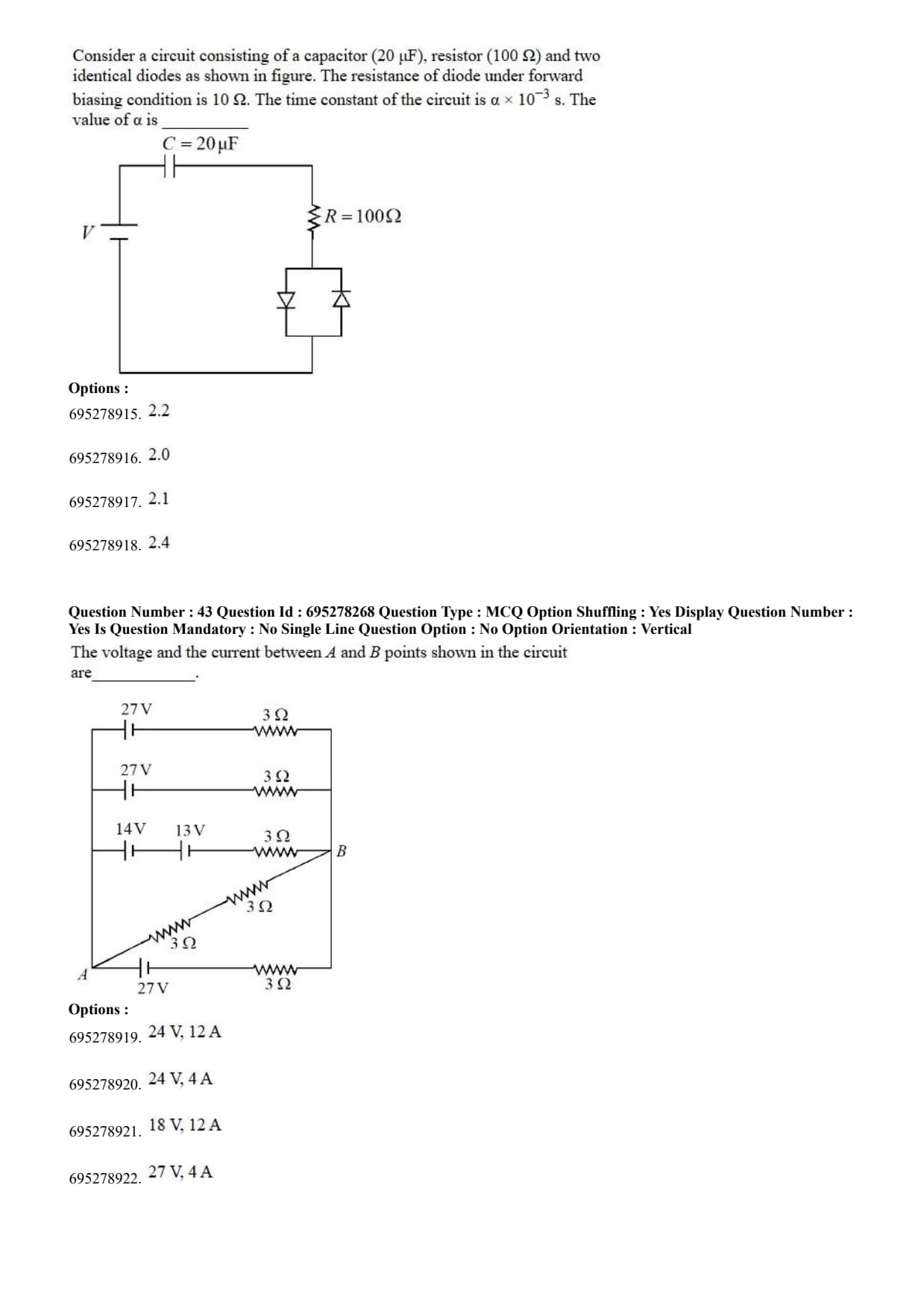
Consider a circuit consisting of a capacitor (20 μF), resistor \((100 \Omega)\) and two identical diodes as shown in figure. The resistance of diode under forward biasing condition is 10 Ω. The time constant of the circuit is \(\alpha \times 10^{-3}\) s. The value of \(\alpha\) is ________.

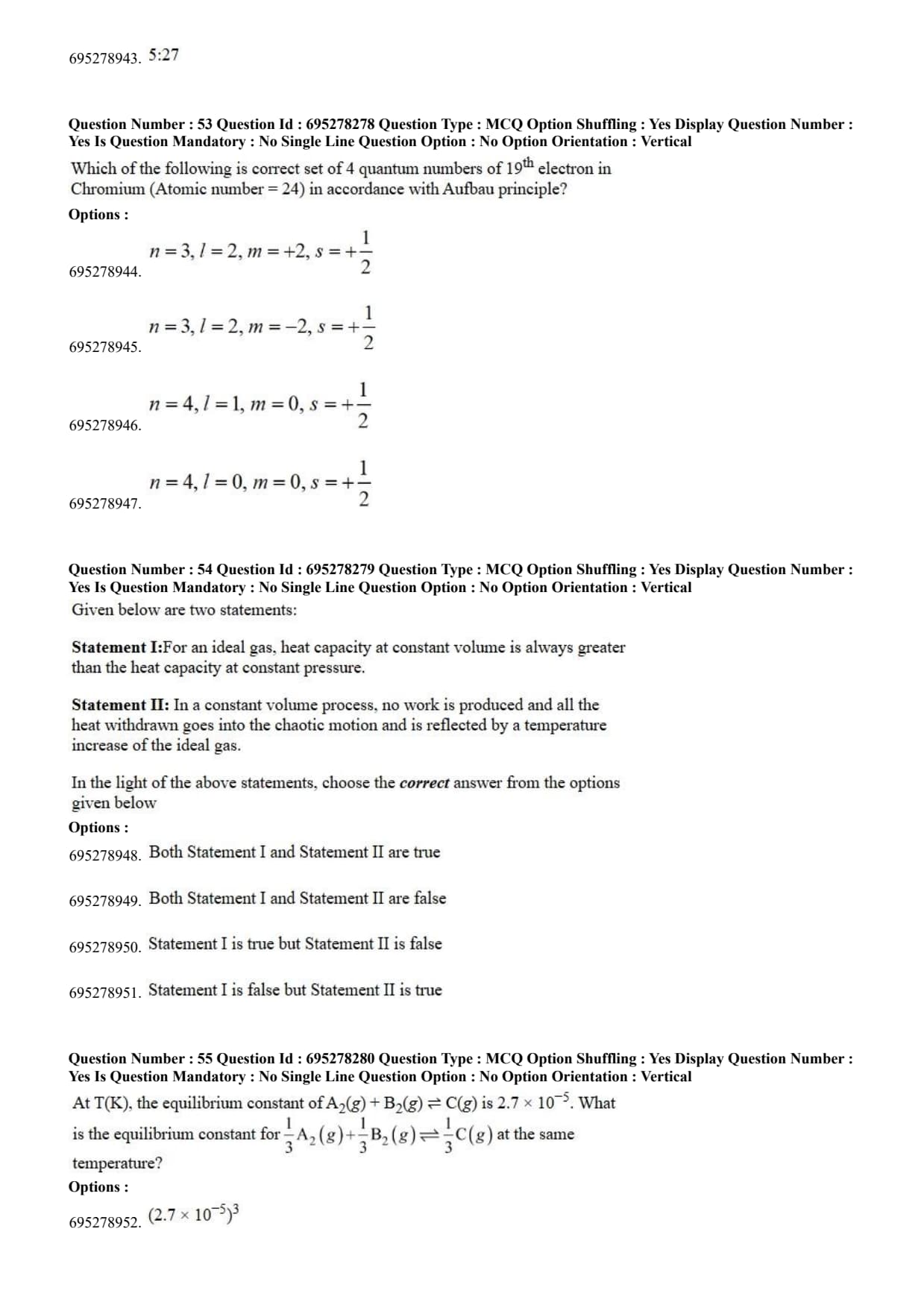
The voltage and the current between A and B points shown in the circuit are ________.

A telescope with objective diameter \(R\) is used to observe a distant star emitting light of wavelength 500 nm, at a resolution of \(5 \times 10^{-7}\) radian. The value of \(R\) is ________ cm.
An unpolarized light is incident on the plane interface of air-dielectric medium shown in figure. If the incident angle is equal to Brewster angle, identify the expression representing reflected wave.

A 1 kg block subjected to two simultaneous forces \((2\hat{i} + 3\hat{j} + 4\hat{k})\) N and \((3\hat{i} - \hat{j} - 2\hat{k})\) N is moved a distance of 25 m along \((3\hat{i} - 4\hat{j})\) direction. The work done in this process is ______ J.
The surface tension of a soap solution is \(3.5 \times 10^{-2}\) N/m. The work required to increase the radius of a soap bubble from 1 cm to 2 cm is \(\alpha \times 10^{-6}\) J. The value of \(\alpha\) is ______. (\(\pi = 22/7\))
The velocity of a particle executing simple harmonic motion along x-axis is described as \(v^2 = 50 - x^2\), where \(x\) represents displacement. If the time period of motion is \(\pi/7\) s, the value of \(x\) is ______.
A body of mass 2 kg begins to move under the influence of time dependent force \(\vec{F} = (2t \hat{i} + 6t^2 \hat{j})\) N, where \(\hat{i}\) and \(\hat{j}\) are unit vectors along x and y-axis respectively. The power produced by the force at \(t = 2\) s is ______ W.
An inductor of 10 mH, capacitor of 0.1 µF and a resistor of 100 Ω are connected in series across an a.c power supply 220 V, 70 Hz. The power factor of the given circuit is 0.5. The difference in the inductive reactance and capacitance reactance is \(\sqrt{3} a\) Ω. The value of \(a\) is ______.
Number of moles and number of molecules in 1.4187 L of SO₂ at STP respectively are
What is the ratio of wave number of first line (lowest energy line) of Balmer series of H atomic spectrum to first line of its Brackett series?
Which of the following is correct set of 4 quantum numbers of 19th electron in Chromium (Atomic number = 24) in accordance with Aufbau principle?
Statement I: For an ideal gas, heat capacity at constant volume is always greater than the heat capacity at constant pressure.
Statement II: In a constant volume process, no work is produced and all the heat withdrawn goes into the chaotic motion and is reflected by a temperature increase of the ideal gas.
In the light of the above statements, choose the correct answer:
At T(K), the equilibrium constant of \(A_2(g) + B_2(g) \rightleftharpoons C(g)\) is \(2.7 \times 10^{-5}\). What is the equilibrium constant for \(\frac{1}{3} A_2(g) + \frac{1}{3} B_2(g) \rightleftharpoons \frac{1}{3} C(g)\) at the same temperature?
In order to oxidise a mixture of 1 mole each of FeC₂O₄, Fe₂(C₂O₄)₃, FeSO₄ and Fe₂(SO₄)₃ in acidic medium, the number of moles of KMnO₄ required is
Consider the first order reaction R → P. The fraction of molecules decomposed in the given first order reaction can be expressed as
A monoatomic anion (A⁻) has 45 neutrons and 36 electrons. Atomic mass, group in the periodic table and physical state at room temperature of the element (A) respectively are
Statement I: The covalency of oxygen is generally two but it can exceed up to four. The oxidation state of oxygen in SO₂ is -2 and in OF₂ it is +2.
Statement II: The anomalous behaviour of oxygen when compared to the other elements of group 16 is due to its small size and high electronegativity.
In the light of the above statements, choose the correct answer:
The correct statements among the following are:
A. Mo(VI) and W(VI) are less stable than Cr(VI).
B. Ce⁴⁺ and Tb⁴⁺ are oxidant while Eu²⁺ and Yb²⁺ are reductant.
C. Cm and Am have seven unpaired electrons.
D. Actinoid contraction is greater from element to element than lanthanoid contraction.
Choose the correct answer:
Correct statements from the following are:
A. Potassium dichromate is an oxidising agent and it oxidises FeSO₄ to Fe₂(SO₄)₃ in acidic medium.
B. Sodium dichromate can be used as primary standard in volumetric estimation.
C. CrO₄²⁻ and Cr₂O₇²⁻ are interconvertible in aqueous solution by varying the pH of the solution.
D. Cr-O-Cr bond angle in Cr₂O₇²⁻ is 126°.
Choose the correct answer:
Match the LIST-I with LIST-II

Increasing order of electron withdrawing power of following functional groups is:
a. -CN
b. -COOH
c. -NO₂
d. -I
An alkene (X) on ozonolysis followed by reduction gives following products. [Assuming products are Glyoxal and Formaldehyde/Acetone based on standard paper context]. The alkene (X) is:

- (A)
![]()
- (B)
![]()
- (C)
![]()
- (D)
![]()


Match the LIST-I with LIST-II

Amongst the following, the total number of compounds soluble in aqueous NaOH at room temperature is:

Product C of the following reaction sequence will be [assuming sequence: Aniline \(\xrightarrow{Br_2/H_2O}\) A \(\xrightarrow{NaNO_2/HCl}\) B \(\xrightarrow{H_3PO_2}\) C]

Statement I: The structure of Maltose is given below: Maltose is a non-reducing sugar.

Statement II: The structure of Lactose is given below: Lactose is a reducing sugar.

In the light of the above statements, choose the correct answer:
Match the LIST-I with LIST-II

Identify the colour of compound 'X' in the sequence of the reaction [assuming the Lassaigne's test for Nitrogen/Sulfur or Nitroprusside test].

According to Lewis theory, the total number of σ bond-pairs and lone pair of electrons around the central atom of \(XeO_6^{4-}\) ion is ______.
Consider the following sequence of reactions to give the major product (X). P g of the major product (X) formed is reacted with NaHCO₃ solution to liberate a gas which occupied 11.2 dm³ at STP. P = ______ g.

2.0 g of a bromo hydrocarbon (X) was subjected to Carius analysis, gave 3.36 g of AgBr. The percentage of carbon in the compound (X) is 26.7%. Total number of carbon atoms in the empirical formula for compound (X) is ______.
The pH of a solution obtained by mixing 5 mL of 0.1 M \(NH_4OH\) solution with 250 mL of 0.1 M \(NH_4Cl\) solution is ______ × 10⁻². (Nearest integer)
Given: \(pK_b (NH_4OH)\) = 4.74
A non-volatile, non-electrolyte solid solute when dissolved in 40 g of a solvent, the vapour pressure of the solvent decreased from 760 mm Hg to 750 mm Hg. If the same solution boils at 320 K, then the number of moles of the solvent present in the solution is ______. (Nearest integer)
[Given: boiling point of the pure solvent = 319.5 K, K_b of the solvent = 0.3 K kg mol⁻¹]




Comments