




NTA has released JEE Main 2026 official question papers on their website jeemain.nta.nic.in. JEE Main 2026 April 4 Shift 2 Question Paper with Answer Key and Solution PDF is available here.
NTA conducted JEE Main 2026 April 4 Shift 2 from 3 PM to 6 PM in CBT Mode in 3 sections: Physics, Chemistry, and Mathematics, prepared according to the latest JEE Main exam pattern.
Also Check:
The JEE Main 2026 today's question paper is updated here.
JEE Main 2026 April 4 Shift 2 Question Paper with Solution PDF
For the function \(f: [1, \infty) \rightarrow [1, \infty)\) defined by \(f(x) = (x - 1)^4 + 1\), among the two statements:
(I) The set \(S = \{x \in [1, \infty) : f(x) = f^{-1}(x)\}\) contains exactly two elements, and
(II) The set \(S = \{x \in [1, \infty) : f(x) = f^{-1}(x + 1)\}\) is an empty set,
Options:
Let \(S = \{z \in \mathbb{C} : z^2 + 4z + 16 = 0\}\). Then \(\sum_{z \in S} |z + \sqrt{3}i|^2\) is equal to:
If the system of equations:
\(x + y + z = 5\)
\(x + 2y + 3z = 9\)
\(x + 3y + \lambda z = \mu\)
has infinitely many solutions, then the value of \(\lambda + \mu\) is:
If \(\alpha = 1\) and \(\beta = 1 + i\sqrt{2}\), where \(i = \sqrt{-1}\) are two roots of the equation
\(x^3 + ax^2 + bx + c = 0, a, b, c \in \mathbb{R}\), then \(\int_{-1}^{1} (x^3 + ax^2 + bx + c) dx\) is equal to:
If the quadratic equation \((\lambda + 2)x^2 - 3\lambda x + 4\lambda = 0, \lambda \neq -2\), has two positive roots, then the number of possible integral values of \(\lambda\) is:
Let \(A = \begin{bmatrix} 1 & 2 & 7
4 & -2 & 8
3 & 8 & -7 \end{bmatrix}\) and \(\det(A - \alpha I) = 0\), where \(\alpha\) is a real number. If the largest possible value of \(\alpha\) is \(p\), then the circle \((x - p)^2 + (y - 2p)^2 = 320\), intersects the co-ordinate axes at:
Let \(\alpha = \frac{1}{4} + \frac{1}{8} + \frac{1}{16} + \dots \infty\) and \(\beta = \frac{1}{3} + \frac{1}{9} + \frac{1}{27} + \dots \infty\). Then the value of \((0.2)^{\log_{\sqrt{5}}(\alpha)} + (0.04)^{\log_{5}(\beta)}\) is equal to:
For 10 observations \(x_1, x_2, \dots, x_{10}\), if \(\sum_{i=1}^{10} (x_i + 2)^2 = 180\) and \(\sum_{i=1}^{10} (x_i - 1)^2 = 90\), then their standard deviation is:
In the expansion of \(\left( 9x - \frac{1}{3\sqrt{x}} \right)^{18}, x > 0\), if the term independent of \(x\) is \((221)k\), then \(k\) is equal to:
Let \(P(3\cos\alpha, 2\sin\alpha), \alpha \neq 0\), be a point on the ellipse \(\frac{x^2}{9} + \frac{y^2}{4} = 1\). \(Q\) be a point on the circle \(x^2 + y^2 - 14x - 14y + 82 = 0\) and \(R\) be a point on the line \(x + y = 5\) such that the centroid of the triangle \(PQR\) is \(\left( 2 + \cos\alpha, 3 + \frac{2}{3}\sin\alpha \right)\). Then the sum of the ordinates of all possible points \(R\) is:
Let \(H: \frac{x^2}{a^2} - \frac{y^2}{b^2} = 1\) be a hyperbola such that the distance between its foci is 6 and the distance between its directrices is \(\frac{8}{3}\). If the line \(x = \alpha\) intersects the hyperbola H at the points A and B such that the area of the triangle AOB is \(4\sqrt{15}\), where O is the origin, then \(a^2\) equals:
\(\max_{0 \leq x \leq \pi} \left( 16 \sin\left(\frac{x}{2}\right) \cos^3\left(\frac{x}{2}\right) \right)\) is equal to:
The shortest distance between the lines
\(\vec{r} = (\frac{1}{3}\hat{i} + \frac{8}{3}\hat{j} - \frac{1}{3}\hat{k}) + \lambda(2\hat{i} - 5\hat{j} + 6\hat{k})\)
and \(\vec{r} = (-\frac{2}{3}\hat{i} - \frac{1}{3}\hat{k}) + \mu(\hat{j} - \hat{k}), \lambda, \mu \in \mathbb{R}\), is:
If \((2\alpha + 1, \alpha^2 - 3\alpha, \frac{\alpha - 1}{2})\) is the image of \((\alpha, 2\alpha, 1)\) in the line \(\frac{x - 2}{3} = \frac{y - 1}{2} = \frac{z}{1}\), then the possible value(s) of \(\alpha\) is (are):
Let \(\hat{u}\) and \(\hat{v}\) be unit vectors inclined at an acute angle such that \(|\hat{u} \times \hat{v}| = \frac{\sqrt{3}}{2}\). If \(\vec{A} = \lambda \hat{u} + \hat{v} + (\hat{u} \times \hat{v})\), then \(\lambda\) is equal to:
Let for some \(\alpha \in \mathbb{R}\), \(f: \mathbb{R} \rightarrow \mathbb{R}\) be a function satisfying \(f(x + y) = f(x) + 2y^2 + y + \alpha xy\) for all \(x, y \in \mathbb{R}\). If \(f(0) = -1\) and \(f(1) = 2\), then the value of \(\sum_{n=1}^{5} (\alpha + f(n))\) is:
Let \(A = \{ (a, b, c) : a, b, c are non-negative integers and a + b + 2c = 22 \}\). Then \(n(A)\) is equal to:
The area of the region bounded by the curves \(x + 3y^2 = 0\) and \(x + 4y^2 = 1\) is equal to:
Let \(y = y(x)\) be the solution of the differential equation:
\(\frac{dy}{dx} + \left( \frac{6x^2 + (3x^2 + 2x^3 + 4)e^{-2x}}{(x^3 + 2)(2 + e^{-2x})} \right)y = 2 + e^{-2x}\), \(x \in (-1, 2)\), satisfying \(y(0) = \frac{3}{2}\). If \(y(1) = \alpha(2 + e^{-2})\), then \(\alpha\) is equal to:
The integral \(\int_{0}^{1} \cot^{-1}(1 + x + x^2) dx\) is equal to:
From a month of 31 days, 3 different dates are selected at random. If the probability that these dates are in an increasing A.P. is equal to \(a/b\), where \(a, b \in \mathbb{N}\) and \(\gcd(a, b) = 1\), then \(a + b\) is equal to _______
Let \(f(x) = \begin{cases} e^{x-1}, & x < 0
x^2 - 5x + 6, & x \ge 0 \end{cases}\) and \(g(x) = f(|x|) + |f(x)|\). If the number of points where \(g\) is not continuous and is not differentiable are \(\alpha\) and \(\beta\) respectively, then \(\alpha + \beta\) is equal to _______.
Let A, B be points on the two half-lines \(x - \sqrt{3}|y| = \alpha, \alpha > 0\) at a distance of \(\alpha\) from their point of intersection P. The line segment AB meets the angle bisector of the given half-lines at the point Q. If \(PQ = \frac{9}{2}\) and R is the radius of the circumcircle of \(\Delta PAB\), then \(\frac{\alpha^2}{R}\) is equal to ________
Let A, B and C be the vertices of a variable right angled triangle inscribed in the parabola \(y^2 = 16x\). Let the vertex B containing the right angle be \((4, 8)\) and the locus of the centroid of \(\Delta ABC\) be a conic \(C_0\). Then three times the length of latus rectum of \(C_0\) is _______.
Let \(f\) be a twice differentiable function such that \(f(x) = \int_0^x \tan(t-x) dt - \int_0^x f(t) \tan t dt, x \in (-\frac{\pi}{2}, \frac{\pi}{2})\). Then \(f''(\frac{\pi}{6}) + 12 f'(-\frac{\pi}{6}) + f(\frac{\pi}{6})\) is equal to ________.
Match the LIST-I with LIST-II

Choose the correct answer from the options given below:
Two cars A and B are moving in the same direction along a straight line with speeds 100 km/h and 80 km/h, respectively such that car A is moving ahead of car B. A person in car B throws a stone with a speed \(v\) so that it hits the car A with a speed of 5 m/s. The value of \(v\) is ______ km/h.
At \(t = 0\), a body of mass 100 g starts moving under the influence of a force \((5\hat{i} + 10\hat{j})\) N. After 2 s its position is \((2x\hat{i} + 5y\hat{j})\) m. The ratio \(x : y\) is______.
If \(x\) and \(y\) coordinates of a projectile as a function of time \((t)\) are given as \(24t\) and \(43.6t - 4.9t^2\), respectively, then the angle (in degrees) made by the projectile with horizontal when \(t = 2\) s is _______.
The height in terms of radius of the earth (\(R\)), at which the acceleration due to gravity becomes \(g/9\), where \(g\) is acceleration due to gravity on earth's surface, is
A metal string A is suspended from a rigid support and its free end is attached to a block of mass M. Second block having mass 2M is suspended at the bottom of the first block using a string B. The area of cross sections of strings A and B are same. The ratio of lengths of strings of A to B is 2 and the ratio of their Young's moduli (\(Y_A / Y_B\)) is 0.5. The ratio of elongations in A to B is _______.
A water spray gun is attached to a hose of cross sectional area \(30 cm^2\). The gun comprises of 10 perforations each of cross sectional area of \(15 mm^2\). If the water flows in the hose with the speed of 50 cm/s, calculate the speed at which the water flows out from each perforation. (Neglect any edge effects)
Given below are two statements: one is labelled as Assertion A and the other is labelled as Reason R
Assertion A: If the average kinetic energy of \(H_2\) and \(O_2\) molecules, kept in two different sized containers are same, then their temperatures will be same.
Reason R: The r.m.s. speed of \(H_2\) and \(O_2\) molecules are same at same temperature.
Choose the correct answer from the options given below
The temperature of a metal strip having coefficient of linear expansion \(\alpha\) is increased from \(T_1\) to \(T_2\) resulting in increase of its length by \(\Delta L_1\). The temperature is further increased from \(T_2\) to \(T_3\) such that the increase in its length is \(\Delta L_2\).
Given \(T_3 + T_1 = 2T_2\) and \(T_2 - T_1 = \Delta T\), the value of \(\Delta L_2\) is ________.
A uniform disc of radius \(R\) and mass \(M\) is free to oscillate about the axis A as shown in the figure. For small oscillations the time period is _______.
(g is acceleration due to gravity)

A rigid dipole undergoes a simple harmonic motion about its centre in the presence of an electric field \(\vec{E}_1 = E_0 \hat{x}\). If another electric field \(\vec{E}_2 = 2E_0 (\hat{y} + \hat{z})\) is introduced to the system, what will be the percentage change in the frequency of the oscillation (approximate)?
From the circuit given below, the capacitance between terminals A and B shown in the circuit is _______ μF.
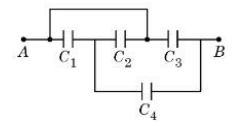
take C_1 = C_2 = C_3 = 1 μF and C_4 = 2 μF.
Given below are two statements: one is labelled as Assertion A and the other is labelled as Reason R
Assertion A: In electrostatics, a conductor does not store any net charge inside.
Reason R: Inside the capacitor (with no dielectric medium), the free charge carriers, if placed between the plates of capacitor, experience force and drift.
Choose the correct answer from the options given below
A solenoid has a core made of material with relative permeability 400. The magnetic field produced in the interior of solenoid is 1.0 T. The magnetic intensity in SI units is \(\alpha \times 10^5\). The value of \(\alpha\) is ________.
(Free space permeability \(\mu_0 = 4\pi \times 10^{-7}\) SI units.)
A magnetic field vector in an electromagnetic wave is represented by
\(\vec{B} = B_0 \sin \left( 2\pi \nu t - \frac{2\pi x}{\lambda} \right) \hat{j}\). Its associated electric field vector is _______.
A convex lens is made from glass material having refractive index of 1.4 with same radius of curvature on both sides. The ratio of its focal length and radius of curvature is:
An unpolarized light of certain intensity passes through a combination of two polarizers whose transmission axes are at \(30^\circ\) and \(90^\circ\), respectively, with respect to the horizontal axis. A third polarizer with its transmission axis at \(60^\circ\) with the horizontal axis is placed between the two existing polarizers. The ratio of the output intensities with and without the third polarizer is:
In Rutherford's alpha-particle scattering experiment, only a few alpha particles rebound back because:
A. The size of gold nucleus is very small as compared to the size of gold atom.
B. Alpha particle and gold nucleus have equal charge.
C. The impact parameter is minimum for a few alpha particles.
D. A few alpha particles have very high kinetic energy.
E. Only a few alpha particles undergo head-on collision with the nuclei.
Choose the correct answer from the options given below:
The de Broglie wavelength associated with an electron accelerated through a potential difference V is \( \lambda_e \) and the de Broglie wavelength associated with a proton accelerated through the same potential difference is \( \lambda_p \). If their corresponding masses are \( m_e \) and \( m_p \), respectively, then the ratio of their de Broglie wavelengths \( \frac{\lambda_e}{\lambda_p} \) is:
Given below are two statements: one is labelled as Assertion A and the other is labelled as Reason R
Assertion A: A diode under reverse-biased condition provides very small current which is nearly independent of voltage until a critical limit at which the current increases drastically.
Reason R: Below the critical voltage limit, only majority charge carriers flow which increases drastically above critical voltage.
choose the correct answer from the options given below:
A diode has Zener voltage of 10 V and maximum power dissipation of 0.5 W, then the minimum resistance to be used in series with this diode for safety when it is connected to a 25 V power supply is _______ \(\Omega\).
A gun mounted on the ground fires bullets in all directions with same speed. The farthest distance the bullets could reach is 6.4 m. The speed of the bullets from the gun is _______ m/s. (take g = 10 m/s\(^2\))
Two identical small bar magnets each of dipole moment \( 3\sqrt{5} J/T \) are placed at a center to center separation of 10 cm, with their axes perpendicular to each other as shown in figure. The value of magnetic field at the point P midway between the magnets is \( \alpha \times 10^{-3} T \). The value of \( \alpha \) is _______. (\( \mu_0 = 4\pi \times 10^{-7} Tm/A \))

A circular coil of radius 2 cm and 125 turns carries a current of 1 A. The coil is placed in a uniform magnetic field of magnitude 0.4 T. The axis of the coil makes an angle of \( 30^\circ \) with the direction of the magnetic field. The torque acting on the coil is \( \alpha \times 10^{-4} N.m \). The value of \( \alpha \) is _______. (\( \pi = 3.14 \))
In a double slit experiment, when one of the slits is covered by a transparent mica sheet of refractive index 1.56, the central fringe shifts to the position of \( 7^{th} \) bright fringe, obtained with both slits uncovered. If the light source wavelength is 450 nm, the thickness of mica sheet is \( \alpha \times 10^{-9} m \). The value of \( \alpha \) is _______.
The correct order of total number of atoms present in
(A) 2 moles of cyclohexane
(B) 684 g of sucrose
(C) 90.8 L of dihydrogen at STP
is:
The species having identical radii according to the Bohr's theory are:
A. H (first orbit)
B. \( He^+ \) (first orbit)
C. \( He^+ \) (Second orbit)
D. \( Li^{2+} \) (first orbit)
E. \( Be^{3+} \) (Second orbit)
Choose the correct answer from the options given below:
Which of the following pictorial diagram most correctly represents the \( \pi^* \) (\( \pi \) - antibonding) molecular orbital between two atoms if the internuclear axis is taken to be in the z-direction ( \( \xrightarrow{z-axis} \) )?
- (A)
![]()
- (B)
![]()
- (C)
![]()
- (D)
![]()


At \( 27^\circ C \), 0.1 M, 1 L \( K_4[Fe(CN)_6] \) aqueous solution and 0.1 M, 1 L \( FeCl_3 \) aqueous solution are placed in a container separated by a semi permeable membrane AB. Assume complete dissociation of both the solutes. Which of the following statement is correct?

20 mL of a solution of acetic acid required 28.4 mL of 0.1 M NaOH for its neutralization. A solution (X) was prepared by mixing 20 mL of the above acetic acid and 14.2 mL of 0.1 M NaOH solution. What is the pH of the solution (X)? (\( pK_a \) value of acetic acid is 4.75).
Match the LIST-I with LIST-II:

The \( 1^{st} \) ionization enthalpy for Mg is +737 kJ/mol. The most probable estimated value of the \( 2^{nd} \) ionization enthalpy of Mg is _______ kJ/mol.
The electronegativity of a group 13 element 'E' is same as that of Ge (on Pauling scale and upto one decimal point). The CORRECT statements about \( E^{3+} \) are:
A. It can act as a reducing agent.
B. It can act as an oxidizing agent.
C. \( E^{3+} \) is more stable than \( E^+ \).
D. The standard electrode potential value for \( E^{3+}/E \) is positive.
Choose the correct answer from the options given below:
Pairs of elements with the same number of electrons in their respective 4f orbital are
[Atomic number: Eu-63, Gd-64, Dy-66, Ho-67, Tm-69, Yb-70, Lu-71, Hf-72]
A. (Eu and Gd)
B. (Dy and Ho)
C. (Yb and Hf)
D. (Lu and Tm)
Choose the correct answer from the options given below:
Consider the metal complexes \( [Ni(en)_3]^{2+} \) (A), \( [NiCl_4]^{2-} \) (B) and \( [Ni(NH_3)_6]^{2+} \) (C). Choose the CORRECT option by considering the number of unpaired electrons present in (A), (B) and (C) respectively and the order of frequency of absorption.
Consider the following molecules/species:
The correct order of carbon - oxygen double bond length is :

Consider \(|x|\) is the difference in oxidation states of Mn in highest manganese fluoride and highest manganese oxide. The ions with \(|x|\) number of unpaired electrons from the following are:
A. \(Sc^{3+}\)
B. \(Zn^{2+}\)
C. \(V^{2+}\)
D. \(Fe^{2+}\)
E. \(Co^{2+}\)
Choose the correct answer from the options given below:
Three different reactions were started with identical initial concentration of reactants. Which of the following statement is correct regarding the given graph showing variation of reactant concentration with time?

Compound (X) [Phenylacetylene] is subjected to the sequence of reactions:

Molar mass of the major product (Y) formed is _______ \(g \cdot mol^{-1}\). (Given molar mass in \(g \cdot mol^{-1}\) C:12, H: 1, O: 16)
The following structures are:

The descending order of acidity among the following compounds is :


 7
7A D-aldotetrose on oxidation with concentrated \(HNO_3\) resulted in optically inactive dicarboxylic acid. The structure of the D-aldotetrose is:
- (A)
![]()
- (B)
![]()
- (C)
![]()
- (D)
![]()


Among \(Fe^{3+}, Pb^{2+}, Cu^{2+}\) and \(Mn^{2+}\), identify the one that gets precipitated out while passing \(H_2S\) in presence of \(NH_4OH\) as group reagent. The highest possible oxidation state of the corresponding metal is:
Match the LIST-I with LIST-II:

If 3.365 g of ethanol (l) is burnt completely in a bomb calorimeter at 298.15 K, the heat produced is 99.472 kJ. The \(|\Delta H_f^\circ|\) of ethanol at 298.15 K is _______ \(\times 10^2\) kJ \(\cdot mol^{-1}\). (Nearest integer)
Given: Standard enthalpy for combustion of graphite = \(-393.5\) kJ \(\cdot mol^{-1}\)
Standard enthalpy of formation of water (l) = \(-285.8\) kJ \(\cdot mol^{-1}\)
Molar mass in \(g \cdot mol^{-1}\) of C, H, O are 12, 1 and 16 respectively
For the following reaction at 50 \(^\circ\)C and at 2 atm pressure,
\(2N_2O_5(g) \rightleftharpoons 2N_2O_4(g) + O_2(g)\)
\(N_2O_5\) is 50% dissociated. The magnitude of standard free energy change at this temperature is x.
x = _______ J \(\cdot mol^{-1}\) [Nearest integer].
Given : R = 8.314 J \(mol^{-1} K^{-1}\), \(\log 2 = 0.30, \log 3 = 0.48, \ln 10 = 2.303, ^\circ C + 273 = K\)
An electrochemical cell, consist of the following two redox couples, \(M^{x+}(aq)/M(s) [E_{red}^\circ = +0.15 V]\) and \(Fe^{3+}(aq)/Fe(s) [E_{red}^\circ = -0.036 V]\). The cell EMF (\(E_{cell}\)) is recorded to be 0.2057 V. If the reaction quotient of the electrochemical cell is found to be \(10^{-z}\), then the value of x is _________. (Nearest integer)
[Given : M is a p-block metal and \(\frac{2.303 RT}{F} = 0.059 V\)]
For a first order reaction \(A \to B\),
x = _______ min. (Nearest integer)

In sulphur estimation, \(2.0 \times 10^{-3}\) mol of an organic compound (X) (molar mass 76 \(g \cdot mol^{-1}\)) gave 0.4813 g of barium sulphate (molar mass 233 \(g \cdot mol^{-1}\)). The percentage of sulphur in the compound (X) is _______ \(\times 10^{-1}\) % (Nearest integer)
JEE Main 2026 Exam Pattern
| Particulars | Details |
|---|---|
| Exam Mode | Online (Computer-Based Test) |
| Paper | B.E./B.Tech |
| Medium of Exam | 13 languages: English, Hindi, Gujarati, Bengali, Tamil, Telugu, Kannada, Marathi, Malayalam, Odia, Punjabi, Assamese, Urdu |
| Duration | 3 hours (180 minutes) |
| Type of Questions | Multiple Choice Questions (MCQs) + Numerical Value Questions |
| Total Marks | 300 marks |
| Subjects | Mathematics, Physics, Chemistry |
| Marking Scheme | +4 for correct answer & -1 for incorrect MCQ and Numerical Value-based Questions |
| Total Questions | 75 Questions |
| Eligibility | Passed or appearing in Class 12 with Physics, Chemistry, and Mathematics |





Comments