




JEE Main 2026 April 5 Shift 1 chemistry question paper is available here with answer key and solutions. NTA conducted the second shift of the day on April 5, 2026, from 9:00 AM to 12:00 PM.
- The JEE Main Chemistry Question Paper contains a total of 25 questions.
- Each correct answer gets you 4 marks while incorrect answers gets you a negative mark of 1.
Candidates can download the JEE Main 2026 April 5 Shift 1 chemistry question paper along with detailed solutions to analyze their performance and understand the exam pattern better.
JEE Main 2026 April 5 Shift 1 Chemistry Question Paper with Solution PDF

Also Check:
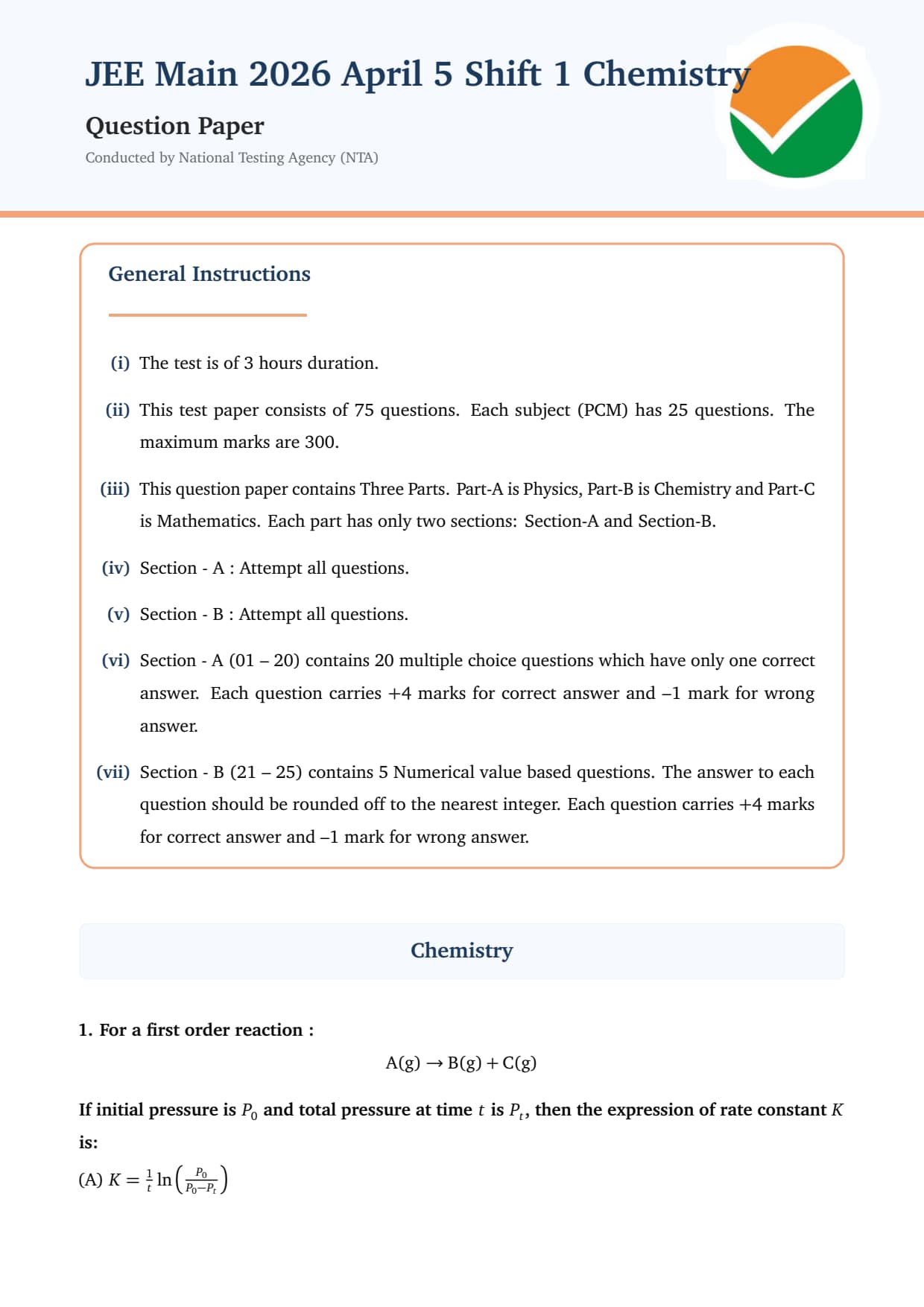

For a first order reaction : \[ A(g) \rightarrow B(g) + C(g) \]
If initial pressure is \( P_0 \) and total pressure at time \( t \) is \( P_t \), then the expression of rate constant \( K \) is:
On heating \(2.76\,g\) of \( Ag_2CO_3 (s) \), some solid residue is left behind. Determine the mass of residue left.
Determine mole fraction of water in an aqueous solution of urea having \(10%\) w/w urea.
For reaction \( A \rightleftharpoons B + C \)
\[ \begin{array}{|c|c|c|c|} \hline \log K_p & 3.5 & 2.5 & 1.5
\hline \frac{1}{T}\,(K^{-1}) & 0.04 & 0.05 & 0.06
\hline \end{array} \]
Calculate \( \dfrac{\Delta H}{R} \) (in Kelvin) based on above data. (In nearest integer)
If solubility of sparingly soluble salt \( M_3A_2(s) \) is \(x\) gm/litre and \(y\) is the molar mass (in gm/mole) of the salt, then determine the value of \( \dfrac{[A^{3-}]}{K_{sp}} \).
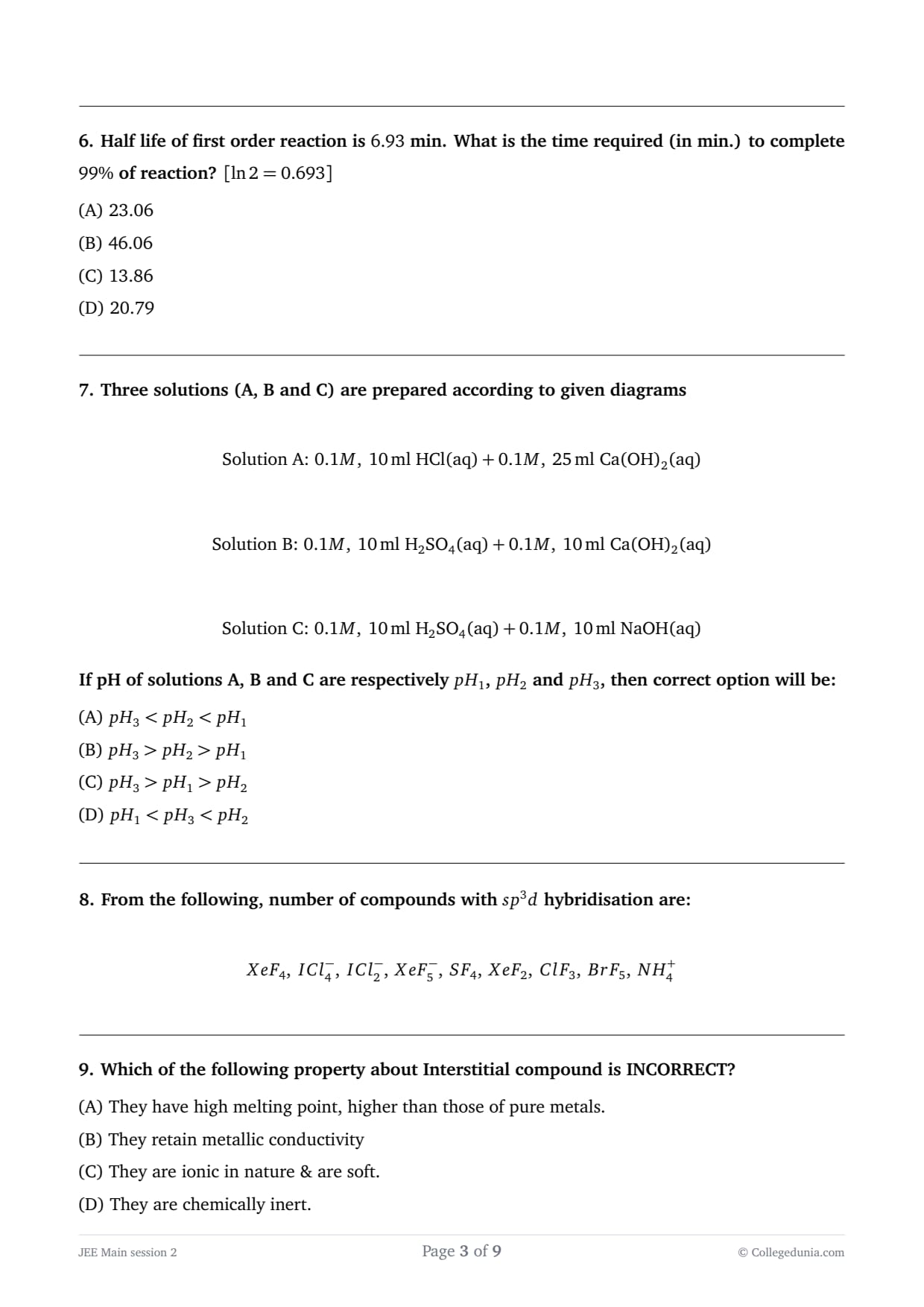
Half life of first order reaction is \(6.93\) min. What is the time required (in min.) to complete \(99%\) of reaction? \([\ln2 = 0.693]\)
Three solutions (A, B and C) are prepared according to given diagrams
\[ Solution A: 0.1M,\;10\,ml HCl(aq) + 0.1M,\;25\,ml Ca(OH)_2(aq) \]
\[ Solution B: 0.1M,\;10\,ml H_2SO_4(aq) + 0.1M,\;10\,ml Ca(OH)_2(aq) \]
\[ Solution C: 0.1M,\;10\,ml H_2SO_4(aq) + 0.1M,\;10\,ml NaOH(aq) \]
If pH of solutions A, B and C are respectively \(pH_1\), \(pH_2\) and \(pH_3\), then correct option will be:
From the following, number of compounds with \(sp^3d\) hybridisation are:
\[ XeF_4,\; ICl_4^-,\; ICl_2^-,\; XeF_5^-,\; SF_4,\; XeF_2,\; ClF_3,\; BrF_5,\; NH_4^+ \]
Which of the following property about Interstitial compound is INCORRECT?
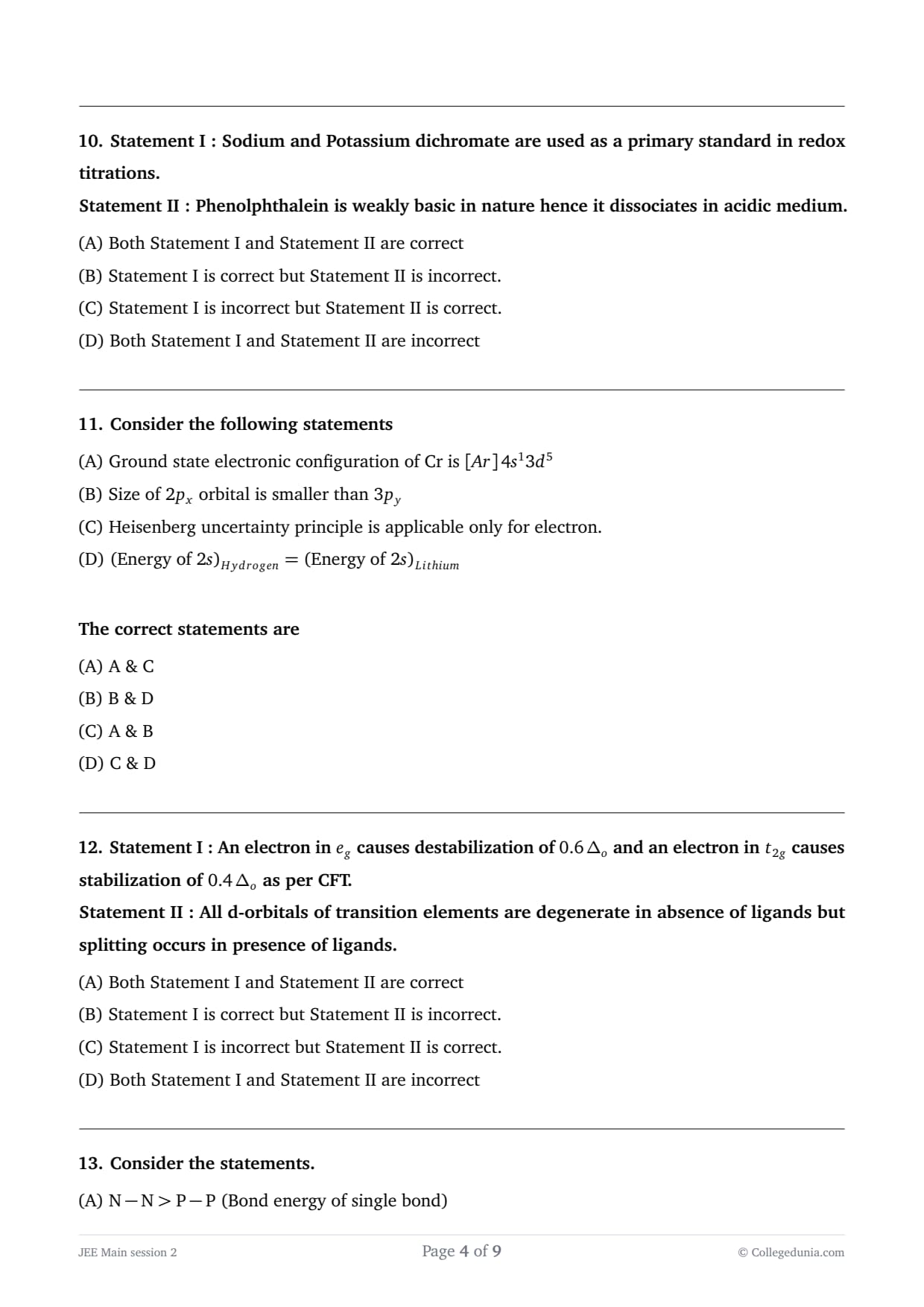
Statement I : Sodium and Potassium dichromate are used as a primary standard in redox titrations.
Statement II : Phenolphthalein is weakly basic in nature hence it dissociates in acidic medium.
Consider the following statements
(A) Ground state electronic configuration of Cr is \([Ar]\,4s^1 3d^5\)
(B) Size of \(2p_x\) orbital is smaller than \(3p_y\)
(C) Heisenberg uncertainty principle is applicable only for electron.
(D) (Energy of \(2s\))\(_{Hydrogen}\) = (Energy of \(2s\))\(_{Lithium}\)
The correct statements are
Statement I : An electron in \( e_g \) causes destabilization of \(0.6\,\Delta_o\) and an electron in \( t_{2g} \) causes stabilization of \(0.4\,\Delta_o\) as per CFT.
Statement II : All d-orbitals of transition elements are degenerate in absence of ligands but splitting occurs in presence of ligands.
Consider the statements.
(A) \( N - N > P - P \) (Bond energy of single bond)
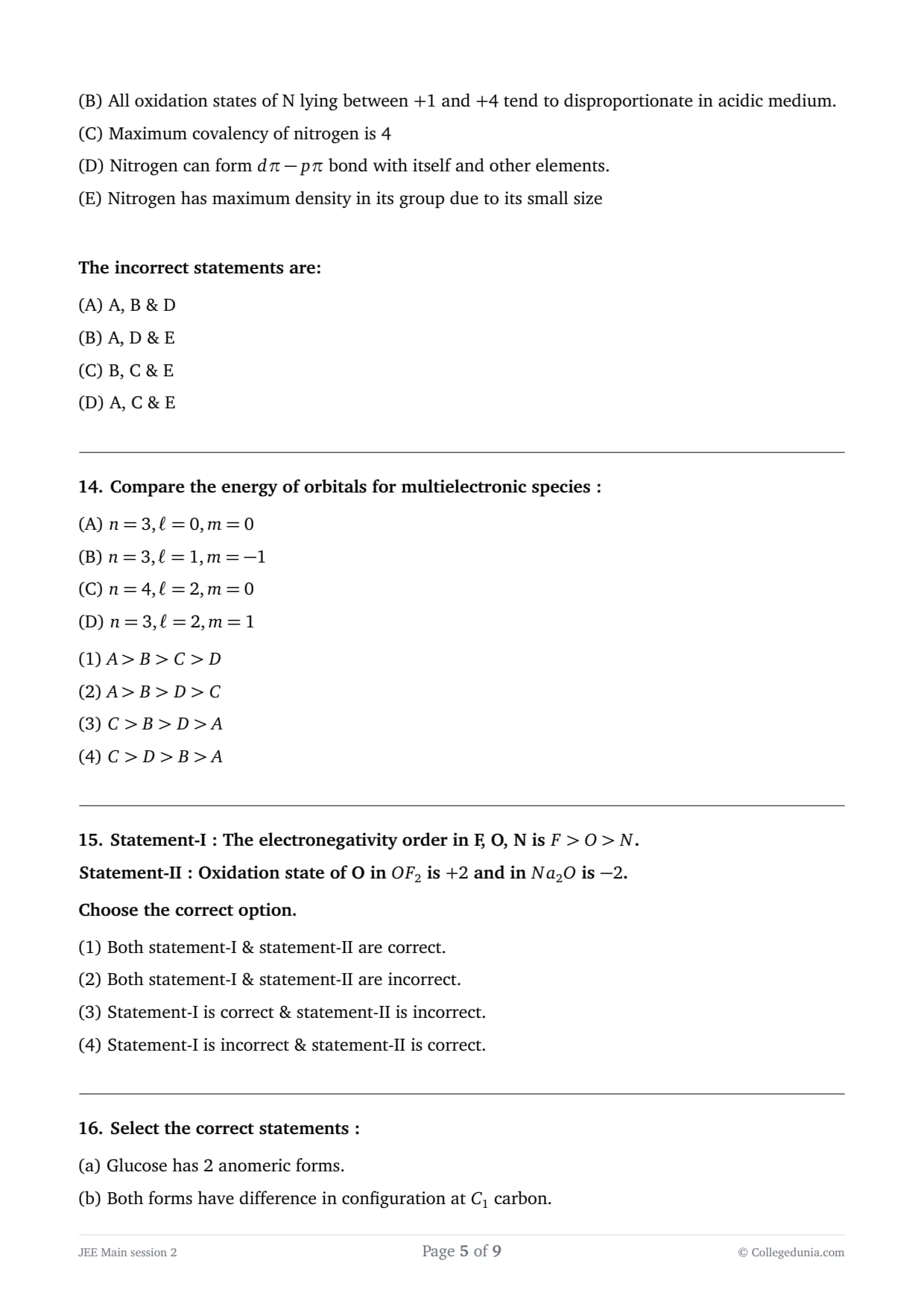
(B) All oxidation states of N lying between \(+1\) and \(+4\) tend to disproportionate in acidic medium.
(C) Maximum covalency of nitrogen is 4
(D) Nitrogen can form \(d\pi - p\pi\) bond with itself and other elements.
(E) Nitrogen has maximum density in its group due to its small size
The incorrect statements are:
Compare the energy of orbitals for multielectronic species :
(A) \(n = 3, \ell = 0, m = 0\)
(B) \(n = 3, \ell = 1, m = -1\)
(C) \(n = 4, \ell = 2, m = 0\)
(D) \(n = 3, \ell = 2, m = 1\)
Statement-I : The electronegativity order in F, O, N is \(F > O > N\).
Statement-II : Oxidation state of O in \(OF_2\) is \(+2\) and in \(Na_2O\) is \(-2\).
Choose the correct option.
Select the correct statements :
(a) Glucose has 2 anomeric forms.
(b) Both forms have difference in configuration at \(C_1\) carbon.
(c) \(\alpha\)-form has more melting point than \(\beta\)-form.
(d) Specific rotation of \(\alpha\)-form is \(+19^\circ\) and \(\beta\)-form has \(+112^\circ\).
(e) \(\alpha\)-form crystallises at \(307^\circ\) and \(\beta\)-form crystallises at \(371^\circ\).
0.4 gm organic compound is subjected to estimation of sulphur by Carius method. In the process \(0.6\) gm of \(BaSO_4\) was formed. Find % of sulphur (nearest integer).
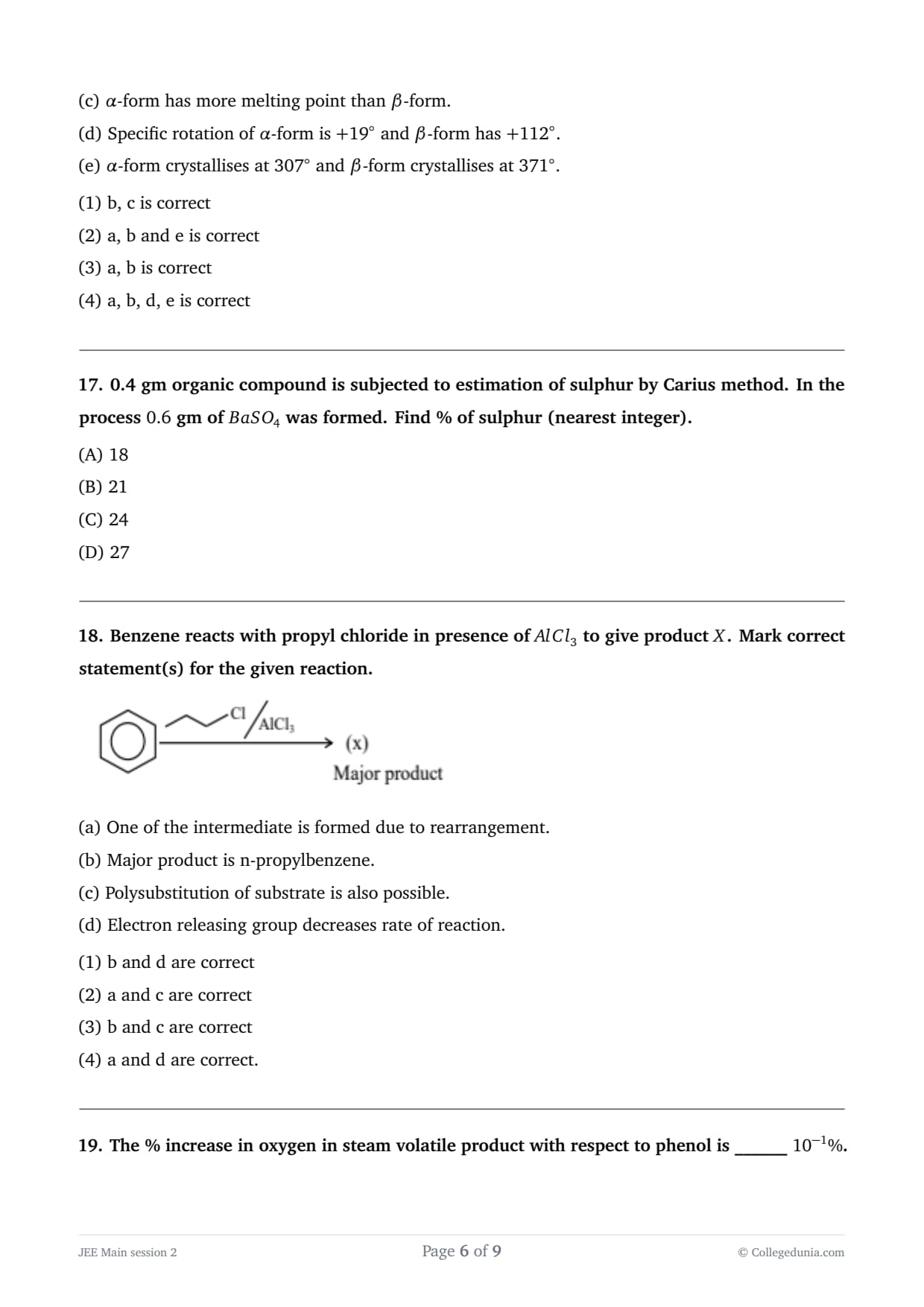
Benzene reacts with propyl chloride in presence of \(AlCl_3\) to give product \(X\). Mark correct statement(s) for the given reaction.
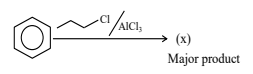
(a) One of the intermediate is formed due to rearrangement.
(b) Major product is n-propylbenzene.
(c) Polysubstitution of substrate is also possible.
(d) Electron releasing group decreases rate of reaction.
Question 19:
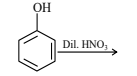
The % increase in oxygen in steam volatile product with respect to phenol is ______ \(10^{-1}%\).
View Solution
Concept:
Phenol undergoes electrophilic substitution with dilute nitric acid to form a mixture of o-nitrophenol and \textit{p-nitrophenol. Among these products, \textit{o-nitrophenol is steam volatile due to intramolecular hydrogen bonding. Therefore, the steam volatile product considered here is o-nitrophenol.
Step 1: Write the reaction.
\[ Phenol \xrightarrow{Dil. HNO_3 o-Nitrophenol + p-Nitrophenol \]
\[ o-Nitrophenol is steam volatile \]
Step 2: Calculate % oxygen in phenol.
Molecular formula of phenol: \[ C_6H_6O \]
Molar mass: \[ 6(12) + 6(1) + 16 = 94 \]
Mass of oxygen in phenol \(=16\).
\[ %O_{phenol}= \frac{16}{94}\times100 \]
\[ %O_{phenol} = 17.02% \]
Step 3: Calculate % oxygen in o-nitrophenol.
Molecular formula: \[ C_6H_5NO_3 \]
Molar mass: \[ 6(12) + 5(1) + 14 + 3(16) = 139 \]
Mass of oxygen \(=3\times16=48\).
\[ %O= \frac{48}{139}\times100 \]
\[ %O = 34.53% \]
Step 4: Calculate increase in oxygen percentage.
\[ Increase = 34.53 - 17.02 \]
\[ = 17.51 \approx 17.5 \]
Given answer format is \(10^{-1}%\):
\[ 17.5 \times 10^{-1} = 175 \]
\[ \boxed{175} \] Quick Tip: o-Nitrophenol is steam volatile due to intramolecular hydrogen bonding, while p-nitrophenol forms intermolecular hydrogen bonding and is not steam volatile.
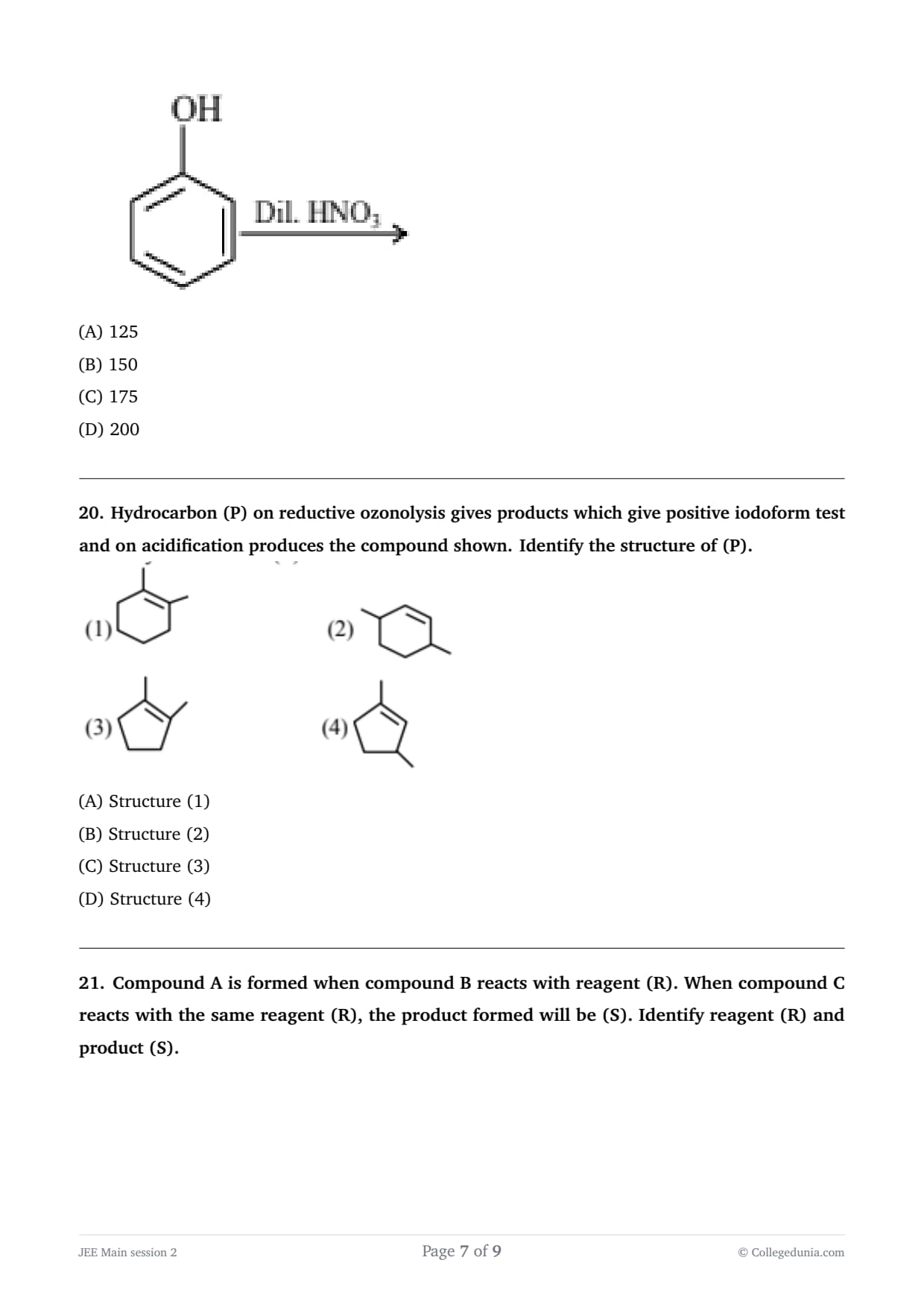
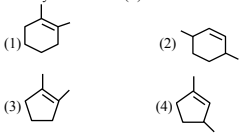
Hydrocarbon (P) on reductive ozonolysis gives products which give positive iodoform test and on acidification produces the compound shown. Identify the structure of (P).
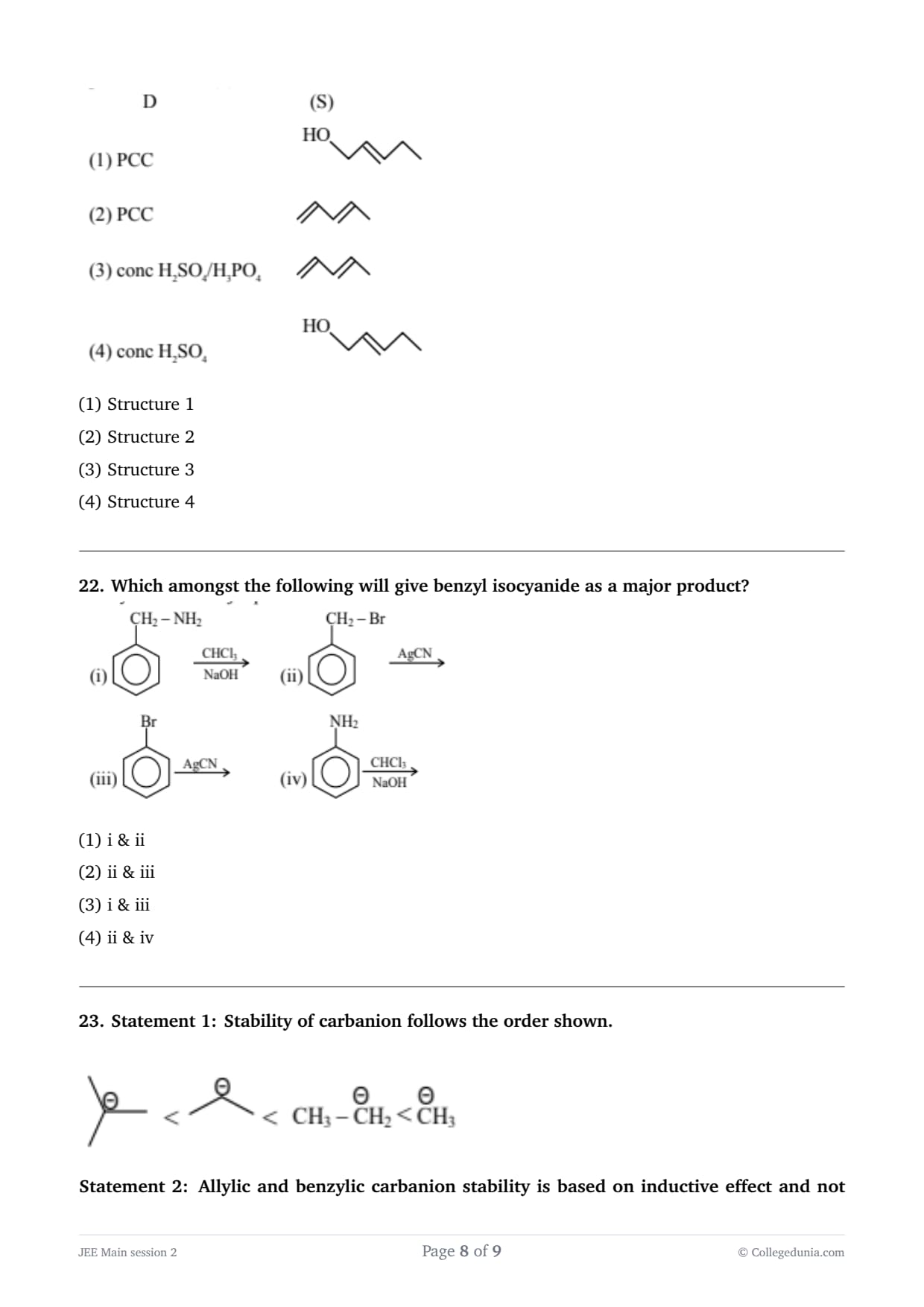
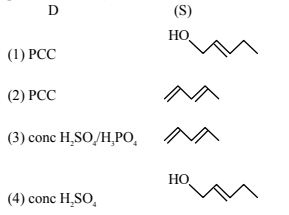
Compound A is formed when compound B reacts with reagent (R). When compound C reacts with the same reagent (R), the product formed will be (S). Identify reagent (R) and product (S).
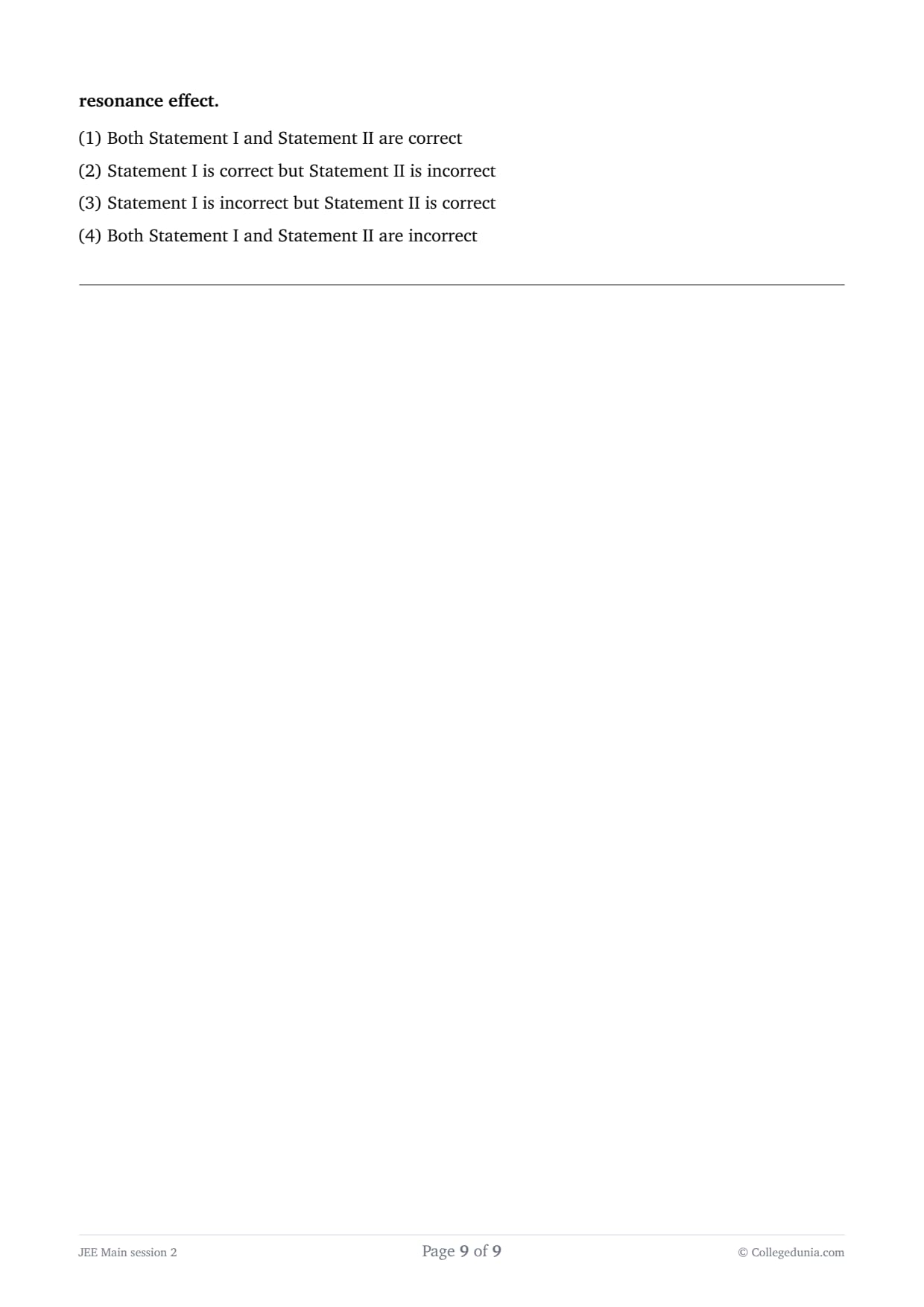
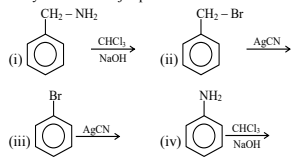
Which amongst the following will give benzyl isocyanide as a major product?
Statement 1: Stability of carbanion follows the order shown.
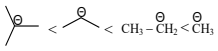
Statement 2: Allylic and benzylic carbanion stability is based on inductive effect and not resonance effect.
JEE Main 2026 Chemistry Exam Pattern
| Particulars | Details |
|---|---|
| Exam Mode | Online (Computer-Based Test) |
| Paper | B.E./B.Tech |
| Medium of Exam | 13 languages: English, Hindi, Gujarati, Bengali, Tamil, Telugu, Kannada, Marathi, Malayalam, Odia, Punjabi, Assamese, Urdu |
| Type of Questions | Multiple Choice Questions (MCQs) + Numerical Value Questions |
| Total Marks | 100 marks |
| Marking Scheme | +4 for correct answer & -1 for incorrect MCQ and Numerical Value-based Questions |
| Total Questions | 25 Questions |





Comments