




JEE Main 2026 April 5 Shift 1 mathematics question paper is available here with answer key and solutions. NTA conducted the second shift of the day on April 5, 2026, from 9:00 AM to 12:00 PM.
- The JEE Main Mathematics Question Paper contains a total of 25 questions.
- Each correct answer gets you 4 marks while incorrect answers gets you a negative mark of 1.
Candidates can download the JEE Main 2026 April 5 Shift 1 mathematics question paper along with detailed solutions to analyze their performance and understand the exam pattern better.
JEE Main 2026 April 5 Shift 1 Mathematics Question Paper with Solution PDF

Also Check:
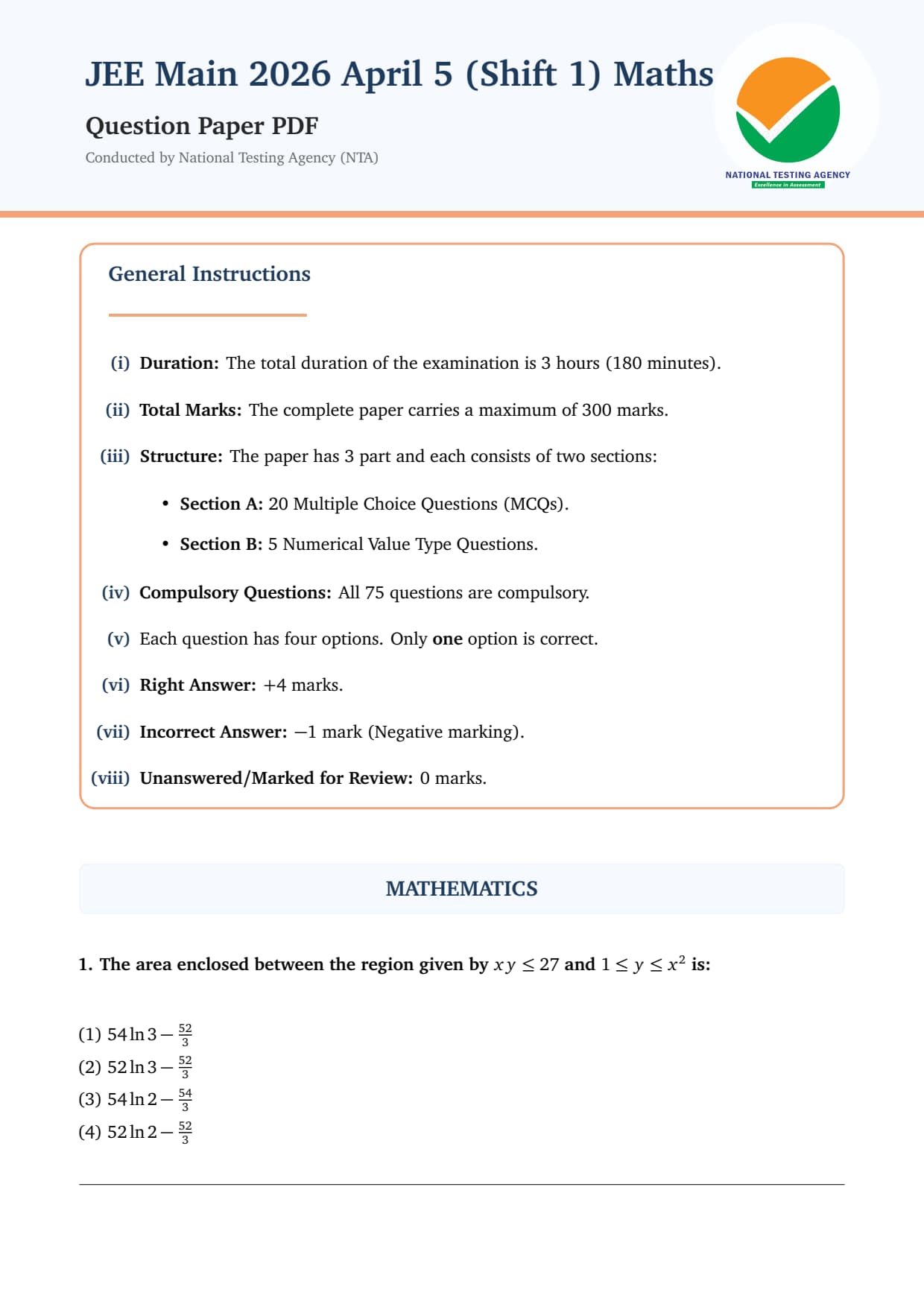
The area enclosed between the region given by \( xy \le 27 \) and \( 1 \le y \le x^2 \) is:
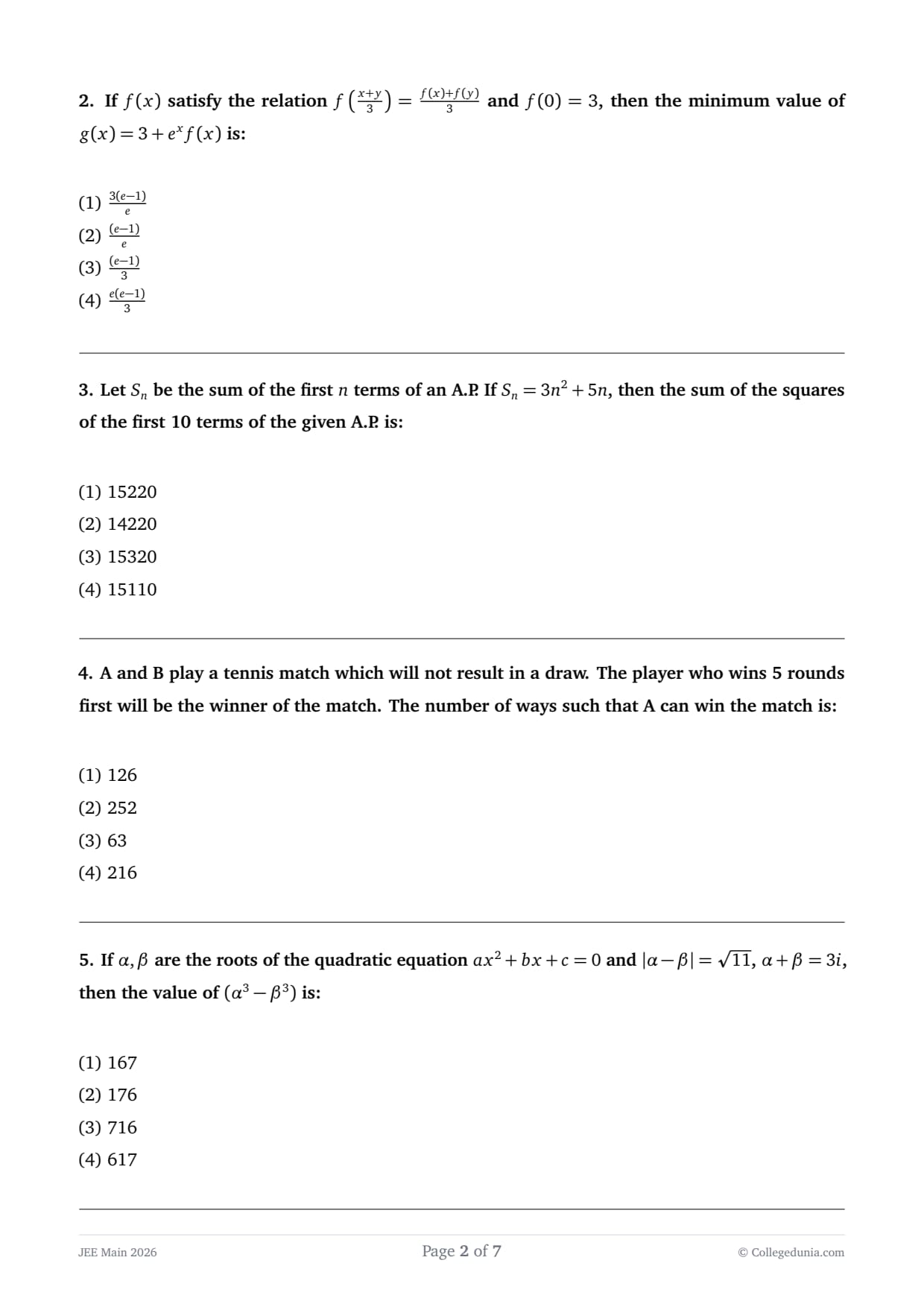
If \( f(x) \) satisfy the relation \( f\left(\frac{x+y}{3}\right) = \frac{f(x) + f(y)}{3} \) and \( f(0) = 3 \), then the minimum value of \( g(x) = 3 + e^x f(x) \) is:
Let \( S_n \) be the sum of the first \( n \) terms of an A.P. If \( S_n = 3n^2 + 5n \), then the sum of the squares of the first 10 terms of the given A.P. is:
A and B play a tennis match which will not result in a draw. The player who wins 5 rounds first will be the winner of the match. The number of ways such that A can win the match is:
If \( \alpha, \beta \) are the roots of the quadratic equation \( ax^2 + bx + c = 0 \) and \( |\alpha - \beta| = \sqrt{11} \), \( \alpha + \beta = 3i \), then the value of \( (\alpha^3 - \beta^3) \) is:
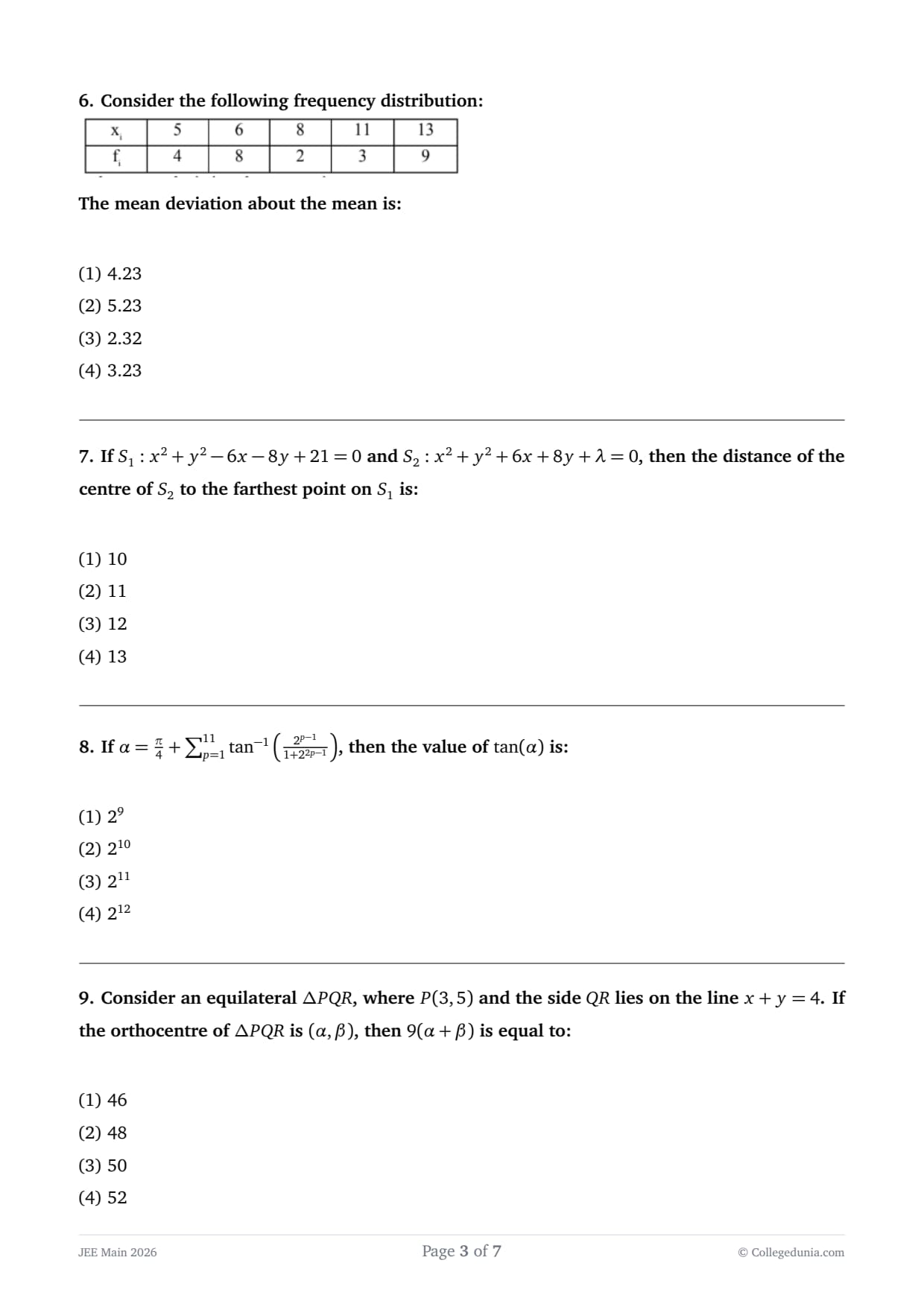
Consider the following frequency distribution:

The mean deviation about the mean is:
If \( S_1: x^2 + y^2 - 6x - 8y + 21 = 0 \) and \( S_2: x^2 + y^2 + 6x + 8y + \lambda = 0 \), then the distance of the centre of \( S_2 \) to the farthest point on \( S_1 \) is:
If \( \alpha = \frac{\pi}{4} + \sum_{p=1}^{11} \tan^{-1} \left( \frac{2^{p-1}}{1 + 2^{2p-1}} \right) \), then the value of \( \tan(\alpha) \) is:
Consider an equilateral \( \Delta PQR \), where \( P(3, 5) \) and the side \( QR \) lies on the line \( x + y = 4 \). If the orthocentre of \( \Delta PQR \) is \( (\alpha, \beta) \), then \( 9(\alpha + \beta) \) is equal to:
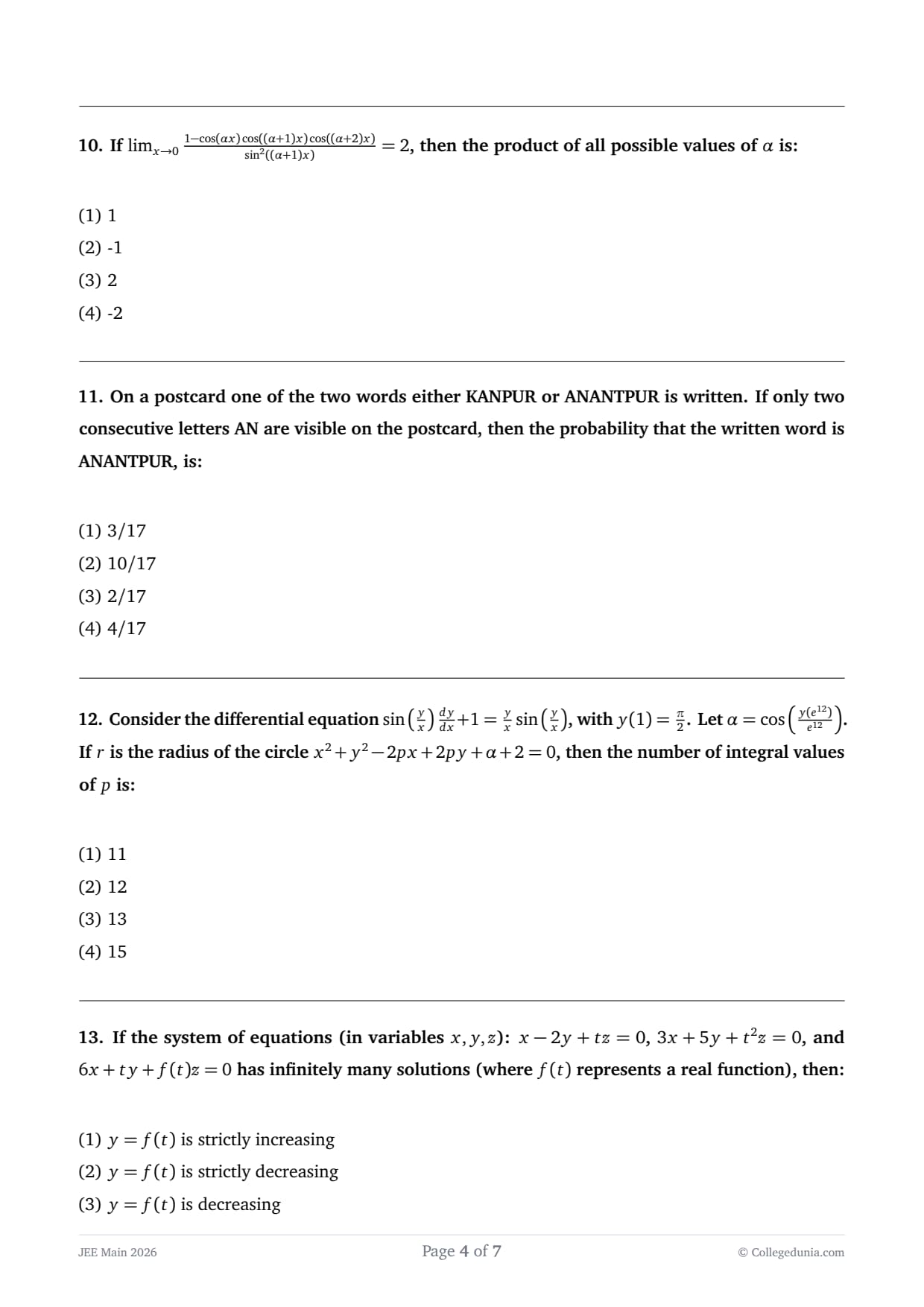
If \( \lim_{x \to 0} \frac{1 - \cos(\alpha x) \cos((\alpha + 1)x) \cos((\alpha + 2)x)}{\sin^2((\alpha + 1)x)} = 2 \), then the product of all possible values of \( \alpha \) is:
On a postcard one of the two words either KANPUR or ANANTPUR is written. If only two consecutive letters AN are visible on the postcard, then the probability that the written word is ANANTPUR, is:
Consider the differential equation \( \sin\left(\frac{y}{x}\right) \frac{dy}{dx} + 1 = \frac{y}{x} \sin\left(\frac{y}{x}\right) \), with \( y(1) = \frac{\pi}{2} \). Let \( \alpha = \cos\left(\frac{y(e^{12})}{e^{12}}\right) \). If \( r \) is the radius of the circle \( x^2 + y^2 - 2px + 2py + \alpha + 2 = 0 \), then the number of integral values of \( p \) is:
If the system of equations (in variables \(x, y, z\)): \(x - 2y + tz = 0\), \(3x + 5y + t^2 z = 0\), and \(6x + ty + f(t)z = 0\) has infinitely many solutions (where \(f(t)\) represents a real function), then:
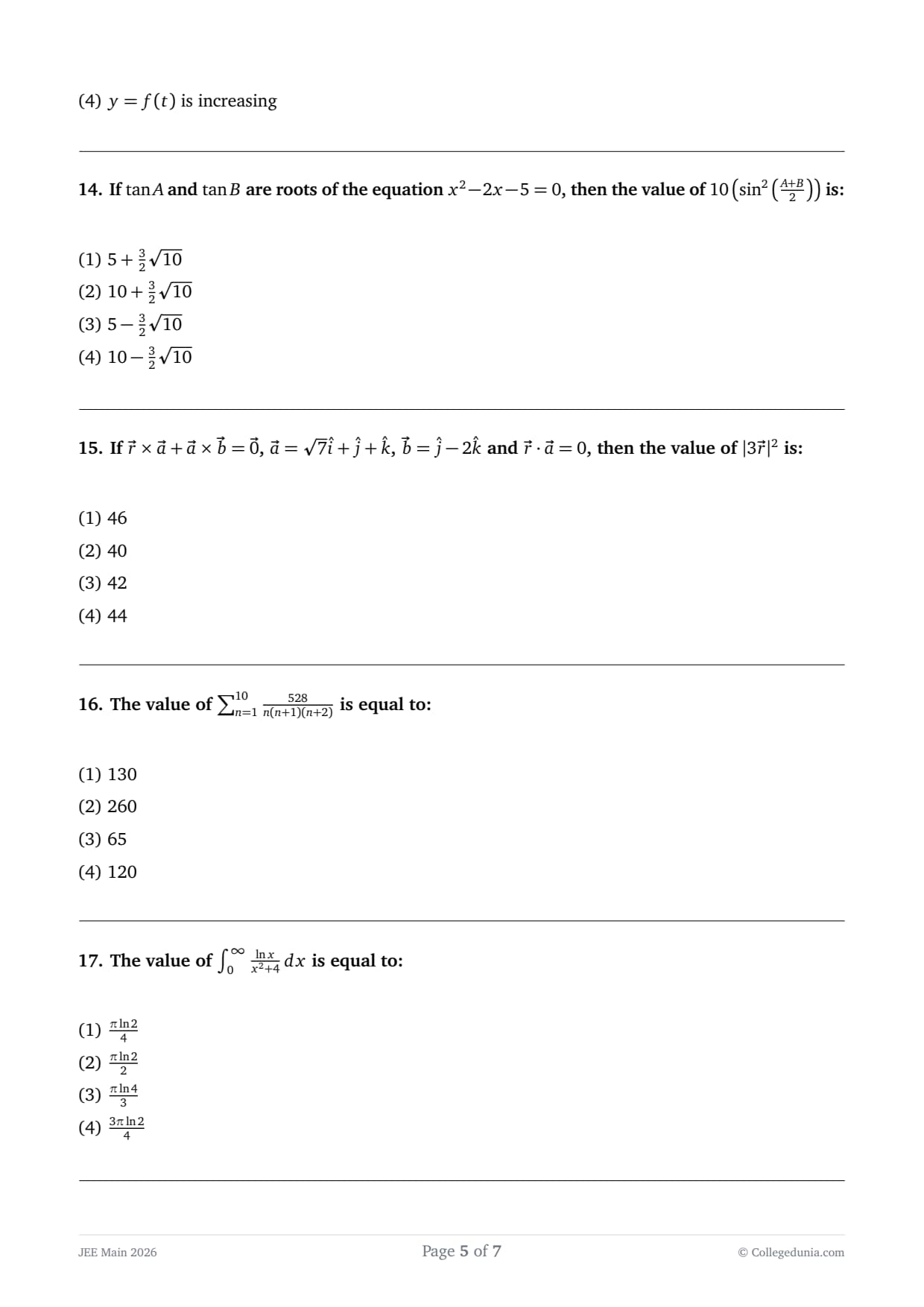
If \( \tan A \) and \( \tan B \) are roots of the equation \( x^2 - 2x - 5 = 0 \), then the value of \( 10\left(\sin^2\left(\frac{A+B}{2}\right)\right) \) is:
If \( \vec{r} \times \vec{a} + \vec{a} \times \vec{b} = \vec{0} \), \( \vec{a} = \sqrt{7}\hat{i} + \hat{j} + \hat{k} \), \( \vec{b} = \hat{j} - 2\hat{k} \) and \( \vec{r} \cdot \vec{a} = 0 \), then the value of \( |3\vec{r}|^2 \) is:
The value of \( \sum_{n=1}^{10} \frac{528}{n(n+1)(n+2)} \) is equal to:
The value of \( \int_{0}^{\infty} \frac{\ln x}{x^2 + 4} \, dx \) is equal to:
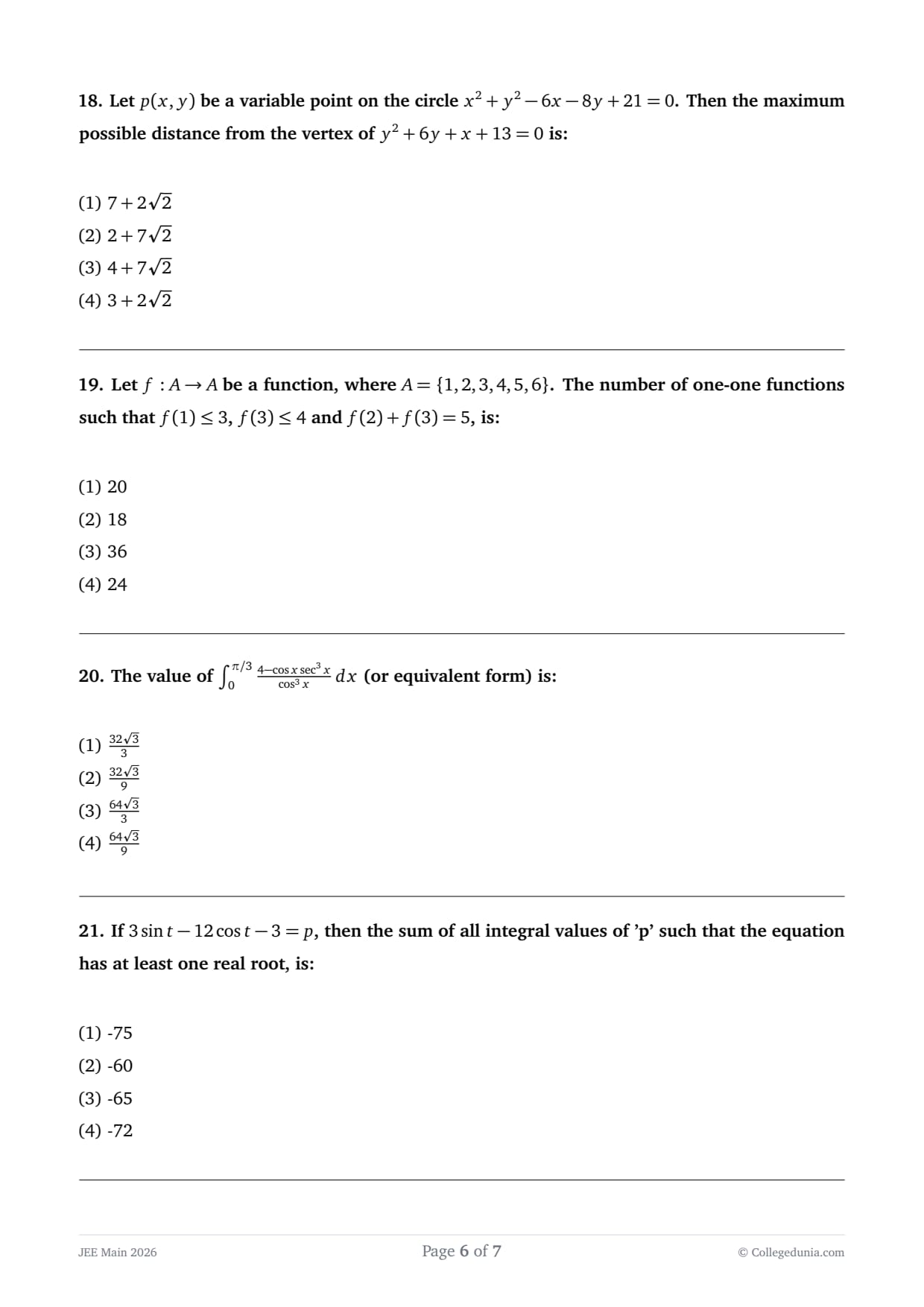
Let \( p(x, y) \) be a variable point on the circle \( x^2 + y^2 - 6x - 8y + 21 = 0 \). Then the maximum possible distance from the vertex of \( y^2 + 6y + x + 13 = 0 \) is:
Let \( f: A \to A \) be a function, where \( A = \{1, 2, 3, 4, 5, 6\} \). The number of one-one functions such that \( f(1) \le 3 \), \( f(3) \le 4 \) and \( f(2) + f(3) = 5 \), is:
The value of \( \int_{0}^{\pi/3} \frac{4 - \cos x \sec^3 x}{\cos^3 x} \, dx \) (or equivalent form) is:
If \( 3\sin t - 12\cos t - 3 = p \), then the sum of all integral values of 'p' such that the equation has at least one real root, is:
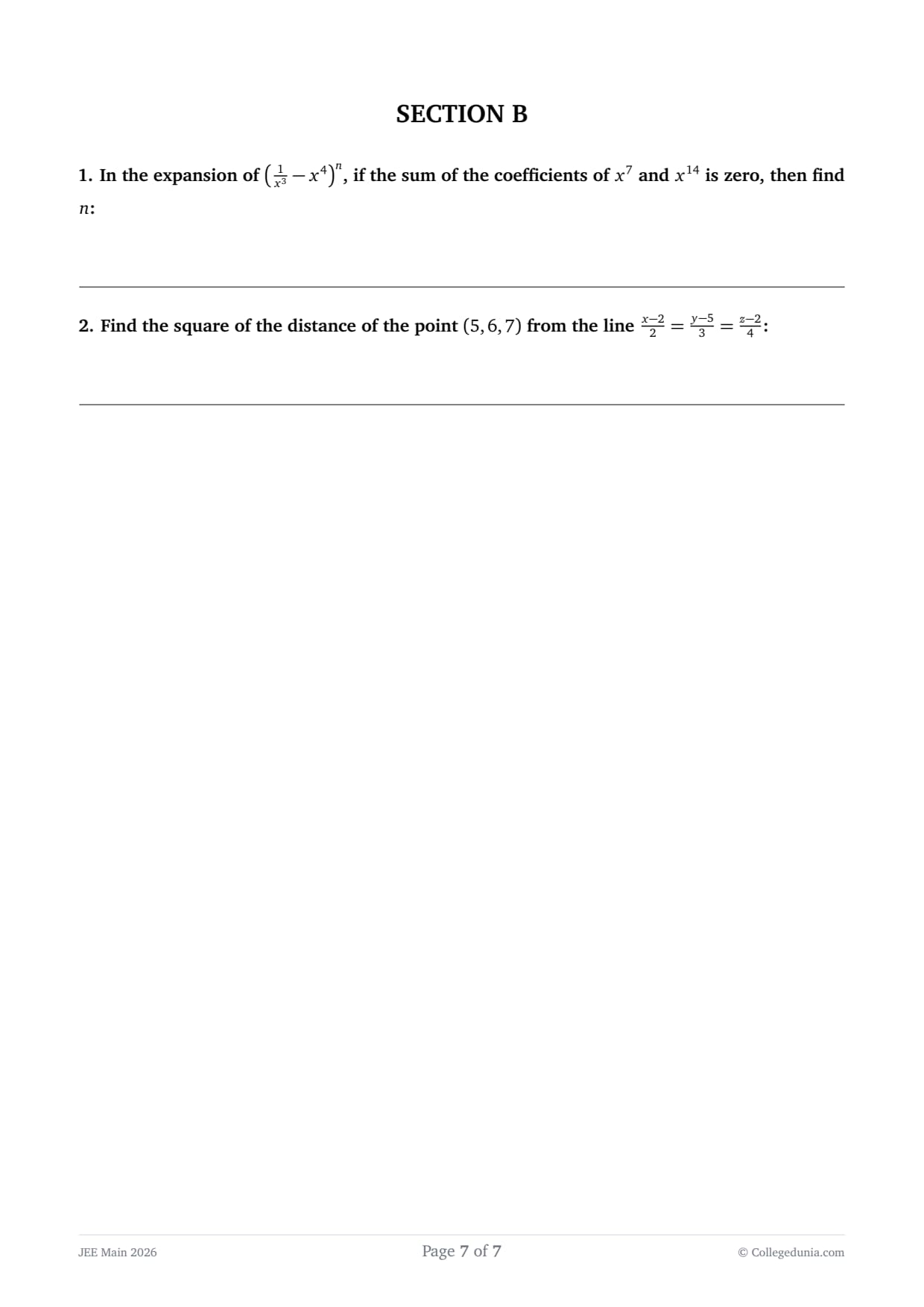
In the expansion of \( \left( \frac{1}{x^3} - x^4 \right)^n \), if the sum of the coefficients of \( x^7 \) and \( x^{14} \) is zero, then find \( n \):
Find the square of the distance of the point \( (5, 6, 7) \) from the line \( \frac{x-2}{2} = \frac{y-5}{3} = \frac{z-2}{4} \):
JEE Main 2026 Mathematics Exam Pattern
| Particulars | Details |
|---|---|
| Exam Mode | Online (Computer-Based Test) |
| Paper | B.E./B.Tech |
| Medium of Exam | 13 languages: English, Hindi, Gujarati, Bengali, Tamil, Telugu, Kannada, Marathi, Malayalam, Odia, Punjabi, Assamese, Urdu |
| Type of Questions | Multiple Choice Questions (MCQs) + Numerical Value Questions |
| Total Marks | 100 marks |
| Marking Scheme | +4 for correct answer & -1 for incorrect MCQ and Numerical Value-based Questions |
| Total Questions | 25 Questions |



Comments