




JEE Main 2026 April 6 Shift 1 Chemistry Question Paper is available here with answer key and solutions. NTA conducted the first shift of the day on April 6, 2026, from 9:00 AM to 12:00 PM.
- The JEE Main Chemistry Question Paper contains a total of 25 questions.
- Each correct answer gets you 4 marks while incorrect answers gets you a negative mark of 1.
Candidates can download the JEE Main 2026 April 6 Shift 1 chemistry question paper along with detailed solutions to analyze their performance and understand the exam pattern better.
JEE Main 2026 April 6 Shift 1 Chemistry Question Paper with Solution PDF
Also Check:
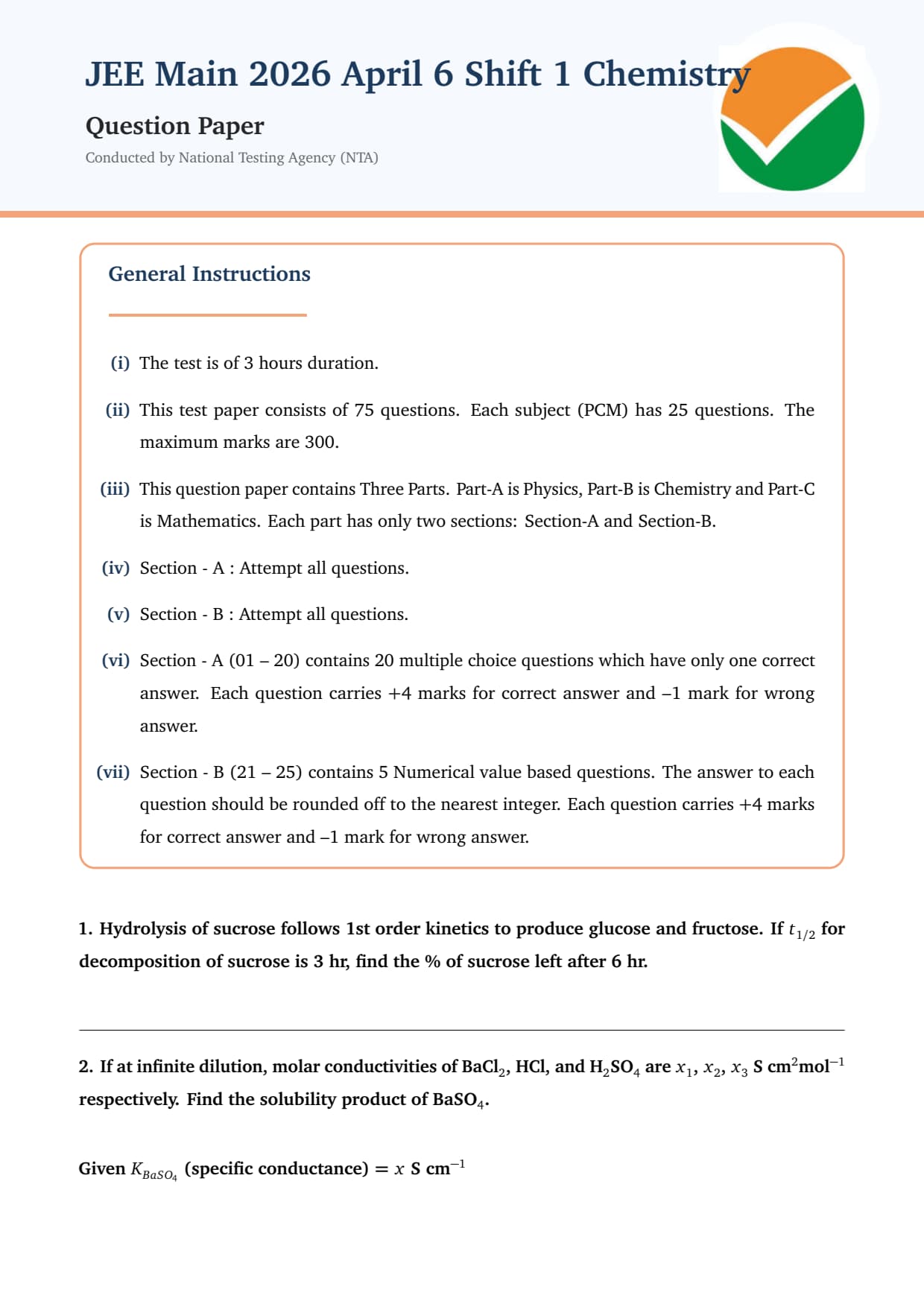
Hydrolysis of sucrose follows 1st order kinetics to produce glucose and fructose. If \( t_{1/2} \) for decomposition of sucrose is 3 hr, find the % of sucrose left after 6 hr.
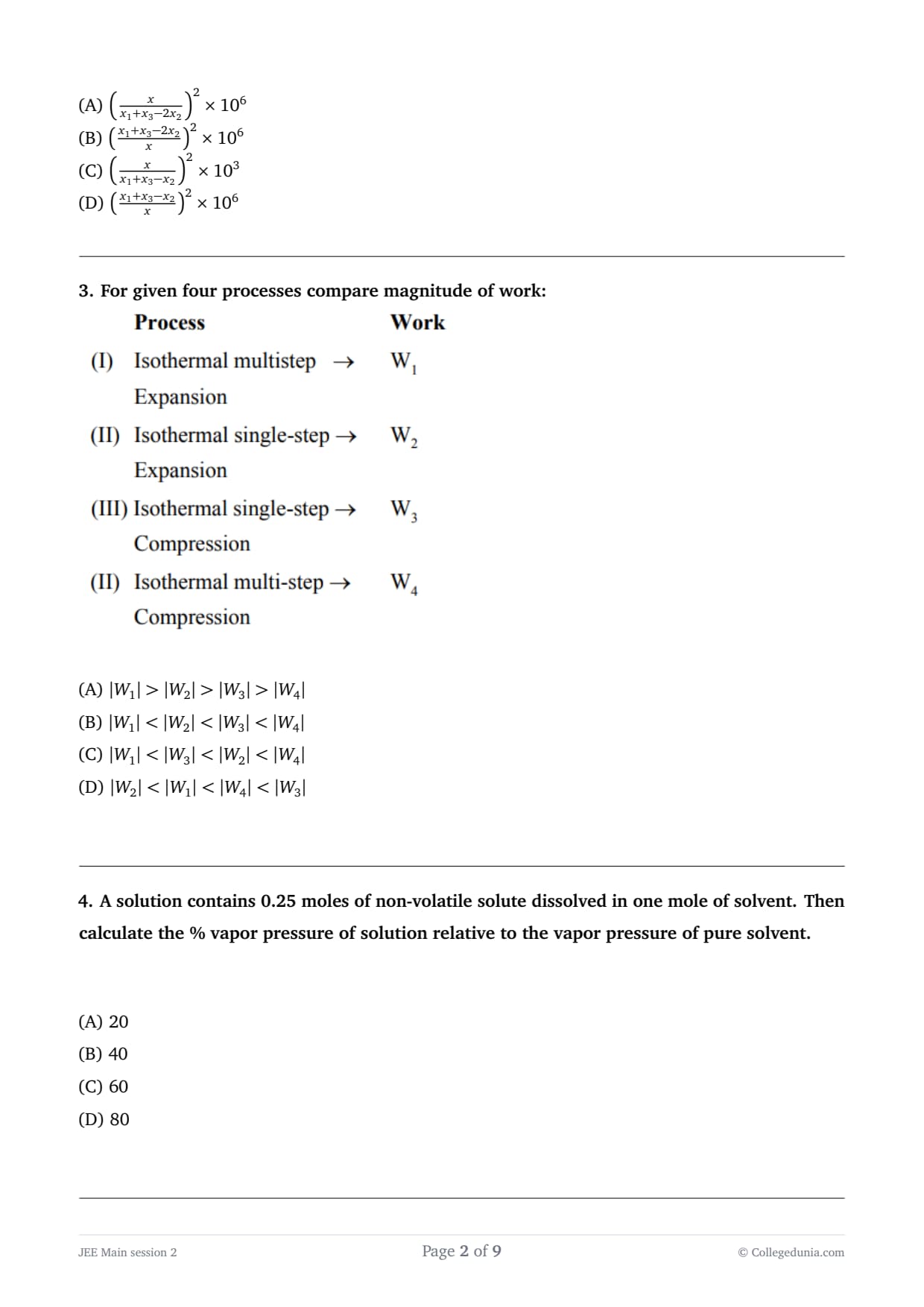
If at infinite dilution, molar conductivities of BaCl\(_2\), HCl and H\(_2\)SO\(_4\) are \( x_1 \), \( x_2 \), \( x_3 \) S cm\(^2\)mol\(^{-1}\) respectively, find solubility product of BaSO\(_4\).
Given \( K_{BaSO_4} \) (Specific conductance) = \( x \) S cm\(^{-1}\)
For given four processes compare magnitude of work:
A solution contains 0.25 moles of non-volatile solute dissolved in one mole of solvent. Then calculate the % vapor pressure of solution relative to the vapor pressure of pure solvent.
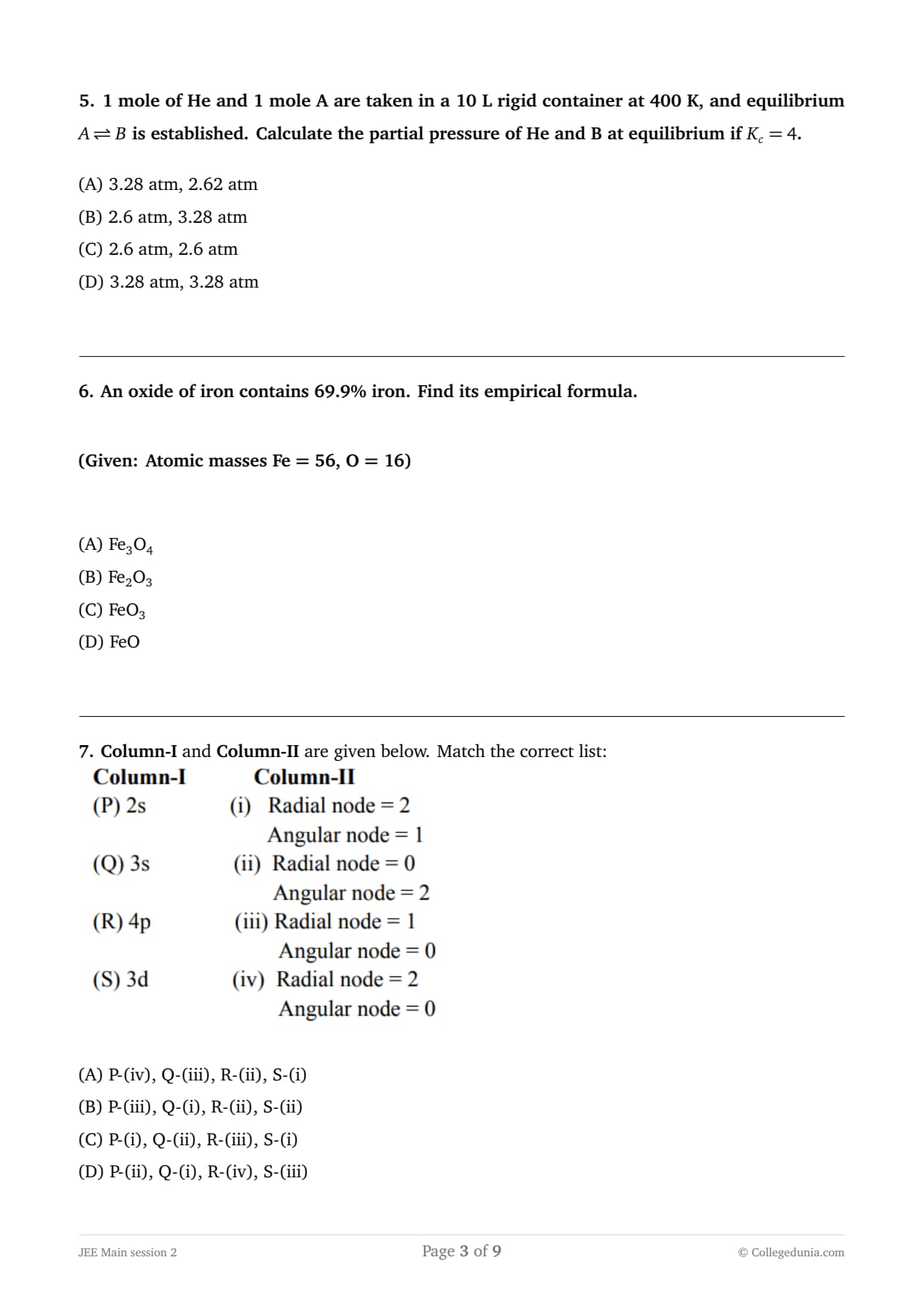
1 mole of He and 1 mole A are taken in a 10 L rigid container at 400 K, and equilibrium \( A \rightleftharpoons B \) is established. Calculate the partial pressure of He and B at equilibrium if \( K_c = 4 \).
An oxide of iron contains 69.9% iron. Find its empirical formula.
(Given: Atomic masses Fe = 56, O = 16)
Column-I and Column-II are given below. Match the correct list:

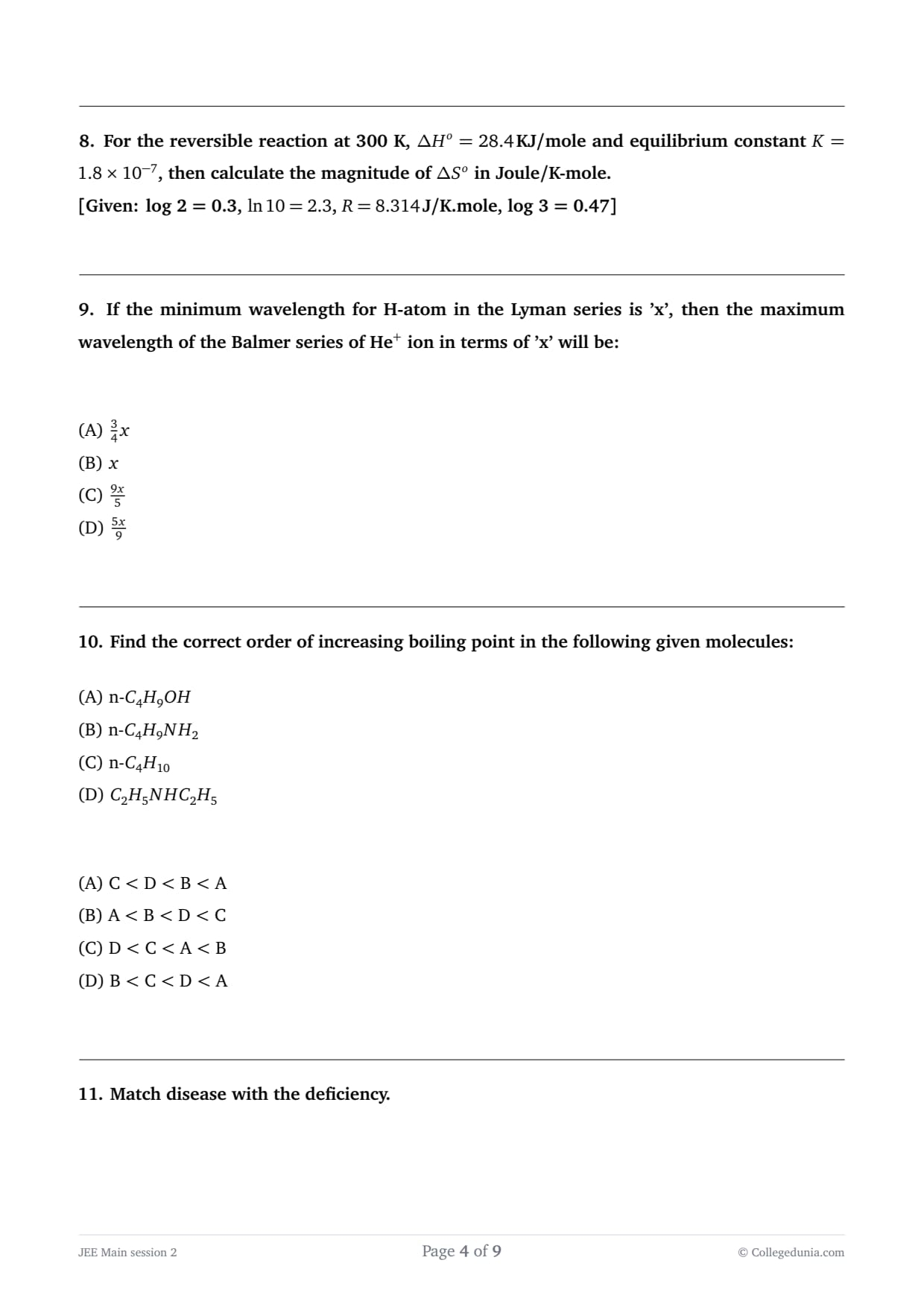
For the reversible reaction at 300 K, \( \Delta H^o = 28.4 \, KJ/mole \) and equilibrium constant \( K = 1.8 \times 10^{-7} \), then calculate the magnitude of \( \Delta S^o \) in Joule/K-mole.
[Given: log 2 = 0.3, \( \ln 10 = 2.3 \), \( R = 8.314 \, J/K.mole \), log 3 = 0.47]
If the minimum wavelength for H-atom in the Lyman series is 'x', then the maximum wavelength of the Balmer series of He\(^+\) ion in terms of 'x' will be:
Find the correct order of increasing boiling point in the following given molecules:
(A) n-\( C_4 H_9 OH \)
(B) n-\( C_4 H_9 NH_2 \)
(C) n-\( C_4 H_{10} \)
(D) \( C_2 H_5 NH C_2 H_5 \)
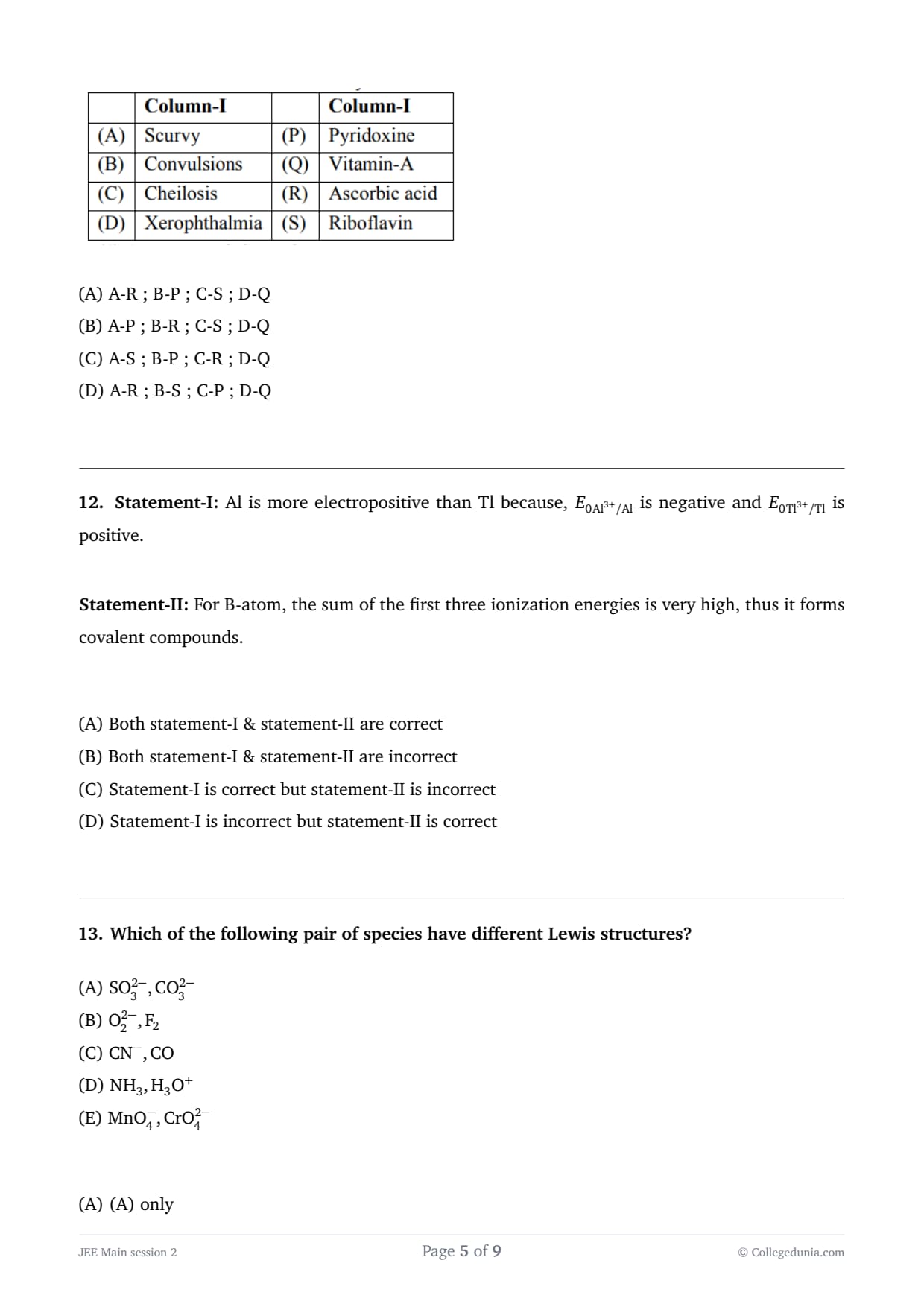
Match disease with the deficiency.

Statement-I: Al is more electropositive than Tl because, \( E_0 \text{Al}^{3+}/\text{Al} \) is negative and \( E_0 \text{Tl}^{3+}/\text{Tl} \) is positive.
Statement-II: For B-atom; sum of first three ionization energies is very high, thus it forms covalent compounds.
Which of the following pair of species have different Lewis structures?
(A) \( \mathrm{SO_3^{2-}, CO_3^{2-}} \)
(B) \( \mathrm{O_2^{2-}, F_2} \)
(C) \( \mathrm{CN^- , CO} \)
(D) \( \mathrm{NH_3, H_3O^+} \)
(E) \( \mathrm{MnO_4^- , CrO_4^{2-}} \)
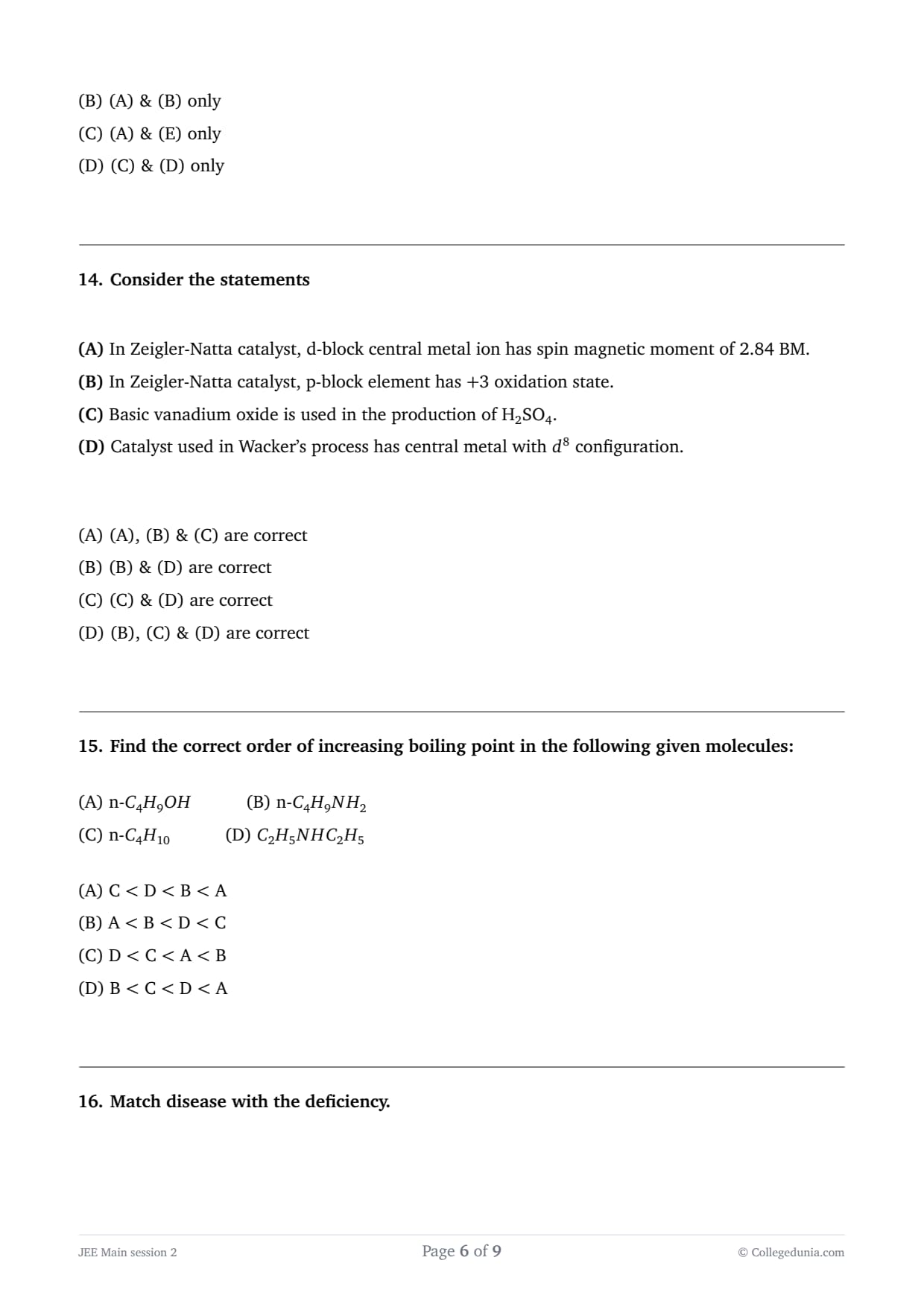
Consider the statements
(A) In Zeigler-Natta catalyst, d-block central metal ion has spin magnetic moment of 2.84 BM.
(B) In Zeigler-Natta catalyst, p-block element has +3 oxidation state.
(C) Basic vanadium oxide is used in the production of \( H_2SO_4 \).
(D) Catalyst used in Wacker's process has central metal with \(d^8\) configuration.
Find the correct order of increasing boiling point in the following given molecules:
(A) n-\( C_4 H_9 OH \) \hspace{1cm (B) n-\( C_4 H_9 NH_2 \)
(C) n-\( C_4 H_{10} \) \hspace{1cm (D) \( C_2 H_5 NH C_2 H_5 \)
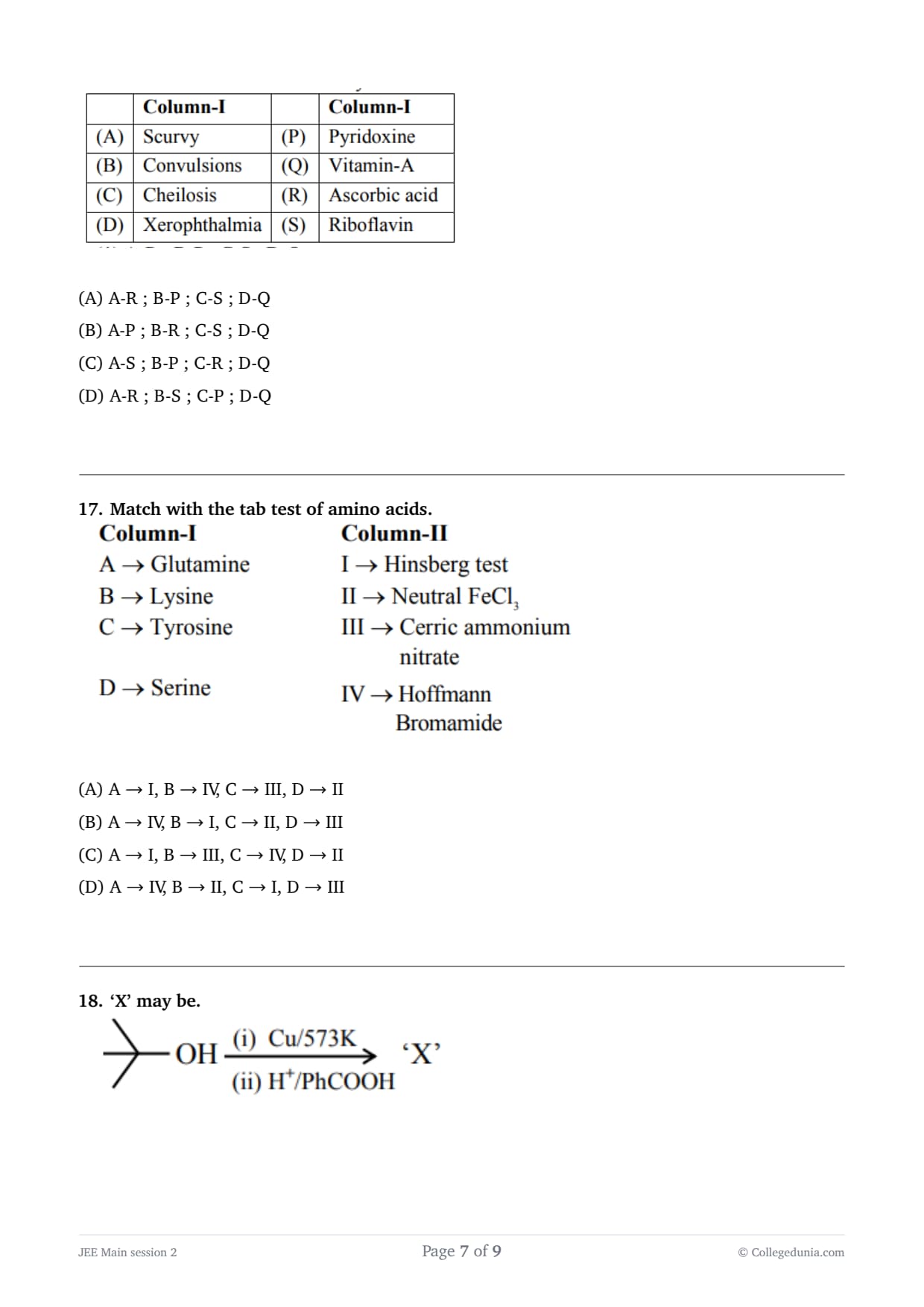
Match disease with the deficiency.

Match with the tab test of amino acids.

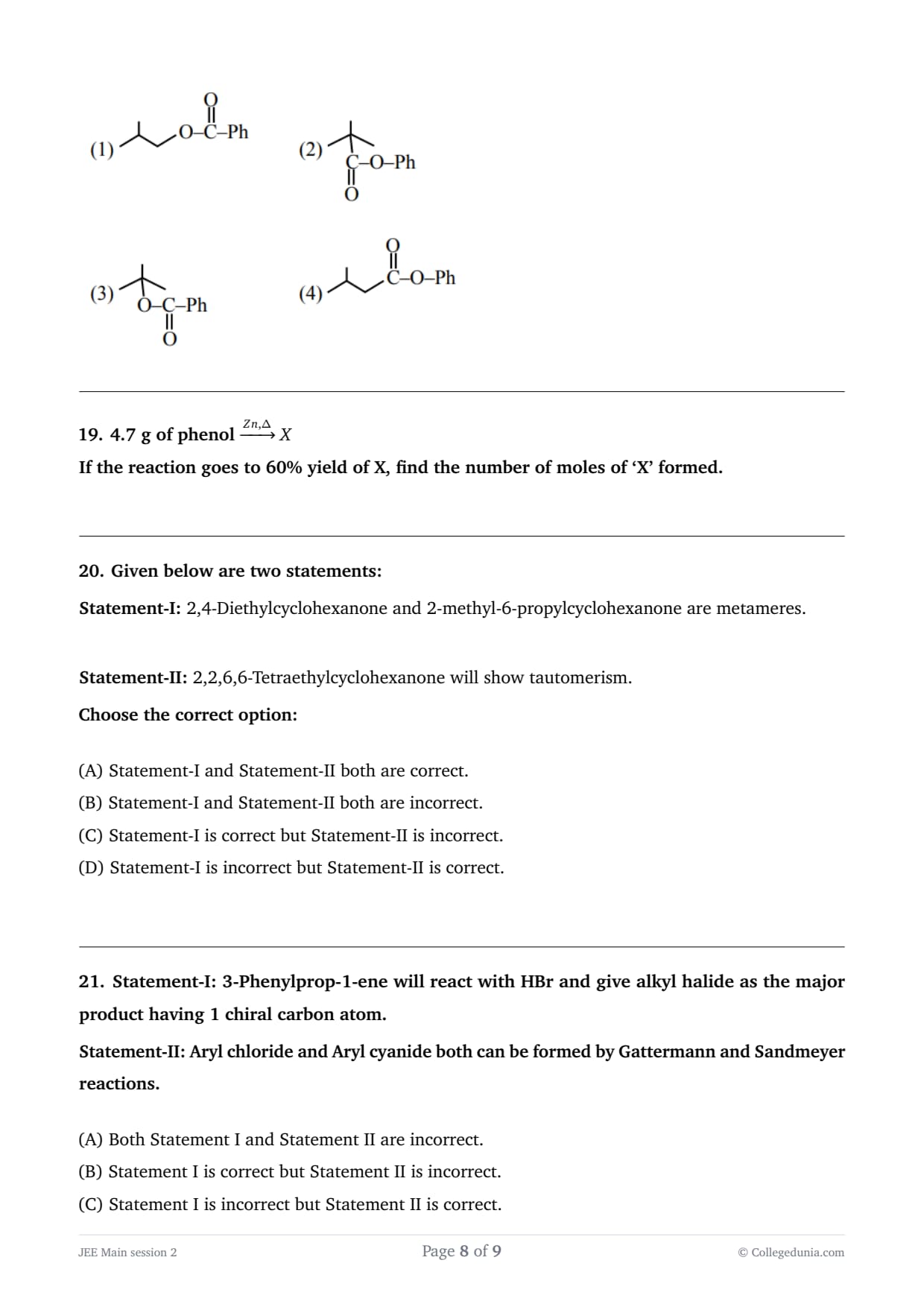
‘X’ may be.


4.7 g of phenol \( \xrightarrow{Zn,\Delta} X \)
If the reaction goes to 60% yield of X, find the number of moles of ‘X’ formed.
Given below are two statements:
Statement-I: 2,4-Diethylcyclohexanone and 2-methyl-6-propylcyclohexanone are metameres.
Statement-II: 2,2,6,6-Tetraethylcyclohexanone will show tautomerism.
Choose the correct option:
Statement-I: 3-Phenylprop-1-ene will react with HBr and give alkyl halide as the major product having 1 chiral carbon atom.
Statement-II: Aryl chloride and Aryl cyanide both can be formed by Gattermann and Sandmeyer reactions.

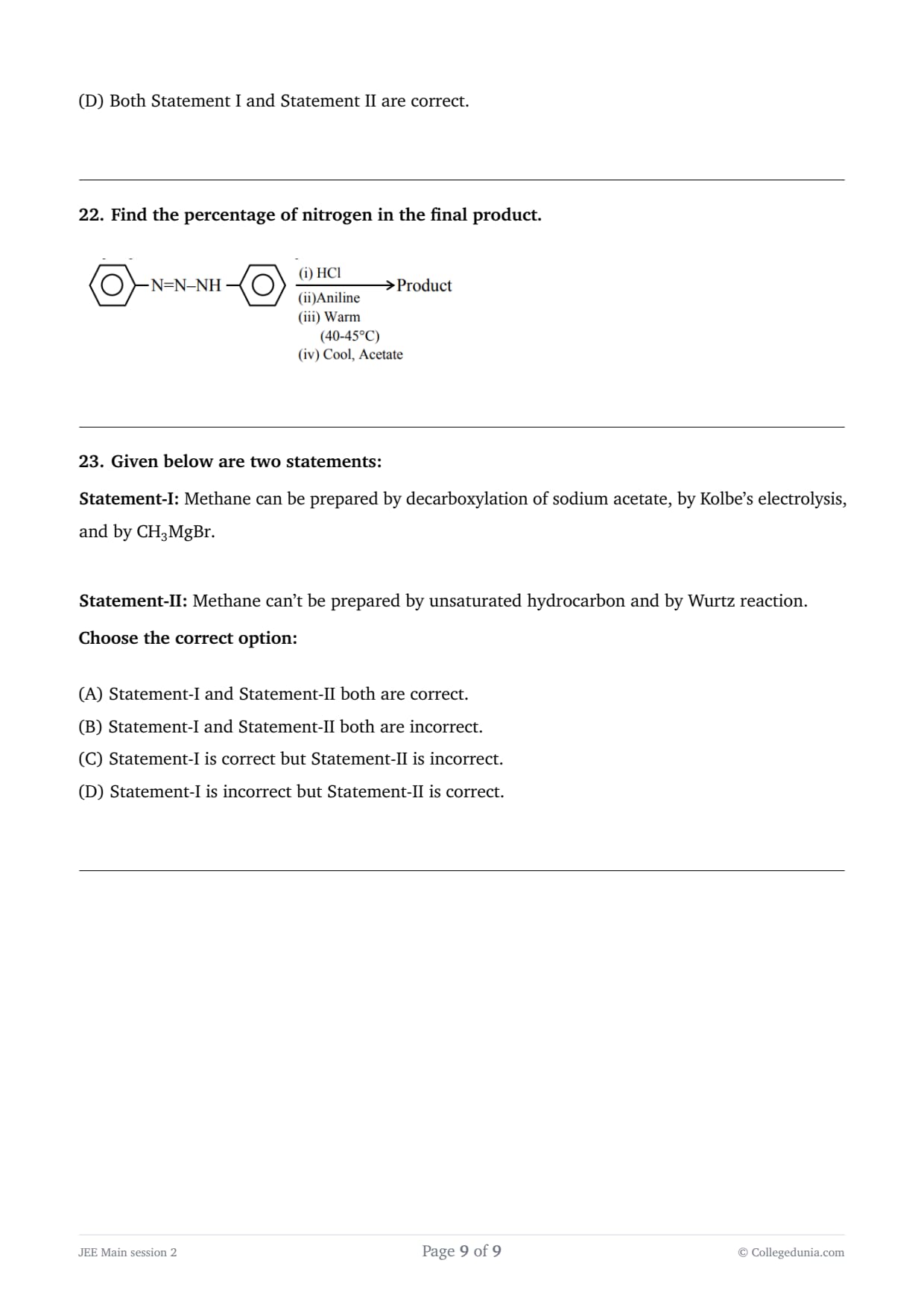
Given below are two statements:
Statement-I: Methane can be prepared by decarboxylation of sodium acetate, by Kolbe’s electrolysis, and by \( CH_3MgBr \).
Statement-II: Methane can’t be prepared by unsaturated hydrocarbon and by Wurtz reaction.
Choose the correct option:
JEE Main 2026 Chemistry Exam Pattern
| Particulars | Details |
|---|---|
| Exam Mode | Online (Computer-Based Test) |
| Paper | B.E./B.Tech |
| Medium of Exam | 13 languages: English, Hindi, Gujarati, Bengali, Tamil, Telugu, Kannada, Marathi, Malayalam, Odia, Punjabi, Assamese, Urdu |
| Type of Questions | Multiple Choice Questions (MCQs) + Numerical Value Questions |
| Total Marks | 100 marks |
| Marking Scheme | +4 for correct answer & -1 for incorrect MCQ and Numerical Value-based Questions |
| Total Questions | 25 Questions |




Comments