




JEE Main 2026 April 6 Shift 2 mathematics question paper is available here with answer key and solutions. NTA conducted the second shift of the day on April 6, 2026, from 3:00 PM to 6:00 PM.
- The JEE Main Mathematics Question Paper contains a total of 25 questions.
- Each correct answer gets you 4 marks while incorrect answers gets you a negative mark of 1.
Candidates can download the JEE Main 2026 April 6 Shift 2 mathematics question paper along with detailed solutions to analyze their performance and understand the exam pattern better.
JEE Main 2026 April 6 Shift 2 Mathematics Question Paper with Solution PDF

Also Check:



Let \((n^2 - 2n + 2)x^2 - 3x + (n^2 - 2n + 2)^2 = 0\) be a quadratic equation. If \(\alpha\) is the minimum value of product of roots and \(\beta\) is the maximum value of sum of roots, then the sum of first six terms of geometric progression whose first term is \(\alpha\) and common ratio is \(\left(\frac{\alpha}{\beta}\right)\), is
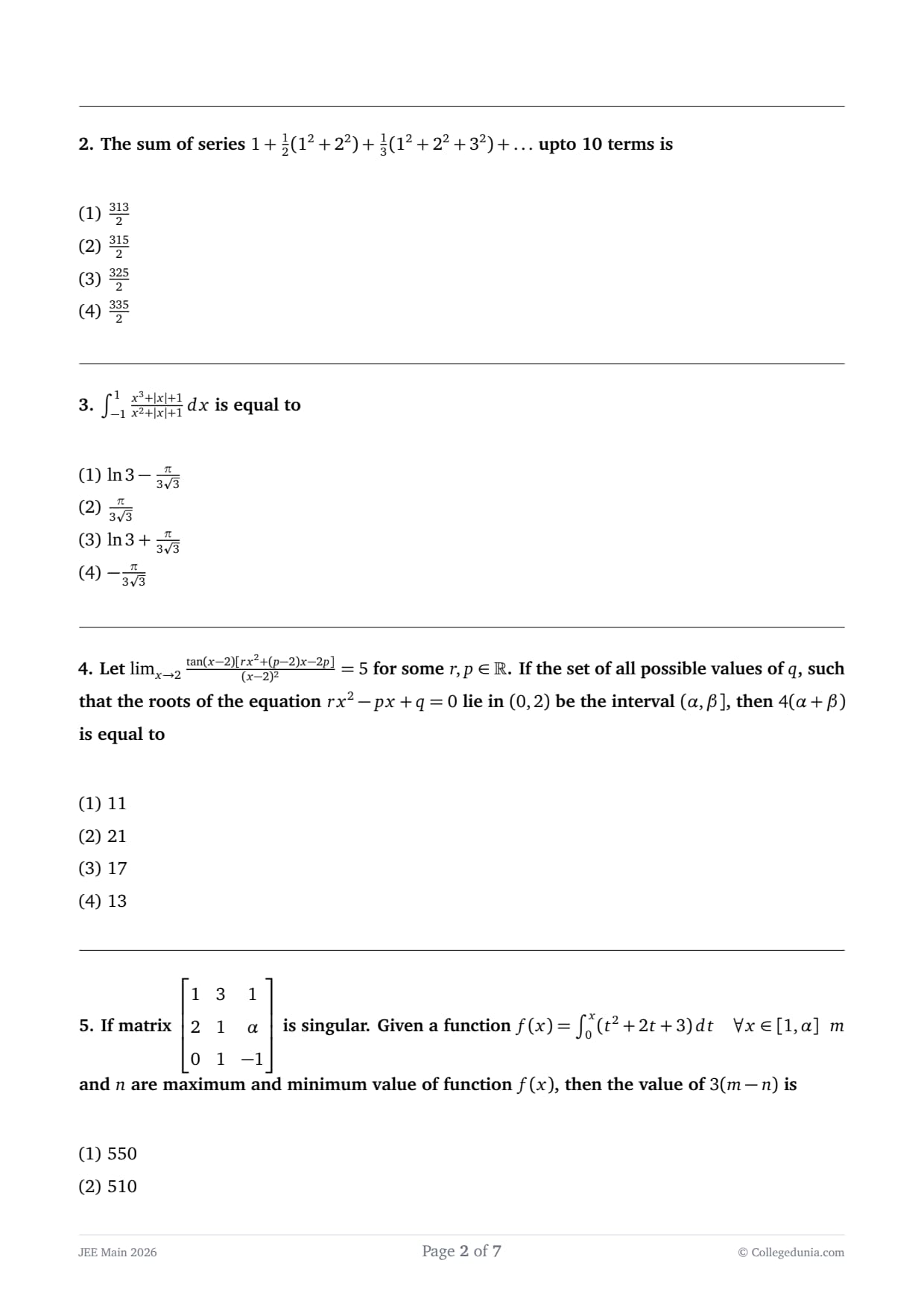
The sum of series \(1 + \frac{1}{2}(1^2 + 2^2) + \frac{1}{3}(1^2 + 2^2 + 3^2) + \dots\) upto 10 terms is
\(\int_{-1}^{1} \frac{x^3 + |x| + 1}{x^2 + |x| + 1} \, dx\) is equal to
Let \(\lim_{x \to 2} \frac{\tan(x-2)[rx^2 + (p-2)x - 2p]}{(x-2)^2} = 5\) for some \(r, p \in \mathbb{R}\). If the set of all possible values of \(q\), such that the roots of the equation \(rx^2 - px + q = 0\) lie in \((0, 2)\) be the interval \((\alpha, \beta]\), then \(4(\alpha + \beta)\) is equal to
If matrix \(\begin{bmatrix} 1 & 3 & 1
2 & 1 & \alpha
0 & 1 & -1 \end{bmatrix}\) is singular. Given a function \(f(x) = \int_{0}^{x} (t^2 + 2t + 3) \, dt \quad \forall x \in [1, \alpha]\) & \(m\) and \(n\) are maximum and minimum value of function \(f(x)\), then the value of \(3(m - n)\) is
Let \(x = 9\) be a directrix of an ellipse centred at \((0, 0)\) and having eccentricity \(\frac{1}{3}\). If focus at \((\alpha, 0)\) (\(\alpha > 0\)), then locus of the mid-point of the chord passing through the focus \((\alpha, 0)\) is
The value of \(x\) which satisfies the equation \(\sin^{-1}\left(\frac{2}{3}\sqrt{1-x^2}\right) = \cot^{-1}(2\sqrt{x})\), is
Let \(f: \mathbb{R} \to \mathbb{R}\), \(f(x) = \frac{2x^2 - 3x + 2}{3x^2 + x + 3}\), then \(f(x)\) is
An ellipse has directrix \(x = 9\) & eccentricity \(= \frac{1}{3}\). If one of its focus is \((\alpha,0)\), \(\alpha > 0\), then locus of the mid-point of the chord passing through \(P(\alpha,0)\) is
A lift of a 10 floor building contains 9 persons and group of 4 and 5 leave the lift on different floor and there is no stoppage of lift at 1st and 2nd floor, then find number of ways this can be done.
Let \(R\) be a relation such that \(R = \{ (x,y) \in \mathbb{N} \times \mathbb{N} \mid x+y \le 7 \}\). Minimum no. of elements to be added in \(R\) so that it becomes transitive is:
The shortest distance between the lines \(\frac{x-3}{-1} = \frac{y-2}{4} = \frac{z-1}{2}\) and \(\frac{x-1}{2} = \frac{y-1}{1} = \frac{z-2}{5}\) is:
A bag contains 6 Red and 6 black balls. 6 pair of balls are selected one by one without replacement then the probability that each of the 6 pairs contains 1 red and 1 black ball.
The area (in square units) of the region \(\{(x, y) : x^2 - 8x \le y \le -x\}\), is
If system of equations \(x \cos \theta - 8y - 12z = 0\), \(x \cos 2\theta + y + 3z = 0\), \(x + y + 3z = 0\) has non-trivial solution, then find sum of values of \(\theta\) (where \(\theta \in [0, 2\pi]\)).
Let \(\vec{a} = 2\hat{i} + 3\hat{j} + 3\hat{k}\), \(\vec{b} = 6\hat{i} + 3\hat{j} + 3\hat{k}\). If \(2\vec{a} + 3\vec{b}\) and \(\vec{a} - \vec{b}\) are two adjacent sides of a triangle then square of area of the triangle is
Consider the observations: 2, 4, \(\alpha\), \(\beta\), 6, 12, 14. If their mean is 8 and variance = 16, then the quadratic equation whose roots are \(3\alpha + 2\) and \(2\beta + 1\), is
Let a hyperbola be \(\frac{x^2}{a^2} - \frac{y^2}{b^2} = 1\) and ellipse be \(\frac{x^2}{9} + \frac{y^2}{8} = 1\). If length of latus rectum of hyperbola is equal to minor axis of ellipse and eccentricity of hyperbola is equal to semi-major axis of ellipse, then \(2ae\) is equal to (where 'e' is the eccentricity of hyperbola)
Let \(f(x+y) = f(x) f(y)\), \(f(0) \neq 0\). If \(x^2 g(x) = \int_0^x (t^2 f(t) + t g(t)) \, dt\), then \(g(2)\) is equal to
Let \(A = \begin{bmatrix} 1 & 0 & 0
3 & 1 & 0
9 & 3 & 1 \end{bmatrix}\). If \(B = [b_{ij}]_{3 \times 3}\) and \(B = A^{99} - I\), then find \(\frac{b_{31} - b_{21}}{b_{32}}\).
If \((1-x)^{10} = \sum_{r=0}^{10} a_r x^r (1-x)^{30-2r}\), then find \(\frac{9a_9}{a_{10}}\).
If \(\alpha\) and \(\beta\) are the roots of the equation \(z^2 - \sqrt{6}i z - 3 = 0\), then find \(\alpha^8 + \beta^8\).
The line \(x - y = 4\) is a chord of the circle \((x - 4)^2 + (y + 3)^2 = 9\), which cuts the circle at points Q \& R. If \(P(\alpha, \beta)\) lies on the circle such that \(PQ = PR\), then find \((6\alpha + 8\beta)^2\).
Let \(f(x) = \begin{cases} x^3 + 8 & x < 0
x^2 - 4 & x \ge 0 \end{cases}\) and \(g(x) = \begin{cases} (x-8)^{1/3} & x < 0
(x+4)^{1/2} & x \ge 0 \end{cases}\) then find number of points of discontinuity of \(g(f(x))\).
JEE Main 2026 Mathematics Exam Pattern
| Particulars | Details |
|---|---|
| Exam Mode | Online (Computer-Based Test) |
| Paper | B.E./B.Tech |
| Medium of Exam | 13 languages: English, Hindi, Gujarati, Bengali, Tamil, Telugu, Kannada, Marathi, Malayalam, Odia, Punjabi, Assamese, Urdu |
| Type of Questions | Multiple Choice Questions (MCQs) + Numerical Value Questions |
| Total Marks | 100 marks |
| Marking Scheme | +4 for correct answer & -1 for incorrect MCQ and Numerical Value-based Questions |
| Total Questions | 25 Questions |



Comments