




JEE Main 2026 April 8 Shift 2 mathematics question paper is available here with answer key and solutions. NTA conducted the second shift of the day on April 8, 2026, from 3:00 PM to 6:00 PM.
- The JEE Main Mathematics Question Paper contains a total of 25 questions.
- Each correct answer gets you 4 marks while incorrect answers gets you a negative mark of 1.
Candidates can download the JEE Main 2026 April 8 Shift 2 mathematics question paper along with detailed solutions to analyze their performance and understand the exam pattern better.
JEE Main 2026 April 8 Shift 2 Mathematics Question Paper with Solution PDF
Also Check:
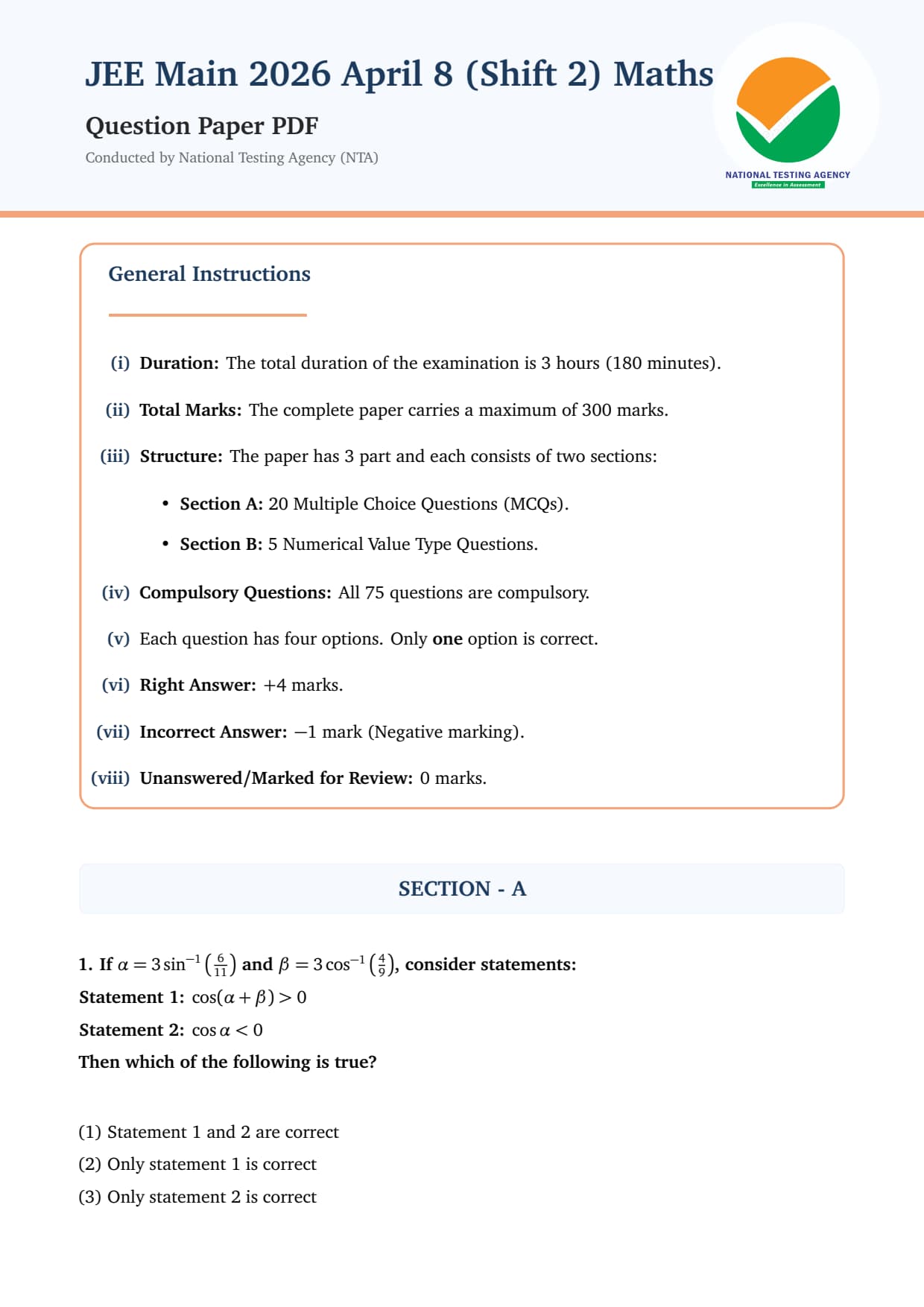
If \(\alpha = 3\sin^{-1}\left(\frac{6}{11}\right)\) and \(\beta = 3\cos^{-1}\left(\frac{4}{9}\right)\), consider statements:
Statement 1: \(\cos(\alpha + \beta) > 0\)
Statement 2: \(\cos\alpha < 0\)
Then which of the following is true?
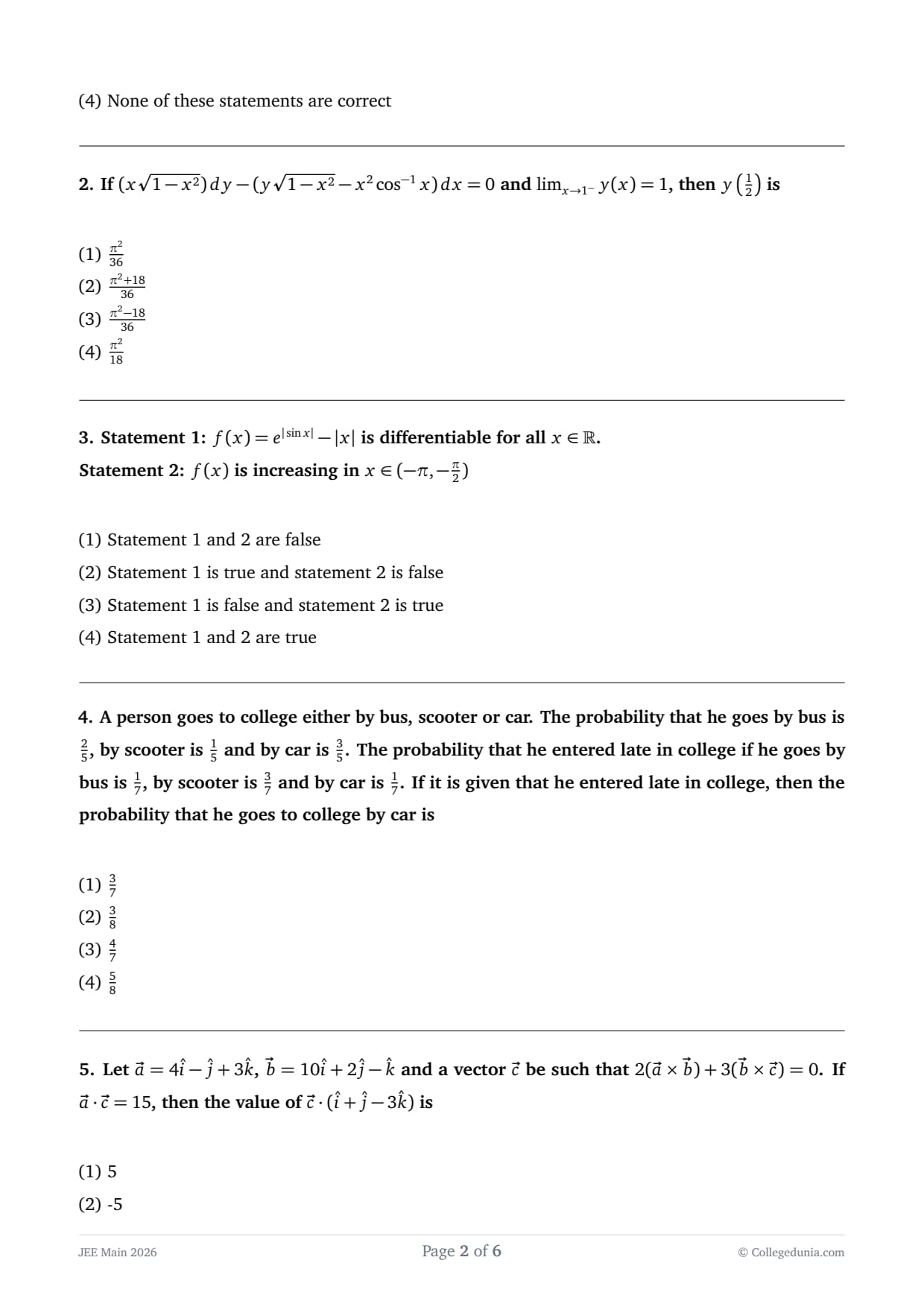
If \((x\sqrt{1-x^2}) \, dy - (y\sqrt{1-x^2} - x^2 \cos^{-1} x) \, dx = 0\) and \(\lim_{x \to 1^-} y(x) = 1\), then \(y\left(\frac{1}{2}\right)\) is
Statement 1: \(f(x) = e^{|\sin x|} - |x|\) is differentiable for all \(x \in \mathbb{R}\).
Statement 2: \(f(x)\) is increasing in \(x \in (-\pi, -\frac{\pi}{2})\)
A person goes to college either by bus, scooter or car. The probability that he goes by bus is \(\frac{2}{5}\), by scooter is \(\frac{1}{5}\) and by car is \(\frac{3}{5}\). The probability that he entered late in college if he goes by bus is \(\frac{1}{7}\), by scooter is \(\frac{3}{7}\) and by car is \(\frac{1}{7}\). If it is given that he entered late in college, then the probability that he goes to college by car is
Let \(\vec{a} = 4\hat{i} - \hat{j} + 3\hat{k}\), \(\vec{b} = 10\hat{i} + 2\hat{j} - \hat{k}\) and a vector \(\vec{c}\) be such that \(2(\vec{a} \times \vec{b}) + 3(\vec{b} \times \vec{c}) = 0\). If \(\vec{a} \cdot \vec{c} = 15\), then the value of \(\vec{c} \cdot (\hat{i} + \hat{j} - 3\hat{k})\) is
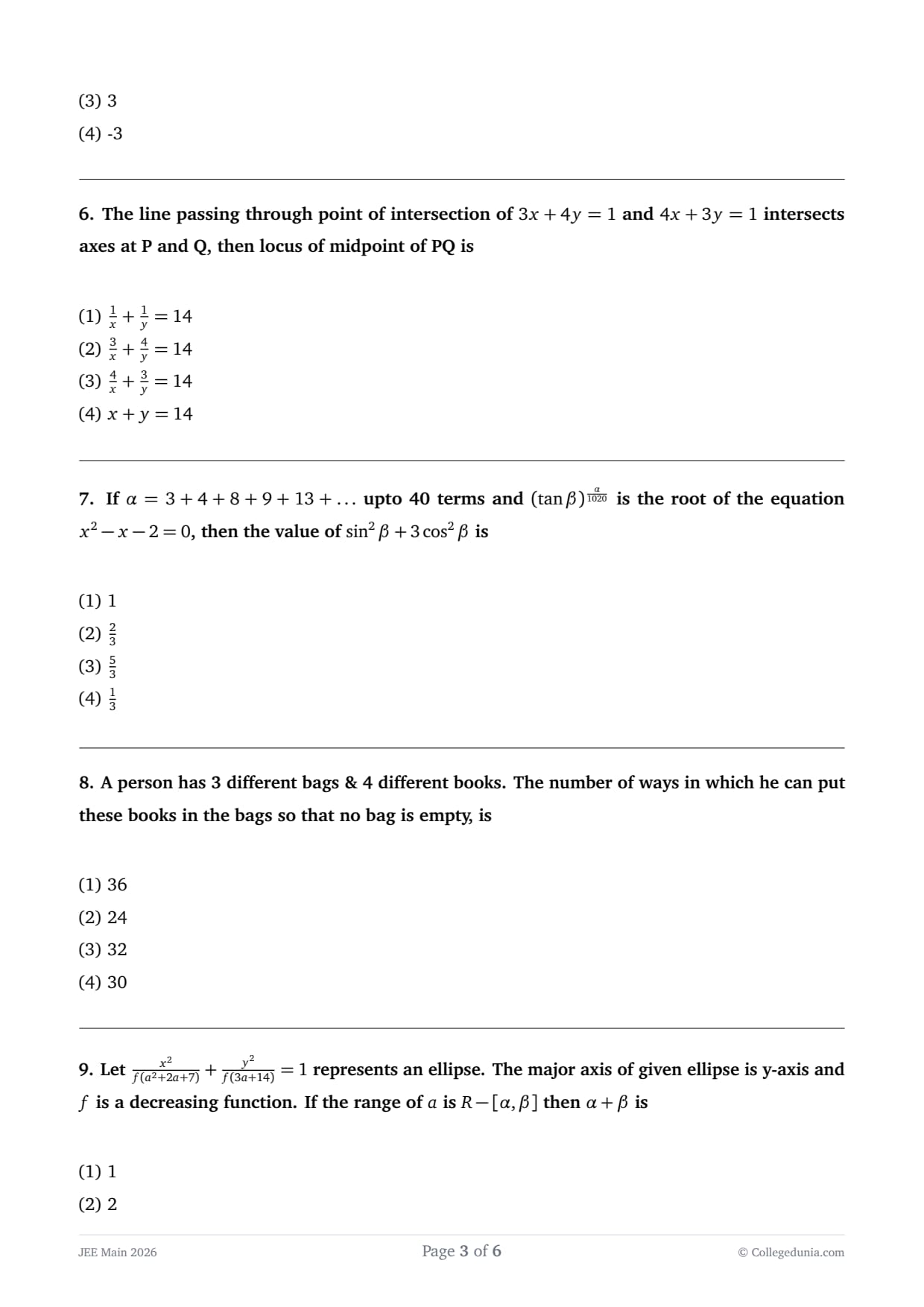
The line passing through point of intersection of \(3x + 4y = 1\) and \(4x + 3y = 1\) intersects axes at P and Q, then locus of midpoint of PQ is
If \(\alpha = 3 + 4 + 8 + 9 + 13 + \dots\) upto 40 terms and \((\tan \beta)^{\frac{\alpha}{1020}}\) is the root of the equation \(x^2 - x - 2 = 0\), then the value of \(\sin^2 \beta + 3\cos^2 \beta\) is
A person has 3 different bags \& 4 different books. The number of ways in which he can put these books in the bags so that no bag is empty, is
Let \(\frac{x^2}{f(a^2 + 2a + 7)} + \frac{y^2}{f(3a + 14)} = 1\) represents an ellipse. The major axis of given ellipse is y-axis and \(f\) is a decreasing function. If the range of \(a\) is \(R - [\alpha, \beta]\) then \(\alpha + \beta\) is
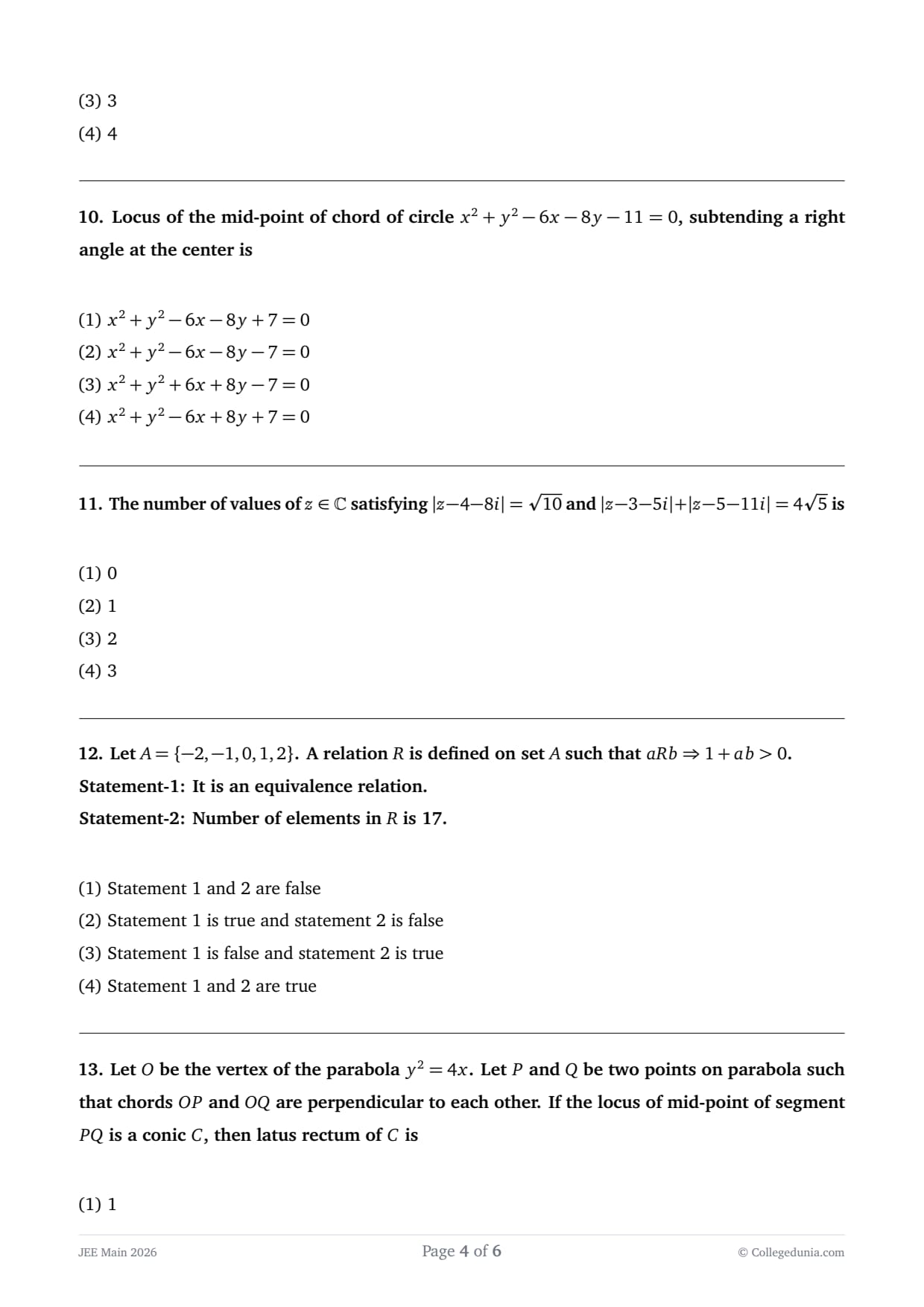
Locus of the mid-point of chord of circle \(x^2 + y^2 - 6x - 8y - 11 = 0\), subtending a right angle at the center is
The number of values of \(z \in \mathbb{C}\) satisfying \(|z-4-8i| = \sqrt{10}\) and \(|z-3-5i| + |z-5-11i| = 4\sqrt{5}\) is
Let \(A = \{-2, -1, 0, 1, 2\}\). A relation \(R\) is defined on set \(A\) such that \(aRb \Rightarrow 1 + ab > 0\).
Statement-1: It is an equivalence relation.
Statement-2: Number of elements in \(R\) is 17.
Let \(O\) be the vertex of the parabola \(y^2 = 4x\). Let \(P\) and \(Q\) be two points on parabola such that chords \(OP\) and \(OQ\) are perpendicular to each other. If the locus of mid-point of segment \(PQ\) is a conic \(C\), then latus rectum of \(C\) is
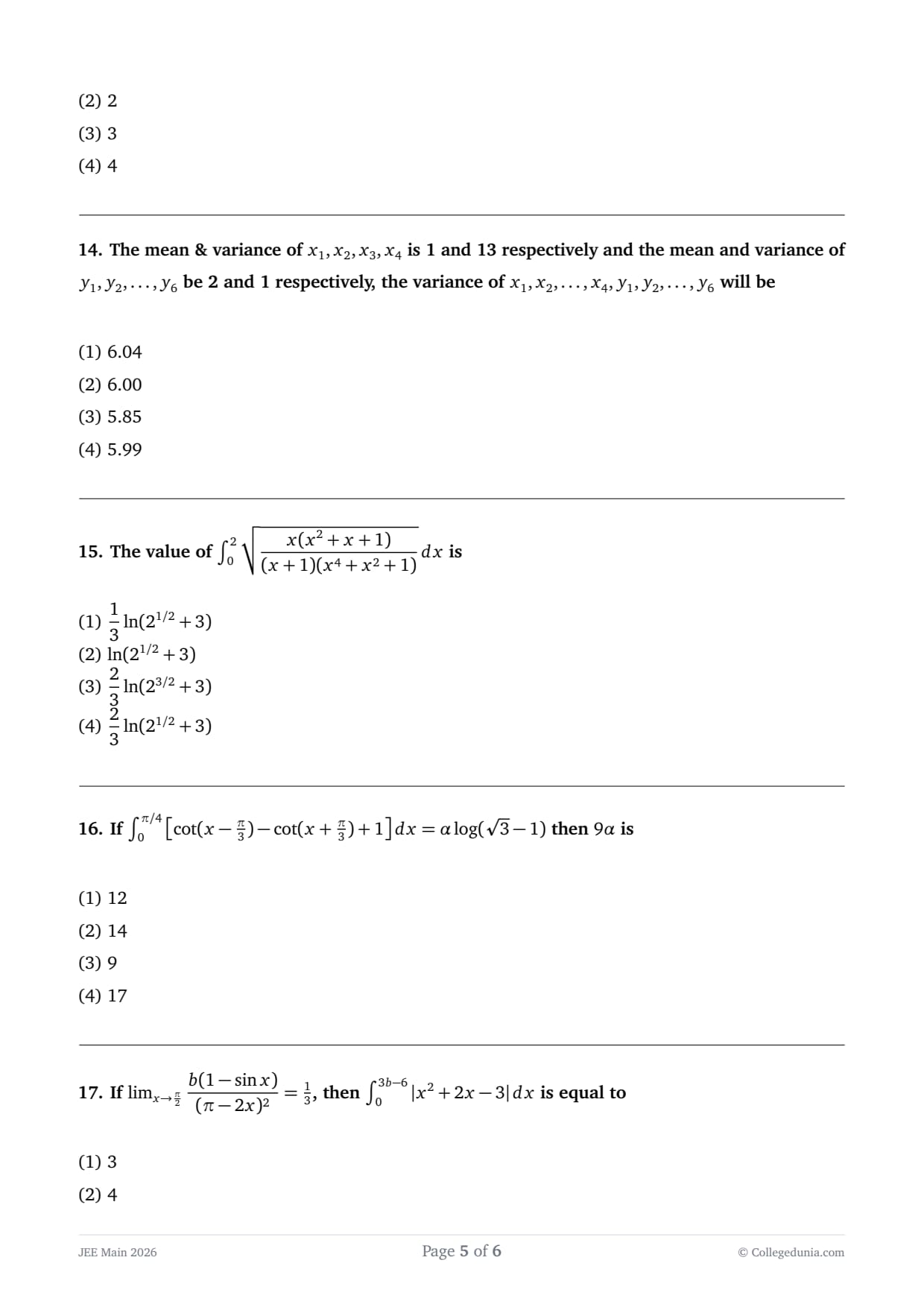
The mean \& variance of \(x_1, x_2, x_3, x_4\) is 1 and 13 respectively and the mean and variance of \(y_1, y_2, \dots, y_6\) be 2 and 1 respectively, the variance of \(x_1, x_2, \dots, x_4, y_1, y_2, \dots, y_6\) will be
The value of \(\int_0^2 \sqrt{\dfrac{x(x^2 + x + 1)}{(x+1)(x^4 + x^2 + 1)}} \, dx\) is
If \(\int_0^{\pi/4} \left[ \cot(x - \frac{\pi}{3}) - \cot(x + \frac{\pi}{3}) + 1 \right] dx = \alpha \log(\sqrt{3} - 1)\) then \(9\alpha\) is
If \(\lim_{x \to \frac{\pi}{2}} \dfrac{b(1 - \sin x)}{(\pi - 2x)^2} = \frac{1}{3}\), then \(\int_0^{3b-6} |x^2 + 2x - 3| \, dx\) is equal to
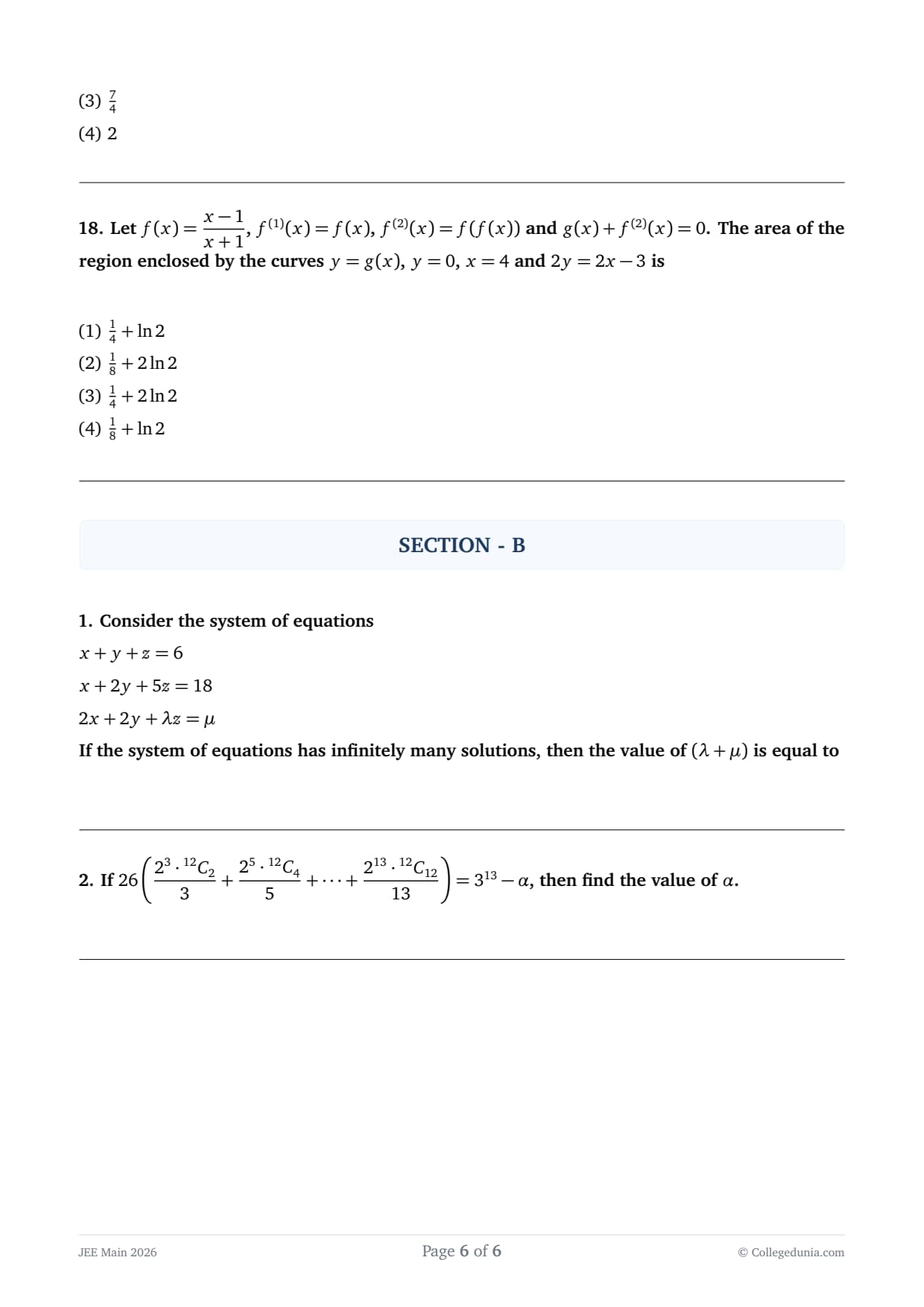
Let \(f(x) = \dfrac{x-1}{x+1}\), \(f^{(1)}(x) = f(x)\), \(f^{(2)}(x) = f(f(x))\) and \(g(x) + f^{(2)}(x) = 0\). The area of the region enclosed by the curves \(y = g(x)\), \(y = 0\), \(x = 4\) and \(2y = 2x - 3\) is
Consider the system of equations
\(x + y + z = 6\)
\(x + 2y + 5z = 18\)
\(2x + 2y + \lambda z = \mu\)
If the system of equations has infinitely many solutions, then the value of \((\lambda + \mu)\) is equal to
If \(26 \left( \dfrac{2^3 \cdot {}^{12}C_2}{3} + \dfrac{2^5 \cdot {}^{12}C_4}{5} + \dots + \dfrac{2^{13} \cdot {}^{12}C_{12}}{13} \right) = 3^{13} - \alpha\), then find the value of \(\alpha\).
JEE Main 2026 Mathematics Exam Pattern
| Particulars | Details |
|---|---|
| Exam Mode | Online (Computer-Based Test) |
| Paper | B.E./B.Tech |
| Medium of Exam | 13 languages: English, Hindi, Gujarati, Bengali, Tamil, Telugu, Kannada, Marathi, Malayalam, Odia, Punjabi, Assamese, Urdu |
| Type of Questions | Multiple Choice Questions (MCQs) + Numerical Value Questions |
| Total Marks | 100 marks |
| Marking Scheme | +4 for correct answer & -1 for incorrect MCQ and Numerical Value-based Questions |
| Total Questions | 25 Questions |



Comments