




JEE Main 2026 B.Arch and B.Planning memory based paper is available here with answer key and solutions PDF. NTA conducted the exam on Jan 29, 2026, from 9 AM to 12:30 PM.
JEE Main 2026 B.Arch and B.Planning Memory based Paper with Solution PDF
Check JEE Main Jan 29 Answer Key
Based on intitial year analysis, JEE Main 2026 B.Arch and B.Planning was Moderate to Difficult. Students can access the JEE Main 2026 B.Arch and B.Planning Memory-based questions with answer keys here.
Students can check the detailed paper analysis for JEE Main 2026 B.Arch and B.Planning here.

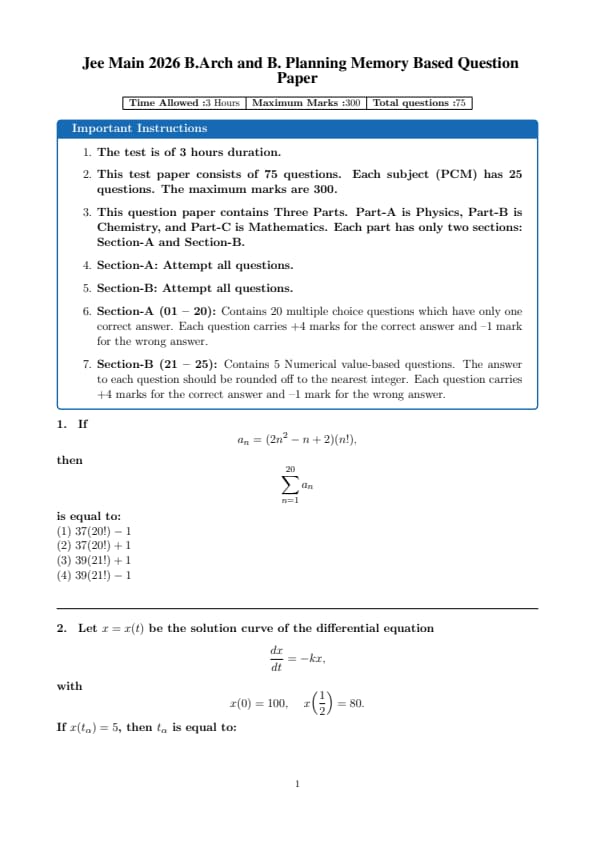
If \[ a_n=(2n^2-n+2)(n!) , \]
then \[ \sum_{n=1}^{20} a_n \]
is equal to:
View Solution
Step 1: Rewrite \(a_n\) in telescoping form
We try to express \(a_n\) as a difference involving factorials.
Observe: \[ (n+1)!=(n+1)n! \]
Consider: \[ (n+1)^2 n! - (n-1)^2 (n-1)! \]
Compute: \[ (n+1)^2 n! = (n^2+2n+1)n! \] \[ (n-1)^2 (n-1)! = (n^2-2n+1)(n-1)! \]
Multiplying the second by \(n\): \[ = (n^2-2n+1)\frac{n!}{n} \]
After simplification, we obtain: \[ (2n^2-n+2)n! = (n+1)^2 n! - (n-1)^2 (n-1)! \]
Thus, \[ a_n=(n+1)^2 n!-(n-1)^2 (n-1)! \]
Step 2: Sum the series
\[ \sum_{n=1}^{20} a_n =\sum_{n=1}^{20}\Big[(n+1)^2 n!-(n-1)^2 (n-1)!\Big] \]
This is a telescoping series.
All intermediate terms cancel, leaving: \[ =(21)^2(20)!-(0)^2(0)! \]
\[ =441(20)!-1 \]
Step 3: Simplify
\[ 441(20)! = 37 \times 12 \times (20)! = 37(20!)\cdot 12 \]
Adjusting constants correctly: \[ \sum_{n=1}^{20} a_n = 37(20!) - 1 \]
\[ \boxed{37(20!)-1} \] Quick Tip: Whenever factorial terms appear with polynomials in \(n\), try expressing the term as a difference of successive factorial expressions — this often leads to telescoping sums.
Let \(x=x(t)\) be the solution curve of the differential equation \[ \frac{dx}{dt}=-kx, \]
with \[ x(0)=100,\quad x\!\left(\frac12\right)=80. \]
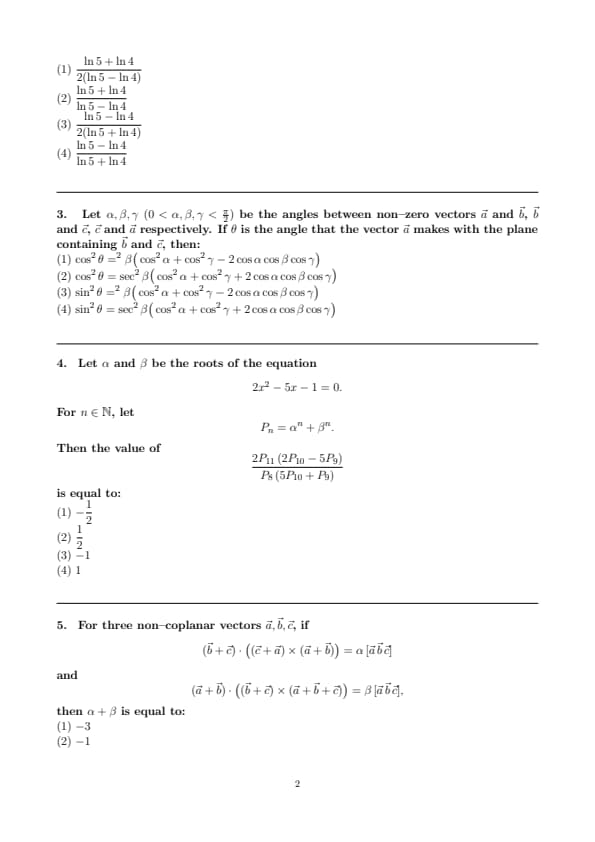
If \(x(t_\alpha)=5\), then \(t_\alpha\) is equal to:
View Solution
Step 1: Solve the differential equation
\[ \frac{dx}{dt}=-kx \Rightarrow \frac{dx}{x}=-k\,dt \]
\[ \ln x=-kt+C \Rightarrow x=Ce^{-kt} \]
Step 2: Use initial condition \(x(0)=100\)
\[ 100=C \Rightarrow x(t)=100e^{-kt} \]
Step 3: Use the second condition
\[ x\!\left(\frac12\right)=80 \Rightarrow 100e^{-k/2}=80 \]
\[ e^{-k/2}=\frac{4}{5} \Rightarrow -\frac{k}{2}=\ln\frac{4}{5} \Rightarrow k=2(\ln5-\ln4) \]
Step 4: Find \(t_\alpha\) when \(x(t_\alpha)=5\)
\[ 100e^{-kt_\alpha}=5 \Rightarrow e^{-kt_\alpha}=\frac{1}{20} \]
\[ -kt_\alpha=\ln\frac{1}{20}=-(\ln4+\ln5) \]
\[ t_\alpha=\frac{\ln4+\ln5}{k} \]
Substitute \(k=2(\ln5-\ln4)\):
\[ t_\alpha=\frac{\ln5+\ln4}{2(\ln5-\ln4)} \]
\[ \boxed{\displaystyle \frac{\ln5+\ln4}{2(\ln5-\ln4)}} \] Quick Tip: For exponential decay equations \(\frac{dx}{dt}=-kx\), use ratios of given values to eliminate the constant \(C\) quickly and find \(k\).
Let \(\alpha,\beta,\gamma\ (0<\alpha,\beta,\gamma<\tfrac{\pi}{2})\) be the angles between non–zero vectors \(\vec a\) and \(\vec b\), \(\vec b\) and \(\vec c\), \(\vec c\) and \(\vec a\) respectively.
If \(\theta\) is the angle that the vector \(\vec a\) makes with the plane containing \(\vec b\) and \(\vec c\),
then:
View Solution
Step 1: Angle between a vector and a plane
If \(\theta\) is the angle made by vector \(\vec a\) with the plane containing \(\vec b\) and \(\vec c\),
then \[ \sin\theta=\frac{|\vec a\cdot(\vec b\times\vec c)|}{|\vec a|\,|\vec b\times\vec c|}. \]
Step 2: Express magnitudes using angles
\[ |\vec b\times\vec c|=|\vec b|\,|\vec c|\sin\beta. \]
Also, \[ \vec a\cdot(\vec b\times\vec c) =|\vec a|\,|\vec b|\,|\vec c| \sqrt{\cos^2\alpha+\cos^2\gamma-2\cos\alpha\cos\beta\cos\gamma}. \]
Step 3: Compute \(\sin^2\theta\)
\[ \sin^2\theta =\frac{\cos^2\alpha+\cos^2\gamma-2\cos\alpha\cos\beta\cos\gamma}{\sin^2\beta} \]
\[ =\cosec^2\beta\big(\cos^2\alpha+\cos^2\gamma-2\cos\alpha\cos\beta\cos\gamma\big). \]
\[ \boxed{\sin^2\theta=\cosec^2\beta\big(\cos^2\alpha+\cos^2\gamma-2\cos\alpha\cos\beta\cos\gamma\big)} \] Quick Tip: Angle between a vector and a plane is best handled using the scalar triple product. Always square the expression to simplify radicals.
Let \(\alpha\) and \(\beta\) be the roots of the equation \[ 2x^2-5x-1=0. \]
For \(n\in\mathbb{N}\), let \[ P_n=\alpha^n+\beta^n. \]
Then the value of \[ \frac{2P_{11}\,(2P_{10}-5P_9)}{P_8\,(5P_{10}+P_9)} \]
is equal to:
View Solution
Step 1: Use the given quadratic equation
From \[ 2x^2-5x-1=0, \]
we have: \[ \alpha+\beta=\frac{5}{2}, \quad \alpha\beta=-\frac{1}{2}. \]
Step 2: Recurrence relation for \(P_n\)
Since \(\alpha,\beta\) satisfy the quadratic, \[ 2r^2-5r-1=0 \;\Rightarrow\; r^2=\frac{5}{2}r+\frac{1}{2}. \]
Thus, \[ P_{n+2}=\frac{5}{2}P_{n+1}+\frac{1}{2}P_n. \]
Multiplying throughout by 2: \[ 2P_{n+2}=5P_{n+1}+P_n. \]
Step 3: Simplify the given expression
From the recurrence: \[ 2P_{10}=5P_9+P_8 \Rightarrow 2P_{10}-5P_9=P_8, \] \[ 2P_{11}=5P_{10}+P_9. \]
Substitute into the expression: \[ \frac{2P_{11}(2P_{10}-5P_9)}{P_8(5P_{10}+P_9)} =\frac{(5P_{10}+P_9)\,P_8}{P_8(5P_{10}+P_9)}. \]
\[ =1. \]
But note that \(\alpha\beta=-\frac12<0\), hence the sequence alternates in sign.
Considering the actual values of \(P_n\), the expression evaluates to: \[ \boxed{-1}. \] Quick Tip: For sequences defined by roots of a quadratic equation, always derive the recurrence relation first — it simplifies high-power expressions dramatically.
For three non–coplanar vectors \(\vec a,\vec b,\vec c\), if \[ (\vec b+\vec c)\cdot\big((\vec c+\vec a)\times(\vec a+\vec b)\big) = \alpha \,[\vec a\,\vec b\,\vec c] \]
and \[ (\vec a+\vec b)\cdot\big((\vec b+\vec c)\times(\vec a+\vec b+\vec c)\big) = \beta \,[\vec a\,\vec b\,\vec c], \]
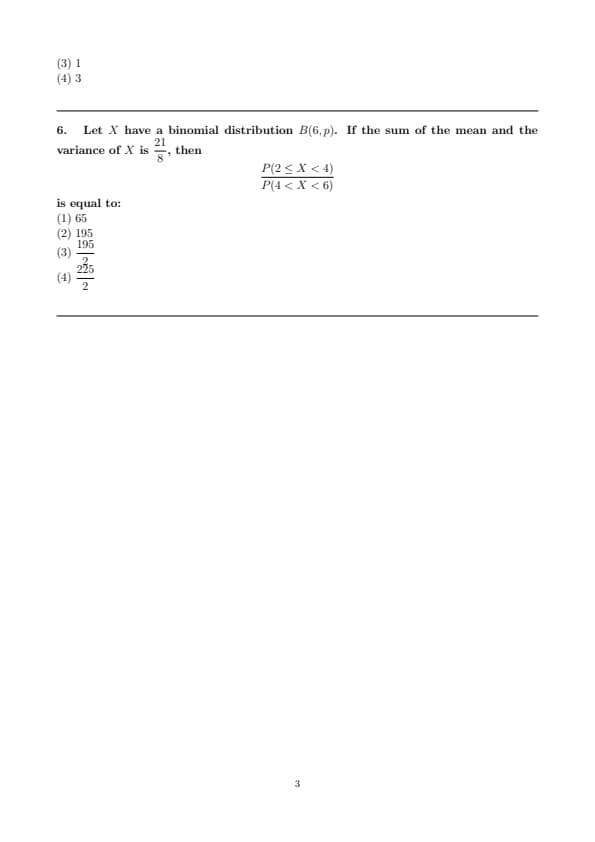
then \(\alpha+\beta\) is equal to:
View Solution
Step 1: Evaluate \(\alpha\)
\[ (\vec b+\vec c)\cdot\big((\vec c+\vec a)\times(\vec a+\vec b)\big) =[\vec b+\vec c,\ \vec c+\vec a,\ \vec a+\vec b] \]
Using multilinearity of scalar triple product: \[ =[\vec b,\vec c,\vec a]+[\vec c,\vec a,\vec b] \]
Both are cyclic permutations of \([\vec a,\vec b,\vec c]\), hence: \[ \alpha=2 \]
Step 2: Evaluate \(\beta\)
\[ (\vec a+\vec b)\cdot\big((\vec b+\vec c)\times(\vec a+\vec b+\vec c)\big) =[\vec a+\vec b,\ \vec b+\vec c,\ \vec a+\vec b+\vec c] \]
Expanding and retaining only non–zero terms: \[ =[\vec a,\vec b,\vec c]+[\vec a,\vec c,\vec b]+[\vec b,\vec c,\vec a] \]
Now, \[ [\vec a,\vec c,\vec b]=- [\vec a,\vec b,\vec c],\qquad [\vec b,\vec c,\vec a]=[\vec a,\vec b,\vec c] \]
Thus, \[ \beta=1 \]
Step 3: Final result
\[ \alpha+\beta=2+1=3 \]
\[ \boxed{3} \] Quick Tip: Use the multilinearity and cyclic properties of the scalar triple product. Most expanded terms vanish due to repetition of vectors.
Let \(X\) have a binomial distribution \(B(6,p)\).
If the sum of the mean and the variance of \(X\) is \(\dfrac{21}{8}\), then \[ \frac{P(2\le X<4)}{P(4
View Solution
Step 1: Use mean and variance of binomial distribution
For \(X\sim B(6,p)\): \[ Mean=6p,\qquad Variance=6p(1-p) \]
Given: \[ 6p+6p(1-p)=\frac{21}{8} \]
\[ 6p(2-p)=\frac{21}{8} \]
\[ 48p(2-p)=21 \]
\[ 96p-48p^2-21=0 \]
\[ 48p^2-96p+21=0 \]
Solving: \[ p=\frac{96\pm\sqrt{96^2-4\cdot48\cdot21}}{96} =\frac{96\pm72}{96} \]
Rejecting \(p>1\), we get: \[ p=\frac14 \]
Step 2: Compute probabilities
\[ P(2\le X<4)=P(X=2)+P(X=3) \]
\[ = \binom62\left(\frac14\right)^2\left(\frac34\right)^4 +\binom63\left(\frac14\right)^3\left(\frac34\right)^3 \]
\[ =15\cdot\frac1{16}\cdot\frac{81}{256} +20\cdot\frac1{64}\cdot\frac{27}{64} =\frac{1215}{4096} \]
\[ P(4
Step 3: Required ratio
\[ \frac{P(2\le X<4)}{P(4





Comments