




As per the NTA official notice, the online application for JEE Mains 2026 will begin in October 2025. The exam will be conducted in two sessions, Session I scheduled to be in January 2026 and Session 2 for April 2026.
- The weightage for each subject in the exam is 33.33%.
- The registration for the exam will be online. The exam will be conducted in CBT mode for Paper 1 (B.E/B.Tech), Paper 2A (B.Arch Mathematics & Aptitude), and Paper 2B (B.Planning) and in offline mode only for the B.Arch Drawing Test.
- The duration of the exam is 3 hours.
Students are advised to stay updated and keep a regular check on NTA’s official website www.nta.ac.in . Students should also know and aim for a safe score according to their category.
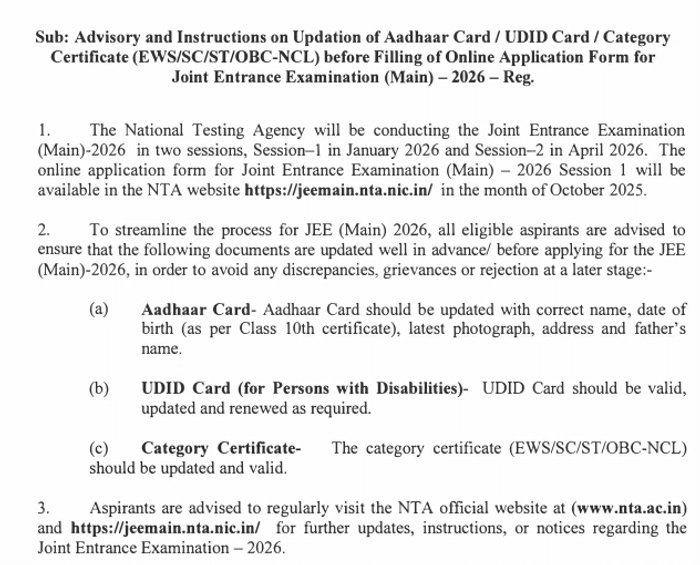
Source: NTA Official Notice
Related Links:
Key Summary
- NTA has released the official notice regarding the dates for JEE Mains 2026. It will be conducted in two sessions in January 2026 and April 2026.
- The candidates will have to get hold of their documents like Aadhar Card, UDI Card (for PwD) and Category certificate.
- The B.Tech exam will have 75 questions for 300 marks. The B.Arch will have 77 questions for 400 marks.
- The B.Plan exam will have 100 questions for 400 marks.
- The difficulty level of the exam usually ranges from moderate to tough.
JEE Main 2026 Exam Schedule
| Expected Exam Dates | Session | Details |
|---|---|---|
| January 2026 | Session 1 | Two shifts per day for Paper-1: • Shift 1: 09:00 AM – 12:00 Noon • Shift 2: 03:00 PM – 06:00 PM |
| April 2026 | Session 2 | Full session window, exact dates & shifts to be announced |
Ques. What is the pass mark in JEE Main?
Ans. In JEE Main, there are no fixed “pass marks” in terms of percentage or marks to take the JEE Main exam, but the candidates need a qualifying cutoff percentile for the JEE Main Counselling and for JEE Advanced.
JEE Main 2025 Qualifying Cut-Off (for JEE Advanced eligibility)
| Category | Cut-Off Percentile |
|---|---|
| General (UR) | 93.1023 |
| Gen-EWS | 80.3830 |
| OBC‑NCL | 79.4314 |
| SC | 61.1527 |
| ST | 47.9026 |
| UR‑PwD | ~0.0079 |
Ques. What is the Time duration of JEE Mains?
Ans. The time duration for the exam is as follows-
| JEE Main Paper | Total Questions | Total Marks | Time Allotted |
|---|---|---|---|
| Paper 1 BE/BTech | 75 | 300 | 3 hours |
| Paper 2A BArch | 77 | 400 | 3.5 hours |
| Paper 2B BPlan | 100 | 400 | 3 hours |
What is the Exam Pattern for JEE Mains 2026?
| Features | Paper 1: B.E./B.Tech | Paper 2A: B.Arch | Paper 2B: B.Plan |
|---|---|---|---|
| Mode of Exam | Computer-Based Test (CBT) | Mathematics & Aptitude: CBTDrawing: Offline | Entirely Computer-Based Test |
| Subjects/Sections | Physics, Chemistry, Mathematics | Mathematics, Aptitude, Drawing | Mathematics, Aptitude, Planning |
| No. of Questions | 75 (25 per subject: 20 MCQs + 5 NVQs – all compulsory) | 77 total: 25 (Math) + 50 (Aptitude) + 2 (Drawing tasks) | 100 total: 25 (Math) + 50 (Aptitude) + 25 (Planning) |
| Type of Questions | MCQs & Numerical Value Questions | MCQs (Math & Aptitude), Drawing tasks | All MCQs |
| Marking Scheme | +4 correct, –1 incorrect (both MCQs & NVQs) | +4 correct, –1 incorrect (Math & Aptitude)Drawing graded out of 100 | +4 correct, –1 incorrect |
| Total Marks | 300 (100 per subject) | 400: Math (100) + Aptitude (200) + Drawing (100) | 400: Math (100) + Aptitude (200) + Planning (100) |
| Duration | 3 hours | ~3½ hours (includes drawing time) | 3 hours |
| Medium of Exam | 13 Languages, including English & Hindi | 13 Languages | 13 Languages |
| Negative Marking for NVQs? | Yes | N/A | N/A |
Ques. What is the subject-wise weightage?
Ans. The subject-wise weightage for the exam is-
| Subject | Weightage |
|---|---|
| Mathematics | 33.33% |
| Physics | 33.33% |
| Chemistry | 33.33% |
| Total | 100% |
Ques. What is the difficulty level of JEE MAINS over the years?
Ans. The analysis of the difficulty level of the exam over the years is given below-
| Year | Overall Difficulty | Physics | Chemistry | Mathematics |
|---|---|---|---|---|
| 2021 | Moderate | Moderate | Easy–Moderate | Moderate–Tough |
| 2022 | Moderate–Tough | Tough | Easy–Moderate | Tough |
| 2023 | Moderate | Moderate | Easy | Moderate–Tough |
| 2024 | Moderate | Easy–Moderate | Easy–Moderate | Moderate–Tough |
| 2025 | Moderate | Moderate | Easy | Moderate–Tough |
Read More:
JEE Main Exam Pattern 2026What is JEE Mains Syllabus?
Physics
| Units | Topics |
|---|---|
| Physics and Measurement | Units & dimensions, Errors & analysis, Vectors |
| Kinematics | Motion in straight line & plane, Relative velocity |
| Laws of Motion | Newton’s laws, Friction, Circular motion |
| Work, Energy and Power | Work–energy theorem, Power, Potential energy curves |
| Rotational Motion | Torque, Angular momentum, Moment of inertia, Rolling motion |
| Gravitation | Law of gravitation, Satellite motion, Escape velocity |
| Properties of Solids and Liquids | Elasticity, Surface tension, Viscosity, Fluid mechanics |
| Thermodynamics | Laws, Heat engines, Entropy |
| Kinetic Theory of Gases | Gas laws, Mean free path, Degrees of freedom |
| Oscillations and Waves | SHM, Damped/forced oscillations, Wave equation, Sound waves |
| Electrostatics | Electric field, Potential, Capacitance |
| Current Electricity | Ohm’s law, Kirchhoff’s laws, Potentiometer, Meter bridge |
| Magnetic Effects of Current & Magnetism | Biot–Savart, Ampere’s law, Magnetic materials |
| Electromagnetic Induction & Alternating Currents | Faraday’s law, Lenz’s law, AC circuits |
| Electromagnetic Waves | Displacement current, Spectrum |
| Optics | Ray optics, Lenses, Wave optics (interference, diffraction, pol.) |
| Dual Nature of Matter & Radiation | Photoelectric effect, de-Broglie |
| Atoms & Nuclei | Bohr model, Radioactivity |
| Electronic Devices | Semiconductors, Diodes, Transistors, Logic gates |
| Experimental Skills | Vernier calipers, Screw gauge, Experiments, Error analysis |
Read More:
JEE Main Physics Syllabus- Download Pdf, Class 11 and 12 Topics-Wise WeightageChemistry
| Units | Topics |
|---|---|
| Some Basic Concepts of Chemistry | Mole concept, Stoichiometry, Atomic masses |
| Atomic Structure | Bohr model, Quantum numbers, Orbitals |
| Chemical Bonding & Molecular Structure | VSEPR, Hybridisation, Molecular orbital theory |
| States of Matter | Gaseous state, Liquid state, Gas laws |
| Chemical Thermodynamics | Enthalpy, Entropy, Free energy |
| Chemical Equilibrium | Le-Chatelier’s principle, Equilibrium constants |
| Ionic Equilibrium | Acids & bases, Buffers, Solubility product |
| Redox Reactions | Oxidation number, Balancing |
| Solutions | Raoult’s law, Colligative properties |
| Electrochemistry | Nernst equation, Conductance |
| Chemical Kinetics | Rate laws, Order, Arrhenius equation |
| Surface Chemistry | Adsorption, Catalysis, Colloids |
| Hydrogen | Isotopes, Hydrides, Water |
| s-Block (Alkali & Alkaline Earth metals) | Properties, Compounds |
| p-Block (Groups 13 & 14) | Boron, Carbon family |
| p-Block (Groups 15,16,17,18) | Nitrogen, Oxygen, Halogens, Noble gases |
| d-Block (Transition elements) | Properties, Compounds, Alloys |
| f-Block (Lanthanides, Actinides) | Oxidation states, Complexes |
| Coordination Compounds | Nomenclature, Bonding theories |
| Environmental Chemistry | Pollution, Green chemistry |
| Organic Chemistry – Basics | Hybridisation, Nomenclature, Mechanisms |
| Hydrocarbons | Alkanes, Alkenes, Alkynes, Aromatics |
| Haloalkanes & Haloarenes | Substitution, Elimination, Reactions |
| Alcohols, Phenols & Ethers | Properties & reactions |
| Aldehydes, Ketones, Carboxylic Acids | Nucleophilic substitution, Oxidation, Reduction |
| Amines | Basicity, Diazonium salts |
| Polymers | Natural & synthetic polymers |
| Biomolecules | Carbohydrates, Proteins, Nucleic acids |
| Chemistry in Everyday Life | Drugs, Detergents, Food additives |
Read More:
JEE Main Chemistry Syllabus 2026: Download PDF, Topic-wise weightage, Difficulty level & Important TopicsMathematics
| Units | Topics |
|---|---|
| Sets, Relations & Functions | Domain, Range, Types of relations |
| Complex Numbers & Quadratic Equations | Argand plane, Modulus, Roots of equations |
| Matrices & Determinants | Inverse, Rank, Properties |
| Permutations & Combinations | Factorials, Counting |
| Binomial Theorem | Expansion, General & middle terms |
| Sequences & Series | AP, GP, HP, Sigma notation |
| Limits, Continuity & Differentiability | L’Hospital rule, Derivatives, Continuity tests |
| Integral Calculus | Indefinite integrals, Definite integrals, Area under curve |
| Differential Equations | Order, Degree, Solutions |
| Coordinate Geometry | Straight line, Circle, Parabola, Ellipse, Hyperbola |
| Three-Dimensional Geometry | Direction cosines, Line & Plane equations |
| Vector Algebra | Scalar & vector products, Applications |
| Trigonometry | Identities, Equations, Inverse trig functions |
| Probability & Statistics | Mean, Variance, Binomial/Poisson/Normal distribution |
| Mathematical Reasoning | Statements, Logical connectives, Implications |
Read More:
JEE Main Maths Syllabus 2026: Download Syllabus PDF, Check Reduced Syllabus, Important TopicsQues. What is the total no. of questions in JEE Mains?
Ans. The total no of questions in the exam are as follows-
| JEE Main Paper | Total Questions | Total Marks | Time Allotted |
|---|---|---|---|
| Paper 1 BE/BTech | 75 | 300 | 3 hours |
| Paper 2A BArch | 77 | 400 | 3.5 hours |
| Paper 2B BPlan | 100 | 400 | 3 hours |
Ques. What is the marking scheme for JEE Mains 2026?
Ans. The marking scheme for the exam is as follows-
| Paper & Course | Subject / Section | Question Type | No. of Qs | Marking Scheme | Total Marks |
|---|---|---|---|---|---|
| Paper 1 (B.E./B.Tech) | Physics A | MCQs (4 options) | 20 | +4 correct, –1 wrong | 80 |
| Physics B | Numerical Value (NAV) | 5 | +4 correct, –1 wrong | 20 | |
| Chemistry A | MCQs (4 options) | 20 | +4 correct, –1 wrong | 80 | |
| Chemistry B | Numerical Value (NAV) | 5 | +4 correct, –1 wrong | 20 | |
| Mathematics A | MCQs (4 options) | 20 | +4 correct, –1 wrong | 80 | |
| Mathematics B | Numerical Value (NAV) | 5 | +4 correct, –1 wrong | 20 | |
| Total (Paper 1) | – | – | 75 | – | 300 |
| Paper 2A (B.Arch) | Mathematics | MCQs (20) + NAV (5) | 25 | +4 correct, –1 wrong (MCQ & NAV) | 100 |
| Aptitude | MCQs | 50 | +4 correct, –1 wrong | 200 | |
| Drawing (Offline) | Drawing-based | 2 | No negative marking | 100 | |
| Total (Paper 2A) | – | – | 77 | – | 400 |
| Paper 2B (B.Planning) | Mathematics | MCQs (20) + NAV (5) | 25 | +4 correct, –1 wrong (MCQ), 0 negative for NAV | 100 |
| Aptitude | MCQs | 50 | +4 correct, –1 wrong | 200 | |
| Planning | MCQs | 25 | +4 correct, –1 wrong | 100 | |
| Total (Paper 2B) | – | – | 100 | – | 400 |
JEE Main 2026 FAQs
Ques. Where can I find the previous year's questions?
Ans.
| Year | Question Paper PDF |
|---|---|
| 2023 | JEE Main 2023 Question Paper PDF |
| 2022 | JEE Main 2022 Question Paper PDF |
| 2021 | JEE Main 2021 Question Paper PDF |
| 2020 | JEE Main 2020 Question Paper PDF |
| 2019 | JEE Main 2019 Question Paper PDF |
| 2018 | JEE Main 2018 Question Paper PDF |
| 2017 | JEE Main 2017 Question Paper PDF |
Ques. What are the high-weightage concepts in the subjects?
Ans. Some of the high-weightage concepts that students should prioritise are as follows-
| Subject | Weightage Insight |
|---|---|
| Mathematics | Calculus + Algebra + Coordinate Geometry cover ~60% of the questions |
| Physics | Mechanics + Electricity & Magnetism account for ~50% of the paper |
| Chemistry | Organic + Physical + Inorganic almost equally weighted (~33% each) |
| Drawing (2A) | Subjective evaluation out of 100 marks |
| Planning (2B) | Tested via MCQs in the Planning section |



Comments