




Physics contributes 80 out of 300 total marks with balanced difficulty. Accuracy and time management plays an important role in solving the paper.
- Mechanics contributes around 9–10 questions with 25–30% weightage that means it dominates the paper and must be prepared well.
- Modern Physics have around 3–4 questions with 10–12% weightage that makes it a high scoring area.
- Optics have around 2–3 questions with 8–10% of weightage but this section is mostly conceptual and time taking.
Around half of the Physics paper contains a few key chapters that’s why candidates must target the preparation based on weightage that can improve the performance.
Key Summary
- Physics plays a crucial role in maintaining score consistency, as it offers a mix of conceptual and direct questions.
- Physics acts as the balancing section in JEE Main, where moderate difficulty and predictable patterns help stabilize overall score.
- In the overall paper, Physics is neither the easiest nor the toughest, but the most scoring when time is managed well.
Also Read:
- JEE Main Physics Preparation 2026: Check Monthly Preparation Plan
- Attend Physics Mock Test
- JEE Main Physics Sample Paper 2026 PDF by NTA
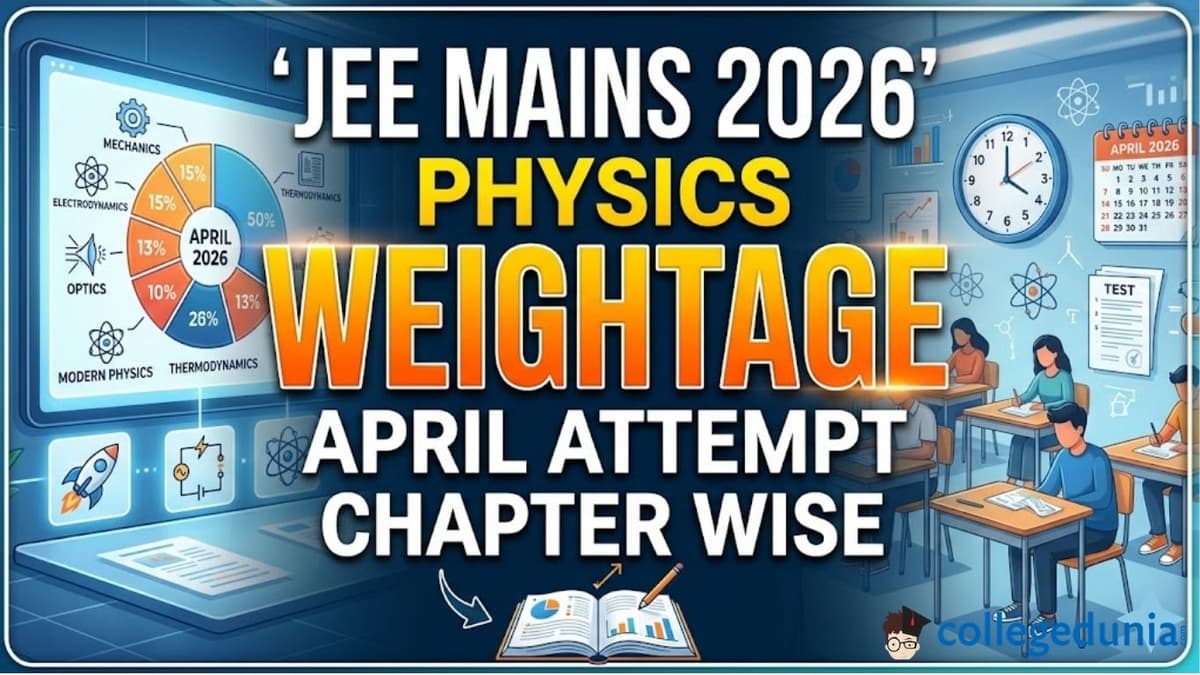
JEE Main 2026 April Shift Physics Chapter-Wise Weightage
- Mechanics alone contributes 25–30% of the paper, meaning 1 out of every 3–4 questions comes from this area, making it unavoidable despite its difficulty.
- Modern Physics offers 10–12% weightage with relatively lower difficulty, making it one of the highest ROI topics (more marks per unit time).
- Current Electricity and Thermodynamics together contribute 15–20%, forming a stable scoring block that appears consistently every shift.
| Chapter / Unit | Approx. No. of Questions | Approx. Weightage (%) |
|---|---|---|
| Mechanics (Kinematics, Laws of Motion, Work, Energy & Power, Rotational Motion) | 9 – 10 | 25 – 30 % |
| Heat & Thermodynamics | 2 – 3 | 8 – 10 % |
| Electrostatics | 2 | 6 % |
| Current Electricity | 2 – 3 | 8 – 12 % |
| Magnetism & Moving Charges | 1 – 2 | 5 – 7 % |
| Optics (Ray + Wave) | 2 – 3 | 8 – 10 % |
| Modern Physics (Atoms, Nuclei, Dual Nature, Electronic Devices) | 3 – 4 | 10 – 12 % |
| Oscillations & Waves | 1 – 2 | 5 – 7 % |
| Units, Measurements & Dimensions | 1 | 3 % |
| Properties of Matter / Fluids / Gravitation | 1 – 2 | 4 – 6 % |
Source: A Blog by Aakash Foundation
Also Read:
- JEE Mains 2026 April 5 Shift 1 Physics Question Paper with Solutions PDF
- JEE Mains 2026 April 5 Shift 2 Physics Question Paper with Solutions PDF
Ques. How much weightage does Physics carry in JEE Main 2026?
Ans. Physics contributes 80 marks out of 300, making it one-third of the paper. Its balanced difficulty makes accuracy and time management very important.
Ques. Why is Modern Physics considered high scoring?
Ans. It usually has 3–4 questions with direct concepts, so students can solve them quickly and gain marks with less effort.
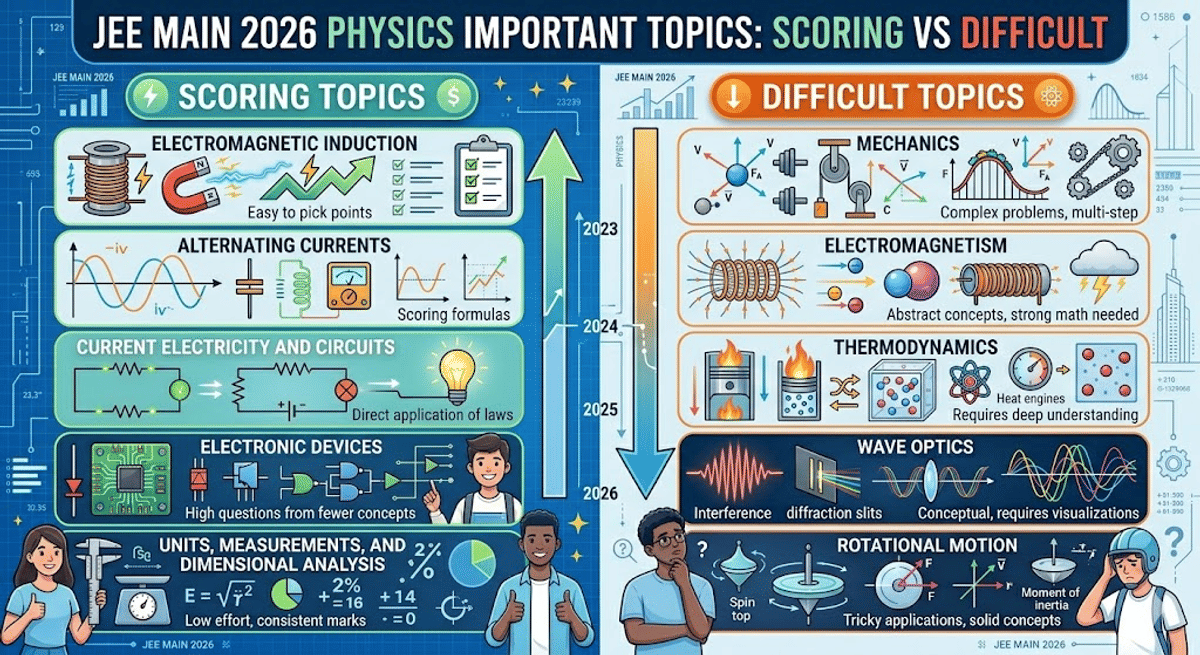
Most Scoring and Difficult JEE Main 2026 Physics Important Topics
- Scoring topics are usually formula-based and direct, so they can be solved quickly in the exam.
- Topics like Current Electricity, EMI, and AC are important because they repeat often and give predictable questions.
| Scoring Topics | Difficult Topics |
|---|---|
| Electromagnetic Induction | Mechanics |
| Alternating Currents | Electromagnetism |
| Current Electricity and Circuits | Thermodynamics |
| Electronic Devices | Wave optics |
| Units, Measurements, and Dimensional Analysis | Rotational Motion |
Source: A Blog by Aakash Foundation
Ques. Which chapter has the highest weightage in Physics?
Ans. Mechanics has the highest weightage with around 9–10 questions (25–30%), making it the most important and unavoidable topic.
JEE Main Class-wise Distribution of Questions: Physics
Understanding the number of questions from class 11th and 12th can help candidates to understand where to focus more.
- In 2024, Class 12 had a small advantage in both January and April attempts.
- In 2025, the number of questions reduced overall, but the balance between both classes remained similar.
- Ignoring Class 11 can be risky, as it still contributes a significant number of questions.
| Year | Attempt | Class 11th | Class 12th |
|---|---|---|---|
| 2024 | January | 141 | 159 |
| April | 143 | 157 | |
| 2025 | January | 121 | 129 |
| April | 109 | 116 |
Ques. Which are the most scoring topics in Physics?
Ans. Modern Physics, Current Electricity, EMI, AC, and Units are considered the most scoring as they are formula-based and less time-consuming.
Important Tips for Preparation of JEE Main 2026 Physics (April Attempt)
- Mechanics is the most important topic, so skipping it can reduce your score a lot.
- Modern Physics is easy and scoring, so it should be prepared well for quick marks.
- Current Electricity and Thermodynamics give regular questions, so they help in stable scoring.
| Focus Area | What to Do | Key Insight | Key Insight |
|---|---|---|---|
| Mechanics (25–30%) | Prioritize problem-solving practice | Highest weight, cannot be skipped | Major score driver |
| Modern Physics (10–12%) | Revise NCERT + PYQs | Easy + high ROI topic | Quick marks gain |
| Current Electricity + Thermo | Practice numericals regularly | Stable 15–20% weightage | Consistent Scoring |
| Stable 15–20% weightage | Attempt EMI, AC, Units first | Low time, high accuracy | Increases attempts |
| Difficult Topics Control | Limit time on Rotation, Optics | High time, low efficiency | Reduces mistakes |
| Class 11 + 12 Balance | Cover both equally | Balanced paper trend | Avoids score loss |
| Low Weight Easy Topics | Prepare Units & formulas well | Low effort, high accuracy | Score stabilizer |
Related News:
- What to Carry with JEE Main Admit Card 2026 on Exam Day
- JEE Main Physics Exam Pattern: Check Marking Scheme, Total Marks, Latest Changes
Ques. Which topics are considered difficult in Physics?
Ans. Mechanics, Rotational Motion, Thermodynamics, and Wave Optics are considered difficult due to lengthy calculations and conceptual complexity.
Ques. How many questions are asked from Optics in JEE Main?
Ans. Around 2–3 questions are asked from Optics, but they are often conceptual and can take more time to solve.
Ques. Is Physics more scoring than Mathematics in JEE Main?
Ans. Yes, Physics is generally more scoring than Mathematics because it has moderate difficulty and requires less time per question.
Ques. Should students focus more on Class 11 or Class 12 Physics?
Ans. Both are equally important as questions are almost evenly distributed, with a slight advantage to Class 12 in recent trends.



Comments