




High weightage NEET chemistry chapters include Aldehydes, Ketones, Chemical bonding, Hydrocarbons, Coordination Compounds, and p-block elements contribute 20-22 questions out of 45. These topics carry high weightage and also recur in 40% of the chemistry section. Class 12 chemistry accounts for 60% of the Chemistry section; the remaining 40% questions come from Class 11 Chemistry.
Most of the questions are from the NCERT directly, and often, the questions are memory-based.
- Aldehydes, Ketones, & carboxylic Acids provide 4-5 questions.
- Chemical bonding & Molecular structure give 3-4 conceptual questions.
- 3-4 questions from Hydrocarbons are usually given directly from NCERT.
- 2-3 Coordination Compounds are very common
- Class 12 p-block elements shoot 2-3 factual questions often from NCERT
- Thermodynamics and Electrochemistry have 2-3 numerical questions
Also Read
Key Summary
- Chemistry contributes 45/180 marks in NEET.
- 16Qs in Organic Chemistry
- 12Q Inorganic Chemistry
- 10Q Physical Chemistry, together cover the section.
- Class 12 Chemistry chapters have high weightage with 60% of overall questions.
- Class 11 Chemistry gives 16-18 questions
- Class 12 Chemistry gives 27-29 questions
- NCERT direct questions are most common in Inorganic & Organic.
- 10–12 chapters contribute nearly 70% of the marks; the rest are lower-weight filler chapters.
- NCERT coverage is direct: 80% of Chemistry questions come straight from NCERT Class 11 & 12 textbooks.
High Weightage NEET Chemistry Chapters
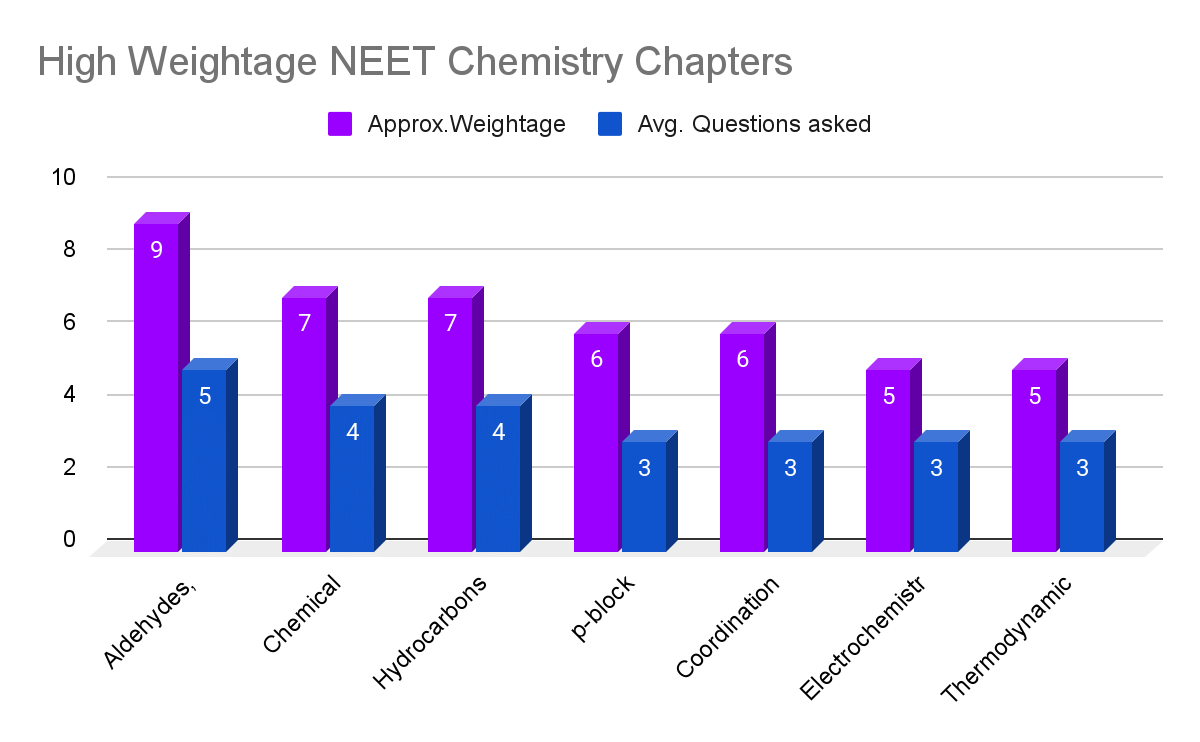
- The topics listed below alone cover 40-45% of NEET Chemistry
- On average, 20-22 questions can come from these topics.
- Practicing these topics with PYQs and NCERT is suggested
| Topics | Approx.Weightage | Avg. Questions asked |
|---|---|---|
| Aldehydes, Ketones & Carboxylic Acids | 8-9% | 4-5 |
| Chemical bonding & Molecular structure | 6-7% | 3-4 |
| Hydrocarbons | 6-7% | 3-4 |
| p-block elements(Class 12) | 5-6% | 2-3 |
| Coordination Compounds | 5-6% | 2-3 |
| Electrochemistry | 4-5% | 2-3 |
| Thermodynamics | 4-5% | 2-3 |
Also Read
NEET 2026High Weightage NEET Chemistry Chapters: Chapter-Wise Weightage
- NEET Chemistry has 45 questions (180 marks) distributed across Class 11 ( 16–18 questions) and Class 12 ( 27–29 questions).
- Class 11 high-weight chapters: Thermodynamics, Equilibrium, Hydrocarbons, and Chemical Bonding.
- Class 12 high-weight chapters: Coordination Compounds, p-Block, Aldehydes/Ketones, and Alcohols/Phenols.
- Inorganic Chemistry Class 12 chapters (d-Block, p-Block, Coordination) together account for 25–28% weightage.
- Class 11 Organic Chemistry (Hydrocarbons, GOC) gives 6–7% weightage.
- Class 12 Organic Chemistry (Aldehydes/Ketones, Haloalkanes, Amines) covers 15–18% weightage.
Also Read
NEET Chemistry Question Paper with Solutions PDFs (2023-2007)| Organic Chemistry | % | Inorganic Chemistry | % | Physical Chemistry | % |
|---|---|---|---|---|---|
| Basic Principles and Techniques | 5% | Classification of Elements & Periodicity | 2% | Basic concepts | 3-4% |
| Hydrocarbons | 6-7% | Hydrogen | 2% | Structure of Atoms | 3-4% |
| Haloalkanes & Haloarenes | 4% | S-block Element(Alkali & Alkaline) | 3% | States of Matter(Gaseous+Liquid) | 2-3% |
| Alcohols, Phenols & Ethers | 4% | p-Block elements(Group13,14,15,16,17,18) | 6% | Thermodynamics | 5% |
| Aldehydes, Ketones & Carboxylic Acids | 9% | d-Block Elements | 4% | Equilibrium(Chemical+Ionic) | 6% |
| Amines | 5% | f-Block Elements | 2% | Redox Reaction | 3% |
| Biomolecules | 4% | Coordination compounds | 5% | Solid State | 2-3% |
| Polymers | 2% | Chemical Bonding & Molecular Structure | 7% | Solutions | 4% |
| Chemistry in everyday life | 2% | Metallurgy | 2% | Electrochemistry | 5% |
| Practical organic/IUPAC/Mechanisms | 2% | Environmental Chemistry | 2% | Chemical Kinetics | 5% |
| Qualitative Analysis | 2% | Surface Chemistry | 2% | ||
| Nuclear Chemistry/Radioactivity | ~1% |
Inorganic Chemistry Weightage in NEET 2026
- Inorganic Chemistry contributes 10–12 questions (25–30% weightage).
- p-Block elements are heavily tested (4–5 questions).
- Chemical Bonding & Periodic Table give 3–4 questions almost every year.
- Coordination Compounds alone can carry 3–4 questions, making it a high-return topic.
- Class 11 chapters like Hydrogen & s-Block are lighter (1–2 questions combined).
- Nearly all questions are direct NCERT-based, especially from Class 12 Inorganic Chemistry.
Also Read
NEET Inorganic Chemistry Topics| Chapters | Approx. Weightage | Approx.Questions |
|---|---|---|
| Chemical Bonding & Molecular Structure | 6-7% | 3-4 |
| p-block elements | 5-6% | 2-3 |
| Coordination Compounds | 5-6% | 2-3 |
| s-block elements | 2-3% | 1-2 |
| d-block elements | 3-4% | 1-2 |
| f-block elements | 1-2% | 1 |
| Hydrogen | 1-2% | 1 |
| Periodic Table | 2-3% | 1-2 |
| Metallurgy | 1-2% | 1 |

Also Read
NEET Exam Pattern Changes 2026High Weightage NEET Chemistry Chapters: Physical Chemistry Weightage
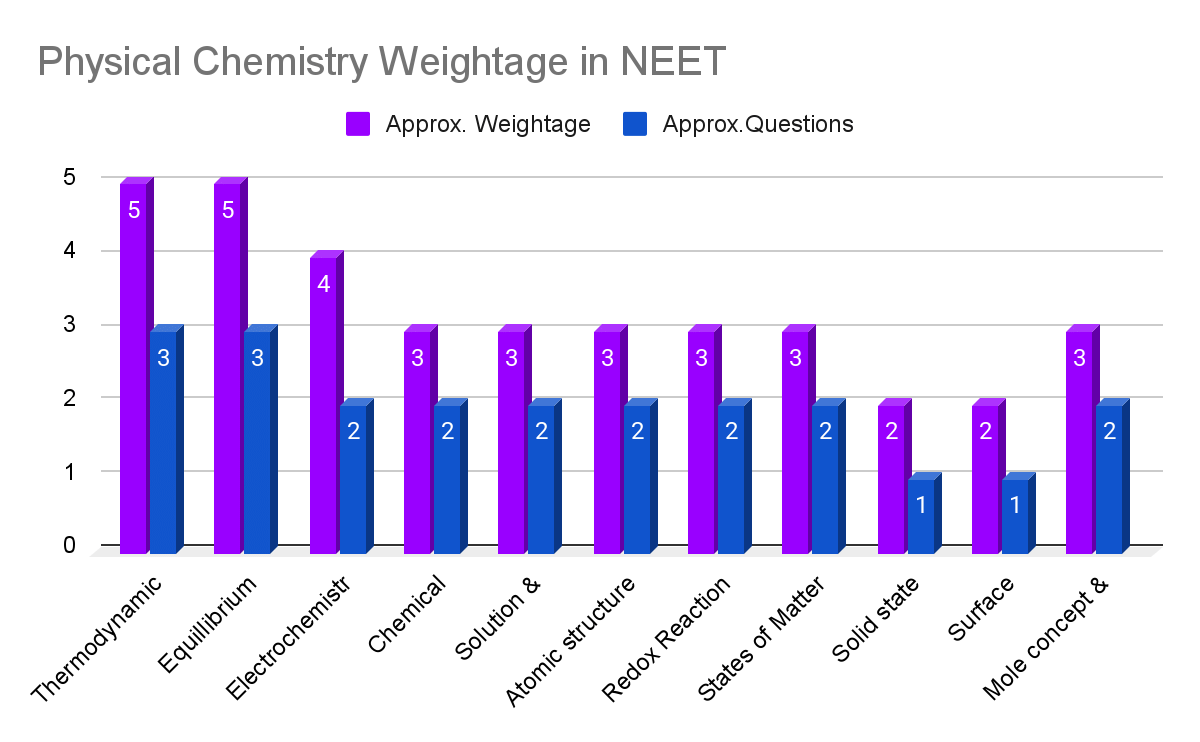
- Physical Chemistry contributes around 9–11 questions (25%).
- Thermodynamics (2–3 questions) and Equilibrium (2–3 questions) dominate.
- Electrochemistry, Chemical Kinetics, and Solutions carry consistent weight (1–2 questions each).
- Atomic Structure & Redox Reaction together form 5–6% weight.
- Numerical problem-solving is higher here compared to Organic/Inorganic.
- Requires both formula memorisation and application-based practice.
| Chapters | Approx. Weightage | Approx.Questions |
|---|---|---|
| Thermodynamics | 4-5% | 2-3 |
| Equilibrium(Chemical+Ionic) | 4-5% | 2-3 |
| Electrochemistry | 3-4% | 2 |
| Chemical Kinetics | 3% | 1-2 |
| Solution & Colligative Properties | 3% | 1-2 |
| Atomic structure | 2-3% | 1-2 |
| Redox Reaction | 2-3% | 1-2 |
| States of Matter | 2-3% | 1-2 |
| Solid state | 2% | 1 |
| Surface Chemistry | 1-2% | 1 |
| Mole concept & Stoichiometry | 2-3% | 1-2 |
Also Read
NEET 2026 Physical Chemistry ChaptersHigh Weightage NEET Chemistry Chapters : Organic Chemistry Weightage
- Organic Chemistry has the highest share: 14–16 questions (35–40%).
- General Organic Chemistry (GOC) & Hydrocarbons from Class 11 are the foundation.
- Class 12 chapters Aldehydes/Ketones, Alcohols/Phenols, Haloalkanes, Amines carry the heaviest weight with 6–7 questions.
- Biomolecules & Polymers give 2–3 direct NCERT questions every year.
- About 60–65% of Organic questions are reaction-based
- Regular practice of named reactions and NCERT exercise questions is crucial.
Also Read
NEET Organic Chemistry| Chapters | Approx. Weightage | Approx.Questions |
|---|---|---|
| Aldehydes, Ketones & Carboxylic Acids | 8-9% | 4-5 |
| Alcohols, Phenols & Ethers | 4-5% | 2-3 |
| Haloakanes & Haloarenes | 3-4% | 2 |
| Amines | 3-4% | 2 |
| Hydrocarbons | 6-7% | 3-4 |
| General Organic Chemistry | 3-4% | 1-2 |
| Biomolecules & Polymers | 3-4% | 1-2 |
| Chemistry in everyday life | 1-2% | 1 |
| Environmental Chemistry | 1-2% | 1 |

NEET Chemistry Section-Wise Expected Weightage for 2026
| Organic Chemistry I (Class 11) | 9-10% |
| Organic Chemistry II (Class 12) | 22-24% |
| Inorganic Chemistry I (Class 11) | 13-14% |
| Inorganic Chemistry II (Class 12) | 20-21% |
| Physical Chemistry I (Class 11) | 15-16% |
| Physical Chemistry II (Class 12) | 19-20% |
Also Read
NEET Chemistry Syllabus 2026High Weightage NEET Chemistry Chapters: Quora Discussion
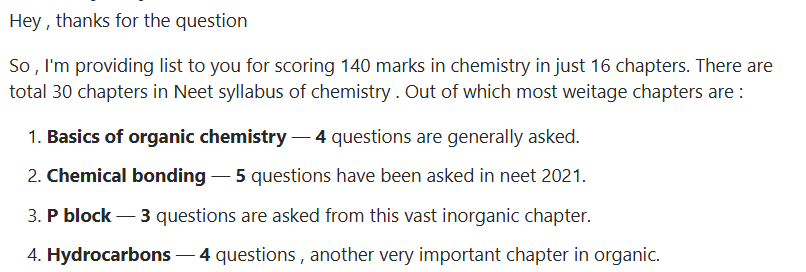
- Quora and Reddit posts on high-weightage NEET chemistry chapters are a must-read.
- Several past exam takers have shared useful insights and chapter-wise weightage.
- You can also find study tips and exam hall tips from these posts.



High Weightage NEET Chemistry Chapters FAQs
Ques. What Chemistry chapters are of high weightage in NEET?
Ans.The high-weightage chapters cover 40–45% of Chemistry with 20–22 questions.
- Aldehydes, Ketones & Carboxylic Acids carry 4–5 questions.
- 3–4 questions appear from Chemical Bonding & Molecular Structure.
- 3–4 questions appear from Hydrocarbons.
- p-Block Elements from Class 12 pose 2–3 questions.
- 2–3 questions. From Coordination Compounds can be expected.
- Thermodynamics & Electrochemistry cover 2–3 questions each.
Ques. What is the 80-20 rule in NEET?
Ans.80-20 rule in NEET means 80% of NEET questions come from 20% of the chapters.
- In Chemistry, 80% of the questions come from chemical bonding, general organic chemistry, coordination, thermodynamics, electrochemistry, and hydrocarbons.
- In Biology, Human Physiology, Genetics, Plant Physiology, Ecology, and Cell Biology, questions occupy 80% of NEET Biology questions.
- In physics, Laws of motion, Modern Physics, Current Electricity, Magnetism, and Optics occupy 80% of the Physics section.
Ques. How to score 650+ in NEET 2025?
Ans.Know the in-and-out of NCERT. 85-90% questions of the Biology questions and 65% of the Chemistry questions come from NCERT.
- Solve the last 15 years of NEET/AITMT papers.
- Take 50 to 60 full mock tests.
- Solve chapter-wise questions from the most repeated chapters.
Ques. Which is the toughest chapter of chemistry for NEET?
Ans.Coordination compounds and d-block n Inorganic chemistry are memory-intensive and comparatively difficult.
- General organic chemistry and named reactions are often confusing in Organic chemistry
- In physical chemistry, Electrochemistry and Ionic equilibrium are vast.
- Electrochemistry is rated as the toughest by 41% aspirants.
- Questions from Thermodynamics and Electrochemistry can even appear in JEE style.
Ques.. Is NEET 2025 hard or easy?
Ans.NEET 2025 is expected to be challenging as usual.
- The overall difficulty of NEET varies by year; 2023 was tougher, while 2024 was moderate.
- Chemistry is usually moderate with many direct NCERT-based questions.
- Physical Chemistry numericals can feel tricky compared to Organic and Inorganic.
Ques. What is the safest score for NEET 2025?
Ans.610-630+ is a safe score in NEET.
- 650+ is a guaranteeing score for well-known medical colleges
- For top government colleges, a safer range is 650–680+.
- Reserved category students may get admission with 580 and below.
Ques. Can I score 720 in NEET 2025?
Ans.Yes, it is possible—though extremely rare.
- 720 means you need to make zero mistakes.
- It is possible with a strategic study approach and time management
- Every year, only a handful of students achieve 720/720.
- To aim for it, practice NCERT line-by-line + PYQs + mock tests.
Ques. How to clear NEET 2026?
Ans.Build a strong NCERT foundation in Physics, Chemistry, and Biology.
- Focus on high-weightage chapters first (Aldehydes/Ketones, Bonding, p-Block, Thermodynamics, etc.).
- Solve at least 5 previous year question papers to understand trends.
- Attempt mock tests regularly to improve accuracy and speed.
- Follow a Class 11 + Class 12 integrated study plan with more time for Biology.
Also Read



Comments