




The NMC has released the official NEET Syllabus 2026, with no major changes from NEET 2025. The NEET Syllabus follows the NCERT Class 11 and 12 format, ensuring continuity and predictability.
In NEET UG, Physics and Chemistry include 20 Units each, whereas Biology includes 10 Units. Whereas biology carries the highest weightage of 50%, Physics and Chemistry carries 25% each.
- In Biology, human physiology carries 35 to 40% weightage, Genetics & Evolution carries 18 to 20% weightage, and Ecology includes 10 to 12% weightage.
- In Physics, Mechanics carries the highest weightage of around 25 to 30%, current electricity & magnetism carries 20 to 22% weightage.
- In Chemistry, organic chemistry carries the highest weightage of around 30 to 35% along with physical chemistry as well.
- For better preparation, you should aim to solve 3-4 mock tests every day for the last 20 days.
In NEET, 180 Questions will be asked, 45 each from chemistry and physics, 90 from biology, and have a total of 720 marks.
Related Links:
Key Summary
- The NEET syllabus 2026 was released in December 2025
- The NEET Syllabus 2026 follows the NCERT Class 11 and 12 format
- Biology carries a weightage of 360 marks according to the NEET syllabus 2026
- As per the NEET syllabus 2026, Physics and Chemistry carry 180 marks each
- In Biology, human physiology carries 35 to 40% weightage
- In Physics, Mechanics carries the highest weightage of around 25 to 30%
- In Chemistry, organic chemistry carries the highest weightage of around 30 to 35%
What is the NEET Syllabus 2026?
The NEET Syllabus includes all topics, concepts, and skills that are asked in the National Eligibility cum Entrance Test, issued by NMC, and is based on the NCERT Class 11 and 12 format.
- In NEET, around 70% of the NEET Questions are repetitive, concept-based questions.
- Around 360 out of 720 marks are from biology, which can shift your rank by 30,000+ ranks.
- Around 80 to 85% of biology and inorganic chemistry questions are NCERT-based, including tables or diagrams.
NEET Syllabus 2026 Changes: Has Anything Really Changed This Year?
In NEET 2026, the NMC has confirmed that the syllabus is similar to that of 2025, with no new additions or deletions, including practical understanding and NCERT Questions.
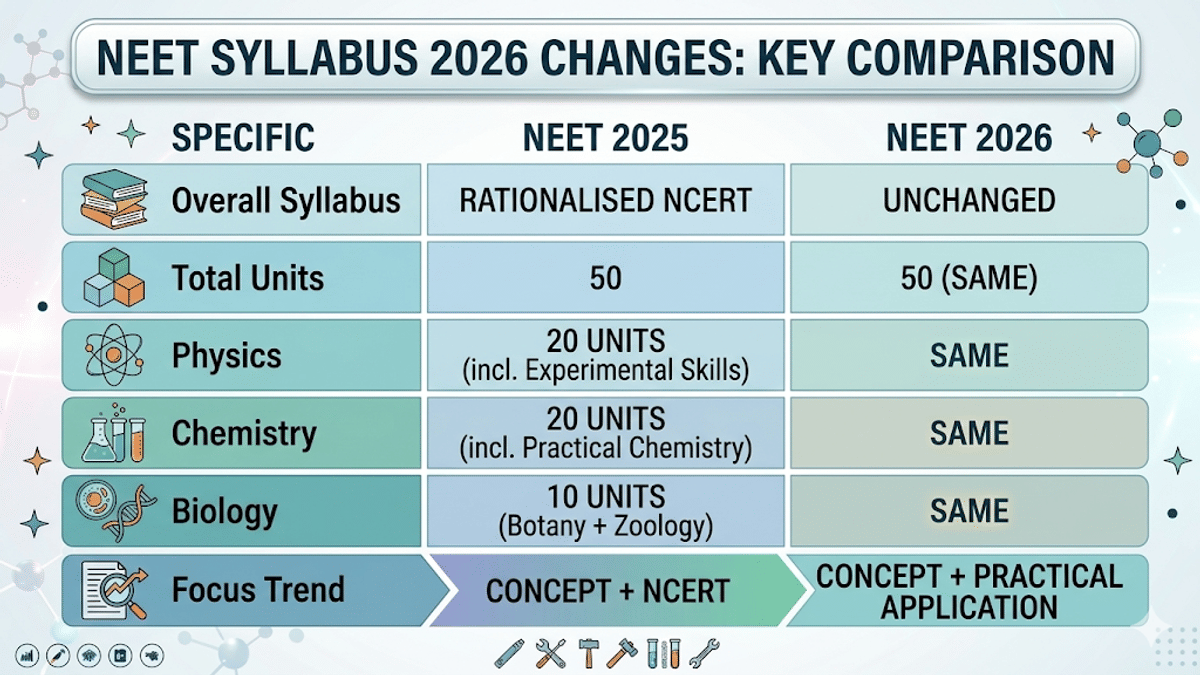
- The overall NEET 2026 syllabus is the same as 2025 (rationalized NCERT)
- Total units in the NEET syllabus 2026 are 50 (unchanged)
- Physics and Chemistry contain 20 units each, including experimental skills for Physics, and practical Chemistry
- Same as NEET 2025, the NEET 2026 syllabus for Biology comprises 10 units (Zoology and Botany)
Topics Deleted in NEET Syllabus 2025
Certain Key topics deleted from the NEET syllabus in 2025 are given in the table below:
- In Physics, Communication Systems, and Some obsolete experimental references were removed from the NEET syllabus 2025
- Surface Chemistry, General Principles & Processes of Isolation of Elements, and Hydrogen (selected parts) were removed from the NEET Chemistry syllabus 2025
- In Biology, Reproduction in Organisms and Environmental Issues were removed from the NEET syllabus 2025
| Subject | Key Topics Deleted in 2025 |
|---|---|
| Physics |
|
| Chemistry |
|
| Biology |
|
| Overall | NCERT rationalisation-based removals |
NEET 2026 Subject-wise Syllabus
NEET Syllabus 2026: Sectional Weightage
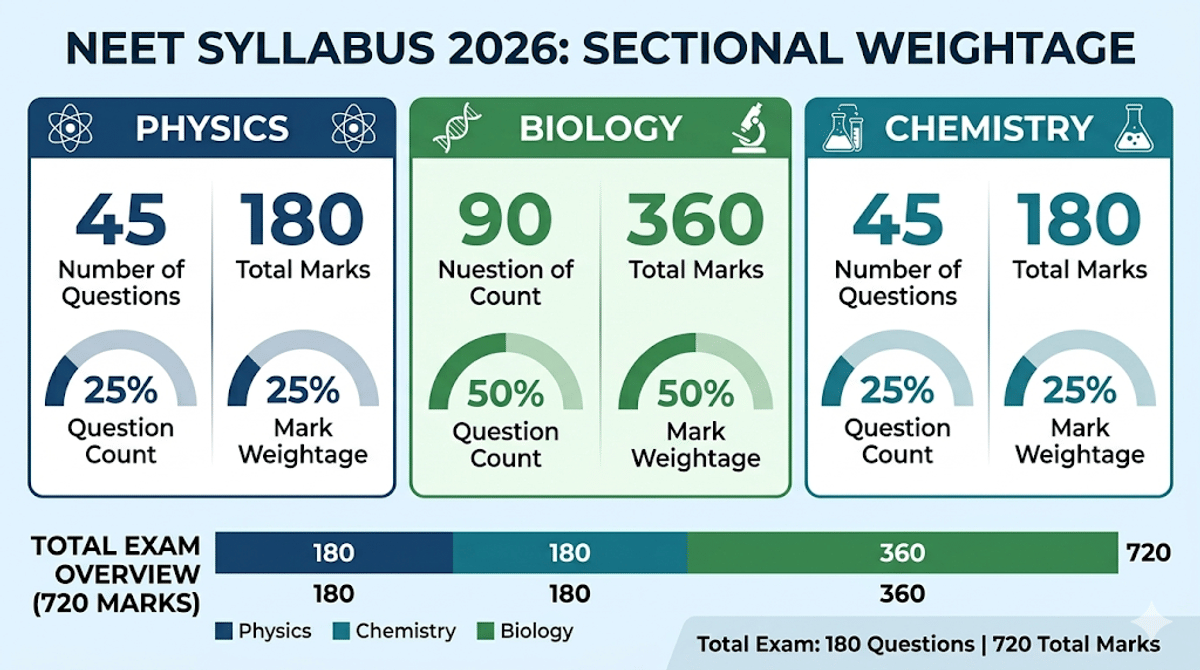
According to the NEET syllabus 2026 and exam pattern, Physics and Chemistry will carry 45 questions each.
- Biology carries 90 questions and a total of 360 marks
- Physics and Chemistry carry 45 questions and 180 marks each
| Section | Number of Questions | Total Marks |
|---|---|---|
| Physics | 45 | 180 |
| Chemistry | 45 | 180 |
| Biology | 90 | 360 |
NEET Syllabus 2026: Physics
The NEET 2026 syllabus for Physics is based on topics including Mechanics, Electromagnetism, Optics, and Modern Physics. Aspirants can check the unit-wise NEET syllabus for Physics in the table below.
| Unit | Topics |
|---|---|
| Units and Measurement | SI Units, dimensional analysis, errors in measurements |
| Kinematics | Motion graphs, uniformly accelerated motion, vectors, projectile motion |
| Laws of Motion | Newton's laws, friction, and dynamics of circular motion |
| Work, Energy, and Power | Work-energy theorem, potential energy, collisions. |
| Rotational Motion | Moment of inertia, torque, angular momentum, rotational equilibrium |
| Gravitation | Kepler's laws, escape velocity, and motion of satellites |
| Properties of Solids/Liquids | Stress-strain, viscosity, surface tension, heat transfer |
| Thermodynamics | Laws of thermodynamics, isothermal and adiabatic processes |
| Kinetic Theory of Gases | Gas laws, degrees of freedom, RMS speed of gas molecules |
| Oscillations and Waves | SHM, waves, superposition, beats, standing waves |
| Electrostatics | Coulomb's law, Gauss's law, potential energy, capacitors |
| Current Electricity | Ohm's law, resistors, cells, Kirchhoff's laws, Wheatstone bridge |
| Magnetism | Ampere's law, Biot-Savart law, torque on a current loop, magnetic dipole |
| EM Induction/AC | Faraday's law, inductance, AC circuits, transformers |
| Electromagnetic Waves | Displacement current, electromagnetic spectrum, applications |
| Optics | Reflection, refraction, lenses, microscopes, wave optics, polarization |
| Dual Nature of Matter | Photoelectric effect, de Broglie waves |
| Atoms and Nuclei | Bohr model, hydrogen spectrum, nuclear energy |
| Electronic Devices | Diodes, rectifiers, transistors, logic gates |
NEET Syllabus 2026: Physics Chapter-Wise Weightage
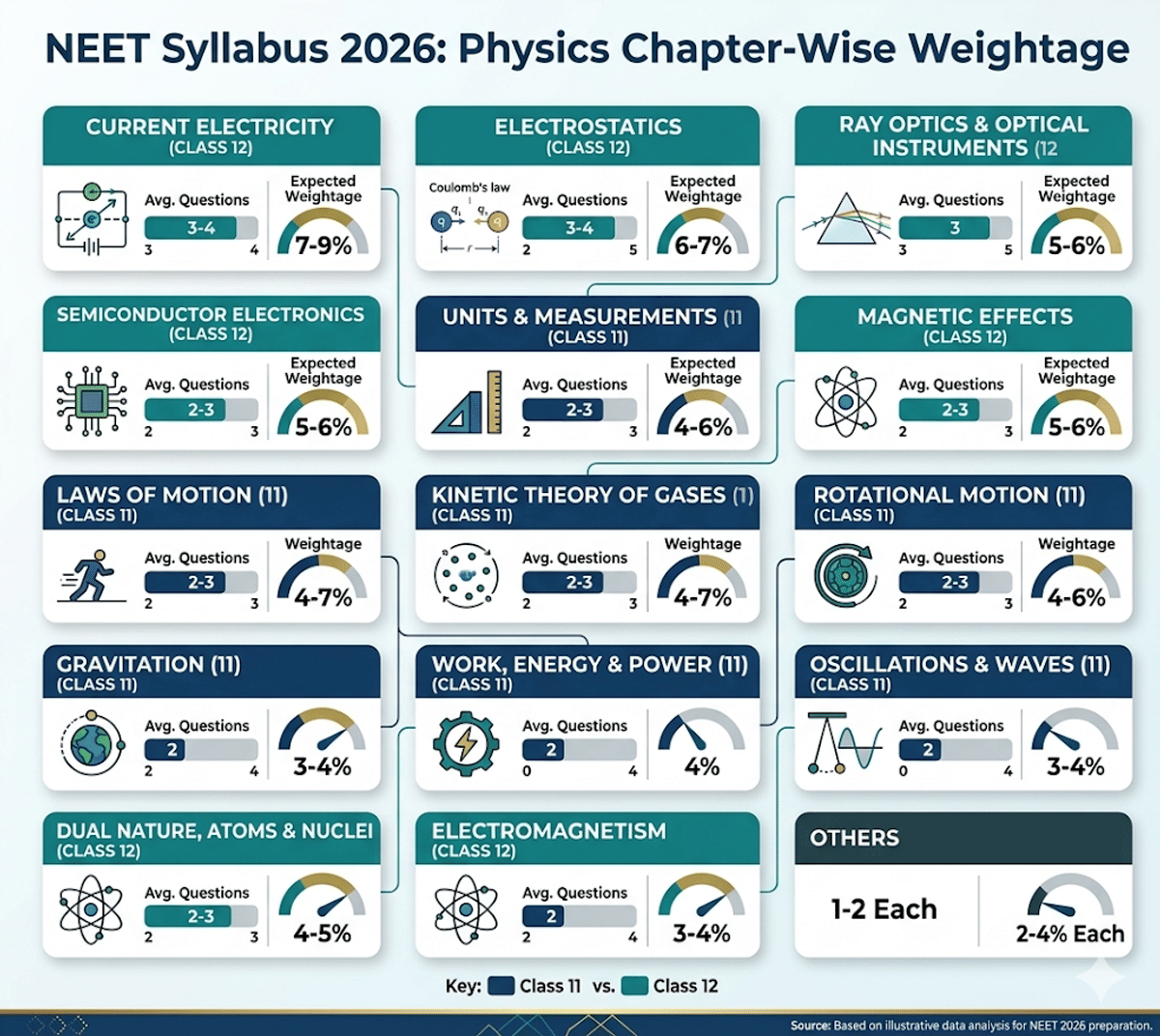
Shreyas Sir, on his YouTube channel, provided detailed chapter-wise weightage for the NEET syllabus 2026. His NEET 2026 chapter-wise weightage is given below:
Class 12th
| Chapter | Avg. Questions | Expected Weightage |
|---|---|---|
| Current Electricity | 3-4 | 7-9% |
| Electrostatics | 3-4 | 6-7% |
| Ray Optics & Optical Instruments | 3 | 5-6% |
| Semiconductor Electronics | 2-3 | 5-6% |
| Magnetic Effects | 2-3 | 5-6% |
| Dual Nature, Atoms & Nuclei | 2-3 | 4-5% |
| Electromagnetism | 2 | 3-4% |
Class 11th
| Chapter | Avg. Questions | Expected Weightage |
|---|---|---|
| Units & Measurements | 2-3 | 4-6% |
| Laws of Motion | 2-3 | 4-7% |
| Kinetic Theory of Gases | 2-3 | 4-7% |
| Rotational Motion | 2-3 | 4-6% |
| Gravitation | 2 | 3-4% |
| Work, Energy & Power | 2 | 4% |
| Oscillations & Waves | 2 | 3-4% |
Also Check:
NEET Syllabus 2026: Chemistry
The NEET 2026 syllabus PDF for Chemistry is divided into 3 sections, including Physical Chemistry, Organic Chemistry, and Inorganic Chemistry, as discussed below.
Physical Chemistry
| Unit | Topics |
|---|---|
| Some Basic Concepts of Chemistry | Mole concept, stoichiometry, laws of chemical combination |
| Atomic Structure | Bohr model, quantum numbers, orbitals, electronic configuration |
| Chemical Bonding | VSEPR theory, hybridization, and molecular orbital theory |
| Thermodynamics | Laws, enthalpy, spontaneity, Gibbs free energy |
| Solutions | Colligative properties, Raoult's law, osmotic pressure |
| Equilibrium | Law of mass action, acids and bases, pH, solubility product |
| Redox Reactions | Oxidation-reduction, balancing redox equations |
| Electrochemistry | Electrolytic cells, Nernst equation, conductance |
| Chemical Kinetics | Rate laws, zero/first-order reactions, Arrhenius equation |
Inorganic Chemistry
| Unit | Topics |
|---|---|
| Classification of Elements | Modern periodic table, trends in properties |
| P-Block Elements | Group 13-18, properties and trends |
| d- and f-Block Elements | Transition metals, lanthanoids, actinoids, properties |
| Coordination Compounds | Werner's theory, IUPAC nomenclature, CFT |
Organic Chemistry
| Unit | Topics |
|---|---|
| Basic Principles | Isomerism, electronic effects, types of reactions |
| Hydrocarbons | Alkanes, alkenes, alkynes, aromatic hydrocarbons |
| Organic Halides | Reactions of alkyl/aryl halides, environmental issues |
| Alcohols, Phenols, Ethers | Properties, reactions, dehydration, acidity |
| Carbonyl Compounds | Aldehydes, ketones, nucleophilic addition, tests |
| Carboxylic Acids | Acid strength, factors affecting acidity |
| Amines | Classification, basicity, reactions |
| Biomolecules | Carbohydrates, proteins, nucleic acids, vitamins |
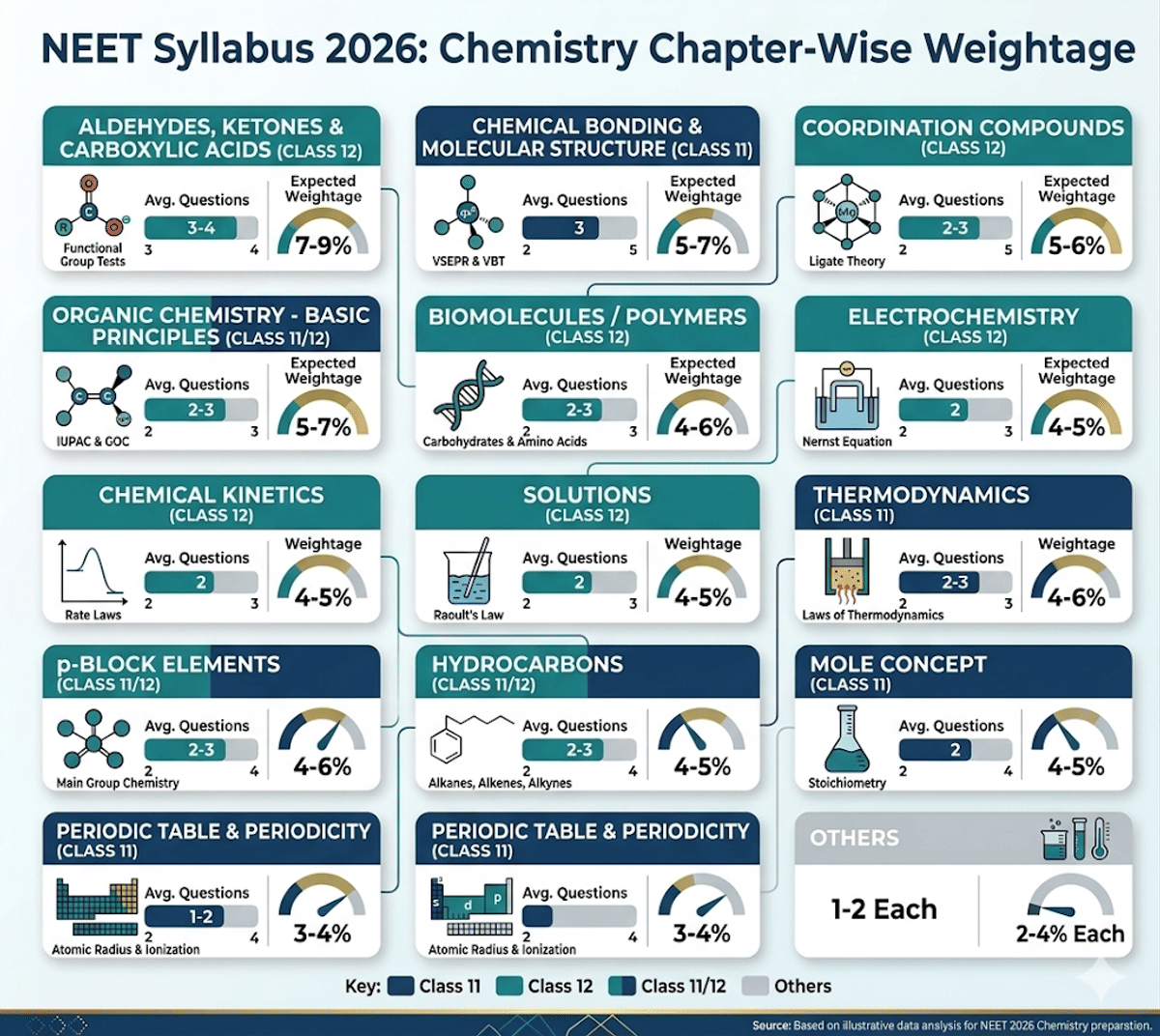
NEET Syllabus 2026: Chemistry Chapter-Wise Weightage
| Chapter (Class) | Avg. Questions | Expected Weightage |
|---|---|---|
| Aldehydes, Ketones & Carboxylic Acids | 3-4 | 7-9% |
| Chemical Bonding & Molecular Structure | 3 | 5-7% |
| Coordination Compounds | 2-3 | 5-6% |
| Organic Chemistry - Basic Principles | 2-3 | 5-7% |
| Biomolecules | 2-3 | 4-6% |
| Electrochemistry | 2 | 4-5% |
| Chemical Kinetics | 2 | 4-5% |
| Solutions | 2 | 4-5% |
| Thermodynamics | 2-3 | 4-6% |
| p-Block Elements | 2-3 | 4-6% |
| Hydrocarbons | 2-3 | 4-5% |
| Mole Concept | 2 | 4-5% |
| Periodic Table & Periodicity | 1-2 | 3-4% |
Check out Shreyas Sir’s Video for More Insights
Also Check:
NEET Syllabus 2026: Biology
NEET 2026 syllabus for Biology includes topics from Zoology and Botany, with some important topics including Human Physiology, Genetics and Evolution, Ecology and Environment, Plant Physiology, and Cell Structure & Function.
| Unit | Topics |
|---|---|
| Diversity in Living World | Classification of plants, animals, fungi; five-kingdom system |
| Structural Organisation | Animal tissues, plant anatomy, and morphology |
| Cell Structure/Function | Cell theory, organelles, cell cycle, mitosis, meiosis |
| Plant Physiology | Photosynthesis, respiration, and plant growth regulators |
| Human Physiology | Digestion, respiration, circulation, excretion, nervous and muscular systems |
| Reproduction | Plant reproduction, human reproduction, reproductive health |
| Genetics and Evolution | Mendel's laws, the molecular basis of inheritance, and the evolution theories |
| Biology and Human Welfare | Diseases, immunity, and microbes in human welfare |
| Biotechnology | Genetic engineering, applications in medicine and agriculture |
| Ecology and Environment | Ecosystems, biodiversity, conservation, and environmental issues |
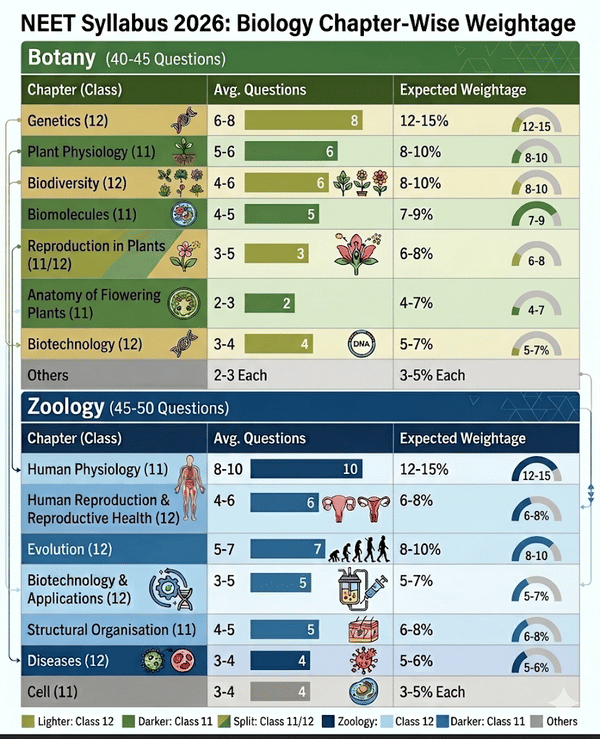
NEET Syllabus 2026: Biology Chapter-Wise Weightage
| Botany (40-45 Questions) | ||
|---|---|---|
| Chapter (Class) | Avg. Questions | Expected Weightage |
| Genetics | 6-8 | 12-15% |
| Plant Physiology | 5-6 | 8-10% |
| Biodiversity | 4-6 | 8-10% |
| Biomolecules | 4-5 | 7-9% |
| Reproduction in Plants | 3-5 | 6-8% |
| Anatomy of Flowering Plants | 2-3 | 4-7% |
| Biotechnology | 3-4 | 5-7% |
| Zoology (45-50 Questions) | ||
| Chapter (Class) | Avg. Questions | Expected Weightage |
| Human Physiology | 8-10 | 12-15% |
| Human Reproduction & Reproductive Health | 4-6 | 6-8% |
| Evolution | 5-7 | 8-10% |
| Biotechnology & Applications | 3-5 | 5-7% |
| Structural Organisation | 4-5 | 6-8% |
| Diseases | 3-4 | 5-6% |
| Cell | 3-4 | 5-6% |
Check out Shreyas Sir’s video for more insights
Ques. What is the basic syllabus of NEET?
Ans. The basic syllabus of NEET includes the NCERT 11th and 12th chapters of Physics, Chemistry, and Biology. With Biology carrying the most weightage (360 marks), Physics and Chemistry carry 180 marks each.
Also Check:
NCERT vs Reference Books for NEET Syllabus 2026
Preparing for the NEET syllabus 2026 requires the right strategy, right guidance, and right resources.
- Using NCERT and reference books as resources can be helpful only when both resources are balanced.
- NCERT could be beneficial in developing the fundamentals; however, reference books are best for detailed explanations and higher concepts.
- Most of the NEET questions are NCERT-friendly
- Reference books cover advanced concepts, but include too much information, consuming too much time during preparation.
| NEET Subjects | Class 12 NCERT Books | Class 11 NCERT Books |
|---|---|---|
| Physics | Download PDF | Download PDF |
| Chemistry | Download PDF | Download PDF |
| Biology | Download PDF | Download PDF |
NCERT uses simple and direct language to help you understand concepts. Whereas reference books use complicated language while defining the concepts.
NEET Reference Books
| NEET Subject | NEET Reference Books |
|---|---|
| Physics |
|
| Chemistry (Physical) |
|
| Chemistry (Organic) |
|
| Chemistry (Inorganic) |
|
| Biology |
|
People asked on Quora: What should be the best material for neet 2026 after observing the difficulty level of neet 2025?
Disha Saini Responded: NCERT is best for all three subjects.
Moleen Raut Answered: I used to attend all classes sincerely. After classes, I used to thoroughly read that topic, solve questions, and do homework. This was my daily routine. Then, before tests, I used to revise specific topics
NEET Syllabus 2026: Recommended PYQ Counts
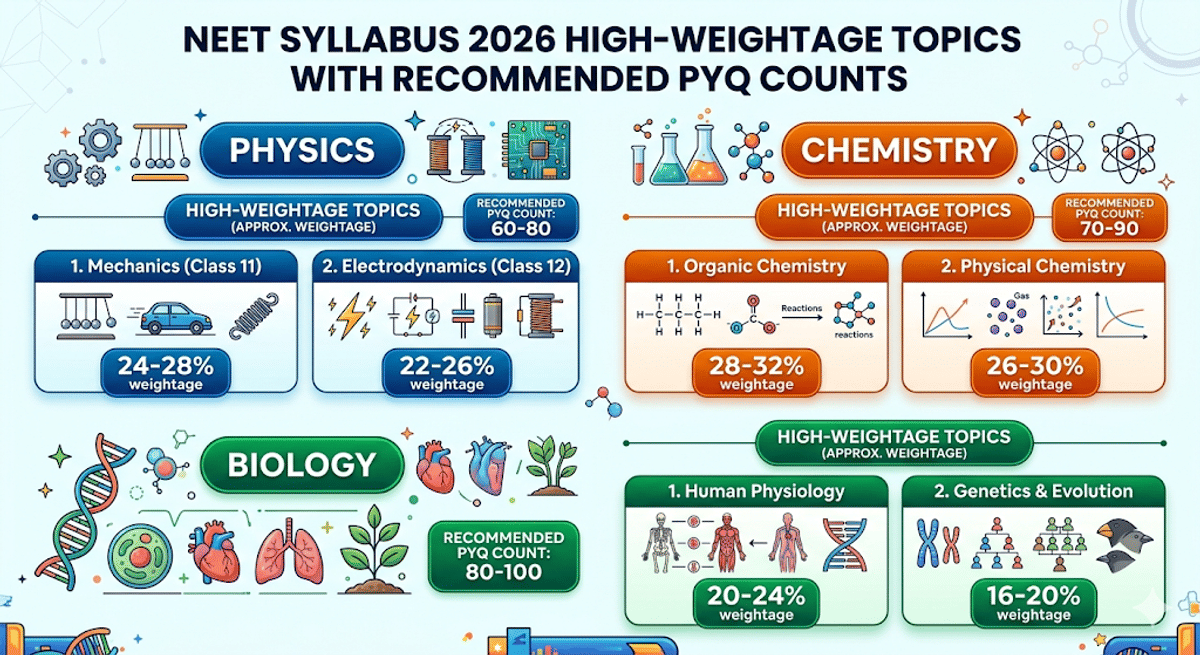
The recommended PYQ counts for NEET 2026 are listed below, along with their expected weightage. For NEET Physics, high-weightage topics include Mechanics and Electrodynamics.
- For Mechanics, the approximate weightage is 24-28%, and the recommended number of PYQs that you must solve is 140+. However, expected weightage for Electrodynamics is 22-26%, and you must solve around 110+ PYQs.
- In NEET Chemistry, you can expect a maximum number of questions from Organic Chemistry (28-32%) and Physical Chemistry (26-30%). You must solve around 130+ PYQs in Organic Chemistry (with focus on mechanisms) and 90+ PYQs in Physical Chemistry (with focus on equilibrium).
- High weightage topics from Biology include Human Physiology (20-24%) and Genetics and Evolution (16-20%). 180+ PYQs are recommended for Human Physiology with a major focus on diagrams, and 110+ PYQs in Genetics and Evolution.
| Subject | Topic | User-Recommended PYQs to Solve |
|---|---|---|
| Physics | Mechanics (Class 11) | 140+ (numericals heavy) |
| Electrodynamics (Class 12) | 110+ | |
| Chemistry | Organic Chemistry | 130+ (mechanisms) |
| Physical Chemistry | 90+ (equilibrium focus) | |
| Biology | Human Physiology | 180+ (diagrams) |
| Genetics & Evolution | 110+ |
Also Read:
Is NEET 487 a Good Score?
A score of 487 in NEET 2026 limits your chances of getting a government seat in MBBS, BDS, and other health courses for the general category. It is possible for reserved categories (SC/ ST/ OBC etc), but expect severe competition.
- Candidates can aim for an MBBS seat in a private college or newer government college with a score of 487 in NEET
NEET 2026 Exam Pattern
As per the NEET 2026 exam pattern, the examination will be conducted in offline mode. The NEET Question paper will comprise 3 sections: Physics, Chemistry, and Biology.
- 45 questions will be asked, each from Physics and Chemistry.
- 90 questions will be asked from the NEET 2026 syllabus for Biology.
- Students will be required to solve a total of 180 questions in 3 hours.
- Total marks in NEET are 720, with 180 marks each from Physics and Chemistry and 360 marks from Biology.
| Particulars | Details |
|---|---|
| Mode of Examination | Offline- pen and paper-based |
| Number of Sections in NEET 2026 | 3 sections |
| NEET 2026 Sections |
|
| Type of Questions in NEET 2026 | MCQs |
| Number of Questions in NEET 2026 | 180 |
| NEET Section-Wise Number of Questions |
|
| NEET Total Marks | 720 |
| NEET Section-Wise Marks |
|
| NEET 2026 Exam Duration | 3 hours |
| NEET 2026 Marking Scheme |
|
Is the NEET Exam Easy?
NEET is considered one of the toughest exams in the country due to the volume of candidates appearing. Every year, almost 23+ lakhs candidates compete for approx 1.1 lakhs medical seats in private and government medical colleges.
- The NEET paper is considered conceptually easier than the JEE Main and Advanced exams
- Subjects like Physics and Chemistry are not as conceptually demanding in NEET as compared to JEE
- NEET, however, is more challenging due to the overall higher competition
NEET Syllabus 2026: Best Books for NEET Preparation
| Subject | Books | Author/ Publisher |
|---|---|---|
| Physics | Concepts of Physics | H.C. Verma |
| Fundamentals of Physics | Halliday, Resnick, and Walker | |
| Problems in General Physics | I.E. Irodov | |
| Understanding Physics | D.C. Pandey | |
| Chemistry | Physical Chemistry | P.W. Atkins |
| Organic Chemistry | Morrison and Boyd | |
| Inorganic Chemistry | J.D. Lee | |
| Organic Chemistry | O.P. Tandon | |
| Biology | Trueman’s Biology (Part 1 and Part 2) | K.N. Bhatia and M.P. Tyagi |
| Objective Biology | Dinesh & K.D. Tripathi | |
| Biology for NEET | C.P. Bansal | |
| Biology Vol 1 & 2 | Dr. S. S. Bhatt |
Source: Reddit
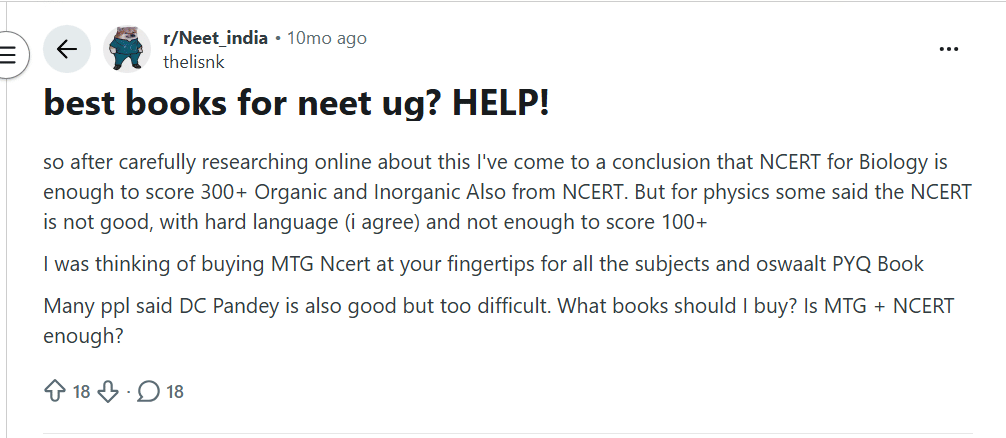
Reddit users were discussing the best books for NEET UG preparation.
NEET Syllabus 2026: 20 Days Preparation Plan
The speaker on the (QS) QUALITY SPEAKS KOTA YouTube channel provided his preparation strategy to crack the NEET 2026 exam in 20 days. His preparation plan is provided in the table below:
| Specific | Details |
|---|---|
| Question-Based Preparation | Focus on solving 5,000 quality questions within 20 days. You should target 250 questions daily: 65 Physics, 65 Chemistry, and 120 Biology. This volume is essential for clearing the cut-off. |
| Resource Selection | Use PYQs, NCERT-based books, and complex problem sets. |
| Efficient Lecture Usage | Do not spend the entire day watching lectures. Use dedicated, short time slots for learning, and prioritize self-study for the majority of the day to ensure retention and practice. |
| Strategic Topic Selection | Avoid starting entirely new, difficult chapters if they require too much time. Instead, focus on strengthening chapters you have previously studied to maximize your scoring potential with the limited time available. |
| Role of Mock Tests | Studying alone is not enough. You must take at least 5-7 mock tests during this period to simulate the exam environment and refine your accuracy. The creator recommends his Prayas test series for relevant practice. |
Final Advice: Avoid the temptation to think about taking a "drop year." Treat the remaining days as a critical, high-stakes sprint. By maintaining a disciplined routine and focusing on high-volume, high-quality question practice, success is achievable.
For more information, check out (QS) QUALITY SPEAKS KOTA’s original video
Also Read:
NEET Syllabus 2026 FAQs
Ques. How do I download the NEET syllabus 2026 PDF?
Ans. The NEET syllabus 2026 is available on the NTA’s official website.
- You can log on to the official website of NEET 2026 at nta.ac.in.
- On the official website, the syllabus will be listed in the notifications section.
- You can click on the link and download the NEET UG syllabus PDF.
Ques. Has the NEET syllabus 2026 changed from the previous year?
Ans. No, the NEET syllabus 2026 is largely the same as the previous year’s syllabus.
Ques. Who is eligible for the NEET exam 2026?
Ans. As per the NEET 2026 eligibility criteria prescribed by NTA, candidates must have completed 17 years of age as on 31 December 2026.
Candidates must have completed class 12th with at least 50% marks aggregate in Physics, Chemistry, and Biology.
Ques. Which year was NEET considered the toughest?
Ans. The NEET 2025 paper is widely regarded as the toughest, especially due to its Physics section.
It featured concept-based numerical problems that demanded in-depth knowledge and problem-solving skills.
Ques. Is frog included in the NEET 2026 syllabus?
Ans. Yes, frog is included in the NEET 2026 syllabus. It falls under the chapter “Structural Organization in Animals” and covers topics like the morphology, anatomy, and functional systems of frogs, along with cockroach studies.
Ques. Is 590 a good score in NEET?
Ans. Yes, scoring 590 in NEET is considered good and can help candidates secure admission in reputed medical colleges such as:
- Indira Gandhi Government Medical College – Maharashtra
- G.S.V.M. Medical College – Uttar Pradesh
- Osmania Medical College – Telangana
- Pt. Raghunath Murmu Medical College – Odisha
- Govt. Medical College ESI & Hospital – Tamil Nadu
- Tirunelveli Medical College – Tamil Nadu
- MKCG Medical College – Odisha
- Jawaharlal Nehru Medical College – Rajasthan
- Pandit Deendayal Upadhyay Medical College – Gujarat



Comments