




NEET 2023 Botany Question Paper with Solutions PDF F4 is available for download. NEET 2023 F4 Botany Question Paper comprises 50 MCQs out of which only 45 are to be attempted. NEET 2023 question F4 Botany is divided into 2 sections- A (35 questions) and B (15 questions).
You can download NEET 2023 Botany question paper with answer key and solutions PDF for F4 using the links given below.
NEET 2023 Botany Question Paper with Solutions PDF F4
| NEET 2023 Botany F4 Question Paper with Answer Key PDF | Download PDF | Check Solutions |

Among eukaryotes, replication of DNA takes place in :
View Solution
Step 1: Understanding the Question:
The question asks to identify the specific phase of the eukaryotic cell cycle where DNA replication occurs.
Step 2: Detailed Explanation:
The eukaryotic cell cycle is divided into four main phases:
1. G\(_1\) phase (Gap 1): This is the phase of cell growth and protein synthesis, where the cell prepares for DNA replication. No DNA replication occurs here.
2. S phase (Synthesis): This is the phase where the cell synthesizes a complete copy of the DNA in its nucleus. The amount of DNA doubles during this phase.
3. G\(_2\) phase (Gap 2): The cell continues to grow and produce proteins and organelles in preparation for mitosis.
4. M phase (Mitosis): This is the phase of nuclear and cell division.
Therefore, DNA replication specifically takes place during the S phase.
Step 3: Final Answer:
Based on the phases of the cell cycle, DNA replication happens in the S phase.
Quick Tip: Remember the mnemonic for the cell cycle: G\(_1\) \(\rightarrow\) S \(\rightarrow\) G\(_2\) \(\rightarrow\) M. The 'S' stands for Synthesis, which refers to the synthesis (replication) of DNA.
Cellulose does not form blue colour with Iodine because
View Solution
Step 1: Understanding the Question:
The question asks for the reason why cellulose does not give a positive result (a blue color) with the iodine test, unlike starch.
Step 2: Detailed Explanation:
The iodine test is used to detect the presence of starch. Starch is a polysaccharide made of two components: amylose and amylopectin. Amylose has a helical (coiled) structure.
When iodine solution is added to starch, the iodine molecules (\(I_2\)) get trapped inside the coils of the amylose helix, forming a starch-iodine complex. This complex absorbs light in a way that gives it a characteristic blue-black color.
Cellulose, on the other hand, is also a polysaccharide of glucose, but it is a linear, unbranched chain of \(\beta\)-1,4 linked glucose units. It does not form helical structures like amylose. Because it lacks these complex helices, there are no spaces to trap the iodine molecules. Consequently, no blue-black color is produced.
Step 3: Final Answer:
Cellulose does not have the helical structure required to trap iodine molecules, so it does not turn blue with iodine.
Quick Tip: The blue color in the iodine test is specific to the coiled structure of amylose in starch. Cellulose has a straight-chain structure, which is why it doesn't react.
In gene gun method used to introduce alien DNA into host cells, microparticles of _________________ metal are used.
View Solution
Step 1: Understanding the Question:
The question asks about the type of metal microparticles used in the gene gun method (biolistics) for genetic transformation.
Step 2: Detailed Explanation:
The gene gun method, also known as biolistics, is a technique for introducing foreign DNA into cells, particularly plant cells which have a rigid cell wall.
In this method, the DNA of interest is coated onto the surface of very small, high-density microparticles. These microparticles act as "bullets".
The metals chosen must be dense, so they have enough momentum to penetrate the cell wall and membrane, and chemically inert, so they do not react with the DNA or cellular components.
Gold (Au) and Tungsten (W) are heavy, dense, and chemically inert metals that are ideal for this purpose. They are used as microprojectiles to carry the foreign DNA into the target cells.
Step 3: Final Answer:
Microparticles of heavy and inert metals like Tungsten or Gold are used in the gene gun method.
Quick Tip: Think of the gene gun as firing tiny, non-reactive "bullets" to deliver genes. Gold (Au) and Tungsten (W) are perfect for this role due to their high density and chemical stability.
What is the function of tassels in the corn cob?
View Solution
Step 1: Understanding the Question:
The question asks for the function of the structures referred to as "tassels in the corn cob." There is a common point of confusion in the terminology here. The corn plant has a tassel at the top and ears (cobs) on the side. The tassel is the male part, and the silk emerging from the cob is the female part. The question's phrasing "tassels in the corn cob" most likely refers to the silks that emerge from the cob. Given the provided answer key, we will address the function of the silks.
Step 2: Detailed Explanation:
In a maize (corn) plant:
Tassel: This is the male inflorescence located at the apex of the plant. Its function is to produce and disperse pollen grains (Option B).
Ear (Corn Cob): This is the female inflorescence. It contains the ovules, which develop into kernels (seeds) after fertilization.
Silks: These are the long, thread-like styles that emerge from the top of the ear. Each silk is connected to an ovule. The function of the feathery silks is to trap airborne pollen grains (Option A).
The question is poorly phrased. However, the correct answer is given as (1) "To trap pollen grains," which is the function of the silks associated with the corn cob. If the question were strictly about the tassel, the answer would be (2). We proceed based on the provided answer.
Step 3: Final Answer:
The silks emerging from the corn cob are designed to trap pollen grains to facilitate fertilization.
Quick Tip: In maize: Tassel (top) is male and disperses pollen. Silk (on the ear/cob) is female and traps pollen. Remember this distinction to avoid confusion.
Given below are two statements: One is labelled as Assertion A and the other is labelled as Reason R :
Assertion A: Late wood has fewer xylary elements with narrow vessels.
Reason R: Cambium is less active in winters.
In the light of the above statements, choose the correct answer from the options given below :
View Solution
Step 1: Understanding the Question:
This is an Assertion-Reason question. We need to evaluate if Assertion (A) and Reason (R) are true, and if R is the correct explanation for A.
Step 2: Detailed Explanation:
Evaluating Assertion A: In temperate regions, the vascular cambium forms two types of secondary xylem (wood) in a year. The wood formed in the later part of the growing season (autumn/winter) is called late wood or autumn wood. This wood is characterized by having fewer xylary elements, and the vessels are narrow and thick-walled. So, Assertion A is true.
Evaluating Reason R: The activity of the vascular cambium is controlled by physiological and environmental factors, such as temperature. In winter or autumn, the conditions are less favorable for growth, so the cambium becomes less active. In spring, when conditions are favorable, the cambium is highly active. So, Reason R is true.
Connecting A and R: Because the cambium is less active in winters (Reason R), it produces fewer xylary elements, and the vessels formed are narrower (Assertion A). This is a direct cause-and-effect relationship. The reduced activity of the cambium leads to the characteristic structure of late wood.
Step 3: Final Answer:
Both Assertion A and Reason R are true statements, and Reason R correctly explains why late wood has the structure described in Assertion A.
Quick Tip: For Assertion-Reason questions, first verify each statement independently. Then, connect them by asking "Why [Assertion]?" If the answer is "[Reason]," then the reason is the correct explanation.
The historic Convention on Biological Diversity, 'The Earth Summit' was held in Rio de Janeiro in the year
View Solution
Step 1: Understanding the Question:
This is a factual question asking for the year of the Earth Summit held in Rio de Janeiro, where the Convention on Biological Diversity (CBD) was established.
Step 2: Detailed Explanation:
The United Nations Conference on Environment and Development (UNCED), popularly known as the Earth Summit or the Rio Summit, was a major international conference held in Rio de Janeiro, Brazil, from June 3 to 14, 1992.
One of the key outcomes of this summit was the opening for signature of the Convention on Biological Diversity (CBD), a multilateral treaty with objectives for conserving biological diversity, the sustainable use of its components, and the fair and equitable sharing of benefits arising out of the utilization of genetic resources.
Step 3: Final Answer:
The Earth Summit was held in Rio de Janeiro in 1992.
Quick Tip: Memorize key dates for environmental treaties: Earth Summit (Rio) - 1992, Kyoto Protocol - 1997, World Summit (Johannesburg) - 2002.
What is the role of RNA polymerase III in the process of transcription in Eukaryotes?
View Solution
Step 1: Understanding the Question:
The question asks to identify the specific types of RNA transcribed by RNA polymerase III in eukaryotic cells.
Step 2: Detailed Explanation:
In eukaryotes, there are three main types of RNA polymerases, each responsible for transcribing different classes of genes:
RNA Polymerase I: Located in the nucleolus, it transcribes the genes for ribosomal RNAs (rRNAs), specifically the 28S, 18S, and 5.8S rRNA molecules.
RNA Polymerase II: Located in the nucleoplasm, it transcribes the precursor of messenger RNA (mRNA), which is called heterogeneous nuclear RNA (hnRNA), as well as most small nuclear RNAs (snRNAs) and microRNAs (miRNAs).
RNA Polymerase III: Located in the nucleoplasm, it is responsible for transcribing the genes for transfer RNA (tRNA), 5S rRNA (a component of the ribosome), and some other small RNAs, including the U6 snRNA.
Therefore, RNA polymerase III transcribes tRNA, 5S rRNA, and snRNAs.
Step 3: Final Answer:
The role of RNA polymerase III is the transcription of tRNA, 5S rRNA, and snRNA.
Quick Tip: Use the mnemonic "1, 2, 3 = r, m, t" to remember the main products: Pol I \(\rightarrow\) rRNA, Pol II \(\rightarrow\) mRNA, Pol III \(\rightarrow\) tRNA. Remember the exceptions like 5S rRNA, which is made by Pol III.
Identify the pair of heterosporous pteridophytes among the following:
View Solution
Step 1: Understanding the Question:
The question asks to identify a pair of pteridophytes that are heterosporous. Heterosporous plants produce two different types of spores: smaller microspores (male) and larger megaspores (female).
Step 2: Detailed Explanation:
Most pteridophytes are homosporous, meaning they produce only one type of spore that develops into a bisexual gametophyte. Examples of homosporous pteridophytes include Lycopodium, \textit{Equisetum, and \textit{Psilotum.
A few genera of pteridophytes are heterosporous. This is an important evolutionary step towards the seed habit seen in gymnosperms and angiosperms. The most common examples of heterosporous pteridophytes are:
\textit{Selaginella (Spike moss)
\textit{Salvinia (a floating fern)
\textit{Marsilea
\textit{Azolla
Looking at the options, the only pair where both plants are heterosporous is \textit{Selaginella and \textit{Salvinia.
Step 3: Final Answer:
Both \textit{Selaginella and \textit{Salvinia are well-known examples of heterosporous pteridophytes.
Quick Tip: Memorize the key examples of heterosporous pteridophytes: \textit{Selaginella, Salvinia, Marsilea, and Azolla. This will help you quickly identify the correct answer in such questions.
Given below are two statements :
Statement I: The forces generated by transpiration can lift a xylem-sized column of water over 130 meters height.
Statement II: Transpiration cools leaf surfaces sometimes 10 to 15 degrees by evaporative cooling.
In the light of the above statements, choose the most appropriate answer from the options given below :
View Solution
Step 1: Understanding the Question:
We need to evaluate the correctness of two separate statements related to the phenomenon of transpiration in plants.
Step 2: Detailed Explanation:
Analysis of Statement I: The ascent of sap in tall trees is primarily explained by the cohesion-tension-transpiration pull model. Water molecules have strong cohesive forces (attraction to each other) and adhesive forces (attraction to xylem walls). The evaporation of water from the leaf surfaces (transpiration) creates a negative pressure potential or tension in the xylem. This pull is transmitted down the continuous water column all the way to the roots. This force is remarkably strong and is sufficient to lift water to the tops of the tallest trees, which can exceed 100 meters. A height of 130 meters is within the theoretical and observed limits of this force. Therefore, Statement I is correct.
Analysis of Statement II: Transpiration is the process of water evaporating from the surfaces of leaves. Evaporation requires energy, which is taken from the leaf in the form of heat (latent heat of vaporization). This process, known as evaporative cooling, helps to dissipate heat and prevents the leaves from overheating, especially under intense sunlight. This cooling effect can lower the leaf temperature by 10 to 15 degrees Celsius compared to the surrounding air. Therefore, Statement II is also correct.
Step 3: Final Answer:
Both statements accurately describe important aspects of transpiration. Statement I describes the power of the transpiration pull, and Statement II describes its cooling effect. Thus, both statements are correct.
Quick Tip: Remember that transpiration has two major benefits for a plant: pulling water and minerals up from the soil and cooling the leaves to prevent heat damage.
The reaction centre in PS II has an absorption maxima at
View Solution
Step 1: Understanding the Question:
The question asks for the wavelength of maximum light absorption for the reaction center of Photosystem II (PS II).
Step 2: Detailed Explanation:
Photosynthesis in higher plants involves two photosystems, Photosystem I (PS I) and Photosystem II (PS II), which work in series. Each photosystem consists of a light-harvesting complex and a reaction center. The reaction center contains a special pair of chlorophyll 'a' molecules that are responsible for the primary photochemical event.
Photosystem II (PS II): Its reaction center is called P680, because it has an absorption maximum at a wavelength of 680 nm.
Photosystem I (PS I): Its reaction center is called P700, because it has an absorption maximum at a wavelength of 700 nm.
The question specifically asks about PS II.
Step 3: Final Answer:
The reaction center in PS II is P680, which has an absorption maximum at 680 nm.
Quick Tip: Associate the photosystem number with the wavelength: PS I \(\rightarrow\) P700 and PS II \(\rightarrow\) P680. Note that PS II comes first in the electron transport chain, despite its name.
Among 'The Evil Quartet', which one is considered the most important cause driving extinction of species?
View Solution
Step 1: Understanding the Question:
The question asks to identify the primary cause of species extinction from the four major causes collectively known as 'The Evil Quartet'.
Step 2: Detailed Explanation:
'The Evil Quartet' is a term used to describe the four main causes of biodiversity loss:
Habitat Loss and Fragmentation: This involves the destruction or division of natural habitats due to activities like deforestation, urbanization, and agriculture. It is widely considered the single most important cause of extinction. When an organism's home is destroyed or broken into small, isolated patches, it can no longer survive and reproduce effectively. For example, the destruction of tropical rainforests is leading to the extinction of a vast number of species.
Over-exploitation: This refers to harvesting species from the wild at rates faster than natural populations can recover (e.g., overfishing, overhunting).
Alien Species Invasions: When non-native species are introduced into an ecosystem, they can outcompete native species for resources, introduce diseases, or become predators, leading to the decline and extinction of native species.
Co-extinctions: This occurs when the extinction of one species causes the extinction of another species that depended on it, such as a plant and its specific pollinator.
Among these four, habitat loss and fragmentation is the leading driver of species extinction globally.
Step 3: Final Answer:
Habitat loss and fragmentation is considered the most important cause driving species to extinction.
Quick Tip: While all four causes in the 'Evil Quartet' are significant, always remember that destroying a species' home (habitat loss) is the number one threat to its survival.
Which of the following stages of meiosis involves division of centromere?
View Solution
Step 1: Understanding the Question:
The question asks to identify the specific stage in meiosis where the centromere of a chromosome divides. The division of the centromere leads to the separation of sister chromatids.
Step 2: Detailed Explanation:
Let's analyze the key events in meiosis:
Meiosis I: This is a reductional division. In Anaphase I, homologous chromosomes separate and move to opposite poles. The sister chromatids, however, remain attached at their centromeres. The centromeres do not divide in Meiosis I.
Meiosis II: This is an equational division, very similar to mitosis.
In Metaphase II, chromosomes (each with two sister chromatids) align at the metaphase plate.
In Anaphase II, the centromere of each chromosome finally divides, allowing the sister chromatids to separate and move to opposite poles. These separated chromatids are now considered individual chromosomes.
Therefore, the division of the centromere occurs during Anaphase II.
Step 3: Final Answer:
Based on the process of meiosis, the centromere splits during Anaphase II.
Quick Tip: Remember: Meiosis I separates homologous chromosomes, while Meiosis II separates sister chromatids. The separation of sister chromatids requires the centromere to split, which happens in Anaphase II.
Spraying of which of the following phytohormone on juvenile conifers helps hastening the maturity period, that leads early seed production?
View Solution
Step 1: Understanding the Question:
The question asks which plant hormone can be used to speed up the maturation process in juvenile conifers to achieve early seed production.
Step 2: Detailed Explanation:
Let's review the functions of the given hormones:
Gibberellic Acid (GA): Gibberellins have many roles, including promoting stem elongation (bolting), germination, and breaking dormancy. A key commercial application is in forestry, where spraying juvenile conifers with GAs hastens their maturity, leading to earlier flowering and seed production. This is useful for breeding programs.
Zeatin: This is a type of cytokinin, primarily involved in promoting cell division, delaying senescence, and overcoming apical dominance. It does not hasten maturity.
Abscisic Acid (ABA): This is a stress hormone, involved in dormancy, stomatal closure, and abscission. It generally inhibits growth.
Indole-3-butyric Acid (IBA): This is a type of auxin, primarily used to induce rooting in stem cuttings.
The specific function of hastening the maturity period in conifers is a well-known effect of Gibberellic acid.
Step 3: Final Answer:
Gibberellic acid is the phytohormone used to accelerate maturity and promote early seed production in juvenile conifers.
Quick Tip: Associate Gibberellins with "growth and speed": stem elongation (bolting), faster germination, and hastening maturity in conifers.
Identify the correct statements:
A. Detrivores perform fragmentation.
B. The humus is further degraded by some microbes during mineralization.
C. Water soluble inorganic nutrients go down into the soil and get precipitated by a process called leaching.
D. The detritus food chain begins with living organisms.
E. Earthworms break down detritus into smaller particles by a process called catabolism.
Choose the correct answer from the options given below:
View Solution
Step 1: Understanding the Question:
The question asks us to identify the correct statements about the process of decomposition from a given list.
Step 2: Detailed Explanation:
Let's analyze each statement:
A. Detrivores perform fragmentation. Detrivores, like earthworms, are organisms that feed on detritus (dead organic matter). They mechanically break down this detritus into smaller particles. This process is called fragmentation. This statement is correct.
B. The humus is further degraded by some microbes during mineralization. Humus is a dark, amorphous substance that is highly resistant to microbial action and decomposes slowly. Over time, microbes degrade this humus, releasing the locked-in inorganic nutrients. This process is called mineralization. This statement is correct.
C. Water soluble inorganic nutrients go down into the soil and get precipitated by a process called leaching. Leaching is the process by which water percolating through the soil carries soluble inorganic nutrients downwards into the soil horizons, where they may become unavailable to plants. This statement is correct.
D. The detritus food chain begins with living organisms. This is incorrect. The detritus food chain (DFC) begins with dead organic matter (detritus). The grazing food chain (GFC) begins with living organisms (producers). This statement is incorrect.
E. Earthworms break down detritus into smaller particles by a process called catabolism. Earthworms break down detritus into smaller particles by fragmentation. Catabolism is the enzymatic process where bacteria and fungi degrade detritus into simpler inorganic substances. Therefore, the process described is fragmentation, not catabolism. This statement is incorrect.
Thus, the only correct statements are A, B, and C.
Step 3: Final Answer:
Statements A, B, and C are correct descriptions of processes involved in decomposition.
Quick Tip: Remember the steps of decomposition in order: Fragmentation (physical breakdown) \(\rightarrow\) Leaching (loss of soluble nutrients) \(\rightarrow\) Catabolism (enzymatic breakdown) \(\rightarrow\) Humification (forming humus) \(\rightarrow\) Mineralization (release of inorganic nutrients).
Which micronutrient is required for splitting of water molecule during photosynthesis?
View Solution
Step 1: Understanding the Question:
The question asks for the specific micronutrient that is essential for the photolysis (splitting) of water during the light-dependent reactions of photosynthesis.
Step 2: Detailed Explanation:
The splitting of water molecules (\(2H_2O \rightarrow 4H^+ + O_2 + 4e^-\)) occurs in Photosystem II (PS II). This reaction is catalyzed by the Oxygen Evolving Complex (OEC). The OEC is a metalloenzyme complex containing a cluster of four manganese ions (\(Mn\)) and one calcium ion (\(Ca^{2+}\)). Chloride ions (\(Cl^-\)) are also required for this process.
Manganese (Mn): It is the central component of the OEC and is directly involved in the redox reactions that lead to water oxidation.
Magnesium (Mg): This is a macronutrient and a central atom in the chlorophyll molecule, essential for capturing light energy, but not for splitting water.
Molybdenum (Mo): This is a component of enzymes like nitrate reductase and nitrogenase, involved in nitrogen metabolism.
Copper (Cu): This is a component of plastocyanin, an electron carrier between PS II and PS I.
Therefore, manganese is the crucial micronutrient for water splitting.
Step 3: Final Answer:
Manganese (Mn) is required for the splitting of water during photosynthesis.
Quick Tip: For water splitting in photosynthesis, remember the trio: Manganese (Mn), Calcium (Ca), and Chlorine (Cl). Mn is the most frequently asked micronutrient in this context.
Large, colourful, fragrant flowers with nectar are seen in
View Solution
Step 1: Understanding the Question:
The question describes a set of floral characteristics (large, colourful, fragrant, with nectar) and asks to identify the type of pollination associated with these features.
Step 2: Detailed Explanation:
Plants have evolved specific floral characteristics to attract their pollinating agents. Let's analyze the options:
Insect pollinated plants (Entomophily): These plants need to attract insects. Their flowers are typically large, brightly coloured (to be visually conspicuous), fragrant (to attract insects from a distance), and produce nectar as a floral reward. This description perfectly matches the question.
Bird pollinated plants (Ornithophily): Flowers are often large and brightly coloured (especially red or orange), but are usually not fragrant, as birds have a poor sense of smell. They produce copious amounts of dilute nectar.
Bat pollinated plants (Chiropterophily): Flowers are typically large, pale or dull-coloured, open at night, and have a strong, musty or fruity odour. They also produce a large amount of nectar.
Wind pollinated plants (Anemophily): These flowers do not need to attract pollinators. They are typically small, inconspicuous, not colourful, lack fragrance, and do not produce nectar. They produce large amounts of light, non-sticky pollen.
The combination of large, colourful, fragrant, and nectar-rich flowers is the classic syndrome for insect pollination.
Step 3: Final Answer:
The described characteristics are adaptations for attracting insects for pollination.
Quick Tip: To remember pollination syndromes: Insects = Colour + Scent + Nectar. Birds = Colour + Nectar (no scent). Wind = Small + Dull + No attractants.
Movement and accumulation of ions across a membrane against their concentration gradient can be explained by
View Solution
Step 1: Understanding the Question:
The question asks for the mechanism that explains the movement of ions across a cell membrane from a region of lower concentration to a region of higher concentration, i.e., "against their concentration gradient."
Step 2: Detailed Explanation:
Let's define the given transport mechanisms:
Passive Transport: This is the movement of substances across a membrane down their concentration gradient (from high to low concentration) without the expenditure of cellular energy. Simple diffusion is a type of passive transport.
Facilitated Diffusion: This is a type of passive transport where substances move down their concentration gradient with the help of membrane proteins (channels or carriers). It does not require energy.
Osmosis: This is the specific movement of water molecules across a semipermeable membrane from a region of high water potential to a region of low water potential. It is a form of passive transport.
Active Transport: This is the movement of substances across a membrane against their concentration gradient (from low to high concentration). This process requires specific carrier proteins and the expenditure of metabolic energy, usually in the form of ATP.
Since the question describes movement against the concentration gradient, it must be active transport.
Step 3: Final Answer:
The transport mechanism that moves substances against a concentration gradient by expending energy is active transport.
Quick Tip: Think of "active" as requiring effort (energy) to go "uphill" (against the gradient). "Passive" means no effort is needed to go "downhill" (down the gradient).
The thickness of ozone in a column of air in the atmosphere is measured in terms of :
View Solution
Step 1: Understanding the Question:
This is a factual question asking for the unit used to measure the thickness of the atmospheric ozone layer.
Step 2: Detailed Explanation:
Let's look at the units mentioned:
Decibels (dB): A unit used to measure the intensity of a sound or the power level of an electrical signal.
Decameter (dam): A unit of length equal to 10 meters.
Kilobase (kb): A unit of length for DNA or RNA fragments, equal to 1000 base pairs.
Dobson units (DU): This is the standard unit for measuring the total amount of ozone in a vertical column of the atmosphere. One Dobson Unit is the number of ozone molecules that would be required to create a layer of pure ozone 0.01 millimeters thick at a temperature of 0 degrees Celsius and a pressure of 1 atmosphere.
The correct unit for measuring ozone column thickness is the Dobson unit.
Step 3: Final Answer:
The thickness of the ozone layer is measured in Dobson units (DU).
Quick Tip: Memorize standard units of measurement for key environmental parameters: Ozone \(\rightarrow\) Dobson Units (DU), Sound \(\rightarrow\) Decibels (dB), Particulate Matter \(\rightarrow\) micrometers (\(\mu\)m).
Upon exposure to UV radiation, DNA stained with ethidium bromide will show
View Solution
Step 1: Understanding the Question:
The question asks about the appearance of DNA when it is stained with ethidium bromide and then exposed to ultraviolet (UV) light. This is a standard technique used in molecular biology.
Step 2: Detailed Explanation:
Agarose gel electrophoresis is a technique used to separate DNA fragments by size. Because DNA is not visible to the naked eye, a staining agent is used to visualize it.
Staining: Ethidium bromide (EtBr) is a fluorescent intercalating agent. It inserts itself between the base pairs of the DNA double helix.
Visualization: When the agarose gel containing the DNA-EtBr complex is exposed to UV radiation, the ethidium bromide absorbs the UV light and fluoresces.
Colour: The light emitted by the fluorescing complex is in the orange part of the visible spectrum. Therefore, the DNA bands appear as bright orange bands on the gel.
Other colours listed are incorrect for this specific staining method.
Step 3: Final Answer:
DNA stained with ethidium bromide fluoresces bright orange under UV light.
Quick Tip: Remember the combination for visualizing DNA in gels: DNA + Ethidium Bromide (EtBr) + UV light = Bright Orange Bands.
Unequivocal proof that DNA is the genetic material was first proposed by
View Solution
Step 1: Understanding the Question:
The question asks to identify the scientist(s) who provided the "unequivocal" or definitive proof that DNA is the genetic material.
Step 2: Detailed Explanation:
Let's review the contributions of the scientists listed:
Frederick Griffith (1928): Conducted the "transforming principle" experiment with Streptococcus pneumoniae. He showed that some substance from heat-killed pathogenic bacteria could transform harmless bacteria into pathogenic ones, but he did not identify the substance.
Avery, Macleod, and McCarthy (1944): They expanded on Griffith's work and demonstrated through biochemical experiments that the transforming principle was DNA. However, their findings were not universally accepted by the scientific community at the time, as many still believed protein was the more likely candidate for genetic material.
Alfred Hershey and Martha Chase (1952): They conducted the famous "blender experiment" using bacteriophages (viruses that infect bacteria). They used radioactive isotopes to label the phage's protein coat (\(^{35S\)) and its DNA (\(^{32}P\)). They showed that only the radioactive DNA entered the host bacterial cell to direct the synthesis of new viruses. This provided clear, unambiguous, and widely accepted proof that DNA is the genetic material.
Wilkins and Franklin: They used X-ray diffraction to study the structure of DNA, which was crucial for Watson and Crick's model, but they did not conduct experiments to prove it was the genetic material.
The Hershey-Chase experiment is considered the "unequivocal proof" that settled the debate.
Step 3: Final Answer:
Alfred Hershey and Martha Chase provided the definitive proof that DNA is the genetic material.
Quick Tip: To distinguish the experiments: Griffith = Transformation principle. Avery et al. = Identified DNA as the principle. Hershey & Chase = Unequivocal proof with radioactive phages.
In tissue culture experiments, leaf mesophyll cells are put in a culture medium to form callus. This phenomenon may be called as
View Solution
Step 1: Understanding the Question:
The question describes a process in plant tissue culture where differentiated cells (leaf mesophyll cells) are induced to divide and form an undifferentiated mass (callus). We need to name this phenomenon.
Step 2: Detailed Explanation:
Let's define the terms related to cell differentiation:
Differentiation: The process by which a less specialized cell becomes a more specialized cell type. For example, a meristematic cell differentiating into a mesophyll cell.
Dedifferentiation: The process by which mature, differentiated, non-dividing cells (like mesophyll cells) revert to a meristematic state and regain the power of cell division. This leads to the formation of an undifferentiated mass of cells called a callus. This exactly matches the process described in the question.
Redifferentiation: The process by which the dedifferentiated cells of the callus differentiate again to form specialized cells and tissues, leading to the formation of a whole plantlet.
Development: The overall sum of processes (growth and differentiation) that an organism undergoes in its life cycle.
Senescence: The process of aging in plants.
The phenomenon where differentiated leaf cells form an undifferentiated callus is called dedifferentiation.
Step 3: Final Answer:
The process is known as dedifferentiation.
Quick Tip: Remember the sequence in tissue culture: Differentiated explant \(\xrightarrow{Dedifferentiation}\) Undifferentiated Callus \(\xrightarrow{Redifferentiation}\) Differentiated Plantlet.
Given below are two statements: One is labelled as Assertion A and the other is labelled as Reason R :
Assertion A: ATP is used at two steps in glycolysis.
Reason R: First ATP is used in converting glucose into glucose-6-phosphate and second ATP is used in conversion of fructose-6-phosphate into fructose-1, 6-diphosphate.
In the light of the above statements, choose the correct answer from the options given below :
View Solution
Step 1: Understanding the Question:
This is an Assertion-Reason question about the use of ATP in the glycolysis pathway. We need to check if both statements are true and if the Reason correctly explains the Assertion.
Step 2: Detailed Explanation:
Evaluating Assertion A: Glycolysis is a 10-step pathway. The initial phase is called the preparatory or investment phase, where energy is consumed. In this phase, two molecules of ATP are indeed used per molecule of glucose. So, Assertion A is true.
Evaluating Reason R: Let's look at the specific steps where ATP is used:
Step 1: Glucose is phosphorylated to glucose-6-phosphate by the enzyme hexokinase. This reaction consumes one molecule of ATP.
\[ Glucose + ATP \xrightarrow{Hexokinase} Glucose-6-phosphate + ADP \]
Step 3: Fructose-6-phosphate is phosphorylated to fructose-1,6-bisphosphate by the enzyme phosphofructokinase-1. This reaction consumes a second molecule of ATP.
\[ Fructose-6-phosphate + ATP \xrightarrow{Phosphofructokinase} Fructose-1,6-bisphosphate + ADP \]
Reason R correctly identifies these two specific steps. So, Reason R is also true.
Connecting A and R: The Assertion states that ATP is used at two steps. The Reason specifies exactly which two steps these are. Therefore, the Reason is the correct and precise explanation for the Assertion.
Step 3: Final Answer:
Both Assertion A and Reason R are true, and R is the correct explanation of A.
Quick Tip: For glycolysis, remember the "investment" phase uses 2 ATP at steps 1 and 3, and the "payoff" phase generates 4 ATP and 2 NADH, for a net gain of 2 ATP and 2 NADH.
The process of appearance of recombination nodules occurs at which sub stage of prophase I in meiosis?
View Solution
Step 1: Understanding the Question:
The question asks to identify the specific substage of Prophase I of meiosis where recombination nodules appear. These nodules are the sites of crossing over.
Step 2: Detailed Explanation:
Prophase I is a long phase divided into five substages:
Leptotene: Chromosomes start to condense and become visible.
Zygotene: Homologous chromosomes pair up in a process called synapsis, forming bivalents. The synaptonemal complex begins to form.
Pachytene: Synapsis is complete. The paired chromosomes are clearly visible as bivalents or tetrads. During this stage, recombination nodules appear on the synaptonemal complex. These are the sites where crossing over (the exchange of genetic material between non-sister chromatids of homologous chromosomes) occurs. The enzyme recombinase is involved.
Diplotene: The synaptonemal complex dissolves, and the homologous chromosomes start to separate, but they remain attached at the sites of crossing over, forming X-shaped structures called chiasmata.
Diakinesis: Chiasmata move towards the ends of the chromatids (terminalisation). The nuclear envelope breaks down, and the spindle begins to form.
Therefore, the appearance of recombination nodules is a characteristic feature of the Pachytene stage.
Step 3: Final Answer:
Recombination nodules, the sites of crossing over, appear during the Pachytene substage of Prophase I.
Quick Tip: Remember the sequence of Prophase I stages with the mnemonic: "Lazy Zebra Paints Dots Daily" (Leptotene, Zygotene, Pachytene, Diplotene, Diakinesis). Associate Pachytene with "Packing" together and exchanging parts (crossing over).
In the equation GPP - R = NPP
GPP is Gross Primary Productivity
NPP is Net Primary Productivity
R here is ___________
View Solution
Step 1: Understanding the Question:
The question asks for the meaning of the term 'R' in the ecological equation relating Gross Primary Productivity (GPP) and Net Primary Productivity (NPP).
Step 2: Key Formula or Approach:
The fundamental equation for energy flow at the producer level is:
\[ NPP = GPP - R \]
Step 3: Detailed Explanation:
Gross Primary Productivity (GPP): This is the total rate at which solar energy is captured by producers (like plants) during photosynthesis to produce organic matter. It represents the total amount of food or energy produced.
Respiratory Loss (R): Producers, being living organisms, need energy to carry out their own life processes (respiration, growth, maintenance). A significant portion of the energy captured in GPP is used up by the plant for its own cellular respiration. This energy is lost as heat.
Net Primary Productivity (NPP): This is the rate at which producers create new biomass after accounting for the energy lost to respiration. It is the energy that is available to the next trophic level (herbivores).
Therefore, 'R' in the equation represents the energy lost by producers through respiration.
Step 4: Final Answer:
In the equation GPP - R = NPP, R stands for Respiratory loss.
Quick Tip: Think of GPP as the 'gross salary' of a plant. 'R' is the 'tax' or 'living expenses' (respiration). NPP is the 'net salary' or 'take-home pay' which is the energy available for growth and to be eaten by others.
The phenomenon of pleiotropism refers to
View Solution
Step 1: Understanding the Question:
The question asks for the definition of pleiotropism (or pleiotropy).
Step 2: Detailed Explanation:
Let's analyze the genetic phenomena described in the options:
Pleiotropy: This is a genetic phenomenon where a single gene controls or influences multiple, often unrelated, phenotypic traits. A classic example is the gene for phenylketonuria (PKU) in humans, which can cause mental retardation, reduced hair pigmentation, and skin issues, all from a single defective gene. Option (B) correctly defines this.
Polygenic Inheritance: This is the opposite of pleiotropy. It's when a single phenotypic character is controlled by more than one gene. Examples include human skin color and height. Option (C) describes polygenic inheritance.
Options (A) and (D) are confusingly worded and do not accurately describe standard genetic principles. Option (A) seems to be a misstatement about dihybrid inheritance. Option (D) incorrectly links multiple alleles to crossing over. Multiple alleles refer to a gene having more than two allelic forms in a population (e.g., ABO blood groups).
Thus, pleiotropism is when one gene has many effects.
Step 3: Final Answer:
The correct definition of pleiotropism is a single gene affecting multiple phenotypic expressions.
Quick Tip: Remember: \textbf{Pleio}tropy \(\rightarrow\) One gene \(\rightarrow\) \textbf{Plethora} of effects. \textbf{Poly}genic \(\rightarrow\) \textbf{Many} genes \(\rightarrow\) One effect.
During the purification process for recombinant DNA technology, addition of chilled ethanol precipitates out
View Solution
Step 1: Understanding the Question:
The question asks what biomolecule is precipitated when chilled ethanol is added during the final steps of DNA purification.
Step 2: Detailed Explanation:
The process of isolating DNA from cells involves several steps:
Lysis: Breaking open the cells to release their contents, including DNA.
Purification: Removing cellular debris and other macromolecules like proteins, RNA, lipids, and polysaccharides. This is done using enzymes like proteases (to digest proteins like histones) and RNases (to digest RNA).
Precipitation: After purification, the DNA is in an aqueous solution. DNA is insoluble in alcohols like ethanol or isopropanol. When chilled ethanol is added to the solution, the DNA precipitates out of the solution as a mass of fine, white threads. The chilling reduces the solubility further, maximizing the yield. This allows the DNA to be collected by spooling it onto a glass rod.
Therefore, the addition of chilled ethanol is the standard method for precipitating purified DNA.
Step 3: Final Answer:
Adding chilled ethanol causes the purified DNA to precipitate out of the solution.
Quick Tip: In DNA extraction, chilled ethanol is like a "magnet" that pulls DNA out of the liquid solution, making it visible and easy to collect.
In angiosperm, the haploid, diploid and triploid structures of a fertilized embryo sac sequentially are :
View Solution
Step 1: Understanding the Question:
The question asks to identify a set of structures from a fertilized embryo sac that are, in order, haploid (n), diploid (2n), and triploid (3n).
Step 2: Detailed Explanation:
Let's determine the ploidy level of the structures in a typical angiosperm embryo sac after fertilization (double fertilization):
Haploid (n) structures: After fertilization, the synergids and antipodal cells are haploid but they soon degenerate. However, they are present for a short time.
Diploid (2n) structures: The zygote is formed by the fusion of one haploid male gamete (n) with the haploid egg cell (n). So, the zygote is diploid (2n).
Triploid (3n) structures: The Primary Endosperm Nucleus (PEN) is formed by the fusion of the second haploid male gamete (n) with the diploid secondary nucleus (formed from the fusion of two haploid polar nuclei, n+n). So, the PEN is triploid (3n).
Now let's check the options for the sequence haploid (n), diploid (2n), triploid (3n):
(A) Antipodals (n), synergids (n), PEN (3n). Incorrect sequence (n, n, 3n).
(B) Synergids (n), Zygote (2n), PEN (3n). Correct sequence (n, 2n, 3n).
(C) Synergids (n), antipodals (n), Polar nuclei (n+n, not yet fertilized). Incorrect.
(D) Synergids (n), PEN (3n), zygote (2n). Incorrect sequence (n, 3n, 2n).
Thus, the correct sequential representation of ploidy levels is synergids (n), zygote (2n), and primary endosperm nucleus (3n).
Step 3: Final Answer:
The correct sequence of haploid, diploid, and triploid structures is Synergids, Zygote, and Primary endosperm nucleus.
Quick Tip: Remember the results of double fertilization: Egg (n) + Gamete (n) = Zygote (2n). Central Cell (n+n) + Gamete (n) = Endosperm (3n). Any remaining original embryo sac cells (synergids, antipodals) are haploid (n).
Axile placentation is observed in
View Solution
Step 1: Understanding the Question:
The question asks to identify the group of plants that all exhibit axile placentation. Placentation is the arrangement of ovules within the ovary.
Step 2: Detailed Explanation:
In axile placentation, the placenta is axial and the ovules are attached to it in a multilocular (chambered) ovary. The septa (partitions) extend from the ovary wall to the central axis.
Let's examine the placentation types for the plants in each option:
(A) China rose (\textit{Hibiscus): Axile. Beans and Lupin (\textit{Fabaceae family): Marginal. This option is incorrect.
(B) Tomato (\textit{Solanaceae): Axile. Dianthus (\textit{Caryophyllaceae): Free-central. Pea (\textit{Fabaceae): Marginal. This option is incorrect.
(C) China rose (\textit{Malvaceae): Axile. Petunia (\textit{Solanaceae): Axile. Lemon (\textit{Citrus, \textit{Rutaceae): Axile. All three plants show axile placentation. This option is correct.
(D) Mustard (\textit{Brassicaceae): Parietal. Cucumber (\textit{Cucurbitaceae): Parietal. Primrose (\textit{Primulaceae): Free-central. This option is incorrect.
Therefore, the correct group is China rose, Petunia, and Lemon.
Step 3: Final Answer:
China rose, Petunia, and Lemon are all examples of plants with axile placentation.
Quick Tip: To remember axile placentation, think of slicing a tomato or a lemon. You can see the seeds attached to the center with partitions separating them into chambers. Common examples: China rose, Tomato, Lemon, Petunia.
Which hormone promotes internode/petiole elongation in deep water rice?
View Solution
Step 1: Understanding the Question:
The question asks for the specific plant hormone responsible for promoting rapid elongation of internodes or petioles in rice plants that are submerged in deep water.
Step 2: Detailed Explanation:
Deep water rice plants have a unique adaptation to survive flooding. When submerged, the plant rapidly elongates its internodes to keep its leaves and flowering parts above the water surface to ensure access to light and air for photosynthesis and pollination.
This rapid elongation is primarily triggered by the gaseous hormone ethylene. In submerged parts of the plant, ethylene accumulates because its diffusion out of the plant is much slower in water than in air. This increased concentration of ethylene promotes cell elongation in the internodes. Although Gibberellins (like GA\(_3\)) are also involved in stem elongation, ethylene is the key signal in this specific response to submergence in deep water rice.
Kinetin: A cytokinin, primarily promotes cell division.
2, 4-D: A synthetic auxin, used as a herbicide at high concentrations.
GA\(_3\): Gibberellic acid, a general promoter of stem elongation (bolting), but ethylene is the primary trigger in this specific context.
Therefore, ethylene is the correct answer.
Step 3: Final Answer:
Ethylene is the hormone that promotes internode/petiole elongation in deep water rice as an adaptation to flooding.
Quick Tip: Associate ethylene with a range of stress responses and senescence, including the specific case of promoting rapid elongation in submerged plants like deep water rice.
Given below are two statements: One labelled as Assertion A and the other labelled as Reason R:
Assertion A: The first stage of gametophyte in the life cycle of moss is protonema stage.
Reason R: Protonema develops directly from spores produced in capsule.
In the light of the above statements, choose the most appropriate answer from options given below:
View Solution
Step 1: Understanding the Question:
This is an Assertion-Reason question about the life cycle of a moss. We must evaluate the truth of both statements and determine if the Reason explains the Assertion.
Step 2: Detailed Explanation:
Evaluating Assertion A: The life cycle of a moss (a bryophyte) starts with a haploid spore. This spore does not directly develop into the main plant body. Instead, it germinates to form a juvenile, filamentous, creeping, green stage called the protonema. This protonema later develops buds that grow into the leafy, adult gametophyte. Thus, the protonema is indeed the first stage of the gametophyte. Assertion A is correct.
Evaluating Reason R: The spores in a moss are produced within the capsule, which is part of the sporophyte. These haploid spores are formed by meiosis. Upon finding a suitable substrate, these spores germinate and grow directly into the protonema. Reason R is correct.
Connecting A and R: The Assertion states that the protonema is the first stage. The Reason explains the origin of this stage, stating that it develops from a spore. This provides a direct and correct explanation for how the protonema stage comes to be the first stage of the gametophyte. The life of the gametophyte begins with the spore, which develops into the protonema.
Step 3: Final Answer:
Both Assertion A and Reason R are correct, and Reason R is the correct explanation of Assertion A.
Quick Tip: Remember the moss life cycle: Spore (n) \(\rightarrow\) Protonema (juvenile gametophyte, n) \(\rightarrow\) Leafy gametophyte (adult, n) \(\rightarrow\) Gametes (n) \(\rightarrow\) Zygote (2n) \(\rightarrow\) Sporophyte (2n) \(\rightarrow\) Spores (n).
Frequency of recombination between gene pairs on same chromosome as a measure of the distance between genes to map their position on chromosome, was used for the first time by
View Solution
Step 1: Understanding the Question:
The question asks to identify the scientist who first used the frequency of genetic recombination to create a map showing the positions of genes on a chromosome.
Step 2: Detailed Explanation:
Let's review the contributions of the scientists listed:
Sutton and Boveri (1902): Independently proposed the Chromosomal Theory of Inheritance, which states that genes are located on chromosomes.
Thomas Hunt Morgan (early 1900s): Working with \textit{Drosophila melanogaster (fruit flies), he provided experimental proof for the Chromosomal Theory of Inheritance. He discovered concepts like linkage (genes on the same chromosome tend to be inherited together) and recombination (crossing over can separate linked genes).
Alfred Sturtevant (1913): He was a student in T.H. Morgan's lab. He had the brilliant insight that the frequency of recombination between two linked genes is proportional to the physical distance separating them on the chromosome. He used recombination data to construct the very first genetic map for the X-chromosome of \textit{Drosophila.
Henking (1891): While studying insect spermatogenesis, he observed a specific nuclear structure which he named the X-body, later identified as the X chromosome.
While Morgan discovered recombination, it was his student, Alfred Sturtevant, who first utilized the frequency of this phenomenon to map gene positions.
Step 3: Final Answer:
Alfred Sturtevant was the first to use recombination frequency to map genes on a chromosome.
Quick Tip: Morgan was the boss who discovered linkage and recombination. Sturtevant was the brilliant student who used the data to create the first gene map.
Family Fabaceae differs from Solanaceae and Liliaceae. With respect to the stamens, pick out the characteristics specific to family Fabaceae but not found in Solanaceae or Liliaceae.
View Solution
Step 1: Understanding the Question:
The question asks for the characteristic of the stamens (androecium) that is unique to the family Fabaceae when compared to Solanaceae and Liliaceae.
Step 2: Detailed Explanation:
Let's compare the androecium characteristics of the three families:
Fabaceae (Pea family): The androecium consists of ten stamens. The characteristic feature is that they are diadelphous, meaning they are united into two bundles. Typically, nine stamens are fused to form a tube, and one is free (9)+1. The anthers are dithecous (having two lobes).
Solanaceae (Potato family): The androecium has five stamens. They are epipetalous, meaning they are attached to the petals. The anthers are dithecous.
Liliaceae (Lily family): The androecium has six stamens, arranged in two whorls of three (3+3). They are epiphyllous or epitepalous, meaning they are attached to the tepals (undifferentiated perianth lobes). The anthers are dithecous.
Comparing the features, the diadelphous condition is a hallmark of the Fabaceae family and is not found in Solanaceae or Liliaceae. Dithecous anthers are common to all three, but the diadelphous arrangement is the specific distinguishing feature in the given options.
Step 3: Final Answer:
The diadelphous condition of stamens is a specific characteristic of Fabaceae that distinguishes it from Solanaceae and Liliaceae.
Quick Tip: Associate key androecium features with families: Fabaceae \(\rightarrow\) Diadelphous (9)+1. Solanaceae \(\rightarrow\) Epipetalous. Liliaceae \(\rightarrow\) Epiphyllous/Epitepalous.
How many ATP and NADPH\(_2\) are required for the synthesis of one molecule of Glucose during Calvin cycle?
View Solution
Step 1: Understanding the Question:
The question asks for the total number of ATP and NADPH\(_2\) (NADPH) molecules consumed in the Calvin cycle to produce one molecule of glucose.
Step 2: Key Formula or Approach:
The synthesis of one molecule of glucose (\(C_6H_{12}O_6\)) requires the fixation of 6 molecules of carbon dioxide (\(CO_2\)). The Calvin cycle fixes one molecule of \(CO_2\) per turn. Therefore, 6 turns of the cycle are needed to produce one glucose molecule. We need to calculate the energy used per turn and multiply it by 6.
Step 3: Detailed Explanation:
The Calvin cycle has three main stages:
Carboxylation: Fixation of one \(CO_2\) molecule. No energy is used here.
Reduction: The product of carboxylation is reduced. This step uses 2 ATP and 2 NADPH per \(CO_2\) fixed.
Regeneration: The initial \(CO_2\) acceptor (RuBP) is regenerated. This step uses 1 ATP per \(CO_2\) fixed.
Total cost per turn (for 1 \(CO_2\)):
ATP = 2 (from reduction) + 1 (from regeneration) = 3 ATP
NADPH = 2 NADPH
Total cost for 6 turns (for 1 Glucose):
Total ATP = \(6 \times 3\) ATP = 18 ATP
Total NADPH = \(6 \times 2\) NADPH = 12 NADPH
Note: NADPH\(_2\) is an older notation for NADPH + H\(^+\), often simplified to NADPH in modern texts.
Step 4: Final Answer:
To synthesize one molecule of glucose, the Calvin cycle requires 18 ATP and 12 NADPH.
Quick Tip: Remember the 3:2 ratio for the Calvin cycle. For every 1 \(CO_2\) fixed, 3 ATP and 2 NADPH are needed. For glucose (6 \(CO_2\)), just multiply by 6: (6x3) ATP = 18 ATP, and (6x2) NADPH = 12 NADPH.
Expressed Sequence Tags (ESTs) refers to
View Solution
Step 1: Understanding the Question:
The question asks for the definition of Expressed Sequence Tags (ESTs), a tool used in genomics, particularly in the Human Genome Project.
Step 2: Detailed Explanation:
The central dogma states that genes (DNA) are transcribed into RNA, which is then translated into protein. The genes that are actively being used by a cell at a particular time are transcribed into messenger RNA (mRNA).
The process of creating ESTs is as follows:
Isolate all the mRNA from a specific tissue or cell type. This collection of mRNA represents all the genes that are currently being "expressed" in those cells.
Use the enzyme reverse transcriptase to create complementary DNA (cDNA) from the mRNA templates.
Sequence short segments (tags) from one or both ends of these cDNA molecules. These short sequences are the Expressed Sequence Tags (ESTs).
Since ESTs are derived from the mRNA population of a cell, they represent fragments of genes that are expressed as RNA. This is a powerful method for identifying and cataloging all the genes that are active in a given cell type. Option (A) is too narrow because not all transcribed RNAs are translated into proteins (e.g., non-coding RNAs). Option (D) is the most accurate and comprehensive definition.
Step 3: Final Answer:
Expressed Sequence Tags (ESTs) refer to all genes that are expressed as RNA, as they are derived from sequencing parts of cDNA which is made from mRNA.
Quick Tip: Think of the name: "Expressed" means the gene is active (transcribed to RNA). "Sequence Tags" means they are just short pieces of the gene's sequence used for identification. So, ESTs are tags for expressed genes.
Given below are two statements :
Statement I: Endarch and exarch are the terms often used for describing the position of secondary xylem in the plant body.
Statement II: Exarch condition is the most common feature of the root system.
In the light of the above statements, choose the correct answer from the options given below:
View Solution
Step 1: Understanding the Question:
The question asks us to evaluate two statements regarding the arrangement of xylem in plants. We need to determine if each statement is true or false.
Step 2: Detailed Explanation:
Analysis of Statement I: The terms 'endarch' and 'exarch' are used to describe the arrangement of primary xylem, not secondary xylem. These terms refer to the position of the first-formed primary xylem (protoxylem) in relation to the later-formed primary xylem (metaxylem).
Endarch: Protoxylem is located towards the center (pith), and metaxylem is towards the periphery. This is characteristic of stems.
Exarch: Protoxylem is located towards the periphery, and metaxylem is towards the center. This is characteristic of roots.
Since the statement says these terms describe secondary xylem, Statement I is incorrect.
Analysis of Statement II: As defined above, the exarch condition, where the protoxylem is on the outer side and development proceeds inwards, is the characteristic arrangement of primary xylem in the root system of plants. Therefore, Statement II is true.
Step 3: Final Answer:
Based on the analysis, Statement I is incorrect, and Statement II is true.
Quick Tip: Remember: \textbf{Ex}arch is for roots (\textbf{ex}it/external protoxylem), and \textbf{En}darch is for stems (\textbf{en}ter/internal protoxylem). These terms apply only to primary xylem.
Which of the following combinations is required for chemiosmosis?
View Solution
Step 1: Understanding the Question:
The question asks for the essential components required for the process of chemiosmosis, which is the mechanism for synthesizing ATP.
Step 2: Detailed Explanation:
Chemiosmosis, as explained by Peter Mitchell's theory, requires four key components to function:
A Membrane: A selectively permeable membrane (like the inner mitochondrial membrane or the thylakoid membrane) is necessary to separate two aqueous compartments and maintain a concentration difference.
A Proton Pump: A mechanism to pump protons (H\(^+\)) across the membrane from one side to the other. This is typically achieved by the energy released during electron transport in an electron transport chain (ETC).
A Proton Gradient: The action of the proton pump creates an electrochemical potential difference, or a proton gradient (also called proton motive force), across the membrane. This gradient stores potential energy.
ATP Synthase: A specialized enzyme complex embedded in the membrane that provides a channel for protons to flow back down their concentration gradient. As protons flow through ATP synthase, the energy stored in the gradient is used to drive the synthesis of ATP from ADP and inorganic phosphate (Pi).
Option (D) correctly lists all four of these essential components. The other options are incorrect because they mention 'NADP synthase' (which is not an enzyme, it should be NADP reductase) or 'electron gradient' instead of the crucial proton gradient.
Step 3: Final Answer:
The correct combination required for chemiosmosis is a membrane, a proton pump, a proton gradient, and ATP synthase.
Quick Tip: Think of chemiosmosis like a hydroelectric dam: The membrane is the dam, the proton pump creates a high water level (proton gradient), and ATP synthase is the turbine that generates energy (ATP) as water flows through it.
How many different proteins does the ribosome consist of?
View Solution
Step 1: Understanding the Question:
The question asks for the approximate total number of different proteins found in a ribosome. Since the question is general, we typically consider the eukaryotic ribosome.
Step 2: Detailed Explanation:
Ribosomes are complex structures composed of ribosomal RNA (rRNA) and ribosomal proteins.
A eukaryotic ribosome is an 80S ribosome, made up of two subunits:
The large subunit (60S): Contains 3 molecules of rRNA and approximately 49 different proteins.
The small subunit (40S): Contains 1 molecule of rRNA and approximately 33 different proteins.
The total number of different proteins in a eukaryotic ribosome is the sum of the proteins in both subunits:
\[ Total proteins \approx 49 + 33 = 82 \]
Among the given options, 80 is the closest value to the actual number of proteins in a eukaryotic ribosome.
For context, a prokaryotic (70S) ribosome has about 55 proteins.
Step 3: Final Answer:
A eukaryotic ribosome consists of approximately 80 different proteins.
Quick Tip: Remember that eukaryotic ribosomes are 80S (60S + 40S) and have around 80 proteins. The "S" values (Svedberg units) are not additive, but the number of proteins is.
Given below are two statements: One is labelled as Assertion A and the other is labelled as Reason R :
Assertion A: A flower is defined as modified shoot wherein the shoot apical meristem changes to floral meristem.
Reason R: Internode of the shoot gets condensed to produce different floral appendages laterally at successive node instead of leaves.
In the light of the above statements, choose the correct answer from the options given below :
View Solution
Step 1: Understanding the Question:
This is an Assertion-Reason question. We need to evaluate if the Assertion (A) and Reason (R) are true statements and if R correctly explains A.
Step 2: Detailed Explanation:
Evaluating Assertion A: The botanical definition of a flower is that it is a highly modified and condensed reproductive shoot. This modification occurs when the shoot apical meristem (SAM), which normally produces leaves and stems, transforms into a floral meristem. The floral meristem has determinate growth and its function is to produce floral parts. So, Assertion A is a correct statement.
Evaluating Reason R: The modification from a vegetative shoot to a flower involves several key changes. One of the most important is the suppression of internodal elongation, which leads to the condensation of the shoot axis. This brings the nodes very close together. At these successive, condensed nodes, the floral appendages (sepals, petals, stamens, and carpels, which are all modified leaves) are produced laterally instead of vegetative leaves. So, Reason R is also a correct statement.
Connecting A and R: The Reason (R) provides the details of the modification process. It explains *how* the shoot is modified when the shoot apical meristem changes to a floral meristem. The condensation of internodes and the production of floral appendages instead of leaves are the direct consequences of this change described in the Assertion (A). Therefore, Reason R is the correct explanation of Assertion A.
Step 3: Final Answer:
Both Assertion A and Reason R are true, and R correctly explains A.
Quick Tip: To confirm the connection in A-R questions, read the statements as "Assertion because Reason". Here: "A flower is a modified shoot BECAUSE the internodes condense and produce floral parts". This makes perfect logical sense.
Match List I with List II :
List I & List II
A. M Phase & I. & Proteins are synthesized
B. G\(_2\) Phase & II. & Inactive phase
C. Quiescent stage & III. & Interval between mitosis and initiation of
DNA replication
D. G\(_1\) Phase & IV. & Equational division
Choose the correct answer from the options given below :
View Solution
Step 1: Understanding the Question:
The question requires matching the phases of the cell cycle (List I) with their correct descriptions (List II).
Step 2: Detailed Explanation:
Let's match each item from List I to its corresponding description in List II.
A. M Phase: This is the mitosis phase, where the cell divides. Mitosis is known as equational division because the number of chromosomes in the parent and daughter cells remains the same. So, A matches with IV.
B. G\(_2\) Phase: This is the second gap phase, which occurs after DNA synthesis (S phase) and before mitosis (M phase). During this phase, the cell prepares for division, and proteins required for mitosis, such as tubulin for spindle fibers, are synthesized. So, B matches with I.
C. Quiescent stage (G\(_0\)): This is a phase where cells exit the cell cycle and are in a metabolically active but non-dividing state. It is often referred to as an inactive phase with respect to proliferation. So, C matches with II.
D. G\(_1\) Phase: This is the first gap phase. It represents the interval between the previous mitosis (M phase) and the initiation of DNA replication (S phase). So, D matches with III.
Combining the matches: A-IV, B-I, C-II, D-III.
Step 3: Final Answer:
The correct matching is A-IV, B-I, C-II, D-III, which corresponds to option (2).
Quick Tip: Memorize the cell cycle order: G\(_1\) \(\rightarrow\) S \(\rightarrow\) G\(_2\) \(\rightarrow\) M. G\(_1\) is the gap before Synthesis (S). G\(_2\) is the gap after Synthesis. M is Mitosis (division). G\(_0\) is the exit or 'quiescent' stage.
Main steps in the formation of Recombinant DNA are given below. Arrange these steps in a correct sequence.
A. Insertion of recombinant DNA into the host cell
B. Cutting of DNA at specific location by restriction enzyme
C. Isolation of desired DNA fragment
D. Amplification of gene of interest using PCR
Choose the correct answer from the options given below :
View Solution
Step 1: Understanding the Question:
The question asks to arrange the given steps for creating recombinant DNA into the correct chronological order.
Step 2: Detailed Explanation:
The process of creating recombinant DNA follows a logical sequence to isolate a specific gene and insert it into a vector. Let's analyze the steps in the correct order of a typical laboratory workflow:
Step B: Cutting of DNA at specific location by restriction enzyme. The process begins with the source DNA (containing the gene) and the vector DNA (e.g., a plasmid). Both are digested with the same restriction enzyme to create compatible ends. This digestion of the source DNA results in a mixture of many different DNA fragments.
Step C: Isolation of desired DNA fragment. From the mixture of fragments generated in the previous step, the specific fragment containing the gene of interest must be separated. This is typically achieved using gel electrophoresis, where the desired fragment is identified and physically isolated. This step must follow the cutting step.
Step D: Amplification of gene of interest using PCR. The amount of DNA isolated from the gel is often very small. To obtain a sufficient quantity for ligation, the isolated fragment is amplified using the Polymerase Chain Reaction (PCR) to create millions of copies.
Step A: Insertion of recombinant DNA into the host cell. After the gene of interest is ligated into the vector (an implied step), the resulting recombinant DNA molecule is introduced into a suitable host cell (e.g., a bacterium) through a process like transformation.
Therefore, the correct sequence of the given steps is B \(\rightarrow\) C \(\rightarrow\) D \(\rightarrow\) A.
Step 3: Final Answer:
The correct sequence for the formation of recombinant DNA is B, C, D, A, which corresponds to option (4).
Quick Tip: Remember the core logic of genetic engineering: Cut (B) the source DNA to create fragments, Isolate (C) the one you want, Copy (D) it to get enough, and finally Transfer (A) the final product into a host.
Given below are two statements:
Statement I: Gause's 'Competitive Exclusion Principle' states that two closely related species competing for the same resources cannot co-exist indefinitely and competitively inferior one will be eliminated eventually.
Statement II: In general, carnivores are more adversely affected by competition than herbivores.
In the light of the above statements, choose the correct answer from the options given below:
View Solution
Step 1: Understanding the Question:
We need to evaluate two statements related to ecological competition and determine their validity.
Step 2: Detailed Explanation:
Analysis of Statement I: This statement provides the definition of Gause's 'Competitive Exclusion Principle'. It correctly states that when two species compete for the exact same limited resources, one species will be better adapted and will outcompete and eventually eliminate the other. This is the standard definition of the principle. Therefore, Statement I is correct.
Analysis of Statement II: This statement makes a broad generalization that carnivores are more adversely affected by competition than herbivores. This is not a universally accepted ecological rule. Competition can be extremely intense at all trophic levels. Herbivores often compete fiercely for optimal food sources, territory, and water, and plants (the producers they feed on) compete for light, water, and nutrients. While competition between carnivores for mobile prey (e.g., lions and hyenas) is a classic example of intense competition, it is not definitively more adverse than the competition faced by herbivores. For example, Connell's classic experiments on barnacles (which are filter-feeding herbivores) demonstrated intense interspecific competition leading to exclusion. Therefore, this generalization is considered incorrect. Statement II is false.
Step 3: Final Answer:
Statement I is a correct definition, while Statement II is an incorrect generalization.
Quick Tip: Gause's Principle is a cornerstone of ecology: "complete competitors cannot coexist". Be wary of broad, absolute statements in ecology like "always" or "more than", as biological systems are complex and full of exceptions.
Match List I with List II:
List I & List II
A. Cohesion & I. & More attraction in liquid phase
B. Adhesion & II. & Mutual attraction among water molecules
C. Surface tension & III. & Water loss in liquid phase
D. Guttation & IV. & Attraction towards polar surfaces
Choose the correct answer from the options given below :
View Solution
Step 1: Understanding the Question:
The question asks to match the terms related to properties of water and water transport in plants (List I) with their correct definitions or descriptions (List II).
Step 2: Detailed Explanation:
Let's analyze and match each term:
A. Cohesion: This is the force of attraction between molecules of the same substance. In the context of water, it refers to the mutual attraction among water molecules, which is due to hydrogen bonding. So, A matches with II.
B. Adhesion: This is the force of attraction between molecules of different substances. In plants, it refers to the attraction of water molecules towards polar surfaces, such as the lignocellulosic walls of the xylem vessels. So, B matches with IV.
C. Surface tension: This is a property of liquids that allows them to resist an external force. It is a direct result of cohesion. Water molecules at the surface have a more attraction in the liquid phase (with each other) than with the air above, creating a tight "skin". So, C matches with I.
D. Guttation: This is the process of exudation of xylem sap from the tips or margins of leaves, typically occurring at night or in highly humid conditions when transpiration is low. It represents water loss in liquid phase. So, D matches with III.
Combining these matches gives the sequence: A-II, B-IV, C-I, D-III.
Step 3: Final Answer:
The correct set of matches is A-II, B-IV, C-I, D-III.
Quick Tip: Remember: \textbf{Co}hesion = attraction to \textbf{co}-workers (same type). \textbf{Ad}hesion = attraction to \textbf{ad}ditional things (different types). Guttation is liquid water "gutting out" of the leaf.
Melonate inhibits the growth of pathogenic bacteria by inhibiting the activity of
View Solution
Step 1: Understanding the Question:
The question asks about the mechanism of action of malonate (referred to as 'melonate'), specifically which enzyme it inhibits to stop the growth of pathogenic bacteria.
Step 2: Detailed Explanation:
Malonate is a classic example of a competitive inhibitor. Its structure is very similar to that of succinate, the substrate for the enzyme succinic dehydrogenase.
Succinic dehydrogenase is a key enzyme in the Krebs cycle (Tricarboxylic acid cycle). It catalyzes the oxidation of succinate to fumarate.
Competitive Inhibition: Because malonate is structurally similar to succinate, it can bind to the active site of the succinic dehydrogenase enzyme. However, the enzyme cannot act on malonate. By occupying the active site, malonate prevents the actual substrate, succinate, from binding.
Effect on Bacteria: This inhibition blocks the Krebs cycle, severely hampering the cell's ability to produce ATP through cellular respiration. This lack of energy production inhibits the growth and proliferation of the bacteria.
The other enzymes listed (Amylase, Lipase, Dinitrogenase) have different substrates and are not inhibited by malonate.
Step 3: Final Answer:
Malonate acts as a competitive inhibitor of the enzyme succinic dehydrogenase, thereby blocking the Krebs cycle.
Quick Tip: Remember the classic pair for competitive inhibition: Succinate is the substrate, Malonate is the inhibitor, and Succinic dehydrogenase is the enzyme. The similar names help in recalling the relationship.
Match List I with List II :
List I & List II
A. Oxidative decarboxylation & I. & Citrate synthase
B. Glycolysis & II. & Pyruvate dehydrogenase
C. Oxidative phosphorylation & III. & Electron transport system
D. Tricarboxylic acid cycle & IV. & EMP pathway
Choose the correct answer from the options given below :
View Solution
Step 1: Understanding the Question:
The question requires matching metabolic processes from List I with their associated enzymes, pathways, or systems from List II.
Step 2: Detailed Explanation:
Let's match each process in List I with its correct counterpart in List II:
A. Oxidative decarboxylation: This refers to the link reaction that converts pyruvate to acetyl-CoA before the Krebs cycle. This reaction is catalyzed by the Pyruvate dehydrogenase complex. So, A matches with II.
B. Glycolysis: This is the initial pathway for glucose breakdown. It is also known as the Embden-Meyerhof-Parnas pathway, or EMP pathway. So, B matches with IV.
C. Oxidative phosphorylation: This is the process where ATP is formed using the energy released from the transfer of electrons. It is carried out by the Electron transport system (ETS) located on the inner mitochondrial membrane. So, C matches with III.
D. Tricarboxylic acid cycle (TCA cycle): Also known as the Krebs cycle. The first step of this cycle involves the combination of acetyl-CoA with oxaloacetate to form citrate, a reaction catalyzed by the enzyme Citrate synthase. This enzyme is a key component of the TCA cycle. So, D matches with I.
The correct combination of matches is A-II, B-IV, C-III, D-I.
Step 3: Final Answer:
Based on the matching, the correct option is (3).
Quick Tip: Associate key terms: Glycolysis \(\leftrightarrow\) EMP pathway. Link reaction \(\leftrightarrow\) Pyruvate dehydrogenase. Krebs/TCA cycle \(\leftrightarrow\) Citrate synthase (entry point). ATP synthesis \(\leftrightarrow\) Oxidative phosphorylation/ETS.
Which of the following statements are correct about Klinefelter's Syndrome?
A. This disorder was first described by Langdon Down (1866).
B. Such an individual has overall masculine development. However, the feminine developement is also expressed.
C. The affected individual is short statured.
D. Physical, psychomotor and mental development is retarded.
E. Such individuals are sterile.
Choose the correct answer from the options given below.
View Solution
Step 1: Understanding the Question:
The question asks to identify the correct statements describing Klinefelter's Syndrome from a given list. Klinefelter's Syndrome is a chromosomal disorder caused by the presence of an extra X chromosome in males (47, XXY).
Step 2: Detailed Explanation:
Let's analyze each statement:
A. This disorder was first described by Langdon Down (1866). This is incorrect. Langdon Down described Down's Syndrome. Klinefelter's syndrome was described by Harry Klinefelter in 1942.
B. Such an individual has overall masculine development. However, the feminine developement is also expressed. This is correct. Individuals are male (due to the Y chromosome) but the extra X chromosome leads to the development of some female characteristics, such as gynaecomastia (development of breasts).
C. The affected individual is short statured. This is incorrect. Individuals with Klinefelter's syndrome are often taller than average.
D. Physical, psychomotor and mental development is retarded. While some learning disabilities or developmental delays can occur, "retarded" is a strong and not universally applicable term. The primary and most consistent features are physical and reproductive. This statement is often considered incorrect in the context of key diagnostic features.
E. Such individuals are sterile. This is correct. The presence of the extra X chromosome leads to underdeveloped testes (testicular atrophy) and failure to produce sperm, resulting in sterility.
The most accurate and defining correct statements from the list are B and E.
Step 3: Final Answer:
Statements B and E correctly describe the key features of Klinefelter's Syndrome.
Quick Tip: For chromosomal syndromes, remember the key karyotype and its main consequences. Klinefelter's = XXY male \(\rightarrow\) masculine but with female traits (gynaecomastia) and sterility.
Which one of the following statements is NOT correct?
View Solution
Step 1: Understanding the Question:
The question asks to identify the incorrect statement among the given options related to water pollution and its effects.
Step 2: Detailed Explanation:
Let's evaluate each statement:
(1) Algal blooms caused by excess of organic matter in water improve water quality and promote fisheries. This statement is incorrect. Eutrophication, caused by excess nutrients (often from organic matter decomposition), leads to explosive growth of algae (algal blooms). When these algae die, they are decomposed by aerobic bacteria, which consume vast amounts of dissolved oxygen. This depletion of oxygen (hypoxia or anoxia) leads to the death of fish and other aquatic organisms. Thus, algal blooms severely degrade water quality and harm fisheries.
(2) Water hyacinth grows abundantly in eutrophic water bodies and leads to an imbalance in the ecosystem dynamics of the water body. This is correct. Water hyacinth is an invasive species that thrives in nutrient-rich (eutrophic) water, causing significant ecological damage.
(3) The amount of some toxic substances of industrial waste water increases in the organisms at successive trophic levels. This is correct. This process is called biomagnification, where non-biodegradable toxins like DDT or mercury concentrate in organisms at higher trophic levels.
(4) The micro-organisms involved in biodegradation of organic matter in a sewage polluted water body consume a lot of oxygen causing the death of aquatic organisms. This is correct. The amount of oxygen required by these microbes is measured as Biochemical Oxygen Demand (BOD). High BOD leads to oxygen depletion and kills aquatic life.
The only statement that is factually wrong is the first one.
Step 3: Final Answer:
The statement that algal blooms improve water quality and promote fisheries is NOT correct.
Quick Tip: Remember that "algal bloom" is a negative term in ecology. It's a sign of eutrophication and leads to oxygen depletion and fish kills, the opposite of improving water quality.
Given below are two statements: One labelled as Assertion A and the other labelled as Reason R:
Assertion A: In gymnosperms the pollen grains are released from the microsporangium and carried by air currents.
Reason R : Air currents carry the pollen grains to the mouth of the archegonia where the male gametes are discharged and pollen tube is not formed.
In the light of the above statements, choose the correct answer from the options given below :
View Solution
Step 1: Understanding the Question:
This is an Assertion-Reason question about pollination in gymnosperms. We need to evaluate both statements for their correctness.
Step 2: Detailed Explanation:
Evaluating Assertion A: Gymnosperms lack flowers and do not rely on insects or other animals for pollination. They produce large quantities of light, winged pollen grains that are released from the microsporangium (pollen sac). These pollen grains are adapted for dispersal by wind (anemophily). So, the assertion that pollen grains are carried by air currents is correct. Assertion A is true.
Evaluating Reason R: The reason describes what happens after the pollen is carried by air currents. While the air does carry the pollen grain to the vicinity of the ovule (which contains the archegonium), the second part of the statement is incorrect. In most gymnosperms (like conifers), the pollen grain germinates on the ovule to form a pollen tube. This tube grows towards the archegonium and discharges the male gametes near the egg cell. The statement that the "pollen tube is not formed" is false for the vast majority of gymnosperms. (Only some primitive gymnosperms have motile sperm, but they still typically involve a pollen tube). Therefore, Reason R is false.
Step 3: Final Answer:
Since the Assertion is true and the Reason is false, the correct option is (2).
Quick Tip: A key evolutionary advance in seed plants (gymnosperms and angiosperms) is the development of the pollen tube (siphonogamy), which eliminates the need for water for fertilization.
Match List I with List II:
List I & List II
A. Iron & I. & Synthesis of auxin
B. Zinc & II. & Component of nitrate reductase
C. Boron & III. & Activator of catalase
D. Molybdenum & IV. & Cell elongation and differentiation
Choose the correct answer from the options given below:
View Solution
Step 1: Understanding the Question:
The question requires matching micronutrients (List I) with their specific physiological functions in plants (List II).
Step 2: Detailed Explanation:
Let's match each micronutrient to its function:
A. Iron (Fe): Iron is a crucial component of proteins involved in electron transport, like cytochromes. It is also an activator of the catalase enzyme and is essential for the formation of chlorophyll. So, A matches with III.
B. Zinc (Zn): Zinc is required for the activity of various enzymes, including carboxylases. It is also essential for the synthesis of auxin (specifically, the precursor tryptophan). So, B matches with I.
C. Boron (B): Boron is required for uptake and utilisation of Ca\(^{2+}\), membrane functioning, pollen germination, and cell elongation and differentiation. So, C matches with IV.
D. Molybdenum (Mo): Molybdenum is a component of several enzymes, most notably nitrate reductase and nitrogenase, both of which are critical for nitrogen metabolism. So, D matches with II.
The correct combination of matches is A-III, B-I, C-IV, D-II.
Step 3: Final Answer:
Based on the functions of the micronutrients, the correct option is (2).
Quick Tip: Memorize at least one key, unique function for major micronutrients: Zn \(\rightarrow\) Auxin synthesis; Mo \(\rightarrow\) Nitrate reductase; B \(\rightarrow\) Pollen germination; Fe \(\rightarrow\) Catalase/Chlorophyll synthesis.
Match List I with List II :
List I & List II
Interaction & Species A and B
A. Mutualism & I. & -(A), 0(B)
B. Commensalism & II. & +(A), 0(B)
C. Amensalism & III. & +(A), -(B)
D. Parasitism & IV. & +(A), +(B)
Choose the correct answer from the options given below:
View Solution
Step 1: Understanding the Question:
The question requires matching the type of ecological interaction (List I) with the symbolic representation of its effect on the two interacting species, A and B (List II). The symbols represent: (+) for a beneficial effect, (-) for a detrimental effect, and (0) for no effect.
Step 2: Detailed Explanation:
Let's define each interaction and find its corresponding symbolic representation.
A. Mutualism: An interaction where both species benefit. This is represented by (+, +). In the given list, this is IV.
B. Commensalism: An interaction where one species benefits, and the other is unaffected. This is represented by (+, 0). In the given list, this is I (Note: based on the image, I is (+,0)).
C. Amensalism: An interaction where one species is harmed, and the other is unaffected. This is represented by (-, 0). In the given list, this is II (Note: based on the image, II is (-,0)).
D. Parasitism: An interaction where one species (the parasite) benefits at the expense of the other (the host). This is represented by (+, -). In the given list, this is III.
Combining the matches gives the sequence: A-IV, B-I, C-II, D-III.
Step 3: Final Answer:
The correct matching of interactions to their symbolic effects is A-IV, B-I, C-II, D-III.
Quick Tip: Create a quick mental table for population interactions: Mutualism(+/+), Commensalism(+/0), Amensalism(-/0), Competition(-/-), Predation/Parasitism(+/-).
Identify the correct statements:
A. Lenticels are the lens-shaped openings permitting the exchange of gases.
B. Bark formed early in the season is called hard bark.
C. Bark is a technical term that refers to all tissues exterior to vascular cambium.
D. Bark refers to periderm and secondary phloem.
E. Phellogen is single-layered in thickness.
Choose the correct answer from the options given below:
View Solution
Step 1: Understanding the Question:
The question asks us to identify which of the given statements about plant anatomy, specifically related to bark and associated structures, are correct.
Step 2: Detailed Explanation:
Let's evaluate each statement:
A. Lenticels are the lens-shaped openings permitting the exchange of gases. This is correct. Lenticels are pores in the periderm of woody stems that allow for gas exchange between the internal tissues and the atmosphere.
B. Bark formed early in the season is called hard bark. This is incorrect. Bark formed early in the season (spring) is called 'soft bark', while bark formed late in the season (autumn) is called 'hard bark'.
C. Bark is a technical term that refers to all tissues exterior to vascular cambium. This is a correct non-technical definition. However, in botany, a more precise definition is usually preferred. Let's evaluate statement D.
D. Bark refers to periderm and secondary phloem. This is also correct and is the more precise, technical definition used in botany. Bark includes the secondary phloem (inner bark) and the periderm (outer bark). Since both C and D are definitions of bark, and D is more specific and widely used in a technical context, it is considered a strong correct statement. In the context of multiple-choice questions, when presented with a general and a specific correct definition, the specific one is often the intended answer.
E. Phellogen is single-layered in thickness. This is incorrect. Phellogen, or cork cambium, is a lateral meristem. While it is a relatively thin layer, it consists of one or more layers of actively dividing cells, not a single layer.
Based on this analysis, statements A and D are unequivocally correct. Statement C is a correct general definition, but D is a more precise technical definition. Statement B and E are incorrect. The combination that includes the most accurate and undisputed statements is A and D.
Step 3: Final Answer:
The correct statements are A and D.
Quick Tip: Remember the components of bark: Everything outside the vascular cambium. More specifically, Inner Bark = Secondary Phloem; Outer Bark = Periderm (Phellogen + Phellem + Phelloderm). Lenticels are the 'breathing pores' in the bark.
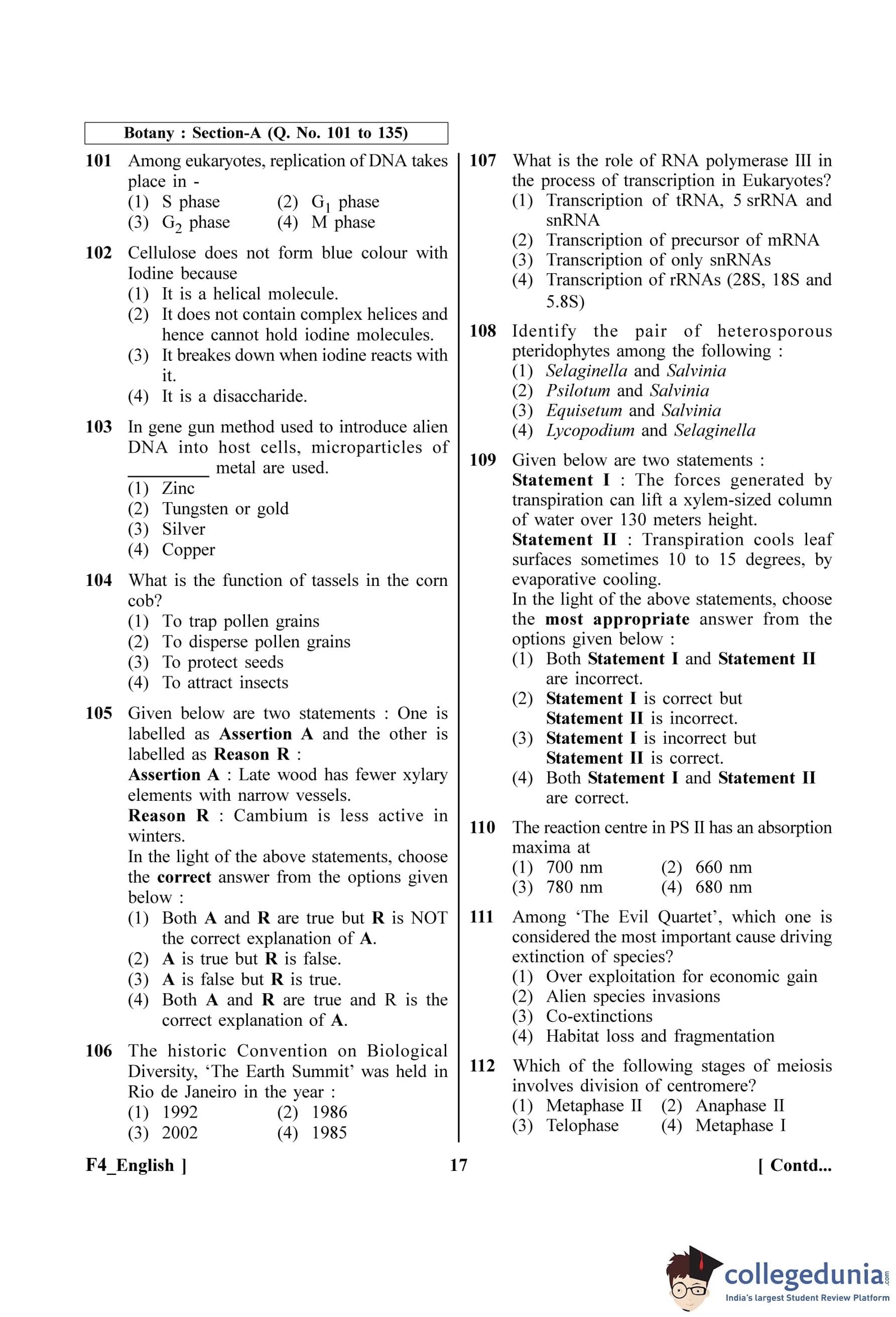
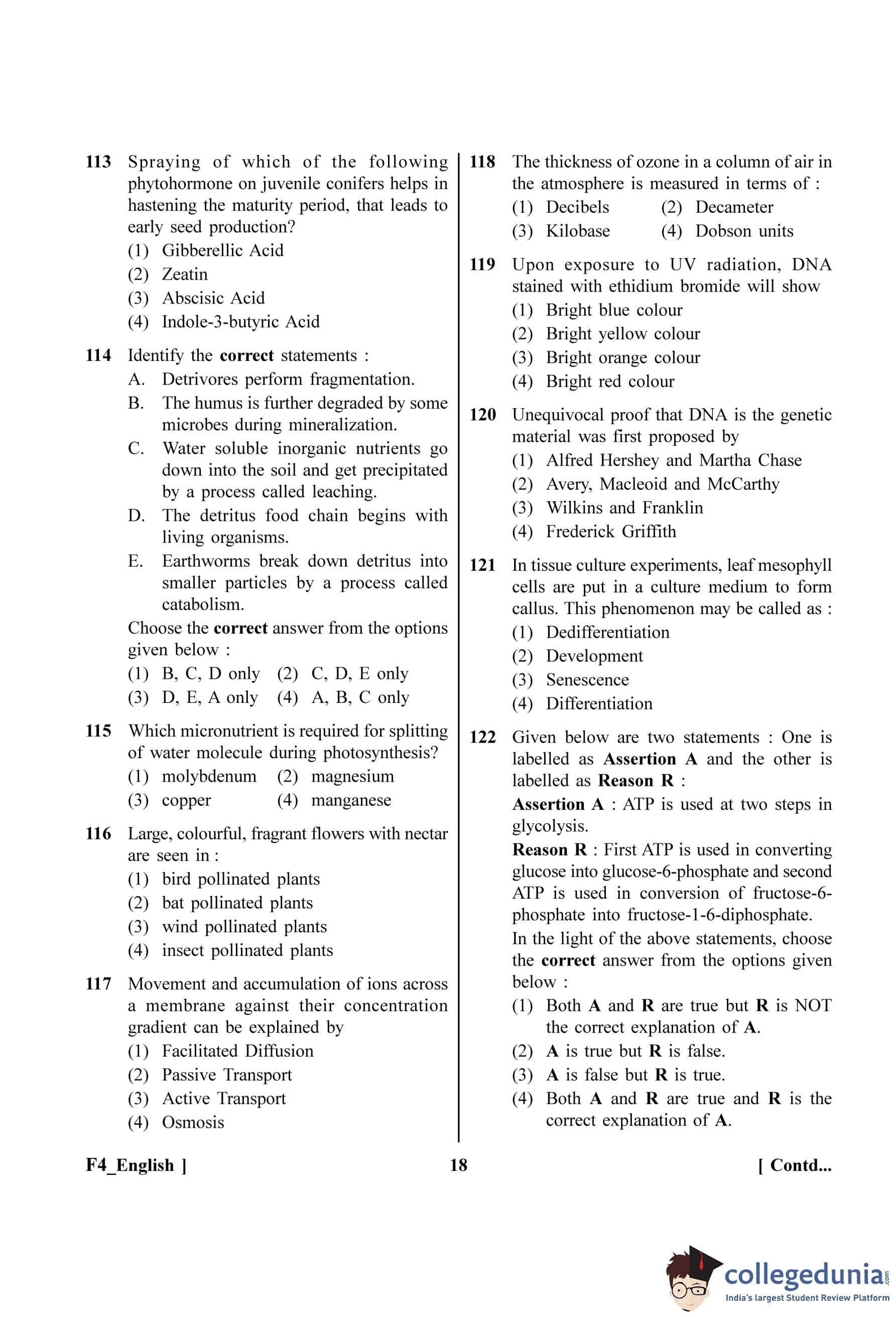
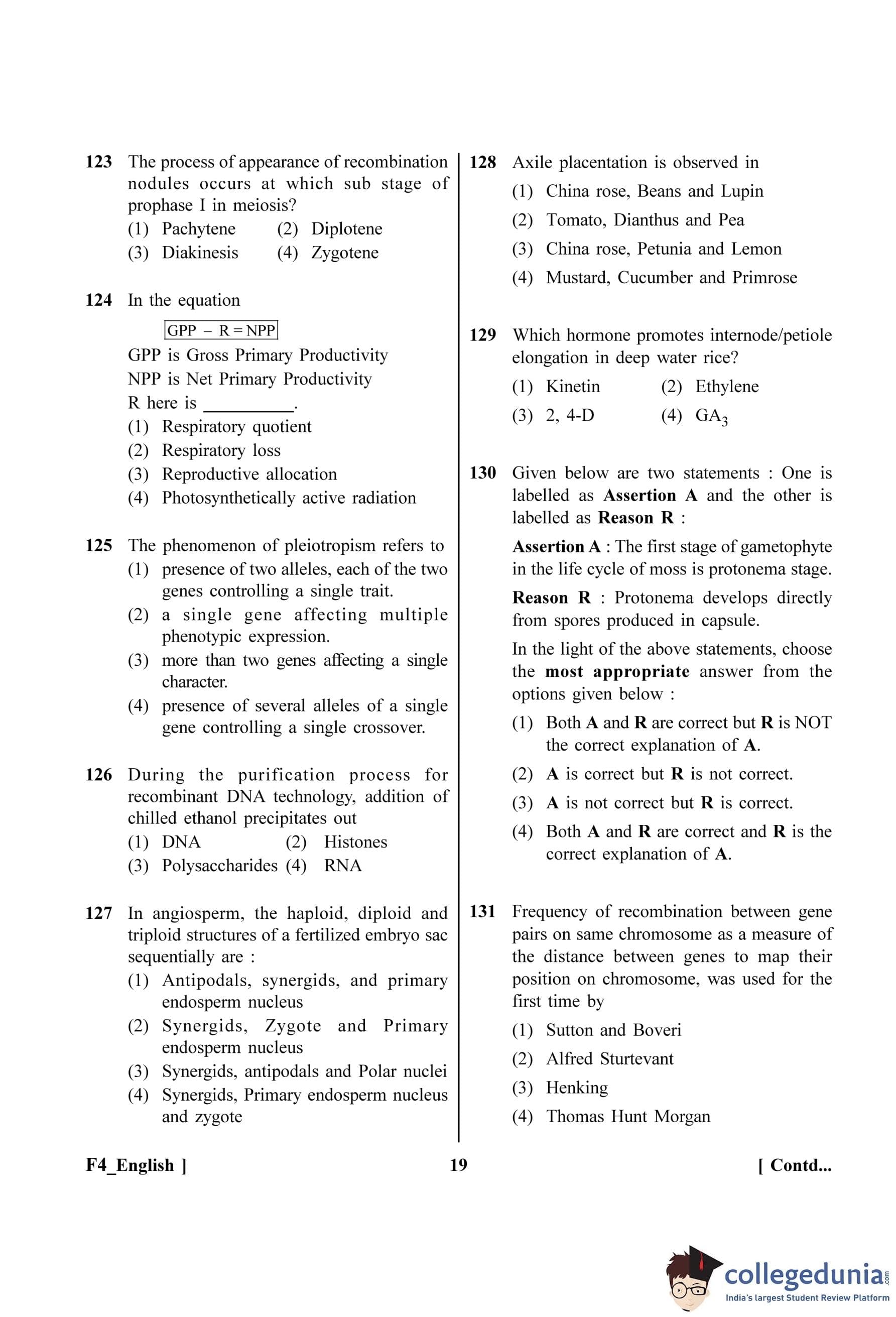
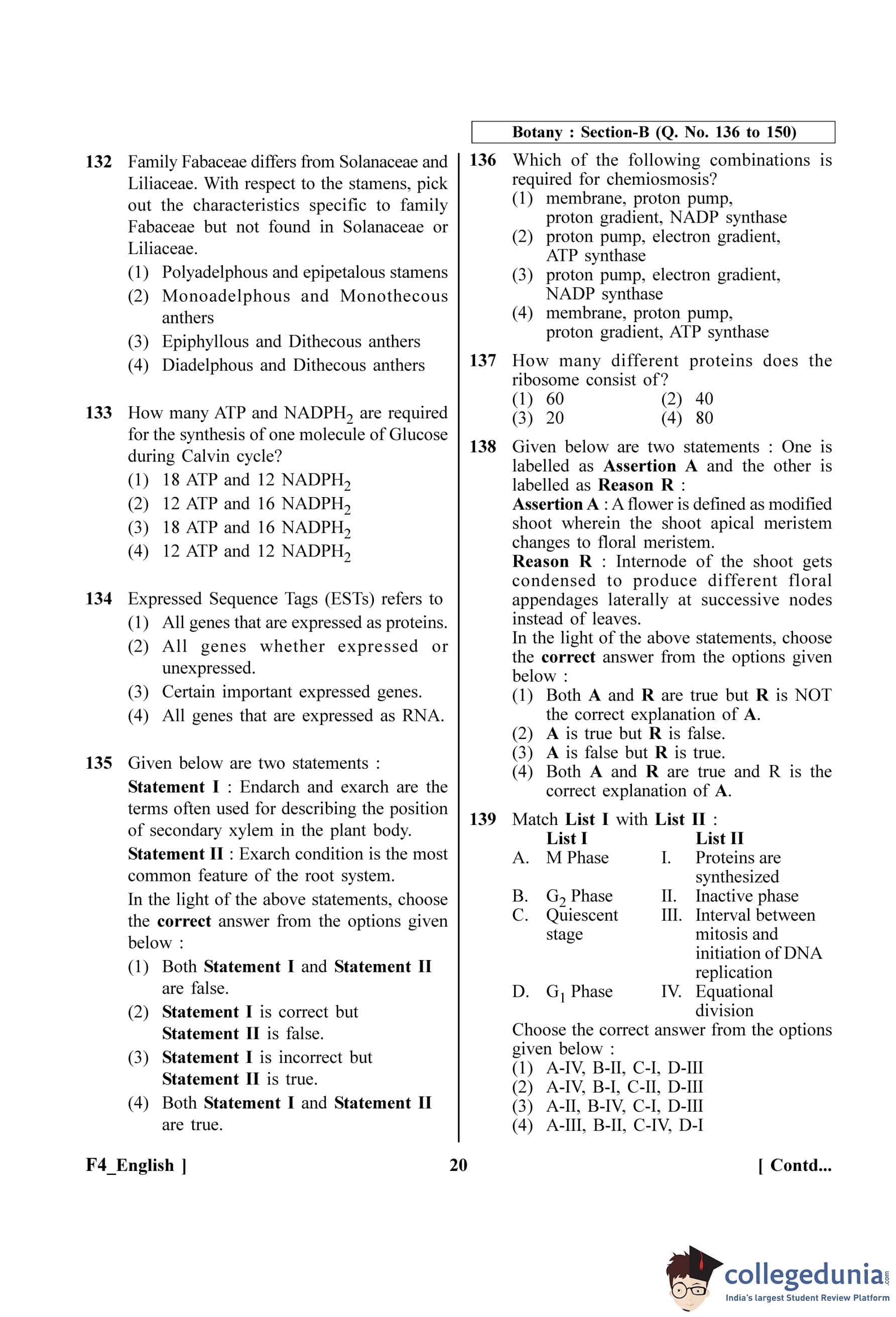
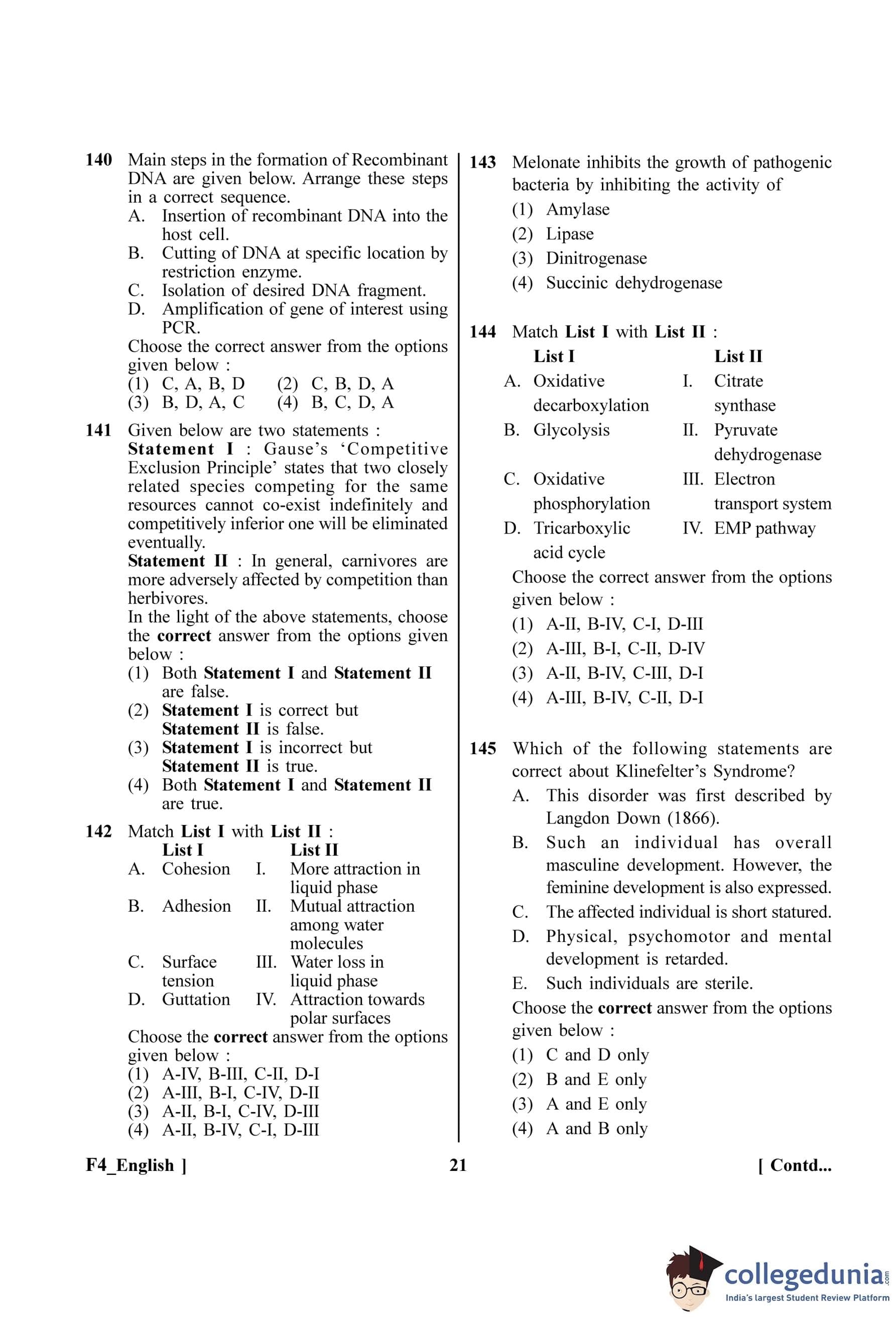
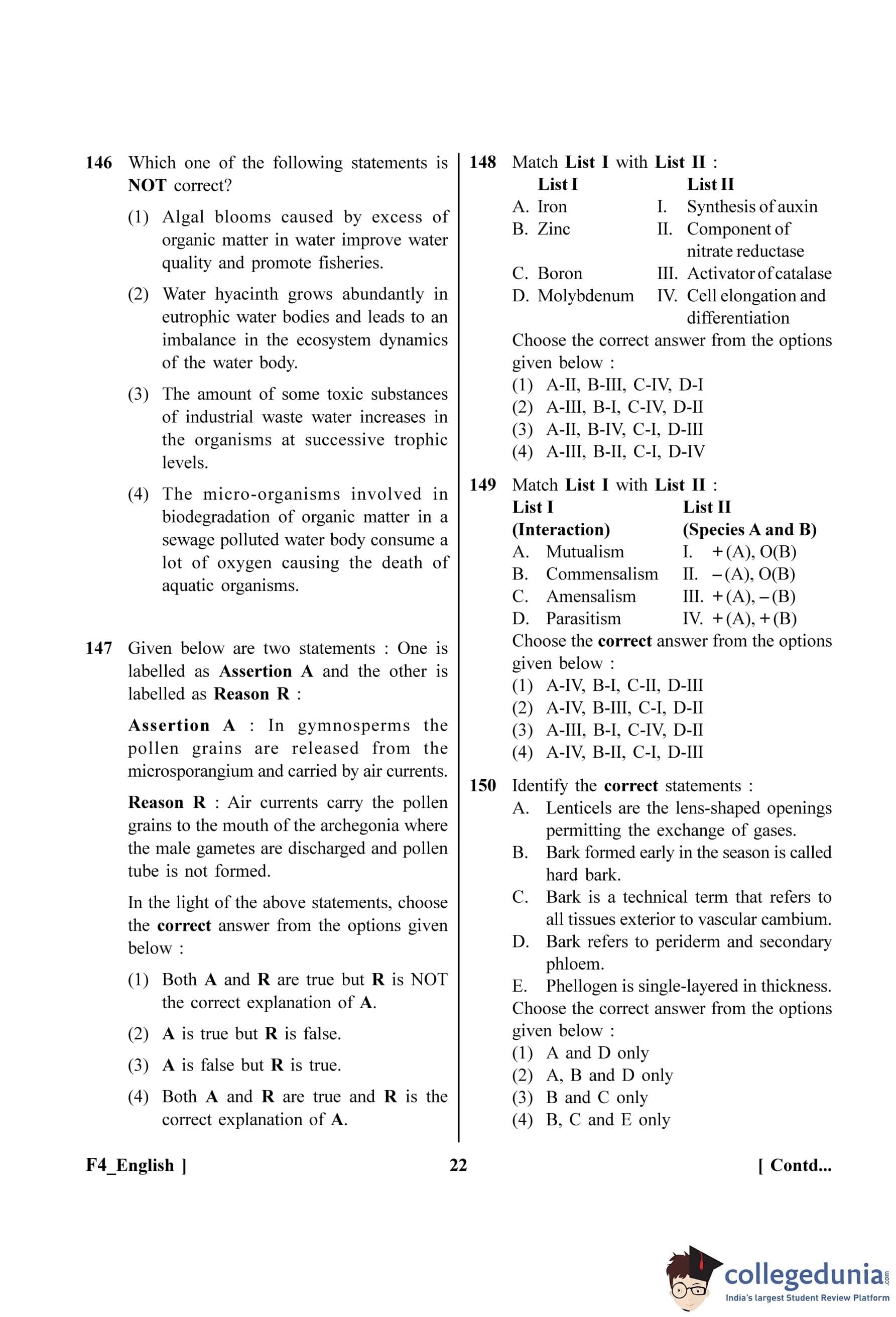
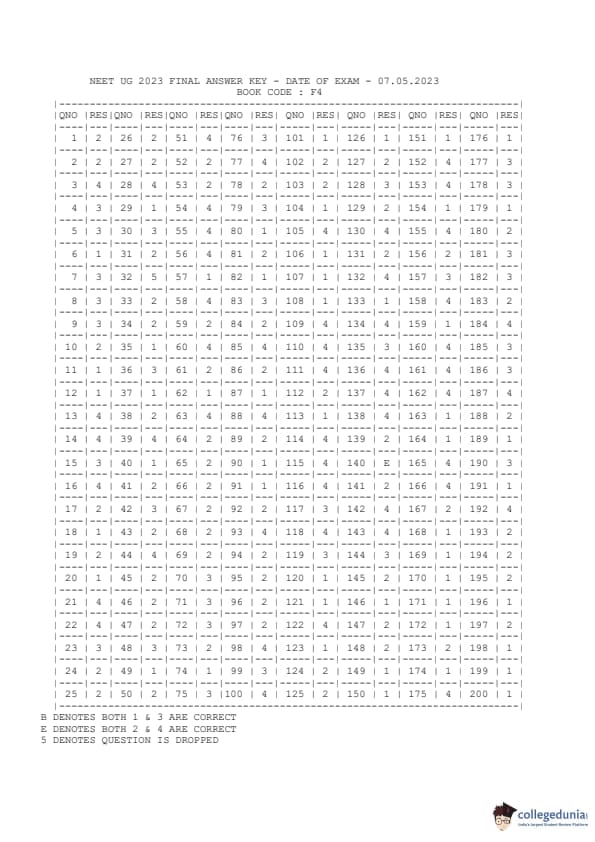
NEET Previous Year Question Papers with Answer Keys
| NEET 2022 Question Papers | NEET 2021 Question Papers | NEET 2020 Question Papers |
| NEET 2019 Question Papers | NEET 2018 Question Papers | NEET 2017 Question Papers |



Comments