




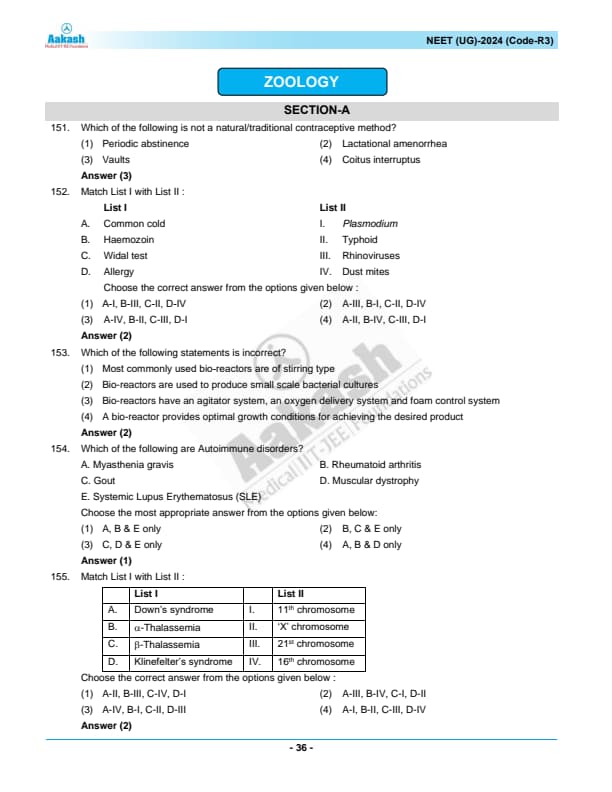
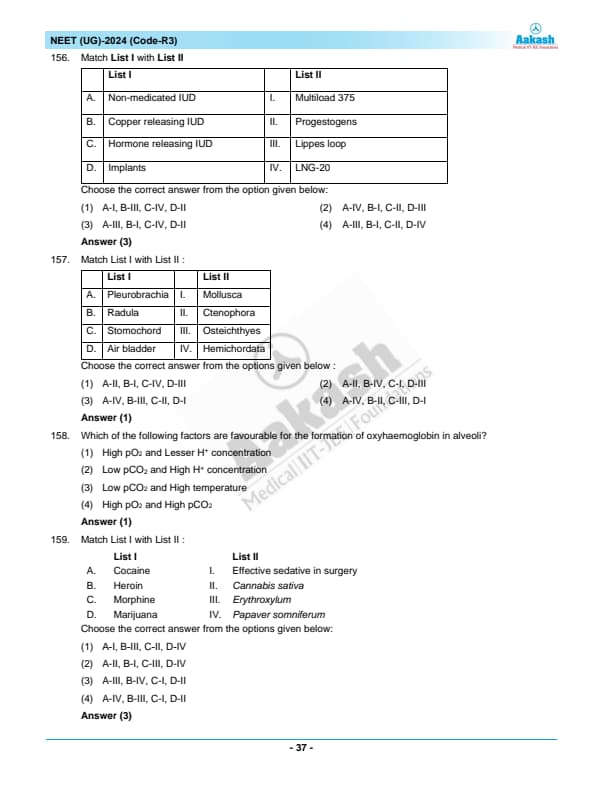
NEET 2024 Zoology Question Paper with Solutions PDF R3 is available for download. NEET 2024 R3 Zoology Question Paper comprises 50 MCQs out of which only 45 are to be attempted. NEET 2024 question R3 Zoology is divided into 2 sections- A (35 questions) and B (15 questions). You can download NEET 2024 zoology question paper with answer key and solutions PDF for R3 using the links given below. [PDF Source: aakash.ac.in]
NEET 2024 Zoology Question Paper with Solutions PDF R3
| NEET 2024 R3 Question Paper with Answer Key | Download PDF | Check Solution |
Which of the following is not a natural/traditional contraceptive method?
View Solution
Match List I with List II
List-I & List-II
A. Common cold & I. Plasmodium
B. Haemozoin & II. Typhoid
C. Widal test & III. Rhinoviruses
D. Allergy & IV. Dust mites
View Solution
Which of the following statements is incorrect?
View Solution
Which of the following are Autoimmune disorders?
A. Myasthenia gravis
B. Rheumatoid arthritis
C. Gout D. Muscular dystrophy
E. Systemic Lupus Erythematosus (SLE)
Choose the correct answer from the options given below:
View Solution
Match List I with List II
List-I & List-II
A. Down’s syndrome & I. 11th chromosome
B. Alpha-Thalassemia & II. ‘X’ chromosome
C. Beta-Thalassemia & III. 21st chromosome
D. Klinefelter’s syndrome & IV. 16th chromosome
Choose the correct answer from the options given below:
View Solution
Match List I with List II
List-I (Type of IUD) & List-II (Example)
A. Non-medicated IUD & I. Multiload 375
B. Copper releasing IUD & III. Lippes loop
C. Hormone releasing IUD & IV. LNG-20
D. Implants & II. Progestogens
Choose the correct answer from the options given below:
View Solution
Match List I with List II
List-I & List-II
A. Pleurobrachia & I. Mollusca
B. Radula & II. Ctenophora
C. Stomochord & III. Osteichthyes
D. Air bladder & IV. Hemichordata
Choose the correct answer from the options given below:
View Solution
Which of the following factors are favourable for the formation of oxyhaemoglobin in alveoli?
View Solution
Match List I with List II
List-I & List-II
A. Cocaine & I. Effective sedative in surgery
B. Heroin & II. Cannabis sativa
C. Morphine & III. Erythroxylum
D. Marijuana & IV. Papaver somniferum
Choose the correct answer from the options given below:
View Solution
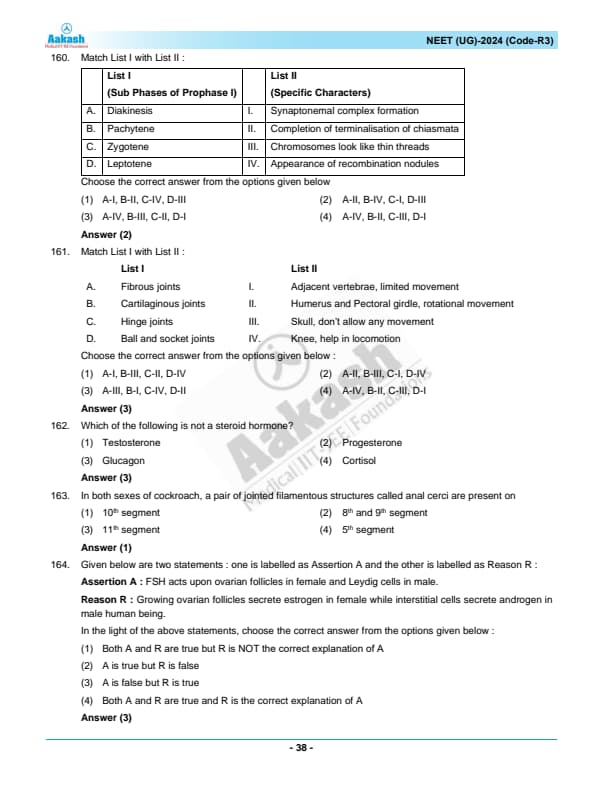
Match List I with List II
List-I (Sub Phases of Prophase I) & List-II (Specific Characters)
A. Diakinesis & I. Synaptonemal complex formation
B. Pachytene & II. Completion of terminalisation of chiasmata
C. Zygotene & III. Chromosomes look like thin threads
D. Leptotene & IV. Appearance of recombination nodules
Choose the correct answer from the options given below:
View Solution
Match List I with List II
List-I & List-II
A. Fibrous joints & I. Adjacent vertebrae, limited movement
B. Cartilaginous joints & II. Humerus and Pectoral girdle, rotational movement
C. Hinge joints & III. Skull, don’t allow any movement
D. Ball and socket joints & IV. Knee, help in locomotion
Choose the correct answer from the options given below:
View Solution
Which of the following is not a steroid hormone?
View Solution
In both sexes of cockroach, a pair of jointed filamentous structures called anal cerci are present on
View Solution
Given below are two statements: one is labelled as Assertion A and the other is labelled as Reason R:
Assertion A: FSH acts upon ovarian follicles in female and Leydig cells in male.
Reason R: Growing ovarian follicles secrete estrogen in female while interstitial cells secrete androgen in male human being.
Choose the correct answer from the options given below:
View Solution
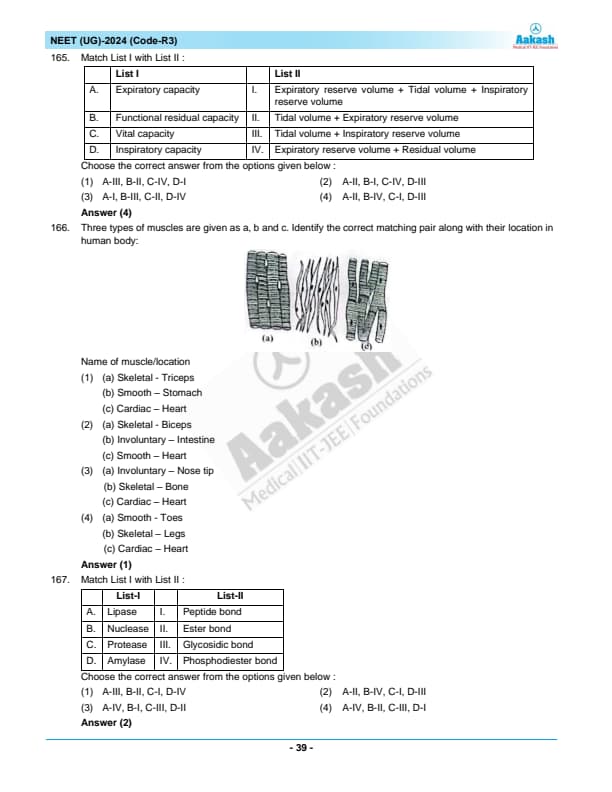
Match List I with List II
List-I (Pulmonary Volumes) & List-II (Corresponding Volumes)
A. Expiratory capacity & I. Expiratory reserve volume + Tidal volume + Inspiratory reserve volume
B. Functional residual capacity & II. Tidal volume + Expiratory reserve volume
C. Vital capacity & III. Tidal volume + Inspiratory reserve volume
D. Inspiratory capacity & IV. Expiratory reserve volume + Residual volume
Choose the correct answer from the options given below:
View Solution
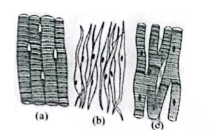
Three types of muscles are given as a, b and c. Identify the correct matching pair along with their location in human body:
Match List I with List II
List-I & List-II
A. Lipase & I. Peptide bond
B. Nuclease & II. Ester bond
C. Protease & III. Glycosidic bond
D. Amylase & IV. Phosphodiester bond
Choose the correct answer from the options given below:
View Solution
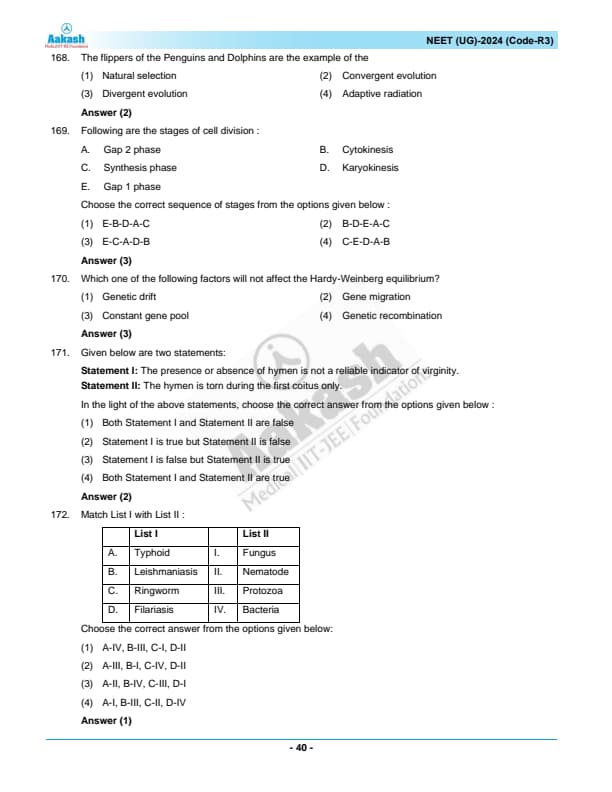
The flippers of the Penguins and Dolphins are the example of the
View Solution
Following are the stages of cell division :
A. Gap 2 phase
B. Cytokinesis
C. Synthesis phase
D. Karyokinesis
E. Gap 1 phase
Choose the correct answer from the options given below:
View Solution
Which one of the following factors will not affect the Hardy-Weinberg equilibrium?
View Solution
Given below are two statements: one is labelled as Assertion A and the other is labelled as Reason R:
Assertion A: FSH acts upon ovarian follicles in female and Leydig cells in male.
Reason R: Growing ovarian follicles secrete estrogen in female while interstitial cells secrete androgen in male human being.
View Solution
Match List I with List II
List-I & List-II
A. Typhoid & I. Fungus
B. Leishmaniasis & II. Nematode
C. Ringworm & III. Protozoa
D. Filariasis & IV. Bacteria
Choose the correct answer from the options given below:
View Solution
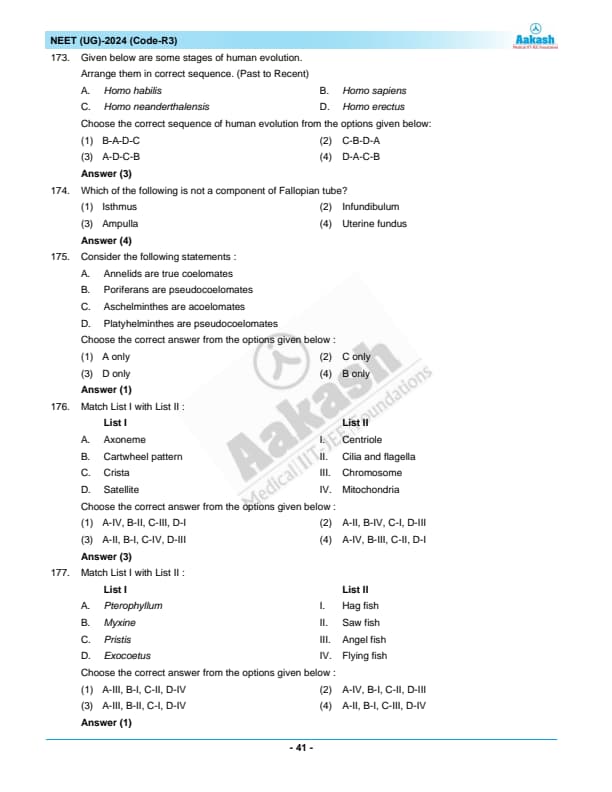
Given below are some stages of human evolution. Arrange them in correct sequence. (Past to Recent)
A. Homo habilis
B. Homo sapiens
C. Homo neanderthalensis
D. Homo erectus
Choose the correct answer from the options given below:
View Solution
Which of the following is not a component of Fallopian tube?
View Solution
Consider the following statements:
A. Annelids are true coelomates
B. Poriferans are pseudocoelomates
C. Aschelminthes are acoelomates
D. Platyhelminthes are pseudocoelomates
Choose the correct answer from the options given below:
View Solution
Match List I with List II
List-I & List-II
A. Axoneme & I. Centriole
B. Cartwheel pattern & II. Cilia and flagella
C. Crista & III. Chromosome
D. Satellite & IV. Mitochondria
Choose the correct answer from the options given below:
View Solution
Match List I with List II
List I & List II
A. Pterophyllum & I. Hag fish
B. Myxine & II. Saw fish
C. Pristis & III. Angel fish
D. Exocoetus & IV. Flying fish
Choose the correct answer from the options given below:
View Solution
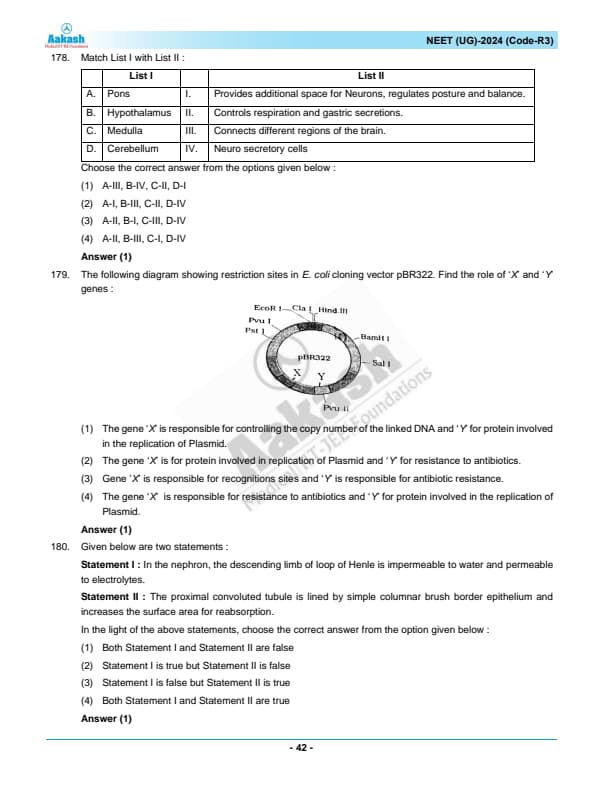
Match List I with List II
List-I & List-II
A. Pons & I. Provides additional space for Neurons, regulates posture and balance.
B. Hypothalamus & II. Controls respiration and gastric secretions.
C. Medulla & III. Connects different regions of the brain.
D. Cerebellum & IV. Neuro secretory cells
Choose the correct answer from the options given below:
View Solution
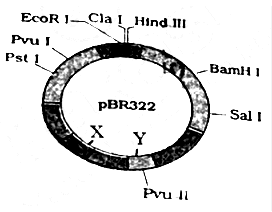
The following diagram showing restriction sites in E. coli cloning vector pBR322. Find the role of ‘X’ and ‘Y’ genes :
View Solution
Given below are two statements :
Statement I : In the nephron, the descending limb of loop of Henle is impermeable to water and permeable to electrolytes.
Statement II : The proximal convoluted tubule is lined by simple columnar brush border epithelium and increases the surface area for reabsorption.
Choose the correct answer from the options given below:
View Solution
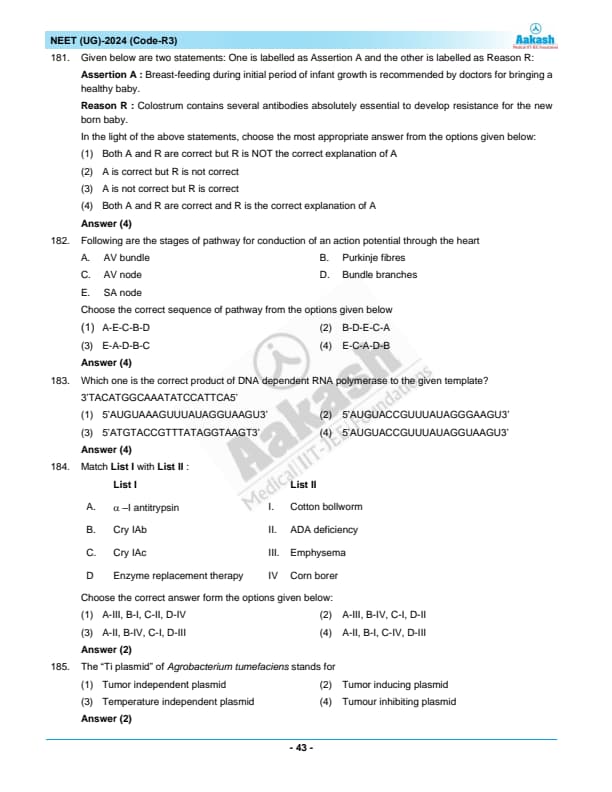
Given below are two statements: One is labelled as Assertion A and the other is labelled as Reason R:
Assertion A : Breast-feeding during initial period of infant growth is recommended by doctors for bringing a healthy baby.
Reason R : Colostrum contains several antibodies absolutely essential to develop resistance for the new born baby.
Choose the correct answer from the options given below:
View Solution
Following are the stages of pathway for conduction of an action potential through the heart:
A. AV bundle
B. Purkinje fibres
C. AV node
D. Bundle branches
E. SA node
Choose the correct answer from the options given below:
View Solution
Which one is the correct product of DNA dependent RNA polymerase to the given template?
3’TACATGGCAAATATCCATTCA5’
View Solution
Match List I with List II
List I & List II
A. –I antitrypsin & I. Cotton bollworm
B. Cry IAb & II. ADA deficiency
C. Cry IAc & III. Emphysema
D. Enzyme replacement therapy & IV. Corn borer
Choose the correct answer from the options given below:
View Solution
The “Ti plasmid” of Agrobacterium tumefaciens stands for
View Solution
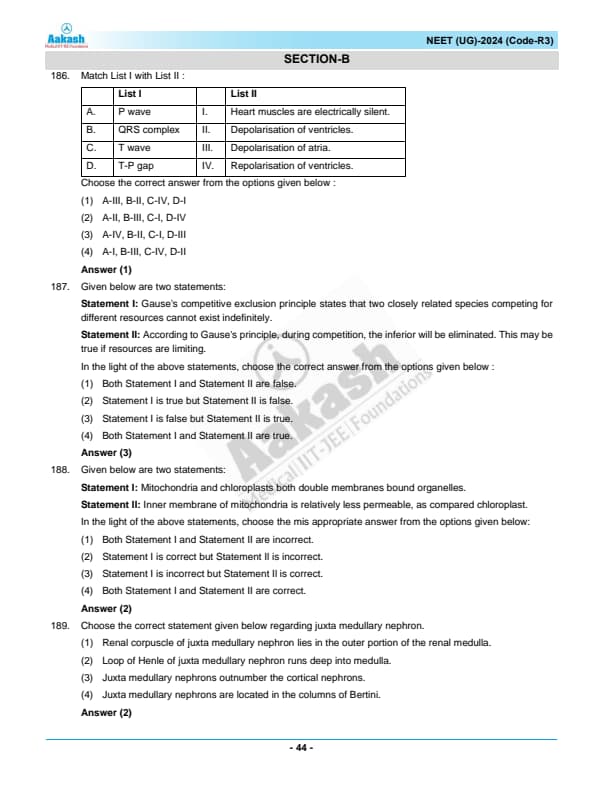
Match List I with List II
List-I & List-II
A. P wave & I. Heart muscles are electrically silent.
B. QRS complex & II. Depolarisation of ventricles.
C. T wave & III. Depolarisation of atria.
D. T-P gap & IV. Repolarisation of ventricles.
Choose the correct answer from the options given below:
View Solution
Given below are two statements:
Statement I: Gause's competitive exclusion principle states that two closely related species competing for different resources cannot exist indefinitely.
Statement II: According to Gause's principle, during competition, the inferior will be eliminated. This may be true if resources are limiting.
Choose the correct answer from the options given below:
View Solution
Given below are two statements:
Statement I: Mitochondria and chloroplasts both double membranes bound organelles.
Statement II: Inner membrane of mitochondria is relatively less permeable, as compared to chloroplast.
Choose the correct answer from the options given below:
View Solution
Choose the correct statement given below regarding juxta medullary nephron.
View Solution
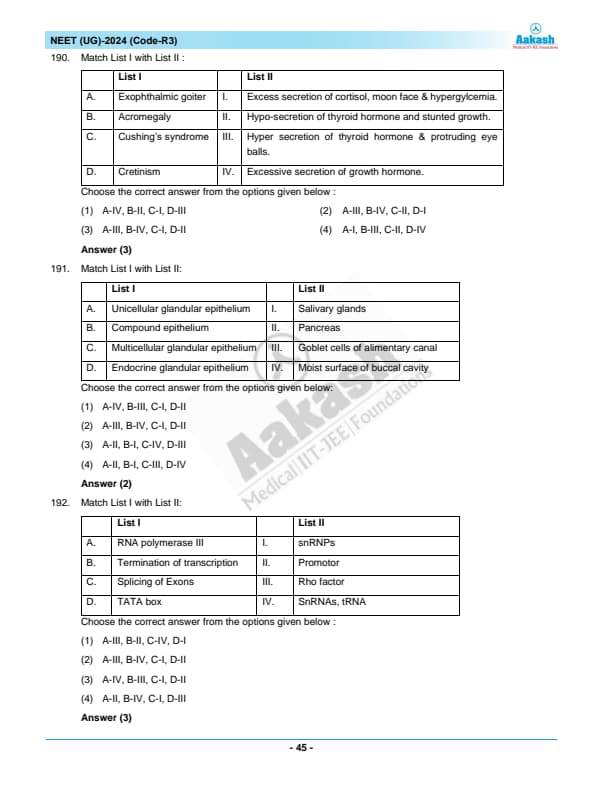
Match List I with List II
List-I & List-II
A. Exophthalmic goiter & I. Excess secretion of cortisol, moon face \& hyperglycemia.
B. Acromegaly & II. Hypo-secretion of thyroid hormone and stunted growth.
C. Cushing’s syndrome & III. Hyper secretion of thyroid hormone \& protruding eyeballs.
D. Cretinism & IV. Excessive secretion of growth hormone.
Choose the correct answer from the options given below:
View Solution
Match List I with List II
List-I & List-II
A. Unicellular glandular epithelium & I. Salivary glands
B. Compound epithelium & II. Pancreas
C. Multicellular glandular epithelium & III. Goblet cells of alimentary canal
D. Endocrine glandular epithelium & IV. Moist surface of buccal cavity
Choose the correct answer from the options given below:
View Solution
Match List I with List II
List I & List II
A. RNA polymerase III & I. snRNPs
B. Termination of transcription & II. Promotor
C. Splicing of Exons & III. Rho factor
D. TATA box & IV. SnRNAs, tRNA
Choose the correct answer from the options given below:
View Solution
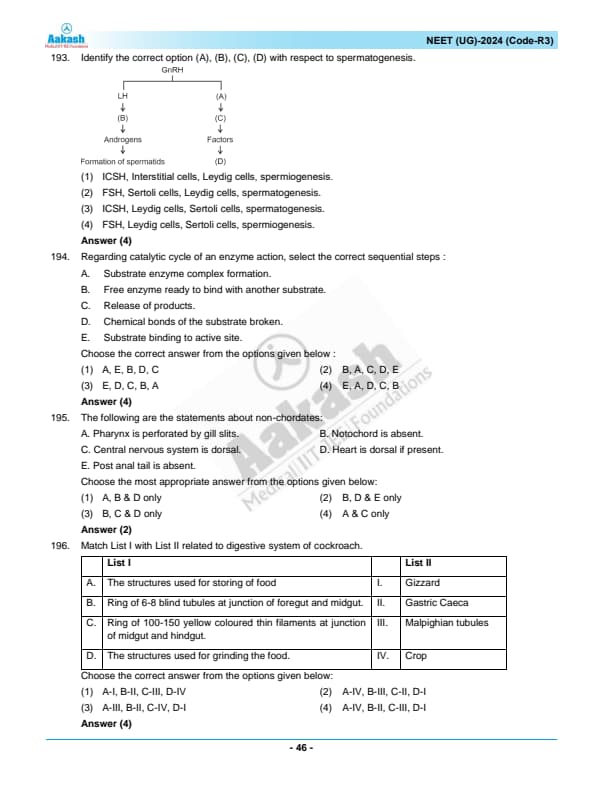
Identify the correct option (A), (B), (C), (D) with respect to spermatogenesis.
View Solution
Regarding catalytic cycle of an enzyme action, select the correct sequential steps:
A. Substrate enzyme complex formation.
B. Free enzyme ready to bind with another substrate.
C. Release of products.
D. Chemical bonds of the substrate broken.
E. Substrate binding to active site.
Choose the correct answer from the options given below:
View Solution
The following are the statements about non-chordates:
A. Pharynx is perforated by gill slits.
B. Notochord is absent.
C. Central nervous system is dorsal.
D. Heart is dorsal if present.
E. Post anal tail is absent.
Choose the correct answer from the options given below:
View Solution
Match List I with List II related to digestive system of cockroach.
List I & List II
A. Structures for storing of food & I. Gizzard
B. Ring: 6-8 blind tubules at junction of foregut and midgut. & II. Gastric Caeca
C. Ring: 100-150 yellow filaments at junction of midgut and hindgut. & III. Malpighian tubules
D. Structures for grinding the food. & IV. Crop
Choose the correct answer from the options given below:
View Solution
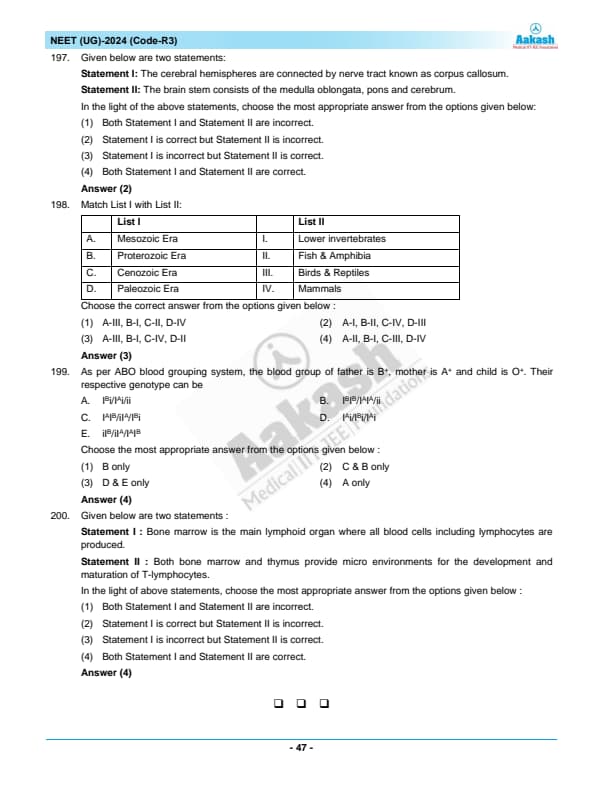
Given below are two statements:
Statement I: The cerebral hemispheres are connected by nerve tract known as corpus callosum.
Statement II: The brain stem consists of the medulla oblongata, pons and cerebrum.
Choose the correct answer from the options given below:
View Solution
Match List I with List II
List I & List II
A. Mesozoic Era & I. Lower invertebrates
B. Proterozoic Era & II. Fish \& Amphibia
C. Cenozoic Era & III. Birds \& Reptiles
D. Paleozoic Era & IV. Mammals
Choose the correct answer from the options given below:
View Solution
As per ABO blood grouping system, the blood group of father is B+, mother is A+ and child is O+. Their respective genotype can be:
View Solution
Given below are two statements:
Statement I: Bone marrow is the main lymphoid organ where all blood cells including lymphocytes are produced.
Statement II: Both bone marrow and thymus provide micro environments for the development and maturation of T-lymphocytes.
Choose the correct answer from the options given below:
View Solution
NEET Previous Year Question Papers with Answer Keys
| NEET 2023 Question Papers | NEET 2022 Question Papers | NEET 2021 Question Papers |
| NEET 2020 Question Papers | NEET 2019 Question Papers | NEET 2018 Question Papers |



Comments