




As per the NEET Physics chapter wise weightage 2026, Physics carries around 45% weightage. Among all topics, Electrostatics, Modern Physics, and Mechanics have high weightage, with Moving Charges and Magnetism having nearly 5-6% weightage in the NEET exam 2026. While these high-weightage topics are important, you should not ignore smaller topics that have 2-3% weightage, as these topics can help you score a good mark.
The Physics section consists of 45 questions with a total of 180 marks.
High Weightage Chapters:
- Magnetic Effects of Current and Magnetism: 10%
- Mechanics: 7%
- Modern Physics: 5%
- Electrostatics: 8%
- Current Electricity: 6%
Also Read

Key Summary
- As per NEET Physics chapter wise weightage 2026, the Physics section has around 45% weightage in the NEET 2026 syllabus.
- Class 12 chapters contribute approximately 54% of Physics questions, while Class 11 chapters contribute about 46%.
- Important chapters with high marks include Current Electricity, Semiconductors & Diodes, and Ray Optics.
- Mechanics chapters like Laws of Motion, Work, Power and Energy, and Motion of a System of Particles have around 7% weightage each.
- Thermodynamics and Thermo properties together contribute about 7%.
- Topics like Oscillations, Waves, Gravitation, and Mechanical Properties of Solids and Fluids have around 2-4% weightage individually.
- Modern Physics chapters, including Dual Nature of Radiation, Atoms and Nuclei, and Electromagnetic Waves, carry moderate weightage (3-6%).
- Optics (Ray Optics and Wave Optics) combined contribute roughly 10% marks.
- Mastery of all topics is essential as NEET asks about 45 questions in Physics, totalling 180 marks.
- Understanding chapter-wise weightage helps in prioritising studies and managing time efficiently.
- Top-weightage chapters help boost scores, but even low-weightage topics should not be ignored.
- Focus on NCERT textbooks for genuine and complete preparation for each chapter.
NEET Physics Physics: Class 11 vs Class 12
- Class 12 chapters cover approximately 57% of the Physics questions, while Class 11 chapters contribute about 43%.
- This indicates a relatively greater emphasis on advanced topics from Class 12.

Also Read
Deleted Syllabus of NEET 2026 PhysicsNEET Physics Chapter Wise Weightage 2026: Class 11 NEET Physics 2026
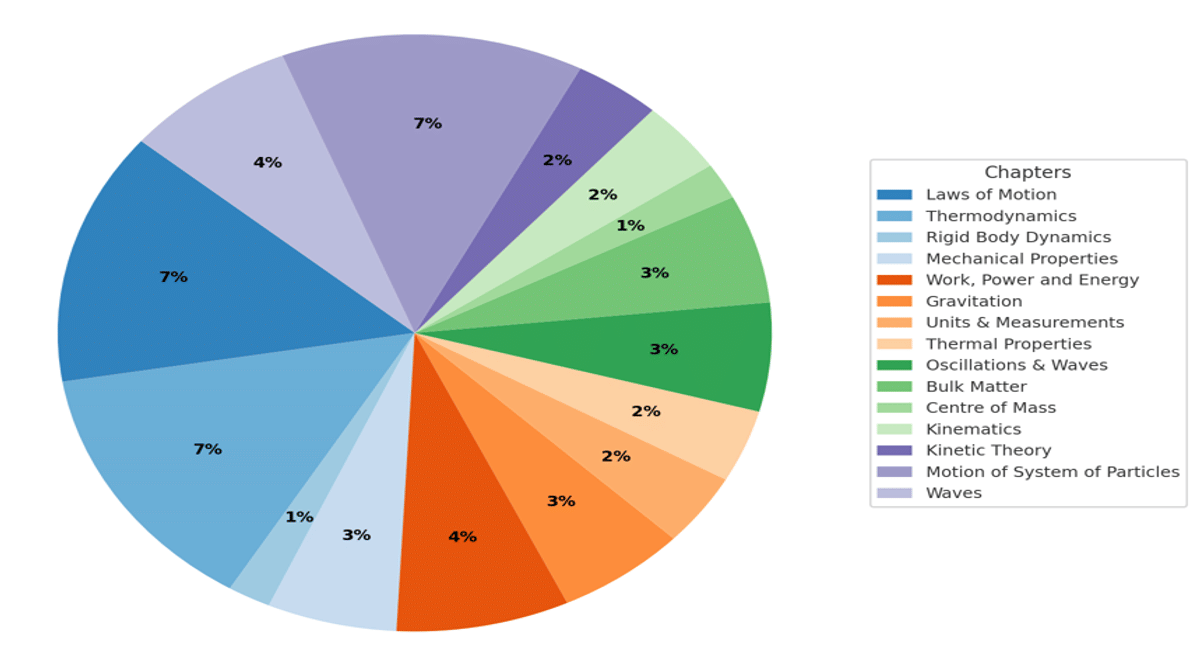
| Chapter Name (NCERT) | Expected Questions | Approximate Weightage (%) |
|---|---|---|
| Laws of Motion | 3 | 7 |
| Thermodynamics | 3 | 7 |
| Motion of System of Particles and Rigid Body | 3 | 7 |
| Work, Power and Energy | 2 | 4 |
| Oscillations and Waves | 1 | 3 |
| Mechanical Properties of Solids and Fluids | 2 | 3 |
| Gravitation | 2 | 3 |
| Current Electricity | 5 | 10 |
| Electromagnetic Induction | 1 | 3 |
| Magnetic Effects of Current and Magnetism | 5 | 10 |
| Ray Optics and Optical Instruments | 3 | 6 |
| Electrostatics | 4 | 8 |
| Electromagnetic Waves | 2 | 4 |
| Dual Nature of Matter and Radiation | 2 | 3 |
| Atoms and Nuclei | 3 | 6 |
| Semiconductor Electronics | 3 | 6 |
| Kinetic Theory of Gases | 1 | 3 |
| Units and Measurements | 1 | 2 |
| Thermal Properties of Matter | 1 | 2 |
NEET Physics Chapter Wise Weightage 2026: Class 12 NEET Physics
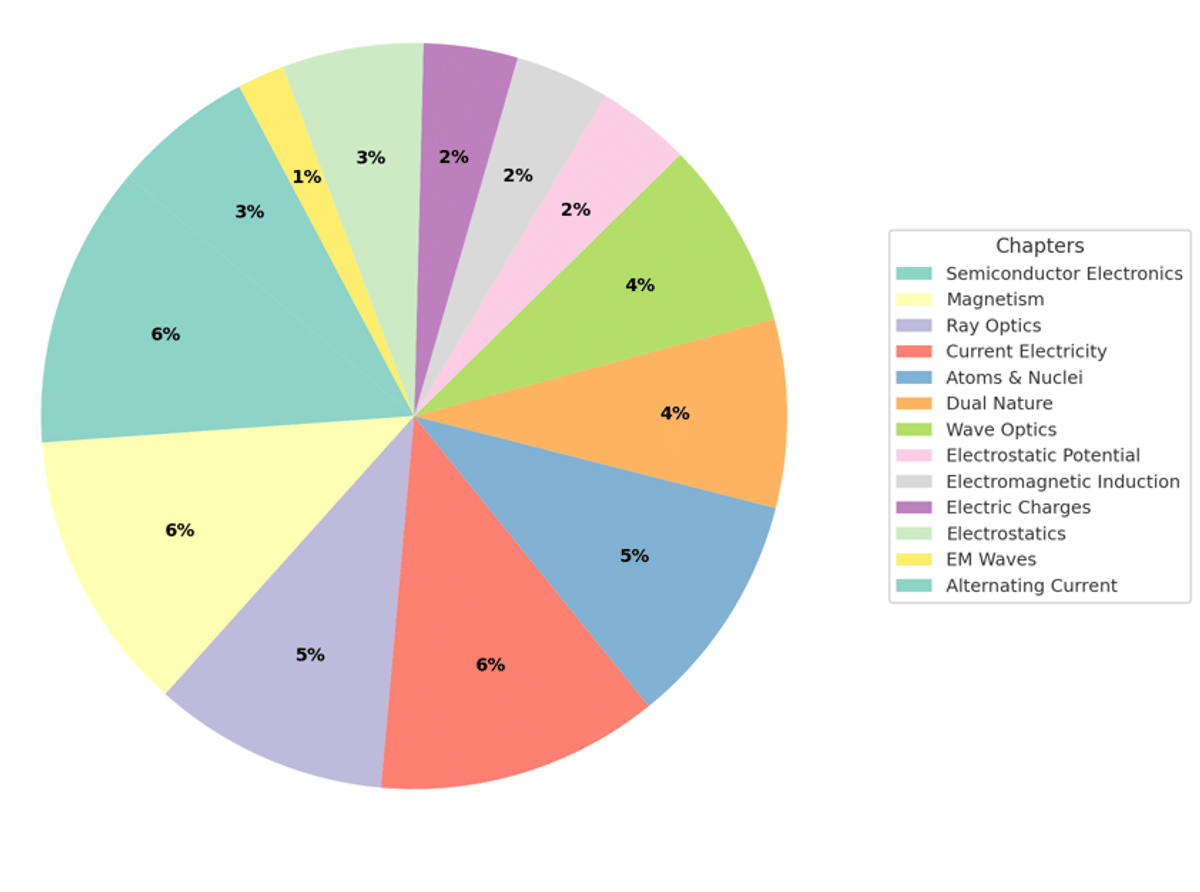
Class 12 topics make up a larger percentage of the Physics section and involve more complex concepts. It's important to understand the NEET Physics Chapter wise weightage 2026 to prepare well.
- Current Electricity, Semiconductor Electronics, and Optics are frequently tested and carry high marks.
| Chapter Title | Estimated Questions | Approximate Weightage |
|---|---|---|
| Semiconductor Electronics | 3 | 6% |
| Magnetism & Magnetic Effects of Curnt | 3 | 6% |
| Ray Optics and Optical Instruments | 3 | 5% |
| Current Electricity | 3 | 6% |
| Atoms and Nuclei | 2 | 5% |
| Dual Nature of Radiation and Matter | 2 | 4% |
| Wave Optics | 2 | 4% |
| Electrostatic Potential and Capacitance | 1 | 2% |
| Electromagnetic Induction | 1 | 2% |
| Electric Charges and Fields | 1 | 2% |
| Electrostatics | 1 | 3% |
| Electromagnetic Waves | 1 | 1% |
| Alternating Current | 1 | 3% |
Rank Based on Weightage: NEET Physics Chapter Wise Weightage 2026
NEET Physics chapters differ in importance based on how many questions are typically asked from each in the exam. Understanding the rank NEET Physics Chapter Wise weightage 2026 helps students focus more on topics that can fetch higher marks.
- Top-ranked chapters: Current Electricity, Semiconductors & Diodes, Kinematics, and Ray Optics stand out as the highest-weightage chapters, often contributing around 6% each to the Physics section. These chapters tend to have the most questions year after year.
- High Weightage Topics: Moving Charges & Magnetism, Rotational Mechanics, Gravitation, and Electric Potential & Capacitance follow closely and collectively cover a significant portion of the paper. Concentrating on these chapters can greatly improve scoring potential.
| Chapter Names | No. of Questions Asked | Estimated Weightage |
|---|---|---|
| Current Electricity, Semiconductors & Diodes | 36 (each) | 6% |
| Kinematics, Ray Optics | 31 (each) | 6% |
| Moving Charges & Magnetism | 28 | 5% |
| Rotational Mechanics, Gravitation | 26 (each) | 5% |
| Electric Potential & Capacitance | 24 | 4% |
| Work, Energy & Power | 23 | 4% |
| Laws of Motion, Dual Nature of Radiation & Matter, Wave Optics | 22 (each) | 4% |
| Units & Measurements | — | 4% |
| Electric Charges & Field | — | 4% |
| Electromagnetic Induction, Alternating Current, EM Waves, SHM | 17 (each) | 4% |
| Atoms, Waves, Thermodynamics, Properties of Fluids, Kinetic Theory, Thermal Properties | 15–16 (each) | 3% |
| Nuclei | 25 | 3% |
| Magnetism & Matter, Properties of Solids | 9 (each) | 2% |
Also Read
Mock Test Series for NEET 2026 FreeImportant Topics: NEET Physics Chapter Wise Weightage 2026 Class 11 Syllabus
The NEET physics syllabus covers mechanics, electricity, optics, electrostatics and modern physics, focusing on understanding physical principles and their applications in medical contexts.
| Chapter Name | Important Topics |
|---|---|
| Units and Measurements | Significant Figures, Errors in Measurement, Measuring Instruments, Mathematical Tools, Binomial Expression, Approximation, Functions & Graphs, Logarithms, Differentiation, Integration |
| Motion in a Straight Line | Frame of Reference, Motion under Gravity (Free Fall), Graph of 1D Motion, Variable Acceleration |
| Motion in a Plane | Vector Addition, Resolution of Vectors, Vector Projection, Projectile Motion, Relative Motion, Circular Motion |
| Newton's Laws of Motion | Newton's First Law, Linear Momentum, Free Body Diagram, Applying Newton's Second Law, Calculation of Acceleration, Frame of Reference, Rocket Propulsion, Types of Friction, Force Graphs, Angle of Friction, Acceleration on Rough Surface, Dynamics of Circular Motion |
| Work, Power and Energy | Work, Work-Energy Theorem, Conservative and Non-Conservative Forces, Potential Energy, Equilibrium, Law of Conservation of Energy, Power, Vertical Circular Motion |
| Centre of Mass and System of Particles | Centre of Mass, Head-on and Oblique Collisions |
| Rotational Motion | Moment of Inertia, Theorems of Moment of Inertia, Radius of Gyration, Angular Momentum, Rolling Motion, Inclined Plane Dynamics |
| Gravitation | Law of Gravitation, Acceleration due to Gravity, Gravitational Potential Energy, Escape Velocity, Satellite Motion, Kepler's Laws, Weightlessness |
| Mechanical Properties of Solids | Hooke's Law, Modulus of Elasticity, Young's Modulus, Pressure |
| Mechanical Properties of Fluids | Buoyancy, Buoyant Force, Equation of Continuity, Bernoulli's Theorem, Viscosity, Surface Tension |
| Thermal Properties of Matter | Thermal Expansion, Specific Heat Capacity, Latent Heat, Calorimetry, Conduction, Radiation |
| Kinetic Theory of Gases | Ideal Gas, Kinetic Theory, Molecular Speeds, Maxwell’s Distribution, Degrees of Freedom, Equipartition of Energy |
| Thermodynamics | Thermal Equilibrium, Zeroth Law, First Law, Carnot Cycle, Heat Pumps |
| Oscillations | Simple Harmonic Motion (SHM), Energy in SHM, Time Period Calculations, Oscillation of Liquid Column |
| Waves | Wave Characteristics, Progressive Waves, Sound Waves, Superposition, Stationary Waves, Echo |
Also Read
NEET 2025 Paper AnalysisImportant Topics: NEET 2026 Physics Syllabus Class 12
This is the table of important topics for NEET 2026. If you are preparing for the Physics section, then you can refer to these, as these topics are often asked based on PYQs. These topics are listed
| Chapter Name | Important Topics |
| Units and Measurements | Significant Figures, Errors in Measurement, Measuring Instruments, Mathematical Tools, Binomial Expression, Functions & Graphs, Logarithms, Differentiation, Integration |
| Motion in a Straight Line | Frame of Reference, Motion under Gravity (Free Fall), Graph of 1D Motion, Variable Acceleration |
| Motion in a Plane | Vector Addition, Resolution of Vectors, Vector Projection, Projectile Motion, Relative Motion, Circular Motion |
| Newton's Laws of Motion | Newton's First and Second Law, Linear Momentum, Free Body Diagram, Rocket Propulsion, Friction, Dynamics of Circular Motion |
| Work, Power, and Energy | Work, Work-Energy Theorem, Conservative and Non-Conservative Forces, Potential Energy, Law of Conservation of Energy, Power, Vertical Circular Motion |
| Centre of Mass & System of Particles | Centre of Mass, Head-on and Oblique Collisions |
| Rotational Motion | Moment of Inertia, Theorems of Moment of Inertia, Radius of Gyration, Angular Momentum, Rolling Motion |
| Gravitation | Law of Gravitation, Acceleration due to Gravity, Gravitational Potential, Escape Velocity, Satellite Motion, Kepler's Laws |
| Mechanical Properties of Solids and Fluids | Hooke's Law, Young's Modulus, Pressure, Buoyancy, Bernoulli's Theorem, Viscosity, Surface Tension |
| Thermal Properties of Matter | Thermal Expansion, Specific Heat, Latent Heat, Calorimetry, Conduction, Radiation |
| Kinetic Theory of Gases | Ideal Gas, Kinetic Theory, Maxwell's Distribution, Degrees of Freedom, Law of Equipartition of Energy |
| Thermodynamics | Laws of Thermodynamics, Carnot Engine, Refrigeration |
| Oscillations | Simple Harmonic Motion, Time Period, Energy in SHM, Pendulum Oscillation |
| Waves | Wave Characteristics, Sound Waves, Superposition, Standing Waves |
| Electric Charges and Fields | Coulomb's Law, Electric Field and Flux, Gauss's Law, Electric Dipole, Electrostatics of Conductors |
| Electrostatic Potential and Capacitance | Electrostatic Potential, Equipotential Surfaces, Capacitors |
| Current Electricity | Ohm's Law, Kirchhoff's Laws, Wheatstone Bridge, RC Circuits |
| Moving Charges and Magnetism | Biot-Savart Law, Ampere's Law, Lorentz Force, Magnetic Force on Moving Charges |
| Magnetism and Matter | Bar Magnets, Magnetic Dipoles, Magnetic Properties, Ferromagnetism, Hysteresis |
| Electromagnetic Induction | Faraday's Law, Lenz's Law, Induced EMF, Self and Mutual Inductance, Transformers |
| Alternating Current | AC Circuits, RMS Values, Power Factor, Resonance, LC Circuits |
| Electromagnetic Waves | Electromagnetic Spectrum, Wave Properties |
| Ray Optics and Optical Instruments | Reflection, Refraction, Lenses, Dispersion, Optical Instruments |
| Wave Optics | Interference, Diffraction, Polarisation |
| Dual Nature of Radiation and Matter | Photoelectric Effect, Quantum Theory |
| Atoms | Bohr's Model, Hydrogen Spectrum |
| Nuclei | Nuclear Stability, Binding Energy, Radioactivity |
Also Read
NEET Physics Preparation TipsNEET Physics Chapter Wise Weightage 2026 FAQs
Ques. What is the weightage of the physics chapter in NEET 2026?
Ans. around 45% based on previous year patterns. If you are preparing for NEET 2026, make sure you check out the NEET Physics Chapter-wise weightage.
Ques. What are the important chapters for NEET 2026?
Ans. Thermodynamics, Equilibrium, Chemical Bonding, and d & f block elements in Chemistry, and Electrostatics, Modern Physics, and Mechanics in Physics are important chapters for NEET 2026
Ques. Will 2026 NEET be easy?
Ans. It's hard to predict if NEET 2026 will be easy or not, since NEET is a competitive exam, there are fewer chances that NEET 2026 will be very easy. It can be moderate to difficult.
Ques. Will physics be removed from NEET in 2026?
Ans. No. Physics will be there in NEET 202,6 and it won't be removed. Just like every year in the NEET exam, Physics will be there.
Also Read



Comments